
|
시장보고서
상품코드
2129352
지휘 통제 시스템 시장 예측(-2031년) : 오퍼링별, 운영 영역별, 지휘 레벨별, 기술별, 배포별, 설치 형태별, 최종사용자별, 지역별Command and Control Systems Market by Offering, Operating Domain, Technology, End User, Deployment, Installation, & Region - Global Forecast to 2031 |
||||||

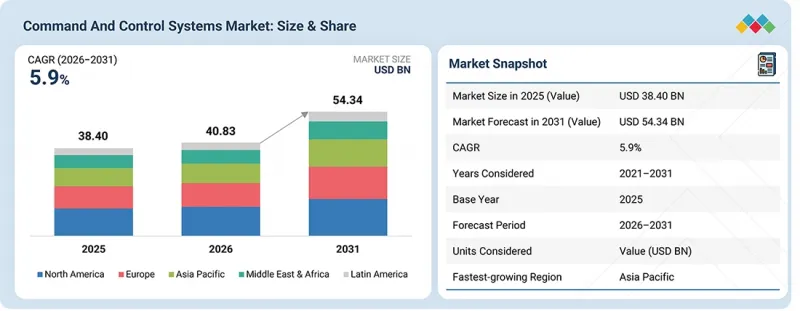
지휘 통제 시스템 시장 규모는 2026년 408억 3,000만 달러에서 2031년까지 543억 4,000만 달러로, CAGR 5.9%로 확대할 것으로 예측됩니다.
지휘통제시스템 시장의 성장을 촉진하는 요인은 국방력 현대화의 진전, 지정학적 긴장의 증가, 그리고 군사 및 치안 작전 간의 연계 강화에 대한 수요 증가입니다.
| 조사 범위 | |
|---|---|
| 조사 대상 기간 | 2020-2031년 |
| 기준연도 | 2025년 |
| 예측 기간 | 2026-2031년 |
| 산정 단위 | 금액(10억 달러) |
| 부문 | 오퍼링별, 운영 영역별, 지휘 레벨별, 기술별, 배포별, 설치 형태별, 최종사용자별, 지역별 |
| 대상 지역 | 북미, 유럽, 아시아태평양, 기타 지역 |
각국 정부 및 국방 기관은 실시간 정보 공유, 상호 운용 가능한 통신, 신속한 의사결정을 가능하게 하기 위해 기존 C2 인프라의 업그레이드를 추진하고 있습니다. 이러한 노력에 따라 육·공·해·우주·사이버 각 영역에 걸친 협력적 작전을 가능하게 하는 최신 지휘 센터, 전술적 C2 시스템, 안전한 통신 네트워크, 공통 작전 상황도 및 소프트웨어 기반 솔루션에 대한 수요가 증가하고 있습니다.
"지휘 수준별로는 예측 기간 중 전술 부문이 가장 큰 점유율을 차지할 것으로 예상됩니다."
현대 군사 작전에서는 작전 최전선에서의 C2 능력이 필수적이기 때문에 예측 기간 중 전술 부문이 가장 큰 시장 점유율을 차지할 것으로 예상됩니다. 전술 부대는 분산된 환경이나 적대적인 환경에서 작전을 수행할 때 실시간 정보, 공유된 상황 인식, 신속한 의사결정, 그리고 신뢰할 수 있는 통신을 필요로 합니다. 나토(NATO)는 계속해서 전개 가능한 C2와 상호 운용성을 중시하고 있는 반면, 미 육군은 전술 최전선에서 데이터베이스 의사결정을 실현하기 위해 ‘차세대 C2’를 개발하고 있습니다.
"배포 형태별로는 플랫폼 통합형 부문이 예측 기간 중 가장 높은 연평균 성장률(CAGR)을 기록할 것으로 예상됩니다."
배치 형태별로 보면 예측 기간 중 ‘플랫폼 통합형’ 부문이 가장 높은 연평균 성장률(CAGR)을 기록할 것으로 예상됩니다. 이는 방위 부대가 항공기, 차량, 함정에 C2 능력을 직접 통합할 필요성이 점점 더 커지고 있기 때문입니다. 플랫폼 통합을 통해 승무원은 독립된 지휘소에 의존하지 않고도 작전 정보에 접근하고, 다른 부대와 통신하며, 임무를 조정할 수 있게 되어 보다 신속한 의사결정과 작전상의 유연성 향상을 지원합니다.
"예측 기간 중 북미가 가장 큰 시장 점유율을 차지할 것으로 예상됩니다."
북미는 미국 및 캐나다의 높은 국방비, 확립된 C2 인프라, 그리고 군사 지휘 시스템의 지속적인 현대화로 인해 예측 기간 중 최대 시장 점유율을 차지할 것으로 예상됩니다. 다중 영역 작전, 통합 항공·미사일 방어, 보안 통신, 그리고 기존 C2 시스템의 업그레이드에 대한 지속적인 투자가 수요를 지원하고 있습니다. 해당 지역의 주요 C2 공급업체들의 존재와 대규모 방위 프로그램 또한 이 시장의 주도적 지위를 더욱 공고히 하고 있습니다.
Lockheed Martin Corporation(미국), RTX(미국), Northrop Grumman(미국), Thales(프랑스), General Dynamics Corporation(미국)은 지휘통제시스템 시장의 주요 기업 중 일부입니다.
조사 범위:
본 조사는 다양한 부문 및 하위 부문에 걸친 지휘통제시스템 시장을 대상으로 합니다. 본 조사의 목적은 다양한 분야 및 지역에서의 해당 시장 규모와 성장 잠재력을 추정하는 것입니다. 또한 본 조사에는 시장의 주요 기업에 대한 상세한 경쟁 분석, 각 기업의 프로필, 제품 및 사업 내용에 대한 주요 발견 사항, 최근 동향, 그리고 각 기업이 채택하고 있는 주요 시장 전략이 포함되어 있습니다.
이 보고서를 구매해야 하는 이유:
이 보고서는 시장을 선도하는 기업과 신규 진입 기업에게 지휘통제시스템 시장 전체의 매출에 대한 가장 정확한 추정치를 제공합니다. 또한 이해관계자가 경쟁 구도를 이해하고, 자사의 비즈니스를 더 유리한 위치에 놓으며, 적절한 시장 진입 전략을 수립하기 위한 추가적인 인사이트를 얻는 데 도움이 됩니다. 더불어 이 보고서는 이해관계자가 시장 동향을 파악하는 데 도움을 주며, 주요 시장 촉진요인, 제약, 과제 및 기회에 대한 정보를 제공합니다.
마지막으로 이 보고서는 다음 사항에 대한 인사이트를 제공합니다. :
- 시장 촉진요인(구식 지휘통제 인프라의 현대화, 다중 영역에서의 작전 조정에 대한 수요 증가),제약 요인(시스템의 분절화 및 상호운용성 제약, 높은 도입 비용 및 수명 주기 비용), 기회(AI 기반 의사결정 지원 애플리케이션의 부상, 무인 시스템 지휘 애플리케이션의 통합), 과제(전술 작전에서의 방어와 기동성 간의 상충 관계, 미션 크리티컬 C2 네트워크에 대한 사이버 보안 위험)
- 시장 침투도: 시장을 선도하는 주요 기업이 제공하는 지휘통제시스템에 대한 포괄적인 정보
- 제품 개발/혁신: 지휘통제시스템 시장의 향후 기술 동향, 연구개발 활동 및 신제품 출시에 대한 상세한 분석
- 시장 개발: 다양한 지역의 수익성 높은 시장에 대한 포괄적인 정보
- 시장 다각화: 지휘통제시스템 시장의 제품 출시 및 개발, 미개발 지역, 최근 동향(거래 및 사업 확장 등) 및 투자에 관한 포괄적인 정보
- 경쟁 분석: 지휘통제시스템 시장의 주요 기업의 시장 점유율, 성장 전략, 제품 및 생산 능력에 대한 상세한 분석
자주 묻는 질문
목차
제1장 서론
제2장 개요
제3장 주요 인사이트
제4장 시장 개요
제5장 업계 동향
제6장 기술 진보, AI에 의한 영향, 특허, 혁신, 향후 응용
제7장 지속가능성과 규제 상황
제8장 고객 상황과 구매 행동
제9장 지휘 통제 시스템 시장(오퍼링별)
제10장 지휘 통제 시스템 시장(운영 영역별)
제11장 지휘 통제 시스템 시장(지휘 레벨별)
제12장 지휘 통제 시스템 시장(기술별)
제13장 지휘 통제 시스템 시장(배포별)
제14장 지휘 통제 시스템 시장(설치 형태별)
제15장 지휘 통제 시스템 시장(최종사용자별)
제16장 지휘 통제 시스템 시장(지역별)
제17장 경쟁 구도
제18장 기업 개요
제19장 조사 방법
제20장 부록
KSA 26.09.17The command and control systems market is projected to grow from USD 40.83 billion in 2026 to USD 54.34 billion by 2031, at a CAGR of 5.9 %. The command and control systems market is driven by increasing defense modernization, rising geopolitical tensions, and the growing need to improve coordination across military and security operations.
| Scope of the Report | |
|---|---|
| Years Considered for the Study | 2020-2031 |
| Base Year | 2025 |
| Forecast Period | 2026-2031 |
| Units Considered | Value (USD Billion) |
| Segments | By Offering, Operation Mode, Technology and Region |
| Regions covered | North America, Europe, APAC, RoW |
Governments and defense forces are upgrading legacy C2 infrastructure to enable real-time information sharing, interoperable communications, and faster decision-making. These efforts are increasing demand for modern command centers, tactical C2 systems, secure communication networks, common operational pictures, and software-based solutions that enable coordinated operations across land, air, maritime, space, and cyber domains.
"By command level, the tactical segment is expected to be the most dominant segment during the forecast period."
The tactical segment is expected to account for the largest market share throughout the forecast period because modern military operations now require C2 capabilities at the point of action. Tactical units need real-time information, shared situational awareness, rapid decision-making, and reliable communication while operating in distributed and contested environments. NATO continues to give importance to deployable C2 and interoperability, while the US Army is developing Next Generation C2 to deliver data-driven decision-making at the tactical edge.
"By deployment, the platform-integrated segment is expected to register the highest CAGR during the forecast period."
By deployment, the platform-integrated segment is expected to register the highest CAGR during the forecast period because defense forces increasingly require C2 capabilities to be embedded directly into aircraft, vehicles, and naval platforms. Platform integration enables crews to access operational information, communicate with other units, and coordinate missions without being dependent on separate command posts, supporting faster decisions and greater operational flexibility.
"North America is expected to account for the largest market share during the forecast period."
North America is expected to account for the largest market share during the forecast period due to high defense spending, established C2 infrastructure, and ongoing modernization of military command systems in the US and Canada. Continued investment in multi-domain operations, integrated air and missile defense, secure communications and replacement of legacy C2 systems is supporting demand. The presence of major C2 providers and large-scale defense programs in the region further supports its leading market position.
Lockheed Martin Corporation (US), RTX(US), Northrop Grumman (US), Thales (France), and General Dynamics Corporation (US) are some of the key players in the command and control systems market.
The breakdown of profiles for primary participants in the command and control systems market is provided below:
- By Company Type: Tier 1 - 40%, Tier 2 - 30%, and Tier 3 - 30%
- By Designation: Directors - 10%, C-level Executives - 20%, and Others (Managers) - 70%
- By Region: North America - 40%, Europe - 25%, Asia Pacific - 15%, Middle East& Africa -17%, and Latin America - 3%
Research Coverage:
This study covers the command and control systems market across various segments and subsegments. It aims to estimate the size and growth potential of this market across different parts and regions. Additionally, this study includes an in-depth competitive analysis of key players in the market, their company profiles, key observations on their products and business offerings, recent developments, and the key market strategies they have adopted.
Reasons to Buy This Report:
The report will help market leaders/new entrants with information on the closest approximations of revenue for the overall command and control systems market. It will also help stakeholders understand the competitive landscape and gain more insights to position their businesses better and plan suitable go-to-market strategies. Moreover, the report will help stakeholders understand the market pulse and will provide information on key market drivers, restraints, challenges, and opportunities.
Lastly, the report provides insights into the following pointers:
- Market Drivers (modernization of legacy command-and-control infrastructure, growing requirement for multi-domain operational coordination), Restraints (system fragmentation and interoperability constraints, high acquisition and lifecycle costs), Opportunities (emergence of AI-enabled decision-support applications, integration of unmanned system command applications), Challenges (protection-mobility trade-offs in tactical operations, cybersecurity risks to mission-critical C2 networks)
- Market Penetration: Comprehensive information on command and control systems offered by the top players in the market
- Product Development/Innovation: Detailed insights on upcoming technologies, research & development activities, and product launches in the command and control systems market
- Market Development: Comprehensive information about lucrative markets across varied regions
- Market Diversification: Exhaustive information about product launches/developments, untapped geographies, recent developments (such as deals, expansions), and investments in the command and control systems market
- Competitive Assessment: In-depth assessment of market share, growth strategies, products, and manufacturing capabilities of leading players in the command and control systems market
TABLE OF CONTENTS
1 INTRODUCTION
- 1.1 STUDY OBJECTIVES
- 1.2 MARKET DEFINITION
- 1.3 STUDY SCOPE
- 1.3.1 INCLUSIONS AND EXCLUSIONS
- 1.3.2 YEARS CONSIDERED
- 1.4 CURRENCY CONSIDERED
- 1.5 STAKEHOLDERS
- 1.6 SUMMARY OF CHANGES
2 EXECUTIVE SUMMARY
- 2.1 KEY INSIGHTS AND MARKET HIGHLIGHTS
- 2.2 KEY MARKET PARTICIPANTS: MAPPING OF STRATEGIC DEVELOPMENTS
- 2.3 DISRUPTIVE TRENDS IN COMMAND AND CONTROL SYSTEMS MARKET
- 2.4 HIGH GROWTH SEGMENTS
- 2.5 REGIONAL SNAPSHOT: MARKET SIZE, GROWTH RATE, AND FORECAST
3 PREMIUM INSIGHTS
- 3.1 ATTRACTIVE OPPORTUNITIES FOR PLAYERS IN COMMAND AND CONTROL SYSTEMS MARKET
- 3.2 COMMAND AND CONTROL SYSTEMS MARKET, BY OFFERING
- 3.3 COMMAND AND CONTROL SYSTEMS MARKET, BY OPERATING DOMAIN
- 3.4 COMMAND AND CONTROL SYSTEMS MARKET, BY DEPLOYMENT
- 3.5 COMMAND AND CONTROL SYSTEMS MARKET, BY COMMAND LEVEL
4 MARKET OVERVIEW
- 4.1 INTRODUCTION
- 4.2 MARKET DYNAMICS
- 4.2.1 DRIVERS
- 4.2.1.1 Modernization of legacy command and control (C2) infrastructure
- 4.2.1.2 Growing requirement for multi-domain operational coordination
- 4.2.1.3 Need for faster battlefield decision-making
- 4.2.2 RESTRAINTS
- 4.2.2.1 System fragmentation and interoperability constraints
- 4.2.2.2 High acquisition and lifecycle costs
- 4.2.3 OPPORTUNITIES
- 4.2.3.1 AI-enabled decision-support applications
- 4.2.3.2 Integration of unmanned system command applications
- 4.2.3.3 C2-as-a-Service and continuous software upgrades
- 4.2.4 CHALLENGES
- 4.2.4.1 Protection-mobility trade-offs in tactical operations
- 4.2.4.2 Cybersecurity risks to mission-critical C2 networks
- 4.2.1 DRIVERS
- 4.3 UNMET NEEDS AND WHITE SPACES IN COMMAND AND CONTROL SYSTEMS MARKET
- 4.4 INTER-CONNECTED MARKETS AND CROSS-SECTOR OPPORTUNITIES
- 4.5 STRATEGIC MOVES BY TIER 1/2/3 PLAYERS
- 4.5.1 STRATEGIC MOVES BY TIER 1, 2, AND 3 PLAYERS
5 INDUSTRY TRENDS
- 5.1 INTRODUCTION
- 5.2 ECOSYSTEM ANALYSIS
- 5.2.1 TRENDS IN GLOBAL COMMAND AND CONTROL SYSTEMS MARKET
- 5.3 VALUE CHAIN ANALYSIS
- 5.4 PRICING ANALYSIS
- 5.4.1 INDICATIVE PRICING ANALYSIS BY OFFERING
- 5.4.2 KEY PRICING INSIGHTS BY OFFERING
- 5.4.3 INDICATIVE PRICING ANALYSIS BY MANUFACTURERS
- 5.4.4 INDICATIVE PRICING ANALYSIS, BY REGION
- 5.4.5 INDICATIVE PRICING ANALYSIS, BY END USER
- 5.5 TRADE ANALYSIS
- 5.5.1 IMPORT SCENARIO (HS CODE 853710)
- 5.5.2 EXPORT SCENARIO (HS CODE 853710)
- 5.5.3 IMPORT SCENARIO (HS CODE 847149)
- 5.5.4 EXPORT SCENARIO (HS CODE 847149)
- 5.6 CASE STUDIES
- 5.6.1 CASE STUDY 1: NORTHROP GRUMMAN DEPLOYS THE INTEGRATED BATTLE COMMAND SYSTEM (IBCS) FOR US ARMY
- 5.6.2 CASE STUDY 2: THALES DELIVERS NATO AIR COMMAND AND CONTROL SYSTEM (ACCS)
- 5.6.3 CASE STUDY 3: ELBIT SYSTEMS DEPLOYS TORCH-X COMMAND AND CONTROL SYSTEM
- 5.7 KEY CONFERENCES & EVENTS, 2026-2027
- 5.8 INVESTMENT & FUNDING SCENARIO
- 5.9 TRENDS & DISRUPTIONS IMPACTING CUSTOMER BUSINESS
- 5.10 OPERATIONAL DATA
- 5.11 TOTAL COST OF OWNERSHIP
- 5.11.1 FRAMEWORK
- 5.12 MACROECONOMIC OUTLOOK
- 5.12.1 INTRODUCTION
- 5.12.2 GDP TRENDS AND FORECAST
- 5.13 BUSINESS MODELS
- 5.13.1 SYSTEM INTEGRATION & PRIME CONTRACTING
- 5.13.2 SOFTWARE LICENSING & C2-AS-A-SERVICE
- 5.13.3 LIFECYCLE SUPPORT & MODERNIZATION SERVICES
6 TECHNOLOGICAL ADVANCEMENTS, AI-DRIVEN IMPACT, PATENTS, INNOVATIONS, AND FUTURE APPLICATIONS
- 6.1 KEY TECHNOLOGIES
- 6.1.1 AI-ENABLED DECISION SUPPORT
- 6.1.2 DATA FABRICS AND DATA-CENTRIC C2 ARCHITECTURE
- 6.1.3 DIGITAL TWINS FOR OPERATIONAL PLANNING
- 6.2 COMPLEMENTARY TECHNOLOGIES
- 6.2.1 RESILIENT TACTICAL COMMUNICATIONS
- 6.2.2 ZERO-TRUST CYBERSECURITY
- 6.3 ADJACENT TECHNOLOGIES
- 6.3.1 INTELLIGENCE, SURVEILLANCE, AND RECONNAISSANCE TECHNOLOGIES
- 6.3.2 ELECTRONIC WARFARE SYSTEMS
- 6.4 TECHNOLOGY ROADMAP
- 6.5 IMPACT OF AI/GENERATIVE AI
- 6.5.1 TOP USE CASES AND MARKET POTENTIAL
- 6.5.2 BEST PRACTICES
- 6.5.3 CASE STUDIES OF AI IMPLEMENTATION
- 6.5.4 INTERCONNECTED ECOSYSTEM AND IMPACT ON MARKET PLAYERS
- 6.5.5 CLIENTS' READINESS TO ADOPT GENERATIVE AI
- 6.6 PATENT ANALYSIS
- 6.7 FUTURE APPLICATIONS
- 6.8 SUCCESS STORIES AND REAL-WORLD APPLICATIONS
- 6.8.1 LOCKHEED MARTIN: AI-ENABLED MULTI-DOMAIN COMMAND AND CONTROL THROUGH JADC2
- 6.8.2 SAAB AB: MODULAR NAVAL COMMAND AND CONTROL THROUGH 9LV COMBAT MANAGEMENT SYSTEM
- 6.8.3 PALANTIR TECHNOLOGIES: AI-DRIVEN COMMAND DECISION SUPPORT THROUGH MAVEN SMART SYSTEM
7 SUSTAINABILITY AND REGULATORY LANDSCAPE
- 7.1 REGIONAL REGULATIONS AND COMPLIANCE
- 7.1.1 REGULATORY BODIES, GOVERNMENT AGENCIES, AND OTHER ORGANIZATIONS
- 7.1.2 INDUSTRY STANDARDS
- 7.2 SUSTAINABILITY INITIATIVES
- 7.2.1 SOFTWARE-LED CAPABILITY UPGRADES
- 7.2.2 TACTICAL MICROGRIDS FOR DEPLOYED COMMAND POSTS
- 7.3 CERTIFICATIONS, LABELING, AND ECO-STANDARDS
8 CUSTOMER LANDSCAPE & BUYER BEHAVIOR
- 8.1 DECISION-MAKING PROCESS
- 8.2 BUYERS, STAKEHOLDERS, AND BUYING EVALUATION CRITERIA
- 8.2.1 KEY STAKEHOLDERS IN BUYING PROCESS
- 8.2.2 BUYING CRITERIA
- 8.3 ADOPTION BARRIERS & INTERNAL CHALLENGES
- 8.4 UNMET NEEDS FROM VARIOUS END-USE INDUSTRIES
9 COMMAND AND CONTROL SYSTEMS MARKET, BY OFFERING
- 9.1 INTRODUCTION
- 9.2 SOFTWARE
- 9.2.1 COMMAND AND MISSION MANAGEMENT
- 9.2.1.1 Growing Mission Complexity to Drive Market
- 9.2.2 COMMON OPERATIONAL PICTURE AND SITUATIONAL AWARENESS
- 9.2.2.1 Multi-Domain Data Integration to Drive Growth
- 9.2.3 PLANNING, TASKING, AND RESOURCE MANAGEMENT
- 9.2.3.1 Data-Driven Planning and Resource Allocation to Drive Market
- 9.2.4 BATTLE MANAGEMENT AND EFFECTS COORDINATION
- 9.2.4.1 Multi-Domain Effects Coordination to Drive Growth
- 9.2.5 DATA INTEGRATION, FUSION, AND INTEROPERABILITY
- 9.2.5.1 Common Data Architectures to Drive Growth
- 9.2.6 COMMAND DECISION SUPPORT AND OPERATIONAL ANALYTICS
- 9.2.6.1 shift toward joint and multi-domain operations to Drive Growth
- 9.2.1 COMMAND AND MISSION MANAGEMENT
- 9.3 HARDWARE
- 9.3.1 C2 COMPUTING AND PROCESSING
- 9.3.1.1 C2 Modernization and Edge Computing to Drive Growth
- 9.3.2 OPERATOR CONSOLES, WORKSTATIONS, AND VISUALIZATION
- 9.3.2.1 Mobile Command Posts and Faster Decision Cycles to Drive Growth
- 9.3.3 TACTICAL, MOBILE, AND PLATFORM-INTEGRATED TERMINALS
- 9.3.3.1 On-the-Move Operations to Drive Growth
- 9.3.4 C2 GATEWAYS AND INTERFACE HARDWARE
- 9.3.4.1 Growing System Interoperability to Drive Growth
- 9.3.5 FIXED AND DEPLOYABLE COMMAND INFRASTRUCTURE
- 9.3.5.1 Mobility and Survivability Requirements to Drive Growth
- 9.3.1 C2 COMPUTING AND PROCESSING
- 9.4 SERVICES
- 9.4.1 CONSULTING, ARCHITECTURE, AND ENGINEERING
- 9.4.1.1 C2 Architecture Complexity to Drive Growth
- 9.4.2 INTEGRATION, INSTALLATION, TESTING, AND COMMISSIONING
- 9.4.2.1 Growing C2 Interoperability Requirements to Drive growth
- 9.4.3 MAINTENANCE, REPAIR, AND TECHNICAL SUPPORT
- 9.4.3.1 Lifecycle Complexity and Continuous Updates to Drive Growth
- 9.4.4 UPGRADES, MODERNIZATION, AND CAPABILITY ENHANCEMENT
- 9.4.4.1 Legacy C2 Replacement and Multi-Domain Requirements to Drive Growth
- 9.4.5 TRAINING AND SIMULATION SUPPORT
- 9.4.5.1 Multi-Domain C2 Complexity to Drive Growth
- 9.4.6 MANAGED C2 OPERATIONS
- 9.4.6.1 Distributed C2 Operations to Drive Growth
- 9.4.1 CONSULTING, ARCHITECTURE, AND ENGINEERING
10 COMMAND AND CONTROL SYSTEMS MARKET, BY OPERATING DOMAIN
- 10.1 INTRODUCTION
- 10.2 1.1 LAND C2
- 10.2.1 MISSION COMMAND AND MANEUVER
- 10.2.1.1 Faster maneuver and distributed operations to drive growth
- 10.2.2 FIRES AND ARTILLERY
- 10.2.2.1 Land forces' reliance on digital command systems to connect sensors to drive growth
- 10.2.3 LAND AIR DEFENSE
- 10.2.3.1 Integrated threat detection and faster engagement to drive growth
- 10.2.4 LOGISTICS AND SUSTAINMENT
- 10.2.4.1 Data-centric logistics requirements to drive growth
- 10.2.5 DISMOUNTED AND TACTICAL OPERATIONS
- 10.2.5.1 Tactical edge connectivity to drive growth
- 10.2.1 MISSION COMMAND AND MANEUVER
- 10.3 AIR C2
- 10.3.1 AIR OPERATIONS
- 10.3.1.1 Continuous air tasking requirements to drive growth
- 10.3.2 AIR BATTLE MANAGEMENT
- 10.3.2.1 Networked decision-making to drive growth
- 10.3.3 AIRSPACE MANAGEMENT
- 10.3.3.1 Growing airspace complexity to drive growth
- 10.3.4 AIR MOBILITY
- 10.3.4.1 Growing airspace complexity to drive growth
- 10.3.1 AIR OPERATIONS
- 10.4 MARITIME C2
- 10.4.1 FLEET AND MARITIME OPERATIONS
- 10.4.1.1 Distributed fleet operations to drive growth
- 10.4.2 SURFACE SHIP OPERATIONS
- 10.4.2.1 Integrated combat-system modernization to drive growth
- 10.4.3 SUBMARINE OPERATIONS
- 10.4.3.1 Undersea warfare modernization to drive growth
- 10.4.4 AMPHIBIOUS AND LITTORAL OPERATIONS
- 10.4.4.1 Distributed littoral warfare to drive growth
- 10.4.1 FLEET AND MARITIME OPERATIONS
- 10.5 SPACE C2
- 10.5.1 SATELLITE COMMAND AND CONTROL
- 10.5.1.1 Rising satellite fleets and ground-system modernization to drive growth
- 10.5.2 SPACE OPERATIONS
- 10.5.2.1 Theater-level integration to drive growth
- 10.5.3 SPACE DOMAIN AWARENESS AND BATTLE MANAGEMENT
- 10.5.3.1 Growing orbital activity and faster threat response to drive growth
- 10.5.4 LAUNCH AND RANGE OPERATIONS
- 10.5.4.1 Higher launch cadence to drive growth
- 10.5.1 SATELLITE COMMAND AND CONTROL
- 10.6 CYBER C2
- 10.6.1 DEFENSIVE CYBER OPERATIONS
- 10.6.1.1 Persistent network defense to drive growth
- 10.6.2 OFFENSIVE CYBER OPERATIONS
- 10.6.2.1 Offensive mission development and operational orchestration to drive growth
- 10.6.3 CYBER MISSION COMMAND AND COORDINATION
- 10.6.3.1 Multi-level cyber coordination to drive growth
- 10.6.1 DEFENSIVE CYBER OPERATIONS
- 10.7 JOINT & MULTI-DOMAIN C2
- 10.7.1 JOINT OPERATIONS COMMAND
- 10.7.1.1 Joint force headquarters modernization to drive growth
- 10.7.2 MULTI-DOMAIN BATTLE MANAGEMENT
- 10.7.2.1 Faster cross-domain decision-making to drive growth
- 10.7.3 JOINT FIRES AND EFFECTS
- 10.7.3.1 Faster sensor-to-shooter coordination to drive growth
- 10.7.4 COALITION AND FEDERATED OPERATIONS
- 10.7.4.1 Federated networks and allied interoperability to drive growth
- 10.7.1 JOINT OPERATIONS COMMAND
11 COMMAND AND CONTROL SYSTEMS MARKET, BY COMMAND LEVEL
- 11.1 INTRODUCTION
- 11.2 STRATEGIC
- 11.2.1 MULTI-DOMAIN INFORMATION REQUIREMENTS AT NATIONAL HEADQUARTERS TO DRIVE GROWTH
- 11.3 OPERATIONAL
- 11.3.1 CROSS-DOMAIN COORDINATION AT THEATER HEADQUARTERS TO DRIVE GROWTH
- 11.4 TACTICAL
- 11.4.1 MOBILE AND SURVIVABLE COMMAND POSTS TO DRIVE GROWTH
12 COMMAND AND CONTROL SYSTEMS MARKET, BY TECHNOLOGY
- 12.1 INTRODUCTION
- 12.2 CONVENTIONAL
- 12.2.1 CONTINUAL OPERATION OF ESTABLISHED C2 ARCHITECTURES TO DRIVE GROWTH
- 12.3 NEXT GENERATION
- 12.3.1 COMMON DATA LAYERS AND MULTI-DOMAIN ARCHITECTURES TO DRIVE GROWTH
13 COMMAND AND CONTROL SYSTEMS MARKET, BY DEPLOYMENT
- 13.1 INTRODUCTION
- 13.2 FIXED
- 13.2.1 MODERNIZATION OF EXISTING COMMAND FACILITIES TO DRIVE GROWTH
- 13.3 DEPLOYABLE
- 13.3.1 COMMAND-POST MOBILITY AND SURVIVABILITY REQUIREMENTS TO DRIVE GROWTH
- 13.4 PLATFORM-INTEGRATED
- 13.4.1 C2 ON-THE-MOVE REQUIREMENTS TO DRIVE GROWTH
- 13.5 PORTABLE 164 13.5.1 DISMOUNTED AND HANDHELD TACTICAL REQUIREMENTS DRIVE GROWTH
14 COMMAND AND CONTROL SYSTEMS MARKET, BY INSTALLATION TYPE
- 14.1 INTRODUCTION
- 14.2 NEW INSTALLATION
- 14.2.1 FIELDING OF NEW C2 ARCHITECTURES TO DRIVE GROWTH
- 14.3 UPGRADE AND MODERNIZATION
- 14.3.1 INCREMENTAL MODERNIZATION OF LEGACY C2 ARCHITECTURES TO DRIVE GROWTH
15 COMMAND AND CONTROL SYSTEMS MARKET, BY END USER
- 15.1 INTRODUCTION
- 15.2 MILITARY AND DEFENSE
- 15.2.1 ALL-DOMAIN INTEROPERABILITY REQUIREMENTS TO DRIVE GROWTH
- 15.3 GOVERNMENT, HOMELAND SECURITY & PUBLIC SAFETY
- 15.3.1 INTEROPERABLE EMERGENCY COMMUNICATIONS REQUIREMENTS TO DRIVE GROWTH
- 15.4 CIVIL & COMMERCIAL
- 15.4.1 AIR TRAFFIC AND TRANSPORTATION MODERNIZATION TO DRIVE GROWTH
16 COMMAND AND CONTROL SYSTEMS MARKET, BY REGION
- 16.1 INTRODUCTION
- 16.2 NORTH AMERICA
- 16.2.1 US
- 16.2.1.1 Multi-domain military integration to drive market
- 16.2.2 CANADA
- 16.2.2.1 Arctic security and defense renewal to drive market
- 16.2.1 US
- 16.3 EUROPE
- 16.3.1 UK
- 16.3.1.1 Digital warfighting transformation to drive growth
- 16.3.2 FRANCE
- 16.3.2.1 Autonomy and digital force modernization to drive market
- 16.3.3 GERMANY
- 16.3.3.1 Bundeswehr transformation and digital command infrastructure to drive market
- 16.3.4 ITALY
- 16.3.4.1 Network-centric force modernization to drive market
- 16.3.5 REST OF EUROPE
- 16.3.1 UK
- 16.4 ASIA PACIFIC
- 16.4.1 INDIA
- 16.4.1.1 Joint force integration and indigenous defense programs to drive market
- 16.4.2 JAPAN
- 16.4.2.1 Joint command modernization and integrated operations to drive market
- 16.4.3 SOUTH KOREA
- 16.4.3.1 Joint force digitalization to support market growth
- 16.4.4 AUSTRALIA
- 16.4.4.1 Long-range defense strategy and integrated force development to drive market
- 16.4.5 REST OF ASIA PACIFIC
- 16.4.1 INDIA
- 16.5 MIDDLE EAST & AFRICA
- 16.5.1 UAE
- 16.5.1.1 Defense technology localization and integrated security networks to drive market
- 16.5.2 SAUDI ARABIA
- 16.5.2.1 Defense industrial localization and digital command modernization to drive market
- 16.5.3 ISRAEL
- 16.5.3.1 Operational innovation and multi-layered defense integration to drive market
- 16.5.4 TURKEY
- 16.5.4.1 Indigenous C2 development and joint operational requirements to drive market
- 16.5.5 SOUTH AFRICA
- 16.5.5.1 Modernization of existing command infrastructure to drive market
- 16.5.1 UAE
- 16.6 LATIN AMERICA
- 16.6.1 BRAZIL
- 16.6.1.1 Modernization of joint military operations to drive market
- 16.6.2 MEXICO
- 16.6.2.1 Integrated internal security operations to drive market
- 16.6.1 BRAZIL
17 COMPETITIVE LANDSCAPE
- 17.1 INTRODUCTION
- 17.2 KEY PLAYER STRATEGIES/RIGHT TO WIN, 2021-2026
- 17.3 REVENUE ANALYSIS, 2021-2025
- 17.4 MARKET SHARE ANALYSIS, 2025
- 17.5 BRAND/PRODUCT COMPARISON
- 17.6 COMPANY VALUATION AND FINANCIAL METRICS
- 17.7 COMPANY EVALUATION MATRIX: KEY PLAYERS, 2025
- 17.7.1 STARS
- 17.7.2 EMERGING LEADERS
- 17.7.3 PERVASIVE PLAYERS
- 17.7.4 PARTICIPANTS
- 17.7.5 COMPANY FOOTPRINT
- 17.7.5.1 Company footprint
- 17.7.5.2 Region footprint
- 17.7.5.3 Offering footprint
- 17.7.5.4 Operating domain footprint
- 17.7.5.5 End user footprint
- 17.8 COMPANY EVALUATION MATRIX: STARTUPS/SMES, 2025
- 17.8.1 PROGRESSIVE COMPANIES
- 17.8.2 RESPONSIVE COMPANIES
- 17.8.3 DYNAMIC COMPANIES
- 17.8.4 STARTING BLOCKS
- 17.8.5 COMPETITIVE BENCHMARKING
- 17.8.5.1 List of startups/SMEs
- 17.8.5.2 Competitive benchmarking of startups/SMEs
- 17.9 COMPETITIVE SCENARIO
- 17.9.1 PRODUCT LAUNCHES/DEVELOPMENTS
- 17.9.2 DEALS
- 17.9.3 OTHER DEVELOPMENTS
18 COMPANY PROFILES
- 18.1 KEY PLAYERS
- 18.1.1 LOCKHEED MARTIN CORPORATION
- 18.1.1.1 Business overview
- 18.1.1.2 Products offered
- 18.1.1.3 Recent developments
- 18.1.1.3.1 Product launches/developments
- 18.1.1.3.2 Deals
- 18.1.1.3.3 Other developments
- 18.1.1.4 MnM view
- 18.1.1.4.1 Right to win
- 18.1.1.4.2 Strategic choices
- 18.1.1.4.3 Weaknesses and competitive threats
- 18.1.2 RTX
- 18.1.2.1 Business overview
- 18.1.2.2 Products offered
- 18.1.2.3 Recent developments
- 18.1.2.3.1 Product launches/developments
- 18.1.2.3.2 Deals
- 18.1.2.3.3 Other developments
- 18.1.2.4 MnM view
- 18.1.2.4.1 Right to win
- 18.1.2.4.2 Strategic choices
- 18.1.2.4.3 Weaknesses and competitive threats
- 18.1.3 NORTHROP GRUMMAN
- 18.1.3.1 Business overview
- 18.1.3.2 Products offered
- 18.1.3.3 Recent developments
- 18.1.3.3.1 Product launches/developments
- 18.1.3.3.2 Deals
- 18.1.3.3.3 Other developments
- 18.1.3.4 MnM view
- 18.1.3.4.1 Right to win
- 18.1.3.4.2 Strategic choices
- 18.1.3.4.3 Weaknesses and competitive threats
- 18.1.4 GENERAL DYNAMICS CORPORATION
- 18.1.4.1 Business overview
- 18.1.4.2 Products offered
- 18.1.4.3 Recent developments
- 18.1.4.3.1 Product launches
- 18.1.4.3.2 Deals
- 18.1.4.3.3 Other developments
- 18.1.4.4 MnM view
- 18.1.4.4.1 Right to win
- 18.1.4.4.2 Strategic choices
- 18.1.4.4.3 Weaknesses and competitive threats
- 18.1.5 THALES
- 18.1.5.1 Business overview
- 18.1.5.2 Products offered
- 18.1.5.3 Recent developments
- 18.1.5.3.1 Product launches/developments
- 18.1.5.3.2 Deals
- 18.1.5.3.3 Other developments
- 18.1.5.4 MnM view
- 18.1.5.4.1 Right to win
- 18.1.5.4.2 Strategic choices
- 18.1.5.4.3 Weaknesses and competitive threats
- 18.1.6 SAAB AB
- 18.1.6.1 Business overview
- 18.1.6.2 Products offered
- 18.1.6.3 Recent developments
- 18.1.6.3.1 Product launches
- 18.1.6.3.2 Deals
- 18.1.6.3.3 Other Developments
- 18.1.7 BAE SYSTEMS
- 18.1.7.1 Business overview
- 18.1.7.2 Products offered
- 18.1.7.3 Recent developments
- 18.1.7.3.1 Product launches/developments
- 18.1.7.3.2 Deals
- 18.1.7.3.3 Other developments
- 18.1.8 LEONARDO S.P.A.
- 18.1.8.1 Business overview
- 18.1.8.2 Products offered
- 18.1.8.3 Recent developments
- 18.1.8.3.1 Product launches/developments
- 18.1.8.3.2 Deals
- 18.1.8.3.3 Other developments
- 18.1.9 L3HARRIS TECHNOLOGIES, INC.
- 18.1.9.1 Business overview
- 18.1.9.2 Products offered
- 18.1.9.3 Recent developments
- 18.1.9.3.1 Product launches/developments
- 18.1.9.3.2 Deals
- 18.1.9.3.3 Other Developments
- 18.1.10 KONGSBERG
- 18.1.10.1 Business overview
- 18.1.10.2 Products offered
- 18.1.10.3 Recent developments
- 18.1.10.3.1 Product launches/developments
- 18.1.10.3.2 Deals
- 18.1.10.3.3 Other developments
- 18.1.11 ELBIT SYSTEMS LTD.
- 18.1.11.1 Business overview
- 18.1.11.2 Products offered
- 18.1.11.3 Recent developments
- 18.1.11.3.1 Product launches/developments
- 18.1.11.3.2 Deals
- 18.1.11.3.3 Other developments
- 18.1.12 AIRBUS
- 18.1.12.1 Business overview
- 18.1.12.2 Products offered
- 18.1.12.3 Recent developments
- 18.1.12.3.1 Product launches/developments
- 18.1.12.3.2 Deals
- 18.1.12.3.3 Other developments
- 18.1.13 RHEINMETALL AG
- 18.1.13.1 Business overview
- 18.1.13.2 Products offered
- 18.1.13.3 Recent developments
- 18.1.13.3.1 Product launches/developments
- 18.1.13.3.2 Deals
- 18.1.13.3.3 Other developments
- 18.1.14 ASELSAN A.S.
- 18.1.14.1 Business overview
- 18.1.14.2 Products offered
- 18.1.14.3 Recent developments
- 18.1.14.3.1 Product launches/developments
- 18.1.14.3.2 Deals
- 18.1.14.3.3 Other developments
- 18.1.15 CACI INTERNATIONAL INC.
- 18.1.15.1 Business overview
- 18.1.15.2 Products offered
- 18.1.15.3 Recent developments
- 18.1.15.3.1 Product launches/developments
- 18.1.15.3.2 Deals
- 18.1.15.3.3 Other developments
- 18.1.16 PALANTIR TECHNOLOGIES
- 18.1.16.1 Business overview
- 18.1.16.2 Products offered
- 18.1.16.3 Recent developments
- 18.1.16.3.1 Deals
- 18.1.16.3.2 Other developments
- 18.1.17 INDRA
- 18.1.17.1 Business overview
- 18.1.17.2 Products offered
- 18.1.17.3 Recent developments
- 18.1.17.3.1 Product launches/developments
- 18.1.17.3.2 Deals
- 18.1.17.3.3 Other developments
- 18.1.18 CODAN LIMITED
- 18.1.18.1 Business overview
- 18.1.18.2 Products offered
- 18.1.18.3 Recent developments
- 18.1.18.3.1 Product launches/developments
- 18.1.18.3.2 Deals
- 18.1.18.3.3 Other developments
- 18.1.1 LOCKHEED MARTIN CORPORATION
- 18.2 OTHER PLAYERS
- 18.2.1 SYSTEMATIC A/S
- 18.2.2 HELSING
- 18.2.3 REBELLION INDUSTRIES
- 18.2.4 4C STRATEGIES AB
- 18.2.5 CARBYNE
- 18.2.6 SEARIDGE TECHNOLOGIES
- 18.2.7 CRITICALARC
- 18.2.8 ADACEL TECHNOLOGIES LIMITED
- 18.2.9 CARMENTA
19 RESEARCH METHODOLOGY
- 19.1 RESEARCH DATA
- 19.1.1 SECONDARY DATA
- 19.1.2 PRIMARY DATA
- 19.1.2.1 Primary participants
- 19.2 FACTOR ANALYSIS
- 19.2.1 INTRODUCTION
- 19.2.2 MACROECONOMIC AND POLICY FACTORS
- 19.2.3 DEMAND-SIDE INDICATORS
- 19.2.4 SUPPLY-SIDE INDICATORS
- 19.2.4.1 Financial trends of defense contractors
- 19.3 MARKET SIZE ESTIMATION
- 19.3.1 BOTTOM-UP APPROACH
- 19.3.1.1 Market size estimation methodology
- 19.3.2 TOP-DOWN APPROACH
- 19.3.1 BOTTOM-UP APPROACH
- 19.4 DATA TRIANGULATION
- 19.5 RESEARCH ASSUMPTIONS
- 19.6 RISK ASSESSMENT
20 APPENDIX
- 20.1 DISCUSSION GUIDE
- 20.2 KNOWLEDGESTORE: MARKETSANDMARKETS' SUBSCRIPTION PORTAL
- 20.3 CUSTOMIZATION OPTIONS
- 20.4 RELATED REPORTS
- 20.5 AUTHOR DETAILS


