|
시장보고서
상품코드
2129356
자동차 시트 시장 예측(-2033년) : 기술별, 내장재별, 컴포넌트별, 차종별, 시트 유형별, 추진 방식별, 재질별, 좌석수별, 판매 채널별, 지역별Automotive Seats Market, ICE & EV, By Seat Type (Bucket, Split Bench), Trim Material (Synthetic Leather, Genuine Leather, Fabric), Vehicle Type (ICE, EV, OHV, ATV, LSV), Technology, Component, Material, Sales Channel and Region - Global Forecast to 2033 |
||||||

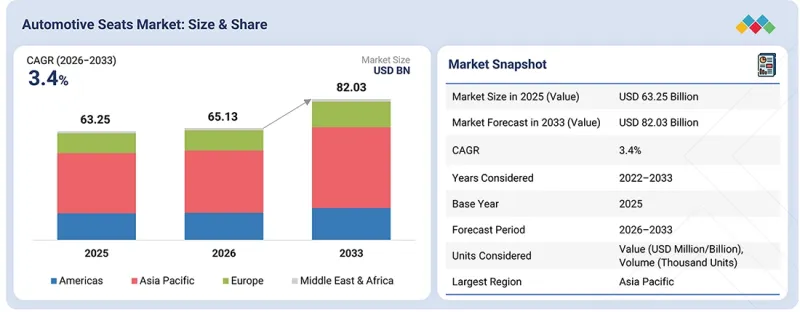
자동차 시트 시장 규모는 2026년 651억 3,000만 달러에서 CAGR 3.4%로 확대하며, 2033년에는 820억 3,000만 달러에 달할 것으로 예측됩니다.
중형차에서의 전동·히터 내장 시트 보급 확대, 고급차에서의 통기 기능·메모리 기능·마사지 기능이 탑재된 시트, 그리고 시트에 통합된 안전 기능의 보급이 자동차 시트 기술 분야의 기능성 및 전자 부품 채택을 주도하고 있습니다. 또한 전기자동차(EV) 및 하이브리드차로의 전환 추세에 따라 시트 공급업체들은 경량 시트 구조와 에너지 효율이 뛰어난 국소적 열 관리 기술에 대한 투자를 촉진하고 있습니다. 또한 탑승자 안전에 관한 규제가 강화됨에 따라 안전벨트 경고 시스템, 탑승자 감지 기능, 그리고 구속 장치의 통합 채택도 증가하고 있습니다.
| 조사 범위 | |
|---|---|
| 조사 대상 기간 | 2026-2033년 |
| 기준연도 | 2025년 |
| 예측 기간 | 2026-2033년 |
| 대상 단위 | 10억 달러 |
| 부문 | 기술별, 내장재별, 컴포넌트별, 차종별, 시트 유형별, 추진 방식별, 재질별, 좌석수별, 판매 채널별, 지역별 |
| 대상 지역 | 아시아태평양, 아메리카, 유럽, 중동 및 아프리카 |
"2026년에는 기술별 자동차 시트 시장에서 전동 시트가 가장 큰 시장 점유율을 차지할 것으로 전망됩니다."
전동 시트는 2026년에 기술별 자동차 시트 시장에서 최대 점유율을 차지할 것으로 예상됩니다. 이는 전동 조절 기능이 다축 위치 조절, 요추 지지대 조절, 메모리 기능, 히터, 통풍, 마사지 기능 등 다양한 부가가치 기능의 기반이 되기 때문입니다. 중국, 인도 및 기타 신흥 시장에서 OEM 각사가 이코노미 클래스 차종의 상위 트림에 4방향 및 6방향 전동 시트를 제공하기 시작함에 따라 승용차 전반에 걸쳐 그 채택이 확대되고 있습니다. 미국, 캐나다, 일본, 한국, 유럽 등 선진 시장에서는 차량내 편의성과 개인 맞춤형 경험 향상을 위한 OEM 업체들의 적극적인 노력에 힘입어 6방향 이상의 전동 시트 보급률이 비교적 높은 임베디드니다. 또한 전동 시트 외에도 시트 히터와 요추 지지대가 일반 모델에서도 점차 보급되고 있지만, 마사지 기능, 전동 사이드 볼스터, 뒷좌석 히터, 전후석 통풍 기능, 메모리 기능, 릴랙세이션 시트 등은 여전히 주로 프리미엄 차량에 집중되어 있습니다. 또한 성장을 거듭하는 SUV 부문에서는 더 넓은 실내 공간과 앞좌석·뒷좌석의 쾌적성이 중시되고 있으며, 전동 시트의 채택이 더욱 가속화되고 있습니다. LCV(소형 상용차)의 경우, 전동 시트는 주로 북미 및 유럽의 프리미엄 픽업트럭과 고급 밴에 탑재되어 있으며, 아시아 및 일부 라틴아메리카 시장에서도 채택이 확대될 것으로 예상됩니다. 한편, 볼보, 다임러, DAF, PACCAR, 프레이트라이너, 켄워스, 맥 등이 제공하는 대형·장거리 트럭 중 일부 모델에서는 운전자의 인체공학적 설계와 장시간 운전에 대응하기 위해 전동 조절식 운전석이 채택되고 있습니다. 따라서 중급 승용차에서의 채택 확대, 차량의 프리미엄화 진전, 그리고 다양한 편의 기능의 통합에 힘입어 향후 수년간 주요 차량 부문 전반에 걸쳐 전동 시트에 대한 수요가 더욱 높아질 것으로 예상됩니다.
"예측 기간 중 BEV는 자동차 시트 시장에서 가장 크고 가장 빠르게 성장하는 부문이 될 것으로 예상됩니다."
BEV는 대체 연료 차량 부문 전체에서 가장 큰 부문을 차지하며, 2026년에는 약 40%의 점유율을 기록할 것으로 전망됩니다. 중국은 전 세계 BEV 생산을 주도하고 있으며, 그 생산 대수의 상당 부분은 경제형 해치백, SUV, 소형차에 집중되어 있습니다. 이러한 차종에서는 표준 기능을 갖춘 전면 버킷 시트와 후면 벤치 시트가 여전히 널리 사용되고 있습니다. 그러나 BYD, NIO, XPENG 등의 OEM 업체들의 수요에 힘입어 SUV 및 기타 차종 부문에서 프리미엄 BEV 라인업이 확대되고 있으며, 이는 전동 시트, 열선 시트, 통풍 기능이 탑재된 시트 및 기타 첨단 시트 기술의 채택 확대를 지원하고 있습니다. 유럽에서는 프리미엄 차량의 비중이 높아, 그 결과 히터, 통풍, 메모리 기능 등을 갖춘 전동 시트에 대한 수요가 증가하고 있습니다. 한편, PHEV나 HEV는 일반적으로 가격대가 높게 책정되어 있으며, 첨단 쾌적성 및 편의 기능을 탑재한 사례가 더 많이 나타납니다. 미국과 캐나다에서 하이브리드 SUV의 보급 확대 역시 시트 히터 및 기타 기술을 활용한 시트 기능에 대한 수요를 더욱 부추기고 있습니다. BEV 및 하이브리드차량이 프리미엄 인테리어, 첨단 편의 기능, 고급 소재, 최적화된 시트 폼,전자제어식 시트 기능을 점점 더 많이 결합해 감에 따라 각 OEM 업체들은 전동 기능, 히터, 통풍, 메모리 기능 및 기타 첨단 시트 기술의 채택을 확대할 것으로 예상되며, 이는 BEV 및 하이브리드차량 부문 모두에서 자동차 시트 시장 가치의 성장을 지원할 것으로 전망됩니다.
"2026년에는 북미와 남미가 자동차 시트 시장에서 두 번째로 큰 시장 점유율을 차지할 전망입니다."
아메리카 지역에서는 SUV, 픽업 트럭, LCV, 풀사이즈 승용차가 시장에서 강력한 존재감을 보이고 있으며, 내구성이 뛰어나고 신체를 확실하게 지지해 주며 기능이 풍부한 시트 시스템에 대한 수요가 증가하고 있습니다. 승용차와 SUV에서는 요추 지지대가 장착된 전동식 앞좌석의 채택이 확대되고 있으며, 상위 트림에서는 전동 조절 기능과 히터, 통풍, 메모리 기능이 결합되는 것이 일반적입니다. 프리미엄 SUV와 대형차에는 마사지 기능이나 강화된 2열 시트 기능이 추가되고 있습니다. 픽업 트럭에서도 유사한 경향이 나타나며, 중급부터 프리미엄급에서는 전동 조절 기능과 히터 기능의 조합이 확대되고 있고, 상위 트림에서는 전동 조절, 히터, 통풍, 메모리 기능을 갖춘 시트가 주류를 이루고 있습니다. 또한 뒷좌석 히터 기능도 보급이 확대되고 있습니다. LCV나 밴은 여전히 기능적인 인체공학에 중점을 두고 있으며, 고급 사양 모델에서는 전동 조절 기능이나 요추 지지대의 중요성이 높아지고 있습니다. 한편, 대형 트럭이나 버스에서는 조절 가능한 요추 지지대, 히터, 통풍, 장시간 쾌적성을 확보하는 기능을 갖춘 서스펜션식 시트가 선호되고 있습니다. 이 지역에서는 대형 차량 플랫폼의 보급이 현저하며, 실내 공간의 확대를 통해 더욱 견고한 시트 구조, 다열 좌석 배치, 캡틴 시트 구성, 그리고 각 좌석 위치에서의 기능성 향상이 가능해졌습니다. 동시에 BEV(배터리 전기자동차)의 보급에 따라 에너지 효율이 뛰어난 열 조절 시트와 전자제어 기능이 미국 및 캐나다의 점점 더 다양한 차종 플랫폼에 도입되고 있습니다. 전반적으로 북미 및 남미 시장은 대형차 부문에서 시트 장착률이 높은 것이 특징이며, 향후 가장 큰 기회가 될 분야는 2열 시트에 대한 기능의 추가 확산, 상용차의 인체공학, 그리고 전동화된 SUV 및 픽업트럭 플랫폼에서의 기능 심화입니다.
자동차 시트 시장은 Lear Corporation(미국), Adient Plc(미국), Forvia(프랑스), Magna International(캐나다), Toyota Boshoku Corporation(일본)과 같은 유서 깊은 기업이 주도하고 있습니다.
조사 범위:
본 시장 조사에서는 기술 유형별, 시트 유형별, 구성품별, 차종별, 재질별, 오프로드 차량별, 내장재별, 추진 방식별, 판매 채널별 및 지역별로 조사하고 있습니다.
이 보고서에서는 자동차 시트 시장의 성장에 영향을 미치는 주요 요인(촉진요인, 제약, 과제, 기회 등)에 대해 포괄적으로 다루고 있습니다. 또한 주요 업계 참여 기업에 대한 상세한 분석을 제공하며, 각 기업의 사업 개요, 솔루션, 서비스,주요 전략, 계약, 제휴, 합의, 신제품·서비스 출시, 합병·인수, 경기 침체의 영향 및 최근 동향에 대한 인사이트를 제시하고 있습니다. 또한 이 보고서에는 자동차 시트 시장 생태계내 주요 참여 기업에 대한 경쟁 분석도 포함되어 있습니다.
이 보고서를 구매해야 하는 이유:
이 보고서는 시장 점유율 및 공급망에 대한 포괄적인 분석과 더불어 부품 제조업체에 대한 상세한 정보를 제공합니다. 자동차 시트 시장 전체의 정확한 매출 추정치를 제시함으로써, 시장을 선도하는 기업과 신규 진입 기업을 지원하는 것을 목표로 합니다. 또한 주요 촉진요인, 억제요인, 과제, 기회를 명확히 밝힘으로써 이해관계자가 시장 역학을 이해하는 데 도움을 줍니다.
이 보고서는 다음 사항에 대한 인사이트를 제공합니다. :
- 주요 촉진요인(시트를 지능형 실내 플랫폼으로 변혁시키는 소프트웨어 정의 차량[SDV] 아키텍처, 자동차 시트 시스템의 컨텐츠 가치를 높이는 인테리어의 프리미엄화) 및 제약 요인(공급업체의 가치 창출을 감소시키는 통합형 인테리어 모듈로의 전환 가속화),기회(기존 하드웨어를 넘어 새로운 수입원을 창출하는 지능형 시트 시스템, 재구성 가능한 시트 아키텍처에 대한 수요를 견인하는 전동화 및 자율주행), 그리고 과제(단일 시트 플랫폼 내에서 쾌적성, 안전성, 중량, 비용의 균형 조정) 등 자동차 시트 시장의 성장에 영향을 미치는 요인에 대한 분석
- 제품 개발/혁신: 자동차 시트 시장의 향후 기술, 연구개발 활동 및 제품 출시에 관한 상세 인사이트
- 시장 개발: 수익성 높은 시장에 대한 포괄적인 정보 - 이 보고서에서는 다양한 지역의 자동차 시트 시장을 분석하고 있습니다
- 시장 다각화: 자동차 시트 시장의 신제품, 미개발 지역, 최근 동향 및 투자에 대한 포괄적인 정보
- 경쟁 분석: 자동차 시트 시장에서 Lear Corporation(미국), Adient Plc(미국), Forvia(프랑스), Magna International(캐나다), Toyota Boshoku Corporation(일본)과 같은 주요 기업의 시장 점유율, 성장 전략 및 서비스 제공에 대한 상세한 평가
자주 묻는 질문
목차
제1장 서론
제2장 개요
제3장 주요 인사이트
제4장 시장 개요
제5장 업계 동향
제6장 기술 진보, AI 도입에 의한 영향, 특허, 혁신, 향후 응용
제7장 규제 상황
제8장 고객 상황과 구매 행동
제9장 자동차 시트 시장(기술별)
제10장 자동차 시트 시장(내장재별)
제11장 자동차 시트 시장(컴포넌트별)
제12장 자동차 시트 시장(차종별)
제13장 전기자동차 용시트 시장(시트 유형별)
제14장 전기자동차 용시트 시장(추진 방식별)
제15장 자동차 시트 시장(시트 유형별)
제16장 자동차 시트 시장(재질별)
제17장 오프로드 차량 용시트 시장(차종별)
제18장 LSV 시트 시장(차종별)
제19장 ATV 시트 시장(좌석수별)
제20장 자동차 시트 내장재 시장(판매 채널별)
제21장 자동차 시트 시장(지역별)
제22장 경쟁 구도
제23장 기업 개요
제24장 조사 방법
제25장 부록
KSA 26.09.17The automotive seats market is projected to reach USD 82.03 billion by 2033, from USD 65.13 billion in 2026, at a CAGR of 3.4%. Rising integration of powered & heated seats across mid-variant cars, ventilation, memory & massage seats in luxury vehicles, and seat-integrated safety functions is shaping the adoption of functional and electronic content in automotive seat technology. Furthermore, inclination toward electric & hybrid vehicles is encouraging seating suppliers to invest in lightweight seat structures and energy-efficient localized thermal management. Stricter occupant safety requirements are also increasing adoption of seat belt warning systems, occupant detection, and restraint integration.
| Scope of the Report | |
|---|---|
| Years Considered for the Study | 2026-2033 |
| Base Year | 2025 |
| Forecast Period | 2026-2033 |
| Units Considered | USD billion |
| Segments | ICE & EV, By Seat Type, Trim Material, Vehicle Type, Technology, Component, Material, Sales Channel and Region |
| Regions covered | Asia Pacific, Americas, Europe and Middle East & Africa |
"Powered seats to hold largest market share in the automotive seats market by technology in 2026."
Powered seats are expected to hold the largest share of the automotive seats market by technology in 2026, as electric adjustment provides the base architecture for several additional value features such as multi-axis positioning, lumbar adjustment, memory, heating, ventilation, and massage, among others. Adoption is increasing across passenger cars as OEMs have started offering 4- and 6-way powered seats in higher variants of economy-range car models across China, India, and other developing markets. Developed markets such as the US, Canada, Japan, South Korea, and Europe show comparatively higher penetration of 6-way and above powered seats, supported by OEMs' progressive approach toward enhanced in-cabin convenience and personalized experience. Further, powered seats along with heated and lumbar support are also gaining traction in mainstream models, while massage, power side bolsters, Rear seat heating, front & rear ventilated seats, memory, and relaxation seats remain largely concentrated in premium vehicles. In addition, the growing SUV segment is further supporting adoption due to greater emphasis on larger cabin spaces and front row & second row comfort. In LCVs, powered seats are mainly offered in premium pickups and luxury vans in North America and Europe, with adoption expected to increase across Asia and selected Latin American markets. Alternatively, some of the heavy & long-haul trucks offered by Volvo, Daimler, DAF, PACCAR, Freightliner, Kenworth, Mack, etc. are offering electrically adjustable driver seats in some models to address driver ergonomics and extended operating hours. Hence, rising adoption in mid-variant passenger cars, increasing vehicle premiumization, and integration of multiple comfort functions are expected to strengthen demand for powered seats across major vehicle segments in the coming years.
"BEVs are expected to be the largest and the fastest-growing segment in the automotive seats market during the forecast period."
BEVs are the largest segment within the total alternative fuel vehicle segment, with about a 40% share in 2026. China leads global BEV production, with high volumes concentrated in economy hatchbacks, SUVs, and small cars, where front bucket seats and rear bench seats with standard functionality remain widely used. However, demand from OEMs such as BYD, NIO, and XPENG is expanding premium BEV offerings across SUVs and other vehicle segments, supporting greater adoption of powered, heated, ventilated, and other advanced seat technologies. Europe has a stronger premium vehicle mix, resulting in higher demand for powered seats with functions such as heating, ventilation, and memory, while PHEVs and HEVs are generally positioned at higher price points and are more frequently equipped with advanced comfort and convenience features. The growing adoption of hybrid SUVs in the US and Canada is further supporting demand for heated seats and other technology-enabled seat functions. As BEVs and hybrid vehicles increasingly combine premium interiors, advanced comfort features, premium materials, optimized seat foams, and electronically controlled seat functions, OEMs are expected to expand the use of powered, heated, ventilated, memory, and other advanced seating technologies, supporting growth in automotive seat value across both BEV and hybrid vehicle segments.
"Americas to account for second largest market share in the automotive seats market in 2026."
Americas benefit from a strong presence of SUVs, pickups, LCVs, and full-size passenger vehicles, creating a higher requirement for durable, supportive, and feature-rich seating systems. Passenger cars and SUVs increasingly use powered front seats with lumbar support, while higher trims commonly combine powered adjustment with heating, ventilation, and memory functions. Premium SUVs and larger vehicles add massage and enhanced second-row functions. Pickups show a similar progression, with mid to premium grades moving toward powered plus heated, and higher grades toward powered, heated, ventilated, and memory seating, while rear seat heating is also expanding. LCVs and vans remain more focused on functional ergonomics, with powered adjustment and lumbar support gaining relevance in higher specification versions, while heavy trucks and buses favor suspension-based seats with adjustable lumbar support, heating, ventilation, and long-duration comfort functions. The region witnesses strong penetration of large vehicle platforms, where greater cabin space enables more substantial seat structures, multiple seating rows, captain seat configurations, and greater functionality per seating position. At the same time, BEV adoption is bringing energy-efficient thermal seating and electronically controlled functions into an expanding range of US and Canadian vehicle platforms. Overall, the Americas market is characterized by high seat content in larger vehicle segments, with the strongest future opportunity coming from deeper feature penetration across second row seating, commercial vehicle ergonomics, and electrified SUV and pickup platforms.
The breakdown of the profile of primary participants in the automotive seats market:
- By Company Type: OEMs - 20%, Automotive Seat Manufacturers - 55%, Automotive Seat Component Manufacturers - 25%
- By Designation: Director Level - 15%, C-Level - 20%, and Others - 65%
- By Region: North America - 30%, Europe - 20%, and Asia Pacific - 50%
The automotive seats market is dominated by established players such as Lear Corporation (US), Adient Plc (US), Forvia (France), Magna International (Canada), and Toyota Boshoku Corporation (Japan).
Research Coverage:
The market study covers the automotive seats market by technology type (heated seats; heated and powered seats; standard seats; powered seats; powered, heated and memory seats; powered, heated, and ventilated seats; powered, heated, ventilated, and memory seats; powered, heated, ventilated, massage and memory seats), by seat type (bucket and split bench), by component (armrests, pneumatic systems, seat belts, seat frames and structures, seat headrests, seat height adjusters, seat recliners, seat tracks, and side curtain airbags), by vehicle type (passenger cars, light commercial vehicles, heavy trucks, and buses), by material (steel, aluminum, and carbon-amide-metal), off-highway vehicle, by vehicle type (construction and mining equipment and agricultural tractors), by trim material (genuine leather, synthetic leather, polyurethan foam, and fabric), Electric vehicle seats market, by propulsion type (battery electric vehicle, fuel cell electric vehicle and plug-in hybrid electric vehicle), LSV seats market, by vehicle type (golf carts, commercial turf utility vehicles, industrial utility vehicles, and personal mobility vehicles), seat trim material by sales channel (OEM and aftermarket), ATV seats market, by seating capacity (one-seater and two-seater), and by region (Asia Pacific, Europe, Americas, and the Middle East & Africa).
The report comprehensively discusses key factors impacting the growth of the Automotive seats market, including drivers, constraints, challenges, and opportunities. It provides detailed analyses of major industry players, offering insights into their business profiles, solutions, services, key strategies, contracts, partnerships, agreements, new product and service launches, mergers and acquisitions, recession impacts, and recent developments. Additionally, the report includes a competitive analysis of key players within the automotive seats market ecosystem.
Reasons to buy this report:
This report offers comprehensive analyses of market share and supply chains and detailed information on component manufacturers. It is designed to aid market leaders and new entrants by providing precise revenue estimates for the overall automotive seats market. Additionally, the report helps stakeholders understand the market dynamics, highlighting key drivers, restraints, challenges, and opportunities.
The report provides insights on the following pointers:
- Analysis of key drivers (software-defined vehicle [SDV] architectures transforming seats into intelligent cabin platforms, interior premiumization increasing content value of automotive seating systems), restraints (increasing shift toward integrated interior modules reducing supplier value capture), opportunities (intelligent seating systems creating new revenue pools beyond traditional hardware, electrification and autonomous mobility driving demand for reconfigurable seating architectures) and challenges (balancing comfort, safety, weight, and cost within a single seat platform) influencing the growth of the automotive seats market
- Product Development/Innovation: Detailed insights on upcoming technologies, R&D activities, and product launches in the automotive seats market
- Market Development: Comprehensive information about lucrative markets - the report analyses the automotive seats market across various regions
- Market Diversification: Exhaustive information about new products, untapped geographies, recent developments, and investments in the automotive seats market
- Competitive Assessment: In-depth assessment of market shares, growth strategies, and service offerings of leading players like Lear Corporation (US), Adient Plc (US), Forvia (France), Magna International (Canada), and Toyota Boshoku Corporation (Japan) in the automotive seats market
TABLE OF CONTENTS
1 INTRODUCTION
- 1.1 STUDY OBJECTIVES
- 1.2 MARKET DEFINITION
- 1.3 MARKET SCOPE
- 1.3.1 MARKET SEGMENTATION AND REGIONAL SCOPE
- 1.3.2 INCLUSIONS AND EXCLUSIONS
- 1.3.3 YEARS CONSIDERED
- 1.4 CURRENCY CONSIDERED
- 1.5 UNIT CONSIDERED
- 1.6 STAKEHOLDERS
- 1.7 SUMMARY OF CHANGES
2 EXECUTIVE SUMMARY
- 2.1 MARKET HIGHLIGHTS AND KEY INSIGHTS
- 2.2 KEY MARKET PARTICIPANTS: MAPPING OF STRATEGIC DEVELOPMENTS
- 2.3 DISRUPTIVE TRENDS IN AUTOMOTIVE SEATS MARKET
- 2.4 HIGH-GROWTH SEGMENTS
- 2.5 REGIONAL SNAPSHOT: MARKET SIZE, GROWTH RATE, AND FORECAST
3 PREMIUM INSIGHTS
- 3.1 ATTRACTIVE OPPORTUNITIES FOR PLAYERS IN AUTOMOTIVE SEATS MARKET
- 3.2 AUTOMOTIVE SEATS MARKET, BY SEAT TYPE
- 3.3 AUTOMOTIVE SEATS MARKET, BY MATERIAL
- 3.4 AUTOMOTIVE SEATS MARKET, BY TRIM MATERIAL
- 3.5 AUTOMOTIVE SEATS MARKET, BY TECHNOLOGY
- 3.6 AUTOMOTIVE SEATS MARKET, BY COMPONENT
- 3.7 AUTOMOTIVE SEATS MARKET, BY VEHICLE TYPE
- 3.8 ELECTRIC VEHICLE SEATS MARKET, BY PROPULSION TYPE
- 3.9 ELECTRIC VEHICLE SEATS MARKET, BY SEAT TYPE
- 3.10 OFF-HIGHWAY SEATS MARKET, BY VEHICLE TYPE
- 3.11 ATV SEATS MARKET, BY SEATING CAPACITY
- 3.12 LSV SEATS MARKET, BY VEHICLE TYPE
- 3.13 AUTOMOTIVE SEAT TRIM MARKET, BY SALES CHANNEL
- 3.14 AUTOMOTIVE SEATS MARKET, BY REGION
4 MARKET OVERVIEW
- 4.1 INTRODUCTION
- 4.2 MARKET DYNAMICS
- 4.2.1 DRIVERS
- 4.2.1.1 Software-defined vehicle architectures transforming seats into intelligent cabin platforms
- 4.2.1.2 Interior premiumization to increase content value of automotive seating systems
- 4.2.2 RESTRAINTS
- 4.2.2.1 Increasing adoption of integrated interior modules reducing supplier value capture
- 4.2.3 OPPORTUNITIES
- 4.2.3.1 Intelligent seating systems creating new revenue pools beyond traditional hardware
- 4.2.3.2 Electrification and autonomous mobility driving demand for reconfigurable seating architectures
- 4.2.4 CHALLENGES
- 4.2.4.1 Balancing comfort, safety, weight, and cost within single-seat platforms
- 4.2.4.2 Rising development and integration costs for advanced seating
- 4.2.1 DRIVERS
- 4.3 UNMET NEEDS AND WHITE SPACES
- 4.4 INTERCONNECTED MARKETS AND CROSS-SECTOR OPPORTUNITIES
- 4.5 STRATEGIC MOVES BY TIER-1/2/3 SUPPLIERS
5 INDUSTRY TRENDS
- 5.1 MACROECONOMIC OUTLOOK
- 5.1.1 GDP TRENDS AND FORECAST
- 5.1.2 TRENDS IN AUTOMOTIVE SEATS MARKET
- 5.2 SUPPLY CHAIN ANALYSIS
- 5.3 ECOSYSTEM ANALYSIS
- 5.3.1 AUTOMOTIVE OEMS
- 5.3.2 SEAT SUPPLIERS
- 5.3.3 FOAM SUPPLIERS
- 5.3.4 TEXTILE SUPPLIERS
- 5.3.5 ELECTRONIC SUPPLIERS
- 5.3.6 SOFTWARE SUPPLIERS
- 5.3.7 SENSOR SUPPLIERS
- 5.3.8 TIER II SUPPLIERS
- 5.3.9 DIGITAL PLATFORM PROVIDERS
- 5.4 PRICING ANALYSIS
- 5.4.1 AVERAGE SELLING PRICE OF AUTOMOTIVE SEATS, BY SEAT TYPE, 2025
- 5.4.2 BUCKET SEATS
- 5.4.3 SPLIT BENCH SEATS
- 5.4.4 AVERAGE SELLING PRICE OF AUTOMOTIVE SEATS, BY TRIM MATERIAL, 2025
- 5.4.5 GENUINE LEATHER
- 5.4.6 SYNTHETIC LEATHER
- 5.4.7 FABRIC
- 5.5 AUTOMOTIVE SEAT EVOLUTION
- 5.5.1 SEAT CONTENT EVOLUTION
- 5.5.2 MECHANICAL VS. INTELLIGENT SEATS
- 5.5.3 LIGHTWEIGHT COST VS. SAVINGS
- 5.5.4 ELECTRONICS CONTRIBUTION
- 5.6 FUTURE REVENUE ANALYSIS
- 5.6.1 ELECTRONICS
- 5.6.2 SOFTWARE
- 5.6.3 SENSORS
- 5.6.4 ARTIFICIAL INTELLIGENCE
- 5.6.5 WELLNESS TECHNOLOGIES
- 5.6.6 PREMIUM MATERIALS
- 5.6.7 OVER-THE-AIR (OTA) UPDATES
- 5.6.8 DIGITAL SERVICES
- 5.6.9 FUTURE REVENUE POOLS IN AUTOMOTIVE SEATS, 2035
- 5.7 FUTURE CABIN ARCHITECTURE
- 5.8 FUTURE OF INTELLIGENT SEATING SYSTEMS
- 5.8.1 OCCUPANT MONITORING SYSTEMS (OMS)
- 5.8.2 BIOMETRIC SENSING
- 5.8.3 AI-BASED POSTURE DETECTION
- 5.8.4 WELLNESS MONITORING
- 5.8.5 ADAPTIVE COMFORT
- 5.8.6 HAPTIC FEEDBACK
- 5.8.7 SEAT MEMORY ECOSYSTEMS
- 5.8.8 DIGITAL SEAT CONTROLLERS
- 5.9 TRADE ANALYSIS
- 5.9.1 IMPORT SCENARIO (HS CODE 940120)
- 5.9.2 EXPORT SCENARIO (HS CODE 940120)
- 5.10 KEY CONFERENCES AND EVENTS, 2026-2027
- 5.11 TRENDS/DISRUPTIONS IMPACTING CUSTOMER BUSINESS
- 5.12 INVESTMENT SCENARIO
- 5.13 CASE STUDY ANALYSIS
- 5.13.1 ADIENT AND AUTOLIV ADDRESS SAFETY RISKS IN DEEPLY RECLINED AUTOMOTIVE SEATS
- 5.13.2 LEAR INTEGRATES THERMAL COMFORT FUNCTIONS INTO SEAT TRIM COVERS
- 5.13.3 FORVIA EXPANDS COMPACT LUMBAR SUPPORT TECHNOLOGY FOR GLOBAL VEHICLE PROGRAMS
- 5.13.4 MAGNA DEVELOPS BIO-BASED AUTOMOTIVE SEAT FOAM TO REDUCE SEATING CARBON IMPACT
- 5.13.5 TOYOTA BOSHOKU INTRODUCES MODULAR TBLOCKS SEATING IN THE NEW LEXUS ES
- 5.14 IMPACT ANALYSIS
- 5.14.1 IMPACT OF EU-INDIA FTA TRADE DEAL ON AUTOMOTIVE AND TRANSPORTATION INDUSTRY
- 5.14.2 IMPACT OF EU-INDIA FTA ON AUTOMOTIVE SEATS MARKET
- 5.14.3 IMPACT OF US-ISRAEL-IRAN CONFLICT ON AUTOMOTIVE AND TRANSPORTATION INDUSTRY
- 5.14.4 IMPACT OF US-ISRAEL-IRAN WAR ON AUTOMOTIVE SEATS MARKET
- 5.14.4.1 Regional impact
- 5.14.4.1.1 Middle East
- 5.14.4.1.2 Europe
- 5.14.4.1.3 India, Japan, and South Korea
- 5.14.4.1.4 China
- 5.14.4.1.5 North America
- 5.14.4.1 Regional impact
- 5.14.5 SDV & ZONAL ARCHITECTURE IMPACT ON SEATING ELECTRONICS
- 5.14.5.1 Centralized computing
- 5.14.5.2 Zonal architecture
- 5.14.5.3 Domain controllers
- 5.14.5.4 OTA-enabled seat ECUs
- 5.14.5.5 Software updates
- 5.14.5.6 Functional safety
6 TECHNOLOGICAL ADVANCEMENTS, AI-DRIVEN IMPACT, PATENTS, INNOVATIONS, AND FUTURE APPLICATIONS
- 6.1 KEY TECHNOLOGIES
- 6.1.1 SMART SEATING SYSTEMS
- 6.1.2 ADVANCED THERMAL COMFORT TECHNOLOGIES
- 6.2 COMPLEMENTARY TECHNOLOGIES
- 6.2.1 IN-CABIN CLIMATE MANAGEMENT SYSTEMS
- 6.2.2 OCCUPANT MONITORING SYSTEMS
- 6.3 ADJACENT TECHNOLOGIES
- 6.3.1 AUTOMOTIVE INTERIOR TRIM SYSTEMS
- 6.4 TECHNOLOGY/PRODUCT ROADMAP
- 6.4.1 SHORT-TERM ROADMAP
- 6.4.2 MID-TERM ROADMAP
- 6.4.3 LONG-TERM ROADMAP
- 6.4.4 LIGHTWEIGHT SEATING TECHNOLOGY ROADMAP
- 6.5 PATENT ANALYSIS
- 6.6 FUTURE APPLICATIONS
- 6.7 IMPACT OF AI/GEN AI ON AUTOMOTIVE SEATS MARKET
- 6.7.1 TOP USE CASES AND MARKET POTENTIAL
- 6.7.2 BEST PRACTICES
- 6.7.3 CASE STUDIES OF AI IMPLEMENTATION
- 6.7.4 INTERCONNECTED ECOSYSTEM AND IMPACT ON MARKET PLAYERS
- 6.7.5 CLIENTS' READINESS TO ADOPT AI/GEN AI IN AUTOMOTIVE SEATS MARKET
7 REGULATORY LANDSCAPE
- 7.1 REGULATORY BODIES, GOVERNMENT AGENCIES, AND OTHER ORGANIZATIONS
- 7.2 SAFETY REGULATIONS, BY COUNTRY/REGION
8 CUSTOMER LANDSCAPE AND BUYER BEHAVIOR
- 8.1 DECISION-MAKING PROCESS
- 8.2 KEY STAKEHOLDERS IN BUYING PROCESS AND THEIR EVALUATION CRITERIA
- 8.2.1 KEY STAKEHOLDERS IN BUYING PROCESS
- 8.2.2 BUYING CRITERIA
- 8.3 ADOPTION BARRIERS AND INTERNAL CHALLENGES
- 8.4 UNMET NEEDS FROM VARIOUS END-USE INDUSTRIES
- 8.5 MARKET PROFITABILITY
- 8.5.1 REVENUE POTENTIAL
- 8.5.2 COST DYNAMICS
- 8.5.3 MARGIN OPPORTUNITIES
9 AUTOMOTIVE SEATS MARKET, BY TECHNOLOGY
- 9.1 INTRODUCTION
- 9.2 STANDARD SEATS
- 9.2.1 WIDESPREAD ADOPTION IN LOW- AND MID-VARIANT CARS TO DRIVE GROWTH
- 9.3 POWERED SEATS
- 9.3.1 RISING INSTALLATION IN SUVS TO DRIVE GROWTH
- 9.4 HEATED AND POWERED SEATS
- 9.4.1 INCREASING DEMAND FOR COMFORT AND CONVENIENCE TO DRIVE GROWTH
- 9.5 HEATED SEATS
- 9.5.1 COLD WEATHER CONDITIONS IN AMERICAS AND EUROPE TO DRIVE GROWTH
- 9.6 POWERED, HEATED, AND MEMORY SEATS
- 9.6.1 LARGE-SCALE INTEGRATION IN PREMIUM VEHICLES TO DRIVE GROWTH
- 9.7 POWERED, HEATED, AND VENTILATED SEATS
- 9.7.1 EXPANDING INSTALLATION IN MID- AND HIGH-END PASSENGER CARS TO DRIVE GROWTH
- 9.8 POWERED, HEATED, VENTILATED, AND MEMORY SEATS
- 9.8.1 EXTENSIVE USE IN PREMIUM COUPES TO DRIVE GROWTH
- 9.9 POWERED, HEATED, VENTILATED, MASSAGE, AND MEMORY SEATS
- 9.9.1 RAPID DEPLOYMENT IN LUXURY VEHICLES TO DRIVE GROWTH
- 9.10 INDUSTRY INSIGHTS
10 AUTOMOTIVE SEATS MARKET, BY TRIM MATERIAL
- 10.1 INTRODUCTION
- 10.2 SYNTHETIC LEATHER
- 10.2.1 FLEXIBILITY AND BETTER AESTHETIC APPEAL TO DRIVE GROWTH
- 10.3 GENUINE LEATHER
- 10.3.1 INCREASING DEPLOYMENT IN PREMIUM AND HIGH-END VEHICLES TO DRIVE GROWTH
- 10.4 FABRIC
- 10.4.1 POLYESTER WOVEN FABRIC
- 10.4.1.1 Growing adoption of recycled polyester and engineered automotive textiles to drive market
- 10.4.2 WOVEN VELOUR FABRIC
- 10.4.2.1 Rising demand for premium comfort and refined interior feel to support market growth
- 10.4.3 PVC AND OTHERS
- 10.4.3.1 Demand for durable and easy-to-maintain seat surfaces to propel market
- 10.4.1 POLYESTER WOVEN FABRIC
- 10.5 POLYURETHANE FOAM
- 10.5.1 GROWING DEMAND FOR ERGONOMICALLY OPTIMIZED AND ADAPTABLE SEAT STRUCTURES TO DRIVE MARKET
- 10.6 INDUSTRY INSIGHTS
11 AUTOMOTIVE SEATS MARKET, BY COMPONENT
- 11.1 INTRODUCTION
- 11.2 ARMRESTS
- 11.2.1 RISING FOCUS ON OCCUPANT COMFORT AND ERGONOMIC SEATING TO DRIVE DEMAND
- 11.3 PNEUMATIC SYSTEMS
- 11.3.1 RISING FOCUS ON VIBRATION ISOLATION AND DRIVER COMFORT IN COMMERCIAL VEHICLES TO DRIVE DEMAND
- 11.4 SEAT BELTS
- 11.4.1 STRENGTHENING OCCUPANT PROTECTION REQUIREMENTS AND INTEGRATION WITH ADVANCED RESTRAINT SYSTEMS TO DRIVE THE DEMAND
- 11.5 SEAT FRAMES AND STRUCTURES
- 11.5.1 RISING EMPHASIS ON SEAT SAFETY, STRUCTURAL STRENGTH, AND CRASH PERFORMANCE TO DRIVE DEMAND
- 11.6 SEAT HEADRESTS
- 11.6.1 STRONGER FOCUS ON REAR IMPACT PROTECTION AND OCCUPANT HEAD POSITIONING TO DRIVE DEMAND
- 11.7 SEAT HEIGHT ADJUSTERS
- 11.7.1 GROWING NEED FOR INDIVIDUALIZED DRIVER POSITIONING AND VISIBILITY TO DRIVE DEMAND
- 11.8 SEAT RECLINERS
- 11.8.1 GROWING DEMAND FOR PERSONALIZED SEATING POSTURE AND FLEXIBLE CABIN USE TO DRIVE MARKET
- 11.9 SEAT TRACKS
- 11.9.1 INCREASING ADOPTION OF MULTI-POSITION AND RECONFIGURABLE SEATING LAYOUTS TO PROPEL MARKET
- 11.10 SIDE CURTAIN AIRBAGS
- 11.10.1 STRONGER FOCUS ON SIDE IMPACT PROTECTION AND OCCUPANT CONTAINMENT TO DRIVE MARKET
- 11.11 INDUSTRY INSIGHTS
12 AUTOMOTIVE SEATS MARKET, BY VEHICLE TYPE
- 12.1 INTRODUCTION
- 12.2 PASSENGER CARS
- 12.2.1 RISING ADOPTION OF SUVS AND LARGER PASSENGER VEHICLES TO DRIVE GROWTH
- 12.3 LIGHT COMMERCIAL VEHICLES
- 12.3.1 EXPANSION OF URBAN DELIVERY AND LAST-MILE LOGISTICS TO DRIVE GROWTH
- 12.4 HEAVY TRUCKS
- 12.4.1 RISING EMPHASIS ON DRIVER COMFORT AND FATIGUE REDUCTION TO DRIVE THE GROWTH
- 12.5 BUSES
- 12.5.1 INCREASING DEMAND FOR SPACE-EFFICIENT AND APPLICATION-SPECIFIC SEATING CONFIGURATIONS TO DRIVE GROWTH
- 12.6 INDUSTRY INSIGHTS
13 ELECTRIC VEHICLE SEATS MARKET, BY SEAT TYPE
- 13.1 INTRODUCTION
- 13.2 BUCKET
- 13.2.1 GROWING DEMAND FOR PERSONALIZED DRIVER POSITIONING AND ERGONOMIC SEATING TO DRIVE GROWTH
- 13.3 SPLIT BENCH
- 13.3.1 GROWING DEMAND FOR SUVS AND FLEXIBLE CABIN UTILIZATION TO DRIVE GROWTH
- 13.4 INDUSTRY INSIGHTS
14 ELECTRIC VEHICLE SEATS MARKET, BY PROPULSION TYPE
- 14.1 INTRODUCTION
- 14.2 BATTERY ELECTRIC VEHICLES
- 14.2.1 EXPANSION OF SOFTWARE-CONTROLLED SEATING AND OCCUPANT-FOCUSED FUNCTIONS TO DRIVE GROWTH
- 14.3 PLUG-IN HYBRID ELECTRIC VEHICLES
- 14.3.1 DUAL POWERTRAIN PACKAGING TO DRIVE DEMAND FOR APPLICATION-SPECIFIC SEAT ENGINEERING
- 14.4 FUEL CELL ELECTRIC VEHICLES
- 14.4.1 LIMITED PRODUCTION AND HIGHER DEMAND FOR PREMIUM SEATS TO PROPEL MARKET
- 14.5 INDUSTRY INSIGHTS
15 AUTOMOTIVE SEATS MARKET, BY SEAT TYPE
- 15.1 INTRODUCTION
- 15.2 BUCKET
- 15.2.1 GROWING DEMAND FOR PERSONALIZED DRIVER POSITIONING AND ERGONOMIC SEATING TO DRIVE GROWTH
- 15.3 SPLIT BENCH
- 15.3.1 GROWING DEMAND FOR SUVS TO DRIVE GROWTH
- 15.4 INDUSTRY INSIGHTS
16 AUTOMOTIVE SEATS MARKET, BY MATERIAL
- 16.1 INTRODUCTION
- 16.2 STEEL
- 16.2.1 STRICTER STRUCTURAL SAFETY REQUIREMENTS TO DRIVE GROWTH
- 16.3 ALUMINUM
- 16.3.1 INCREASING PREFERENCE FOR LIGHTWEIGHT MATERIALS TO DRIVE GROWTH
- 16.4 CARBON-AMIDE-METAL
- 16.4.1 LIGHTWEIGHT SEAT STRUCTURES WITH INTEGRATED FUNCTIONS TO DRIVE GROWTH
- 16.5 INDUSTRY INSIGHTS
17 OFF-HIGHWAY VEHICLE SEATS MARKET, BY VEHICLE TYPE
- 17.1 INTRODUCTION
- 17.2 CONSTRUCTION AND MINING EQUIPMENT
- 17.2.1 INCREASING FOCUS ON OPERATOR SAFETY, ERGONOMICS, AND VIBRATION CONTROL TO DRIVE DEMAND
- 17.3 AGRICULTURAL TRACTORS
- 17.3.1 RISING FOCUS ON WHOLE BODY VIBRATION CONTROL AND OPERATOR ERGONOMICS TO DRIVE DEMAND
- 17.4 INDUSTRY INSIGHTS
18 LSV SEATS MARKET, BY VEHICLE TYPE
- 18.1 INTRODUCTION
- 18.2 GOLF CARTS
- 18.2.1 NEED FOR OCCUPANT RETENTION AND SEATING STABILITY ON UNEVEN GOLF COURSE TERRAIN TO DRIVE GROWTH
- 18.3 COMMERCIAL TURF UTILITY VEHICLES
- 18.3.1 RISING DEMAND FOR OPERATOR-FOCUSED SEATING IN INTENSIVE TURF MAINTENANCE OPERATIONS TO DRIVE GROWTH
- 18.4 INDUSTRIAL UTILITY VEHICLES
- 18.4.1 HIGHER OPERATOR UTILIZATION REQUIREMENTS TO DRIVE GROWTH
- 18.5 PERSONAL MOBILITY VEHICLES
- 18.5.1 GROWING EMPHASIS ON OCCUPANT-SPECIFIC SEATING ERGONOMICS TO DRIVE GROWTH
- 18.6 INDUSTRY INSIGHTS
19 ATV SEATS MARKET, BY SEATING CAPACITY
- 19.1 INTRODUCTION
- 19.2 ONE-SEATER
- 19.2.1 RIDER-FOCUSED SEAT DESIGN TO DRIVE DEMAND
- 19.3 TWO-SEATER
- 19.3.1 PASSENGER SAFETY AND COMFORT TO DRIVE MARKET
- 19.4 INDUSTRY INSIGHTS
20 AUTOMOTIVE SEAT TRIM MARKET, BY SALES CHANNEL
- 20.1 INTRODUCTION
- 20.2 OEM
- 20.2.1 GROWING OEM DEMAND FOR ADVANCED SEAT MATERIALS TO DRIVE MARKET
- 20.3 AFTERMARKET
- 20.3.1 GROWING DEMAND FOR SEAT REPLACEMENT AND CUSTOMIZATION TO PROPEL GROWTH
- 20.4 INDUSTRY INSIGHTS
21 AUTOMOTIVE SEATS MARKET, BY REGION
- 21.1 INTRODUCTION
- 21.2 AMERICAS
- 21.2.1 US
- 21.2.1.1 Growing adoption of electrified and software-enabled vehicle interiors to drive growth
- 21.2.2 MEXICO
- 21.2.2.1 Expansion of electrified vehicle production and higher electrical content to drive growth
- 21.2.3 CANADA
- 21.2.3.1 Cold climate requirements to drive demand for electrically heated seating
- 21.2.4 BRAZIL
- 21.2.4.1 Premiumization of electrified SUVs and higher comfort content in locally available models to drive growth
- 21.2.5 ARGENTINA
- 21.2.5.1 Strong pickup and commercial vehicle orientation requiring robust, function-focused seating to drive growth
- 21.2.6 REST OF AMERICAS
- 21.2.1 US
- 21.3 ASIA PACIFIC
- 21.3.1 CHINA
- 21.3.1.1 Rapid shift toward personalized and lounge style seating to drive growth
- 21.3.2 INDIA
- 21.3.2.1 Rising demand for ventilated and comfort-focused seating to drive growth
- 21.3.3 INDONESIA
- 21.3.3.1 Expansion of family-oriented MPVs with multi-occupant seating requirements to drive growth
- 21.3.4 JAPAN
- 21.3.4.1 Aging driver population to increase demand for easy access and personalized power seating
- 21.3.5 SOUTH KOREA
- 21.3.5.1 Integration of wellness and relaxation functions to drive growth
- 21.3.6 THAILAND
- 21.3.6.1 Expansion of locally produced SUVs and higher specification passenger vehicles to drive growth
- 21.3.7 REST OF ASIA PACIFIC
- 21.3.1 CHINA
- 21.4 EUROPE
- 21.4.1 FRANCE
- 21.4.1.1 Integration of ergonomic and adaptive seating into mainstream French passenger cars to drive growth
- 21.4.2 GERMANY
- 21.4.2.1 Shift toward multi-function seat systems in premium vehicle platforms to drive growth
- 21.4.3 ITALY
- 21.4.3.1 Lightweight seat engineering for premium vehicles to drive growth
- 21.4.4 RUSSIA
- 21.4.4.1 Growing demand for localized occupant heating to support market growth
- 21.4.5 SPAIN
- 21.4.5.1 Increasing localization of electrified vehicle production to drive growth
- 21.4.6 TURKEY
- 21.4.6.1 Strong light commercial vehicle production to create demand for ergonomic driver seating
- 21.4.7 UK
- 21.4.7.1 Growth of premium SUVs and luxury vehicle production to drive growth
- 21.4.8 REST OF EUROPE
- 21.4.1 FRANCE
- 21.5 MIDDLE EAST & AFRICA
- 21.5.1 SAUDI ARABIA
- 21.5.1.1 High ambient temperatures to drive seat-level thermal comfort
- 21.5.2 SOUTH AFRICA
- 21.5.2.1 Export program requirements to raise seat specification and engineering content
- 21.5.3 REST OF MIDDLE EAST & AFRICA
- 21.5.1 SAUDI ARABIA
22 COMPETITIVE LANDSCAPE
- 22.1 OVERVIEW
- 22.2 KEY PLAYER COMPETITIVE STRATEGIES/RIGHT TO WIN, JANUARY 2022-JULY 2026
- 22.2.1 SUPPLIER ANALYSIS
- 22.3 REVENUE ANALYSIS, 2021-2025
- 22.4 MARKET SHARE ANALYSIS, 2025
- 22.5 BRAND COMPARISON
- 22.6 COMPANY EVALUATION MATRIX: AUTOMOTIVE SEAT MANUFACTURERS, 2025
- 22.6.1 STARS
- 22.6.2 EMERGING LEADERS
- 22.6.3 PERVASIVE PLAYERS
- 22.6.4 PARTICIPANTS
- 22.6.5 COMPANY FOOTPRINT: AUTOMOTIVE SEAT MANUFACTURERS, 2025
- 22.6.5.1 Company footprint
- 22.6.5.2 Region footprint
- 22.6.5.3 Seat type footprint
- 22.6.5.4 Vehicle type footprint
- 22.7 COMPANY EVALUATION MATRIX: AUTOMOTIVE SEAT COMPONENT MANUFACTURERS
- 22.7.1 PROGRESSIVE COMPANIES
- 22.7.2 RESPONSIVE COMPANIES
- 22.7.3 DYNAMIC COMPANIES
- 22.7.4 STARTING BLOCKS
- 22.7.5 COMPANY FOOTPRINT: AUTOMOTIVE SEAT COMPONENT MANUFACTURERS, 2025
- 22.7.5.1 Company footprint
- 22.7.5.2 Region footprint
- 22.7.5.3 Seat type footprint
- 22.7.5.4 Vehicle type footprint
- 22.8 COMPANY VALUATION AND FINANCIAL METRICS
- 22.9 COMPETITIVE SCENARIO
- 22.9.1 PRODUCT LAUNCHES
- 22.9.2 DEALS
- 22.9.3 EXPANSIONS
23 COMPANY PROFILES
- 23.1 KEY PLAYERS
- 23.1.1 LEAR CORPORATION
- 23.1.1.1 Business overview
- 23.1.1.2 Products offered
- 23.1.1.3 Recent developments
- 23.1.1.3.1 Product launches
- 23.1.1.3.2 Deals
- 23.1.1.3.3 Expansions
- 23.1.1.4 MnM view
- 23.1.1.4.1 Key strengths
- 23.1.1.4.2 Strategic choices
- 23.1.1.4.3 Weaknesses and competitive threats
- 23.1.2 ADIENT PLC
- 23.1.2.1 Business overview
- 23.1.2.2 Products offered
- 23.1.2.3 Recent developments
- 23.1.2.3.1 Product launches
- 23.1.2.3.2 Deals
- 23.1.2.3.3 Expansions
- 23.1.2.3.4 Other developments
- 23.1.2.4 MnM view
- 23.1.2.4.1 Key strengths
- 23.1.2.4.2 Strategic choices
- 23.1.2.4.3 Weaknesses and competitive threats
- 23.1.3 FORVIA
- 23.1.3.1 Business overview
- 23.1.3.2 Products offered
- 23.1.3.3 Recent developments
- 23.1.3.3.1 Product launches
- 23.1.3.3.2 Deals
- 23.1.3.3.3 Expansions
- 23.1.3.3.4 Other developments
- 23.1.3.4 MnM view
- 23.1.3.4.1 Key strengths
- 23.1.3.4.2 Strategic choices
- 23.1.3.4.3 Weaknesses and competitive threats
- 23.1.4 MAGNA INTERNATIONAL
- 23.1.4.1 Business overview
- 23.1.4.2 Products offered
- 23.1.4.3 Recent developments
- 23.1.4.3.1 Deals
- 23.1.4.3.2 Expansions
- 23.1.4.4 MnM view
- 23.1.4.4.1 Key strengths
- 23.1.4.4.2 Strategic choices
- 23.1.4.4.3 Weaknesses and competitive threats
- 23.1.5 TOYOTA BOSHOKU CORPORATION
- 23.1.5.1 Business overview
- 23.1.5.2 Products offered
- 23.1.5.3 Recent developments
- 23.1.5.3.1 Product launches
- 23.1.5.3.2 Deals
- 23.1.5.3.3 Expansions
- 23.1.5.4 MnM view
- 23.1.5.4.1 Key strengths
- 23.1.5.4.2 Strategic choices
- 23.1.5.4.3 Weaknesses and competitive threats
- 23.1.6 TS TECH CO., LTD.
- 23.1.6.1 Business overview
- 23.1.6.2 Products offered
- 23.1.6.3 Recent developments
- 23.1.7 AISIN CORPORATION
- 23.1.7.1 Business overview
- 23.1.7.2 Products offered
- 23.1.7.3 Recent developments
- 23.1.7.3.1 Deals
- 23.1.7.3.2 Expansions
- 23.1.8 NHK SPRING CO., LTD.
- 23.1.8.1 Business overview
- 23.1.8.2 Products offered
- 23.1.8.3 Recent developments
- 23.1.8.3.1 Expansions
- 23.1.9 TACHI-S CO., LTD.
- 23.1.9.1 Business overview
- 23.1.9.2 Products offered
- 23.1.9.3 Recent developments
- 23.1.9.3.1 Deals
- 23.1.9.3.2 Expansions
- 23.1.10 GENTHERM
- 23.1.10.1 Business overview
- 23.1.10.2 Products offered
- 23.1.1 LEAR CORPORATION
- 23.2 OTHER PLAYERS
- 23.2.1 BROSE FAHRZEUGTEILE SE & CO. KG
- 23.2.2 GRAMMER AG
- 23.2.3 YANFENG INTERNATIONAL AUTOMOTIVE TECHNOLOGY CO., LTD.
- 23.2.4 C.I.E.B. KAHOVEC
- 23.2.5 PHOENIX SEATING LIMITED
- 23.2.6 IG BAUERHIN GMBH
- 23.2.7 SABELT
- 23.2.8 GUELPH MANUFACTURING
- 23.2.9 CAMACO-AMVIAN
- 23.2.10 FREEDMAN SEATING COMPANY
- 23.2.11 DAE WON KANG UP
- 23.2.12 TATA AUTOCOMP SYSTEMS
- 23.2.13 SUMMIT AUTO SEATS
- 23.2.14 HARITA SEATING SYSTEMS LTD.
- 23.2.15 DELTA KOGYO CO. LTD.
- 23.2.16 BHARAT SEATS LIMITED (BSL)
- 23.3 PLAYERS FOR SEAT COMPONENT MANUFACTURERS
- 23.3.1 FISHER DYNAMICS
- 23.3.2 RCO ENGINEERING
- 23.3.3 TOYO SEAT
- 23.3.4 IMASEN ELECTRIC INDUSTRIAL
- 23.3.5 INOAC CORPORATION
- 23.3.6 AISIN SHIROKI CORPORATION
- 23.3.7 KWANG MYUNG INDUSTRY CO., LTD.
- 23.3.8 AUSTEM CO., LTD.
- 23.3.9 NINGBO JIFENG AUTO PARTS CO., LTD.
- 23.3.10 COMMERCIAL VEHICLE GROUP, INC.
24 RESEARCH METHODOLOGY
- 24.1 RESEARCH DATA
- 24.1.1 SECONDARY DATA
- 24.1.1.1 List of secondary sources
- 24.1.1.2 Key data from secondary sources
- 24.1.2 PRIMARY DATA
- 24.1.2.1 List of primary participants
- 24.1.3 SAMPLING TECHNIQUES AND DATA COLLECTION METHODS
- 24.1.1 SECONDARY DATA
- 24.2 MARKET SIZE ESTIMATION
- 24.2.1 BOTTOM-UP APPROACH
- 24.2.2 TOP-DOWN APPROACH
- 24.3 DATA TRIANGULATION
- 24.4 RESEARCH ASSUMPTIONS AND RISK ASSESSMENT
- 24.5 RESEARCH LIMITATIONS
25 APPENDIX
- 25.1 INSIGHTS FROM INDUSTRY EXPERTS
- 25.2 DISCUSSION GUIDE
- 25.3 KNOWLEDGESTORE: MARKETSANDMARKETS' SUBSCRIPTION PORTAL
- 25.4 CUSTOMIZATION OPTIONS
- 25.4.1 PASSENGER CARS SEATS MARKET, BY VEHICLE BODY TYPE
- 25.4.1.1 Sedans
- 25.4.1.2 SUVs
- 25.4.1.3 Hatchbacks
- 25.4.2 AUTOMOTIVE SEATS MARKET, BY SEATING CONFIGURATION
- 25.4.2.1 2 Seater
- 25.4.2.2 4 Seater
- 25.4.2.3 5 Seater
- 25.4.2.4 6 Seater
- 25.4.2.5 7 Seater
- 25.4.2.6 8+ Seater
- 25.4.3 AUTOMOTIVE SEATS MARKET, BY VEHICLE PRICE POSITIONING
- 25.4.3.1 Economy
- 25.4.3.2 Mid-Range
- 25.4.3.3 Premium
- 25.4.3.4 Luxury
- 25.4.1 PASSENGER CARS SEATS MARKET, BY VEHICLE BODY TYPE
- 25.5 RELATED REPORTS
- 25.6 AUTHOR DETAILS