
|
시장보고서
상품코드
2130447
해상 안전 시스템 시장 : 제공 제품별, 용도별, 운영 환경별, 지역별 예측(-2031년)Maritime Safety System Market by Offering (Hardware, Software, Services), Safety Application (Navigation & Collision Prevention, Vessel Traffic & Situational Awareness), Operating Environment (Onboard Vessel, Onshore) - Global Forecast to 2031 |
||||||

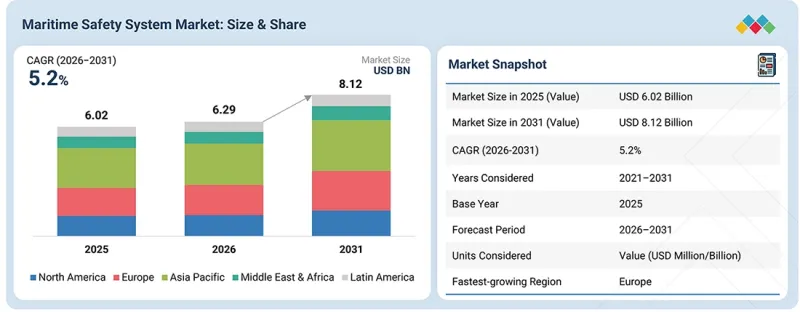
해상 안전 시스템 시장 규모는 2026년 62억 9,000만 달러에서 2031년까지 81억 2,000만 달러로 성장할 것으로 예상되며, 예측 기간 중 연평균 복합 성장률(CAGR)은 5.2%를 나타낼 전망입니다.
선박 운항자들이 복잡하고 혼잡한 해상 환경에서 상황 인식을 향상시키고, 인적 오류로 인한 사고를 줄이며, 보다 안전한 의사 결정을 지원하기를 점점 더 요구함에 따라, AI를 활용한 항해 지원 및 충돌 방지 기술은 해상 안전 시스템 시장에서 큰 비즈니스 기회로 부상하고 있습니다.
| 조사 범위 | |
|---|---|
| 조사 대상 기간 | 2021-2031년 |
| 기준 연도 | 2025년 |
| 예측 기간 | 2026-2031년 |
| 산정 단위 | 100만/10억 달러 |
| 부문 | 제공 제품별, 용도별, 운영 환경별, 지역별 |
| 대상 지역 | 북미, 유럽, 아시아태평양, 중동 및 아프리카, 라틴아메리카 |
AI, 머신러닝, 컴퓨터 비전, 센서 융합 및 고급 분석 기술을 활용하여 레이더, AIS, 카메라, LiDAR, GNSS, ECDIS 및 기타 선박 탑재 센서에서 수집된 데이터를 통합함으로써, 주변 선박, 장애물 및 잠재적 위험을 실시간으로 감지하고 분류할 수 있습니다. 이러한 기능을 통해 시스템은 선박의 비정상적인 동작을 식별하고, 잠재적인 충돌 위험을 예측하며, 조기 경보를 발령하고, 의사 결정 지원 권장 사항을 통해 항해사를 지원할 수 있습니다. 이러한 시장 기회는 지속적인 모니터링과 신속한 대응이 극히 중요한 상선, 여객선, 해양 선박, 항만, 그리고 자율 항해 선박 및 원격 조종 선박에서 특히 두드러집니다. AI를 활용한 지각, 자율 항해 및 충돌 회피 솔루션을 개발하는 기업은 자사의 기술을 기존 브리지 시스템, ECDIS, VTS 및 육상 감시 플랫폼과 통합함으로써, 단일 용도에 그치지 않는 사업 확장을 도모할 수 있습니다.
“규제 요건과 디지털 항법 기술의 보급 확대를 배경으로, 항법·측위 기기가 하드웨어 분야에서 가장 급속한 성장을 이룰 전망입니다.”
안전 용도별로 보면, 2026년에는 항해 및 충돌 방지가 해상 안전 시스템 시장에서 가장 큰 점유율을 차지할 것으로 예측됩니다. 이 부문은 레이더, ECDIS, AIS, GNSS, 항해 센서, 충돌 회피 시스템 및 관련 의사결정 지원 기술 등 항해 기능이 의무화되어 있으며, 안전상 극히 중요하다는 특성에 힘입고 있습니다. 디지털화 및 상호 운용 가능한 항해로의 전환이 수요를 더욱 강화하고 있습니다. IHO의 S-100 프레임워크는 2026년 1월에 운영이 시작되었으며, S-101 전자해도, S-102 수심 데이터, S-104 수위 정보, S-111 표층류,S-124 항행 경보, 그리고 S-129 선체 하부 여유 공간 관리가 1단계 제품 사양으로 발효되었습니다. IMO 또한 항해 안전성을 높이기 위한 해양 정보의 통합, 교환, 표시, 분석을 핵심으로 e-네비게이션을 정의하고 있으며, 통합 항해 시스템 및 충돌 방지 시스템에 대한 지속적인 투자를 뒷받침하고 있습니다.
“2026년에는 탑재 의무 및 선박 현대화에 힘입어 하드웨어 부문이 최대 시장 점유율을 차지할 전망”
제품별로 보면, 2026년에는 하드웨어 부문이 해상 안전 시스템 시장에서 가장 큰 점유율을 차지할 것으로 추정됩니다. 해상 안전은 여전히 항행·측위 시스템, 통신·조난 신호 장치, 화재·위험 방지 장치, 긴급·구명 장치, 선박 교통·감시 장치 등의 물리적 장비에 크게 의존하고 있습니다. 이러한 시스템은 규제, 형식 승인 및 선박 고유의 요건의 적용을 받으며, 비교적 안정적인 갱신·업그레이드 시장을 형성하고 있습니다. 동시에 하드웨어는 단독 기기로 작동하는 것이 아니라 소프트웨어, 연결성 및 육상 서비스와의 통합이 진행되고 있습니다. S-100 호환 ECDIS로의 전환은 항해용 하드웨어의 현대화를 촉진할 것으로 예측됩니다. 이는 IHO(국제수로기구) 규격에 따라 해당 ECDIS 장비가 관련 S-100 프레임워크를 준수해야 하기 때문입니다.
“아시아태평양은 엄격한 규제 체계, 첨단 조선 기술, 그리고 디지털 항법 기술의 적극적인 도입에 힘입어 해상 안전 시스템 시장에서 가장 큰 점유율을 차지할 전망입니다.”
아시아태평양은 이 지역의 광대한 해안선, 주요 상업항의 고밀도 분포, 해상 무역의 확대, 그리고 주요 항로에서의 선박 교통량 증가에 힘입어 전 세계 해상 안전 시스템 시장에서 가장 큰 점유율을 차지할 것으로 예측됩니다. 중국, 일본, 인도, 한국, 싱가포르, 호주 등의 국가들은 항만 현대화, 선단 갱신, 선박 감시, 항해 및 해양 보안 인프라에 막대한 투자를 하고 있습니다. 이 지역에서 자동식별장치(AIS), 세계해사조난안전시스템(GMDSS), 레이더 및 감시 시스템, 선박 감시 솔루션, 통합 항해 기술의 채택 확대가 시장 수요를 더욱 강화하고 있습니다. 또한, 해난 사고, 해적 행위, 불법 어업, 연안 경비, 환경 위험, 선박 교통 관리에 대한 우려가 높아짐에 따라 각국 정부와 해운 회사들은 첨단 안전 솔루션을 도입하도록 촉진되고 있습니다. 급속한 디지털화는 AI, IoT, 실시간 감시, 자율 항해, 예측 분석 및 연결형 해양 안전 플랫폼에 대한 기회도 창출하고 있으며, 국제해사기구(IMO)는 아시아태평양 전체에서 디지털화와 전자 항해를 적극적으로 추진하고 있습니다.
“유럽은 선단 확대, 조선 활동, 디지털화 및 자율 항해 선박 개발에 힘입어 예측 기간 동안 가장 빠른 성장세를 기록할 것으로 전망됩니다.”
유럽은 엄격한 해양 안전 규제, 디지털화의 가속화, 선박 교통 관리의 현대화, 그리고 첨단 항해·감시 기술의 도입 확대가 맞물려 해상 안전 시스템 시장에서 가장 빠르게 성장하고 있는 지역입니다. 유럽연합(EU)은 ‘2024-2025년 해상 안전 패키지’ 및 유럽해사안전청(EMSA)의 권한 강화를 통해 해상 안전 체계를 적극적으로 강화하고 있으며, 해상 감시, 사이버 보안 복원력, 위기 대응 준비, 디지털 시스템,및 안전 규제 집행에 더욱 중점을 두고 있습니다. 동시에 EU는 2025년 8월부터 적용이 시작되어 회원국 간의 해사 정보 교환을 통합하는 ‘유럽 해사 단일 창구 환경(EMSWe)’ 등의 노력을 통해 디지털 해사 인프라를 확충하고 있습니다. 또한, ‘SafeSeaNet’ 및 기타 EMSA 플랫폼은 당국에 지속적인 선박 추적 정보와 운항 정보를 제공합니다. 규제 강화 역시 선박 감시 및 상황 인식 시스템에 대한 수요를 직접적으로 촉진하고 있으며, 유럽위원회는 EU 수역에서 운항하는 안전 기준을 충족하지 않는 선박에 대한 감시 및 조사를 개선하기 위해 선박 보고 의무 제도를 강화하고 있습니다.
FURUNO(일본), Kongsberg Maritime(노르웨이), Wartsila(핀란드), Japan Radio Co.(JRC)(일본), Tokyo Keiki(일본),Sperry Marine(미국), SRT Marine Systems(영국), Consilium Safety(스웨덴), Drager(독일), NAVTOR(노르웨이), Marlink(프랑스), Viasat/Inmarsat Maritime(미국), Iridium Communications(미국),Cobham Satcom(영국), VIKING Life-Saving Equipment(덴마크), Survitec(영국), Orca AI(이스라엘), Avikus(한국), SEA.AI(오스트리아), M2Intelligence(한국),Hefring Marine(아이슬란드), NAPA(핀란드), Maritime Optima(노르웨이), Seaber(프랑스), Clearbot(홍콩), FleetMon(독일), Sea Machines Robotics(미국), Captain AI(벨기에) 등이 해상 안전 시스템 시장의 주요 기업들입니다.
본 조사에서는 해상 안전 시스템 시장의 이러한 주요 기업들에 대해 기업 프로파일, 최근 동향 및 주요 시장 전략을 포함한 상세한 경쟁 분석을 수행하고 있습니다.
조사 범위
본 조사 보고서에서는 해상 안전 시스템 시장을 다음과 같은 제공 품목(하드웨어(항법·위치 측정 기기, 통신·조난 신호 기기, 비상·구명 기기, 화재·위험 방지 기기, 선박 교통·감시 기기),소프트웨어(항법·충돌 회피 소프트웨어, 선박 교통·상황 인식 소프트웨어, 안전 관리·감시 소프트웨어, 긴급 대응·의사결정 지원 소프트웨어)), 서비스(전문 서비스(설치·통합 서비스, 도입·설정 서비스, 컨설팅·자문 서비스,검사·시험·인증 서비스, 교육·시뮬레이션 서비스))(매니지드 서비스(원격 안전 감시 서비스, 원격 운용·지원 서비스));안전 용도(항행·충돌 방지,선박 교통·상황 인식, 통신·조난 관리, 긴급 대응·인명 안전, 화재·위험 방지, 선박·승무원 안전 감시); 운용 환경(선박 탑재, 육상 및 해양 시설); 그리고 지역(북미, 유럽,아시아태평양, 중동 및 아프리카, 라틴아메리카)로 분류됩니다. 본 보고서의 조사 범위에는 해상 안전 시스템 시장의 성장에 영향을 미치는 주요 요인(촉진요인, 제약 요인, 과제 및 기회 등)에 대한 상세 정보가 포함되어 있습니다. 주요 업계 참여 기업에 대해 상세한 분석을 수행하여, 해당 기업의 사업 개요, 솔루션, 서비스,주요 전략, 계약·제휴·합의, 신제품 및 서비스 출시, 합병·인수, 그리고 해상 안전 시스템 시장과 관련된 최근 동향에 대한 인사이트를 제공합니다. 또한, 본 보고서에서는 시장 생태계에 진입하는 신생 기업에 대한 경쟁 분석도 다루고 있습니다.
본 보고서를 구매해야 하는 이유
본 보고서는 시장 선도 기업 및 신규 진출기업에게 해상 안전 시스템 시장 전체 및 그 하위 부문의 매출에 대한 가장 정확한 추정치 정보를 제공합니다. 이를 통해 이해관계자는 경쟁 구도를 이해하고, 자사의 비즈니스를 더 유리한 위치에 놓으며, 적절한 시장 진출 전략을 수립하기 위한 추가적인 인사이트를 얻을 수 있습니다. 또한 이해관계자가 시장 동향을 파악하고, 주요 시장 성장 촉진요인, 제약 요인, 과제 및 기회에 대한 정보를 얻는 데에도 도움이 됩니다.
본 보고서는 다음 사항에 대한 인사이트를 제공합니다.
- 주요 성장 촉진요인(해상 안전 규제 및 규정 준수 요건 강화, 항해 및 선박 운항의 디지털화),제약 요인(높은 도입·통합 비용, 복잡한 인증 요건), 기회(AI를 활용한 항해 및 충돌 방지, S-100 기반 디지털 해상 항해), 과제(안전성이 극히 중요한 용도에서의 AI 신뢰성, 이종 시스템 통합)에 대한 분석
- 제품 개발/혁신 : 신기술, AI를 활용한 충돌 회피 시스템, 자율 항해 플랫폼, 위성 통신 솔루션, 통합 브리지 시스템, 원격 모니터링 플랫폼, 진행 중인 연구 개발 활동, 그리고 해상 안전 시스템 시장에서의 신제품 및 신규 서비스 출시에 대한 상세한 인사이트
- 시장 개발 : 고성장 시장 기회, 진전되는 선단의 디지털화 및 자율 선박 도입 동향, 그리고 북미, 유럽, 아시아태평양, 중동 및 아프리카, 라틴아메리카에 걸친 지역별 분석에 관한 종합적인 정보
- 시장 다각화 : 해상 안전 시스템 시장의 새로운 하드웨어 및 소프트웨어 솔루션, 신흥 안전 용도, 미개척 최종 사용자 부문, 지역 확장 전략 및 투자에 관한 종합적인 정보
- 경쟁사 평가 : FURUNO(일본), Kongsberg Maritime(노르웨이), Wartsila(핀란드),Japan Radio Co.(JRC)(일본), Sperry Marine(미국), Consilium Safety(스웨덴), Drager(독일), NAVTOR(노르웨이), VIKING Life-Saving Equipment(덴마크),Survitec(영국), Orca AI(이스라엘) 및 해상 안전 시스템 시장에서 사업을 전개하는 기타 주요 기업에 대해 시장 점유율, 성장 전략, 파트너십, 인수, 제품 혁신, 서비스 제공에 관한 상세한 평가를 수행합니다.
자주 묻는 질문
목차
제1장 서론
제2장 주요 요약
제3장 프리미엄 인사이트
제4장 시장 개요
제5장 업계 동향
제6장 기술 진보, AI의 영향, 특허, 혁신, 향후 응용
제7장 관세 분석과 규제 상황
제8장 고객 현황과 구매 행동
제9장 해상 안전 시스템 시장(제공 제품별)
제10장 해상 안전 시스템 시장(용도별)
제11장 해상 안전 시스템 시장(운영 환경별)
제12장 해상 안전 시스템 시장(지역별)
제13장 경쟁 구도
제14장 기업 개요
제15장 조사 방법
제16장 인접 시장 및 관련 시장
제17장 부록
KTH 26.09.28The maritime safety system market is projected to grow from USD 6.29 billion in 2026 to USD 8.12 billion by 2031, at a CAGR of 5.2% during the forecast period. AI-enabled navigation and collision prevention represent a significant opportunity in the maritime safety system market as vessel operators increasingly seek to improve situational awareness, reduce human-error-related incidents, and support safer decision-making in complex and congested maritime environments.
| Scope of the Report | |
|---|---|
| Years Considered for the Study | 2021-2031 |
| Base Year | 2025 |
| Forecast Period | 2026-2031 |
| Units Considered | USD Million/Billion |
| Segments | Offering, Safety Application, Operating Environment, and Region |
| Regions covered | North America, Europe, Asia Pacific, Middle East & Africa, and Latin America |
AI, machine learning, computer vision, sensor fusion, and advanced analytics can combine inputs from radar, AIS, cameras, LiDAR, GNSS, ECDIS, and other onboard sensors to detect and classify surrounding vessels, obstacles, and potential hazards in real time. These capabilities enable systems to identify abnormal vessel behavior, predict potential collision risks, generate early warnings, and support navigators with decision-support recommendations. The opportunity is particularly strong for commercial shipping, passenger vessels, offshore vessels, ports, and autonomous or remotely operated vessels, where continuous monitoring and rapid response are critical. Companies developing AI-based perception, autonomous navigation, and collision-avoidance solutions can also expand beyond standalone applications by integrating their technologies with existing bridge systems, ECDIS, VTS, and shore-based monitoring platforms.
"Navigation & positioning equipment to be fastest-growing hardware, driven by regulatory requirements and increasing adoption of digital navigation technologies"
By safety application, navigation & collision prevention is expected to account for the largest share of the maritime safety system market in 2026. The segment is supported by the mandatory and safety-critical nature of navigation functions, including radar, ECDIS, AIS, GNSS, navigation sensors, collision-avoidance systems, and related decision-support technologies. The transition toward digital and interoperable navigation is further strengthening demand. The IHO's S-100 framework became operational in January 2026, with S-101 Electronic Navigational Charts, S-102 bathymetric data, S-104 water-level information, S-111 surface currents, S-124 navigational warnings, and S-129 under-keel clearance management entering into force as Phase 1 product specifications. IMO also defines e-navigation around the integration, exchange, presentation, and analysis of marine information to enhance safety of navigation, supporting continued investment in integrated navigation and collision-prevention systems.
"Hardware segment to account for the largest market share in 2026, supported by mandatory carriage requirements and vessel modernization"
By offering, the hardware segment is estimated to account for the largest share of the maritime safety system market in 2026. Maritime safety remains strongly dependent on physical equipment such as navigation and positioning systems, communication and distress equipment, fire and hazard protection equipment, emergency and life-saving equipment, and vessel traffic and monitoring equipment. These systems are subject to regulatory, type-approval, and vessel-specific requirements, creating a relatively stable replacement and upgrade market. At the same time, hardware is increasingly being integrated with software, connectivity, and shore-based services rather than operating as standalone equipment. The transition to S-100-compatible ECDIS is expected to support modernization of navigation hardware, with IHO standards requiring applicable ECDIS equipment to support the relevant S-100 framework.
"Asia Pacific to account for the largest share of the maritime safety system market, driven by stringent regulatory frameworks, advanced shipbuilding, and strong adoption of digital navigation technologies"
Asia Pacific is expected to account for the largest share of the global maritime safety system market, supported by the region's extensive coastline, high concentration of major commercial ports, growing maritime trade, and increasing vessel traffic across key shipping routes. Countries such as China, Japan, India, South Korea, Singapore, and Australia are investing significantly in port modernization, fleet upgrades, vessel monitoring, navigation, and maritime security infrastructure. The region's growing adoption of Automatic Identification Systems (AIS), Global Maritime Distress and Safety Systems (GMDSS), radar and surveillance systems, vessel monitoring solutions, and integrated navigation technologies is further strengthening market demand. In addition, increasing concerns related to maritime accidents, piracy, illegal fishing, coastal security, environmental risks, and vessel traffic management are encouraging governments and shipping companies to deploy advanced safety solutions. Rapid digitalization is also creating opportunities for AI, IoT, real-time monitoring, autonomous navigation, predictive analytics, and connected maritime safety platforms, with IMO actively promoting digitalization and e-navigation across the Asia-Pacific region.
"Europe to register the fastest growth during the forecast period, driven by fleet expansion, shipbuilding activity, digitalization, and autonomous-vessel development"
Europe is the fastest-growing region in the maritime safety system market, supported by a combination of stringent maritime safety regulations, accelerated digitalization, modernization of vessel traffic management, and increasing adoption of advanced navigation and monitoring technologies. The European Union has been actively strengthening its maritime safety framework through the 2024-2025 Maritime Safety Package and the enhanced mandate of the European Maritime Safety Agency (EMSA), with greater emphasis on maritime surveillance, cybersecurity resilience, crisis preparedness, digital systems, and safety enforcement. At the same time, the EU is expanding digital maritime infrastructure through initiatives such as the European Maritime Single Window environment (EMSWe), which became applicable in August 2025 and integrates maritime information exchange across Member States, while SafeSeaNet and other EMSA platforms provide continuous vessel-tracking and operational information to authorities. Regulatory tightening is also directly stimulating demand for vessel monitoring and situational-awareness systems, with the European Commission strengthening Mandatory Ship Reporting Systems to improve monitoring and investigation of unsafe vessels operating in EU waters.
Breakdown of Primaries
In-depth interviews were conducted with chief executive officers (CEOs), innovation and technology directors, system integrators, and executives from various key organizations operating in the maritime safety system market.
- By Company: Tier 1 - 25%, Tier 2 - 41%, and Tier 3 - 34%
- By Designation: Directors - 31%, Managers - 46%, and Others - 23%
- By Region: North America - 39%, Europe - 22%, Asia Pacific - 28%, Middle East & Africa - 4%, and Latin America - 7%
FURUNO (Japan), Kongsberg Maritime (Norway), Wartsila (Finland), Japan Radio Co. (JRC) (Japan), Tokyo Keiki (Japan), Sperry Marine (USA), SRT Marine Systems (UK), Consilium Safety (Sweden), Drager (Germany), NAVTOR (Norway), Marlink (France), Viasat/Inmarsat Maritime (USA), Iridium Communications (USA), Cobham Satcom (UK), VIKING Life-Saving Equipment (Denmark), Survitec (UK), Orca AI (Israel), Avikus (South Korea), SEA.AI (Austria), M2Intelligence (South Korea), Hefring Marine (Iceland), NAPA (Finland), Maritime Optima (Norway), Seaber (France), Clearbot (Hong Kong), FleetMon (Germany), Sea Machines Robotics (USA), and Captain AI (Belgium) are some of the key players in the maritime safety system market.
The study includes an in-depth competitive analysis of these key players in the maritime safety system market, with their company profiles, recent developments, and key market strategies.
Research Coverage
This research report categorizes the maritime safety system market by offering (hardware (navigation & positioning equipment, communication & distress equipment, emergency & life-saving equipment, fire & hazard protection equipment and vessel traffic & monitoring equipment), software (navigation & collision avoidance software, vessel traffic & situational awareness software, safety management & monitoring software and emergency response & decision support software)), and services (professional services (installation & integration services, implementation & configuration services, consulting & advisory services, inspection, testing & certification services, training & simulation services)) (managed services (remote safety monitoring services and remote operations & support services)); safety application (navigation & collision prevention, vessel traffic & situational awareness, communication & distress management, emergency response & life safety, fire & hazard protection and vessel & crew safety monitoring); operating environment (onboard vessel, onshore and offshore installation); and region (North America, Europe, Asia Pacific, Middle East & Africa, and Latin America). The scope of the report covers detailed information regarding the major factors, such as drivers, restraints, challenges, and opportunities, influencing the growth of the maritime safety system market. A detailed analysis of the key industry players has been done to provide insights into their business overview, solutions, and services; key strategies; contracts, partnerships, agreements; new product & service launches; mergers & acquisitions; and recent developments associated with the maritime safety system market. Competitive analysis of upcoming startups in the market ecosystem is covered in this report.
Reasons to Buy This Report
The report will provide market leaders and new entrants with information on the closest approximations of the revenue numbers for the overall maritime safety system market and its subsegments. It would help stakeholders understand the competitive landscape and gain more insights to position their business better and plan suitable go-to-market strategies. It also helps stakeholders understand the pulse of the market and provides them with information on key market drivers, restraints, challenges, and opportunities.
The report provides insights into the following pointers:
- Analysis of key drivers (Increasing maritime safety regulations and compliance requirements, Digitalization of navigation and vessel operations), restraints (High installation and integration costs, Complex certification requirements), opportunities (AI-enabled navigation and collision prevention, S-100-based digital maritime navigation), and challenges (Reliability of AI in safety-critical applications, Integration of heterogeneous systems)
- Product Development/Innovation: Detailed insights into emerging technologies, AI-powered collision avoidance systems, autonomous navigation platforms, satellite communication solutions, integrated bridge systems, remote monitoring platforms, ongoing research & development activities, and new product and service launches in the maritime safety system market
- Market Development: Comprehensive information about high-growth market opportunities, evolving fleet digitalization and autonomous-vessel adoption trends, and regional analysis across North America, Europe, Asia Pacific, the Middle East & Africa, and Latin America
- Market Diversification: Exhaustive information about new hardware and software solutions, emerging safety applications, untapped end-user segments, regional expansion strategies, and investments across the maritime safety system market
- Competitive Assessment: In-depth assessment of market shares, growth strategies, partnerships, acquisitions, product innovations, and service offerings of FURUNO (Japan), Kongsberg Maritime (Norway), Wartsila (Finland), Japan Radio Co. (JRC) (Japan), Sperry Marine (USA), Consilium Safety (Sweden), Drager (Germany), NAVTOR (Norway), VIKING Life-Saving Equipment (Denmark), Survitec (UK), Orca AI (Israel), and other leading companies operating in the maritime safety system market.
TABLE OF CONTENTS
1 INTRODUCTION
- 1.1 STUDY OBJECTIVES
- 1.2 MARKET DEFINITION
- 1.2.1 INCLUSIONS AND EXCLUSIONS
- 1.3 MARKET SCOPE
- 1.3.1 MARKET SEGMENTATION
- 1.3.2 YEARS CONSIDERED
- 1.4 CURRENCY CONSIDERED
- 1.5 STAKEHOLDERS
- 1.6 SUMMARY OF CHANGES
2 EXECUTIVE SUMMARY
- 2.1 MARKET HIGHLIGHTS AND KEY INSIGHTS
- 2.2 KEY MARKET PARTICIPANTS: MAPPING OF STRATEGIC DEVELOPMENTS
- 2.3 DISRUPTIVE TRENDS IN MARITIME SAFETY SYSTEM MARKET
- 2.4 HIGH-GROWTH SEGMENTS
- 2.5 REGIONAL SNAPSHOT: MARKET SIZE, GROWTH RATE, AND FORECAST
3 PREMIUM INSIGHTS
- 3.1 ATTRACTIVE OPPORTUNITIES IN MARITIME SAFETY SYSTEM MARKET
- 3.2 MARITIME SAFETY SYSTEM MARKET, BY REGION
- 3.3 MARITIME SAFETY SYSTEM MARKET, BY OFFERING
- 3.4 ASIA PACIFIC: MARITIME SAFETY SYSTEM MARKET, BY OFFERING AND OPERATING ENVIRONMENT
- 3.5 MARITIME SAFETY SYSTEM MARKET, BY REGION
4 MARKET OVERVIEW
- 4.1 INTRODUCTION
- 4.2 MARKET DYNAMICS
- 4.2.1 DRIVERS
- 4.2.1.1 Increasing maritime safety regulations and compliance requirements
- 4.2.1.2 Digitalization of navigation and vessel operations
- 4.2.1.3 Growing maritime traffic and collision risks
- 4.2.1.4 Adoption of autonomous and remotely operated vessels
- 4.2.2 RESTRAINTS
- 4.2.2.1 High installation and integration costs
- 4.2.2.2 Complex certification requirements
- 4.2.3 OPPORTUNITIES
- 4.2.3.1 AI-enabled navigation and collision prevention
- 4.2.3.2 S-100-based digital maritime navigation
- 4.2.3.3 Digital VTS and shore-based safety infrastructure
- 4.2.4 CHALLENGES
- 4.2.4.1 Reliability of AI in safety-critical applications
- 4.2.4.2 Integration of heterogeneous systems
- 4.2.1 DRIVERS
- 4.3 UNMET NEEDS AND WHITE SPACES
- 4.3.1 UNMET NEEDS IN MARITIME SAFETY SYSTEMS
- 4.3.2 WHITE SPACE OPPORTUNITIES
- 4.4 INTERCONNECTED MARKETS AND CROSS-SECTOR OPPORTUNITIES
- 4.4.1 INTERCONNECTED MARKETS
- 4.4.2 CROSS-SECTOR OPPORTUNITIES
- 4.5 STRATEGIC MOVES BY TIER-1/2/3 PLAYERS
- 4.5.1 STRATEGIC MOVES BY TIER-1/2/3 PLAYERS
5 INDUSTRY TRENDS
- 5.1 EVOLUTION OF MARITIME SAFETY SYSTEM
- 5.2 PORTER'S FIVE FORCES ANALYSIS
- 5.2.1 INTENSITY OF COMPETITIVE RIVALRY
- 5.2.2 BARGAINING POWER OF SUPPLIERS
- 5.2.3 BARGAINING POWER OF BUYERS
- 5.2.4 THREAT OF SUBSTITUTES
- 5.2.5 THREAT OF NEW ENTRANTS
- 5.3 MACROECONOMIC OUTLOOK
- 5.3.1 INTRODUCTION
- 5.3.2 GDP TRENDS AND FORECAST
- 5.3.3 TRENDS IN MARITIME SAFETY AND NAVIGATION INDUSTRY
- 5.3.4 TRENDS IN AI, AUTOMATION, AND MARITIME DIGITAL INTELLIGENCE
- 5.4 SUPPLY CHAIN ANALYSIS
- 5.5 ECOSYSTEM ANALYSIS
- 5.5.1 VESSEL TRAFFIC & SITUATIONAL AWARENESS SYSTEM VENDORS
- 5.5.2 MARITIME E-NAVIGATION & DIGITAL SAFETY SOFTWARE VENDORS
- 5.5.3 MARITIME E-NAVIGATION & DIGITAL SAFETY SOFTWARE VENDORS
- 5.5.4 MARITIME SAFETY HARDWARE & MARINE ELECTRONICS VENDORS
- 5.5.5 MARITIME SAFETY SOFTWARE & ANALYTICS VENDORS
- 5.5.6 MARITIME SAFETY CONNECTIVITY & DIGITAL SERVICE PROVIDERS
- 5.5.7 MARITIME SAFETY SYSTEM INTEGRATORS & SERVICE PROVIDERS
- 5.6 PRICING ANALYSIS
- 5.6.1 AVERAGE SELLING PRICE OF OFFERINGS, BY KEY PLAYER, 2026
- 5.6.2 AVERAGE SELLING PRICE OF SAFETY APPLICATIONS, 2026
- 5.7 TRADE ANALYSIS
- 5.7.1 EXPORT SCENARIO OF COMPUTER PROCESSING UNITS (HSN: 847150)
- 5.7.2 IMPORT SCENARIO OF RADIO NAVIGATIONAL AID APPARATUS UNITS (HSN: 852691)
- 5.8 KEY CONFERENCES AND EVENTS, 2026-2027
- 5.9 TRENDS/DISRUPTIONS IMPACTING CUSTOMER BUSINESS
- 5.10 INVESTMENT AND FUNDING SCENARIO
- 5.11 CASE STUDY ANALYSIS
- 5.11.1 M2INTELLIGENCE AND NEWPORT SHIP MANAGEMENT: DIGITAL TRANSFORMATION OF MARITIME OPERATIONS
- 5.11.2 WARTSILA ENHANCES VESSEL TRAFFIC MANAGEMENT AND SAFETY AT PORT OF CALLAO
- 5.11.3 JRC ENABLES SAFER NAVIGATION THROUGH J-MARINE NECST AND ECDIS INTEGRATION
- 5.11.4 ST ENGINEERING DEPLOYS AUTONOMOUS NAVIGATION AND COLLISION AVOIDANCE FOR SMAV
- 5.11.5 SAAB UPGRADES VESSEL TRAFFIC SERVICES AT SCHELDT RADAR NETWORK
- 5.11.6 KONGSBERG NORCONTROL DELIVERS VESSEL TRAFFIC SERVICE SYSTEM TO PORT OF LONDON AUTHORITY
- 5.11.7 FURUNO DEPLOYS SURVEILLANCE RADAR FOR YOKOHAMA VESSEL MANAGEMENT CENTRE
- 5.11.8 MARLINK PROTECTS HOPPER DREDGER'S CRITICAL NAVIGATION SYSTEMS
- 5.11.9 AVIKUS ENABLES AUTONOMOUS NAVIGATION ON PRISM COURAGE LNG CARRIER
- 5.12 IMPACT OF 2025 US TARIFF - MARITIME SAFETY SYSTEM MARKET
- 5.12.1 INTRODUCTION
- 5.12.1.1 Tariff/Trade policy updates (January-June 2026)
- 5.12.2 KEY TARIFF RATES
- 5.12.3 PRICE IMPACT ANALYSIS
- 5.12.3.1 Strategic shifts and emerging trends
- 5.12.4 IMPACT ON COUNTRIES/REGIONS
- 5.12.4.1 US
- 5.12.4.2 Europe
- 5.12.4.3 China
- 5.12.4.4 Asia Pacific (excluding China)
- 5.12.5 IMPACT ON SAFETY APPLICATIONS
- 5.12.5.1 Navigation & collision prevention
- 5.12.5.2 Vessel traffic & situational awareness
- 5.12.5.3 Communication & distress management
- 5.12.5.4 Emergency response & life safety
- 5.12.5.5 Fire & hazard protection
- 5.12.5.6 Vessel & crew safety monitoring
- 5.12.1 INTRODUCTION
6 TECHNOLOGICAL ADVANCEMENTS, AI-DRIVEN IMPACT, PATENTS, INNOVATIONS, AND FUTURE APPLICATIONS
- 6.1 KEY EMERGING TECHNOLOGIES
- 6.1.1 RADAR & ADVANCED SENSING TECHNOLOGIES
- 6.1.2 POSITIONING & NAVIGATION TECHNOLOGIES
- 6.1.3 AUTOMATIC IDENTIFICATION & TRACKING TECHNOLOGIES
- 6.1.4 COMMUNICATION & CONNECTIVITY TECHNOLOGIES
- 6.1.5 INTERNET OF THINGS (IOT) & EDGE COMPUTING
- 6.1.6 ARTIFICIAL INTELLIGENCE & MACHINE LEARNING
- 6.1.7 AUTOMATION & AUTONOMOUS NAVIGATION
- 6.2 COMPLEMENTARY TECHNOLOGIES
- 6.2.1 COMPUTER VISION
- 6.2.2 DIGITAL TWINS & SIMULATION
- 6.2.3 ADVANCED DATA ANALYTICS
- 6.2.4 CYBERSECURITY & CYBER-RESILIENCE
- 6.3 ADJACENT TECHNOLOGIES
- 6.3.1 MARITIME CYBERSECURITY
- 6.3.2 PORT AUTOMATION
- 6.3.3 OFFSHORE INFRASTRUCTURE MONITORING
- 6.3.4 AUTONOMOUS UNDERWATER VEHICLES & REMOTELY OPERATED VEHICLES
- 6.3.5 MARITIME ENVIRONMENTAL MONITORING
- 6.3.6 PREDICTIVE MAINTENANCE
- 6.3.7 QUANTUM POSITIONING & COMMUNICATION
- 6.4 PRODUCT ROADMAP
- 6.5 PATENT ANALYSIS
- 6.5.1 METHODOLOGY
- 6.5.2 PATENTS FILED, BY DOCUMENT TYPE, 2016-2026
- 6.5.3 INNOVATION AND PATENT APPLICATIONS
- 6.6 FUTURE APPLICATIONS
- 6.6.1 AI-ENABLED MARITIME DECISION SUPPORT
- 6.6.2 AUTONOMOUS & REMOTELY OPERATED VESSELS
- 6.6.3 S-100 & DIGITAL E-NAVIGATION SERVICES
- 6.6.4 INTELLIGENT VESSEL TRAFFIC SERVICES (VTS)
- 6.6.5 DIGITAL TWIN & PREDICTIVE SAFETY MANAGEMENT
- 6.7 IMPACT OF AI/GEN AI ON MARITIME SAFETY SYSTEM MARKET
- 6.7.1 BEST PRACTICES IN MARITIME SAFETY SYSTEM MARKET
- 6.7.2 CASE STUDIES OF AI IMPLEMENTATION IN MARITIME SAFETY SYSTEM MARKET
- 6.7.3 CLIENTS' READINESS TO ADOPT GENERATIVE AI IN MARITIME SAFETY SYSTEM MARKET
- 6.8 SUCCESS STORIES AND REAL-WORLD APPLICATIONS
- 6.8.1 KONGSBERG MARITIME: AI-ENABLED MARITIME SITUATIONAL AWARENESS
- 6.8.2 JRC: AI-BASED INTEGRATED NAVIGATION SUPPORT
7 TARIFF ANALYSIS AND REGULATORY LANDSCAPE
- 7.1 TARIFF RELATED TO MARITIME NAVIGATION AND SAFETY EQUIPMENT
- 7.1.1 TARIFF RELATED TO RADIO NAVIGATIONAL AID APPARATUS (HSN: 852691)
- 7.2 REGIONAL REGULATIONS AND COMPLIANCE
- 7.2.1 REGULATORY BODIES, GOVERNMENT AGENCIES, AND OTHER ORGANIZATIONS
- 7.2.2 KEY REGULATIONS
- 7.2.2.1 North America
- 7.2.2.1.1 US Navigation Safety Regulations - 33 CFR Part 164 (US)
- 7.2.2.1.2 Navigation Safety Regulations, 2020 - Canada
- 7.2.2.2 Europe
- 7.2.2.2.1 Directive 2002/59/EC - Vessel Traffic Monitoring and Information System (EU)
- 7.2.2.2.2 Directive 2009/45/EC - Safety Rules and Standards for Passenger Ships (EU)
- 7.2.2.2.3 Merchant Shipping (Safety of Navigation) Regulations 2020 - UK
- 7.2.2.3 Asia Pacific
- 7.2.2.3.1 SOLAS Convention - Safety of Life at Sea
- 7.2.2.3.2 COLREG 1972 - International Regulations for Preventing Collisions at Sea
- 7.2.2.3.3 STCW Convention - Standards of Training, Certification and Watchkeeping for Seafarers
- 7.2.2.4 Middle East & Africa (MEA)
- 7.2.2.4.1 Riyadh Memorandum of Understanding on Port State Control
- 7.2.2.4.2 Abuja Memorandum of Understanding on Port State Control
- 7.2.2.4.3 Indian Ocean Memorandum of Understanding on Port State Control
- 7.2.2.5 Latin America
- 7.2.2.5.1 Acuerdo de Vina del Mar - Port State Control
- 7.2.2.5.2 Caribbean Memorandum of Understanding on Port State Control
- 7.2.2.1 North America
- 7.2.3 INDUSTRY STANDARDS
8 CUSTOMER LANDSCAPE AND BUYER BEHAVIOR
- 8.1 DECISION-MAKING PROCESS
- 8.2 KEY STAKEHOLDERS INVOLVED IN BUYING PROCESS AND THEIR EVALUATION CRITERIA
- 8.2.1 KEY STAKEHOLDERS IN BUYING PROCESS
- 8.2.2 BUYING CRITERIA
- 8.3 ADOPTION BARRIERS AND INTERNAL CHALLENGES
- 8.4 UNMET NEEDS FROM VARIOUS INDUSTRY APPLICATIONS
9 MARITIME SAFETY SYSTEM MARKET, BY OFFERING
- 9.1 INTRODUCTION
- 9.1.1 DRIVERS: MARITIME SAFETY SYSTEM MARKET, BY OFFERING
- 9.2 HARDWARE
- 9.2.1 NAVIGATION & POSITIONING EQUIPMENT
- 9.2.1.1 Enabling real-time navigation, situational awareness, and decision support
- 9.2.2 COMMUNICATION & DISTRESS EQUIPMENT
- 9.2.2.1 Supporting reliable distress alerting, emergency response, and ship-shore information exchange
- 9.2.3 EMERGENCY & LIFE-SAVING EQUIPMENT
- 9.2.3.1 Enhancing maritime emergency systems for safety and reliability
- 9.2.4 FIRE & HAZARD PROTECTION EQUIPMENT
- 9.2.4.1 Addressing emerging fire and hazardous conditions across increasingly complex vessel environments
- 9.2.5 VESSEL TRAFFIC & MONITORING EQUIPMENT
- 9.2.5.1 Providing continuous vessel tracking, enhanced situational awareness, and reliable maritime traffic management across complex operating environments
- 9.2.1 NAVIGATION & POSITIONING EQUIPMENT
- 9.3 SOFTWARE
- 9.3.1 NAVIGATION & COLLISION-AVOIDANCE SOFTWARE
- 9.3.1.1 Increasing adoption of digital navigation, integrated bridge systems, and advanced collision-risk detection to drive segment
- 9.3.2 VESSEL TRAFFIC & SITUATIONAL AWARENESS SOFTWARE
- 9.3.2.1 Growing vessel traffic and need for real-time maritime-domain awareness to drive segment
- 9.3.3 SAFETY MANAGEMENT & MONITORING SOFTWARE
- 9.3.3.1 Increasing demand for centralized monitoring of vessel systems, safety conditions, and operational risks to drive segment
- 9.3.4 EMERGENCY RESPONSE & DECISION-SUPPORT SOFTWARE
- 9.3.4.1 Rising requirements for faster incident detection, emergency coordination, and data-driven response to drive segment
- 9.3.1 NAVIGATION & COLLISION-AVOIDANCE SOFTWARE
- 9.4 SERVICES
- 9.4.1 PROFESSIONAL SERVICES
- 9.4.1.1 Increasing demand for installation, system integration, retrofit, certification, training, and commissioning to drive segment
- 9.4.1.2 Installation & integration services
- 9.4.1.3 Implementation & configuration services
- 9.4.1.4 Consulting & advisory services
- 9.4.1.5 Inspection, testing, & certification services
- 9.4.1.6 Training & simulation services
- 9.4.2 MANAGED SERVICES
- 9.4.2.1 Growing adoption of remote monitoring, predictive maintenance, remote technical support, and connected ship-shore operations to drive segment
- 9.4.2.2 Remote safety monitoring services
- 9.4.2.3 Remote operations & support services
- 9.4.1 PROFESSIONAL SERVICES
10 MARITIME SAFETY SYSTEM MARKET, BY APPLICATION
- 10.1 INTRODUCTION
- 10.1.1 DRIVERS: MARITIME SAFETY SYSTEM MARKET, BY APPLICATION
- 10.2 NAVIGATION & COLLISION PREVENTION
- 10.2.1 INCREASING VESSEL TRAFFIC AND NEED FOR IMPROVING COLLISION-RISK DETECTION TO DRIVE ADOPTION OF ADVANCED NAVIGATION AND COLLISION-PREVENTION SYSTEMS
- 10.3 VESSEL TRAFFIC & SITUATIONAL AWARENESS
- 10.3.1 GROWING MARITIME TRAFFIC AND NEED FOR REAL-TIME VESSEL TRACKING TO DRIVE DEMAND FOR VTS, AIS, RADAR, AND INTEGRATED SITUATIONAL-AWARENESS SYSTEMS
- 10.4 COMMUNICATION & DISTRESS MANAGEMENT
- 10.4.1 MODERNIZATION OF GMDSS AND NEED FOR RELIABLE GLOBAL DISTRESS COMMUNICATIONS TO DRIVE DEMAND FOR ADVANCED MARITIME COMMUNICATION AND SAFETY SYSTEMS
- 10.5 EMERGENCY RESPONSE & LIFE SAFETY
- 10.5.1 INCREASING FOCUS ON EMERGENCY PREPAREDNESS AND RAPID RESPONSE TO DRIVE DEMAND FOR LIFE-SAVING AND EMERGENCY-RESPONSE SYSTEMS
- 10.6 FIRE & HAZARD PROTECTION
- 10.6.1 STRICTER FIRE-SAFETY REQUIREMENTS AND EMERGENCE OF NEW VESSEL FUELS AND CARGO RISKS TO DRIVE DEMAND FOR ADVANCED FIRE DETECTION, SUPPRESSION, AND HAZARD-PROTECTION SYSTEMS
- 10.7 VESSEL & CREW SAFETY MONITORING
- 10.7.1 GROWING DEMAND FOR CONTINUOUS MONITORING OF VESSEL AND CREW CONDITIONS TO DRIVE ADOPTION OF CONNECTED SENSORS, REMOTE MONITORING, AND REAL-TIME SAFETY-MANAGEMENT SYSTEMS
11 MARITIME SAFETY SYSTEM MARKET, BY OPERATING ENVIRONMENT
- 11.1 INTRODUCTION
- 11.1.1 DRIVERS: MARITIME SAFETY SYSTEM MARKET, BY OPERATING ENVIRONMENT
- 11.2 ONBOARD VESSEL
- 11.2.1 FLEET MODERNIZATION, REGULATORY COMPLIANCE, AND REPLACEMENT OF AGING ONBOARD SAFETY SYSTEMS DRIVING ADOPTION
- 11.3 ONSHORE
- 11.3.1 PORT EXPANSION, VTS MODERNIZATION, AND INCREASING SHIP-SHORE INFORMATION EXCHANGE DRIVING DEMAND FOR ONSHORE SAFETY SYSTEMS
- 11.4 OFFSHORE INSTALLATION
- 11.4.1 GROWING OFFSHORE OPERATIONS AND NEED FOR RELIABLE MONITORING, COMMUNICATION, EMERGENCY RESPONSE, AND HAZARD PROTECTION DRIVING ADOPTION
12 MARITIME SAFETY SYSTEM MARKET, BY REGION
- 12.1 INTRODUCTION
- 12.2 NORTH AMERICA
- 12.2.1 NORTH AMERICA: MARITIME SAFETY SYSTEM MARKET DRIVERS
- 12.2.2 US
- 12.2.2.1 Strengthening maritime safety adoption through fleet modernization, port infrastructure investment, and cybersecurity requirements
- 12.2.3 CANADA
- 12.2.3.1 Driving maritime safety adoption through vessel traffic services modernization, coastal and Arctic operations, and investment in navigation and monitoring infrastructure
- 12.3 EUROPE
- 12.3.1 EUROPE: MARITIME SAFETY SYSTEM MARKET DRIVERS
- 12.3.2 UK
- 12.3.2.1 Accelerating maritime safety adoption through digital navigation, maritime autonomy initiatives, fleet modernization, and advanced vessel traffic and safety technologies
- 12.3.3 GERMANY
- 12.3.3.1 Strengthening maritime safety adoption through advanced port infrastructure, autonomous shipping development, and modernization of navigation and vessel traffic systems
- 12.3.4 FRANCE
- 12.3.4.1 Expanding maritime safety adoption through dense shipping activity, port digitalization, and modernization of navigation systems
- 12.3.5 ITALY
- 12.3.5.1 Driving maritime safety adoption through VTS modernization, extensive passenger and commercial vessel activity, and investment in maritime surveillance and safety infrastructure
- 12.3.6 SPAIN
- 12.3.6.1 Scaling maritime safety adoption through port digitalization, navigation safety programs, and continued investment in surveillance and emergency-response capabilities
- 12.3.7 GREECE
- 12.3.7.1 Strengthening maritime safety through fleet dominance, digital surveillance, and navigation modernization
- 12.3.8 REST OF EUROPE
- 12.4 ASIA PACIFIC
- 12.4.1 ASIA PACIFIC: MARITIME SAFETY SYSTEM MARKET DRIVERS
- 12.4.2 CHINA
- 12.4.2.1 Strengthening maritime safety adoption through smart-shipping initiatives, autonomous-vessel development, digital maritime infrastructure, and navigation systems modernization
- 12.4.3 INDIA
- 12.4.3.1 Driving maritime safety adoption through port modernization, digital maritime governance, coastal and inland navigation development, and stronger navigation and communication infrastructure
- 12.4.4 JAPAN
- 12.4.4.1 Advancing maritime safety through autonomous-shipping standards, digital navigation, advanced marine electronics, and modernization of communication and search-and-rescue systems
- 12.4.5 SOUTH KOREA
- 12.4.5.1 Accelerating maritime safety technology through AI-enabled navigation, intelligent maritime traffic systems, autonomous vessels, and digital maritime infrastructure
- 12.4.6 AUSTRALIA & NEW ZEALAND
- 12.4.6.1 Supporting maritime safety modernization through autonomous-vessel development, digitalization, port and harbor safety upgrades, and strengthened regulatory frameworks
- 12.4.7 REST OF ASIA PACIFIC
- 12.5 MIDDLE EAST & AFRICA
- 12.5.1 MIDDLE EAST & AFRICA: MARITIME SAFETY SYSTEM MARKET DRIVERS
- 12.5.2 SAUDI ARABIA
- 12.5.2.1 Expanding maritime safety capabilities through port development, digital maritime infrastructure, navigation modernization, and stronger regulatory and compliance programs
- 12.5.3 UAE
- 12.5.3.1 Strengthening maritime safety through major port infrastructure, digital maritime services, vessel traffic management, and advanced navigation and monitoring systems
- 12.5.4 SOUTH AFRICA
- 12.5.4.1 Advancing maritime safety through digital maritime services, Maritime Single Window initiatives, port-system modernization, and stronger vessel monitoring and operational capabilities
- 12.5.5 QATAR
- 12.5.5.1 Developing maritime safety capabilities through navigation and communication modernization, maritime regulatory compliance, search-and-rescue preparedness, and digital maritime technologies
- 12.5.6 REST OF MIDDLE EAST & AFRICA
- 12.6 LATIN AMERICA
- 12.6.1 LATIN AMERICA: MARITIME SAFETY SYSTEM MARKET DRIVERS
- 12.6.2 BRAZIL
- 12.6.2.1 Expanding maritime safety adoption through port modernization, coastal and inland navigation development, offshore operations, and technology-enabled maritime infrastructure
- 12.6.3 MEXICO
- 12.6.3.1 Strengthening maritime safety through commercial port and offshore activity, maritime surveillance, regulatory enforcement, and modernization of navigation and communication systems
- 12.6.4 ARGENTINA
- 12.6.4.1 Advancing maritime safety through AIS-based vessel monitoring, fishing-vessel safety regulation, maritime surveillance, and modernization of navigation and emergency-response capabilities
- 12.6.5 REST OF LATIN AMERICA
13 COMPETITIVE LANDSCAPE
- 13.1 OVERVIEW
- 13.2 KEY PLAYER COMPETITIVE STRATEGIES, 2021-2026
- 13.3 REVENUE ANALYSIS, 2021-2025
- 13.4 MARKET SHARE ANALYSIS, 2025
- 13.4.1 MARKET RANKING ANALYSIS, 2025
- 13.5 PRODUCT COMPARISON
- 13.5.1 COMPARATIVE ANALYSIS OF MARITIME SAFETY SYSTEM PLATFORMS
- 13.5.1.1 Kongsberg Maritime's K-Bridge Integrated Bridge System
- 13.5.1.2 FURUNO VOYAGER / Marine Radar & ECDIS
- 13.5.1.3 JRC Marine Navigation & Communication Systems
- 13.5.1.4 M2Intelligence ECDISmart
- 13.5.1 COMPARATIVE ANALYSIS OF MARITIME SAFETY SYSTEM PLATFORMS
- 13.6 COMPANY EVALUATION MATRIX: INTEGRATED NAVIGATION, COMMUNICATION, & VESSEL SAFETY SYSTEMS, 2025
- 13.6.1 STARS
- 13.6.2 EMERGING LEADERS
- 13.6.3 PERVASIVE PLAYERS
- 13.6.4 PARTICIPANTS
- 13.6.5 COMPANY FOOTPRINT: INTEGRATED NAVIGATION, COMMUNICATION, & VESSEL SAFETY SYSTEMS, 2025
- 13.6.5.1 Company footprint
- 13.6.5.2 Regional footprint
- 13.6.5.3 Offering footprint
- 13.6.5.4 Application footprint
- 13.6.5.5 Operating environment footprint
- 13.7 COMPANY EVALUATION MATRIX: EMERGENCY, LIFE, & HAZARD SAFETY SYSTEMS, 2025
- 13.7.1 STARS
- 13.7.2 EMERGING LEADERS
- 13.7.3 PERVASIVE PLAYERS
- 13.7.4 PARTICIPANTS
- 13.7.5 COMPANY FOOTPRINT: EMERGENCY, LIFE, & HAZARD SAFETY SYSTEMS, 2025
- 13.7.5.1 Company footprint
- 13.7.5.2 Regional footprint
- 13.7.5.3 Offering footprint
- 13.7.5.4 Application footprint
- 13.7.5.5 Operating environment footprint
- 13.8 COMPANY EVALUATION MATRIX: INTELLIGENT & AUTONOMOUS MARITIME SAFETY SYSTEMS, 2025
- 13.8.1 STARS
- 13.8.2 EMERGING LEADERS
- 13.8.3 PERVASIVE PLAYERS
- 13.8.4 PARTICIPANTS
- 13.8.5 COMPANY FOOTPRINT: INTELLIGENT & AUTONOMOUS MARITIME SAFETY SYSTEMS, 2025
- 13.8.5.1 Company footprint
- 13.8.5.2 Regional footprint
- 13.8.5.3 Offering footprint
- 13.8.5.4 Application footprint
- 13.8.5.5 Operating environment footprint
- 13.9 COMPANY VALUATION AND FINANCIAL METRICS
- 13.10 COMPETITIVE SCENARIO
- 13.10.1 PRODUCT LAUNCHES/ENHANCEMENTS
- 13.10.2 DEALS
14 COMPANY PROFILES
- 14.1 INTRODUCTION
- 14.2 MAJOR PLAYERS
- 14.2.1 KONGSBERG MARITIME
- 14.2.1.1 Business overview
- 14.2.1.2 Products/Solutions/Services offered
- 14.2.1.3 Recent developments
- 14.2.1.3.1 Product launches/enhancements
- 14.2.1.3.2 Deals
- 14.2.1.3.3 Other developments
- 14.2.1.4 MnM view
- 14.2.1.4.1 Key strengths
- 14.2.1.4.2 Strategic choices
- 14.2.1.4.3 Weaknesses and competitive threats
- 14.2.2 FURUNO ELECTRIC CO., LTD.
- 14.2.2.1 Business overview
- 14.2.2.2 Products/Solutions/Services offered
- 14.2.2.3 Recent developments
- 14.2.2.3.1 Product launches/enhancements
- 14.2.2.3.2 Deals
- 14.2.2.3.3 Other developments
- 14.2.2.4 MnM view
- 14.2.2.4.1 Key strengths
- 14.2.2.4.2 Strategic choices
- 14.2.2.4.3 Weaknesses and competitive threats
- 14.2.3 JAPAN RADIO CO., LTD. (JRC)
- 14.2.3.1 Business overview
- 14.2.3.2 Products/Solutions/Services offered
- 14.2.3.3 Recent developments
- 14.2.3.3.1 Product launches/enhancements
- 14.2.3.3.2 Deals
- 14.2.3.4 MnM view
- 14.2.3.4.1 Key strengths
- 14.2.3.4.2 Strategic choices
- 14.2.3.4.3 Weaknesses and competitive threats
- 14.2.4 NAVICO GROUP
- 14.2.4.1 Business overview
- 14.2.4.2 Products/Solutions/Services offered
- 14.2.4.3 Recent developments
- 14.2.4.3.1 Product launches/enhancements
- 14.2.4.3.2 Deals
- 14.2.4.4 MnM view
- 14.2.4.4.1 Key strengths
- 14.2.4.4.2 Strategic choices
- 14.2.4.4.3 Weaknesses and competitive threats
- 14.2.5 GARMIN
- 14.2.5.1 Business overview
- 14.2.5.2 Products/Solutions/Services offered
- 14.2.5.3 Recent developments
- 14.2.5.3.1 Product launches/enhancements
- 14.2.5.3.2 Deals
- 14.2.5.4 MnM view
- 14.2.5.4.1 Key strengths
- 14.2.5.4.2 Strategic choices
- 14.2.5.4.3 Weaknesses and competitive threats
- 14.2.6 CONSILIUM SAFETY
- 14.2.6.1 Business overview
- 14.2.6.2 Products/Solutions/Services offered
- 14.2.6.3 Recent developments
- 14.2.6.3.1 Product launches/enhancements
- 14.2.6.3.2 Deals
- 14.2.7 ANSCHUTZ
- 14.2.7.1 Business overview
- 14.2.7.2 Products/Solutions/Services offered
- 14.2.7.3 Recent developments
- 14.2.7.3.1 Deals
- 14.2.8 TOKYO KEIKI INC.
- 14.2.8.1 Business overview
- 14.2.8.2 Products/Solutions/Services offered
- 14.2.8.3 Recent developments
- 14.2.8.3.1 Product launches/enhancements
- 14.2.8.3.2 Deals
- 14.2.8.3.3 Other developments
- 14.2.9 COBHAM SATCOM
- 14.2.9.1 Business overview
- 14.2.9.2 Products/Solutions/Services offered
- 14.2.9.3 Recent developments
- 14.2.9.3.1 Product launches/enhancements
- 14.2.9.3.2 Deals
- 14.2.9.3.3 Other developments
- 14.2.10 SPERRY MARINE
- 14.2.10.1 Business overview
- 14.2.10.2 Products/Solutions/Services offered
- 14.2.10.3 Recent developments
- 14.2.10.3.1 Product launches/enhancements
- 14.2.10.3.2 Deals
- 14.2.10.3.3 Other developments
- 14.2.1 KONGSBERG MARITIME
- 14.3 OTHER PLAYERS
- 14.3.1 M2INTELLIGENCE
- 14.3.1.1 Business overview
- 14.3.1.2 Products/Solutions/Services offered
- 14.3.1.3 Recent developments
- 14.3.1.3.1 Product launches/enhancements
- 14.3.1.4 MnM view
- 14.3.1.4.1 Key strengths
- 14.3.1.4.2 Strategic choices
- 14.3.1.4.3 Weaknesses and competitive threats
- 14.3.2 VIKING LIFE-SAVING EQUIPMENT
- 14.3.3 SRT MARINE SYSTEMS PLC
- 14.3.4 IRIDIUM COMMUNICATIONS INC.
- 14.3.5 ORCA AI
- 14.3.6 AVIKUS
- 14.3.7 SEA.AI
- 14.3.8 NAPA
- 14.3.9 HEFRING MARINE
- 14.3.10 MARITIME OPTIMA
- 14.3.11 FLEETMON
- 14.3.12 SEABER
- 14.3.13 SEA MACHINES ROBOTICS
- 14.3.14 CLEARBOT
- 14.3.15 CAPTAIN AI
- 14.3.16 OCEAN INFINITY
- 14.3.17 SEA MACHINES ROBOTICS
- 14.3.18 ORION/SAT
- 14.3.19 NAUTICUS ROBOTICS
- 14.3.20 BUFFALO AUTOMATION
- 14.3.21 SHIPIN SYSTEMS
- 14.3.22 SHONE
- 14.3.23 DIMEQ
- 14.3.24 AETHER NORDIC
- 14.3.1 M2INTELLIGENCE
15 RESEARCH METHODOLOGY
- 15.1 RESEARCH DATA
- 15.1.1 SECONDARY DATA
- 15.1.2 PRIMARY DATA
- 15.1.2.1 Breakup of primary profiles
- 15.1.2.2 Key industry insights
- 15.2 MARKET BREAKUP AND DATA TRIANGULATION
- 15.3 MARKET SIZE ESTIMATION
- 15.3.1 TOP-DOWN APPROACH
- 15.3.2 BOTTOM-UP APPROACH
- 15.4 MARKET FORECAST
- 15.5 RESEARCH ASSUMPTIONS
- 15.6 RESEARCH LIMITATIONS
16 ADJACENT AND RELATED MARKETS
- 16.1 INTRODUCTION
- 16.2 SMART TRANSPORTATION MARKET - GLOBAL FORECAST TO 2032
- 16.2.1 MARKET DEFINITION
- 16.2.2 MARKET OVERVIEW
- 16.2.2.1 Smart transportation market, by transportation mode
- 16.2.2.2 Smart transportation market, by end user
- 16.2.2.3 Smart transportation market, by region
- 16.3 TRANSPORTATION MANAGEMENT SYSTEM MARKET - GLOBAL FORECAST TO 2030
- 16.3.1 MARKET DEFINITION
- 16.3.2 MARKET OVERVIEW
- 16.3.2.1 Transportation management system market, by offering
- 16.3.2.2 Transportation management system market, by transportation mode
- 16.3.2.3 Transportation management system market, by end user
- 16.3.2.4 Transportation management system market, by region
17 APPENDIX
- 17.1 DISCUSSION GUIDE
- 17.2 KNOWLEDGESTORE: MARKETSANDMARKETS' SUBSCRIPTION PORTAL
- 17.3 CUSTOMIZATION OPTIONS
- 17.4 RELATED REPORTS
- 17.5 AUTHOR DETAILS


