

|
시장보고서
상품코드
2130452
암 종양 프로파일링 시장 : 제품 및 서비스(기기&시스템·어세이&키트·서비스), 기술(NGS·PCR·IHC·ISH/FISH), 검체 유형, 용도, 암 유형, 최종 사용자, 지역별 예측(-2031년)Cancer Tumor Profiling Market by Product & Service Offering (Instruments/Systems, Assays/Kits, Services), Technology (NGS, PCR, IHC, ISH/FISH), Sample Type, Application, Cancer Type, End User & Region - Global Forecast to 2031 |
||||||

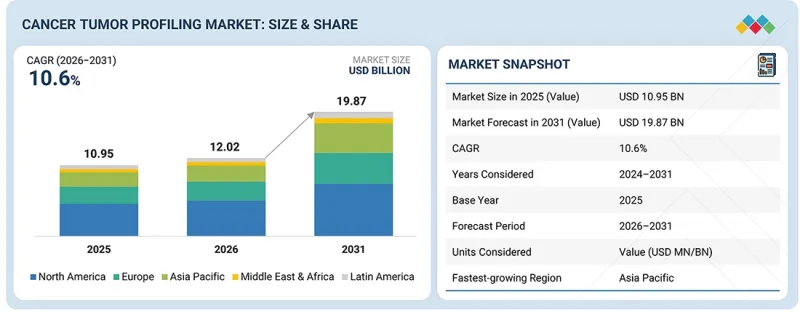
암 종양 프로파일링 시장 규모는 2026년 120억 2,000만 달러에서 2031년에는 198억 7,000만 달러에 이를 것으로 예측되며, CAGR은 10.6%를 나타낼 전망입니다.
전 세계 암 종양 프로파일링 시장은 암 발병률 상승, 분자 표적 치료제 및 면역 요법의 승인 증가, 일상적인 암 진료에 분자 프로파일링 도입 확대 등을 배경으로 예측 기간 동안 강력한 성장을 이룰 것으로 전망됩니다. 또한, 차세대 염기서열 분석(NGS), 중합효소 연쇄반응(PCR), 면역조직화학(IHC), 인 시투 하이브리다이제이션(ISH), 액체 생검,바이오정보학의 발전은 물론, 종합적인 종양 특성 평가, 치료법 선택, 치료 반응 모니터링, 재발 감지, 바이오마커 기반 임상시험에 대한 수요 증가에 힘입어 더욱 가속화되고 있습니다.
반면, 분석법 개발 및 검증에 드는 높은 비용, 복잡한 규제 승인 절차, 보험 급여 제한, 데이터 분석의 어려움, 지역에 따라 선진적인 분자 검사 인프라의 이용 가능성에 차이가 있다는 점 등이 시장 성장을 어느 정도 억제할 것으로 예측됩니다.
| 조사 범위 | |
|---|---|
| 조사 대상 기간 | 2026-2031년 |
| 기준 연도 | 2025년 |
| 예측 기간 | 2026-2031년 |
| 단위 | 금액(달러) |
| 부문 | 제공 구분, 기술, 검체, 용도, 암 유형, 최종 사용자 |
| 대상 지역 | 북미, 유럽, 아시아태평양, 라틴아메리카, 중동 및 아프리카 |
“제공 구분별로는 어세이, 키트, 시약, 소모품이 2025년에 가장 큰 점유율을 차지”
조직 및 혈액을 이용한 프로파일링 워크플로우에서 이러한 제품들이 지속적으로 사용됨에 따라, 2025년에 가장 큰 점유율을 차지했습니다. 시퀀싱 시약, PCR용 소모품, 항체, 프로브, 검체 전처리 키트, 기타 분석 구성품은 환자별 검사에 필요하기 때문에 지속적인 매출을 창출하고 있습니다. 이 제품들이 고처리량 플랫폼과 호환되며, 진단, 분자 특성 평가, 치료법 선택, 임상 연구에서의 활용이 확대되고 있는 점도 이 부문의 선도적인 위치를 더욱 뒷받침하고 있습니다.
“기술별로는 차세대 시퀀싱이 2025년에 최대 점유율을 차지”
이 기술은 여러 유전자 및 유전체 변이를 동시에 분석하여 희귀 바이오마커나 동반 바이오마커를 검출할 수 있을 뿐만 아니라, 조직 및 혈액 검체를 통한 종합적인 유전체 프로파일링을 지원할 수 있는 능력 덕분에 최대 점유율을 차지하게 되었습니다. 광범위한 종양 패널, 동반 진단 분석법, 액체 생검 워크플로우의 이용 증가에 더해, 임상시험에서 확장 가능한 분자 프로파일링에 대한 수요가 높아짐에 따라 예측 기간 동안 이 기술의 주도적 지위가 더욱 공고해질 것으로 예측됩니다.
“아시아태평양이 2026년부터 2031년에 걸쳐 가장 높은 연평균 성장률(CAGR)을 나타낼 전망”
이 주요 요인으로는 암 발병률 상승, 암 진료 인프라 확충, 분자진단에 대한 투자 증가, 정밀 의학의 도입 확대 등이 있습니다. 또한, NGS 및 액체 생검 검사에 대한 접근성 개선, 제약 기업의 임상시험 확대, 지역 유전체 검사 시설 확충, 중국, 일본, 인도, 한국, 호주, 동남아시아에서 세계 기업 및 국내 진단 기업의 입지 확대도 시장 성장을 뒷받침하고 있습니다.
본 보고서에서는 세계의 암 종양 프로파일링 시장을 조사했으며, 시장 개요, 시장 성장에 영향을 미치는 각종 요인 분석, 기술·특허 동향, 법규제 환경, 사례 연구, 시장 규모 추이 및 전망, 각종 분류·지역/주요 국가별 상세 분석, 경쟁 구도, 주요 기업 프로파일 등을 정리했습니다.
목차
제1장 서론
제2장 주요 요약
제3장 프리미엄 인사이트
제4장 시장 개요
제5장 업계 동향
제6장 기술 진보, AI의 영향, 특허, 혁신, 향후 용도
제7장 지속가능성과 규제 상황
제8장 고객 현황과 구매 행동
제9장 암 종양 프로파일링 시장 : 제품 및 서비스별
제10장 암 종양 프로파일링 시장 : 검체 유형별
제11장 암 종양 프로파일링 시장 : 용도별
제12장 암 종양 프로파일링 시장 : 암 유형별
제13장 암 종양 프로파일링 시장 : 최종 사용자별
제14장 암 종양 프로파일링 시장 : 지역별
제15장 경쟁 구도
제16장 기업 개요
제17장 조사 방법
제18장 부록
KTHThe cancer tumor profiling market is projected to reach USD 19.87 billion by 2031 from USD 12.02 billion in 2026, at a CAGR of 10.6%. The global cancer tumor profiling market is projected to witness strong growth during the forecast period, supported by rising cancer incidence, increasing approvals of targeted therapies and immunotherapies, and growing integration of molecular profiling into routine oncology care. Market expansion is further supported by advances in next-generation sequencing (NGS), polymerase chain reaction (PCR), immunohistochemistry (IHC), in situ hybridization (ISH), liquid biopsy, and bioinformatics, along with increasing demand for comprehensive tumor characterization, treatment selection, treatment-response monitoring, recurrence detection, and biomarker-driven clinical trials. However, high assay-development and validation costs, complex regulatory pathways, reimbursement limitations, data-interpretation complexity, and uneven availability of advanced molecular testing infrastructure across regions are expected to restrain market growth to some extent.
| Scope of the Report | |
|---|---|
| Years Considered for the Study | 2026-2031 |
| Base Year | 2025 |
| Forecast Period | 2026-2031 |
| Units Considered | Value (USD billion) |
| Segments | Offering, Technology, Sample Type, Application, Cancer Type, End User |
| Regions covered | North America, Europe, the Asia Pacific, Latin America, the Middle East, and Africa |
"Assays, kits, reagents, and consumables accounted for the largest share of the cancer tumor profiling market, by offering, in 2025."
Based on offering, the cancer tumor profiling market is segmented into products and services. Products include instruments and systems; and assays, kits, reagents, and consumables. Services include clinical tumor profiling testing services and biopharmaceutical, clinical-trial, and companion diagnostic services. In 2025, assays, kits, reagents, and consumables accounted for the largest share due to their recurring use across tissue and blood-based profiling workflows. Sequencing reagents, PCR consumables, antibodies, probes, sample-preparation kits, and other assay components are required for each patient test, creating sustained pull-through revenue. Their compatibility with high-throughput platforms and expanding use in diagnosis, molecular characterization, treatment selection, and clinical research further support the leading position of this segment.
"Next-generation sequencing accounted for the largest share of the cancer tumor profiling market, by technology, in 2025."
Based on technology, the global cancer tumor profiling market is segmented into next-generation sequencing; polymerase chain reaction, including qPCR, RT-PCR, and digital PCR; immunohistochemistry; in situ hybridization, including FISH, CISH, and SISH; and other tumor profiling technologies. In 2025, next-generation sequencing accounted for the largest share because of its ability to analyze multiple genes and genomic alterations simultaneously, detect rare and co-occurring biomarkers, and support comprehensive genomic profiling from tissue and blood samples. Increasing use of broad oncology panels, companion diagnostic assays, and liquid-biopsy workflows, together with growing demand for scalable molecular profiling in clinical trials, is expected to reinforce the segment's leading position during the forecast period.
"The Asia Pacific region is projected to grow at the highest CAGR in the cancer tumor profiling market from 2026 to 2031."
The cancer tumor profiling market is segmented into North America, Europe, Asia Pacific, Latin America, and the Middle East & Africa. During the forecast period, Asia Pacific is projected to register the highest CAGR due to rising cancer incidence, expanding oncology infrastructure, increasing investment in molecular diagnostics, and growing adoption of precision-medicine approaches. Growth is further supported by improving access to NGS and liquid-biopsy testing, expansion of pharmaceutical clinical trials, establishment of regional genomic laboratories, and the increasing presence of global and domestic diagnostics companies across China, Japan, India, South Korea, Australia, and Southeast Asia.
List of Companies Profiled in the Report
- F. Hoffmann-La Roche AG
- Illumina, Inc.
- Guardant Health, Inc.
- Tempus AI, Inc.
- Thermo Fisher Scientific Inc.
- QIAGEN N.V.
- Laboratory Corporation of America Holdings (Labcorp)
- Abbott Laboratories
- Natera, Inc.
- NeoGenomics, Inc.
- Myriad Genetics, Inc.
- Agilent Technologies, Inc.
- Quest Diagnostics Incorporated
- Caris Life Sciences, Inc.
- Danaher Corporation
Research Coverage
This research report categorizes the cancer tumor profiling market by offering, technology, sample type, application, cancer type, end user, and region. The report provides detailed information on major market factors, including drivers, restraints, opportunities, and challenges. It analyzes leading industry participants and provides insights into their business overviews, product and service portfolios, technology capabilities, market positions, and key strategies, including product launches and approvals, partnerships, collaborations, agreements, acquisitions, expansions, and other recent developments. The report also covers regulatory trends, reimbursement considerations, precision-oncology adoption, biomarker-testing practices, and emerging technologies such as liquid biopsy, minimal residual disease testing, AI-enabled interpretation, spatial biology, and multi-omics. In addition, it evaluates established companies and emerging participants across the global cancer tumor profiling ecosystem.
Key Benefits of Buying the Report
The report will help market leaders and new entrants by providing close approximations of revenue for the overall cancer tumor profiling market and its subsegments. It will help stakeholders understand the competitive landscape, identify high-growth opportunities, assess technology and regional trends, and formulate effective product, partnership, investment, and go-to-market strategies. The report also provides an integrated view of the market pulse, covering key drivers, restraints, opportunities, and challenges.
The report provides insights into the following points:
- Analysis of key drivers, including increasing adoption of precision oncology and targeted therapies, expansion of NGS-based comprehensive genomic profiling, rising use of liquid biopsy, growing cancer incidence, and increasing pharmaceutical-diagnostic collaborations. The report also examines restraints such as high development and validation costs, reimbursement limitations, and data-interpretation complexity, as well as challenges related to regulatory requirements, standardization, and limited testing infrastructure in emerging markets.
- Product Development/Innovation: Detailed insights into newly launched and pipeline tumor profiling assays, sequencing platforms, pathology solutions, liquid-biopsy tests, companion diagnostics, minimal residual disease solutions, AI-enabled interpretation tools, and integrated molecular testing workflows.
- Market Development: Comprehensive information on attractive markets and growth opportunities across North America, Europe, Asia Pacific, Latin America, and the Middle East & Africa, including country-level adoption patterns and regional expansion strategies.
- Market Diversification: Exhaustive information on product and service portfolios, technology developments, regulatory approvals, pharmaceutical partnerships, clinical-trial collaborations, acquisitions, laboratory expansions, and investments in the cancer tumor profiling market.
- Competitive Assessment: In-depth assessment of market shares, growth strategies, technology capabilities, clinical testing footprints, and service offerings of leading players, including F. Hoffmann-La Roche AG, Guardant Health, Inc., Illumina, Inc., Tempus AI, Inc., Thermo Fisher Scientific Inc., QIAGEN N.V., Laboratory Corporation of America Holdings, Natera, Inc., NeoGenomics, Inc., Myriad Genetics, Inc., Agilent Technologies, Inc., Quest Diagnostics Incorporated, Caris Life Sciences, Inc., Abbott Laboratories, and Danaher Corporation.
TABLE OF CONTENTS
1 INTRODUCTION
- 1.1 STUDY OBJECTIVES
- 1.2 MARKET DEFINITION
- 1.3 STUDY SCOPE
- 1.3.1 MARKETS COVERED & REGIONAL SCOPE
- 1.3.2 INCLUSIONS & EXCLUSIONS
- 1.3.3 YEARS CONSIDERED
- 1.4 CURRENCY CONSIDERED
- 1.5 STAKEHOLDERS
- 1.6 SUMMARY OF CHANGES
2 EXECUTIVE SUMMARY
- 2.1 KEY INSIGHTS & MARKET HIGHLIGHTS
- 2.2 KEY MARKET PARTICIPANTS: INSIGHTS & STRATEGIC DEVELOPMENTS
- 2.3 DISRUPTIVE TRENDS SHAPING MARKET GROWTH
- 2.4 HIGH-GROWTH SEGMENTS & EMERGING FRONTIERS
- 2.5 SNAPSHOT: GLOBAL MARKET SIZE, GROWTH RATE, AND FORECAST
3 PREMIUM INSIGHTS
- 3.1 CANCER/TUMOR PROFILING MARKET OVERVIEW
- 3.2 CANCER/TUMOR PROFILING MARKET, BY PRODUCT & SERVICE OFFERING, 2026 VS. 2031
- 3.3 CANCER/TUMOR PROFILING MARKET, BY PRODUCT TYPE, 2026 VS. 2031
- 3.4 CANCER/TUMOR PROFILING MARKET, BY SERVICE TYPE, 2026 VS. 2031
- 3.5 CANCER/TUMOR PROFILING MARKET, BY TECHNOLOGY, 2026 VS. 2031
- 3.6 CANCER/TUMOR PROFILING MARKET, BY SAMPLE TYPE, 2026 VS. 2031
- 3.7 CANCER/TUMOR PROFILING MARKET, BY APPLICATION TYPE, 2026 VS. 2031
- 3.8 CANCER/TUMOR PROFILING MARKET, BY CLINICAL APPLICATION TYPE, 2026 VS. 2031
- 3.9 CANCER/TUMOR PROFILING MARKET, BY RESEARCH AND DRUG DEVELOPMENT APPLICATION, 2026 VS. 2031
- 3.10 CANCER/TUMOR PROFILING MARKET, BY CANCER TYPE, 2026 VS. 2031
- 3.11 CANCER/TUMOR PROFILING MARKET, BY SOLID TUMOR TYPE, 2026 VS. 2031
- 3.12 CANCER/TUMOR PROFILING MARKET, BY LIQUID TUMOR, 2026 VS. 2031
- 3.13 CANCER/TUMOR PROFILING MARKET, BY END USER, 2026 VS. 2031
- 3.14 CANCER/TUMOR PROFILING MARKET, BY HOSPITALS, CANCER CENTERS AND ONCOLOGY CLINICS, 2026 VS. 2031
- 3.15 CANCER/TUMOR PROFILING MARKET: GEOGRAPHIC GROWTH OPPORTUNITIES
4 MARKET OVERVIEW
- 4.1 INTRODUCTION
- 4.2 MARKET DYNAMICS
- 4.2.1 DRIVERS
- 4.2.1.1 Increasing adoption of precision oncology and targeted therapies
- 4.2.1.2 Rising adoption of comprehensive genomic profiling and NGS-based testing
- 4.2.1.3 Increasing cancer incidence and demand for molecular characterization
- 4.2.2 RESTRAINTS
- 4.2.2.1 High development, clinical validation, and regulatory approval costs
- 4.2.3 OPPORTUNITIES
- 4.2.3.1 Expansion of liquid biopsy and minimally invasive tumor profiling
- 4.2.3.2 AI-driven biomarker interpretation and digital pathology integration
- 4.2.4 CHALLENGES
- 4.2.4.1 Regulatory complexity associated with multi-analyte tumor profiling tests
- 4.2.1 DRIVERS
- 4.3 UNMET NEEDS & WHITE SPACES
- 4.3.1 UNMET NEEDS IN CANCER/TUMOR PROFILING MARKET
- 4.3.2 WHITE SPACE OPPORTUNITIES
- 4.4 INTERCONNECTED MARKETS & CROSS-SECTOR OPPORTUNITIES
- 4.4.1 INTERCONNECTED MARKETS
- 4.4.2 CROSS-SECTOR OPPORTUNITIES
- 4.5 STRATEGIC MOVES BY TIER 1/2/3 PLAYERS
- 4.5.1 KEY MOVES & STRATEGIC FOCUS
5 INDUSTRY TRENDS
- 5.1 PORTER'S FIVE FORCES ANALYSIS
- 5.1.1 BARGAINING POWER OF SUPPLIERS
- 5.1.2 BARGAINING POWER OF BUYERS
- 5.1.3 THREAT OF NEW ENTRANTS
- 5.1.4 THREAT OF SUBSTITUTES
- 5.1.5 INTENSITY OF COMPETITIVE RIVALRY
- 5.2 MACROECONOMIC INDICATORS
- 5.2.1 INTRODUCTION
- 5.2.2 GDP TRENDS & FORECAST
- 5.2.3 TRENDS IN GLOBAL CANCER/TUMOR PROFILING INDUSTRY
- 5.3 SUPPLY CHAIN ANALYSIS
- 5.4 VALUE CHAIN ANALYSIS
- 5.5 ECOSYSTEM ANALYSIS
- 5.5.1 CANCER/TUMOR PROFILING MARKET: ROLE OF COMPANIES IN ECOSYSTEM
- 5.6 PRICING ANALYSIS
- 5.6.1 AVERAGE SELLING PRICE TREND OF CANCER/TUMOR PROFILING OFFERING, BY KEY PLAYER, 2024-2026
- 5.6.2 AVERAGE SELLING PRICE TREND OF CANCER/TUMOR PROFILING OFFERING, BY REGION, 2024-2026
- 5.7 TRADE ANALYSIS
- 5.7.1 IMPORT SCENARIO (HS CODE 3822)
- 5.7.2 EXPORT SCENARIO (HS CODE 3822)
- 5.8 KEY CONFERENCES & EVENTS, 2026-2027
- 5.9 TRENDS/DISRUPTIONS IMPACTING CUSTOMERS' BUSINESSES
- 5.10 INVESTMENT & FUNDING SCENARIO
- 5.11 IMPACT OF 2025 US TARIFFS ON COMPANION DIAGNOSTICS MARKET
- 5.11.1 INTRODUCTION
- 5.11.2 KEY TARIFF RATES
- 5.11.3 PRICE IMPACT ANALYSIS
- 5.11.4 IMPACT ON REGIONS
- 5.11.4.1 North America
- 5.11.4.2 Europe
- 5.11.4.3 Asia Pacific
- 5.11.5 IMPACT ON END-USE INDUSTRIES
- 5.11.5.1 Hospitals, Cancer Centers, and Oncology Clinics
- 5.11.5.2 Independent and Specialty Reference Laboratories
- 5.11.5.3 Pharmaceutical and Biotechnology Companies
- 5.11.5.4 Other end user
6 TECHNOLOGICAL ADVANCEMENTS, AI-DRIVEN IMPACT, PATENTS, INNOVATIONS, AND FUTURE APPLICATIONS
- 6.1 KEY EMERGING TECHNOLOGIES
- 6.1.1 HIGH-SENSITIVITY LIQUID BIOPSY AND ERROR-CORRECTED SEQUENCING
- 6.1.2 SPATIAL, SINGLE-CELL, AND MULTIPLEX TISSUE PROFILING
- 6.2 COMPLEMENTARY TECHNOLOGIES
- 6.2.1 AI-ENABLED BIOINFORMATICS AND CLINICAL DECISION SUPPORT
- 6.2.2 DIGITAL PATHOLOGY AND IMAGE ANALYSIS
- 6.3 ADJACENT TECHNOLOGIES
- 6.3.1 MOLECULAR IMAGING AND RADIOMICS
- 6.4 TECHNOLOGY/PRODUCT ROADMAP
- 6.5 PATENT ANALYSIS
- 6.6 FUTURE APPLICATIONS
- 6.7 IMPACT OF AI/GENERATIVE AI ON CANCER/TUMOR PROFILING MARKET
- 6.7.1 INTRODUCTION
- 6.7.2 TOP USE CASES & MARKET POTENTIAL
- 6.7.3 KEY COMPANIES IMPLEMENTING AI
- 6.7.4 FUTURE OF AI
7 SUSTAINABILITY & REGULATORY LANDSCAPE
- 7.1 REGIONAL REGULATIONS & COMPLIANCE
- 7.1.1 REGULATORY ANALYSIS
- 7.1.1.1 North America
- 7.1.1.1.1 US
- 7.1.1.1.2 Canada
- 7.1.1.2 Europe
- 7.1.1.2.1 Germany
- 7.1.1.2.2 UK
- 7.1.1.2.3 France
- 7.1.1.2.4 Italy
- 7.1.1.3 Asia Pacific
- 7.1.1.3.1 China
- 7.1.1.3.2 Japan
- 7.1.1.3.3 India
- 7.1.1.3.4 Australia
- 7.1.1.4 Latin America
- 7.1.1.4.1 Brazil
- 7.1.1.4.2 Mexico
- 7.1.1.5 Middle East
- 7.1.1.5.1 Africa
- 7.1.1.1 North America
- 7.1.2 REGULATORY BODIES, GOVERNMENT AGENCIES, AND OTHER ORGANIZATIONS
- 7.1.1 REGULATORY ANALYSIS
- 7.2 SUSTAINABILITY INITIATIVES
- 7.2.1 ENVIRONMENTAL IMPACT & ECO-FRIENDLY INITIATIVES
- 7.2.1.1 Eco-friendly initiatives
- 7.2.2 SUSTAINABILITY IMPACT & REGULATORY POLICY INITIATIVES
- 7.2.1 ENVIRONMENTAL IMPACT & ECO-FRIENDLY INITIATIVES
8 CUSTOMER LANDSCAPE & BUYER BEHAVIOR
- 8.1 DECISION-MAKING PROCESS
- 8.2 BUYER STAKEHOLDERS & BUYING EVALUATION CRITERIA
- 8.2.1 KEY STAKEHOLDERS IN BUYING PROCESS
- 8.2.2 BUYING CRITERIA
- 8.3 ADOPTION BARRIERS & INTERNAL CHALLENGES
- 8.4 UNMET NEEDS IN VARIOUS END-USE INDUSTRIES
- 8.5 MARKET PROFITABILITY
- 8.5.1 REVENUE POTENTIAL
- 8.5.2 COST DYNAMICS
9 CANCER/TUMOR PROFILING MARKET, BY PRODUCT & SERVICE OFFERING
- 9.1 INTRODUCTION
- 9.2 PRODUCTS
- 9.2.1 INSTRUMENTS AND SYSTEMS
- 9.2.1.1 Decentralized molecular testing and pressure to cut turnaround time to drive instrument demand
- 9.2.2 ASSAYS, KITS, REAGENTS, AND CONSUMABLES
- 9.2.2.1 Recurring-use model to link procedure volume directly to revenue
- 9.2.1 INSTRUMENTS AND SYSTEMS
- 9.3 SERVICES
- 9.3.1 CLINICAL TUMOR PROFILING TESTING SERVICES
- 9.3.1.1 Rising clinical oncology tests and high selling prices to drive services growth
- 9.3.2 BIOPHARMACEUTICAL, CLINICAL-TRIAL, AND COMPANION DIAGNOSTIC SERVICES
- 9.3.2.1 Expanding oncology drug development to require broader biomarker adoption
- 9.3.1 CLINICAL TUMOR PROFILING TESTING SERVICES
10 CANCER/TUMOR PROFILING MARKET, BY SAMPLE TYPE
- 10.1 INTRODUCTION
- 10.2 TISSUE SAMPLES
- 10.2.1 TISSUE BIOPSY
- 10.3 BLOOD SAMPLES
- 10.3.1 LIQUID BIOPSY
- 10.4 BONE MARROW
- 10.4.1 RESEARCH AND CLINICAL-TRIAL SPECIMENS
- 10.5 OTHER SAMPLE TYPES
11 CANCER/TUMOR PROFILING MARKET, BY APPLICATION
- 11.1 INTRODUCTION
- 11.2 CLINICAL APPLICATIONS
- 11.2.1 CANCER DIAGNOSIS, MOLECULAR CHARACTERIZATION, AND PROGNOSTIC/RISK ASSESSMENT
- 11.2.1.1 Integration of multi-omic biomarkers to redefine tumor diagnosis and classification
- 11.2.2 TREATMENT SELECTION AND COMPANION DIAGNOSTICS
- 11.2.2.1 Expanding targeted-therapy pipelines and pharma-diagnostic partnerships to drive companion diagnostics
- 11.2.3 TREATMENT-RESPONSE AND RESISTANCE MONITORING
- 11.2.3.1 Growing on-therapy profiling to monitor response and emerging resistance
- 11.2.4 RESIDUAL DISEASE, POST-TREATMENT SURVEILLANCE, AND RECURRENCE DETECTION
- 11.2.4.1 Rising molecular residual disease testing to detect recurrence early
- 11.2.1 CANCER DIAGNOSIS, MOLECULAR CHARACTERIZATION, AND PROGNOSTIC/RISK ASSESSMENT
- 11.3 RESEARCH AND DRUG-DEVELOPMENT APPLICATIONS
- 11.3.1 BIOMARKER, TARGET, AND EARLY DRUG DISCOVERY
- 11.3.1.1 Wider use of whole-exome, transcriptome, and proteomic profiling to accelerate drug discovery
- 11.3.2 PRECLINICAL DEVELOPMENT AND VALIDATION
- 11.3.2.1 Molecular profiling of preclinical models to validate targets and characterize resistance
- 11.3.3 CLINICAL TRIALS, PATIENT STRATIFICATION, AND ENROLLMENT
- 11.3.3.1 Growing number of oncology clinical trials to embed biomarker profiling
- 11.3.1 BIOMARKER, TARGET, AND EARLY DRUG DISCOVERY
12 CANCER/TUMOR PROFILING MARKET, BY CANCER TYPE
- 12.1 INTRODUCTION
- 12.2 SOLID TUMORS
- 12.2.1 LUNG CANCER
- 12.2.1.1 Broad actionable biomarkers to drive high molecular testing in lung cancer
- 12.2.2 BREAST CANCER
- 12.2.2.1 High incidence and complex molecular classification to expand breast cancer profiling
- 12.2.3 COLORECTAL CANCER
- 12.2.3.1 Established biomarkers and emerging MRD testing to expand colorectal cancer profiling
- 12.2.4 PROSTATE CANCER
- 12.2.4.1 Growing HRR-targeted therapies to broaden profiling in metastatic prostate cancer
- 12.2.5 GYNECOLOGIC CANCERS
- 12.2.5.1 HRD/BRCA testing and endometrial molecular stratification to drive gynecologic profiling
- 12.2.6 MELANOMA
- 12.2.6.1 BRAF testing and immunotherapy biomarkers to sustain melanoma profiling
- 12.2.7 BRAIN AND CENTRAL NERVOUS SYSTEM TUMORS
- 12.2.7.1 Molecular criteria in WHO definitions to make profiling essential for CNS tumors
- 12.2.8 HEAD AND NECK CANCERS
- 12.2.8.1 Rising immunotherapy use and PD-L1 testing to expand head and neck cancer profiling
- 12.2.9 OTHER SOLID TUMORS
- 12.2.1 LUNG CANCER
- 12.3 LIQUID TUMOR/HEMATOLOGIC MALIGNANCIES
- 12.3.1 LEUKEMIA
- 12.3.1.1 Routine molecular diagnosis and frequent MRD monitoring to drive leukemia profiling
- 12.3.2 LYMPHOMAS
- 12.3.2.1 Complex classification and growing genomic testing to broaden lymphoma profiling
- 12.3.3 MULTIPLE MYELOMA AND OTHER LIQUID TUMORS
- 12.3.3.1 NGS and sensitive MRD assays to create repeat testing in multiple myeloma
- 12.3.1 LEUKEMIA
13 CANCER/TUMOR PROFILING MARKET, BY END USER
- 13.1 INTRODUCTION
- 13.2 HOSPITALS, CANCER CENTERS, AND ONCOLOGY CLINICS
- 13.2.1 MULTISPECIALTY HOSPITALS
- 13.2.1.1 Growing integration of biomarker testing to embed profiling in hospital oncology pathways
- 13.2.2 DEDICATED CANCER HOSPITALS AND CANCER CENTERS
- 13.2.2.1 High oncology volumes and research programs to drive profiling at cancer centers
- 13.2.1 MULTISPECIALTY HOSPITALS
- 13.3 INDEPENDENT AND SPECIALTY REFERENCE LABORATORIES
- 13.4 PHARMACEUTICAL AND BIOTECHNOLOGY COMPANIES
- 13.5 CONTRACT RESEARCH ORGANIZATIONS AND CENTRAL LABORATORIES
- 13.6 OTHER END USERS
14 CANCER/TUMOR PROFILING MARKET, BY REGION
- 14.1 INTRODUCTION
- 14.2 NORTH AMERICA
- 14.2.1 US
- 14.2.1.1 Advanced clinical genomics infrastructure and broad regulatory approvals to augment market growth
- 14.2.2 CANADA
- 14.2.2.1 Public funding of molecular profiling and expansion of national genomics capabilities to support growth
- 14.2.1 US
- 14.3 EUROPE
- 14.3.1 GERMANY
- 14.3.1.1 Strong molecular tumor board networks and multi-omic precision oncology infrastructure to drive adoption
- 14.3.2 UK
- 14.3.2.1 NHS-funded genomic testing and centralized genomic laboratory network to support market maturity
- 14.3.3 FRANCE
- 14.3.3.1 National genomic medicine infrastructure to accelerate tumor profiling
- 14.3.4 ITALY
- 14.3.4.1 Public funding for NGS and genomic testing to support precision-oncology expansion
- 14.3.5 SPAIN
- 14.3.5.1 National genomic test catalog and strong oncology research network to support market growth
- 14.3.6 REST OF EUROPE
- 14.3.1 GERMANY
- 14.4 ASIA PACIFIC
- 14.4.1 CHINA
- 14.4.1.1 Large cancer burden and formalization of clinical NGS standards to drive market expansion
- 14.4.2 JAPAN
- 14.4.2.1 National insurance coverage and C-CAT infrastructure to support broad CGP adoption
- 14.4.3 INDIA
- 14.4.3.1 Rising cancer burden and expansion of indigenous genomic infrastructure to support high growth
- 14.4.4 SOUTH KOREA
- 14.4.4.1 Government-backed NGS precision-oncology programs to accelerate clinical adoption
- 14.4.5 AUSTRALIA
- 14.4.5.1 National genomics framework and government investments to strengthen precision oncology
- 14.4.6 REST OF ASIA PACIFIC
- 14.4.1 CHINA
- 14.5 LATIN AMERICA
- 14.5.1 BRAZIL
- 14.5.1.1 National genomics program and local tumor atlas development to accelerate precision oncology
- 14.5.2 MEXICO
- 14.5.2.1 Expansion of national cancer genotyping infrastructure to support market development
- 14.5.3 REST OF LATIN AMERICA
- 14.5.1 BRAZIL
- 14.6 MIDDLE EAST & AFRICA
- 14.6.1 BOOMING HEALTHCARE INVESTMENTS TO AID GROWTH
- 14.7 GCC COUNTRIES
- 14.7.1 GOVERNMENT-LED GENOMICS AND PRECISION-MEDICINE INVESTMENTS TO CREATE HIGH-GROWTH OPPORTUNITIES
- 14.8 REST OF MIDDLE EAST & AFRICA
- 14.8.1 LARGE UNMET NEED FOR BIOMARKER TESTING AND GRADUAL BUILD-OUT OF MOLECULAR ONCOLOGY CAPACITY
15 COMPETITIVE LANDSCAPE
- 15.1 INTRODUCTION
- 15.2 KEY PLAYER STRATEGIES/RIGHT TO WIN
- 15.2.1 OVERVIEW OF STRATEGIES DEPLOYED BY PLAYERS IN CANCER/TUMOR PROFILING MARKET
- 15.3 REVENUE ANALYSIS, 2023-2025
- 15.4 MARKET SHARE ANALYSIS, 2025
- 15.5 COMPANY EVALUATION MATRIX: KEY PLAYERS, 2025
- 15.5.1 STARS
- 15.5.2 EMERGING LEADERS
- 15.5.3 PERVASIVE PLAYERS
- 15.5.4 PARTICIPANTS
- 15.5.5 COMPANY FOOTPRINT: KEY PLAYERS, 2025
- 15.5.5.1 Company footprint
- 15.5.5.2 Regional footprint
- 15.5.5.3 Product & service footprint
- 15.5.5.4 Technology footprint
- 15.5.5.5 Sample Type footprint
- 15.6 COMPANY EVALUATION MATRIX: STARTUPS/SMES, 2025
- 15.6.1 PROGRESSIVE COMPANIES
- 15.6.2 RESPONSIVE COMPANIES
- 15.6.3 DYNAMIC COMPANIES
- 15.6.4 STARTING BLOCKS
- 15.6.5 COMPANY EVALUATION MATRIX: STARTUPS/SMES, 2025
- 15.6.5.1 Detailed list of key startups/SMEs
- 15.6.5.2 Competitive benchmarking of startups/SMEs (1/2)
- 15.6.5.3 Competitive benchmarking of startups/SMEs (2/2)
- 15.7 COMPANY VALUATION & FINANCIAL METRICS
- 15.7.1 FINANCIAL METRICS
- 15.7.2 COMPANY VALUATION
- 15.8 BRAND/PRODUCT COMPARISON
- 15.9 COMPETITIVE SCENARIO
- 15.9.1 PRODUCT LAUNCHES & APPROVALS
- 15.9.2 DEALS
- 15.9.3 EXPANSIONS
- 15.9.4 OTHER DEVELOPMENTS
16 COMPANY PROFILES
- 16.1 KEY PLAYERS
- 16.1.1 F. HOFFMANN-LA ROCHE LTD.
- 16.1.1.1 Business overview
- 16.1.1.2 Products offered
- 16.1.1.3 Recent developments
- 16.1.1.3.1 Product launches & approvals
- 16.1.1.3.2 Deals
- 16.1.1.3.3 Expansions
- 16.1.1.4 MnM view
- 16.1.1.4.1 Key strengths
- 16.1.1.4.2 Strategic choices
- 16.1.1.4.3 Weaknesses & competitive threats
- 16.1.2 ILLUMINA, INC.
- 16.1.2.1 Business overview
- 16.1.2.2 Products offered
- 16.1.2.3 Recent developments
- 16.1.2.3.1 Product launches & approvals
- 16.1.2.3.2 Deals
- 16.1.2.3.3 Other developments
- 16.1.2.4 MnM view
- 16.1.2.4.1 Key strengths
- 16.1.2.4.2 Strategic choices
- 16.1.2.4.3 Weaknesses & competitive threats
- 16.1.3 THERMO FISHER SCIENTIFIC INC.
- 16.1.3.1 Business overview
- 16.1.3.2 Products offered
- 16.1.3.3 Recent developments
- 16.1.3.3.1 Product launches
- 16.1.3.3.2 Deals
- 16.1.3.4 MnM view
- 16.1.3.4.1 Key strengths
- 16.1.3.4.2 Strategic choices
- 16.1.3.4.3 Weaknesses & competitive threats
- 16.1.4 QIAGEN
- 16.1.4.1 Business overview
- 16.1.4.2 Products offered
- 16.1.4.3 Recent developments
- 16.1.4.3.1 Product launches & approvals
- 16.1.4.3.2 Deals
- 16.1.4.3.3 Expansions
- 16.1.4.4 MnM view
- 16.1.4.4.1 Key strengths
- 16.1.4.4.2 Strategic choices
- 16.1.4.4.3 Weaknesses & competitive threats
- 16.1.5 GUARDANT HEALTH
- 16.1.5.1 Business overview
- 16.1.5.2 Products offered
- 16.1.5.3 Recent developments
- 16.1.5.3.1 Product launches & approvals
- 16.1.5.4 MnM view
- 16.1.5.4.1 Key strengths
- 16.1.5.4.2 Strategic choices
- 16.1.5.4.3 Weaknesses & competitive threats
- 16.1.6 LABCORP
- 16.1.6.1 Business overview
- 16.1.6.2 Product & Services offered
- 16.1.6.3 Recent developments
- 16.1.6.3.1 Service Launches, and Approvals
- 16.1.6.3.2 Deals
- 16.1.6.3.3 Expansions
- 16.1.7 ABBOTT
- 16.1.7.1 Business overview
- 16.1.7.2 Products offered
- 16.1.7.3 Recent developments
- 16.1.7.3.1 Product approvals
- 16.1.7.3.2 Deals
- 16.1.8 TEMPUS AI, INC.
- 16.1.8.1 Business overview
- 16.1.8.2 Products offered
- 16.1.8.3 Recent developments
- 16.1.8.3.1 Product approvals
- 16.1.8.3.2 Deals
- 16.1.8.3.3 Other developments
- 16.1.9 NATERA, INC.
- 16.1.9.1 Business overview
- 16.1.9.2 Products offered
- 16.1.9.3 Recent developments
- 16.1.9.3.1 Product launches & Approvals
- 16.1.9.3.2 Deals
- 16.1.9.3.3 Expansions
- 16.1.9.3.4 Other developments
- 16.1.10 NEOGENOMICS LABORATORIES, INC
- 16.1.10.1 Business overview
- 16.1.10.2 Products offered
- 16.1.10.3 Recent developments
- 16.1.10.3.1 Product launches & approvals
- 16.1.10.3.2 Deals
- 16.1.10.3.3 Expansions
- 16.1.11 MYRIAD GENETICS, INC.
- 16.1.11.1 Business overview
- 16.1.11.2 Products offered
- 16.1.11.3 Recent developments
- 16.1.11.3.1 Product launches & approvals
- 16.1.11.3.2 Deals
- 16.1.12 AGILENT TECHNOLOGIES, INC
- 16.1.12.1 Business overview
- 16.1.12.2 Products offered
- 16.1.12.3 Recent developments
- 16.1.12.3.1 Product launches & approvals
- 16.1.12.3.2 Deals
- 16.1.12.3.3 Expansions
- 16.1.13 QUEST DIAGNOSTICS
- 16.1.13.1 Business overview
- 16.1.13.2 Products/Services/Solutions offered
- 16.1.13.3 Recent developments
- 16.1.13.3.1 Product/Services launches & approvals
- 16.1.13.3.2 Deals
- 16.1.14 CARIS LIFE SCIENCES, INC.
- 16.1.14.1 Business overview
- 16.1.14.2 Products offered
- 16.1.14.3 Recent developments
- 16.1.14.3.1 Product launches & approvals
- 16.1.14.3.2 Deals
- 16.1.15 DANAHER
- 16.1.15.1 Business overview
- 16.1.15.2 Products offered
- 16.1.15.3 Recent developments
- 16.1.15.3.1 Deals
- 16.1.1 F. HOFFMANN-LA ROCHE LTD.
- 16.2 OTHER PLAYERS
- 16.2.1 INSIGHT MOLECULAR DIAGNOSTICS, INC (IMDX) (ONCOCYTE CORPORATION)
- 16.2.2 ONCODNA SA
- 16.2.3 MOLECULAR HEALTH GMBH
- 16.2.4 ALMAC DIAGNOSTIC SERVICES (THE ALMAC GROUP)
- 16.2.5 INVIVOSCRIBE, INC.
- 16.2.6 ACT GENOMICS CO., LTD.
- 16.2.7 LUCENCE HEALTH INC
- 16.2.8 GC GENOME CORPORATION
- 16.2.9 MEDGENOME LABS LTD.
- 16.2.10 MGI TECH CO., LTD.
17 RESEARCH METHODOLOGY
- 17.1 RESEARCH DATA
- 17.1.1 SECONDARY DATA
- 17.1.1.1 List of secondary sources
- 17.1.1.2 Key data from secondary sources
- 17.1.2 PRIMARY DATA
- 17.1.2.1 List of primary sources
- 17.1.2.2 Key data from primary sources
- 17.1.2.3 Key industry insights
- 17.1.2.4 Breakdown of primary interviews
- 17.1.1 SECONDARY DATA
- 17.2 MARKET SIZE ESTIMATION
- 17.2.1 TOTAL MARKET SIZE: CANCER/TUMOR PROFILING MARKET
- 17.2.2 BOTTOM-UP APPROACH
- 17.2.2.1 Approach 1: Revenue estimation of key players
- 17.2.2.2 Approach 2: Study of annual reports and investor presentations
- 17.2.2.3 Approach 3: Primary interviews
- 17.2.2.4 Growth forecast
- 17.2.3 TOP-DOWN APPROACH
- 17.3 DATA TRIANGULATION
- 17.4 RESEARCH ASSUMPTIONS
- 17.4.1 STUDY-RELATED ASSUMPTIONS
- 17.4.2 GROWTH RATE ASSUMPTIONS
- 17.5 RESEARCH LIMITATIONS
- 17.6 RISK ASSESSMENT
18 APPENDIX
- 18.1 DISCUSSION GUIDE
- 18.2 KNOWLEDGESTORE: MARKETSANDMARKETS' SUBSCRIPTION PORTAL
- 18.3 CUSTOMIZATION OPTIONS
- 18.4 RELATED REPORTS
- 18.5 AUTHOR DETAILS


