

|
시장보고서
상품코드
2131877
항공기 상태 모니터링 시스템(AHMS) 시장 : 항공기 유형(민간 항공, 비즈니스 & 일반 항공, 군용 항공, UAV), 시스템 유형, 구성요소, 최종사용자, 운용 방식, 설치 장소, 지역별 - 세계 예측(-2031년)Aircraft Health Monitoring System Market by Aircraft Type (Commercial Aviation, Business & General Aviation, Military Aviation, & UAV), System Type, Component, End User, Operation Mode, Installation and Region - Global Forecast to 2031 |
||||||

항공기 상태 모니터링 시스템(AHMS) 시장 규모는 항공사, 군용 항공 사업자, MRO 사업자, 항공기 OEM, 기타 플릿 사업자에 의한 실시간 상태 모니터링, 고장 감지, 진단, 예지보전, 항공기 가동률 관리에 대한 이 시스템의 활용을 배경으로 성장이 전망됩니다.
| 조사 범위 | |
|---|---|
| 조사 대상 기간 | 2020-2031년 |
| 기준 연도 | 2025년 |
| 예측 기간 | 2026-2031년 |
| 단위 | 금액(달러) |
| 부문 | 항공기 유형, 구성요소, 최종사용자, 지역별 |
| 대상 지역 | 북미, 유럽, 아시아태평양, 기타 지역 |
또한, 이러한 수요는 커넥티드 항공기 및 디지털 대응 항공기의 증가, 예정 외 정비 및 항공기 운항 중단 사고 감소에 대한 관심 고조, 센서 및 기내 데이터 수집 시스템의 통합 진전,항공기 시스템 및 구성품의 상태와 열화를 모니터링하기 위한 첨단 분석 기술의 도입 등 여러 요인에 의해 주도되고 있습니다. 이러한 이유로, 차세대 항공기에 내장형 상태 모니터링 기능의 통합 확대 또한 민간 항공기, 비즈니스 항공기, 군용기, 무인항공기(UAV)에서의 AHMS 도입 확대에 크게 기여하고 있습니다.
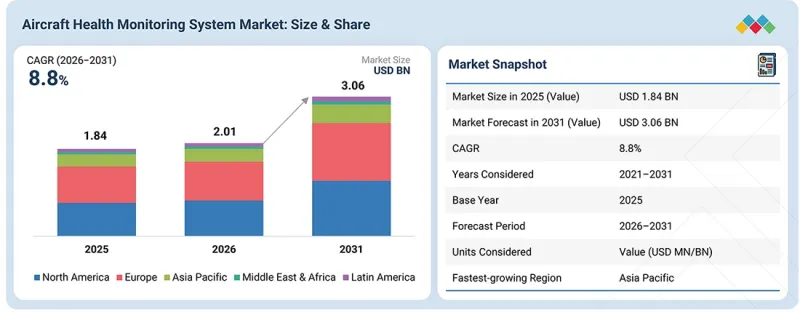
현재의 항공기 조달 동향 및 각종 헬스 모니터링 시스템 간의 지속적인 연계를 고려할 때, 항공기 상태 모니터링 시스템(AHMS)의 시장 규모는 예측 기간 동안 연평균 성장률(CAGR) 8.8%로 확대되어, 2026년 20억 1,000만 달러에서 2031년에는 30억 6,000만 달러에 달할 것으로 전망됩니다.
차세대 항공기에 헬스 모니터링 시스템이 탑재되고, 기존 기단의 개조 건수가 증가하며, 항공기 인도 대수가 늘어나면서 AHMS 도입 대수는 증가하고 있습니다. 헬스 및 사용 모니터링 시스템 외에도 엔진 헬스 모니터링 시스템, 구조 헬스 모니터링 시스템, 통합 상태 모니터링 아키텍처 역시 시장 성장을 촉진하고 있습니다.
“항공기 유형별로는 민간 항공 부문이 예측 기간 동안 가장 큰 시장 점유율을 차지할 전망입니다.”
항공사 및 항공기 OEM이 협폭기, 광폭기, 지역 수송기, 상업용 헬리콥터에 내장형 상태 모니터링 기능을 점점 더 많이 통합함에 따라, 상업용 항공 부문이 시장에서 가장 큰 점유율을 차지할 것으로 예상됩니다. 높은 기단 가동률, 대규모 항공기 인도, 상태 기반 정비 및 예측 정비의 도입 확대가 상업용 기단 전체에 걸쳐 AHMS의 보다 광범위한 도입을 뒷받침하고 있습니다. 헬스 및 사용 모니터링 시스템, 엔진 헬스 모니터링 시스템, 구조 헬스 모니터링 시스템, 통합 상태 모니터링 아키텍처를 통해 운항 사업자는 고장 감지, 부품 열화 평가, 정비 계획 개선이 가능해집니다. 예측 기간 동안 지속적인 기단 확대, 개조(레트로핏)의 진전, 첨단 센서, 기내 처리, 진단, 예측 정비, AI를 활용한 분석 기능의 통합이 진행됨에 따라 민간 항공 부문은 더욱 강화될 것으로 예상됩니다.
“군사·정부 항공기 부문은 예측 기간 동안 상당한 성장을 기록할 전망입니다.”
방위 기관 및 정부 기관이 항공기의 가동률, 임무 수행 태세, 정비 효율을 향상시키기 위해 AHMS 도입을 확대하고 있으므로, 해당 부문은 현저한 성장을 기록할 것으로 예상됩니다. 군용 항공기 함대의 현대화, 노후화된 항공기의 개조, 운용 빈도 증가, 상태 기반 정비 도입, 센서, 진단, 예측 정비, 기내 데이터 처리 기술의 발전이 첨단 항공기 건강 모니터링 기능에 대한 수요를 뒷받침하고 있습니다.
“북미는 예측 기간 동안 큰 점유율을 차지할 것으로 전망됩니다.”
북미는 대규모 항공기 보유 대수, 항공기 OEM 및 시스템 공급업체의 강력한 입지, 첨단 정비 인프라, 디지털 항공기 기술의 높은 보급률에 힘입어 시장에서 큰 점유율을 차지할 것으로 예상됩니다. 또한, 지속적인 기단 현대화, 개조 활동, 임베디드 건강 모니터링의 통합, 예측 유지보수에 대한 투자가 지역 전체 기단에서의 수요를 더욱 촉진하고 있습니다.
본 보고서에서는 전 세계 항공기 상태 모니터링 시스템(AHMS) 시장을 조사하여, 시장 개요, 시장 성장에 영향을 미치는 각종 요인 분석, 기술·특허 동향, 법규제 환경, 사례 연구, 시장 규모 추정 및 전망,각 구분·지역/주요 국가별 상세 분석, 경쟁 현황, 주요 기업 개요 등을 정리하고 있습니다.
자주 묻는 질문
목차
제1장 소개
제2장 주요 요약
제3장 주요 인사이트
제4장 시장 개요
제5장 업계 동향
제6장 기술의 진보, AI의 영향, 특허, 혁신, 향후 응용
제7장 지속가능성과 규제 상황
제8장 고객 상황과 구매 행동
제9장 항공기 상태 모니터링 시스템(AHMS) 시장 : 항공기 유형별
제10장 항공기 상태 모니터링 시스템(AHMS) 시장 : 시스템 유형별
제11장 항공기 상태 모니터링 시스템(AHMS) 시장 : 구성요소별
제12장 항공기 상태 모니터링 시스템(AHMS) 시장 : 최종사용자별
제13장 항공기 상태 모니터링 시스템(AHMS) 시장 : 운용 방식별
제14장 항공기 상태 모니터링 시스템(AHMS) 시장 : 설치 장소별
제15장 항공기 상태 모니터링 시스템(AHMS) 시장 : 지역별
제16장 경쟁 구도
제17장 기업 개요
제18장 조사 방법
제19장 부록
KSM 26.09.28The aircraft health monitoring system (AHMS) market is expected to grow, owing to the use of aircraft health monitoring systems for real-time condition monitoring, fault detection, diagnostics, predictive maintenance, and aircraft availability management by airlines, military operators, MRO organizations, aircraft OEMs, and other fleet operators.
| Scope of the Report | |
|---|---|
| Years Considered for the Study | 2020-2031 |
| Base Year | 2025 |
| Forecast Period | 2026-2031 |
| Units Considered | Value (USD Billion) |
| Segments | By Aircraft Type, Component, End User and Region |
| Regions covered | North America, Europe, APAC, RoW |
Moreover, the demand is driven by multiple variables, such as the increasing number of connected and digitally enabled aircraft, rising emphasis on reducing unscheduled maintenance and aircraft-on-ground events, increasing integration of sensors and onboard data-acquisition systems, and adoption of advanced analytics for monitoring the condition and degradation of aircraft systems and components. Thus, the increasing integration of embedded health-monitoring capabilities in new-generation aircraft is also significantly expanding the deployment of AHMS across commercial, business, military, and UAV.
Based on current aircraft procurement and the continued link between various health-monitoring systems, the aircraft health monitoring systems sector is projected to grow from USD 2.01 billion in 2026 to USD 3.06 billion by 2031 at a CAGR of 8.8% during the forecast period. Aircraft health monitoring system's installed base is increasing due to health monitoring systems being embedded in new-generation aircraft, the number of existing fleets undergoing retrofits, and the increase in aircraft deliveries. In addition to health and usage monitoring systems, the market is stimulated by engine health monitoring systems, structural health monitoring systems, and integrated condition-monitoring architecture.
"By aircraft type, the commercial aviation segment is expected to hold the largest market share during the forecast period."
As airlines and aircraft OEMs increasingly integrate embedded health monitoring capabilities across narrow-body, wide-body, regional transport aircraft, and commercial helicopters, commercial aviation is expected to account for the largest share of the aircraft health monitoring systems market. High fleet utilization, large aircraft deliveries, and growing adoption of condition-based and predictive maintenance are supporting wider deployment of AHMS across commercial fleets. Health and usage monitoring systems, engine health monitoring systems, structural health monitoring systems, and integrated condition-monitoring architectures enable operators to detect faults, assess component degradation, and improve maintenance planning. During the forecast period, continued fleet expansion, retrofit activity, and increasing integration of advanced sensors, onboard processing, diagnostics, prognostics, and AI-enabled analytics are expected to further strengthen the commercial aviation segment.
"Military and government aviation organizations are expected to record significant growth during the forecast period."
Military and government aviation organizations are expected to record significant growth in the aircraft health monitoring system market as defense forces and government agencies increasingly adopt AHMS to improve aircraft availability, mission readiness, and maintenance efficiency. Military fleet modernization, aging aircraft upgrades, increasing operational tempo, condition-based maintenance adoption, and advancements in sensors, diagnostics, prognostics, and onboard data processing are supporting demand for advanced aircraft health monitoring capability.
"North America is projected to hold substantial share during the forecast period."
North America is expected to hold a substantial share of the aircraft health monitoring system market, supported by a large aircraft fleet, strong presence of aircraft OEMs and system suppliers, advanced maintenance infrastructure, and high adoption of digital aircraft technologies. Continued fleet modernization, retrofit activity, embedded health monitoring integration, and investment in predictive maintenance are further supporting regional demand across fleets.
The breakdown of profiles for primary participants in the aircraft health monitoring system market is provided below:
- By Company Type: Tier 1 - 45%, Tier 2 - 30%, and Tier 3 - 25%
- By Designation: Directors - 15%, C-Level Executives - 25%, and Others (Managers and Other Non-C-Level Executives) - 60%
- By Region: North America - 20%, Europe - 10%, Asia Pacific - 35%, Middle East & Africa - 25%, and Latin America - 10%
Airbus (Netherlands), The Boeing Company (US), Safran (France), Rolls-Royce PLC (UK), Leonardo S.p.A (Italy), Megitt SA (Switzerland), and Honeywell Aerospace (US) are among the key companies considered in the aircraft health monitoring system market.
Research Coverage:
This market study evaluates the aircraft health monitoring system market across its principal segments and subsegments and examines the potential of each market across major regions. The study includes an in-depth assessment of key participants, product portfolios, company positioning, integration programs, contract activity, technology developments, procurement trends, and the strategies adopted to strengthen market presence.
Reasons to Buy This Report:
The report is intended to help market leaders, suppliers, and new entrants to develop a grounded view of the aircraft health monitoring system revenue opportunity and the competitive environment surrounding it. It supports portfolio planning, market-entry decisions, partner identification, and go-to-market prioritization by combining demand drivers, restraints, country-level procurement signals, technology shifts, and competitive activity in a single market view.
The report provides insights into the following pointers:
- Market drivers (growing shift toward predictive & condition-based aircraft maintenance, increasing complexity and interdependence of modern aircraft systems driving need for integrated health monitoring, growing OEM integration of health monitoring systems), restraints (high cost, integration, and retrofit burden of advanced aircraft health monitoring systems, and limited availability of representative failure and degradation data for AHMS algorithm development and validation), opportunities (expansion of AHMS coverage into previously under-monitored aircraft subsystems, broader AHMS penetration across light and medium civil rotorcraft, development of health monitoring solution for next-generation open-fan and advanced turbine engine architecture), and challenges (presenting complex AHMS output without creating alert overload or integration ambiguity and protecting AHMS connectivity & health data against cybersecurity and data integrity threats)
- Market Penetration: Comprehensive information on aircraft health monitoring systems offered by leading suppliers across onboard and on-ground installations
- Product Development/Innovation: Detailed assessment of emerging aircraft health monitoring system architectures, advanced sensor integration, onboard data-acquisition and processing capabilities, AI-enabled diagnostics and prognostics, integrated condition-monitoring solutions and product-development activities across the market
- Market Development: Comprehensive information on high-potential markets across regions, including procurement programs, fleet modernization, aircraft health monitoring system deployment, and aircraft health monitoring system integration opportunities
- Market Diversification: Detailed coverage of new aircraft health monitoring system products, adjacent aircraft health monitoring system applications, underpenetrated geographies, recent contracts, partnerships, investments, and new routes to market
- Competitive Assessment: In-depth evaluation of market share, growth strategies, product positioning, aircraft health monitoring system portfolios, integration strengths, manufacturing capabilities, and program exposure of leading companies
TABLE OF CONTENTS
1 INTRODUCTION
- 1.1 STUDY OBJECTIVES
- 1.2 MARKET DEFINITION
- 1.3 STUDY SCOPE
- 1.3.1 MARKET SEGMENTATION & REGIONAL SNAPSHOT
- 1.3.2 INCLUSIONS AND EXCLUSIONS
- 1.3.3 YEARS CONSIDERED
- 1.4 CURRENCY CONSIDERED
- 1.5 STAKEHOLDERS
2 EXECUTIVE SUMMARY
- 2.1 MARKET HIGHLIGHTS AND KEY INSIGHTS
- 2.2 KEY MARKET PARTICIPANTS: MAPPING OF STRATEGIC DEVELOPMENTS
- 2.3 DISRUPTIVE TRENDS IN AIRCRAFT HEALTH MONITORING SYSTEM MARKET
- 2.4 HIGH-GROWTH SEGMENTS
- 2.5 REGIONAL SNAPSHOT: MARKET SIZE, GROWTH RATE, AND FORECAST
3 PREMIUM INSIGHTS
- 3.1 ATTRACTIVE OPPORTUNITIES FOR PLAYERS IN AIRCRAFT HEALTH MONITORING SYSTEM MARKET
- 3.2 AIRCRAFT HEALTH MONITORING SYSTEM MARKET, BY OPERATION MODE
- 3.3 AIRCRAFT HEALTH MONITORING SYSTEM MARKET, BY COMPONENT TYPE
- 3.4 AIRCRAFT HEALTH MONITORING SYSTEM MARKET, BY AIRCRAFT TYPE
- 3.5 AIRCRAFT HEALTH MONITORING SYSTEM MARKET, BY END USER
4 MARKET OVERVIEW
- 4.1 INTRODUCTION
- 4.2 MARKET DYNAMICS
- 4.2.1 DRIVERS
- 4.2.1.1 Growing shift toward predictive and condition-based aircraft maintenance
- 4.2.1.2 Increasing complexity and interdependence of modern aircraft systems driving need for integrated health monitoring
- 4.2.1.3 Growing OEM integration of health monitoring systems as line-fit equipment in new-generation aircraft
- 4.2.2 RESTRAINTS
- 4.2.2.1 High acquisition, integration, and retrofit burden of advanced aircraft health monitoring system
- 4.2.2.2 Limited availability of representative failure and degradation data for AHMS algorithm development and validation
- 4.2.3 OPPORTUNITIES
- 4.2.3.1 Expansion of AHMS coverage into previously under-monitored aircraft subsystems
- 4.2.3.2 Broader AHMS penetration across light and medium civil rotorcraft
- 4.2.3.3 Development of health monitoring solutions for next-generation open-fan and advanced turbine engine architectures
- 4.2.4 CHALLENGES
- 4.2.4.1 Protecting AHMS connectivity and health data against cybersecurity and data integrity threats
- 4.2.4.2 Presenting complex AHMS outputs without creating alert overload or interpretation ambiguity
- 4.2.1 DRIVERS
- 4.3 UNMET NEEDS AND WHITE SPACES IN AIRCRAFT HEALTH MONITORING SYSTEM MARKET
- 4.4 INTER-CONNECTED MARKETS AND CROSS-SECTOR OPPORTUNITIES
- 4.5 STRATEGIC MOVES BY TIER 1/2/3 PLAYERS
5 INDUSTRY TRENDS
- 5.1 INTRODUCTION
- 5.2 MACROECONOMIC OUTLOOK
- 5.2.1 INTRODUCTION
- 5.2.2 GDP TRENDS AND FORECAST
- 5.2.3 TRENDS IN GLOBAL AIRCRAFT HEALTH MONITORING SYSTEM MARKET
- 5.3 VALUE CHAIN ANALYSIS
- 5.4 ECOSYSTEM ANALYSIS
- 5.5 TRADE ANALYSIS
- 5.5.1 IMPORT SCENARIO (HS CODE 9031)
- 5.5.2 EXPORT SCENARIO (HS CODE 9031)
- 5.6 KEY CONFERENCES & EVENTS, 2026-2027
- 5.7 TRENDS & DISRUPTIONS IMPACTING CUSTOMER BUSINESS
- 5.8 INVESTMENT & FUNDING SCENARIO
- 5.9 PRICING ANALYSIS
- 5.10 AVERAGE SELLING PRICE OF AIRCRAFT HEALTH MONITORING SYSTEM MARKET, BY AIRCRAFT TYPE
- 5.11 AVERAGE SELLING PRICE, BY REGION
- 5.12 OPERATIONAL DATA
- 5.13 CASE STUDIES
- 5.13.1 CASE STUDY 1: INDIGO ADOPTED AIRBUS SKYWISE HEALTH MONITORING FOR A320 FAMILY FLEET
- 5.13.2 CASE STUDY 2: LEONARDO S.P.A. INTEGRATED HEALTH & USAGE MONITORING INTO M-346 AIRCRAFT TO SUPPORT CONDITION-BASED MAINTENANCE
- 5.13.3 CASE STUDY 3: KOREA AEROSPACE INDUSTRIES INTEGRATED GE AEROSPACE HUMS INTO KOREAN MARINE ATTACK HELICOPTER
- 5.14 TOTAL COST OF OWNERSHIP
- 5.14.1 INTEGRATION AND DEPLOYMENT COSTS
- 5.14.2 TRAINING AND SPARES COSTS
- 5.14.3 ANNUAL OPERATIONS & MAINTENANCE COSTS
- 5.14.4 MID-LIFE UPGRADE AND SYSTEM REFRESH COSTS
- 5.14.5 OTHER COSTS
- 5.15 BILL OF MATERIALS (BOM ANALYSIS)
- 5.16 BUSINESS MODELS
- 5.16.1 DIRECT AIRCRAFT SALES (CAPITAL PROCUREMENT MODEL)
- 5.16.2 OEM / LINE-FIT AND INTEGRATED HARDWARE-SOFTWARE SUPPLY MODEL
- 5.16.3 SOFTWARE LICENSING & SUBSCRIPTION MODEL
6 TECHNOLOGICAL ADVANCEMENTS, AI-DRIVEN IMPACT, PATENTS, INNOVATIONS, AND FUTURE APPLICATIONS
- 6.1 KEY EMERGING TECHNOLOGIES
- 6.1.1 AI-ENABLED DIAGNOSTICS, PROGNOSTICS, AND PREDICTIVE HEALTH ASSESSMENT
- 6.1.2 DIGITAL-TWIN AND MODEL-BASED AIRCRAFT HEALTH MONITORING
- 6.1.3 ADVANCED SENSORS, SENSOR FUSION, AND ON-BOARD HEALTH-DATA PROCESSING
- 6.2 COMPLEMENTARY TECHNOLOGIES
- 6.2.1 BUILT-IN TEST EQUIPMENT, CENTRAL MAINTENANCE COMPUTERS, AND ON-BOARD DIAGNOSTIC SYSTEMS
- 6.2.2 AIRCRAFT DATA ACQUISITION, RECORDING, AND INTERFACE SYSTEMS
- 6.3 ADJACENT TECHNOLOGIES
- 6.3.1 DIGITAL MAINTENANCE PLANNING AND TECHNICAL OPERATIONS MANAGEMENT SYSTEMS
- 6.3.2 FLEET AVAILABILITY AND MAINTENANCE RESOURCE OPTIMIZATION SYSTEMS
- 6.4 TECHNOLOGY/PRODUCT ROADMAP
- 6.5 EMERGING TECHNOLOGY TRENDS
- 6.5.1 RETROFIT-READY AND MULTI-OEM AHMS DEPLOYMENT
- 6.5.2 SOFTWARE-CONFIGURABLE AND UPGRADEABLE AHMS PLATFORMS
- 6.5.3 LOW-SWAP AND FUNCTIONALLY CONSOLIDATED AHMS ELECTRONICS
- 6.5.4 CYBERSECURE AHMS DATA AND SOFTWARE ARCHITECTURES
- 6.5.5 SELF-MONITORING AND SENSOR-INTEGRITY VERIFICATION CAPABILITIES
- 6.5.6 FAULT-TOLERANT AND FUNCTIONALLY SEGREGATED AHMS ARCHITECTURES
- 6.5.7 AHMS EVOLUTION FOR ELECTRIFIED AND NEXT-GENERATION AIRCRAFT SYSTEMS
- 6.6 PATENT ANALYSIS
- 6.7 FUTURE APPLICATIONS
- 6.8 IMPACT OF AI/GEN AI ON AIRCRAFT HEALTH MONITORING SYSTEM MARKET
- 6.8.1 TOP USE CASES AND MARKET POTENTIAL AIRCRAFT HEALTH MONITORING SYSTEM MARKET
- 6.8.2 BEST PRACTICES FOLLOWED BY MANUFACTURERS IN AIRCRAFT HEALTH MONITORING SYSTEM MARKET
- 6.8.3 CASE STUDIES OF AI IMPLEMENTATION IN AIRCRAFT HEALTH MONITORING SYSTEM MARKET
- 6.8.4 INTERCONNECTED ADJACENT ECOSYSTEM AND IMPACT ON MARKET PLAYERS
- 6.8.5 CLIENTS' READINESS TO ADOPT GENERATIVE AI
- 6.9 SUCCESS STORIES AND REAL-WORLD APPLICATIONS
7 SUSTAINABILITY AND REGULATORY LANDSCAPE
- 7.1 REGIONAL REGULATIONS AND COMPLIANCE
- 7.1.1 REGULATORY BODIES, GOVERNMENT AGENCIES, AND OTHER ORGANIZATIONS
- 7.2 INDUSTRY STANDARDS
- 7.3 SUSTAINABILITY INITIATIVES
- 7.4 ECO-APPLICATIONS
- 7.5 SUSTAINABILITY IMPACT AND REGULATORY POLICY INITIATIVES
- 7.5.1 SUSTAINABILITY IMPACT ON AIRCRAFT HEALTH MONITORING SYSTEM MARKET
- 7.5.2 REGULATORY POLICIES GOVERNING AIRCRAFT HEALTH MONITORING SYSTEM CERTIFICATION, PROCUREMENT, AND DEPLOYMENT
- 7.6 CERTIFICATIONS, LABELING, AND ECO-STANDARDS
8 CUSTOMER LANDSCAPE AND BUYER BEHAVIOR
- 8.1 DECISION-MAKING PROCESS
- 8.2 KEY STAKEHOLDERS IN BUYING PROCESS AND THEIR EVALUATION CRITERIA
- 8.2.1 KEY STAKEHOLDERS IN BUYING PROCESS
- 8.2.2 BUYING CRITERIA
- 8.3 ADOPTION BARRIERS AND INTERNAL CHALLENGES
- 8.4 UNMET NEEDS OF END USERS
- 8.4.1 NEED FOR ACCURATE, ACTIONABLE, AND TRUSTED HEALTH INFORMATION
- 8.4.2 NEED FOR INTEROPERABLE, ADAPTABLE, AND FUTURE-READY ARCHITECTURES
- 8.4.3 NEED FOR FLEET-WIDE COVERAGE AND LIFECYCLE PRODUCT CONTINUITY
9 AIRCRAFT HEALTH MONITORING SYSTEM MARKET, BY AIRCRAFT TYPE
- 9.1 INTRODUCTION
- 9.2 COMMERCIAL AVIATION
- 9.2.1 NARROW-BODY AIRCRAFT
- 9.2.1.1 Large installed fleet and high flight-cycle intensity to drive adoption
- 9.2.2 WIDE-BODY AIRCRAFT
- 9.2.2.1 Complex aircraft architectures and long-haul operations to drive advanced AHMS integration in wide-body aircraft
- 9.2.3 REGIONAL TRANSPORT AIRCRAFT
- 9.2.3.1 Geographically distributed regional operations to increase value of centralized aircraft health monitoring
- 9.2.4 COMMERCIAL HELICOPTERS
- 9.2.4.1 Continuous monitoring of vibration-intensive dynamic components to drive growth
- 9.2.1 NARROW-BODY AIRCRAFT
- 9.3 BUSINESS & GENERAL AVIATION
- 9.3.1 BUSINESS JETS
- 9.3.1.1 Growing emphasis on aircraft availability, integrated diagnostics, and engine condition monitoring to drive market
- 9.3.2 LIGHT AIRCRAFT
- 9.3.2.1 Growing integration of digital engine monitoring and on-board diagnostics to support growth
- 9.3.1 BUSINESS JETS
- 9.4 MILITARY AVIATION
- 9.4.1 FIGHTER AIRCRAFT
- 9.4.1.1 High mission readiness requirements and intensive operating profiles to drive adoption
- 9.4.2 TRANSPORT AIRCRAFT
- 9.4.2.1 High aircraft utilization and distributed logistics operations to strengthen AHMS demand in military transport aircraft
- 9.4.3 SPECIAL MISSION AIRCRAFT
- 9.4.3.1 Complex aircraft architectures and integrated mission configurations to increase need for comprehensive health monitoring in special mission aircraft
- 9.4.4 MILITARY HELICOPTERS
- 9.4.4.1 Monitoring of rotor, transmission, and drivetrain components to drive growth
- 9.4.1 FIGHTER AIRCRAFT
- 9.5 UNMANNED AERIAL VEHICLES
- 9.5.1 FIXED-WING UAV
- 9.5.1.1 Extended-endurance mission profiles and high propulsion dependency to strengthen AHMS adoption in fixed-wing UAVS
- 9.5.2 ROTARY-WING UAV
- 9.5.2.1 Vibration-intensive rotor and drivetrain components to increase need for condition monitoring in rotary-wing UAVS
- 9.5.1 FIXED-WING UAV
10 AIRCRAFT HEALTH MONITORING SYSTEM MARKET, BY SYSTEM TYPE
- 10.1 INTRODUCTION
- 10.2 AIRCRAFT CONDITION MONITORING AND ON-BOARD MONITORING SYSTEMS (ACMS)
- 10.2.1 INCREASING AIRCRAFT-SYSTEM COMPLEXITY AND CENTRALIZED FAULT MONITORING TO DRIVE ACMS ADOPTION
- 10.3 HEALTH AND USAGE MONITORING SYSTEMS (HUMS)
- 10.3.1 VIBRATION-INTENSIVE DYNAMIC COMPONENTS AND USAGE-BASED MAINTENANCE REQUIREMENTS SUSTAIN HUMS DEMAND
- 10.4 STRUCTURAL HEALTH MONITORING SYSTEMS (SHMS)
- 10.4.1 GROWING REQUIREMENT FOR CONTINUOUS STRUCTURAL INTEGRITY ASSESSMENT TO SUPPORT SHMS ADOPTION
- 10.5 ENGINE HEALTH MONITORING SYSTEMS (HUMS)
- 10.5.1 INCREASING NEED FOR CONTINUOUS ENGINE PERFORMANCE ASSESSMENT TO DRIVE EHMS ADOPTION
- 10.6 OTHERS
11 AIRCRAFT HEALTH MONITORING SYSTEM MARKET, BY COMPONENT (MARKET SIZE & FORECAST TO 2031-USD MILLION)
- 11.1 INTRODUCTION
- 11.2 HARDWARE
- 11.2.1 SENSORS
- 11.2.1.1 Increasing requirement for multi-parameter aircraft-condition data to drive sensor integration
- 11.2.1.2 Vibration and acoustic sensors
- 11.2.1.3 Strain, load, and structural sensors
- 11.2.1.4 Temperature sensors
- 11.2.1.5 Pressure sensors
- 11.2.1.6 Speed, phase, and position sensors
- 11.2.1.7 Flow sensors
- 11.2.1.8 Other sensors
- 11.2.2 DATA ACQUISITION, SIGNAL CONDITIONING, AND INTERFACE UNITS
- 11.2.2.1 Increasing sensor data volumes to strengthen demand for data acquisition and signal processing hardware
- 11.2.3 ON-BOARD HEALTH MANAGEMENT AND CENTRAL-MAINTENANCE COMPUTING UNITS
- 11.2.3.1 Increasing sensor data volumes to strengthen demand for data acquisition and signal processing hardware
- 11.2.1 SENSORS
- 11.3 SOFTWARE
- 11.3.1 CONDITION MONITORING SOFTWARE
- 11.3.1.1 Shift toward predictive maintenance and health-state analytics to strengthen demand for condition monitoring software
- 11.3.2 PROGNOSTICS, PREDICTIVE MAINTENANCE AND REMAINING USEFUL-LIFE ANALYTICS SOFTWARE
- 11.3.2.1 Need to optimize component removal timing and maintenance intervals to drive adoption of remaining-useful-life analytics
- 11.3.3 DIAGNOSTICS/FAULT ISOLATION SOFTWARE
- 11.3.3.1 Increasing aircraft system complexity to create need for faster and more accurate fault isolation
- 11.3.4 FLEET HEALTH MONITORING AND VISUALIZATION SOFTWARE
- 11.3.4.1 Growing fleet scale and operational complexity to increase need for centralized fleet-wide health visibility
- 11.3.1 CONDITION MONITORING SOFTWARE
12 AIRCRAFT HEALTH MONITORING SYSTEM MARKET, BY END USER (MARKET SIZE & FORECAST TO 2031-USD MILLION)
- 12.1 INTRODUCTION
- 12.2 AIRCRAFT OPERATORS
- 12.2.1 GROWING REQUIREMENT FOR FLEET AVAILABILITY AND IN-SERVICE CONDITION VISIBILITY TO DRIVE AHMS ADOPTION AMONG AIRCRAFT OPERATORS
- 12.3 AIRCRAFT OEMS
- 12.3.1 INCREASING INTEGRATION OF EMBEDDED HEALTH-MONITORING ARCHITECTURES TO STRENGTHEN ROLE OF AIRCRAFT OEMS
- 12.4 MILITARY AND GOVERNMENT AVIATION ORGANIZATIONS
- 12.4.1 MISSION READINESS AND CONDITION-BASED MAINTENANCE REQUIREMENTS TO DRIVE AHMS ADOPTION ACROSS GOVERNMENT FLEETS
- 12.5 INDEPENDENT/THIRD-PARTY AIRCRAFT MRO ORGANIZATIONS
- 12.5.1 INCREASING USE OF AIRCRAFT-HEALTH DATA FOR DIAGNOSTICS AND MAINTENANCE EXECUTION TO SUPPORT AHMS ADOPTION AMONG INDEPENDENT MRO ORGANIZATIONS
- 12.6 AIRCRAFT LEASING COMPANIES
- 12.6.1 GROWING EMPHASIS ON ASSET CONDITION TRANSPARENCY AND LIFECYCLE OVERSIGHT TO EXPAND AHMS RELEVANCE FOR AIRCRAFT LEASING COMPANIES
13 AIRCRAFT HEALTH MONITORING SYSTEM MARKET, BY OPERATION MODE (MARKET SIZE & FORECAST TO 2031-USD MILLION)
- 13.1 INTRODUCTION
- 13.2 REAL-TIME
- 13.2.1 INCREASING REQUIREMENT FOR IMMEDIATE AIRCRAFT-CONDITION AWARENESS TO STRENGTHEN REAL-TIME AHMS ADOPTION
- 13.3 NON-REAL-TIME
- 13.3.1 GROWING USE OF POST-FLIGHT TREND ANALYSIS AND HISTORICAL CONDITION DATA TO SUPPORT NON-REAL-TIME AHMS DEMAND
14 AIRCRAFT HEALTH MONITORING SYSTEM MARKET, BY INSTALLATION (MARKET SIZE & FORECAST TO 2031-USD MILLION)
- 14.1 INTRODUCTION
- 14.2 ON-BOARD
- 14.2.1 INCREASING EMBEDDED SENSING AND EDGE PROCESSING TO STRENGTHEN ON-BOARD AHMS INTEGRATION
- 14.3 ON-GROUND
- 14.3.1 EXPANDING AIRCRAFT DATA VOLUMES AND FLEET-LEVEL ANALYSIS TO DRIVE ON-GROUND AHMS ADOPTION
15 AIRCRAFT HEALTH MONITORING SYSTEM MARKET, BY REGION (MARKET SIZE & FORECAST TO 2031 - USD MILLION)
- 15.1 INTRODUCTION
- 15.2 NORTH AMERICA
- 15.2.1 US
- 15.2.1.1 Large installed aircraft base and expanding adoption of advanced health monitoring systems to drive market
- 15.2.2 CANADA
- 15.2.2.1 Extensive rotorcraft operations across remote and specialized missions accelerate HUMS adoption in Canada
- 15.2.1 US
- 15.3 EUROPE
- 15.3.1 FRANCE
- 15.3.1.1 Strong aerospace OEM, propulsion, and digital health monitoring ecosystem to support market
- 15.3.2 GERMANY
- 15.3.2.1 Government-backed aviation R&D to drive market
- 15.3.3 UK
- 15.3.3.1 Convergence of data-driven airline health monitoring and next-generation rotorcraft modernization to drive market
- 15.3.4 ITALY
- 15.3.4.1 Domestic development and integration of prognostic health monitoring technologies to drive market
- 15.3.5 SPAIN
- 15.3.5.1 Specialized aerostructures and aircraft system engineering ecosystem to drive market
- 15.3.6 NETHERLANDS
- 15.3.6.1 Fleet modernization and adoption of aircraft with advanced health-monitoring capabilities to drive market
- 15.3.7 POLAND
- 15.3.7.1 Advanced military aircraft induction and domestic HUMS- equipped helicopter production to drive market
- 15.3.8 REST OF EUROPE
- 15.3.1 FRANCE
- 15.4 ASIA PACIFIC
- 15.4.1 INDIA
- 15.4.1.1 Scale-up of indigenous rotorcraft production and HUMS localization to drive market
- 15.4.2 JAPAN
- 15.4.2.1 Expansion of UAV and business aviation activities to drive market
- 15.4.3 SOUTH KOREA
- 15.4.3.1 Commercial aircraft health monitoring adoption and military HUMS localization to drive market
- 15.4.4 AUSTRALIA
- 15.4.4.1 Strong business aviation base and expanding long-endurance UAV operations to drive market
- 15.4.5 THAILAND
- 15.4.5.1 Introduction of health monitoring-enabled commercial and military aircraft to drive market
- 15.4.6 INDONESIA
- 15.4.6.1 Expansion of HUMS-equipped rotorcraft across offshore and military operations to drive market
- 15.4.7 REST OF ASIA PACIFIC
- 15.4.1 INDIA
- 15.5 LATIN AMERICA
- 15.5.1 BRAZIL
- 15.5.1.1 Domestic development of aircraft health monitoring platforms and expanding e-jet deployment to drive market
- 15.5.2 MEXICO
- 15.5.2.1 Expansion of LEAP-1B-powered Boeing 737 MAX fleet to drive market
- 15.5.3 ARGENTINA
- 15.5.3.1 Commercial fleet renewal to expand addressable base for aircraft-level health monitoring
- 15.5.4 REST OF LATIN AMERICA
- 15.5.1 BRAZIL
- 15.6 MIDDLE EAST & AFRICA
- 15.6.1 GCC COUNTRIES
- 15.6.1.1 Saudi Arabia
- 15.6.1.1.1 Greenfield digital airline development to create direct pathway for AHMS integration
- 15.6.1.2 UAE
- 15.6.1.2.1 Large-scale widebody hub operations to accelerate fleet-wide AHMS adoption
- 15.6.1.1 Saudi Arabia
- 15.6.2 TURKEY
- 15.6.2.1 Serial production and multi-operator procurement of GOKBEY helicopters to expand HUMS addressable base
- 15.6.3 ISRAEL
- 15.6.3.1 Defense-led multi-platform integration of vision-based PHM to drive market
- 15.6.4 REST OF MIDDLE EAST
- 15.6.5 SOUTH AFRICA
- 15.6.5.1 Operator-led integration of aircraft sensor data into predictive condition monitoring to drive market
- 15.6.6 NIGERIA
- 15.6.6.1 Expansion of high-value business aviation and UAV operations to drive market
- 15.6.7 REST OF AFRICA
- 15.6.1 GCC COUNTRIES
16 COMPETITIVE LANDSCAPE
- 16.1 INTRODUCTION
- 16.2 KEY PLAYER STRATEGIES/RIGHT TO WIN, 2021-2026
- 16.3 REVENUE ANALYSIS, 2021-2025
- 16.4 MARKET SHARE ANALYSIS, 2025
- 16.5 BRAND/PRODUCT COMPARISON
- 16.6 COMPANY VALUATION AND FINANCIAL METRICS
- 16.7 COMPANY EVALUATION MATRIX: KEY PLAYERS, 2025
- 16.7.1 STARS
- 16.7.2 EMERGING LEADERS
- 16.7.3 PERVASIVE PLAYERS
- 16.7.4 PARTICIPANTS
- 16.7.5 COMPANY FOOTPRINT, KEY PLAYERS, 2025
- 16.7.5.1 Company footprint
- 16.7.5.2 Region footprint
- 16.7.5.3 End user footprint
- 16.7.5.4 Operation mode
- 16.8 COMPANY EVALUATION MATRIX: STARTUPS/SMES, 2025
- 16.8.1 PROGRESSIVE COMPANIES
- 16.8.2 RESPONSIVE COMPANIES
- 16.8.3 DYNAMIC COMPANIES
- 16.8.4 STARTING BLOCKS
- 16.8.5 COMPETITIVE BENCHMARKING: STARTUPS/SMES, 2025
- 16.8.5.1 List of startups/SMEs
- 16.8.5.2 Competitive benchmarking of startups/SMEs
- 16.9 COMPETITIVE SCENARIO
- 16.9.1 PRODUCT LAUNCHES/DEVELOPMENTS
- 16.9.2 DEALS
- 16.9.3 OTHER DEVELOPMENTS
17 COMPANY PROFILES
- 17.1 KEY PLAYERS
- 17.1.1 AIRBUS
- 17.1.1.1 Business overview
- 17.1.1.2 Products/ Solutions/ Services offered
- 17.1.1.3 Recent developments
- 17.1.1.3.1 Deals
- 17.1.1.3.2 Other developments
- 17.1.2 LEONARDO S.P.A.
- 17.1.2.1 Business overview
- 17.1.2.2 Products/ Solutions/ Services offered
- 17.1.2.3 Recent developments
- 17.1.2.3.1 Product launches/developments
- 17.1.2.3.2 Other developments
- 17.1.3 THE BOEING COMPANY
- 17.1.3.1 Business overview
- 17.1.3.2 Products/ Solutions/ Services offered
- 17.1.3.3 Recent developments
- 17.1.3.3.1 Product launches/developments
- 17.1.3.3.2 Deals
- 17.1.3.3.3 Other developments
- 17.1.4 RTX
- 17.1.4.1 Business overview
- 17.1.4.2 Products/ Solutions/ Services offered
- 17.1.4.3 Recent developments
- 17.1.4.3.1 Deals
- 17.1.4.4 MnM view
- 17.1.4.4.1 Right to win
- 17.1.4.4.2 Strategic choices
- 17.1.4.4.3 Weaknesses and competitive threats
- 17.1.5 GE AEROSPACE
- 17.1.5.1 Business overview
- 17.1.5.2 Products/ Solutions/ Services offered
- 17.1.5.3 Recent developments
- 17.1.5.3.1 Product launches/developments/approvals/upgrades
- 17.1.5.3.2 Deals
- 17.1.5.3.3 Other developments
- 17.1.5.4 MnM view
- 17.1.5.4.1 Right to win
- 17.1.5.4.2 Strategic choices
- 17.1.5.4.3 Weaknesses and competitive threats
- 17.1.6 GPMS INTERNATIONAL, INC.
- 17.1.6.1 Business overview
- 17.1.6.2 Products/ Solutions/ Services offered
- 17.1.6.3 Recent developments
- 17.1.6.3.1 Product enhancements/approvals
- 17.1.6.3.2 Deals
- 17.1.6.3.3 Other developments
- 17.1.7 HONEYWELL AEROSPACE
- 17.1.7.1 Business overview
- 17.1.7.2 Products/ Solutions/ Services offered
- 17.1.7.3 Recent developments
- 17.1.7.3.1 Product launches/enhancements
- 17.1.7.3.2 Other developments
- 17.1.7.4 MnM view
- 17.1.7.4.1 Right to win
- 17.1.7.4.2 Strategic choices
- 17.1.7.4.3 Weaknesses and competitive threats
- 17.1.8 ROLLS-ROYCE PLC
- 17.1.8.1 Business overview
- 17.1.8.2 Products/ Solutions/ Services offered
- 17.1.8.3 Recent developments
- 17.1.8.3.1 Product launches/deployments
- 17.1.8.3.2 Deals
- 17.1.8.4 MnM view
- 17.1.8.4.1 Right to win
- 17.1.8.4.2 Strategic choices
- 17.1.8.4.3 Weaknesses and competitive threats
- 17.1.9 MEGGITT SA
- 17.1.9.1 Business overview
- 17.1.9.2 Products/ Solutions/ Services offered
- 17.1.9.3 Recent developments
- 17.1.9.3.1 Product launches/developments
- 17.1.9.3.2 Deals
- 17.1.10 EATON
- 17.1.10.1 Business overview
- 17.1.10.2 Products/ Solutions/ Services offered
- 17.1.10.3 Recent developments
- 17.1.10.3.1 Product enhancements/developments
- 17.1.10.3.2 Deals
- 17.1.11 SAFRAN
- 17.1.11.1 Business overview
- 17.1.11.2 Products/ Solutions/ Services offered
- 17.1.11.3 Recent developments
- 17.1.11.3.1 Product launches/developments/enhancements
- 17.1.11.3.2 Deals
- 17.1.11.3.3 Other developments
- 17.1.11.4 MnM view
- 17.1.11.4.1 Right to win
- 17.1.11.4.2 Strategic choices
- 17.1.11.4.3 Weaknesses and competitive threats
- 17.1.12 ACRON AVIATION
- 17.1.12.1 Business overview
- 17.1.12.2 Products/ Solutions/ Services offered
- 17.1.12.3 Recent developments
- 17.1.12.3.1 Deals
- 17.1.13 SIMMONDS PRECISION PRODUCTS INC.
- 17.1.13.1 Business overview
- 17.1.13.2 Products/ Solutions/ Services offered
- 17.1.13.3 Recent developments
- 17.1.13.3.1 Deals
- 17.1.14 SKYTRAC SYSTEMS LTD.
- 17.1.14.1 Business overview
- 17.1.14.2 Products/ Solutions/ Services offered
- 17.1.14.3 Recent developments
- 17.1.14.3.1 Deals
- 17.1.15 EMBRAER
- 17.1.15.1 Business overview
- 17.1.15.2 Products/ Solutions/ Services offered
- 17.1.15.3 Recent developments
- 17.1.15.3.1 Product launches/developments/enhancements
- 17.1.15.3.2 Deals
- 17.1.1 AIRBUS
- 17.2 OTHER PLAYERS
- 17.2.1 HELITUNE
- 17.2.2 RMCI, INC.
- 17.2.3 GASTOPS LTD.
- 17.2.4 HOWELL INSTRUMENTS, INC.
- 17.2.5 AKV INC.
- 17.2.6 METIS DESIGN CORPORATION
- 17.2.7 ACELLENT TECHNOLOGIES, INC.
- 17.2.8 PHOTONFIRST INTERNATIONAL
- 17.2.9 ISD SA, INTEGRATED SYSTEMS DEVELOPMENT
- 17.2.10 LPP S.R.O.
18 RESEARCH METHODOLOGY
- 18.1 RESEARCH DATA
- 18.1.1 SECONDARY DATA
- 18.1.1.1 Key data from secondary sources
- 18.1.1.2 List of key secondary sources
- 18.1.2 PRIMARY DATA
- 18.1.2.1 Key data from primary sources
- 18.1.2.2 Key primary participants
- 18.1.2.3 Breakdown of primary interviews
- 18.1.1 SECONDARY DATA
- 18.2 MARKET SIZE ESTIMATION
- 18.2.1 BOTTOM-UP APPROACH
- 18.2.2 TOP-DOWN APPROACH
- 18.2.3 MARKET SIZE CALCULATION FOR BASE YEAR
- 18.3 MARKET FORECAST APPROACH
- 18.3.1 SUPPLY SIDE
- 18.3.2 DEMAND SIDE
- 18.4 DATA TRIANGULATION
- 18.5 FACTOR ANALYSIS
- 18.6 RESEARCH ASSUMPTIONS
- 18.7 RESEARCH LIMITATIONS
- 18.8 RISK ASSESSMENT
19 APPENDIX
- 19.1 DISCUSSION GUIDE
- 19.2 ANNEXURE
- 19.3 KNOWLEDGESTORE: MARKETSANDMARKETS' SUBSCRIPTION PORTAL
- 19.4 CUSTOMIZATION OPTIONS
- 19.5 RELATED REPORTS
- 19.6 AUTHOR DETAILS


