

|
시장보고서
상품코드
2132650
열가소성 폴리이미드 시장 예측(-2032년) : 형태, 제품 유형(비충전, 유리 충전, 탄소 충전), 가공 기술, 최종사용자 산업(전기 및 전자, 자동차, 항공우주 및 방위, 산업용 기계), 지역별Thermoplastic Polyimide Market by Form, Product Type (Unfilled, Glass-Filled, Carbon-Filled), Processing Technique, End-use Industry (Electrical & Electronics, Automotive, Aerospace & Defense, Industrial Machinery), and Region - Global Forecast to 2032 |
||||||

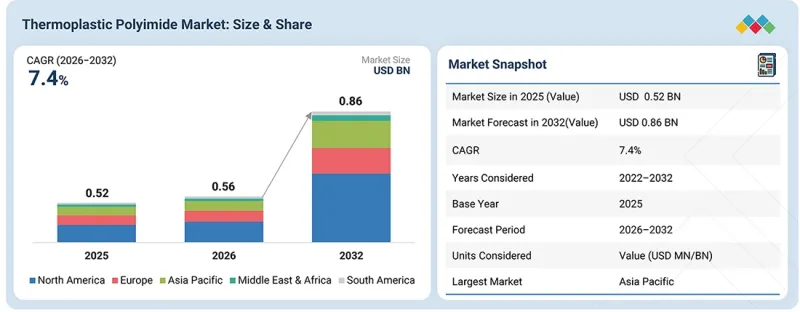
세계의 열가소성 폴리이미드 시장 규모는 2026년 5억 6,000만 달러에서 2032년에는 8억 6,000만 달러로 성장하며, 예측 기간 중 CAGR은 7.4%에 달할 것으로 전망되고 있습니다.
| 조사 범위 | |
|---|---|
| 조사 대상 기간 | 2022-2032년 |
| 기준연도 | 2025년 |
| 예측 기간 | 2026-2032년 |
| 단위 | 금액(달러/톤) |
| 부문 | 형태, 제품 유형, 가공 기술, 최종사용자 산업, 지역 |
| 대상 지역 | 아시아태평양, 유럽, 북미, 중동 및 아프리카, 남미 |
이 시장은 항공우주 및 방위 분야에서의 경량·내열 소재 수요 증가에 더해, 전기·전자, 자동차, 항공우주·방위, 산업 기계, 의료 및 기타 산업을 포함한 각 최종사용자 산업 전반에 걸친 수요 확대에 힘입어 성장하고 있습니다.
"최종사용자 산업별로는 전기·전자 분야가 시장에서 가장 큰 점유율을 차지할 전망"
이러한 성장은 전자 부품, 전기 절연재, 커넥터, 소켓, 필름, 전선·케이블, 반도체 제조 장비 분야에서 고성능 소재에 대한 수요 증가에 힘입어 이루어지고 있습니다. 이러한 용도에서는 고온이나 가혹한 화학적 환경에서도 치수 안정성, 전기적 성능, 기계적 무결성을 유지할 수 있는 소재가 요구됩니다. 열가소성 폴리이미드는 낮은 아웃가스성과 높은 청정성을 갖추고 있으며, 정밀한 전기·전자 용도에 사용하기에 적합합니다.
전자 부품의 복잡화와 소형화가 진전되는 데다, 첨단 반도체 제조 및 전자 기기의 확대에 따라 열가소성 폴리이미드에 대한 수요는 더욱 증가할 것으로 예상됩니다. 이 소재는 고온 성능, 전기 절연성, 치수 안정성, 용융 가공성을 모두 갖추고 있으며, 복잡하고 고정밀도 부품의 제조가 가능합니다. 각 제조사들이 가혹한 작동 조건에서도 신뢰성 높은 성능을 유지할 수 있는 소재를 점점 더 요구함에 따라 전기·전자 분야는 열가소성 폴리이미드의 주요 응용 분야로 계속 자리매김할 것으로 예상됩니다.
"제품 유형별로는 비충진 열가소성 폴리이미드가 가장 큰 점유율을 차지할 전망"
이러한 우위는 보강 섬유나 충전제를 첨가하지 않아도 열가소성 폴리이미드의 고유한 특성만으로도 충분한 용도에서 비충진 등급이 널리 사용되고 있다는 점에 기인합니다. 비충진 열가소성 폴리이미드는 내열성, 치수 안정성, 내화학성, 전기 절연성, 낮은 아웃가스성, 청정성을 갖추고 있으며, 정밀 부품, 필름, 튜브, 전선·케이블, 전기·전자 용도에서의 사용을 지원하고 있습니다. 전기·전자, 자동차, 항공우주·방위, 산업 기계 등 각 용도에서 고성능 소재에 대한 수요가 증가함에 따라 비충진 등급에 대한 수요는 지속될 것으로 예상됩니다. 각 제조사들이 고온 환경이나 가혹한 사용 조건에서도 신뢰성 높은 성능을 유지할 수 있는 소재를 점점 더 요구함에 따라 비충진 부문은 예측 기간 중 주도적인 위치를 유지할 것으로 전망됩니다.
이 보고서에서는 전 세계 열가소성 폴리이미드 시장을 조사하여, 시장 개요, 시장 성장에 영향을 미치는 다양한 요인에 대한 분석, 기술·특허 동향, 법규제 환경, 사례 연구, 시장 규모 추이 및 예측, 각종 분류·지역/주요 국가별 상세 분석, 경쟁 구도, 주요 기업 개요 등을 정리하여 전해드립니다.
자주 묻는 질문
목차
제1장 서론
제2장 개요
제3장 주요 인사이트
제4장 시장 개요
제5장 업계 동향
제6장 기술의 진보, AI의 영향, 특허, 향후 응용
제7장 지속가능성과 규제 상황
제8장 고객 상황과 구매 행동
제9장 열가소성 폴리이미드 시장 : 형태별
제10장 열가소성 폴리이미드 시장 : 제품 유형별
제11장 열가소성 폴리이미드 시장 : 최종사용자 산업별
제12장 열가소성 폴리이미드 시장 : 가공 기술별
제13장 열가소성 폴리이미드 시장 : 지역별
제14장 경쟁 구도
제15장 기업 개요
제16장 조사 방법
제17장 부록
KSA 26.10.01The global thermoplastic polyimide market is projected to grow from USD 0.56 billion in 2026 to USD 0.86 billion by 2032, at a CAGR of 7.4% during the forecast period.
| Scope of the Report | |
|---|---|
| Years Considered for the Study | 2022-2032 |
| Base Year | 2025 |
| Forecast Period | 2026-2032 |
| Units Considered | Value (USD Million/Ton) |
| Segments | Form, Product Type, Processing Technique, End-use Industry, and Region |
| Regions covered | Asia Pacific, Europe, North America, the Middle East & Africa, and South America |
The market is driven by increasing demand for lightweight, high-temperature materials in aerospace and defense applications, as well as growing demand across end-use industries including electrical and electronics, automotive, aerospace and defense, industrial machinery, medical, and other industries.
"Electrical & electronics, by end-use industry, is estimated to account for the largest share of the market."
The electrical & electronics segment is projected to account for the largest share of the thermoplastic polyimide market during the forecast period. This growth is driven by increasing demand for high-performance materials in electronic components, electrical insulation, connectors, sockets, films, wires and cables, and semiconductor manufacturing equipment. These applications require materials that can maintain dimensional stability, electrical performance, and mechanical integrity under elevated temperatures and demanding chemical environments. Thermoplastic polyimide also offers low outgassing and high cleanliness, which support its use in precision electrical and electronic applications.
The increasing complexity and miniaturization of electronic components, along with the expansion of advanced semiconductor manufacturing and electronic equipment, are expected to further support demand for thermoplastic polyimide. Its combination of high-temperature performance, electrical insulation, dimensional stability, and melt processability enables the production of complex, high-precision components. As manufacturers increasingly require materials that maintain reliable performance under demanding operating conditions, the electrical & electronics segment is expected to remain a key application area for thermoplastic polyimide.
"Unfilled thermoplastic polyimide, by product type, is estimated to account for the largest share of the thermoplastic polyimide market."
The unfilled thermoplastic polyimide segment is projected to account for the largest share of the thermoplastic polyimide market. This dominance is supported by the broad use of unfilled grades in applications where the inherent properties of thermoplastic polyimide are sufficient without adding reinforcing fibers or fillers. Unfilled thermoplastic polyimide provides high-temperature resistance, dimensional stability, chemical resistance, electrical insulation, low outgassing, and cleanliness, supporting its use in precision components, films, tubes, wires and cables, and electrical and electronics applications. The growing demand for high-performance materials in electrical and electronics, automotive, aerospace and defense, and industrial machinery applications is expected to sustain demand for unfilled grades. As manufacturers increasingly require materials that can maintain reliable performance under elevated temperatures and demanding operating conditions, the unfilled segment is expected to retain its leading position throughout the forecast period.
Profile breakdown of primary participants for the report:
- By Company Type: Tier 1 - 16%, Tier 2 - 36%, and Tier 3 - 48%
- By Designation: C-level - 16%, Director Level - 24%, and Others - 60%
- By Region: North America - 36%, Europe - 24%, Asia Pacific - 20%, Middle East & Africa - 12%, and South America - 8%
Mitsui Chemicals (Japan), SABIC (Saudi Arabia), Mitsubishi Gas Chemical Company, Inc. (Japan), Wanhua Chemical (China), and Kingfa Sci. & Tech. Co., Ltd are some of the major players operating in the thermoplastic polyimide market. These players have adopted strategies such as acquisitions, expansions, partnerships, and agreements to increase their market share and business revenue.
Research Coverage:
The report defines, segments, and projects the thermoplastic polyimide market based on form, product type, processing technique, end-use industry, and region. It provides detailed information on the major factors influencing market growth, such as drivers, restraints, opportunities, and challenges. It strategically profiles thermoplastic polyimide manufacturers, analyzes their market shares and core competencies, and tracks and analyzes competitive developments, such as expansions, partnerships, and product launches, undertaken in the market.
Reasons to Buy the Report:
The report is expected to help the market leaders/new entrants in the market by providing them with the closest approximations of revenue numbers of the thermoplastic polyimide market and its segments. This report is also expected to help stakeholders obtain an improved understanding of the competitive landscape of the market, gain insights to improve the position of their businesses, and make suitable go-to-market strategies. It also enables stakeholders to understand the pulse of the market and provides them with information on key market drivers, restraints, challenges, and opportunities.
The report provides insights on the following pointers:
- Analysis of key drivers (Increasing Demand for Lightweight, High-Temperature Materials in Aerospace and Defense Applications, Growing Demand from Industrial and Automotive Application), restraints (high production costs and complex processing requirements of thermoplastic polyimides, availability of alternative high-performance engineering polymers), opportunities (increasing electrification of the automotive industry and growing adoption of electric vehicles, expansion of semiconductor manufacturing and advanced electronic packaging), and challenges (limited commercial availability and narrow supplier base) influencing the growth of the thermoplastic polyimide market.
- Product Development/Innovation: Detailed insights on upcoming technologies, research & development activities in the thermoplastic polyimide market.
- Market Development: Comprehensive information about lucrative markets - the report analyzes the thermoplastic polyimide market across varied regions.
- Market Diversification: Exhaustive information about new products, various types, untapped geographies, recent developments, and investments in the thermoplastic polyimide market.
- Competitive Assessment: In-depth assessment of market shares, growth strategies, and product offerings of leading players such as Mitsui Chemicals (Japan), Sabic (Saudi Arabia), Solver Polyimide (China), Huntsman (US), Mitsubishi Gas Chemical Company, Inc. (Japan), Jiangsu Junhua HPP Co., Ltd. (China), Changzhou Sunchem New Material Co., Ltd. (China), Wanhua Chemical (China), Arakawa Chemical Industries, Ltd. (Japan), Arkema (France), Evonik (Germany), Allstar Material (China), Jiangsu Qingquan Chemical Co., Ltd. (China), Kingfa Sci. & Tech. Co., Ltd. (China), and others in the thermoplastic polyimide market.
TABLE OF CONTENTS
1 INTRODUCTION
- 1.1 STUDY OBJECTIVES
- 1.2 MARKET DEFINITION
- 1.3 STUDY SCOPE
- 1.3.1 MARKETS COVERED AND REGIONAL SCOPE
- 1.4 INCLUSIONS AND EXCLUSIONS
- 1.4.1 YEARS CONSIDERED
- 1.4.2 CURRENCY CONSIDERED
- 1.4.3 UNIT CONSIDERED
- 1.5 STAKEHOLDERS
- 1.6 RESEARCH LIMITATIONS
2 EXECUTIVE SUMMARY
- 2.1 KEY INSIGHTS AND MARKET HIGHLIGHTS
- 2.2 KEY MARKET PARTICIPANTS: SHARE INSIGHTS AND STRATEGIC DEVELOPMENTS
- 2.3 DISRUPTIVE TRENDS IN THERMOPLASTIC POLYIMIDE MARKET
- 2.4 HIGH-GROWTH SEGMENTS
- 2.5 REGIONAL SNAPSHOT: MARKET SIZE, GROWTH RATE, AND FORECAST
3 PREMIUM INSIGHTS
- 3.1 ATTRACTIVE OPPORTUNITIES FOR PLAYERS IN THERMOPLASTIC POLYIMIDE MARKET
- 3.2 THERMOPLASTIC POLYIMIDE MARKET, BY FORM
- 3.3 THERMOPLASTIC POLYIMIDE MARKET, BY PRODUCT TYPE
- 3.4 THERMOPLASTIC POLYIMIDE MARKET, BY END-USE INDUSTRY
- 3.5 THERMOPLASTIC POLYIMIDE MARKET, BY REGION
- 3.6 THERMOPLASTIC POLYIMIDE MARKET, BY COUNTRY
4 MARKET OVERVIEW
- 4.1 INTRODUCTION
- 4.2 MARKET DYNAMICS
- 4.2.1 DRIVERS
- 4.2.1.1 Increasing demand for lightweight, high-temperature materials in aerospace & defense applications
- 4.2.1.2 Growing demand from industrial and automotive applications
- 4.2.2 RESTRAINTS
- 4.2.2.1 High production costs and complex processing requirements of thermoplastic polyimides
- 4.2.2.2 Availability of alternative high-performance engineering polymers
- 4.2.3 OPPORTUNITIES
- 4.2.3.1 Increasing electrification of automotive industry and growing adoption of electric vehicles
- 4.2.3.2 Expansion of semiconductor manufacturing and advanced electronic packaging
- 4.2.4 CHALLENGES
- 4.2.4.1 Limited commercial availability and narrow supplier base
- 4.2.1 DRIVERS
- 4.3 UNMET NEEDS AND WHITE SPACES
- 4.3.1 UNMET NEEDS IN THERMOPLASTIC POLYIMIDE MARKET
- 4.3.2 WHITE SPACE OPPORTUNITIES
- 4.4 INTERCONNECTED MARKETS AND CROSS-SECTOR OPPORTUNITIES
- 4.4.1 INTERCONNECTED MARKETS
- 4.4.2 CROSS-SECTOR OPPORTUNITIES
- 4.5 EMERGING BUSINESS MODELS AND ECOSYSTEM SHIFTS
- 4.5.1 EMERGING BUSINESS MODELS
- 4.5.2 ECOSYSTEM SHIFTS
- 4.6 STRATEGIC MOVES BY TIER 1/2/3 PLAYERS
- 4.6.1 KEY MOVES AND STRATEGIC FOCUS
5 INDUSTRY TRENDS
- 5.1 PORTER'S FIVE FORCES ANALYSIS
- 5.1.1 THREAT OF NEW ENTRANTS
- 5.1.2 THREAT OF SUBSTITUTES
- 5.1.3 BARGAINING POWER OF SUPPLIERS
- 5.1.4 BARGAINING POWER OF BUYERS
- 5.1.5 INTENSITY OF COMPETITIVE RIVALRY
- 5.2 MACROECONOMICS INDICATORS
- 5.2.1 INTRODUCTION
- 5.2.2 GDP TRENDS AND FORECAST
- 5.2.3 TRENDS IN GLOBAL AUTOMOTIVE INDUSTRY
- 5.2.4 TRENDS IN GLOBAL ELECTRONICS INDUSTRY
- 5.2.5 TRENDS IN GLOBAL AEROSPACE INDUSTRY
- 5.3 VALUE CHAIN ANALYSIS
- 5.4 ECOSYSTEM ANALYSIS
- 5.5 PRICING ANALYSIS
- 5.5.1 AVERAGE SELLING PRICE, BY KEY PLAYERS
- 5.5.2 AVERAGE SELLING PRICE TREND, BY REGION
- 5.6 KEY CONFERENCES AND EVENTS, 2026-2027
- 5.7 TRENDS/DISRUPTIONS IMPACTING CUSTOMER BUSINESS
- 5.8 INVESTMENT AND FUNDING SCENARIO
- 5.9 CASE STUDY ANALYSIS
- 5.9.1 SABIC EXTEM THERMOPLASTIC POLYIMIDE ENABLING IR OPTICAL SENSOR MINIATURIZATION
- 5.9.2 NASA GLENN RESEARCH CENTER EVALUATION OF THERMOPLASTIC POLYIMIDE FOR HIGH-TEMPERATURE ELECTRICAL INSULATION
- 5.9.3 EXTRUSION 3D PRINTING OF INTRINSICALLY FLUORESCENT THERMOPLASTIC POLYIMIDE FOR FUNCTIONAL HIGH-TEMPERATURE COMPONENTS
6 TECHNOLOGICAL ADVANCEMENTS, AI-DRIVEN IMPACT, PATENTS, AND FUTURE APPLICATIONS
- 6.1 OVERVIEW
- 6.2 KEY TECHNOLOGIES
- 6.2.1 INJECTION MOLDING PROCESS
- 6.2.2 EXTRUSION TECHNOLOGY
- 6.3 COMPLEMENTARY TECHNOLOGIES
- 6.3.1 THERMOPLASTIC FILM AND COATING TECHNOLOGY
- 6.4 ADJACENT TECHNOLOGIES
- 6.4.1 ADDITIVE MANUFACTURING OF HIGH-TEMPERATURE THERMOPLASTICS
- 6.5 PATENT ANALYSIS
- 6.5.1 INTRODUCTION
- 6.5.2 METHODOLOGY
- 6.5.3 DOCUMENT TYPE
- 6.5.4 INSIGHTS
- 6.5.5 LEGAL STATUS OF PATENTS
- 6.5.6 JURISDICTION ANALYSIS
- 6.5.7 TOP APPLICANTS
- 6.5.8 LIST OF MAJOR PATENTS
- 6.6 FUTURE APPLICATIONS
- 6.6.1 ELECTRIFIED AEROSPACE & SPACE SYSTEMS: HIGH-TEMPERATURE INSULATION FOR ELECTRIC AIRCRAFT, SATELLITES, AND SPACE ELECTRONICS
- 6.6.2 EV POWER ELECTRONICS & BATTERY SYSTEMS: ADVANCED INSULATION MATERIALS FOR MOTORS, INVERTERS, AND BATTERY MODULES
- 6.6.3 5G/6G FLEXIBLE ELECTRONICS & SEMICONDUCTOR PACKAGING: LOW-DIELECTRIC FILMS AND FLEXIBLE SUBSTRATES FOR HIGH-FREQUENCY DEVICES
- 6.6.4 HIGH-TEMPERATURE ADDITIVE MANUFACTURING: LIGHTWEIGHT 3D-PRINTED COMPONENTS FOR AEROSPACE, INDUSTRIAL, AND ELECTRONIC APPLICATIONS
- 6.6.5 ADVANCED INDUSTRIAL & SEMICONDUCTOR EQUIPMENT: HIGH-TEMPERATURE COMPONENTS FOR SEMICONDUCTOR TOOLS, SENSORS, AND INDUSTRIAL SYSTEMS
- 6.7 IMPACT OF AI/GEN AI ON THERMOPLASTIC POLYIMIDE MARKET
- 6.7.1 TOP USE CASES AND MARKET POTENTIAL
- 6.7.2 BEST PRACTICES: COMPANIES/INSTITUTIONS USE CASES
- 6.7.3 CASE STUDIES OF THERMOPLASTIC POLYIMIDE MARKET
- 6.7.4 INTERCONNECTED ADJACENT ECOSYSTEM AND IMPACT ON MARKET PLAYERS
- 6.7.5 CLIENTS' READINESS TO ADOPT GENERATIVE AI IN THERMOPLASTIC POLYIMIDE MARKET
- 6.7.6 SUCCESS STORIES AND REAL WORLD APPLICATIONS
- 6.7.7 MITSUI CHEMICALS: AI DRIVEN MATERIALS INFORMATICS FOR ADVANCED POLYMER DEVELOPMENT
- 6.7.8 SABIC: AI-ENABLED DIGITAL OPTIMIZATION IN THERMOPLASTIC POLYIMIDE OPERATIONS
7 SUSTAINABILITY AND REGULATORY LANDSCAPE
- 7.1 REGIONAL REGULATIONS AND COMPLIANCE
- 7.1.1 REGULATORY BODIES, GOVERNMENT AGENCIES, AND OTHER ORGANIZATIONS
- 7.1.2 INDUSTRY STANDARDS
- 7.2 SUSTAINABILITY INITIATIVES
- 7.2.1 CARBON IMPACT AND ECO APPLICATIONS OF THERMOPLASTIC POLYIMIDE
- 7.3 SUSTAINABILITY IMPACT AND REGULATORY POLICY INITIATIVES
- 7.4 CERTIFICATIONS, LABELING, AND ECO STANDARDS
8 CUSTOMER LANDSCAPE & BUYER BEHAVIOR
- 8.1 DECISION-MAKING PROCESS
- 8.2 KEY STAKEHOLDERS AND BUYING CRITERIA
- 8.2.1 KEY STAKEHOLDERS IN BUYING PROCESS
- 8.2.2 BUYING CRITERIA
- 8.3 ADOPTION BARRIERS & INTERNAL CHALLENGES
- 8.4 UNMET NEEDS IN VARIOUS END-USE INDUSTRIES
- 8.5 MARKET PROFITABILITY
- 8.5.1 REVENUE POTENTIAL
- 8.5.2 COST DYNAMICS
- 8.5.3 MARGIN OPPORTUNITIES IN KEY APPLICATIONS
9 THERMOPLASTIC POLYIMIDE MARKET, BY FORM
- 9.1 INTRODUCTION
- 9.2 RESIN
- 9.2.1 HIGH-TEMPERATURE PERFORMANCE AND MELT PROCESSABILITY
- 9.3 POWDER
- 9.3.1 COMPOSITE PROCESSING AND HIGH-TEMPERATURE APPLICATIONS
- 9.4 OTHER FORMS
10 THERMOPLASTIC POLYIMIDE MARKET, BY PRODUCT TYPE
- 10.1 INTRODUCTION
- 10.2 UNFILLED THERMOPLASTIC POLYIMIDE
- 10.2.1 HIGH-TEMPERATURE PERFORMANCE AND CLEANLINESS SUPPORT
- 10.3 GLASS-FILLED THERMOPLASTIC POLYIMIDE
- 10.3.1 HIGHER STIFFNESS AND DIMENSIONAL STABILITY
- 10.4 CARBON-FILLED THERMOPLASTIC POLYIMIDE
- 10.4.1 HIGH STRENGTH-TO-WEIGHT PERFORMANCE
- 10.5 OTHER PRODUCT TYPES
11 THERMOPLASTIC POLYIMIDE MARKET, BY END-USE INDUSTRY
- 11.1 INTRODUCTION
- 11.2 ELECTRICAL & ELECTRONICS
- 11.2.1 HIGH-TEMPERATURE ELECTRONICS AND SEMICONDUCTOR PROCESSING
- 11.3 AUTOMOTIVE
- 11.3.1 HIGH-TEMPERATURE PERFORMANCE AND VEHICLE ELECTRIFICATION
- 11.4 AEROSPACE & DEFENSE
- 11.4.1 DEMAND FOR LIGHTWEIGHT, HIGH-TEMPERATURE-RESISTANT STRUCTURES AND COMPONENTS
- 11.5 INDUSTRIAL MACHINERY
- 11.5.1 WEAR RESISTANCE AND DIMENSIONAL STABILITY
- 11.6 OTHER END-USE INDUSTRIES
12 BY PROCESSING TECHNIQUE
- 12.1 INTRODUCTION
- 12.2 INJECTION MOLDING
- 12.3 EXTRUSION
13 THERMOPLASTIC POLYIMIDE MARKET, BY REGION
- 13.1 INTRODUCTION
- 13.2 NORTH AMERICA
- 13.2.1 US
- 13.2.1.1 Semiconductor expansion, aerospace production, and vehicle electrification
- 13.2.2 CANADA
- 13.2.2.1 Aerospace, automotive, and semiconductor manufacturing
- 13.2.3 MEXICO
- 13.2.3.1 Automotive and aerospace manufacturing
- 13.2.1 US
- 13.3 EUROPE
- 13.3.1 GERMANY
- 13.3.1.1 Automotive manufacturing and semiconductor expansion
- 13.3.2 UK
- 13.3.2.1 Aerospace, automotive, and semiconductor capabilities
- 13.3.3 FRANCE
- 13.3.3.1 Aerospace and automotive manufacturing provide key application bases
- 13.3.4 ITALY
- 13.3.4.1 Automotive manufacturing and microelectronics development
- 13.3.5 SPAIN
- 13.3.5.1 Automotive manufacturing provides significant application base
- 13.3.6 REST OF EUROPE
- 13.3.1 GERMANY
- 13.4 ASIA PACIFIC
- 13.4.1 CHINA
- 13.4.1.1 Automotive and electronics manufacturing support demand
- 13.4.2 SOUTH KOREA
- 13.4.2.1 Strong automotive, semiconductor, electrical & electronics, aerospace, and advanced manufacturing industries
- 13.4.3 JAPAN
- 13.4.3.1 Automotive, electronics, and semiconductor manufacturing support demand
- 13.4.4 INDIA
- 13.4.4.1 Increasing domestic production and localization across automotive and semiconductor manufacturing
- 13.4.5 MALAYSIA
- 13.4.5.1 Established semiconductor ecosystem and increasingly advanced manufacturing activities
- 13.4.6 REST OF ASIA PACIFIC
- 13.4.1 CHINA
- 13.5 MIDDLE EAST & AFRICA
- 13.5.1 SAUDI ARABIA
- 13.5.1.1 Industrial diversification supports emerging applications
- 13.5.2 UAE
- 13.5.2.1 Advanced manufacturing and aerospace support emerging TPI applications
- 13.5.3 REST OF GCC COUNTRIES
- 13.5.3.1 Industrial diversification and advanced manufacturing
- 13.5.4 REST OF MIDDLE EAST & AFRICA
- 13.5.1 SAUDI ARABIA
- 13.6 SOUTH AMERICA
- 13.6.1 BRAZIL
- 13.6.1.1 Established automotive, aerospace, electronics, and industrial manufacturing capabilities
- 13.6.2 ARGENTINA
- 13.6.2.1 Automotive manufacturing provides key TPI application pathway
- 13.6.3 REST OF SOUTH AMERICA
- 13.6.1 BRAZIL
14 COMPETITIVE LANDSCAPE
- 14.1 INTRODUCTION
- 14.2 KEY PLAYER STRATEGIES/RIGHT TO WIN
- 14.3 REVENUE ANALYSIS
- 14.4 MARKET SHARE AND RANKING ANALYSES
- 14.4.1 MARKET SHARE OF KEY PLAYERS
- 14.5 BRAND/PRODUCT COMPARISON
- 14.6 COMPANY VALUATION AND FINANCIAL METRICS
- 14.7 COMPANY EVALUATION MATRIX: KEY PLAYERS, 2025
- 14.7.1 STARS
- 14.7.2 EMERGING LEADERS
- 14.7.3 PERVASIVE PLAYERS
- 14.7.4 PARTICIPANTS
- 14.7.5 COMPANY FOOTPRINT: KEY PLAYERS, 2025
- 14.7.5.1 Company footprint
- 14.7.5.2 Region footprint
- 14.7.5.3 Form footprint
- 14.7.5.4 Product type footprint
- 14.7.5.5 End-use industry footprint
- 14.8 COMPETITIVE SCENARIO
- 14.8.1 DEALS
15 COMPANY PROFILES
- 15.1 MAJOR PLAYERS
- 15.1.1 MITSUI CHEMICALS, INC.
- 15.1.1.1 Business overview
- 15.1.1.2 Products/Solutions/Services offered
- 15.1.1.3 Recent developments
- 15.1.1.3.1 Deals
- 15.1.1.4 MnM view
- 15.1.1.4.1 Key strengths
- 15.1.1.4.2 Strategic choices
- 15.1.1.4.3 Weaknesses and competitive threats
- 15.1.2 SABIC
- 15.1.2.1 Business overview
- 15.1.2.2 Products/Solutions/Services offered
- 15.1.2.3 Recent developments
- 15.1.2.4 MnM view
- 15.1.2.4.1 Key strengths
- 15.1.2.4.2 Strategic choices
- 15.1.2.4.3 Weaknesses and competitive threats
- 15.1.3 ARAKAWA CHEMICAL INDUSTRIES, LTD.
- 15.1.3.1 Business overview
- 15.1.3.2 Products/Solutions/Services offered
- 15.1.3.3 Recent developments
- 15.1.3.4 MnM view
- 15.1.3.4.1 Key strengths
- 15.1.3.4.2 Strategic choices
- 15.1.3.4.3 Weaknesses and competitive threats
- 15.1.4 MITSUBISHI GAS CHEMICAL COMPANY, INC.
- 15.1.4.1 Business overview
- 15.1.4.2 Products/Solutions/Services offered
- 15.1.4.3 Recent developments
- 15.1.4.4 MnM view
- 15.1.4.4.1 Key strengths
- 15.1.4.4.2 Strategic choices
- 15.1.4.4.3 Weaknesses and competitive threats
- 15.1.5 HUNTSMAN
- 15.1.5.1 Business overview
- 15.1.5.2 Products/Solutions/Services offered
- 15.1.5.3 Recent developments
- 15.1.5.4 MnM view
- 15.1.5.4.1 Key strengths
- 15.1.5.4.2 Strategic choices
- 15.1.5.4.3 Weaknesses and competitive threats
- 15.1.6 SOLVER POLYIMIDE
- 15.1.6.1 Business overview
- 15.1.6.2 Products/Solutions/Services offered
- 15.1.6.3 Recent developments
- 15.1.7 JIANGSU JUNHUA HPP CO., LTD.
- 15.1.7.1 Business overview
- 15.1.7.2 Products/Solutions/Services offered
- 15.1.7.3 Recent developments
- 15.1.8 CHANGZHOU SUNCHEM NEW MATERIAL CO., LTD.
- 15.1.8.1 Business overview
- 15.1.8.2 Products/Solutions/Services offered
- 15.1.8.3 Recent developments
- 15.1.9 WANHUA CHEMICAL GROUP CO. LTD
- 15.1.9.1 Business overview
- 15.1.9.2 Products/Solutions/Services offered
- 15.1.9.3 Recent developments
- 15.1.10 EVONIK
- 15.1.10.1 Business overview
- 15.1.10.2 Products/Solutions/Services offered
- 15.1.10.3 Recent developments
- 15.1.11 ARKEMA
- 15.1.11.1 Business overview
- 15.1.11.2 Products/Solutions/Services offered
- 15.1.11.3 Recent developments
- 15.1.12 JIANGSU QINGQUAN CHEMICAL CO., LTD.
- 15.1.12.1 Business overview
- 15.1.12.2 Products/Solutions/Services offered
- 15.1.12.3 Recent developments
- 15.1.13 KINGFA SCI. & TECH. CO., LTD.
- 15.1.13.1 Business overview
- 15.1.13.2 Products/Solutions/Services offered
- 15.1.13.3 Recent developments
- 15.1.14 ALLSTAR MATERIAL
- 15.1.14.1 Business overview
- 15.1.14.2 Products/Solutions/Services offered
- 15.1.14.3 Recent developments
- 15.1.1 MITSUI CHEMICALS, INC.
16 RESEARCH METHODOLOGY
- 16.1 RESEARCH DATA
- 16.1.1 SECONDARY DATA
- 16.1.1.1 List of key secondary sources
- 16.1.2 PRIMARY DATA
- 16.1.2.1 List of participating companies for primary research
- 16.1.2.2 Breakdown of primary interviews
- 16.1.1 SECONDARY DATA
- 16.2 MARKET SIZE ESTIMATION
- 16.2.1 TOP-DOWN APPROACH
- 16.2.2 BOTTOM-UP APPROACH
- 16.3 MARKET FORECAST APPROACH
- 16.3.1 DEMAND SIDE ANALYSIS
- 16.3.2 SUPPLY SIDE ANALYSIS
- 16.3.3 CALCULATION FOR SUPPLY SIDE ANALYSIS
- 16.4 GROWTH FORECAST
- 16.5 DATA TRIANGULATION
- 16.6 FACTOR ANALYSIS
17 APPENDIX
- 17.1 DISCUSSION GUIDE
- 17.2 KNOWLEDGESTORE: MARKETSANDMARKETS' SUBSCRIPTION PORTAL
- 17.3 CUSTOMIZATION OPTIONS
- 17.4 RELATED REPORTS
- 17.5 AUTHOR DETAILS


