
|
시장보고서
상품코드
2132653
발전기 냉각 시스템 시장 예측(-2031년) : 냉각 기술, 제품 유형, 발전기 설계, 구조 유형, 정격 출력, 용도, 최종사용자 산업(상업, 산업, 유틸리티), 지역별Generator Cooling Systems Market By Cooling Technology, By Product Type, By Generator Design, By Construction Type, By Power Rating, By Application, By End-use Industry (Commercial, Industrial, Utilities), and Region - Global Forecast to 2031 |
||||||

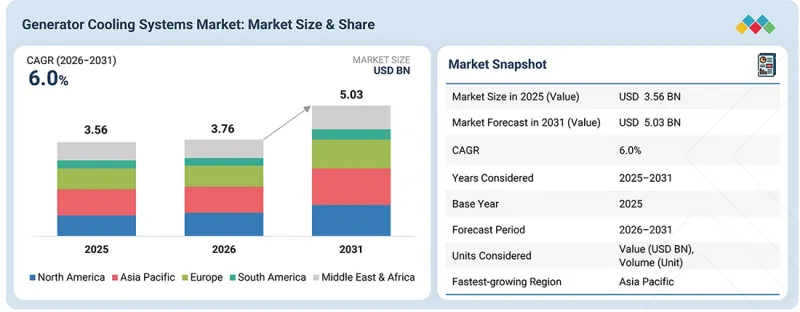
발전기 냉각 시스템 시장 규모는 2026년 37억 6,000만 달러에서 2031년에는 50억 3,000만 달러에 달할 것으로 예측되고 있으며, 예측 기간 중 CAGR은 6.0%에 달할 전망입니다.
| 조사 범위 | |
|---|---|
| 조사 대상 기간 | 2025-2031년 |
| 기준연도 | 2025년 |
| 예측 기간 | 2026-2031년 |
| 단위 | 금액(달러)·수량(유닛) |
| 부문 | 냉각 기술, 제품 유형, 발전기 설계, 구조 유형, 용도, 정격 출력, 최종사용자 산업, 지역 |
| 대상 지역 | 북미, 아시아태평양, 유럽, 중동 및 아프리카, 남미 |
발전기 냉각 시스템 시장은 다양한 산업 분야에서 신뢰성이 높고 효율적이며 견고한 발전 방식에 대한 수요가 증가함에 따라 확대되고 있습니다. 백업 전원이나 현장 전원으로 발전기를 활용하는 시설의 수도 증가하고 있습니다. 데이터센터, 제조 공장, 건설 현장, 공공 인프라, 광산의 확장이 발전기 냉각 시스템의 수요를 끌어올리고 있습니다. 또한 통신 시설, 상업 시설, 중요 인프라에서는 연속 운전이 가능한 발전 시스템에 대한 강한 수요가 나타나고 있습니다. 대용량 발전 설비의 도입이 진행됨에 따라 열 관리 시스템의 중요성도 한층 더 높아지고 있습니다.
"액체 냉각 시스템 부문이 예측 기간 중 가장 큰 부문이 될 것으로 전망됩니다."
냉각 기술별로는 뛰어난 방열성, 정확한 온도 제어, 장시간 가동되는 대용량 발전기에 대응할 수 있는 능력 덕분에 액체 냉각 시스템 부문이 가장 큰 점유율을 차지할 것으로 예상됩니다. 이러한 시스템은 데이터센터, 산업 시설, 공공 사업, 석탄·가스 산업, 상업용 빌딩, 중요 인프라에서 매우 광범위하게 채택되고 있습니다. 비상 전원, 상용 전원, 연속 전원용 대용량 발전기가 점점 더 보급되고 있으며, 가혹한 가동 조건 하에서 신뢰성 높은 열 관리에 대한 수요가 높아지고 있는 점이 액체 냉각 시스템의 도입을 지원하고 있습니다.
"제품 유형별로는 엔진 탑재형 통합 냉각 시스템이 예측 기간 중 가장 큰 부문이 될 전망입니다."
예측 기간 중, 엔진 탑재형 통합 냉각 시스템 부문은 컴팩트한 크기, 통합 설계, 효율적인 방열 성능, 다양한 발전기에 대한 호환성 덕분에 전체 시장을 주도할 것으로 예상됩니다. 이러한 시스템은 발전기 엔진에 직접 통합되어 있으며, 일반적으로 라디에이터, 팬, 관련 냉각 회로 등 필수 냉각 구성 요소를 갖추고 있으며, 엔진의 작동 온도에 대응하는 즉시 사용 가능한 냉각 솔루션을 제공합니다. 비상 전원, 상시 전원, 연속 전원 등 다양한 발전 용도로 활용되면서 그 보급이 가속화되고 있습니다. 산업, 상업, 건설, 통신, 중요 전원 등 다양한 분야에서 가동되는 발전 세트의 수가 증가하고 있는 점도 엔진 탑재형 통합 냉각 시스템의 수요를 지원하는 요인으로 작용하고 있습니다.
"발전기 설계별로는 고정형이 예측 기간 중 가장 큰 부문이 될 전망입니다."
이는 각종 산업, 상업 시설, 공공 사업, 데이터센터, 중요 인프라 시설에 예비 전원, 상용 전원, 연속 전원을 공급하기 위해 널리 사용되고 있기 때문입니다. 고정된 장소에 설치되는 고정형 발전기는 장기간에 걸쳐 신뢰성 높은 전력을 공급하도록 설계되었습니다. 신뢰성 높은 백업 전원과 현장 전원이 필요한 시설에서 널리 사용되고 있는 점이 관련 냉각 시스템에 대한 높은 수요로 이어지고 있습니다. 전력 공급에 크게 의존하는 산업 시설, 데이터센터, 상업용 빌딩, 공공 사업 및 기타 주요 부문의 지속적인 확장은 고정형 발전기용 냉각 시스템에 대한 수요도 계속 증가할 것으로 전망됩니다.
"아시아태평양은 예측 기간 중 가장 큰 시장이 될 전망입니다."
이는 주로 산업화, 인프라 개발, 제조업의 확대, 안정적이고 신뢰성 높은 전력 공급에 대한 수요 증가에 기인합니다. 중국, 인도, 일본, 한국 등의 국가들이 주요 견인 역할을 하고 있습니다. 발전기는 산업 시설, 상업용 빌딩, 데이터센터, 건설 현장, 공공 사업, 전력이 필수적인 기타 용도에 설치되어 있습니다. 데이터센터, 제조 공장, 인프라 구축 활동의 증가에 따라 예비 전원, 상용 전원, 연속 전원용 발전기의 설치가 증가하고 있습니다.
이 보고서에서는 전 세계 발전기 냉각 시스템 시장을 조사하여, 시장 개요, 시장 성장에 영향을 미치는 각종 요인에 대한 분석, 기술 및 특허 동향, 법규제 환경, 사례 연구, 시장 규모 추이 및 전망, 각종 분류·지역/주요 국가별 상세 분석, 경쟁 구도, 주요 기업 개요 등을 정리하여 전해드립니다.
자주 묻는 질문
목차
제1장 서론
제2장 개요
제3장 주요 인사이트
제4장 시장 개요
제5장 업계 동향
제6장 기술의 진보, AI의 영향, 특허, 혁신
제7장 규제 상황과 지속가능성 구상
제8장 고객 상황과 구매 행동
제9장 발전기 냉각 시스템 시장 : 용도별
제10장 발전기 냉각 시스템 시장 : 최종사용자 산업별
제11장 발전기 냉각 시스템 시장 : 냉각 기술별
제12장 발전기 냉각 시스템 시장 : 구조 유형별
제13장 발전기 냉각 시스템 시장 : 출력 정격별
제14장 발전기 냉각 시스템 시장 : 제품 유형별
제15장 발전기 냉각 시스템 시장 : 발전기 설계별
제16장 발전기 냉각 시스템 시장 : 지역별
제17장 경쟁 구도
제18장 기업 개요
제19장 조사 방법
제20장 부록
KSA 26.10.01The generator cooling systems market is expected to reach USD 5.03 billion by 2031 from USD 3.76 billion in 2026, at a CAGR of 6.0% during the forecast period.
| Scope of the Report | |
|---|---|
| Years Considered for the Study | 2025-2031 |
| Base Year | 2025 |
| Forecast Period | 2026-2031 |
| Units Considered | Value (USD Million/Billion) Volume (Unit) |
| Segments | Cooling Technology, Product Type, Generator Design, Construction Type, Application, Power Rating, End-Use Industry, and Region |
| Regions covered | North America, Asia Pacific, Europe, Middle East & Africa, and South America |
The generator cooling systems market is expanding because of the increasing demand for reliable, efficient, and sturdy power-generation methods in various industries. The number of plants using generators for backup and on-site power is growing. The growth of data centers, manufacturing plants, building works, utility lines, and mines is fueling the demand for generator cooling systems. Additionally, telecommunications, commercial facilities, and critical infrastructure are showing a powerful demand for generator systems that can keep running continuously. As more large generating units are installed, the requirement for a thermal management system becomes more important.
"The liquid-cooled systems segment is projected to be the largest cooling technology segment in the generator cooling systems market during the forecast period."
Based on cooling technology, the liquid-cooled systems segment is expected to hold the largest share, owing to their superior heat dissipation, accurate temperature control, and ability to cater to high-capacity generator sets with long runtime. These systems are very common in data centers, industrial buildings, utilities, coal & gas industries, commercial buildings, and critical infrastructure. High-capacity generator sets for standby, prime, and continuous power are becoming more prevalent, and the need for dependable thermal management under harsh operating conditions is driving the installation of liquid-cooled systems.
"Engine-mounted integrated cooling systems are projected to be the largest product type segment in the generator cooling systems market during the forecast period."
During the forecast period, the engine-mounted integrated cooling systems segment is expected to dominate the overall generator cooling systems market because of their compact size, integrated design, efficient heat dissipation, and suitability for a wide variety of generator sets. These systems are directly integrated with the generator engine and usually contain essential cooling components like radiators, fans, and associated cooling circuits, which provide a ready cooling solution for engine operating temperature. Their usage in various power generation applications such as standby, prime & continuous power generation, among others, supports their widespread adoption. The increasing number of generator sets being put into usage in various sectors like industrial, commercial, construction, telecommunications, and critical power are supporting factor for the demand for engine-mounted integrated cooling systems.
"Stationary is projected to be the largest generator design segment in the generator cooling systems market during the forecast period."
By generator design, the stationary generator sets segment is projected to hold the largest share in generator cooling systems as they are extensively used to generate standby, prime, and continuous power for various industries, commercial establishments, utilities, data centers, and critical infrastructure facilities. Installed in fixed locations, stationary generator sets are designed to provide dependable power for long periods. Their usage supports facilities that require dependable backup and on-site power help to explain why demand for their associated cooling systems is high. The ongoing expansion of industrial plants, data centers, commercial buildings, utilities, and other key sectors that rely heavily on power supply tends to continue generating a need for cooling systems for fixed generator sets.
"Asia Pacific is projected to be the largest region in the generator cooling systems market during the forecast period."
The generator cooling systems market in Asia Pacific is expected to experience a considerable rise in revenue by 2031. This is largely due to industrialization, infrastructure development, manufacturing expansion, and the growing demand for stable and reliable power supply. Countries like China, India, Japan, and South Korea are among the main contributors. Generator sets are installed at industrial premises, commercial buildings, data centers, construction sites, utilities, and other applications where electricity is a critical component. With data centers, manufacturing plants, and infrastructure activities increasing, there is a rise in standby, prime, and continuous types of generator sets being installed.
By Company Type: Tier 1: 40%, Tier 2: 30%, and Tier 3: 30%
By Designation: Directors: 30%, Managers: 20%, and Others: 50%
By Region: North America: 20%, Europe: 10%, Asia Pacific: 40%, South America: 10%, and Middle East & Africa 20%
Notes: Others include sales, marketing, and product managers.
Tier 1: >USD 1 Billion; Tier 2: USD 500 million-1 Billion; and Tier 3: <USD 500 million
Companies Covered: Modine (US), Kelvion Holding GmbH (Germany), Cummins Inc. (US), Alfa Laval (Sweden), AKG of America (US), API Heat Transfer (US), Vestas Aircoil A/S (Denmark), LUVE (Italy), SPX Technologies (US), and Guangxi Dingbo Generator Set Manufacturing Co., Ltd. (China) are covered in the report.
The study includes an in-depth competitive analysis of these key players in the generator cooling systems market, with their company profiles, recent developments, and key market strategies.
Research Coverage
This research report categorizes the generator cooling systems market based on cooling type (Air-Cooled Systems, Liquid-Cooled Systems, Hybrid Cooling Systems, Evaporative Cooling Systems), product type (Skid-Mounted Cooling Systems, Remote Radiator Systems, Containerized Cooling Systems, Engine-Mounted Integrated Cooling Systems, Modular Cooling Systems), generator design (Portable, Stationary), construction type (Heat Exchanger Construction, System Construction, Cooling Circuit Architecture), application (Standby, Prime & Continuous, Peak Shaving), power rating (Up To 500 Kw, 500-1,000 Kw, 1-2 MW, Above 2 MW), and end-use industry (Commercial, Industrial, Utilities). The report's scope covers detailed information regarding drivers, restraints, challenges, and opportunities influencing the growth of the generator cooling systems market. A detailed analysis of the key industry players has been conducted to provide insights into their business overview, products offered, and key strategies, such as mergers, acquisitions, product launches, partnerships, and expansions, associated with the generator cooling systems market. This report covers a competitive analysis of upcoming startups in the generator cooling systems market ecosystem.
Reasons to Buy the Report
The report will offer the market leaders/new entrants with information on the closest approximations of the revenue numbers for the overall generator cooling systems market and the subsegments. This report will help stakeholders understand the competitive landscape, gain more insights into positioning their businesses better, and plan suitable go-to-market strategies. The report will help stakeholders understand the pulse of the market and provide them with information on key market drivers, restraints, challenges, and opportunities.
The report provides insights into the following points:
- Analysis of key drivers (Rising demand for reliable backup and continuous power generation, Growing data center and AI infrastructure driving generator deployment, and Increasing demand for efficient generator cooling systems), restraints (High initial cost of advanced cooling systems, Volatility in aluminum and copper prices, and Complex cooling requirements across generator applications), opportunities (Growing demand for modular and integrated cooling systems and Growing adoption of customized cooling solutions), and challenges (Balancing cooling performance with system cost, Maintaining reliable cooling under extreme ambient conditions, and Meeting evolving emissions and environmental requirements).
- Product Development/Innovation: Detailed insights into upcoming technologies, research & development activities, and product & service launches in the generator cooling systems market.
- Market Development: Comprehensive information about profitable markets - the report analyzes the generator cooling systems market across varied regions.
- Market Diversification: Exhaustive information about new products & services, untapped geographies, recent developments, and investments in the generator cooling systems market
- Competitive Assessment: In-depth assessment of market shares, growth strategies, and service offerings of leading players such as Modine (US), Kelvion Holding GmbH (Germany), Cummins Inc. (US), Alfa Laval (Sweden), AKG of America (US), API Heat Transfer (US), Vestas Aircoil A/S (Denmark), LUVE (Italy), SPX Technologies (US), and Guangxi Dingbo Generator Set Manufacturing Co., Ltd. (China), among others.
TABLE OF CONTENTS
1 INTRODUCTION
- 1.1 STUDY OBJECTIVES
- 1.2 MARKET DEFINITION
- 1.3 STUDY SCOPE
- 1.3.1 MARKET SEGMENTATION & REGIONAL SCOPE
- 1.3.2 INCLUSIONS & EXCLUSIONS
- 1.3.3 YEARS CONSIDERED
- 1.3.4 UNITS CONSIDERED
- 1.3.4.1 Currency/Value unit
- 1.3.4.2 Volume unit
- 1.4 STAKEHOLDERS
2 EXECUTIVE SUMMARY
- 2.1 KEY INSIGHTS AND MARKET HIGHLIGHTS
- 2.2 KEY MARKET PARTICIPANTS: MAPPING OF STRATEGIC DEVELOPMENTS
- 2.3 DISRUPTIVE TRENDS SHAPING GENERATOR COOLING SYSTEMS MARKET
- 2.4 HIGH-GROWTH SEGMENTS
- 2.5 SNAPSHOT: GLOBAL MARKET SIZE, GROWTH RATE, AND FORECAST
3 PREMIUM INSIGHTS
- 3.1 ATTRACTIVE OPPORTUNITIES FOR GENERATOR COOLING SYSTEMS MARKET PLAYERS
- 3.2 GENERATOR COOLING SYSTEMS MARKET, BY PRODUCT TYPE
- 3.3 GENERATOR COOLING SYSTEMS MARKET, BY GENERATOR DESIGN
- 3.4 GENERATOR COOLING SYSTEMS MARKET, BY POWER RATING
- 3.5 GENERATOR COOLING SYSTEMS MARKET, BY END-USE INDUSTRY
- 3.6 GENERATOR COOLING SYSTEMS MARKET, BY COUNTRY
4 MARKET OVERVIEW
- 4.1 INTRODUCTION
- 4.2 MARKET DYNAMICS
- 4.2.1 DRIVERS
- 4.2.1.1 Rising demand for reliable backup and continuous power generation
- 4.2.1.2 Growing data center and AI infrastructure driving generator deployment
- 4.2.1.3 Increasing demand for energy-efficient generator cooling systems
- 4.2.2 RESTRAINTS
- 4.2.2.1 High initial cost of advanced cooling systems
- 4.2.2.2 Volatility in aluminum and copper prices
- 4.2.2.3 Complex cooling requirements across generator applications
- 4.2.3 OPPORTUNITIES
- 4.2.3.1 Growing demand for modular and integrated cooling systems
- 4.2.3.2 Growing adoption of customized cooling solutions
- 4.2.4 CHALLENGES
- 4.2.4.1 Balancing cooling performance with system cost
- 4.2.4.2 Maintaining reliable cooling under extreme ambient conditions
- 4.2.4.3 Meeting evolving emissions and environmental requirements
- 4.2.1 DRIVERS
- 4.3 UNMET NEEDS AND WHITE SPACES
- 4.3.1 UNMET NEEDS IN GENERATOR COOLING SYSTEMS MARKET
- 4.3.2 WHITE SPACE OPPORTUNITIES
- 4.4 INTERCONNECTED MARKETS AND CROSS-SECTOR OPPORTUNITIES
- 4.4.1 INTERCONNECTED MARKETS
- 4.4.2 CROSS-SECTOR OPPORTUNITIES
- 4.5 EMERGING BUSINESS MODELS AND ECOSYSTEM SHIFTS
- 4.5.1 EMERGING BUSINESS MODELS
- 4.5.2 ECOSYSTEM SHIFTS
- 4.6 STRATEGIC MOVES BY TIER-1/2/3 PLAYERS
- 4.6.1 KEY MOVES AND STRATEGIC FOCUS
5 INDUSTRY TRENDS
- 5.1 PORTER'S FIVE FORCES ANALYSIS
- 5.1.1 THREAT OF NEW ENTRANTS
- 5.1.2 THREAT OF SUBSTITUTES
- 5.1.3 BARGAINING POWER OF SUPPLIERS
- 5.1.4 BARGAINING POWER OF BUYERS
- 5.1.5 INTENSITY OF COMPETITIVE RIVALRY
- 5.2 MACROECONOMIC OUTLOOK
- 5.2.1 GLOBAL GDP TRENDS
- 5.3 VALUE CHAIN ANALYSIS
- 5.4 ECOSYSTEM ANALYSIS
- 5.5 PRICING ANALYSIS
- 5.5.1 AVERAGE SELLING PRICE TREND, BY REGION
- 5.5.2 AVERAGE SELLING PRICE TREND, BY TYPE
- 5.6 TRADE ANALYSIS
- 5.6.1 IMPORT SCENARIO (HS CODE 841990)
- 5.6.2 EXPORT SCENARIO (HS CODE 841990)
- 5.7 KEY CONFERENCES AND EVENTS
- 5.8 TRENDS AND DISRUPTIONS IMPACTING CUSTOMER BUSINESS
- 5.9 INVESTMENT AND FUNDING SCENARIO
- 5.10 CASE STUDY ANALYSIS
- 5.10.1 GENERATOR COOLING SYSTEMS IN INDUSTRIAL APPLICATIONS
- 5.10.2 GENERATOR COOLING SYSTEMS IN UTILITY APPLICATIONS
- 5.11 IMPACT OF 2025 US TARIFF - GENERATOR COOLING SYSTEMS MARKET
- 5.11.1 INTRODUCTION
- 5.11.2 KEY TARIFF RATES
- 5.11.3 PRICE IMPACT ANALYSIS
- 5.11.4 IMPACT ON REGIONS
- 5.11.4.1 North America
- 5.11.4.2 Europe
- 5.11.4.3 Asia Pacific
- 5.11.5 IMPACT ON END-USE INDUSTRIES
6 TECHNOLOGICAL ADVANCEMENTS, AI-DRIVEN IMPACT, PATENTS, AND INNOVATIONS
- 6.1 KEY EMERGING TECHNOLOGIES
- 6.1.1 VARIABLE-SPEED FAN AND ELECTRONICALLY CONTROLLED COOLING SYSTEMS
- 6.1.2 HIGH-AMBIENT AND HIGH-EFFICIENCY RADIATOR SYSTEMS
- 6.1.3 ADVANCED HEAT EXCHANGERS AND REMOTE COOLING SYSTEMS
- 6.2 COMPLEMENTARY TECHNOLOGIES
- 6.2.1 DIGITAL COOLING MONITORING AND GENERATOR CONTROL SYSTEMS
- 6.2.2 ADVANCED COOLANT AND COOLING-WATER MANAGEMENT
- 6.3 ADJACENT TECHNOLOGIES
- 6.3.1 CHARGE-AIR COOLING AND AFTERCOOLER SYSTEMS
- 6.3.2 AI-BASED PREDICTIVE COOLING-SYSTEM MONITORING
- 6.4 TECHNOLOGY/PRODUCT ROADMAP
- 6.4.1 SHORT-TERM (2026-2027) |OPTIMIZATION & PERFORMANCE ENHANCEMENT
- 6.4.2 MID-TERM (2027-2030) | EXPANSION & STANDARDIZATION
- 6.4.3 LONG-TERM (2030-2035+) | ADVANCED FUNCTIONALITY & SUSTAINABLE INNOVATION
- 6.5 PATENT ANALYSIS
- 6.5.1 LEGAL STATUS OF PATENTS
- 6.5.2 JURISDICTION ANALYSIS
- 6.6 FUTURE APPLICATIONS
- 6.6.1 ADVANCED THERMAL MANAGEMENT & HIGH-EFFICIENCY COOLING SOLUTIONS
- 6.6.2 AUTOMATED COOLING CONTROL & ADVANCED SYSTEM TECHNOLOGIES
- 6.6.3 SMART COOLING PERFORMANCE MONITORING SYSTEMS
- 6.6.4 DIGITAL MANUFACTURING & SYSTEM INTEGRATION PLATFORMS
- 6.6.5 ADVANCED HEAT-TRANSFER & HIGH-PERFORMANCE COOLING TECHNOLOGIES
- 6.7 IMPACT OF AI/GEN AI ON GENERATOR COOLING SYSTEMS MARKET
- 6.7.1 TOP USE CASES AND MARKET POTENTIAL
- 6.7.2 BEST PRACTICES IN GENERATOR COOLING SYSTEMS MARKET
- 6.7.3 CASE STUDIES OF AI IMPLEMENTATION IN GENERATOR COOLING SYSTEMS MARKET
- 6.7.4 INTERCONNECTED ADJACENT ECOSYSTEM AND IMPACT ON MARKET PLAYERS
- 6.7.5 CLIENTS' READINESS TO ADOPT GENERATIVE AI IN GENERATOR COOLING SYSTEMS MARKET
7 REGULATORY LANDSCAPE AND SUSTAINABILITY INITIATIVES
- 7.1 REGIONAL REGULATIONS AND COMPLIANCE
- 7.1.1 REGULATORY BODIES, GOVERNMENT AGENCIES, AND OTHER ORGANIZATIONS
- 7.1.2 INDUSTRY STANDARDS
- 7.2 REGULATORY POLICY INITIATIVES
- 7.2.1 SAFETY PROTOCOLS
- 7.2.2 SUSTAINABLE DEVELOPMENT
- 7.2.3 STANDARDIZATION
- 7.2.4 CIRCULAR ECONOMY
- 7.3 SUSTAINABILITY INITIATIVES
- 7.3.1 THERMAL PERFORMANCE, ENVIRONMENTAL, AND SAFETY INITIATIVES
- 7.3.1.1 Low-carbon materials and sustainable product strategies
- 7.3.1.2 Green buildings & eco applications
- 7.3.1 THERMAL PERFORMANCE, ENVIRONMENTAL, AND SAFETY INITIATIVES
- 7.4 SUSTAINABILITY IMPACT & REGULATORY POLICY INITIATIVES
- 7.5 CERTIFICATIONS, LABELING, AND ECO-STANDARDS
8 CUSTOMER LANDSCAPE & BUYER BEHAVIOR
- 8.1 DECISION-MAKING PROCESS
- 8.2 KEY STAKEHOLDERS AND BUYING CRITERIA
- 8.2.1 KEY STAKEHOLDERS IN BUYING PROCESS
- 8.2.2 BUYING CRITERIA
- 8.3 ADOPTION BARRIERS & INTERNAL CHALLENGES
- 8.4 UNMET NEEDS IN VARIOUS END-USE INDUSTRIES
- 8.5 MARKET PROFITABILITY
- 8.5.1 REVENUE POTENTIAL
- 8.5.2 COST DYNAMICS
- 8.5.3 MARGIN OPPORTUNITIES IN KEY END-USE INDUSTRIES
9 GENERATOR COOLING SYSTEMS MARKET, BY APPLICATION
- 9.1 INTRODUCTION
- 9.2 STANDBY
- 9.3 PRIME & CONTINUOUS
- 9.4 PEAK SHAVING
10 GENERATOR COOLING SYSTEMS MARKET, BY END-USE INDUSTRY
- 10.1 INTRODUCTION
- 10.2 INDUSTRIAL
- 10.2.1 RISING INDUSTRIAL POWER REQUIREMENTS TO BOOST MARKET
- 10.3 COMMERCIAL
- 10.3.1 GROWING DEMAND FOR RELIABLE BACKUP POWER TO BOOST MARKET
- 10.4 UTILITIES
- 10.4.1 RISING POWER GENERATION REQUIREMENTS TO DRIVE MARKET
11 GENERATOR COOLING SYSTEMS MARKET, BY COOLING TECHNOLOGY
- 11.1 INTRODUCTION
- 11.2 AIR-COOLED SYSTEMS
- 11.2.1 COST-EFFECTIVE AND RELIABLE COOLING SOLUTION TO SUPPORT GENERATOR PERFORMANCE
- 11.3 LIQUID-COOLED SYSTEMS
- 11.3.1 EFFICIENT HEAT MANAGEMENT TO DRIVE ADOPTION IN HIGH-CAPACITY GENERATORS
- 11.4 HYBRID COOLING SYSTEMS
- 11.4.1 COMBINATION OF MULTIPLE COOLING TECHNOLOGIES TO ENHANCE GENERATOR EFFICIENCY
- 11.5 EVAPORATIVE COOLING SYSTEMS
- 11.5.1 EFFICIENT HEAT DISSIPATION TO SUPPORT GENERATOR PERFORMANCE
12 GENERATOR COOLING SYSTEMS MARKET, BY CONSTRUCTION TYPE
- 12.1 INTRODUCTION
- 12.2 HEAT EXCHANGER
- 12.2.1 PLATE HEAT EXCHANGERS
- 12.2.2 SHELL & TUBE EXCHANGERS
- 12.2.3 OTHER TYPES
- 12.3 SYSTEM CONSTRUCTION
- 12.3.1 WELDED SKID SYSTEMS
- 12.3.2 MODULAR SYSTEMS
- 12.3.3 CONTAINERIZED SYSTEMS
- 12.3.4 ENCLOSED VS OPEN SYSTEMS
- 12.4 COOLING CIRCUIT ARCHITECTURE
- 12.4.1 SINGLE-LOOP
- 12.4.2 DUAL-LOOP
- 12.4.3 MULTI-LOOP
13 GENERATOR COOLING SYSTEMS MARKET, BY POWER RATING
- 13.1 INTRODUCTION
- 13.2 UP TO 500 KW
- 13.3 500-1,000 KW
- 13.4 1-2 MW
- 13.5 ABOVE 2 MW
14 GENERATOR COOLING SYSTEMS MARKET, BY PRODUCT TYPE
- 14.1 INTRODUCTION
- 14.2 REMOTE RADIATOR COOLING SYSTEMS
- 14.2.1 FLEXIBLE COOLING CONFIGURATION TO SUPPORT HIGH-CAPACITY GENERATORS
- 14.3 ENGINE-MOUNTED COOLING SYSTEMS
- 14.3.1 COMPACT INTEGRATION TO SUPPORT SIMPLIFIED GENERATOR OPERATION
- 14.4 CONTAINERIZED COOLING SYSTEMS
- 14.4.1 INTEGRATED AND PORTABLE SOLUTIONS TO MEET FLEXIBLE POWER REQUIREMENTS
- 14.5 OTHERS
- 14.5.1 SPECIALIZED COOLING SOLUTIONS FOR DIVERSE GENERATOR APPLICATIONS
15 GENERATOR COOLING SYSTEMS MARKET, BY GENERATOR DESIGN
- 15.1 INTRODUCTION
- 15.2 PORTABLE 121 15.3 STATIONARY
16 GENERATOR COOLING SYSTEMS MARKET, BY REGION
- 16.1 INTRODUCTION
- 16.2 NORTH AMERICA
- 16.2.1 US
- 16.2.1.1 Strong power demand and infrastructure development to drive market
- 16.2.2 CANADA
- 16.2.2.1 Increasing infrastructure investment and power generation to drive market
- 16.2.3 MEXICO
- 16.2.3.1 Increased investment in infrastructure and energy projects to drive market
- 16.2.1 US
- 16.3 EUROPE
- 16.3.1 GERMANY
- 16.3.1.1 Expanding power infrastructure and data center capacity to drive market
- 16.3.2 FRANCE
- 16.3.2.1 Investment in power infrastructure and electrification to drive market
- 16.3.3 UK
- 16.3.3.1 Government initiatives and data center investments to drive market
- 16.3.4 REST OF EUROPE
- 16.3.1 GERMANY
- 16.4 ASIA PACIFIC
- 16.4.1 CHINA
- 16.4.1.1 Expansion of transportation infrastructure to drive market
- 16.4.2 INDIA
- 16.4.2.1 Government initiatives and infrastructure investment to drive market
- 16.4.3 JAPAN
- 16.4.3.1 Infrastructure resilience investment to support market
- 16.4.4 SOUTH KOREA
- 16.4.4.1 Strong semiconductor and industrial manufacturing industry to fuel market
- 16.4.5 AUSTRALIA
- 16.4.5.1 Growth in mining and remote power applications to drive market
- 16.4.6 REST OF ASIA PACIFIC
- 16.4.1 CHINA
- 16.5 MIDDLE EAST & AFRICA
- 16.5.1 GCC COUNTRIES
- 16.5.1.1 Saudi Arabia
- 16.5.1.1.1 Vision 2030 infrastructure and giga-project development to drive market
- 16.5.1.2 UAE
- 16.5.1.2.1 Infrastructure development and data center expansion to boost market
- 16.5.1.3 Rest of GCC
- 16.5.1.1 Saudi Arabia
- 16.5.2 SOUTH AFRICA
- 16.5.2.1 Infrastructure and energy investment to boost market
- 16.5.3 REST OF MIDDLE EAST & AFRICA
- 16.5.1 GCC COUNTRIES
- 16.6 SOUTH AMERICA
- 16.6.1 BRAZIL
- 16.6.1.1 Infrastructure and industrial development to drive market
- 16.6.2 ARGENTINA
- 16.6.2.1 Energy and mining expansion to support market
- 16.6.3 REST OF SOUTH AMERICA
- 16.6.1 BRAZIL
17 COMPETITIVE LANDSCAPE
- 17.1 INTRODUCTION
- 17.2 KEY PLAYER STRATEGIES/RIGHT TO WIN
- 17.3 REVENUE ANALYSIS, 2021-2025
- 17.4 MARKET SHARE ANALYSIS, 2025
- 17.5 PRODUCT COMPARISON
- 17.6 COMPANY EVALUATION MATRIX: KEY PLAYERS, 2025
- 17.6.1 STARS
- 17.6.2 EMERGING LEADERS
- 17.6.3 PERVASIVE PLAYERS
- 17.6.4 PARTICIPANTS
- 17.6.5 COMPANY FOOTPRINT: KEY PLAYERS, 2025
- 17.6.5.1 Company footprint
- 17.6.5.2 Region footprint
- 17.6.5.3 Cooling type footprint
- 17.6.5.4 Generator design footprint
- 17.6.5.5 Application footprint
- 17.6.5.6 Power rating footprint
- 17.6.5.7 End-use footprint
- 17.7 COMPANY EVALUATION MATRIX: STARTUPS/SMES, 2025
- 17.7.1 PROGRESSIVE COMPANIES
- 17.7.2 RESPONSIVE COMPANIES
- 17.7.3 DYNAMIC COMPANIES
- 17.7.4 STARTING BLOCKS
- 17.7.5 COMPETITIVE BENCHMARKING: STARTUPS/SMES, 2025
- 17.7.5.1 Detailed list of key startups/SMEs
- 17.7.5.2 Competitive benchmarking of key startups/SMEs
- 17.8 COMPANY VALUATION & FINANCIAL METRICS
- 17.8.1 FINANCIAL METRICS
- 17.8.2 COMPANY VALUATION
- 17.8.3 ENTERPRISE VALUATION
- 17.9 COMPETITIVE SCENARIO
- 17.9.1 PRODUCT LAUNCHES
- 17.9.2 DEALS
- 17.9.3 EXPANSIONS
18 COMPANY PROFILES
- 18.1 KEY PLAYERS
- 18.1.1 AKG OF AMERICA
- 18.1.1.1 Business overview
- 18.1.1.2 Products/Solutions/Services offered
- 18.1.1.3 Recent developments
- 18.1.1.3.1 Expansions
- 18.1.1.4 MnM view
- 18.1.1.4.1 Key strengths
- 18.1.1.4.2 Strategic choices
- 18.1.1.4.3 Weaknesses and competitive threats
- 18.1.2 MODINE
- 18.1.2.1 Business overview
- 18.1.2.2 Products/Solutions/Services offered
- 18.1.2.3 Recent developments
- 18.1.2.3.1 Others
- 18.1.2.4 MnM view
- 18.1.2.4.1 Key strengths
- 18.1.2.4.2 Strategic choices
- 18.1.2.4.3 Weaknesses and competitive threats
- 18.1.3 KELVION HOLDING GMBH
- 18.1.3.1 Business overview
- 18.1.3.2 Products/Solutions/Services offered
- 18.1.3.3 Recent developments
- 18.1.3.3.1 Expansions
- 18.1.3.3.2 Deals
- 18.1.3.4 MnM view
- 18.1.3.4.1 Key strengths
- 18.1.3.4.2 Strategic choices
- 18.1.3.4.3 Weaknesses and competitive threats
- 18.1.4 API HEAT TRANSFER
- 18.1.4.1 Business overview
- 18.1.4.2 Products/Solutions/Services offered
- 18.1.4.3 Recent developments
- 18.1.4.3.1 Expansions
- 18.1.4.4 MnM view
- 18.1.4.4.1 Key strengths
- 18.1.4.4.2 Strategic choices
- 18.1.4.4.3 Weaknesses and competitive threats
- 18.1.5 VESTAS AIRCOIL A/S
- 18.1.5.1 Business overview
- 18.1.5.2 Products/Solutions/Services offered
- 18.1.5.3 MnM view
- 18.1.5.3.1 Key strengths
- 18.1.5.3.2 Strategic choices
- 18.1.5.3.3 Weaknesses and competitive threats
- 18.1.6 LU-VE
- 18.1.6.1 Business overview
- 18.1.6.2 Products/Solutions/Services offered
- 18.1.6.3 MnM view
- 18.1.6.3.1 Key strengths
- 18.1.6.3.2 Strategic choices
- 18.1.6.3.3 Weaknesses and competitive threats
- 18.1.7 SPX TECHNOLOGIES
- 18.1.7.1 Business overview
- 18.1.7.2 Products/Solutions/Services offered
- 18.1.7.3 MnM view
- 18.1.7.3.1 Key strengths
- 18.1.7.3.2 Strategic choices
- 18.1.7.3.3 Weaknesses and competitive threats
- 18.1.8 ALFA LAVAL
- 18.1.8.1 Business overview
- 18.1.8.2 Products/Solutions/Services offered
- 18.1.8.3 MnM view
- 18.1.8.3.1 Key strengths
- 18.1.8.3.2 Strategic choices
- 18.1.8.3.3 Weaknesses and competitive threats
- 18.1.9 INC.
- 18.1.9.1 Business overview
- 18.1.9.2 Products/Solutions/Services offered
- 18.1.9.3 Recent developments
- 18.1.9.3.1 Product launches
- 18.1.9.3.2 Expansions
- 18.1.9.4 MnM view
- 18.1.9.4.1 Key strengths
- 18.1.9.4.2 Strategic choices
- 18.1.9.4.3 Weaknesses and competitive threats
- 18.1.10 GUANGXI DINGBO GENERATOR SET MANUFACTURING CO., LTD.
- 18.1.10.1 Business overview
- 18.1.10.2 Products/Solutions/Services offered
- 18.1.10.3 MnM view
- 18.1.10.3.1 Key strengths
- 18.1.10.3.2 Strategic choices
- 18.1.10.3.3 Weaknesses and competitive threats
- 18.1.1 AKG OF AMERICA
- 18.2 OTHER PLAYERS
- 18.2.1 ALKRAFT
- 18.2.2 AMERICAS GENERATORS INC
- 18.2.3 BANCO PRODUCTS (INDIA) LTD
- 18.2.4 BELL INTERCOOLERS
- 18.2.5 CHANGZHOU VRCOOLERTECH REFRIGERATION CO., LTD.
- 18.2.6 COXONS GROUP AUSTRALIA
- 18.2.7 JIANGSU WEICHUANG RADIATOR MANUFACTURING CO., LTD
- 18.2.8 MACALLISTER MACHINERY COMPANY, INC
- 18.2.9 NBR COOLING SYSTEMS
- 18.2.10 STERLING THERMAL TECHNOLOGY
- 18.2.11 TITANX ENGINE COOLING
- 18.2.12 TRANSTHERM COOLING INDUSTRIES LTD
- 18.2.13 VARUN RADIATORS
- 18.2.14 WINGFAN LTD. & CO. KG
- 18.2.15 WUXI XINSHENG HEAT EXCHANGER TECHNOLOGY CO., LTD
- 18.2.16 ASO GENSET
19 RESEARCH METHODOLOGY
- 19.1 RESEARCH DATA
- 19.1.1 SECONDARY DATA
- 19.1.1.1 Key data from secondary sources
- 19.1.2 PRIMARY DATA
- 19.1.2.1 Key data from primary sources
- 19.1.2.2 Key industry insights
- 19.1.2.3 Breakdown of primary interviews
- 19.1.1 SECONDARY DATA
- 19.2 MARKET SIZE ESTIMATION
- 19.2.1 BOTTOM-UP APPROACH
- 19.2.2 TOP-DOWN APPROACH
- 19.3 DATA TRIANGULATION
- 19.4 STUDY ASSUMPTIONS
- 19.5 RESEARCH LIMITATIONS
20 APPENDIX
- 20.1 DISCUSSION GUIDE
- 20.2 KNOWLEDGESTORE: MARKETSANDMARKETS' SUBSCRIPTION PORTAL
- 20.3 CUSTOMIZATION OPTIONS
- 20.4 RELATED REPORTS
- 20.5 AUTHOR DETAILS


