

|
시장보고서
상품코드
2132663
자동차 시험 장비 시장 예측(-2033년) : 장비별, 용도별, 차종별, 추진 방식별, 최종 시장별, 첨단 기술별, 지역별Automotive Test Equipment Market by ICE & EV Equipment (Chassis, Engine, Transmission Dynamometer, Wheel, HIL, E-Axle, Battery, Emotor, NVH and Other), Application, Vehicle (PC, CV), Propulsion, Technology, End Market & Region - Global Forecast to 2033 |
||||||

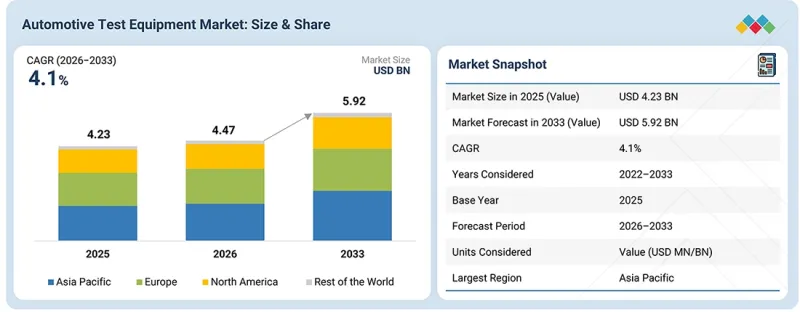
자동차용 시험 장비 시장 규모는 2026년 44억 7,000만 달러에서 2033년까지 59억 2,000만 달러로 성장하며, CAGR은 4.1%에 달할 것으로 예측됩니다.
| 조사 범위 | |
|---|---|
| 조사 대상 기간 | 2026-2033년 |
| 기준연도 | 2025년 |
| 예측 기간 | 2026-2033년 |
| 대상 단위 | 10억 달러 |
| 부문 | 장비별, 용도별, 차종별, 추진 방식별, 최종 시장별, 첨단 기술별, 지역별 |
| 대상 지역 | 아시아태평양, 북미, 유럽, 세계의 기타 지역 |
자동차 산업의 성장은 각 OEM 업체가 설정하는 더욱 엄격한 시험 규제와 높아지는 품질 기준에 의해 주도되고 있습니다. 이러한 기준은 부품 수준의 검증에서 포괄적인 차량 시험으로 그 범위를 확대하고 있습니다. ADAS, 전동 파워트레인, 커넥티드 기능, 소프트웨어 제어 섀시 시스템으로 인해 차량의 복잡성이 증가함에 따라 더욱 광범위한 시험이 필요해지고 있습니다. 여기에는 ADAS, ECU, 내구성, NVH, EMC 및 최종 라인 시험이 포함됩니다.
또한 OEM의 생산 시설 확장, 새로운 기술·연구개발 센터 설립, 정규 서비스 네트워크 확대, 그리고 노후화된 시험 장비의 현대화 및 갱신도 시장 성장을 지원하는 요인이 될 것입니다. 소프트웨어 정의 차량(SDV)으로의 전환에 따라 재현 가능한 시험 프로세스, 진단, 보정, 하드웨어-인-더-루프(HIL) 시험, 자동 검증 및 최종 라인 검사에 대한 수요가 증가할 것입니다.
인도 자동차 연구 협회(ARAI)의 ADAS 테스트 시티와 같은 최근 동향은, 통제되고 재현 가능한 차량 시험에 특화된 인프라가 확대되고 있음을 여실히 보여주고 있습니다. 서비스 수준에서는 차량에 탑재되는 전자 기기 및 센서의 증가에 따라 휠 얼라인먼트, 점검, 진단, 교정 및 기타 정비 공장용 시험 장비에 대한 수요가 높아지고 있습니다. 그 결과, OEM 공장, 1차 공급업체, 시험 센터, 딜러 및 독립 서비스 네트워크 전반에 걸쳐 수요가 확대될 것으로 예상됩니다. 자동 측정 기능, OEM 전용 데이터베이스, 소프트웨어 업데이트 및 통합 기능을 갖춘 장비에 대한 관심이 높아질 것입니다.
"ADAS의 보급으로 인해 센서 교정 및 차량 검증용 장비에 대한 수요가 확대되고 있습니다."
ADAS 시험 장비는 자동차 업계에서 급속한 성장이 예상되는 분야로 부상하고 있습니다. 이는 추진 방식에 관계없이 승용차 및 상용차 모두에서 카메라, 레이더, 라이더(LiDAR), 센서, 스티어링, 브레이크, 차량 제어 시스템 등 다양한 시스템을 정밀하게 검증해야 하기 때문입니다. 어댑티브 크루즈 컨트롤, 자동긴급제동, 차선 유지 보조, 주차 보조와 같은 기능의 채택이 확대됨에 따라 정적 및 동적 ADAS 보정, 센서 타겟 시스템, 레이더 및 카메라 시뮬레이션, 제어 하의 차량 시험에 대한 수요가 증가하고 있습니다. 인도 자동차 연구 협회(ARAI)는 재현 가능한 실제 상황 시나리오에서의 시험에 대한 이러한 증가하는 수요에 부응하기 위해, 인도 국내의 전용 ADAS 검증 인프라를 확충하고 있습니다.
또한 각 장비 공급업체들은 ADAS 테스트를 진단, 캘리브레이션, 차량 동역학, 자동 계측과 통합하고 있습니다. 이를 통해 OEM, Tier 1 공급업체, 딜러, 서비스 센터는 공통된 프레임워크 내에서 여러 검증 절차를 수행할 수 있게 됩니다. ADAS 기능의 범위가 다양한 차종으로 확대됨에 따라 이러한 동향은 단순히 추진 기술의 발전에 의존하는 것이 아니라 규제 요건, 안전 기준 및 캘리브레이션 요구 사항에 의해 점점 더 좌우될 것입니다.
"승용차는 플랫폼당 테스트 밀도가 높아짐에 따라 자동차 시장의 수요를 견인할 것으로 예상됩니다."
승용차는 자동차 시장에서 계속해서 가장 큰 부문를 차지할 전망입니다. 이는 각 OEM 업체들이 더 많은 차량 플랫폼과 변종을 출시하고 있는 데다, EV의 파워트레인, 배터리, ADAS, 브레이크 시스템, NVH, EMC, 전자기기 및 소프트웨어 제어 기능에 대한 시험 요구 사항이 증가하고 있기 때문입니다.
주요 OEM 각사는 사내에 대규모 시험 시설을 보유하고 있지만, 생산 공장 및 연구개발·기술 센터의 확대, 신차 프로그램의 증가, 그리고 구형 설비의 교체로 인해 AVL, HORIBA, dSPACE, Keysight Technologies, AB Dynamics, MAHA와 같은 시험 장비 제조사에 대한 수요는 지속될 전망입니다.
또한 TUV SUD나 DEKRA와 같은 독립계 시험 서비스 제공업체는 인증, 형식 승인, EMC, 배터리 시험, ADAS, 차량 검증 등의 분야에서 각 OEM 업체를 지원하게 될 것입니다. 그 결과, 시장은 단순히 자동차 생산 대수의 증가뿐만 아니라, 각 플랫폼에 대한 시험 요건의 강화, 사내 시험 역량의 확대, 신규 시설 건설, 설비 갱신 및 선택적 아웃소싱에 힘입어 성장할 것으로 예상됩니다.
"ADAS 안전 요건의 엄격화로 인해 유럽에서는 시나리오 기반 시뮬레이션 및 HIL 시험에 대한 수요가 증가하고 있습니다."
유럽에서는 ADAS에 대한 안전 요건의 강화에 따라 첨단 자동차 시험 장비에 대한 투자가 확대되고 있습니다. 이러한 요건으로 인해 자동긴급제동, 차선 유지 보조, 운전자 모니터링, 취약한 도로 이용자 감지 등의 기능 검증 프로세스가 확대되고 있습니다. 2026년을 향해 진화를 거듭하고 있는 Euro NCAP 프로토콜에서는 각 OEM 업체들이 다양한 교통 상황, 도로 이용자, 센서 고장, 극한 상황에 걸쳐 검증해야 하는 시나리오의 수와 복잡성이 증가하고 있습니다.
그 결과, 테스트는 시나리오 기반 시뮬레이션, HIL 테스트, 레이더 및 카메라용 타겟 시뮬레이터, 자동화된 시험장 시스템으로 점점 더 전환되고 있습니다. 예를 들어 2026년 8월 AB Dynamics는 eMpulse Test Systems를 인수하기 위해 1,100만 달러를 투자했으며, 최대 1,500만 달러를 추가로 지급할 가능성이 있습니다. 이러한 동향은 유럽의 자동차 제조사들이 제한적인 실차 테스트에서 시나리오 주도형 대규모 검증으로 전환하고 있음을 보여줍니다. 이러한 변화로 인해 HIL 플랫폼, 시나리오 생성 툴, 로봇 타겟 시스템 및 가상 형식 인증 솔루션에 대한 수요가 증가하고 있습니다.
자동차용 시험 장비 시장은 AVL(오스트리아), HORIBA Ltd.(일본), National Instruments(미국), Durr AG(독일), Robert Bosch GmbH(독일) 등 정평이 나 있는 시험 장비 제조사와 자동차 엔지니어링 기업이 주도하고 있습니다. 또한 OEM 및 1차 공급업체들도 전기자동차(EV), 배터리,ADAS, 전자기기 및 소프트웨어를 광범위하게 활용하는 차량 프로그램을 지원하기 위해 사내 시험 역량을 강화하고 있습니다. 시장 참여 기업은 경쟁력을 강화하기 위해 통합 테스트 셀, 고전압 파워트레인 시험, 자동 검증, HIL 및 가상 시험, 모듈형 계측 플랫폼, 생산 연계형 EOL 시스템에 주력하고 있습니다. 전략적 노력으로는 전기자동차 배터리 및 e-파워트레인 시험 시설에 대한 투자, OEM 및 Tier 1 공급업체와의 제휴, 자동 시험 역량 확대, 시험 하드웨어와 시뮬레이션, 데이터 수집 및 분석 플랫폼과의 통합 등이 있습니다.
조사 범위:
이 보고서에서는 장비별(섀시 동력계, 엔진 동력계, 변속기 동력계, 차량 배기가스 시험 시스템,휠 얼라인먼트 테스터, 연료 분사 펌프 테스터, 하드웨어 인 더 루프(HIL) 시험대, 배터리 시험 장치, 전동 모터 시험 장치, E-액슬 시험, 차량 충전·고전압 시험 시스템,EV 드라이브트레인 시험, 브레이크 시험 장비, NVH 시험 장비, ADAS 시험 장비, 내구성 시험 장비, EMC·환경 시험 장비, 기타),용도별(모바일/태블릿 기반 장비 및 PC/노트북 기반 장비), 추진 방식별(내연기관(ICE) 및 EV), 차종별(승용차 및 상용차), 최종 시장별(OEM 조립 공장, 연구개발/기술 센터 및 인증 서비스 센터),첨단 기술별(센서 시험, 지각 시스템 시험, ECU 시험, ADAS 시험, 시뮬레이션 시험, 엣지 컴퓨팅 및 V2X 시험), 그리고 지역별(아시아태평양, 유럽, 북미 및 기타 지역). 본 조사에서는 자동차용 시험 장비 시장의 경쟁 현황 및 주요 기업에 대한 개요도 포괄적으로 다루고 있습니다.
또한 본 조사에서는 시장내 주요 기업에 대한 상세한 경쟁 분석 외에도 기업 개요, 제품 및 사업 전개에 관한 주요 관찰 사항, 최근 동향, 주요 시장 전략에 대해서도 다루고 있습니다.
- 이 보고서는 자동차용 시험 장비 시장의 생태계 및 그 하위 부문별 매출에 대한 가장 정확한 추정치를 제공함으로써, 이 시장의 시장 리더와 신규 진입 기업을 지원합니다.
- 이 보고서는 이해관계자들이 경쟁 구도를 이해하고, 비즈니스 위치를 최적화하며, 적절한 시장 진입 전략을 수립하기 위한 추가적인 인사이트를 얻는 데 도움이 됩니다.
- 또한 이 보고서는 이해관계자가 시장 동향을 파악하고, 주요 시장 촉진요인, 시장 억제요인, 과제 및 기회에 대한 정보를 얻는 데 도움이 됩니다.
이 보고서는 다음 사항에 대한 인사이트를 제공합니다. :
- 주요 촉진요인(자동차용 전자기기 및 소프트웨어의 복잡화, 전동화에 따른 고전압 및 배터리 시험에 대한 투자 확대, ADAS의 보급 확대와 자동화 수준 향상, 안전·배기가스·사이버 보안에 관한 규제 강화, 그리고 차량 개발 주기 단축을 요구하는 OEM의 압력),제약 요인(하드웨어와 소프트웨어 테스트 환경 간의 통합 복잡성, 숙련된 전문 인력 부족으로 인한 고도화된 테스트 제약, 테스트 플랫폼 간의 표준화 부재, 그리고 고도화된 테스트 인프라의 높은 자본 비용),기회(소프트웨어 정의형 차량 테스트 플랫폼, EV 및 배터리 테스트, ADAS/AD 검증, AI를 활용한 자동 테스트, OTA 및 사이버 보안 검증, 신흥 시장의 테스트 인프라), 그리고 과제(주요 OEM의 독자적인 테스트 플랫폼 사내 개발, 자본 집약적인 테스트 장비의 긴 갱신 주기,하드웨어 의존형 테스트에서 소프트웨어 정의형 및 가상 검증으로의 전환, 그리고 대규모 테스트 데이터세트와 급속한 차량 아키텍처 변화로 인한 시스템 요구 사항 증가)
- 제품 개발 및 혁신: 자동차 테스트 장비 시장의 향후 기술, 연구개발 활동 및 신제품 출시에 대한 상세 인사이트.
- 시장 개발: 수익성이 높은 시장에 대한 포괄적인 정보. 이 보고서는 다양한 지역에 걸친 자동차용 시험 장비 시장을 분석합니다.
- 시장 다각화: 자동차용 시험 장비 시장의 신제품, 미개발 지역, 최근 동향 및 투자에 대한 포괄적인 정보를 제공합니다.
- 경쟁 평가: AVL(오스트리아), HORIBA Ltd.(일본), National Instruments(미국), Durr AG(독일), Robert Bosch GmbH(독일) 등 주요 기업의 시장 순위, 성장 전략 및 서비스 제공에 대한 상세한 평가.
자주 묻는 질문
목차
제1장 서론
제2장 개요
제3장 주요 인사이트
제4장 시장 개요
제5장 업계 동향
제6장 자동차 시험 장비 시장에서 기술 진보, AI에 의한 영향, 특허, 혁신, 향후 응용
제7장 지속가능성과 규제 상황
제8장 고객 상황과 구매 행동
제9장 자동차 시험 장비 시장(장비별)
제10장 자동차 시험 장비 시장(용도별)
제11장 자동차 시험 장비 시장(차종별)
제12장 자동차 시험 장비 시장(추진 방식별)
제13장 자동차 시험 장비 시장(최종 시장별)
제14장 자동차 시험 장비 시장(첨단 기술별)
제15장 자동차 시험 장비 시장(지역별)
제16장 경쟁 구도
제17장 기업 개요
제18장 조사 방법
제19장 부록
KSA 26.10.01The automotive test equipment market is projected to grow from USD 4.47 billion in 2026 to USD 5.92 billion by 2033, at a CAGR of 4.1%.
| Scope of the Report | |
|---|---|
| Years Considered for the Study | 2026-2033 |
| Base Year | 2025 |
| Forecast Period | 2026-2033 |
| Units Considered | USD billion |
| Segments | ICE & EV Equipment, Application, Vehicle, Propulsion, Technology, End Market & Region |
| Regions covered | Asia Pacific, North America, Europe, Rest of the World |
Growth in the automotive industry is being driven by stricter testing regulations and rising quality standards set by OEMs. These standards are extending from component-level validation to comprehensive vehicle testing. The increasing complexity of vehicles, driven by ADAS, electrified powertrains, connected functions, and software-controlled chassis systems, necessitates a broader range of testing. This includes ADAS, ECU, durability, NVH, EMC, and end-of-line testing.
Furthermore, growth will be fueled by the expansion of OEM production facilities, the establishment of new technical and R&D centers, the expansion of authorized service networks, and the modernization or replacement of aging test equipment. The transition towards software-defined vehicles will heighten the demand for repeatable testing processes, diagnostics, calibration, Hardware-in-the-Loop (HIL) testing, automated validation, and end-of-line inspections.
Recent developments, such as the Automotive Research Association of India's (ARAI) ADAS Test City, highlight the growing infrastructure dedicated to controlled and repeatable vehicle testing. At the service level, the rise in electronic and sensor content in vehicles is driving the need for wheel alignment, inspections, diagnostics, calibration, and other workshop testing equipment. Consequently, demand is expected to grow across OEM plants, Tier 1 suppliers, testing centers, dealerships, and independent service networks. There will be a greater emphasis on equipment that offers automated measurement, OEM-specific databases, software updates, and integration capabilities.
"ADAS adoption is expanding the demand for sensor calibration and vehicle validation equipment."
ADAS test equipment is rapidly emerging as a high-potential segment in the automotive industry. This is due to the need for precise validation of various systems, including cameras, radar, LiDAR, sensors, steering, braking, and vehicle control systems in both passenger and commercial vehicles, regardless of their propulsion type. The increasing adoption of features such as adaptive cruise control, automatic emergency braking, lane-keeping assistance, and parking assistance is driving demand for both static and dynamic ADAS calibration, sensor target systems, radar and camera simulations, and controlled vehicle testing. The Automotive Research Association of India (ARAI) is expanding its dedicated ADAS validation infrastructure in India to meet this growing need for repeatable real-world scenario testing.
Equipment suppliers are also integrating ADAS testing with diagnostics, calibration, vehicle dynamics, and automated measurements. This enables OEMs, Tier 1 suppliers, dealerships, and service centers to perform multiple validation procedures within a common framework. As the content of ADAS features expands across different vehicle models, it will increasingly be influenced by regulatory requirements, safety standards, and calibration needs, rather than solely depending on advancements in propulsion technologies.
"Passenger vehicles are expected to lead the demand market for vehicles through higher testing intensity per platform."
Passenger vehicles are expected to remain the largest segment in the vehicle market. This is due to OEMs launching more vehicle platforms and variants, as well as increasing testing requirements for EV powertrains, batteries, ADAS, braking systems, NVH, EMC, electronics, and software-controlled functions.
While major OEMs have significant in-house testing facilities, the growth of production plants, R&D and technical centers, new vehicle programs, and the replacement of outdated equipment will sustain demand for test equipment manufacturers such as AVL, HORIBA, dSPACE, Keysight Technologies, AB Dynamics, and MAHA.
Additionally, independent testing providers such as TUV SUD and DEKRA will support OEMs in areas including certification, homologation, EMC, battery testing, ADAS, and vehicle validation. As a result, the market is expected to grow due to increased testing requirements for each platform, the expansion of in-house testing capabilities, the construction of new facilities, equipment replacement, and selective outsourcing-rather than solely on increased vehicle production.
"Stricter ADAS safety requirements are driving the demand for scenario-based simulation and HIL testing in Europe."
Europe is ramping up investment in advanced automotive testing equipment due to stricter safety requirements for ADAS. These requirements are expanding validation processes for features such as automatic emergency braking, lane-keeping assistance, driver monitoring, and vulnerable road user detection. The evolving Euro NCAP protocols for 2026 introduce a greater number and complexity of scenarios that OEMs must validate across various traffic conditions, road users, sensor failures, and edge cases.
As a result, testing is increasingly shifting toward scenario-based simulation, HIL testing, radar and camera target simulators, and automated proving ground systems. For example, in August 2026, AB Dynamics invested USD 11 million to acquire eMpulse Test Systems, with an additional potential payment of up to USD 15 million. These developments indicate that OEMs in Europe are transitioning from limited physical testing to high-volume, scenario-driven validation. This shift is driving increased demand for HIL platforms, scenario-generation tools, robotic target systems, and virtual homologation solutions.
In-depth interviews were conducted with CEOs, marketing directors, other innovation and technology directors, and executives from various key organizations operating in this market.
- By Company Type: OEMs (50%), Tier 1 (30%), Test Service Providers (20%)
- By Designation: CXOs (20%), Directors(30%), Others (50%)
- By Country: Asia Pacific (40%), North America (25%), Europe (20%), and the Rest of the World (15%)
The automotive test equipment market is led by established test equipment manufacturers and automotive engineering companies, including AVL (Austria), HORIBA Ltd. (Japan), National Instruments (US), Durr AG (Germany), and Robert Bosch GmbH (Germany). OEMs and Tier 1 suppliers are also strengthening their internal testing capabilities to support EV, battery, ADAS, electronics, and software-intensive vehicle programs. Market participants are focusing on integrated test cells, high-voltage powertrain testing, automated validation, HIL and virtual testing, modular measurement platforms, and production-linked EOL systems to strengthen their competitive position. Strategic initiatives include investments in EV battery and e-powertrain test facilities, partnerships with OEMs and Tier 1 suppliers, expansion of automated testing capabilities, and integration of test hardware with simulation, data acquisition, and analytics platforms.
Research Coverage:
The report covers the market by equipment (chassis dynamometers, engine dynamometers, transmission dynamometers, vehicle emission test systems, wheel alignment testers, fuel injection pump testers, Hardware-in-the-Loop (HIL) test benches, battery test equipment, E-motor test equipment, E-axle testing, vehicle charging & high-voltage test systems, EV drivetrain testing, brake test equipment, NVH test equipment, ADAS test equipment, durability test equipment, EMC & environmental test equipment, and others), application (mobile/tablet-based equipment and PC/laptop-based equipment), propulsion (ICE and EVs), vehicle type (passenger cars and commercial vehicles), end market (OEM assembly plants, R&D/technical centers, and authorized service centers), advanced technology (sensor testing, perception system testing, ECU testing, ADAS testing, simulation testing, edge computing, and V2X testing), and region (Asia Pacific, Europe, North America, and the Rest of the World). It covers the competitive landscape and profiles of the major players in the automotive test equipment market.
The study also includes an in-depth competitive analysis of the key players in the market, along with their company profiles, key observations related to product and business offerings, recent developments, and key market strategies.
Key Benefits of Buying the Report:
- This report will help market leaders/new entrants in this market with information on the closest approximations of revenue numbers for the Automotive Test Equipment Market ecosystem and its subsegments.
- This report will help stakeholders understand the competitive landscape and gain more insights to better position their businesses and plan suitable go-to-market strategies.
- This report will also help stakeholders understand the market's pulse and provide information on key market drivers, restraints, challenges, and opportunities.
The report provides insight on the following pointers:
- Analysis of key drivers (increasing vehicle electronics and software complexity, electrification driving high-voltage and battery testing investment, growing ADAS penetration and higher automation levels, stricter safety, emissions, and cybersecurity regulations, and OEM pressure to shorten vehicle development cycles), restraints (integration complexity between hardware and software testing environments, limited skilled expertise constrains advanced testing, lack of standardization across testing platforms, and high capital cost of advanced testing infrastructure), opportunities (software-defined vehicle testing platforms, EV and battery testing or ADAS/AD validation, AI-enabled automated testing, OTA and cybersecurity validation, and emerging-market testing infrastructure), and challenges (in-house development of proprietary testing platforms by large OEMs, long replacement cycles for capital-intensive testing equipment, shift from hardware-intensive testing toward software-defined and virtual validation, and large test datasets and rapid vehicle architecture changes increase system requirements)
- Product Development/Innovation: Detailed insights into upcoming technologies, research & development activities, and product launches in the automotive test equipment market.
- Market Development: Comprehensive information about lucrative markets; the report analyzes the automotive test equipment market across varied regions.
- Market Diversification: Exhaustive information about new products, untapped geographies, recent developments, and investments in the automotive test equipment market.
- Competitive Assessment: In-depth assessment of market ranking, growth strategies, and service offerings of leading players like AVL (Austria), HORIBA Ltd. (Japan), National Instruments (US), Durr AG (Germany), and Robert Bosch GmbH (Germany).
TABLE OF CONTENTS
1 INTRODUCTION
- 1.1 STUDY OBJECTIVES
- 1.2 MARKET DEFINITION
- 1.2.1 INCLUSIONS AND EXCLUSIONS
- 1.3 STUDY SCOPE
- 1.3.1 MARKET SEGMENTATION AND REGIONAL SNAPSHOT
- 1.3.2 YEARS CONSIDERED
- 1.4 CURRENCY CONSIDERED
- 1.5 STAKEHOLDERS
- 1.6 SUMMARY OF CHANGES
2 EXECUTIVE SUMMARY
- 2.1 MARKET HIGHLIGHTS AND KEY INSIGHTS
- 2.2 KEY MARKET PARTICIPANTS: MAPPING OF STRATEGIC DEVELOPMENTS
- 2.3 DISRUPTIVE TRENDS IN AUTOMOTIVE TEST EQUIPMENT MARKET
- 2.4 HIGH-GROWTH SEGMENTS IN AUTOMOTIVE TEST EQUIPMENT MARKET
- 2.5 REGIONAL SNAPSHOT: MARKET SIZE, GROWTH RATE, AND FORECAST
3 PREMIUM INSIGHTS
- 3.1 ATTRACTIVE OPPORTUNITIES FOR PLAYERS IN AUTOMOTIVE TEST EQUIPMENT MARKET
- 3.2 AUTOMOTIVE TEST EQUIPMENT MARKET, BY EQUIPMENT TYPE
- 3.3 AUTOMOTIVE TEST EQUIPMENT MARKET, BY APPLICATION
- 3.4 AUTOMOTIVE TEST EQUIPMENT MARKET, VEHICLE TYPE
- 3.5 AUTOMOTIVE TEST EQUIPMENT MARKET, BY PROPULSION
- 3.6 AUTOMOTIVE TEST EQUIPMENT MARKET, BY END MARKET
4 MARKET OVERVIEW
- 4.1 INTRODUCTION
- 4.2 MARKET DYNAMICS
- 4.2.1 DRIVERS
- 4.2.1.1 Increasing vehicle electronics and software complexity
- 4.2.1.2 Electrification driving high-voltage and battery testing investment
- 4.2.1.3 Growing ADAS penetration and higher automation levels
- 4.2.1.4 Emissions regulations
- 4.2.1.5 OEM pressure to shorten vehicle development cycles
- 4.2.2 RESTRAINTS
- 4.2.2.1 Integration of complexity between hardware and software testing environments
- 4.2.2.2 Limited expertise constrains advanced testing
- 4.2.2.3 Lack of standardization across testing platforms
- 4.2.2.4 High capital cost of advanced testing infrastructure
- 4.2.3 OPPORTUNITIES
- 4.2.3.1 Software-defined vehicle (SDV) testing platforms
- 4.2.3.2 EV and battery testing and validation
- 4.2.3.3 OTA and cybersecurity validation
- 4.2.3.4 Emerging market testing infrastructure
- 4.2.4 CHALLENGES
- 4.2.4.1 In-house development of proprietary testing platforms by large OEMs
- 4.2.4.2 Long replacement cycles for capital-intensive test equipment
- 4.2.4.3 Large test datasets and rapid vehicle architecture changes increase system requirements
- 4.2.1 DRIVERS
- 4.3 UNMET NEEDS AND WHITE SPACES
- 4.3.1 LIMITED VALIDATION COVERAGE FOR COMPLEX E/E ARCHITECTURES AND SOFTWARE-DEFINED VEHICLES
- 4.3.2 HIGH COST AND LIMITED UTILIZATION OF ADVANCED TESTING INFRASTRUCTURE
- 4.3.3 FRAGMENTED TEST DATA AND LIMITED AUTOMATED FAILURE ANALYSIS
5 INDUSTRY TRENDS
- 5.1 MACROECONOMIC INDICATORS
- 5.1.1 INTRODUCTION
- 5.1.2 GDP TRENDS AND FORECAST
- 5.1.3 TRENDS IN AUTOMOTIVE TESTING, INSPECTION, AND CERTIFICATION (TIC) INDUSTRY
- 5.1.4 TRENDS IN GLOBAL AUTOMOTIVE INDUSTRY
- 5.2 SUPPLY CHAIN ANALYSIS
- 5.3 ECOSYSTEM ANALYSIS
- 5.3.1 RAW MATERIAL/COMPONENT SUPPLIERS
- 5.3.2 TEST EQUIPMENT MANUFACTURERS
- 5.3.3 TESTING SOFTWARE PROVIDERS
- 5.3.4 SIMULATION TOOL PROVIDERS
- 5.3.5 THIRD-PARTY TESTING SERVICE PROVIDERS
- 5.3.6 END USERS
- 5.4 PRICING ANALYSIS
- 5.4.1 BY VEHICLE TYPE
- 5.4.2 PRICING ANALYSIS, BY EQUIPMENT AND REGION
- 5.5 TRADE ANALYSIS
- 5.5.1 IMPORT SCENARIO (HS CODE 903180)
- 5.5.2 EXPORT SCENARIO (HS CODE 903180)
- 5.6 KEY CONFERENCES & EVENTS, 2026-2027
- 5.7 TRENDS & DISRUPTIONS IMPACTING CUSTOMER BUSINESS
- 5.8 INVESTMENT AND FUNDING SCENARIO
- 5.9 CASE STUDY ANALYSIS
- 5.9.1 NOVELIC DEVELOPED HIGHLY PROGRAMMABLE AND CONFIGURABLE HIGH-SPEED DATA LOGGER PLATFORM TO ENABLE LOW-LATENCY DATA STREAMING
- 5.9.2 BRIGGS & STRATTON UTILIZED SIEMENS' FLEXIBLE AND INTUITIVE SIMCENTER TESTLAB SOFTWARE TO INTEGRATE SOFTWARE AND HARDWARE TESTING INTO SEAMLESS WORKFLOW
- 5.9.3 MAN TRUCK & BUS DEPLOYED VECTOR INDIGO TO OPTIMIZE DIAGNOSTIC VALIDATION AND TESTING PROCESSES
- 5.9.4 AVL DEVELOPED HIGH-VOLTAGE BATTERY TEST SYSTEM TO ACCELERATE EV BATTERY VALIDATION
- 5.9.5 HORIBA DEVELOPED INTEGRATED ELECTRIC POWERTRAIN TEST SYSTEM TO IMPROVE ELECTRIFIED DRIVELINE VALIDATION
- 5.10 STARTUP AND SME INNOVATIONS IN AUTOMOTIVE TESTING
- 5.11 REGIONAL INVESTMENT HOTSPOTS: LOCALIZED TESTING CAPABILITIES & COST ADVANTAGES
- 5.12 CAPEX OPTIMIZATION AND VALUE GENERATION ACROSS KEY AUTOMOTIVE TEST EQUIPMENT END USERS
- 5.12.1 CAPEX OPTIMIZATION FOR CHASSIS DYNAMOMETER
- 5.12.2 CAPEX OPTIMIZATION FOR EV DRIVETRAIN TESTING
- 5.12.3 CAPEX OPTIMIZATION FOR BATTERY TEST EQUIPMENT
- 5.12.4 CAPEX OPTIMIZATION FOR E-MOTOR TEST EQUIPMENT
- 5.13 OEM STRATEGIES IN AUTOMOTIVE TESTING
- 5.14 IMPACT OF ISRAEL-IRAN WAR
- 5.14.1 INTRODUCTION
- 5.14.2 ENERGY MARKET DISRUPTION
- 5.14.3 OPERATING COST IMPACT
- 5.14.4 MARKET DEMAND SHIFT
- 5.14.5 SUPPLY CHAIN AND LOCALIZATION IMPACT
- 5.14.6 STRATEGIC MARKET OUTLOOK
- 5.15 EU-INDIA TRADE DEAL IMPACT ANALYSIS
- 5.15.1 INTRODUCTION
- 5.15.2 EU TARIFFS
- 5.15.3 RECENT AUTOMOTIVE TEST CENTERS OPENED/EXPANDED
6 TECHNOLOGICAL ADVANCEMENTS, AI-DRIVEN IMPACT, PATENTS, INNOVATIONS, AND FUTURE APPLICATIONS IN AUTOMOTIVE TEST EQUIPMENT MARKET
- 6.1 TECHNOLOGY ANALYSIS
- 6.1.1 KEY TECHNOLOGIES
- 6.1.1.1 E-motor test benches
- 6.1.1.2 Battery test systems
- 6.1.1.3 Battery emulation and EV testing
- 6.1.1.4 Software in the Loop (SiL )
- 6.1.1.5 Vehicle network simulation
- 6.1.2 COMPLEMENTARY TECHNOLOGIES
- 6.1.2.1 Simulation and modeling software
- 6.1.2.2 Data acquisition & analytics (DAQ & analytics)
- 6.1.2.3 Digital twins
- 6.1.2.4 AI-enabled test automation
- 6.1.3 ADJACENT TECHNOLOGIES
- 6.1.3.1 Cybersecurity testing tools
- 6.1.3.2 Autonomous driving test ecosystem
- 6.1.3.3 Cloud connected test management
- 6.1.1 KEY TECHNOLOGIES
- 6.2 PATENT ANALYSIS
- 6.3 IMPACT OF AI/GEN AI ON AUTOMOTIVE TEST EQUIPMENT MARKET
- 6.3.1 AUTOMOTIVE TESTING STRATEGIES ADOPTED BY OEMS
- 6.3.2 IN-HOUSE VS. OUTSOURCED TESTING
- 6.3.3 TESTING INFRASTRUCTURE DIGITIZATION
- 6.3.4 END-OF-LINE (EOL) AUTOMATION
- 6.3.5 MODULAR AND SCALABLE TEST PLATFORMS
- 6.3.6 SDV AND CYBERSECURITY TESTING
- 6.3.7 GLOBAL R&D MANUFACTURING NETWORK INTEGRATION
- 6.3.8 STANDARDIZATION AND REGULATORY READINESS
- 6.3.9 PARTNERSHIP WITH TEST EQUIPMENT SUPPLIERS
- 6.3.10 SUSTAINABILITY AND ENERGY-EFFICIENT TESTING
- 6.3.11 ARTIFICIAL INTELLIGENCE AND PREDICTIVE TESTING MODELS
- 6.4 TOP USE CASES AND MARKET POTENTIAL
- 6.4.1 KEY AI/GENERATIVE AI USE CASES IN AUTOMOTIVE TEST EQUIPMENT MARKET
- 6.4.2 MARKET POTENTIAL
- 6.4.3 BEST PRACTICES FOLLOWED BY MANUFACTURERS/OEMS IN AUTOMOTIVE TEST EQUIPMENT MARKET
- 6.4.3.1 AI-driven integration patterns
- 6.4.4 CASE STUDIES RELATED TO AI IMPLEMENTATION IN AUTOMOTIVE TEST EQUIPMENT MARKET
- 6.4.4.1 AI-driven test optimization and predictive validation
- 6.4.4.2 AI-driven predictive maintenance of test equipment
- 6.4.4.3 Generative AI-driven test case and scenario generation
- 6.4.5 INTERCONNECTED ECOSYSTEM AND IMPACT ON MARKET PLAYERS
- 6.4.6 CLIENTS' READINESS TO ADOPT AI-INTEGRATED AUTOMOTIVE TEST EQUIPMENT SOLUTIONS
7 SUSTAINABILITY AND REGULATORY LANDSCAPE
- 7.1 REGULATORY LANDSCAPE
- 7.1.1 COUNTRY-WISE REGULATIONS
- 7.1.2 REGULATORY BODIES, GOVERNMENT AGENCIES, AND OTHER ORGANIZATIONS
- 7.1.3 INDUSTRY STANDARDS
- 7.2 SUSTAINABILITY INITIATIVES
- 7.2.1 SUSTAINABILITY IMPACT AND REGULATORY POLICY INITIATIVES
- 7.2.2 CERTIFICATION, LABELING, AND ECO-STANDARDS
- 7.2.2.1 Certification, labelling, and environmental standards relevant to automotive test equipment market
8 CUSTOMER LANDSCAPE AND BUYING BEHAVIOR
- 8.1 DECISION-MAKING PROCESS
- 8.2 KEY STAKEHOLDERS AND BUYING CRITERIA
- 8.2.1 MOBILE/TABLET-BASED EQUIPMENT
- 8.2.2 PC/LAPTOP-BASED EQUIPMENT
- 8.2.3 KEY STAKEHOLDERS IN BUYING PROCESS
- 8.2.4 BUYING CRITERIA
- 8.3 ADOPTION BARRIERS & INTERNAL CHALLENGES
- 8.4 UNMET NEEDS OF VARIOUS END USERS
9 AUTOMOTIVE TEST EQUIPMENT MARKET, BY EQUIPMENT
- 9.1 INTRODUCTION
- 9.2 ENGINE DYNAMOMETER
- 9.2.1 DEMAND FOR POWERTRAIN VALIDATION, EMISSIONS COMPLIANCE, AND HYBRID ENGINE TESTING TO SUPPORT MARKET GROWTH
- 9.3 CHASSIS DYNAMOMETER
- 9.3.1 STRICTER EMISSION AND VEHICLE PERFORMANCE REQUIREMENTS TO BOOST ADOPTION
- 9.4 VEHICLE EMISSION TEST SYSTEM
- 9.4.1 STRINGENT REGULATIONS, AIR QUALITY FOCUS, AND HYBRID VEHICLE ADOPTION TO DRIVE MARKET
- 9.5 WHEEL ALIGNMENT TESTER
- 9.5.1 INCREASING ADOPTION OF AUTOMATED VEHICLES AND PRECISION DRIVETRAIN TESTING TO DRIVE MARKET
- 9.6 TRANSMISSION DYNAMOMETER
- 9.6.1 HIGH VEHICLE PARC, OEM SERVICE EXPANSION, AND POWERTRAIN SHIFT TO DRIVE MARKET
- 9.7 FUEL INJECTION PUMP TESTER
- 9.7.1 HYBRID POWERTRAIN RETENTION AND DIESEL AFTERMARKET DEMAND TO SUPPORT GROWTH
- 9.8 BATTERY TEST EQUIPMENT
- 9.8.1 RISING HIGH VOLTAGE, FAST CHARGING, AND BATTERY SAFETY REQUIREMENTS TO DRIVE MARKET
- 9.9 E-MOTOR TEST EQUIPMENT
- 9.9.1 RISING EV PRODUCTION AND HIGH-VOLTAGE E-MOTOR DEVELOPMENT TO DRIVE MARKET
- 9.10 E-AXLE TESTING
- 9.10.1 GROWING DEMAND FOR LIFECYCLE TESTING OF E-AXLES IN FLEET AND SHARED MOBILITY EVS TO DRIVE MARKET
- 9.11 EV DRIVETRAIN TESTING
- 9.11.1 NEXT-GEN VALIDATION IN EV DRIVETRAINS TO DRIVE MARKET
- 9.12 HARDWARE-IN-THE-LOOP (HIL) TESTING
- 9.12.1 RISING SOFTWARE COMPLEXITY AND REAL TIME ECU VALIDATION REQUIREMENTS TO DRIVE MARKET
- 9.13 VEHICLE CHARGING & HIGH-VOLTAGE TEST SYSTEM
- 9.13.1 HIGH-VOLTAGE BATTERY PACKS AND V2G CAPABILITIES IN EVS TO DRIVE MARKET
- 9.14 BRAKE TEST EQUIPMENT
- 9.14.1 ADVANCED BRAKING SYSTEMS AND ELECTRIFICATION TO DRIVE MARKET
- 9.15 NOISE, VIBRATION, AND HARSHNESS (NVH) TEST EQUIPMENT
- 9.15.1 EV POWERTRAIN COMPLEXITY AND LOW NOISE REQUIREMENTS TO DRIVE MARKET
- 9.16 ADAS TEST EQUIPMENT
- 9.16.1 INCREASING SENSOR COMPLEXITY AND AUTOMATED DRIVING VALIDATION TO DRIVE MARKET
- 9.17 DURABILITY TEST EQUIPMENT
- 9.17.1 EV POWERTRAIN COMPLEXITY AND LONGER VALIDATION REQUIREMENTS TO DRIVE MARKET
- 9.18 ELECTROMAGNETIC COMPATIBILITY (EMC) & ENVIRONMENTAL TEST EQUIPMENT
- 9.18.1 ELECTRIFICATION AND CONNECTED VEHICLE COMPLEXITY TO DRIVE MARKET
- 9.19 OTHERS
- 9.20 KEY PRIMARY INSIGHTS
10 AUTOMOTIVE TEST EQUIPMENT MARKET, BY APPLICATION
- 10.1 INTRODUCTION
- 10.2 MOBILE/TABLET-BASED EQUIPMENT
- 10.2.1 RISING CONNECTED VEHICLE COMPLEXITY AND EV DIAGNOSTICS TO DRIVE GROWTH
- 10.3 PC/LAPTOP-BASED EQUIPMENT
- 10.3.1 HIGH COMPUTATIONAL POWER AND MULTI-SYSTEM INTEGRATION TO DRIVE MARKET
- 10.4 KEY PRIMARY INSIGHTS
11 AUTOMOTIVE TEST EQUIPMENT MARKET, BY VEHICLE TYPE
- 11.1 INTRODUCTION
- 11.1.1 COMPARISON OF TEST EQUIPMENT SPECIFICATIONS IN PASSENGER CAR AND COMMERCIAL VEHICLE
- 11.2 PASSENGER CAR
- 11.2.1 ADVANCEMENTS IN ADAS AND AUTONOMOUS DRIVING TECHNOLOGIES TO DRIVE MARKET
- 11.3 COMMERCIAL VEHICLE
- 11.3.1 INCREASING DEMAND FOR HEAVY-DUTY CHASSIS AND ENGINE DYNAMOMETERS TO DRIVE MARKET
- 11.3.2 LIGHT COMMERCIAL VEHICLE
- 11.3.3 HEAVY COMMERCIAL VEHICLE
- 11.4 KEY PRIMARY INSIGHTS
12 AUTOMOTIVE TEST EQUIPMENT MARKET, BY PROPULSION
- 12.1 INTRODUCTION
- 12.2 INTERNAL COMBUSTION ENGINE (ICE)
- 12.2.1 ADVANCEMENTS IN ENGINE TECHNOLOGIES AND STRICT EMISSION REGULATIONS TO DRIVE MARKET
- 12.3 EV
- 12.3.1 INCREASING DEMAND FOR ADVANCED BATTERY TESTING TO DRIVE MARKET
- 12.4 KEY PRIMARY INSIGHTS
13 AUTOMOTIVE TEST EQUIPMENT MARKET, BY END MARKET
- 13.1 INTRODUCTION
- 13.2 AUTHORIZED SERVICE CENTER
- 13.2.1 RISING DEMAND FOR WHEEL ALIGNMENT TESTERS TO DRIVE MARKET
- 13.3 OEM ASSEMBLY PLANT
- 13.3.1 AUTOMATED END-OF-LINE TESTING AND PLANT MODERNIZATION TO DRIVE MARKET
- 13.4 R&D/TECHNICAL CENTER
- 13.4.1 DEMAND FOR ADVANCED ADAS AND AUTONOMOUS SYSTEM TESTING TECHNOLOGIES TO DRIVE MARKET
- 13.5 KEY PRIMARY INSIGHTS
14 AUTOMOTIVE TEST EQUIPMENT MARKET, BY ADVANCED TECHNOLOGY
- 14.1 INTRODUCTION
- 14.2 ECU TESTING
- 14.3 DATA LOGGER
- 14.4 SIMULATION TESTING
- 14.4.1 CRASH IMPACT SIMULATION
- 14.4.2 AUTONOMOUS DRIVING SIMULATOR
- 14.5 SENSOR TESTING
- 14.6 PERCEPTION SYSTEM TESTING
- 14.7 EDGE COMPUTING
- 14.8 V2X TESTING
- 14.9 KEY PRIMARY INSIGHTS
15 AUTOMOTIVE TEST EQUIPMENT MARKET, BY REGION
- 15.1 INTRODUCTION
- 15.2 ASIA PACIFIC
- 15.2.1 CHINA
- 15.2.1.1 Adoption of expansion strategy by OEMs to drive market
- 15.2.2 INDIA
- 15.2.2.1 Rapid expansion of authorized service centers to foster growth
- 15.2.3 JAPAN
- 15.2.3.1 Assembly plant growth and rise in R&D investments to drive market
- 15.2.4 SOUTH KOREA
- 15.2.4.1 Heavy investments in advanced battery test equipment to boost market
- 15.2.5 REST OF ASIA PACIFIC
- 15.2.1 CHINA
- 15.3 EUROPE
- 15.3.1 FRANCE
- 15.3.1.1 EV adoption and stricter regulations accelerate demand
- 15.3.2 GERMANY
- 15.3.2.1 R&D and ADAS investments to expand demand
- 15.3.3 ITALY
- 15.3.3.1 Hybrid production and EV testing to drive demand
- 15.3.4 SPAIN
- 15.3.4.1 Advanced testing and quality assurance drive growth
- 15.3.5 UK
- 15.3.5.1 High voltage validation and ADAS protocols to reshape demand
- 15.3.6 REST OF EUROPE
- 15.3.1 FRANCE
- 15.4 NORTH AMERICA
- 15.4.1 CANADA
- 15.4.1.1 Localized EV testing capabilities to strengthen battery and powertrain equipment demand
- 15.4.2 MEXICO
- 15.4.2.1 Testing capacity to expand with rising OEM validation demand
- 15.4.3 US
- 15.4.3.1 Advanced dynamometer deployment to accelerate EV powertrain validation
- 15.4.1 CANADA
- 15.5 REST OF THE WORLD
- 15.5.1 BRAZIL
- 15.5.1.1 Production localization to strengthen automotive testing demand
- 15.5.2 RUSSIA
- 15.5.2.1 Import substitution and localized validation infrastructure to strengthen demand
- 15.5.3 OTHERS
- 15.5.1 BRAZIL
16 COMPETITIVE LANDSCAPE
- 16.1 INTRODUCTION
- 16.2 KEY PLAYER STRATEGIES/RIGHT TO WIN
- 16.3 MARKET SHARE ANALYSIS, 2025
- 16.4 REVENUE ANALYSIS, 2022-2025
- 16.5 COMPANY VALUATION AND FINANCIAL METRICS
- 16.6 BRAND/PRODUCT COMPARISON
- 16.7 COMPANY EVALUATION MATRIX: KEY PLAYERS, 2025
- 16.7.1 STARS
- 16.7.2 EMERGING LEADERS
- 16.7.3 PERVASIVE PLAYERS
- 16.7.4 PARTICIPANTS
- 16.7.5 COMPANY FOOTPRINT
- 16.7.5.1 Company footprint
- 16.7.5.2 Region footprint
- 16.7.5.3 Equipment footprint
- 16.7.5.4 Vehicle type footprint
- 16.8 COMPANY EVALUATION MATRIX: STARTUPS/SMES, 2025
- 16.8.1 PROGRESSIVE COMPANIES
- 16.8.2 RESPONSIVE COMPANIES
- 16.8.3 DYNAMIC COMPANIES
- 16.8.4 STARTING BLOCKS
- 16.8.5 COMPETITIVE BENCHMARKING
- 16.8.5.1 List of startups/SMEs
- 16.8.5.2 Competitive benchmarking of startups/SMEs
- 16.9 COMPETITIVE SCENARIO
- 16.9.1 PRODUCT LAUNCHES/DEVELOPMENTS
- 16.9.2 DEALS
- 16.9.3 EXPANSIONS
- 16.9.4 OTHER DEVELOPMENTS
17 COMPANY PROFILES
- 17.1 KEY PLAYERS
- 17.1.1 AVL
- 17.1.1.1 Business overview
- 17.1.1.2 Products offered
- 17.1.1.3 Recent developments
- 17.1.1.3.1 Product launches/developments
- 17.1.1.3.2 Deals
- 17.1.1.3.3 Expansions
- 17.1.1.3.4 Other developments
- 17.1.1.4 MnM view
- 17.1.1.4.1 Key strengths
- 17.1.1.4.2 Strategic choices
- 17.1.1.4.3 Weaknesses and competitive threats
- 17.1.2 HORIBA GROUP
- 17.1.2.1 Business overview
- 17.1.2.2 Products offered
- 17.1.2.3 Recent developments
- 17.1.2.3.1 Product launches/developments
- 17.1.2.3.2 Deals
- 17.1.2.3.3 Expansions
- 17.1.2.3.4 Other developments
- 17.1.2.4 MnM view
- 17.1.2.4.1 Key strengths
- 17.1.2.4.2 Strategic choices
- 17.1.2.4.3 Weaknesses and competitive threats
- 17.1.3 NATIONAL INSTRUMENTS
- 17.1.3.1 Business overview
- 17.1.3.2 Products offered
- 17.1.3.3 Recent developments
- 17.1.3.3.1 Product launches/developments
- 17.1.3.3.2 Deals
- 17.1.3.4 MnM view
- 17.1.3.4.1 Key strengths
- 17.1.3.4.2 Strategic choices
- 17.1.3.4.3 Weaknesses and competitive threats
- 17.1.4 DURR GROUP
- 17.1.4.1 Business overview
- 17.1.4.2 Products offered
- 17.1.4.3 Recent developments
- 17.1.4.3.1 Product launches/developments
- 17.1.4.3.2 Deals
- 17.1.4.3.3 Expansions
- 17.1.4.3.4 Other developments
- 17.1.4.4 MnM view
- 17.1.4.4.1 Key strengths
- 17.1.4.4.2 Strategic choices
- 17.1.4.4.3 Weaknesses and competitive threats
- 17.1.5 ROBERT BOSCH GMBH
- 17.1.5.1 Business overview
- 17.1.5.2 Products offered
- 17.1.5.3 Recent developments
- 17.1.5.3.1 Product launches/developments
- 17.1.5.3.2 Deals
- 17.1.5.3.3 Other developments
- 17.1.5.4 MnM view
- 17.1.5.4.1 Key strengths
- 17.1.5.4.2 Strategic choices
- 17.1.5.4.3 Weaknesses and competitive threats
- 17.1.6 PHINIA INC.
- 17.1.6.1 Business overview
- 17.1.6.2 Products offered
- 17.1.6.3 Recent developments
- 17.1.6.3.1 Product launches/developments
- 17.1.6.3.2 Deals
- 17.1.6.3.3 Other developments
- 17.1.7 ILLINOIS TOOL WORKS INC.
- 17.1.7.1 Business overview
- 17.1.7.2 Products offered
- 17.1.7.3 Recent developments
- 17.1.7.3.1 Deals
- 17.1.7.3.2 Other developments
- 17.1.8 SIEMENS
- 17.1.8.1 Business overview
- 17.1.8.2 Products offered
- 17.1.8.3 Recent developments
- 17.1.8.3.1 Product launches/developments
- 17.1.8.3.2 Deals
- 17.1.9 CONTINENTAL AG
- 17.1.9.1 Business overview
- 17.1.9.2 Products offered
- 17.1.9.3 Recent developments
- 17.1.9.3.1 Deals
- 17.1.9.3.2 Expansions
- 17.1.9.3.3 Other developments
- 17.1.10 VECTOR INFORMATIK GMBH
- 17.1.10.1 Business overview
- 17.1.10.2 Products offered
- 17.1.10.3 Recent developments
- 17.1.10.3.1 Product launches/enhancements
- 17.1.10.3.2 Deals
- 17.1.11 SOFTING AG
- 17.1.11.1 Business overview
- 17.1.11.2 Products offered
- 17.1.11.3 Recent developments
- 17.1.11.3.1 Other developments
- 17.1.12 MUSTANG ADVANCED ENGINEERING
- 17.1.12.1 Business overview
- 17.1.12.2 Products offered
- 17.1.12.3 Recent developments
- 17.1.12.3.1 Product developments
- 17.1.12.3.2 Deals
- 17.1.12.3.3 Expansions
- 17.1.12.3.4 Other developments
- 17.1.13 SCHAEFFLER AG
- 17.1.13.1 Business overview
- 17.1.13.2 Products offered
- 17.1.13.3 Recent developments
- 17.1.13.3.1 Deals
- 17.1.14 MAHA MASCHINENBAU HALDENWANG GMBH & CO. KG
- 17.1.14.1 Business overview
- 17.1.14.2 Products offered
- 17.1.14.3 Recent developments
- 17.1.14.3.1 Deals
- 17.1.14.3.2 Other developments
- 17.1.15 MULLER AUTOMOTIVE
- 17.1.15.1 Business overview
- 17.1.15.2 Products offered
- 17.1.1 AVL
- 17.2 OTHER PLAYERS
- 17.2.1 INTERTEK GROUP PLC
- 17.2.2 TUV SUD
- 17.2.3 ROHDE & SCHWARZ
- 17.2.4 SINFONIA TECHNOLOGY CO., LTD.
- 17.2.5 AMPRO TESTING MACHINES
- 17.2.6 AMETEK CTS
- 17.2.7 AUTEL INTELLIGENT TECHNOLOGY CORP., LTD.
- 17.2.8 NSM INDUSTRIAL SOLUTIONS PVT LTD
- 17.2.9 DSA DATEN- UND SYSTEMTECHNIK GMBH
- 17.2.10 IPETRONIK GMBH & CO. KG
- 17.2.11 HUFF TECHNOLOGIES
- 17.2.12 DYNO ONE INC.
- 17.2.13 DRIVE SYSTEM DESIGN
- 17.2.14 ANTHONY BEST DYNAMICS LIMITED
- 17.2.15 SAJ TEST PLANT PVT. LTD.
- 17.2.16 MAXEYE TECHNOLOGIES
18 RESEARCH METHODOLOGY
- 18.1 RESEARCH DATA
- 18.1.1 SECONDARY DATA
- 18.1.2 KEY SECONDARY SOURCES
- 18.1.2.1 List of secondary sources
- 18.1.2.2 Key data from secondary sources
- 18.1.3 PRIMARY DATA
- 18.1.3.1 Primary interviews - demand and supply sides
- 18.1.3.2 Key industry insights and breakdown of primary interviews
- 18.1.3.3 List of primary participants
- 18.2 MARKET SIZE ESTIMATION
- 18.2.1 TOP-DOWN APPROACH
- 18.3 DATA TRIANGULATION
- 18.4 FACTOR ANALYSIS
- 18.5 RESEARCH ASSUMPTIONS
- 18.6 RESEARCH LIMITATIONS
- 18.7 RISK ASSESSMENT
19 APPENDIX
- 19.1 KEY INSIGHTS OF INDUSTRY EXPERTS
- 19.2 DISCUSSION GUIDE
- 19.3 KNOWLEDGESTORE: MARKETSANDMARKETS' SUBSCRIPTION PORTAL
- 19.4 CUSTOMIZATION OPTIONS
- 19.4.1 AUTOMOTIVE TEST EQUIPMENT MARKET, BY PROPULSION, AT THE COUNTRY LEVEL
- 19.4.2 ADDITIONAL COUNTRIES MAPPING OF (UP TO THREE IN THE REPORT)
- 19.4.3 COMPANY INFORMATION
- 19.4.3.1 Profiles of additional market players (up to five)
- 19.5 RELATED REPORTS
- 19.6 AUTHOR DETAILS


