

|
시장보고서
상품코드
2134054
바닥 난방 시장 : 제품 유형별(매니폴드 & 밸브, 존 밸브, 난방용 배관, 배선 센터, 서멀 액추에이터, 난방용 케이블, 매트, 서모스탯 & 센서), 설치 구분별(신축, 개조), 제공별, 지역별 - 세계 예측(-2032년)Underfloor Heating Market by Product Type (Manifolds & Valves, Zone Valves, Heating Pipes, Wiring Centers, Thermal Actuators, Heating Cables, Mats, Thermostats & Sensors), Installation (New, Retrofit), Offering, and Region - Global Forecast to 2032 |
||||||

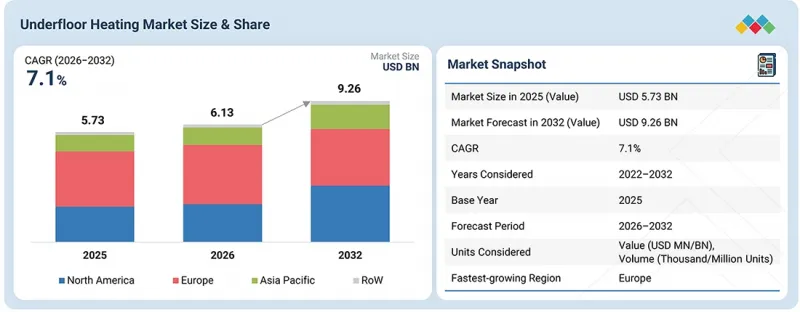
세계의 바닥 난방 시장 규모는 2026년에 61억 3,000만 달러에서 2032년에는 92억 6,000만 달러에 달할 것으로 예측되며, CAGR은 7.1%를 기록할 전망입니다.
현대 시설에서는 복잡한 실내 환경에서 지속적인 저온 열 관리가 요구됨에 따라, 에너지 절약 건축 기준의 보급에 힘입어 바닥 난방 시스템에 대한 수요가 증가하고 있습니다. 또한, 스마트홈오토메이션, IoT 지원 온도 조절기, 공기-물식 히트 펌프에 대한 관심이 높아지는 가운데, 시스템의 균형 조정 요구 사항이 크게 증가하고 있어 신뢰성이 높고 구역별로 온도 조절이 가능한 시스템에 대한 수요가 높아지고 있습니다. 부적절하거나 불균일한 열 분포는 실내 쾌적성을 저해하고, 운영 시 에너지 효율을 떨어뜨리며, 공과금 증가를 초래할 가능성이 있습니다.
| 조사 범위 | |
|---|---|
| 조사 대상 기간 | 2021-2032년 |
| 기준 연도 | 2025년 |
| 예측 기간 | 2026-2032년 |
| 단위 | 금액(달러) |
| 부문 | 제품 유형, 설치 구분, 제공, 지역별 |
| 대상 지역 | 북미, 유럽, 아시아태평양, 기타 지역 |
그 결과, 특히 현대적인 주택 및 상업 시설에서 건물 운영자 및 부동산 소유주는 열적 정밀도를 유지하고, 건물의 에너지 소비량을 줄이며, 엄격한 환경 건축 기준을 준수하기 위해 첨단 배관 매니폴드,가교 폴리에틸렌(PEX) 배관, 멀티존 디지털 온도 조절기를 도입하고 있습니다.
“2026년부터 2032년까지 서비스 부문이 가장 높은 연평균 성장률(CAGR)을 기록할 전망”
서비스 부문은 전문적인 시스템 설계, 정밀한 설치, 장기적인 유지보수 지원에 대한 수요가 증가하고 있어, 예측 기간 동안 가장 빠른 성장을 이룰 것으로 전망됩니다. 현대적인 바닥 난방 시스템(특히 복잡한 온수 배관 네트워크나 일체형 전기 히터 매트)에서는 다양한 바닥재와 구조 하부층 전체에 걸쳐 균일한 열 분포를 확보하기 위해 전문적인 엔지니어링이 필요합니다. 이러한 전문 지식은 주택 리모델링, 대규모 상업 시설, 의료 시설 등 고효율 적용 분야에서 매우 중요합니다. 이러한 장소에서는 바닥 아래에 부적절하게 설치할 경우 에너지 성능 저하 및 고액의 구조 보수 비용으로 이어질 우려가 있습니다. 건물의 탈탄소화 정책과 그린 빌딩 기준에 힘입어 저온 난방 인프라가 확대됨에 따라, 시스템 밸런스 조정 및 압력 시험 설정이 필수적입니다. 또한, 전문 서비스에서는 지속적인 진단 지원, 온수 매니폴드의 밸런스 조정, 자동화된 스마트홈 공조 플랫폼과의 통합 등이 제공되고 있습니다.
“주거 부문이 2025년에 가장 큰 점유율을 기록”
이는 주택 건축 분야에서 에너지 효율이 높은 공조 제어와 균일한 열 분포가 널리 요구되고 있기 때문입니다. 현대 주택 개발에서는 공기-물 히트 펌프, 멀티존 물 순환 매니폴드, 슬림형 건식 리모델링 패널, 스마트 IoT 온도 조절기 등의 통합형 건축 기술이 지속적으로 도입되고 있습니다. 이러한 용도에서는 에너지 효율을 최적화하고, 에너지 비용을 절감하며, 쾌적한 주거 환경을 실현하기 위해 균형 잡힌 유체 순환과 정밀한 온도 조절이 요구됩니다. 단독주택, 공동주택, 주택 개조 프로젝트에서 건물의 탈탄소화에 관한 규제 도입이 확대되고 있는 점에서도, 신뢰성이 높은 전용 복사식 바닥 난방 인프라에 대한 안정적인 수요가 발생하고 있습니다.
“2026년부터 2032년까지 북미의 바닥 난방 시장이 놀라운 성장률을 보일 전망”
지역별로 보면 북미는 예측 기간 동안 성장률이 두 번째로 높은 지역이 될 것으로 예상됩니다. 이 지역의 시장은 특히 주택 리모델링, 신축 주택, 고급 상업 시설을 중심으로 에너지 효율이 높고 쾌적성이 뛰어난 난방 솔루션에 대한 수요 증가에 힘입어 성장하고 있습니다. 열펌프 및 기타 저탄소 난방 기술의 도입 확대는 더 낮은 수온에서도 효율적으로 가동할 수 있는 온수식 바닥 난방 시스템과 시너지 효과를 창출하고 있습니다. 동시에, 엄격한 에너지 효율 요건과 건축물 성능에 대한 중요성이 높아짐에 따라, 개발업자와 주택 소유주들은 에너지 소비를 줄이고 열적 쾌적성을 향상시킬 수 있는 통합형 난방 솔루션 도입을 검토하고 있습니다. 특히 미국과 캐나다의 한랭 지역에서는 노후화된 건축물의 개보수가 진행되고 있으며, 이는 잠재 시장의 확대로 이어지고 있습니다. 구역별 온도 제어, 스마트홈과의 연동, 외관을 해치지 않는 난방에 대한 소비자의 선호도 증가도 도입을 뒷받침하고 있습니다. 한편, 고급 욕실과 주방, 그리고 하이엔드 주택 개발에 대한 수요가 증가함에 따라 전기식 바닥 난방은 쾌적성을 높이는 솔루션으로서 점점 더 매력적인 선택지가 되고 있습니다.
본 보고서에서는 전 세계 바닥 난방 시장을 조사하여 시장 개요, 시장 성장에 영향을 미치는 각종 요인 분석, 기술 및 특허 동향, 법규제 환경, 사례 연구, 시장 규모 추정 및 전망, 각종 분류·지역/주요 국가별 상세 분석, 경쟁 상황, 주요 기업 개요 등을 정리하고 있습니다.
자주 묻는 질문
목차
제1장 소개
제2장 주요 요약
제3장 주요 인사이트
제4장 시장 개요
제5장 업계 동향
제6장 기술의 진보, AI의 영향, 특허, 혁신, 향후 응용
제7장 규제 상황
제8장 고객 상황과 구매 행동
제9장 바닥 난방에 적절한 바닥재 종류
제10장 바닥 난방 시스템 연결 유형
제11장 바닥 난방 구성요소
제12장 바닥 난방 시장 : 설치 구분별
제13장 바닥 난방 시장 : 제공별
제14장 바닥 난방 시장 : 제품 유형별
제15장 바닥 난방 시장 : 용도별
제16장 바닥 난방 시장 : 지역별
제17장 경쟁 구도
제18장 기업 개요
제19장 조사 방법
제20장 부록
KSMThe global underfloor heating market is anticipated to reach USD 6.13 billion in 2026 and USD 9.26 billion by 2032, registering a CAGR of 7.1%. The demand for underfloor heating systems is increasing with the proliferation of energy-efficient building standards as modern facilities require continuous, low-temperature thermal management in complex indoor environments. The focus on smart home automation, connected IoT thermostats, and air-to-water heat pumps has significantly increased system balancing requirements, leading to a greater need for dependable, zone-specific temperature regulation. Inadequate or uneven thermal distribution can degrade indoor comfort, reduce operational energy efficiency, and cause elevated utility expenses.
| Scope of the Report | |
|---|---|
| Years Considered for the Study | 2021-2032 |
| Base Year | 2025 |
| Forecast Period | 2026-2032 |
| Units Considered | Value (USD Billion) |
| Segments | By Product Type, Installation, Offering and Region |
| Regions covered | North America, Europe, APAC, RoW |
As a result, building operators and property owners are integrating advanced distribution manifolds, cross-linked polyethylene (PEX) piping, and multi-zone digital thermostats to maintain thermal accuracy, lower building energy footprints, and comply with strict environmental building codes, especially in modern residential and commercial properties.
"Services segment to record the highest CAGR in the underfloor heating market from 2026 to 2032"
By offering, the services segment is expected to be the fastest-growing during the forecast period due to the increasing need for professional system design, precision installation, and long-term maintenance support. Modern underfloor heating systems (particularly complex hydronic pipe networks and integrated electric heating mats) require specialized engineering to ensure uniform thermal distribution across diverse flooring types and structural substrates. This expertise is critical for high-efficiency applications such as residential retrofits, large commercial spaces, and healthcare facilities where improper sub-floor installation can result in suboptimal energy performance or expensive structural repairs. With the expansion of low-temperature heating infrastructure driven by building decarbonization policies and green building standards, configuring system balancing and pressure testing has become essential. Additionally, professional services provide ongoing diagnostic support, hydronic manifold balancing, and integration with automated smart home climate platforms.
"Residential segment captured the largest share of the underfloor heating market in 2025"
By application, the residential segment held the largest market share in 2025 due to the widespread requirement for energy-efficient climate control and uniform heat distribution in domestic buildings. Modern residential developments continuously incorporate integrated building technologies such as air-to-water heat pumps, multi-zone hydronic manifolds, low-profile dry retrofit panels, and smart IoT thermostats. These applications require balanced fluid circulation and precise temperature regulation to optimize energy efficiency, reduce utility costs, and enable comfortable living environments. The expanding adoption of building decarbonization mandates across single-family housing, multi-family apartment complexes, and home renovation projects creates a consistent demand for reliable, dedicated radiant underfloor heating infrastructure.
"North America to grow at a significant rate in the underfloor heating market between 2026 and 2032"
By region, North America is expected to be the second-fastest-growing region during the forecast period. The regional market is driven by rising demand for energy-efficient and high-comfort heating solutions, particularly across residential renovations, new housing, and premium commercial spaces. Increasing adoption of heat pumps and other low-carbon heating technologies is creating synergies with hydronic underfloor systems, which can operate efficiently at lower water temperatures. In parallel, stringent energy-efficiency requirements and growing emphasis on building performance are encouraging developers and homeowners to consider integrated heating solutions that can reduce energy consumption and improve thermal comfort. Renovation of aging building stock, especially in colder parts of the US and Canada, is further expanding the addressable market. Rising consumer preference for zoned temperature control, smart-home integration, and aesthetically unobtrusive heating is also supporting adoption. Meanwhile, demand for luxury bathrooms, kitchens, and high-end residential developments is positioning electric underfloor heating as an increasingly attractive comfort-enhancement solution.
- By Company Type: Tier 1 - 25%, Tier 2 - 40%, and Tier 3 - 35%
- By Designation: Directors - 35%, C-level Executives - 30%, and Others - 35%
- By Region: North America - 25%, Europe - 20%, Asia Pacific - 45%, and RoW - 10%
Prominent players profiled in this report include Uponor Corporation (Finland), Danfoss (Denmark), REHAU (Switzerland), Resideo Technologies Inc (US), Watts (US), Warmup Plc (UK), MAGNUM Heating Group B.V. (Netherlands), Emerson Electric Co. (US), Robert Bosch GmbH (Germany), and Mitsubishi Electric Corporation (Japan), among others.
Research Coverage
The report defines, describes, and forecasts the underfloor heating market based on offering (hardware and services), product type (hydronic underfloor heating and electric underfloor heating), installation type (new installations and retrofit installations), application (residential, commercial, industrial, healthcare, sports & entertainment, and others), and Region (North America, Europe, Asia Pacific, and RoW). It provides detailed information regarding drivers, restraints, opportunities, and challenges influencing the market's growth. It also analyzes competitive developments, including acquisitions, product launches, expansions, and actions taken by key players to grow in the market.
Reasons to Buy This Report
The report will help market leaders/new entrants with information on the closest approximations of the revenue for the overall underfloor heating market and its subsegments. The report will help stakeholders understand the competitive landscape and gain more insight to position their business better and plan suitable go-to-market strategies. The report also helps stakeholders understand the market's pulse and provides information on key drivers, restraints, opportunities, and challenges.
The report will provide insights into the following points:
- Analysis of key drivers (Increasing demand for energy-efficient heating solutions, Rising implementation of stringent building codes and decarbonization mandates), restraints (High initial setup and installation costs, Longer thermal response times compared with convective heating systems), opportunities (Emergence of IoT-based smart thermostats and home automation, Integration with renewable energy sources), and challenges (Setup and retrofitting issues in existing building structures, Compatibility limitations across diverse flooring materials) influencing the growth of the underfloor heating market
- Product Development/Innovation: Detailed insights into upcoming technologies, research & development activities, and product launches in the market
- Market Development: Comprehensive information about lucrative markets (the report analyzes the market across various regions)
- Market Diversification: Exhaustive information about new products launched, untapped geographies, recent developments, and investments in the market
- Competitive Assessment: In-depth assessment of market share, growth strategies, and offerings of leading players, including Uponor Corporation (Finland), Danfoss (Denmark), REHAU (Switzerland), Resideo Technologies Inc (US), and Watts (US), in the market
TABLE OF CONTENTS
1 INTRODUCTION
- 1.1 STUDY OBJECTIVES
- 1.2 MARKET DEFINITION
- 1.3 MARKET SCOPE
- 1.3.1 MARKETS COVERED AND REGIONAL SCOPE
- 1.3.2 YEARS CONSIDERED
- 1.3.3 INCLUSIONS AND EXCLUSIONS
- 1.4 CURRENCY CONSIDERED
- 1.5 UNITS CONSIDERED
- 1.6 STAKEHOLDERS
- 1.7 SUMMARY OF CHANGES
2 EXECUTIVE SUMMARY
- 2.1 MARKET HIGHLIGHTS AND KEY INSIGHTS
- 2.2 KEY MARKET PARTICIPANTS: MAPPING OF STRATEGIC DEVELOPMENTS
- 2.3 DISRUPTIVE TRENDS IN UNDERFLOOR HEATING MARKET
- 2.4 HIGH-GROWTH SEGMENTS
- 2.5 REGIONAL SNAPSHOT: MARKET SIZE, GROWTH RATE, AND FORECAST
3 PREMIUM INSIGHTS
- 3.1 ATTRACTIVE OPPORTUNITIES FOR PLAYERS IN UNDERFLOOR HEATING MARKET
- 3.2 UNDERFLOOR HEATING MARKET, BY OFFERING
- 3.3 UNDERFLOOR HEATING MARKET, BY PRODUCT TYPE
- 3.4 UNDERFLOOR HEATING MARKET, BY INSTALLATION TYPE
- 3.5 UNDERFLOOR HEATING MARKET, BY APPLICATION
- 3.6 UNDERFLOOR HEATING MARKET IN NORTH AMERICA, BY APPLICATION AND COUNTRY
- 3.7 UNDERFLOOR HEATING MARKET, BY COUNTRY
4 MARKET OVERVIEW
- 4.1 INTRODUCTION
- 4.2 MARKET DYNAMICS
- 4.2.1 DRIVERS
- 4.2.1.1 Increasing demand for cost-effective and advanced heating solutions
- 4.2.1.2 Rising adoption due to government support and incentives
- 4.2.1.3 Implementation of stringent building codes
- 4.2.1.4 Integration of renewable energy sources
- 4.2.2 RESTRAINTS
- 4.2.2.1 Longer response time than for other heating systems
- 4.2.2.2 High installation costs
- 4.2.2.3 Time-consuming and complex regulatory approval process
- 4.2.3 OPPORTUNITIES
- 4.2.3.1 Technological advancements and digitalization trends
- 4.2.3.2 Emergence of IoT-based underfloor heating systems
- 4.2.3.3 Expanding construction industry
- 4.2.4 CHALLENGES
- 4.2.4.1 Setup issues associated with underfloor heating systems
- 4.2.1 DRIVERS
- 4.3 INTERCONNECTED MARKETS AND CROSS SECTOR OPPORTUNITIES
- 4.4 STRATEGIC MOVES BY TIER 1/2/3 PLAYERS
5 INDUSTRY TRENDS
- 5.1 PORTER'S FIVE FORCES ANALYSIS
- 5.1.1 THREAT OF NEW ENTRANTS
- 5.1.2 THREAT OF SUBSTITUTES
- 5.1.3 BARGAINING POWER OF SUPPLIERS
- 5.1.4 BARGAINING POWER OF BUYERS
- 5.1.5 INTENSITY OF COMPETITIVE RIVALRY
- 5.2 MACROECONOMIC OUTLOOK
- 5.2.1 INTRODUCTION
- 5.2.2 GDP TRENDS AND FORECAST
- 5.2.3 TRENDS IN RESIDENTIAL APPLICATION
- 5.2.4 TRENDS IN COMMERCIAL APPLICATION
- 5.2.5 TRENDS IN INDUSTRIAL APPLICATION
- 5.3 VALUE CHAIN ANALYSIS
- 5.4 ECOSYSTEM ANALYSIS
- 5.5 PRICING ANALYSIS
- 5.5.1 INDICATIVE PRICING OF UNDERFLOOR HEATING, BY KEY PLAYER, 2025
- 5.5.2 AVERAGE SELLING PRICE TREND, BY REGION, 2022-2025
- 5.6 TRADE ANALYSIS
- 5.6.1 IMPORT SCENARIO (HS CODE 841861)
- 5.6.2 EXPORT SCENARIO (HS CODE 841861)
- 5.7 KEY CONFERENCES AND EVENTS, 2026-2027
- 5.8 TRENDS/DISRUPTIONS IMPACTING CUSTOMER BUSINESS
- 5.9 INVESTMENT AND FUNDING SCENARIO
- 5.10 CASE STUDY ANALYSIS
- 5.10.1 UPONOR RADIANT UNDERFLOOR HEATING SYSTEM INSTALLED IN RESIDENTIAL PROJECT TO OPTIMIZE THERMAL EFFICIENCY AND AIR QUALITY
- 5.10.2 HARROW ROAD DEVELOPMENT INSTALLS WARMUP HYDRONIC UNDERFLOOR HEATING SYSTEM TO OPTIMIZE ENERGY PERFORMANCE
- 5.10.3 ROSSLYN CASTLE INSTALLS REHAU UNDERFLOOR HEATING SYSTEM TO DELIVER LOW CARBON HEAT AND PRESERVE HISTORIC ARCHITECTURE
- 5.10.4 DANFOSS ICON2 SYSTEM INSTALLED IN RESIDENTIAL PROPERTY TO IMPROVE THERMAL REGULATION AND REDUCE ENERGY CONSUMPTION
- 5.10.5 COPENHAGEN MODERN COMMUNITY DEPLOYS DANFOSS HYDRONIC UNDERFLOOR HEATING SYSTEM TO ENHANCE DISTRICT ENERGY EFFICIENCY
- 5.11 IMPACT OF 2025 US TARIFF - UNDERFLOOR HEATING MARKET
- 5.11.1 INTRODUCTION
- 5.11.2 KEY TARIFF RATES
- 5.11.3 PRICE IMPACT ANALYSIS
- 5.11.4 IMPACT ON COUNTRIES/REGIONS
- 5.11.4.1 US
- 5.11.4.2 Europe
- 5.11.4.3 Asia Pacific
- 5.11.5 IMPACT ON APPLICATIONS
6 TECHNOLOGICAL ADVANCEMENTS, AI-DRIVEN IMPACT, PATENTS, INNOVATIONS, AND FUTURE APPLICATIONS
- 6.1 TECHNOLOGY ANALYSIS
- 6.1.1 KEY TECHNOLOGIES
- 6.1.1.1 Internet of Things (IoT)
- 6.1.1.2 Predictive maintenance
- 6.1.2 COMPLEMENTARY TECHNOLOGIES
- 6.1.2.1 Artificial intelligence (AI)
- 6.1.3 ADJACENT TECHNOLOGIES
- 6.1.3.1 Graphene heating films
- 6.1.1 KEY TECHNOLOGIES
- 6.2 TECHNOLOGY/PRODUCT ROADMAP
- 6.3 PATENT ANALYSIS
- 6.4 IMPACT OF AI/GEN AI ON UNDERFLOOR HEATING MARKET
- 6.4.1 TOP USE CASES AND MARKET POTENTIAL
- 6.4.1.1 Adaptive radiant control via machine learning (GF building flow solutions/Uponor Smatrix AI)
- 6.4.1.2 Cloud-based AI heating optimization for district-connected buildings (Danfoss Leanheat Building)
- 6.4.1.3 Real-time occupancy-based heating automation (Honeywell Forge + Cisco Spaces Integration)
- 6.4.2 BEST PRACTICES FOLLOWED BY OEMS IN UNDERFLOOR HEATING MARKET
- 6.4.3 CASE STUDIES RELATED TO AI/GEN AI IMPLEMENTATION IN UNDERFLOOR HEATING MARKET
- 6.4.4 INTERCONNECTED ECOSYSTEM AND IMPACT ON MARKET PLAYERS
- 6.4.5 CLIENTS' READINESS TO ADOPT AI/GEN AI-INTEGRATED UNDERFLOOR HEATING SOLUTIONS
- 6.4.1 TOP USE CASES AND MARKET POTENTIAL
- 6.5 SUCCESS STORIES AND REAL WORLD APPLICATIONS
7 REGULATORY LANDSCAPE
- 7.1 REGIONAL REGULATIONS AND COMPLIANCE
- 7.1.1 REGULATORY BODIES, GOVERNMENT AGENCIES, AND OTHER ORGANIZATIONS
- 7.1.2 STANDARDS
- 7.1.3 REGULATIONS
8 CUSTOMER LANDSCAPE & BUYER BEHAVIOUR
- 8.1 INTRODUCTION
- 8.2 DECISION-MAKING PROCESS
- 8.3 KEY STAKEHOLDERS INVOLVED IN BUYING PROCESS AND EVALUATION CRITERIA
- 8.3.1 KEY STAKEHOLDERS IN BUYING PROCESS
- 8.3.2 BUYING CRITERIA
- 8.4 ADOPTION BARRIERS AND INTERNAL CHALLENGES
- 8.5 UNMET NEEDS OF VARIOUS APPLICATIONS
- 8.6 MARKET PROFITABILITY
- 8.6.1 REVENUE POTENTIAL
- 8.6.2 COST DYNAMICS
- 8.6.3 MARGIN OPPORTUNITIES, BY APPLICATION
9 TYPES OF FLOOR COVERINGS FOR UNDERFLOOR HEATING
- 9.1 INTRODUCTION
- 9.2 TILE AND STONE
- 9.2.1 PROVIDE LONG-LASTING WARMTH DUE TO HIGH THERMAL CONDUCTIVITY
- 9.3 WOOD FLOORING
- 9.3.1 OFFERS VARYING DEGREES OF WARMTH BASED ON DENSITY
- 9.4 LAMINATE FLOORING
- 9.4.1 MOST APPROPRIATE CHOICE FOR RESIDENTIAL APPLICATIONS
- 9.5 VINYL AND LINOLEUM FLOORING
- 9.5.1 PROVIDES QUICK HEATING AND COOLING IN HOMES
- 9.6 RUBBER AND CARPET FLOORING
- 9.6.1 HIGHLY CONDUCTIVE RUBBER PREFERRED IN INDUSTRIAL AREAS
10 CONNECTION TYPES OF UNDERFLOOR HEATING SYSTEMS
- 10.1 INTRODUCTION
- 10.2 CONNECTED
- 10.2.1 IMPROVED FUNCTIONALITY DUE TO INTEGRATION OF NEW TECHNOLOGIES
- 10.3 NON-CONNECTED
- 10.3.1 COST-EFFECTIVE AND EASY TO INSTALL
11 COMPONENTS OF UNDERFLOOR HEATING
- 11.1 INTRODUCTION
- 11.2 HEATING COMPONENTS
- 11.2.1 HEATING PIPES
- 11.2.2 HEATING CABLES
- 11.2.3 HEATING MATS
- 11.2.4 HEATING FILMS
- 11.2.5 OTHER HEATING ELEMENTS
- 11.3 HYDRONIC COMPONENTS
- 11.3.1 MANIFOLDS
- 11.3.2 ACTUATORS
- 11.3.3 PUMPS
- 11.3.4 MIXING VALVES
- 11.3.5 ZONE VALVES
- 11.3.6 FLOW METERS
- 11.3.7 PIPE FITTINGS
- 11.3.8 BALANCING VALVES
- 11.3.9 WIRING CENTERS
- 11.4 THERMAL COMPONENTS
- 11.4.1 INSULATION BOARDS
- 11.4.2 THERMAL REFLECTIVE LAYERS
- 11.4.3 UNDERLAYMENTS
- 11.4.4 SCREEDS
- 11.4.5 FLOOR PANELS
- 11.5 CONTROL COMPONENTS
- 11.5.1 THERMOSTATS
- 11.5.2 SENSORS
- 11.5.2.1 Temperature sensors
- 11.5.2.2 Floor sensors
- 11.5.2.3 Humidity sensors
- 11.5.3 SMART CONTROLLERS
- 11.5.4 ZONE CONTROLLERS
- 11.5.5 WI-FI CONTROLLERS
- 11.5.6 WIRELESS CONTROLS
12 UNDERFLOOR HEATING MARKET, BY INSTALLATION TYPE
- 12.1 INTRODUCTION
- 12.2 NEW INSTALLATIONS
- 12.2.1 STRICT ENERGY EFFICIENCY STANDARDS AND CODES TO DRIVE DEMAND
- 12.3 RETROFIT INSTALLATIONS
- 12.3.1 WIDER ADOPTION OF ELECTRIC SYSTEMS FOR RENOVATIONS TO BOOST MARKET
13 UNDERFLOOR HEATING MARKET, BY OFFERING
- 13.1 INTRODUCTION
- 13.2 HARDWARE
- 13.2.1 ADVANCEMENTS RELATED TO HARDWARE INTEGRATION TO DRIVE DEMAND
- 13.3 SERVICES
- 13.3.1 INCREASED DEMAND IN RESIDENTIAL AND COMMERCIAL SECTORS TO BOOST MARKET
14 UNDERFLOOR HEATING MARKET, BY PRODUCT TYPE
- 14.1 INTRODUCTION
- 14.2 HYDRONIC UNDERFLOOR HEATING
- 14.2.1 HEATING PIPES
- 14.2.1.1 Designed to disperse heat evenly
- 14.2.2 THERMOSTATS & SENSORS
- 14.2.2.1 Used to regulate temperature
- 14.2.3 THERMAL ACTUATORS
- 14.2.3.1 Designed to control hot water flow in underfloor heating zones
- 14.2.4 ZONE VALVES
- 14.2.4.1 Used to control heating operations of different building zones
- 14.2.5 WIRING CENTERS
- 14.2.5.1 Regulate heating operations from centralized location
- 14.2.6 MANIFOLDS & VALVES
- 14.2.6.1 Used to control room temperature
- 14.2.1 HEATING PIPES
- 14.3 ELECTRIC UNDERFLOOR HEATING
- 14.3.1 HEATING CABLES
- 14.3.1.1 Used to facilitate underfloor heating
- 14.3.2 HEATING MATS
- 14.3.2.1 Critical part of DIY-based underfloor heating systems
- 14.3.3 THERMOSTATS & SENSORS
- 14.3.3.1 Monitor and maintain floor temperature
- 14.3.1 HEATING CABLES
15 UNDERFLOOR HEATING MARKET, BY APPLICATION
- 15.1 INTRODUCTION
- 15.2 RESIDENTIAL
- 15.2.1 SINGLE-FAMILY HOMES
- 15.2.1.1 Need for energy efficiency and design flexibility to drive demand
- 15.2.2 APARTMENTS
- 15.2.2.1 Reduced energy consumption to boost market
- 15.2.1 SINGLE-FAMILY HOMES
- 15.3 COMMERCIAL
- 15.3.1 RETAIL
- 15.3.1.1 Growing adoption of humidity control systems to drive market
- 15.3.2 TRANSPORTATION AND LOGISTICS
- 15.3.2.1 Need for efficient heating systems to fuel adoption
- 15.3.3 HOSPITALITY
- 15.3.3.1 High energy efficiency and aesthetic advantages to drive demand
- 15.3.1 RETAIL
- 15.4 HEALTHCARE
- 15.4.1 GROWING DEPLOYMENT IN MEDICAL FACILITIES TO PROPEL MARKET
- 15.5 SPORTS & ENTERTAINMENT
- 15.5.1 RISING USE TO CREATE COMFORTABLE ENVIRONMENTS TO DRIVE MARKET
- 15.6 INDUSTRIAL
- 15.6.1 INCREASING DEPLOYMENT IN VARIOUS SETTINGS TO DRIVE DEMAND
- 15.7 OTHERS
16 UNDERFLOOR HEATING MARKET, BY REGION
- 16.1 INTRODUCTION
- 16.2 NORTH AMERICA
- 16.2.1 US
- 16.2.1.1 Strict government regulations to drive demand
- 16.2.2 CANADA
- 16.2.2.1 Increasing public awareness to boost market
- 16.2.3 MEXICO
- 16.2.3.1 Government efforts to increase adoption to bolster market
- 16.2.1 US
- 16.3 EUROPE
- 16.3.1 UK
- 16.3.1.1 Government initiatives and regulations to boost market
- 16.3.2 GERMANY
- 16.3.2.1 Mandatory construction standards and directives to drive demand
- 16.3.3 FRANCE
- 16.3.3.1 Focus on sustainability to fuel market
- 16.3.4 BELGIUM
- 16.3.4.1 Increasing renovation and retrofit projects to boost market
- 16.3.5 NETHERLANDS
- 16.3.5.1 Focus on reducing energy consumption to drive market
- 16.3.6 POLAND
- 16.3.6.1 Commitment to thermal modernization to boost demand
- 16.3.7 REST OF EUROPE
- 16.3.1 UK
- 16.4 ASIA PACIFIC
- 16.4.1 CHINA
- 16.4.1.1 Need to reduce greenhouse gas emissions to drive market
- 16.4.2 JAPAN
- 16.4.2.1 Increasing demand for modern heating solutions to fuel market
- 16.4.3 SOUTH KOREA
- 16.4.3.1 Rising requirement for efficient heating systems to propel demand
- 16.4.4 REST OF ASIA PACIFIC
- 16.4.1 CHINA
- 16.5 ROW
- 16.5.1 MIDDLE EAST & AFRICA
- 16.5.1.1 Expanding luxury real estate developments and green building standards to drive demand
- 16.5.2 SOUTH AMERICA
- 16.5.2.1 Growing demand for sustainable solutions to bolster market
- 16.5.1 MIDDLE EAST & AFRICA
17 COMPETITIVE LANDSCAPE
- 17.1 OVERVIEW
- 17.2 KEY PLAYER COMPETITIVE STRATEGIES/RIGHT TO WIN, 2023-2026
- 17.2.1 PRODUCT PORTFOLIO EXPANSION
- 17.2.2 REGIONAL FOOTPRINT EXPANSION
- 17.2.3 SOLUTION OFFERING EXPANSION
- 17.2.4 ORGANIC/INORGANIC STRATEGIES
- 17.3 REVENUE ANALYSIS, 2021-2025
- 17.4 MARKET SHARE ANALYSIS, 2O25
- 17.5 COMPANY VALUATION AND FINANCIAL METRICS
- 17.6 BRAND COMPARISON
- 17.7 COMPANY EVALUATION MATRIX: KEY PLAYERS, 2025
- 17.7.1 STARS
- 17.7.2 EMERGING LEADERS
- 17.7.3 PERVASIVE PLAYERS
- 17.7.4 PARTICIPANTS
- 17.7.5 COMPANY FOOTPRINT: KEY PLAYERS, 2025
- 17.7.5.1 Company footprint
- 17.7.5.2 Region footprint
- 17.7.5.3 Product type footprint
- 17.7.5.4 Installation type footprint
- 17.7.5.5 Application footprint
- 17.8 COMPANY EVALUATION MATRIX: STARTUPS/SMES, 2025
- 17.8.1 PROGRESSIVE COMPANIES
- 17.8.2 RESPONSIVE COMPANIES
- 17.8.3 DYNAMIC COMPANIES
- 17.8.4 STARTING BLOCKS
- 17.8.5 COMPETITIVE BENCHMARKING: STARTUPS/SMES, 2025
- 17.8.5.1 Detailed list of key startups/SMEs
- 17.8.5.2 Competitive benchmarking of key startups/SMEs
- 17.9 COMPETITIVE SCENARIO
- 17.9.1 PRODUCT LAUNCHES
- 17.9.2 DEALS
18 COMPANY PROFILES
- 18.1 KEY PLAYERS
- 18.1.1 UPONOR CORPORATION
- 18.1.1.1 Business overview
- 18.1.1.2 Products/Solutions/Services offered
- 18.1.1.3 Recent developments
- 18.1.1.3.1 Deals
- 18.1.1.4 MnM view
- 18.1.1.4.1 Key strengths/Right to win
- 18.1.1.4.2 Strategic choices
- 18.1.1.4.3 Weaknesses/Competitive threats
- 18.1.2 DANFOSS
- 18.1.2.1 Business overview
- 18.1.2.2 Products/Solutions/Services offered
- 18.1.2.3 Recent developments
- 18.1.2.3.1 Deals
- 18.1.2.4 MnM view
- 18.1.2.4.1 Key strengths/Right to win
- 18.1.2.4.2 Strategic choices
- 18.1.2.4.3 Weaknesses/Competitive threats
- 18.1.3 REHAU LTD
- 18.1.3.1 Business overview
- 18.1.3.2 Products/Solutions/Services offered
- 18.1.3.3 Recent developments
- 18.1.3.3.1 Product launches
- 18.1.3.4 MnM view
- 18.1.3.4.1 Key strengths/Right to win
- 18.1.3.4.2 Strategic choices
- 18.1.3.4.3 Weaknesses/Competitive threats
- 18.1.4 RESIDEO TECHNOLOGIES INC.
- 18.1.4.1 Business overview
- 18.1.4.2 Products/Solutions/Services offered
- 18.1.4.3 Recent developments
- 18.1.4.3.1 Product launches
- 18.1.4.3.2 Deals
- 18.1.4.4 MnM view
- 18.1.4.4.1 Key strengths/Right to win
- 18.1.4.4.2 Strategic choices
- 18.1.4.4.3 Weaknesses/Competitive threats
- 18.1.5 WATTS
- 18.1.5.1 Business overview
- 18.1.5.2 Products/Solutions/Services offered
- 18.1.5.3 Recent developments
- 18.1.5.3.1 Product launches
- 18.1.5.4 MnM view
- 18.1.5.4.1 Key strengths/Right to win
- 18.1.5.4.2 Strategic choices
- 18.1.5.4.3 Weaknesses/Competitive threats
- 18.1.6 WARMUP PLC
- 18.1.6.1 Business overview
- 18.1.6.2 Products/Solutions/Services offered
- 18.1.6.3 Recent developments
- 18.1.6.3.1 Product launches
- 18.1.6.4 MnM view
- 18.1.6.4.1 Key strengths/Right to win
- 18.1.6.4.2 Strategic choices
- 18.1.6.4.3 Weaknesses/Competitive threats
- 18.1.7 MAGNUM HEATING GROUP B.V.
- 18.1.7.1 Business overview
- 18.1.7.2 Products/Solutions/Services offered
- 18.1.7.3 MnM view
- 18.1.7.3.1 Key strengths/Right to win
- 18.1.7.3.2 Strategic choices
- 18.1.7.3.3 Weaknesses/Competitive threats
- 18.1.8 EMERSON ELECTRIC CO.
- 18.1.8.1 Business overview
- 18.1.8.2 Products/Solutions/Services offered
- 18.1.9 ROBERT BOSCH GMBH
- 18.1.9.1 Business overview
- 18.1.9.2 Products/Solutions/Services offered
- 18.1.9.3 Recent developments
- 18.1.9.3.1 Deals
- 18.1.10 MITSUBISHI ELECTRIC CORPORATION
- 18.1.10.1 Business overview
- 18.1.10.2 Products/Solutions/Services offered
- 18.1.10.3 Recent developments
- 18.1.10.3.1 Product launches
- 18.1.11 SIEMENS AG
- 18.1.11.1 Business overview
- 18.1.11.2 Products/Solutions/Services offered
- 18.1.12 SCHNEIDER ELECTRIC
- 18.1.12.1 Business overview
- 18.1.12.2 Products/Solutions/Services offered
- 18.1.13 INCOGNITO HEAT CO.
- 18.1.13.1 Business overview
- 18.1.13.2 Products/Solutions/Services offered
- 18.1.1 UPONOR CORPORATION
- 18.2 OTHER PLAYERS
- 18.2.1 MYSON
- 18.2.2 THERMOSOFT INTERNATIONAL CORPORATION
- 18.2.3 FLEXEL INTERNATIONAL
- 18.2.4 NEXANS
- 18.2.5 AMUHEAT
- 18.2.6 ESI HEATING AND COOLING
- 18.2.7 JANES RADIANT HEATING
- 18.2.8 WARMAFLOOR
- 18.2.9 RAYOTEC LTD
- 18.2.10 RBT UNDERFLOOR LTD
- 18.2.11 UHEAT
- 18.2.12 SCHLUTER SYSTEMS
19 RESEARCH METHODOLOGY
- 19.1 RESEARCH DATA
- 19.1.1 SECONDARY DATA
- 19.1.1.1 List of key secondary sources
- 19.1.1.2 Key data from secondary sources
- 19.1.2 PRIMARY DATA
- 19.1.2.1 List of primary interview participants
- 19.1.2.2 Breakdown of primary interviews
- 19.1.2.3 Key data from primary sources
- 19.1.2.4 Key industry insights
- 19.1.3 SECONDARY AND PRIMARY RESEARCH
- 19.1.1 SECONDARY DATA
- 19.2 MARKET SIZE ESTIMATION
- 19.2.1 BOTTOM-UP APPROACH
- 19.2.1.1 Approach to arrive at market size using bottom-up analysis (demand side)
- 19.2.2 TOP-DOWN APPROACH
- 19.2.2.1 Approach to arrive at market size using top-down analysis (supply side)
- 19.2.1 BOTTOM-UP APPROACH
- 19.3 FACTOR ANALYSIS
- 19.3.1 DEMAND-SIDE ANALYSIS
- 19.3.2 SUPPLY-SIDE ANALYSIS
- 19.4 MARKET BREAKDOWN AND DATA TRIANGULATION
- 19.5 RESEARCH ASSUMPTIONS
- 19.6 RISK ANALYSIS
- 19.7 RESEARCH LIMITATIONS
20 APPENDIX
- 20.1 KNOWLEDGESTORE: MARKETSANDMARKETS' SUBSCRIPTION PORTAL
- 20.2 CUSTOMIZATION OPTIONS
- 20.3 RELATED REPORTS
- 20.4 AUTHOR DETAILS


