

|
시장보고서
상품코드
2134055
의료기기 시장 : 유형별(체외진단, 심혈관, 영상 진단, 안과, 내시경, 정형외과, 당뇨병 관리, 상처 치료, 신장/투석, 호흡기 케어), 지역별 - 세계 예측(-2031년)Medical Devices Market Size By Type (In Vitro Diagnostic Devices, Cardiovascular, Imaging, Ophthalmology, Endoscopy, Orthopedic, Diabetes Care, Wound Care Devices, Kidney/Dialysis Devices, Respiratory Care) and Region - Global Forecast to 2031 |
||||||

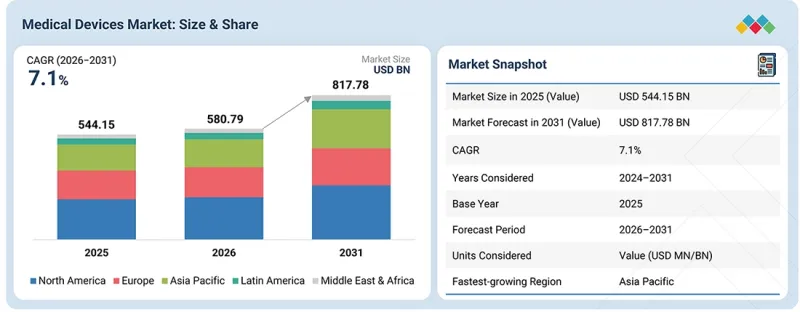
세계의 의료기기 시장 규모는 2026년 5,807억 9,000만 달러에서 2031년에는 8,177억 8,000만 달러에 달할 것으로 예측되며, CAGR은 7.1%가 될 전망입니다.
| 조사 범위 | |
|---|---|
| 조사 대상 기간 | 2026-2031년 |
| 기준 연도 | 2025년 |
| 예측 기간 | 2026-2031년 |
| 단위 | 금액(달러) |
| 부문 | 유형·지역 |
| 대상 지역 | 북미, 유럽, 아시아태평양, 라틴아메리카, 중동 및 아프리카(GCC 국가·기타 중동 및 아프리카 국가) |
의료기기 시장의 성장은 만성 질환 유병률의 증가와 세계 인구의 고령화 가속화에 힘입어 견인되고 있으며, 이에 따라 진단 기기, 심혈관 기기, 정형외과 기기, 안과 기기 및 기타 의료기기에 대한 수요가 지속적으로 증가하고 있습니다. 반면, 심혈관 시스템, 정형외과 임플란트, 진단 기기 등 첨단 의료기기는 비용이 높기 때문에 특히 의료 예산이 제한적인 개발도상국에서는 도입이 제한되고 있습니다. 또한, 이 시장은 엄격한 규제 체계와 장기간에 걸친 제품 승인 절차는 물론, 첨단 의료 기술을 운용할 수 있는 숙련된 의료 인력의 부족과 같은 과제에도 직면해 있으며, 이러한 요인들이 제품 도입 및 임상 적용을 지연시킬 가능성이 있습니다. 이러한 장벽이 있음에도 불구하고, 신흥 경제국에서의 급속한 의료 인프라 확충은 큰 성장 기회를 가져오고 있습니다. 병원, 외래 수술 센터, 진단 검사실, 디지털 헬스케어 시스템에 대한 투자 증가와 더불어 의료 보험 적용 범위의 확장으로 인해 첨단 의료 기술에 대한 접근성이 개선되고 있으며, 이를 통해 주요 제조사들은 세계 사업 확장을 가속화하고 장기적인 시장 성장을 강화할 수 있게 되었습니다.
“제품 유형별로는 심혈관 기기 부문이 2025년에 두 번째로 큰 점유율을 차지했습니다.”
이는 심혈관질환(CVD)의 전 세계적인 질병 부담이 증가하고 있으며, 첨단 진단 및 중재 기술에 대한 수요가 높아지고 있기 때문입니다. 세계보건기구(WHO)에 따르면, 2022년에는 약 1,980만 명이 심혈관질환으로 사망했으며, 이는 전 세계 사망자 수의 약 32%를 차지합니다. 또한, 미국 질병통제예방센터(CDC)의 보고에 따르면, 2023년 미국에서는 91만 9,032명이 심혈관질환으로 사망했습니다. 이러한 높은 질병 부담으로 인해 심장박동관리 기기, 관상동맥 스텐트, 심장판막, 카테터, 혈관 중재술 시스템의 도입이 대폭 확대되고 있습니다. 또한 고령 인구 증가에 더해 고혈압, 당뇨병, 비만의 유병률 상승으로 인해 심혈관 기기에 대한 수요도 높아지고 있습니다. 또한, 최소침습적 심혈관 치료에 대한 선호도가 높아지고 지속적인 기술 발전도 수요를 뒷받침하고 있습니다. 그 결과, 심혈관 기기 부문은 세계 의료기기 시장에서 계속해서 중요한 위치를 차지하고 있습니다.
“예측 기간 동안 북미 시장에서 미국은 가장 높은 연평균 성장률(CAGR)을 기록하며 성장할 것으로 예상됩니다.”
의료기기 시장은 북미, 유럽, 아시아태평양, 라틴아메리카, 중동 및 아프리카의 5개 주요 지역으로 분류됩니다. 이 중 2025년에는 북미가 전 세계 의료기기 시장을 주도했습니다. 북미 시장은 다시 미국과 캐나다로 나뉩니다. 그중에서도 2025년에는 미국이 북미 시장에서 가장 큰 점유율을 차지했습니다. 이는 만성 질환의 높은 유병률, 선진적인 의료 인프라, 막대한 의료비 지출, 주요 의료기기 제조업체들의 강력한 입지 때문인 것으로 분석됩니다. 미국 질병통제예방센터(CDC)에 따르면, 가장 흔한 심장 질환인 관상동맥질환으로 인해 2022년에는 37만 1,506명이 사망했습니다. 또한 CDC는 2024년 6월, 미국 성인의 약 5,300만 명이 관절염을 앓고 있다고 보고했습니다. 한편, 2026년에 발표된 CDC 데이터에 따르면 성인 10명 중 1명 이상(3,700만 명)이 만성 신장질환(CKD)을 앓고 있는 것으로 추정됩니다. 이러한 막대한 질병 부담이 심혈관, 정형외과, 진단, 신장 치료용 의료기기에 대한 지속적인 수요를 견인하고 있습니다. 또한, 미국은 첨단 의료 기술의 신속한 도입, 유리한 보험 환급 제도, 강력한 연구개발 투자, 주요 의료기기 기업의 본사가 위치해 있다는 점 등의 혜택을 누리고 있으며, 이러한 요인들이 지속적인 제품 혁신을 뒷받침하고 지역 의료기기 시장에서 미국의 리더십을 강화하고 있습니다.
본 보고서에서는 전 세계 의료기기 시장을 조사하여 시장 개요, 시장 성장에 영향을 미치는 각종 요인 분석, 기술 및 특허 동향, 법규제 환경, 사례 연구, 시장 규모 추정 및 전망, 각종 분류·지역/주요 국가별 상세 분석, 경쟁 구도, 주요 기업 개요 등을 정리하고 있습니다.
자주 묻는 질문
목차
제1장 소개
제2장 주요 요약
제3장 주요 인사이트
제4장 시장 개요
제5장 업계 동향
제6장 기술의 진보, AI의 영향, 특허, 혁신, 향후 응용
제7장 지속가능성과 규제 상황
제8장 고객 상황과 구매 행동
제9장 의료기기 시장 : 유형별
제10장 의료기기 시장 : 지역별
제11장 경쟁 구도
제12장 기업 개요
제13장 조사 방법
제14장 부록
KSM 26.10.02The global medical devices market is projected to reach USD 817.78 billion by 2031 from USD 580.79 billion in 2026, at a CAGR of 7.1%.
| Scope of the Report | |
|---|---|
| Years Considered for the Study | 2026-2031 |
| Base Year | 2025 |
| Forecast Period | 2026-2031 |
| Units Considered | Value (USD billion) |
| Segments | Type and Region |
| Regions covered | North America, Europe, Asia Pacific, Latin America, and the Middle East & Africa (GCC Countries and the Rest of Middle East & Africa) |
The growth of the medical devices market is driven by the increasing prevalence of chronic diseases and the rapidly aging global population, which continues to raise demand for diagnostic, cardiovascular, orthopedic, ophthalmic devices, and other medical devices. However, the high cost of advanced medical devices, including cardiovascular systems, orthopedic implants, and diagnostic equipment, restrains adoption, particularly in developing countries with limited healthcare budgets. The market also faces challenges from stringent regulatory frameworks and lengthy product approval processes, as well as shortages of skilled healthcare professionals capable of operating sophisticated medical technologies, which can delay product adoption and clinical implementation. Despite these barriers, the rapidly developing healthcare infrastructure in emerging economies presents significant growth opportunities. Increasing investments in hospitals, ambulatory surgery centers, diagnostic laboratories, and digital healthcare systems, along with expanding health insurance coverage, are improving access to advanced medical technologies, enabling leading manufacturers to expand their global footprint and strengthen long-term market growth.
"By type, the cardiovascular devices segment held the second-largest share of the medical devices market in 2025."
Based on type, the medical devices market comprises in vitro diagnostic devices, cardiovascular devices, imaging devices, orthopedic devices, ophthalmology devices, endoscopy devices, diabetes care devices, wound care devices, kidney/dialysis devices, respiratory care devices and other medical devices. Among these, cardiovascular devices held the second-largest share of the market in 2025. This is due to the increasing global burden of cardiovascular diseases (CVDs) and the growing demand for advanced diagnostic and interventional technologies. According to the World Health Organization (WHO), an estimated 19.8 million people died from cardiovascular diseases in 2022, accounting for approximately 32% of all global deaths. Additionally, the US Centers for Disease Control and Prevention (CDC) reported that 919,032 people died from cardiovascular disease in the US in 2023. This high disease burden has significantly increased the adoption of cardiac rhythm management devices, coronary stents, heart valves, catheters, and vascular intervention systems. The rising aging population, along with the increasing prevalence of hypertension, diabetes, and obesity, has led to a greater demand for cardiovascular devices. This demand is further bolstered by a growing preference for minimally invasive cardiovascular procedures and ongoing technological advancements. As a result, the cardiovascular devices segment continues to hold a prominent position in the global medical devices market.
"The US is expected to grow at the highest CAGR in the North American market during the forecast period."
The medical devices market is divided into five major regions: North America, Europe, Asia Pacific, Latin America, and the Middle East & Africa. Among these, North America dominated the global medical devices market in 2025. The North American market is further divided into the US and Canada. Among these, the US held the largest share of the North American market in 2025. This is due to its high prevalence of chronic diseases, advanced healthcare infrastructure, substantial healthcare spending, and strong presence of leading medical device manufacturers. According to the US Centers for Disease Control and Prevention (CDC), coronary heart disease, the most common type of heart disease, caused 371,506 deaths in 2022. The CDC also reported in June 2024 that approximately 53 million US adults have arthritis, while CDC data released in 2026 estimated that more than 1 in 10 adults (37 million people) have chronic kidney disease (CKD). This significant disease burden drives sustained demand for cardiovascular, orthopedic, diagnostic, and renal care devices. In addition, the US benefits from the rapid adoption of advanced medical technologies, favorable reimbursement systems, strong research and development investments, and the presence of major medical device company headquarters, which support continuous product innovation and reinforce the country's leadership in the regional medical devices market.
A breakdown of the primary participants (supply side) for the medical devices market referred to in this report is provided below:
- By Company Type: Tier 1 (35%), Tier 2 (40%), and Tier 3 (25%)
- By Designation: C-level Executives (45%), Directors (35%), and Others (20%)
- By Region: North America (27%), Europe (25%), Asia Pacific (30%), Latin America (8%), and the Middle East & Africa (10%)
Prominent players in the medical devices market include Medtronic (Ireland), Johnson & Johnson (US), B. Braun SE (Germany), Olympus Corporation (Japan), GE Healthcare (US), and Boston Scientific (US), among others.
Research Coverage
The report analyzes the medical devices market and estimates its size and future growth potential across segments (type and region). The report also includes a competitive analysis of the key players in this market along with their company profiles, product offerings, recent developments, and key market strategies.
Reasons to Buy the Report
The report will help market leaders/new entrants in this market by providing revenue estimates for the overall medical devices market. This report will help stakeholders understand the competitive landscape and gain deeper insights to better position their businesses and plan suitable go-to-market strategies. The report also helps stakeholders understand the market pulse and provides information on key drivers, restraints, challenges, and opportunities.
This report provides insights into the following pointers:
- Analysis of key drivers (rising aging population and increasing prevalence of chronic diseases), restraints (high cost of various medical devices), opportunities (rapidly developing healthcare sector in emerging economies), and challenges (shortage of skilled healthcare professionals and stringent regulatory framework).
- Market Penetration: It includes extensive information on the products offered by the major players in the global medical devices market. The report includes various segments: type and region.
- Product Enhancement/Innovation: Comprehensive details about new product launches and anticipated trends in the global medical devices market.
- Market Development: Thorough knowledge and analysis of the profitable rising markets by type and region.
- Market Diversification: Comprehensive information about newly launched products, expanding markets, current advancements, and investments in the global medical devices market.
- Competitive Assessment: Thorough evaluation of the market shares, growth plans, product offerings, and capacities of the major competitors in the global medical devices market.
TABLE OF CONTENTS
1 INTRODUCTION
- 1.1 STUDY OBJECTIVES
- 1.2 MARKET DEFINITION
- 1.3 STUDY SCOPE
- 1.3.1 MARKETS COVERED & REGIONAL SEGMENTATION
- 1.3.2 INCLUSIONS & EXCLUSIONS
- 1.3.3 YEARS CONSIDERED
- 1.3.4 CURRENCY CONSIDERED
- 1.4 STAKEHOLDERS
2 EXECUTIVE SUMMARY
- 2.1 KEY INSIGHTS & MARKET HIGHLIGHTS
- 2.2 KEY MARKET PARTICIPANTS: INSIGHTS & DEVELOPMENTS
- 2.3 DISRUPTIVE TRENDS SHAPING MARKET GROWTH
- 2.4 HIGH-GROWTH SEGMENTS & EMERGING FRONTIERS
- 2.5 SNAPSHOT: GLOBAL MARKET SIZE, GROWTH RATE, AND FORECAST
3 PREMIUM INSIGHTS
- 3.1 MEDICAL DEVICES MARKET OVERVIEW
- 3.2 MEDICAL DEVICES MARKET: GEOGRAPHIC GROWTH OPPORTUNITIES
- 3.3 MEDICAL DEVICES MARKET: DEVELOPED VS. EMERGING ECONOMIES
4 MARKET OVERVIEW
- 4.1 INTRODUCTION
- 4.2 MARKET DYNAMICS
- 4.2.1 IN VITRO DIAGNOSTIC DEVICES MARKET
- 4.2.1.1 Drivers
- 4.2.1.1.1 Gradual shift from centralized testing to point-of-care testing
- 4.2.1.1.2 Growing awareness of early disease diagnosis across emerging countries
- 4.2.1.2 Restraints
- 4.2.1.2.1 Reimbursement pressure and test-price controls
- 4.2.1.3 Opportunities
- 4.2.1.3.1 Expansion of companion diagnostics (CDx) and oncology testing
- 4.2.1.4 Challenges
- 4.2.1.4.1 Operational barriers and data privacy and cybersecurity risks
- 4.2.1.1 Drivers
- 4.2.2 CARDIOVASCULAR DEVICES MARKET
- 4.2.2.1 Drivers
- 4.2.2.1.1 Rising prevalence of cardiovascular diseases
- 4.2.2.2 Restraints
- 4.2.2.2.1 Stringent regulatory guidelines for product approval
- 4.2.2.3 Opportunities
- 4.2.2.3.1 Growing healthcare needs and improving medical infrastructure in emerging countries
- 4.2.2.4 Challenges
- 4.2.2.4.1 Product recalls and device-related safety events
- 4.2.2.1 Drivers
- 4.2.3 IMAGING DEVICES MARKET
- 4.2.3.1 Drivers
- 4.2.3.1.1 Increasing funds, investments, and grants by public-private investors
- 4.2.3.2 Restraints
- 4.2.3.2.1 High cost of diagnostic imaging systems
- 4.2.3.3 Opportunities
- 4.2.3.3.1 Growing adoption of artificial intelligence (AI) and advanced analytics
- 4.2.3.4 Challenges
- 4.2.3.4.1 Increasing adoption of refurbished diagnostic imaging systems
- 4.2.3.1 Drivers
- 4.2.4 ORTHOPEDIC DEVICES MARKET
- 4.2.4.1 Drivers
- 4.2.4.1.1 Rising prevalence of orthopedic diseases
- 4.2.4.2 Restraints
- 4.2.4.2.1 Risks and complications associated with orthopedic surgical procedures
- 4.2.4.2.2 High cost of orthopedic devices and surgical procedures
- 4.2.4.3 Opportunities
- 4.2.4.3.1 Increasing adoption of robotics and 3D printing in orthopedics
- 4.2.4.4 Challenges
- 4.2.4.4.1 Shortage of orthopedic surgeons
- 4.2.4.1 Drivers
- 4.2.5 OPHTHALMOLOGY DEVICES MARKET
- 4.2.5.1 Drivers
- 4.2.5.1.1 Rising prevalence of eye disorders
- 4.2.5.2 Restraints
- 4.2.5.2.1 High cost & potential risks associated with eye surgery
- 4.2.5.3 Opportunities
- 4.2.5.3.1 Growing adoption of minimally invasive ophthalmic surgical procedures
- 4.2.5.4 Challenges
- 4.2.5.4.1 Low accessibility to eye care services in emerging and low-income countries
- 4.2.5.1 Drivers
- 4.2.6 ENDOSCOPY DEVICES MARKET
- 4.2.6.1 Drivers
- 4.2.6.1.1 Rising investments, funding, and grants for endoscopy procedures
- 4.2.6.1.2 Increasing incidence of inflammatory bowel disease (IBD) and colorectal cancer
- 4.2.6.2 Restraints
- 4.2.6.2.1 High overhead cost and procedural risks associated with endoscopy
- 4.2.6.3 Opportunities
- 4.2.6.3.1 Rapidly developing healthcare sector in emerging economies
- 4.2.6.4 Challenges
- 4.2.6.4.1 Increasing number of product recalls
- 4.2.6.5 Lack of proper sterilization and reprocessing
- 4.2.6.1 Drivers
- 4.2.7 DIABETES CARE DEVICES MARKET
- 4.2.7.1 Drivers
- 4.2.7.1.1 Increasing prevalence of diabetes
- 4.2.7.2 Restraints
- 4.2.7.2.1 High cost of advanced diabetes care devices
- 4.2.7.3 Opportunities
- 4.2.7.3.1 Increasing adoption of advanced implantable continuous glucose monitoring (CGM) devices
- 4.2.7.4 Challenges
- 4.2.7.4.1 High costs and socioeconomic disparities
- 4.2.7.1 Drivers
- 4.2.8 WOUND CARE DEVICES MARKET
- 4.2.8.1 Drivers
- 4.2.8.1.1 Rising incidents of traumatic injuries and burn cases
- 4.2.8.2 Restraints
- 4.2.8.2.1 Risks associated with advanced wound care
- 4.2.8.3 Opportunities
- 4.2.8.3.1 Growth potential in emerging economies
- 4.2.8.4 Challenges
- 4.2.8.4.1 Shortage of trained professionals and limited access to wound care devices
- 4.2.8.1 Drivers
- 4.2.9 KIDNEY/DIALYSIS DEVICES MARKET
- 4.2.9.1 Drivers
- 4.2.9.1.1 Rising prevalence of chronic kidney disease (CKD)
- 4.2.9.2 Restraints
- 4.2.9.2.1 Risks, complications, and high procedural costs associated with dialysis treatments
- 4.2.9.3 Opportunities
- 4.2.9.3.1 Increasing number of dialysis centers in emerging economies
- 4.2.9.4 Challenges
- 4.2.9.4.1 Increasing number of product recalls and growing preference for renal transplantation
- 4.2.9.1 Drivers
- 4.2.10 RESPIRATORY CARE DEVICES MARKET
- 4.2.10.1 Drivers
- 4.2.10.1.1 Rising prevalence of chronic respiratory disease
- 4.2.10.2 Restraints
- 4.2.10.2.1 Unfavorable reimbursement scenario
- 4.2.10.3 Opportunities
- 4.2.10.3.1 High growth in developing countries across Asia Pacific and Latin America
- 4.2.10.4 Challenges
- 4.2.10.4.1 Harmful effects of certain devices on neonates
- 4.2.10.1 Drivers
- 4.2.1 IN VITRO DIAGNOSTIC DEVICES MARKET
- 4.3 UNMET NEEDS & WHITE SPACES
- 4.3.1 UNMET NEEDS IN MEDICAL DEVICES MARKET
- 4.3.2 WHITE SPACE OPPORTUNITIES
- 4.4 INTERCONNECTED MARKETS & CROSS-SECTOR OPPORTUNITIES
- 4.4.1 INTERCONNECTED MARKETS
- 4.4.2 CROSS-SECTOR OPPORTUNITIES
- 4.5 STRATEGIC MOVES BY TIER-1/2/3 PLAYERS
5 INDUSTRY TRENDS
- 5.1 PORTER'S FIVE FORCES ANALYSIS
- 5.1.1 THREAT OF NEW ENTRANTS
- 5.1.2 THREAT OF SUBSTITUTES
- 5.1.3 BARGAINING POWER OF BUYERS
- 5.1.4 BARGAINING POWER OF SUPPLIERS
- 5.1.5 INTENSITY OF COMPETITIVE RIVALRY
- 5.2 MACROECONOMIC OUTLOOK
- 5.2.1 INTRODUCTION
- 5.2.2 GDP TRENDS & FORECAST
- 5.2.3 TRENDS IN MINIMALLY INVASIVE SURGERY (MIS) INDUSTRY
- 5.2.4 TRENDS IN SURGICAL ROBOTS INDUSTRY
- 5.3 SUPPLY CHAIN ANALYSIS
- 5.4 VALUE CHAIN ANALYSIS
- 5.5 ECOSYSTEM ANALYSIS
- 5.6 PRICING ANALYSIS
- 5.6.1 AVERAGE SELLING PRICE TREND OF MEDICAL DEVICES, BY KEY PLAYER (2023-2025)
- 5.6.2 AVERAGE SELLING PRICE TREND OF MEDICAL DEVICES, BY REGION (2023-2025)
- 5.7 TRADE ANALYSIS
- 5.7.1 IMPORT SCENARIO (HS CODE 9018)
- 5.7.2 EXPORT DATA (HS CODE 9018)
- 5.8 KEY CONFERENCES & EVENTS, 2026-2027
- 5.9 TRENDS/DISRUPTIONS IMPACTING CUSTOMERS' BUSINESSES
- 5.10 INVESTMENT & FUNDING SCENARIO
- 5.11 IMPACT OF 2025 US TARIFFS ON MEDICAL DEVICES MARKET
- 5.11.1 INTRODUCTION
- 5.11.2 KEY TARIFF RATES
- 5.11.3 PRICE IMPACT ANALYSIS
- 5.11.4 IMPACT ON COUNTRIES/REGIONS
- 5.11.4.1 North America
- 5.11.4.2 Europe
- 5.11.4.3 Asia Pacific
- 5.11.5 END-USE INDUSTRY IMPACT
6 TECHNOLOGICAL ADVANCEMENTS, AI-DRIVEN IMPACT, PATENTS, INNOVATIONS, AND FUTURE APPLICATIONS
- 6.1 KEY EMERGING TECHNOLOGIES
- 6.1.1 ROBOTIC-ASSISTED & COMPUTER-ASSISTED INTERVENTIONS
- 6.1.2 POINT-OF-CARE (POC) & MINIATURIZED DIAGNOSTICS
- 6.2 COMPLEMENTARY TECHNOLOGIES
- 6.2.1 DIGITAL INTERNET OF MEDICAL THINGS (IOMT) & CLOUD CONNECTIVITY
- 6.3 TECHNOLOGY/PRODUCT ROADMAP
- 6.3.1 SHORT TERM (2025-2027) | FOUNDATION & EARLY COMMERCIALIZATION
- 6.3.2 MID TERM (2027-2030) | EXPANSION & STANDARDIZATION
- 6.3.3 LONG TERM (2030-2035+) | MASS COMMERCIALIZATION & DISRUPTION
- 6.4 PATENT ANALYSIS
- 6.4.1 INSIGHTS: JURISDICTION & TOP APPLICANT ANALYSIS
- 6.5 FUTURE APPLICATIONS
- 6.6 IMPACT OF AI/GEN AI ON MEDICAL DEVICES MARKET
- 6.6.1 TOP USE CASES & MARKET POTENTIAL
- 6.6.2 CASE STUDIES OF AI IMPLEMENTATION IN MEDICAL DEVICES MARKET
- 6.6.3 INTERCONNECTED ADJACENT ECOSYSTEMS & IMPACT ON MARKET PLAYERS
- 6.6.4 CLIENTS' READINESS TO ADOPT GENERATIVE AI IN MEDICAL DEVICES MARKET
7 SUSTAINABILITY & REGULATORY LANDSCAPE
- 7.1 REGIONAL REGULATIONS & COMPLIANCE
- 7.1.1 REGULATORY BODIES, GOVERNMENT AGENCIES, AND OTHER ORGANIZATIONS
- 7.1.2 INDUSTRY STANDARDS
- 7.2 SUSTAINABILITY INITIATIVES
- 7.2.1 CARBON IMPACT & ECO-APPLICATIONS OF MEDICAL DEVICES MARKET
- 7.2.1.1 Carbon impact reduction
- 7.2.1.2 Eco-applications
- 7.2.1 CARBON IMPACT & ECO-APPLICATIONS OF MEDICAL DEVICES MARKET
- 7.3 SUSTAINABILITY IMPACT & REGULATORY POLICY INITIATIVES
- 7.4 CERTIFICATIONS, LABELING, AND ECO-STANDARDS
- 7.5 REIMBURSEMENT ANALYSIS
8 CUSTOMER LANDSCAPE & BUYER BEHAVIOR
- 8.1 DECISION-MAKING PROCESS
- 8.2 BUYER STAKEHOLDERS & BUYING EVALUATION CRITERIA
- 8.2.1 KEY STAKEHOLDERS IN BUYING PROCESS
- 8.2.2 KEY BUYING CRITERIA
- 8.3 ADOPTION BARRIERS & INTERNAL CHALLENGES
- 8.4 UNMET NEEDS FROM VARIOUS END-USE INDUSTRIES
- 8.5 MARKET PROFITABILITY
- 8.5.1 REVENUE POTENTIAL
- 8.5.2 COST DYNAMICS
- 8.5.3 MARGIN OPPORTUNITIES IN KEY APPLICATIONS
9 MEDICAL DEVICES MARKET, BY TYPE
- 9.1 INTRODUCTION
- 9.2 IN VITRO DIAGNOSTIC DEVICES
- 9.2.1 WIDESPREAD DIAGNOSTIC TESTING TO DRIVE DEMAND FOR IN VITRO DIAGNOSTIC DEVICES
- 9.3 CARDIOVASCULAR DEVICES
- 9.3.1 RISING CARDIOVASCULAR DISEASE BURDEN TO DRIVE DEMAND FOR CARDIOVASCULAR DEVICES
- 9.4 WOUND CARE DEVICES
- 9.4.1 RISING PREVALENCE OF CHRONIC WOUNDS AND ADVANCED WOUND MANAGEMENT TO DRIVE WOUND CARE DEVICE ADOPTION
- 9.5 RESPIRATORY CARE DEVICES
- 9.5.1 SHIFT TOWARD HOME-BASED RESPIRATORY MANAGEMENT AND NONINVASIVE THERAPIES TO DRIVE DEVICE ADOPTION
- 9.6 ORTHOPEDIC DEVICES
- 9.6.1 GROWING MUSCULOSKELETAL DISEASE BURDEN AND ADVANCES IN RECONSTRUCTIVE SURGERY TO SUPPORT MARKET GROWTH
- 9.7 KIDNEY/DIALYSIS DEVICES
- 9.7.1 RISING BURDEN OF CHRONIC KIDNEY DISEASE AND EXPANDING RENAL REPLACEMENT THERAPIES TO BOOST GROWTH
- 9.8 DIABETES CARE DEVICES
- 9.8.1 RISING DIABETES PREVALENCE AND ADVANCES IN CONTINUOUS GLUCOSE MONITORING TO FUEL GROWTH
- 9.9 ENDOSCOPY DEVICES
- 9.9.1 GROWING DEMAND FOR MINIMALLY INVASIVE DIAGNOSIS AND THERAPY TO CONTRIBUTE TO MARKET GROWTH
- 9.10 OPHTHALMOLOGY DEVICES
- 9.10.1 RISING GLOBAL BURDEN OF VISION IMPAIRMENT TO BOOST MARKET GROWTH
- 9.11 IMAGING DEVICES
- 9.11.1 GROWING DEMAND FOR ADVANCED DIAGNOSTIC IMAGING O FUEL GROWTH
- 9.12 OTHER MEDICAL DEVICES
10 MEDICAL DEVICES MARKET, BY REGION
- 10.1 INTRODUCTION
- 10.2 NORTH AMERICA
- 10.2.1 MACROECONOMIC OUTLOOK FOR NORTH AMERICA
- 10.2.2 US
- 10.2.2.1 US to hold major share in North American medical devices market
- 10.2.3 CANADA
- 10.2.3.1 Growing chronic disease burden and aging population to support Canada's market
- 10.3 EUROPE
- 10.3.1 MACROECONOMIC OUTLOOK FOR EUROPE
- 10.3.2 GERMANY
- 10.3.2.1 Germany's leadership in medtech manufacturing, hospital modernization, and aging population to support market expansion
- 10.3.3 UK
- 10.3.3.1 NHS diagnostic modernization and medtech innovation to accelerate market growth
- 10.3.4 FRANCE
- 10.3.4.1 France's emphasis on early diagnosis and specialized care to drive medical device demand
- 10.3.5 ITALY
- 10.3.5.1 Hospital technology modernization and expanding surgical care to drive medical device demand
- 10.3.6 SPAIN
- 10.3.6.1 Digital transformation of national health system to accelerate medical device adoption
- 10.3.7 REST OF EUROPE
- 10.4 ASIA PACIFIC
- 10.4.1 MACROECONOMIC OUTLOOK FOR ASIA PACIFIC
- 10.4.2 CHINA
- 10.4.2.1 Healthcare capacity expansion to drive medical device demand in China
- 10.4.3 JAPAN
- 10.4.3.1 Healthy aging policies and advanced healthcare delivery to drive market growth
- 10.4.4 INDIA
- 10.4.4.1 Expanding specialty healthcare access to drive medical device demand
- 10.4.5 AUSTRALIA
- 10.4.5.1 Expanding access to specialist healthcare services to support market growth
- 10.4.6 SOUTH KOREA
- 10.4.6.1 Biohealth innovation and AI-enabled healthcare to drive adoption
- 10.4.7 REST OF ASIA PACIFIC
- 10.5 LATIN AMERICA
- 10.5.1 MACROECONOMIC OUTLOOK FOR LATIN AMERICA
- 10.5.2 BRAZIL
- 10.5.2.1 Strengthening domestic healthcare innovation and medical device production to boost market
- 10.5.3 MEXICO
- 10.5.3.1 Medical technology manufacturing expansion to support growth
- 10.5.4 REST OF LATIN AMERICA
- 10.6 MIDDLE EAST & AFRICA
- 10.6.1 MACROECONOMIC OUTLOOK FOR MIDDLE EAST & AFRICA
- 10.6.2 GCC COUNTRIES
- 10.6.2.1 Healthcare transformation programs and smart hospital initiatives to drive medical device demand
- 10.6.3 REST OF MIDDLE EAST & AFRICA
11 COMPETITIVE LANDSCAPE
- 11.1 INTRODUCTION
- 11.2 KEY PLAYER STRATEGIES/RIGHT TO WIN
- 11.2.1 OVERVIEW OF STRATEGIES ADOPTED BY KEY PLAYERS IN MEDICAL DEVICES MARKET
- 11.3 REVENUE ANALYSIS, 2021-2025
- 11.4 MARKET SHARE ANALYSIS, 2025
- 11.4.1 GLOBAL IN VITRO DIAGNOSTIC DEVICES MARKET SHARE ANALYSIS, 2025
- 11.4.2 GLOBAL CARDIOVASCULAR DEVICES MARKET SHARE ANALYSIS, 2025
- 11.4.3 GLOBAL ORTHOPEDIC DEVICES MARKET SHARE ANALYSIS, 2025
- 11.4.4 GLOBAL DIABETES CARE DEVICES MARKET SHARE ANALYSIS, 2025
- 11.4.5 GLOBAL ENDOSCOPY DEVICES MARKET SHARE ANALYSIS, 2025
- 11.5 COMPANY EVALUATION MATRIX: KEY PLAYERS, 2025
- 11.5.1 STARS
- 11.5.2 EMERGING LEADERS
- 11.5.3 PERVASIVE PLAYERS
- 11.5.4 PARTICIPANTS
- 11.5.5 COMPANY FOOTPRINT: KEY PLAYERS, 2025
- 11.5.5.1 Company footprint
- 11.5.5.2 Region footprint
- 11.5.5.3 Type footprint
- 11.6 COMPANY EVALUATION MATRIX: STARTUPS/SMES, 2025
- 11.6.1 PROGRESSIVE COMPANIES
- 11.6.2 RESPONSIVE COMPANIES
- 11.6.3 DYNAMIC COMPANIES
- 11.6.4 STARTING BLOCKS
- 11.6.5 COMPETITIVE BENCHMARKING: STARTUPS/SMES, 2025
- 11.6.5.1 Detailed list of key startups/SMEs
- 11.6.5.2 Competitive benchmarking of key startups/SMEs
- 11.7 COMPANY VALUATION & FINANCIAL METRICS
- 11.7.1 FINANCIAL METRICS
- 11.7.2 COMPANY VALUATION
- 11.8 BRAND/PRODUCT COMPARISON
- 11.9 COMPETITIVE SCENARIO
- 11.9.1 PRODUCT LAUNCHES & APPROVALS
- 11.9.2 DEALS
- 11.9.3 EXPANSION
12 COMPANY PROFILES
- 12.1 KEY PLAYERS
- 12.1.1 MEDTRONIC PLC
- 12.1.1.1 Business overview
- 12.1.1.2 Products offered
- 12.1.1.3 Recent developments
- 12.1.1.3.1 Product launches & approvals
- 12.1.1.4 MnM view
- 12.1.1.4.1 Right to win
- 12.1.1.4.2 Strategic choices
- 12.1.1.4.3 Weaknesses & competitive threats
- 12.1.2 JOHNSON & JOHNSON
- 12.1.2.1 Business overview
- 12.1.2.2 Products offered
- 12.1.2.3 Recent developments
- 12.1.2.3.1 Product launches & approvals
- 12.1.2.3.2 Deals
- 12.1.2.3.3 Expansions
- 12.1.2.4 MnM view
- 12.1.2.4.1 Right to win
- 12.1.2.4.2 Strategic choices
- 12.1.2.4.3 Weaknesses & competitive threats
- 12.1.3 ABBOTT
- 12.1.3.1 Business overview
- 12.1.3.2 Products offered
- 12.1.3.3 Recent developments
- 12.1.3.3.1 Product launches & approvals
- 12.1.3.3.2 Deals
- 12.1.3.3.3 Expansions
- 12.1.4 KONINKLIJKE PHILIPS N.V.
- 12.1.4.1 Business overview
- 12.1.4.2 Products offered
- 12.1.4.3 Recent developments
- 12.1.4.3.1 Product launches
- 12.1.4.3.2 Deals
- 12.1.4.3.3 Expansions
- 12.1.5 SIEMENS HEALTHINEERS AG
- 12.1.5.1 Business overview
- 12.1.5.2 Products offered
- 12.1.5.3 Recent developments
- 12.1.5.3.1 Product launches & approvals
- 12.1.5.3.2 Deals
- 12.1.5.3.3 Expansions
- 12.1.6 STRYKER CORPORATION
- 12.1.6.1 Business overview
- 12.1.6.2 Products offered
- 12.1.6.3 Recent developments
- 12.1.6.3.1 Deals
- 12.1.7 B. BRAUN SE
- 12.1.7.1 Business overview
- 12.1.7.2 Products offered
- 12.1.7.3 Recent developments
- 12.1.7.3.1 Deals
- 12.1.7.3.2 Expansions
- 12.1.7.4 MnM view
- 12.1.7.4.1 Right to win
- 12.1.7.4.2 Strategic choices
- 12.1.7.4.3 Weaknesses & competitive threats
- 12.1.8 SMITH & NEPHEW
- 12.1.8.1 Business overview
- 12.1.8.2 Products offered
- 12.1.8.3 Recent developments
- 12.1.8.3.1 Product launches
- 12.1.9 BOSTON SCIENTIFIC CORPORATION
- 12.1.9.1 Business overview
- 12.1.9.2 Products offered
- 12.1.9.3 Recent developments
- 12.1.9.3.1 Product approvals
- 12.1.9.3.2 Deals
- 12.1.10 F. HOFFMANN-LA ROCHE LTD.
- 12.1.10.1 Business overview
- 12.1.10.2 Products offered
- 12.1.10.3 Recent developments
- 12.1.10.3.1 Product launches & approvals
- 12.1.10.3.2 Deals
- 12.1.1 MEDTRONIC PLC
- 12.2 OTHER PLAYERS
- 12.2.1 BECTON, DICKINSON AND COMPANY
- 12.2.2 BAXTER INTERNATIONAL, INC.
- 12.2.3 ZIMMER BIOMET HOLDINGS, INC.
- 12.2.4 OLYMPUS CORPORATION
- 12.2.5 TERUMO CORPORATION
- 12.2.6 FUJIFILM CORPORATION
- 12.2.7 DANAHER CORPORATION
- 12.2.8 FRESENIUS SE & CO. KGAA
- 12.2.9 TELEFLEX INCORPORATED
- 12.2.10 GE HEALTHCARE TECHNOLOGIES INC.
- 12.2.11 SHENZHEN MINDRAY BIO-MEDICAL ELECTRONICS CO., LTD.
- 12.2.12 DEXCOM, INC.
- 12.2.13 THERMO FISHER SCIENTIFIC INC.
- 12.2.14 ALCON INC.
- 12.2.15 NIPRO CORPORATION
13 RESEARCH METHODOLOGY
- 13.1 RESEARCH DATA
- 13.1.1 SECONDARY DATA
- 13.1.1.1 Key data from secondary sources
- 13.1.2 PRIMARY DATA
- 13.1.2.1 Key data from primary sources
- 13.1.2.2 Key industry insights
- 13.1.1 SECONDARY DATA
- 13.2 MARKET SIZE ESTIMATION
- 13.3 MARKET BREAKDOWN & DATA TRIANGULATION
- 13.4 MARKET RANKING ANALYSIS
- 13.5 STUDY ASSUMPTIONS
- 13.6 RESEARCH LIMITATIONS
- 13.6.1 METHODOLOGY-RELATED LIMITATIONS
- 13.6.2 SCOPE-RELATED LIMITATIONS
- 13.7 RISK ASSESSMENT
14 APPENDIX
- 14.1 DISCUSSION GUIDE
- 14.2 KNOWLEDGESTORE: MARKETSANDMARKETS' SUBSCRIPTION PORTAL
- 14.3 CUSTOMIZATION OPTIONS
- 14.4 RELATED REPORTS
- 14.5 AUTHOR DETAILS


