

|
시장보고서
상품코드
2136425
산업용 호스 시장 : 소재별(천연 고무, 니트릴 고무, 폴리염화비닐, 실리콘, 폴리우레탄, 에틸렌 프로필렌 디엔 모노머, 초고분자량 폴리에틸렌), 매체별, 산업별, 지역별 - 세계 예측(-2032년)Industrial Hose Market by Material Type (Natural Rubber, Nitrile Rubber, Polyvinyl Chloride, Silicone, Polyurethane, Ethylene Propylene Diene Monomer, Ultra High Molecular Weight Polyethylene), Media Type, Industry and Region - Global Forecast to 2032 |
||||||

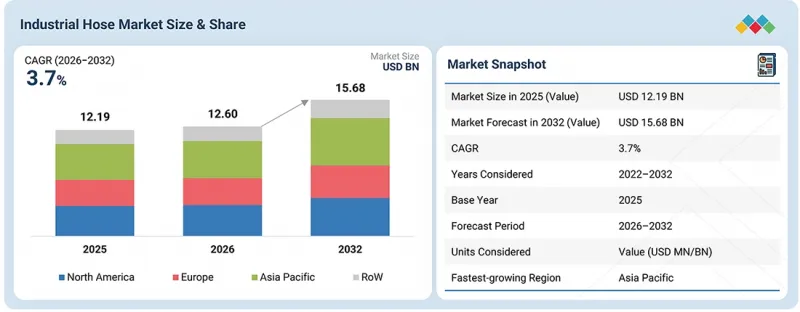
세계의 산업용 호스 시장 규모는 2026년 126억 달러에서 2032년에는 156억 8,000만 달러에 달할 것으로 예측되며, 연평균 성장률(CAGR)은 3.7%에 이를 전망입니다. 엄격한 작업장 안전 지침이 보급되고, 현대 시설에서는 복잡한 운영 환경 하에서 지속적인 고압 유체 관리가 요구됨에 따라 산업용 호스 시스템에 대한 수요가 증가하고 있습니다. 스마트 팩토리의 자동화, 연결형 IoT 텔레메트리 시스템, 고압 유압 회로에 대한 관심이 높아짐에 따라 시스템의 균형 조정 요구 사항이 크게 증가하고 있으며, 신뢰성이 높고 구역별로 최적화된 압력 조절에 대한 필요성이 커지고 있습니다.
유체의 분배가 불충분하거나 불균일할 경우, 장비의 성능이 저하되고 가동 처리량이 감소할 뿐만 아니라 유지보수 비용이 증가할 가능성이 있습니다.
| 조사 범위 | |
|---|---|
| 조사 대상 기간 | 2021-2033년 |
| 기준 연도 | 2025년 |
| 예측 기간 | 2026-2033년 |
| 단위 | 금액(달러) |
| 부문 | 소재, 산업, 지역별 |
| 대상 지역 | 북미, 유럽, 아시아태평양, 기타 지역 |
그 결과, 플랜트 운영자 및 시설 엔지니어들은 특히 현대적인 화학·제조 시설에서 압력 정확도를 유지하고, 가동 중 누출 위험을 줄이며, 엄격한 환경 격리 기준을 준수하기 위해 첨단 분배 매니폴드, 와이어 스파이럴 보강 엘라스토머,다중 포트 진단용 커플링을 도입하고 있습니다.
“2026년부터 2032년까지 공기·가스 부문이 가장 높은 연평균 성장률(CAGR)을 기록할 전망”
매체 유형별로는 기밀성이 높은 공기 수송, 고압 봉쇄, 엄격한 작업장 배기가스 규제에 대한 수요 증가를 배경으로, 예측 기간 동안 공기·가스 부문이 가장 빠른 성장을 이룰 것으로 예상됩니다. 최신 가스 및 공기용 호스 시스템(특히 멀티 스파이럴형, 와이어 보강 어셈블리, 정전기 방지 복합 호스)에서는 다양한 산업용 장비와 가혹한 가동 환경에서 균일한 압력 분포를 확보하기 위해 전문적인 엔지니어링이 요구됩니다. 이러한 전문 지식은 자동화 공장의 로봇 공학, 반도체 가스 처리, 정유소의 연료 이송과 같은 고효율 용도에서 매우 중요합니다. 이러한 용도에서는 배관 설치가 부적절할 경우, 위험한 누출 및 막대한 비용이 수반되는 예기치 않은 플랜트 가동 중단으로 이어질 우려가 있습니다.
“석유·가스 부문이 2025년에 최대 점유율을 차지”
산업별로는 석유·가스 부문이 2025년에 가장 큰 시장 점유율을 차지했습니다. 이는 가혹한 가동 환경 하에서 고압 유체의 봉쇄 및 신뢰성 높은 이송이 널리 요구되고 있기 때문입니다. 현대 탐사 및 다운스트림 부문 개발에서는 멀티 스파이럴형 와이어 보강 어셈블리, 대용량 화학약품 이송용 호스, 모듈식 압착 커플링, 스마트 누출 감지 칼라와 같은 통합된 유체 처리 기술이 지속적으로 도입되고 있습니다. 이러한 용도에서는 이송 효율을 최적화하고, 유지보수로 인한 가동 중단 시간을 줄이며, 안전한 산업 작업 환경을 확보하기 위해 균형 잡힌 유체 순환과 정밀한 압력 조절이 요구됩니다.
“2032년에는 북미가 시장에서 큰 점유율을 차지할 전망”
지역별로 보면 2032년에는 북미가 큰 시장 점유율을 차지할 것으로 예상됩니다. 북미 시장은 특히 유전 운영, 화학 처리 플랜트, 첨단 제조 시설에서 내구성이 뛰어난 고압 유체 이송 솔루션에 대한 수요가 증가하고 있는 것을 배경으로 성장하고 있습니다. 자동 유압 기계 및 산업용 로봇의 도입 확대는 연속적인 기계적 사이클이나 고압 조건에서도 효율적으로 작동할 수 있는 강화 엘라스토머 호스 어셈블리와 시너지 효과를 창출하고 있습니다. 동시에, 엄격한 작업장 안전 요건과 환경으로의 유체 누출 방지를 중시하는 움직임이 강화됨에 따라, 플랜트 운영자와 유지보수 엔지니어들은 유체 누출을 줄이고 가동 신뢰성을 향상시킬 수 있는 통합형 호스 솔루션의 도입을 추진하고 있습니다.
본 보고서에서는 전 세계 산업용 호스 시장을 조사하여, 시장 개요, 시장 성장에 영향을 미치는 각종 요인 분석, 기술 및 특허 동향, 법규제 환경, 사례 연구, 시장 규모 추정 및 전망, 각종 분류·지역/주요 국가별 상세 분석, 경쟁 구도, 주요 기업 개요 등을 정리하고 있습니다.
자주 묻는 질문
목차
제1장 소개
제2장 주요 요약
제3장 주요 인사이트
제4장 시장 개요
제5장 업계 동향
제6장 기술의 진보, AI의 영향, 특허, 혁신, 향후 응용
제7장 규제 상황
제8장 고객 상황과 구매 행동
제9장 산업용 호스 종류
제10장 산업용 호스 시장 : 매체 유형별
제11장 산업용 호스 시장 : 소재별
제12장 산업용 호스 시장 : 산업별
제13장 산업용 호스 시장 : 지역별
제14장 경쟁 구도
제15장 기업 개요
제16장 조사 방법
제17장 부록
KSM 26.10.07The global industrial hose market is expected to reach USD 12.60 billion in 2026 and USD 15.68 billion by 2032, reflecting a CAGR of 3.7%. Demand for industrial hose systems is rising as strict workplace safety directives proliferate, and modern facilities require continuous, high-pressure fluid management in complex operating environments. The focus on smart factory automation, connected IoT telemetry collars, and high-pressure hydraulic circuits has significantly increased system balancing requirements, leading to a greater need for dependable, zone-specific pressure regulation. Inadequate or uneven fluid distribution can degrade equipment performance, reduce operational throughput, and increase maintenance costs.
| Scope of the Report | |
|---|---|
| Years Considered for the Study | 2021-2033 |
| Base Year | 2025 |
| Forecast Period | 2026-2033 |
| Units Considered | Value (USD Billion) |
| Segments | By Material Type, Industry and Region |
| Regions covered | North America, Europe, APAC, RoW |
As a result, plant operators and facility engineers are integrating advanced distribution manifolds, wire-spiral-reinforced elastomers, and multi-port diagnostic couplings to maintain pressure accuracy, reduce the risk of operational leaks, and comply with strict environmental containment codes, especially in modern chemical and manufacturing facilities.
"Air & gas segment to record the highest CAGR in the industrial hose market from 2026 to 2032"
By media type, the air & gas segment is expected to be the fastest-growing during the forecast period, driven by the increasing need for leak-tight pneumatic conveyance, high-pressure containment, and strict workplace emissions control. Modern gas and pneumatic hose systems (particularly multi-spiral, wire-reinforced assemblies and anti-static composite lines) require specialized engineering to ensure uniform pressure distribution across diverse industrial tooling and severe operating environments. This expertise is critical for high-efficiency applications such as automated factory robotics, semiconductor gas handling, and refinery fuel transfer, where improper line installation can result in hazardous fugitive emissions or expensive, unscheduled plant shutdowns.
"Oil & gas segment captured the largest share of the industrial hose market in 2025"
By industry, the oil & gas segment held the largest market share in 2025 due to the widespread need for high-pressure fluid containment and reliable conveyance in extreme operating environments. Modern exploration and downstream developments continuously incorporate integrated fluid-handling technologies such as multi-spiral wire-reinforced assemblies, high-capacity chemical transfer hoses, modular crimped couplings, and smart leak-detection collars. These applications require balanced fluid circulation and precise pressure regulation to optimize transfer efficiency, reduce maintenance downtime, and ensure safe industrial working environments.
"North America to hold a significant share in the industrial hose market in 2032"
By region, North America is expected to hold a significant market share in 2032. The regional market is driven by rising demand for durable, high-pressure fluid conveyance solutions, particularly across oilfield operations, chemical processing plants, and advanced manufacturing facilities. Increasing adoption of automated hydraulic machinery and industrial robotics is creating synergies with reinforced elastomer hose assemblies, which can operate efficiently under continuous mechanical cycling and high-pressure conditions. In parallel, stringent workplace safety requirements and a growing emphasis on environmental fluid containment are encouraging plant operators and maintenance engineers to consider integrated hose solutions that can reduce fluid leakage and improve operational reliability.
- By Company Type: Tier 1 - 25%, Tier 2 - 45%, and Tier 3 - 30%
- By Designation: Directors - 20%, C-level Executives - 50%, and Others - 30%
- By Region: North America - 30%, Europe - 25%, Asia Pacific - 35%, and RoW - 10%
Prominent players profiled in this report include PARKER HANNIFIN CORP (US), Continental AG (Germany), Gates Corporation (US), Trelleborg Group (Sweden), Danfoss (Denmark), Semperit AG Holding (Austria), HANSA-FLEX AG (Germany), Bridgestone Corporation (Japan), The Yokohama Rubber Co., Ltd. (Japan), and Sumitomo Riko Company Limited (Japan).
Research Coverage
The report defines, describes, and forecasts the industrial hose market by material type (natural rubber, nitrile rubber, PVC, silicone, polyurethane, and others), media type (water, oil, hot water & steam, air & gas, food & beverages, and chemicals), industry (automotive, infrastructure, oil & gas, pharmaceuticals, food & beverages, water & wastewater treatment, chemicals, mining, agriculture, and other industries), and region (North America, Europe, Asia Pacific, and RoW). It provides detailed information on the drivers, restraints, opportunities, and challenges influencing the market's growth. It also analyzes competitive developments, including acquisitions, product launches, expansions, and actions taken by key players to grow in the market.
Reasons to Buy This Report
The report will provide market leaders and new entrants with the closest available estimates of revenue for the overall industrial hose market and its subsegments. It will help stakeholders understand the competitive landscape and gain insights to position their business more effectively and plan suitable go-to-market strategies. The report also helps stakeholders understand the market's pulse and provides information on key drivers, restraints, opportunities, and challenges.
The report will provide insights into the following points:
- Analysis of key drivers (Increasing demand for high-pressure fluid conveyance across manufacturing automation, rising implementation of strict workplace safety norms and fluid containment regulations), restraints (High price volatility of raw materials such as synthetic elastomers and steel wire, Shorter operating service life and frequent wear under severe industrial abrasive environments), opportunities (Emergence of IoT-enabled condition monitoring and smart leak detection systems, Integration with green hydrogen and renewable energy transfer infrastructure), and challenges (High compliance and certification burdens across strict regional safety directives, Compatibility limitations across non-standardized end fittings and legacy equipment) influencing the growth of the industrial hose market
- Product Development/Innovation: Detailed insights into upcoming technologies, research & development activities, and product launches in the market
- Market Development: Comprehensive information about lucrative markets (the report analyzes the market across various regions)
- Market Diversification: Exhaustive information about new products launched, untapped geographies, recent developments, and investments in the market
- Competitive Assessment: In-depth assessment of market share, growth strategies, and offerings of leading players, including Parker Hannifin Corp (US), Continental AG (Germany), Gates Corporation (US), Trelleborg Group (Sweden), and Danfoss (Denmark), in the market.
TABLE OF CONTENTS
1 INTRODUCTION
- 1.1 STUDY OBJECTIVES
- 1.2 MARKET DEFINITION
- 1.3 STUDY SCOPE
- 1.3.1 MARKETS COVERED AND REGIONAL SCOPE
- 1.3.2 INCLUSIONS AND EXCLUSIONS
- 1.3.3 YEARS CONSIDERED
- 1.4 CURRENCY CONSIDERED
- 1.5 LIMITATIONS
- 1.6 STAKEHOLDERS
- 1.7 SUMMARY OF CHANGES
2 EXECUTIVE SUMMARY
- 2.1 MARKET HIGHLIGHTS AND KEY INSIGHTS
- 2.2 KEY MARKET PARTICIPANTS: MAPPING OF STRATEGIC DEVELOPMENTS
- 2.3 DISRUPTIVE TRENDS IN INDUSTRIAL HOSE MARKET
- 2.4 HIGH GROWTH SEGMENTS
- 2.5 REGIONAL SNAPSHOT: MARKET SIZE, GROWTH RATE, AND FORECAST
3 PREMIUM INSIGHTS
- 3.1 ATTRACTIVE OPPORTUNITIES FOR PLAYERS IN INDUSTRIAL HOSE MARKET
- 3.2 INDUSTRIAL HOSE MARKET, BY MATERIAL TYPE
- 3.3 INDUSTRIAL HOSE MARKET, BY MEDIA TYPE
- 3.4 INDUSTRIAL HOSE MARKET, BY INDUSTRY
- 3.5 INDUSTRIAL HOSE MARKET, BY GEOGRAPHY
4 MARKET OVERVIEW
- 4.1 INTRODUCTION
- 4.2 MARKET DYNAMICS
- 4.2.1 DRIVERS
- 4.2.1.1 Massive infrastructure projects focused on establishing resilient and efficient urban environments
- 4.2.1.2 Evolving industrial demands and regulatory frameworks
- 4.2.1.3 Accelerating shift toward smart manufacturing, automation, and digital transformation
- 4.2.2 RESTRAINTS
- 4.2.2.1 Recurrent replacement costs due to shorter lifespan of hoses
- 4.2.2.2 Investment uncertainty due to technology obsolescence
- 4.2.3 OPPORTUNITIES
- 4.2.3.1 Growing demand for customized and application-specific industrial hoses
- 4.2.4 CHALLENGES
- 4.2.4.1 Complexities in balancing innovation, cost, and compliance in specialized hose applications
- 4.2.4.2 Issues in maintaining competitive position in dynamic market
- 4.2.1 DRIVERS
- 4.3 INTERCONNECTED MARKETS AND CROSS-SECTOR OPPORTUNITIES
- 4.4 STRATEGIC MOVES BY TIER 1/2/3 PLAYERS
5 INDUSTRY TRENDS
- 5.1 PORTER'S FIVE FORCES ANALYSIS
- 5.1.1 THREAT OF NEW ENTRANTS
- 5.1.2 THREAT OF SUBSTITUTES
- 5.1.3 BARGAINING POWER OF SUPPLIERS
- 5.1.4 BARGAINING POWER OF BUYERS
- 5.1.5 INTENSITY OF COMPETITIVE RIVALRY
- 5.2 MACROECONOMIC OUTLOOK
- 5.2.1 INTRODUCTION
- 5.2.2 GDP TRENDS AND FORECAST
- 5.2.3 TRENDS IN GLOBAL MINING INDUSTRY
- 5.2.4 TRENDS IN GLOBAL OIL & GAS INDUSTRY
- 5.2.5 TRENDS IN GLOBAL CONSTRUCTION INDUSTRY
- 5.3 VALUE CHAIN ANALYSIS
- 5.4 ECOSYSTEM ANALYSIS
- 5.5 TRADE ANALYSIS
- 5.5.1 IMPORT SCENARIO (HS CODE 4009)
- 5.5.2 EXPORT SCENARIO (HS CODE 4009)
- 5.6 KEY CONFERENCES AND EVENTS, 2026-2027
- 5.7 TRENDS/DISRUPTIONS IMPACTING CUSTOMER BUSINESS
- 5.8 INVESTMENT AND FUNDING SCENARIO
- 5.9 CASE STUDY ANALYSIS
- 5.9.1 GLOBAL MINING OPERATOR INSTALLS CONTINENTAL CONTITECH INTELLIGENT HOSE SYSTEM TO IMPROVE SAFETY AND REDUCE DOWNTIME
- 5.9.2 GLOBAL CONSTRUCTION OPERATOR DEPLOYS PARKER TRACKING SYSTEM TO IMPROVE ASSET VISIBILITY AND REDUCE EQUIPMENT DOWNTIME
- 5.9.3 SURFACE MINING OPERATOR ADOPTS GATES HYDRAULIC HOSE MANAGEMENT SYSTEM TO IMPROVE SAFETY AND REDUCE DOWNTIME
- 5.9.4 CHEMICAL PROCESSING FACILITY USES TRELLEBORG HOSE MANAGEMENT SYSTEM TO IMPROVE SAFETY AND REDUCE DOWNTIME
- 5.9.5 UNDERGROUND MINING OPERATOR INSTALLS EATON AEROQUIP SPIRAL HOSE SYSTEM TO IMPROVE UPTIME AND REDUCE DOWNTIME
- 5.10 IMPACT OF US TARIFFS - INDUSTRIAL HOSE MARKET
- 5.10.1 INTRODUCTION
- 5.10.2 KEY TARIFF RATES
- 5.10.3 PRICE IMPACT ANALYSIS
- 5.10.4 IMPACT ON COUNTRIES/REGIONS
- 5.10.4.1 US
- 5.10.4.2 Europe
- 5.10.4.3 Asia Pacific
- 5.10.5 IMPACT ON INDUSTRIES
6 TECHNOLOGICAL ADVANCEMENTS, AI-DRIVEN IMPACT, PATENTS, INNOVATIONS, AND FUTURE APPLICATIONS
- 6.1 TECHNOLOGY ANALYSIS
- 6.1.1 KEY TECHNOLOGIES
- 6.1.1.1 High-performance polymers
- 6.1.1.2 Advanced reinforcement techniques
- 6.1.1.3 IoT-integrated hoses
- 6.1.2 ADJACENT TECHNOLOGIES
- 6.1.2.1 Industrial automation systems
- 6.1.2.2 AI and predictive maintenance software
- 6.1.3 COMPLEMENTARY TECHNOLOGIES
- 6.1.3.1 Couplings and fittings
- 6.1.3.2 External condition monitoring devices
- 6.1.1 KEY TECHNOLOGIES
- 6.2 TECHNOLOGY/PRODUCT ROADMAP
- 6.3 PATENT ANALYSIS
- 6.4 IMPACT OF AI ON INDUSTRIAL HOSE MARKET
- 6.4.1 TOP USE CASES AND MARKET POTENTIAL
- 6.4.1.1 AI and IoT-powered predictive maintenance in heavy fluid conveyance
- 6.4.1.2 Digital crimp verification and asset tracking by industrial equipment manufacturers
- 6.4.1.3 Fleet reliability and operational telemetry insights
- 6.4.2 BEST PRACTICES FOLLOWED BY MANUFACTURERS/OEMS IN INDUSTRIAL HOSE MARKET
- 6.4.3 CASE STUDIES RELATED TO AI IMPLEMENTATION IN INDUSTRIAL HOSE MARKET
- 6.4.4 INTERCONNECTED ECOSYSTEM AND IMPACT ON MARKET PLAYERS
- 6.4.5 CLIENTS' READINESS TO ADOPT AI-INTEGRATED INDUSTRIAL HOSES
- 6.4.1 TOP USE CASES AND MARKET POTENTIAL
- 6.5 SUCCESS STORIES AND REAL-WORLD APPLICATIONS
7 REGULATORY LANDSCAPE
- 7.1 REGIONAL REGULATIONS AND COMPLIANCE
- 7.1.1 REGULATORY BODIES, GOVERNMENT AGENCIES, AND OTHER ORGANIZATIONS
- 7.1.2 STANDARDS
- 7.1.3 REGULATIONS
8 CUSTOMER LANDSCAPE AND BUYER BEHAVIOR
- 8.1 INTRODUCTION
- 8.2 DECISION-MAKING PROCESS
- 8.3 KEY STAKEHOLDERS INVOLVED IN BUYING PROCESS AND THEIR EVALUATION CRITERIA
- 8.3.1 KEY STAKEHOLDERS IN BUYING PROCESS
- 8.3.2 BUYING CRITERIA
- 8.4 ADOPTION BARRIERS AND INTERNAL CHALLENGES
- 8.5 UNMET NEEDS OF VARIOUS INDUSTRIES
- 8.6 MARKET PROFITABILITY
- 8.6.1 REVENUE POTENTIAL
- 8.6.2 COST DYNAMICS
- 8.6.3 MARGIN OPPORTUNITIES, BY INDUSTRY
9 TYPES OF INDUSTRIAL HOSES
- 9.1 INTRODUCTION
- 9.2 LAY-FLAT HOSES
- 9.3 WRAS HOSES
- 9.4 OIL-RESISTANT HOSES
10 INDUSTRIAL HOSE MARKET, BY MEDIA TYPE
- 10.1 INTRODUCTION
- 10.2 WATER
- 10.2.1 RIGOROUS BUILDING FIRE-SAFETY CODES AND WIDER UPTAKE OF AUTOMATIC SPRINKLER SYSTEMS TO FUEL SEGMENTAL GROWTH
- 10.3 OIL
- 10.3.1 RISING CRUDE OUTPUT AND REFINERY CAPACITY ADDITIONS TO BOOST SEGMENTAL GROWTH
- 10.4 HOT WATER & STEAM
- 10.4.1 WIDENING INDUSTRIAL STEAM APPLICATIONS AND OUTLAYS IN ENERGY-INTENSIVE INDUSTRIES TO AUGMENT SEGMENTAL GROWTH
- 10.5 AIR & GAS
- 10.5.1 TIGHTENING WORKPLACE SAFETY NORMS AND REGULATORY COMPLIANCE MANDATES TO BOOST SEGMENTAL GROWTH
- 10.6 FOOD & BEVERAGE
- 10.6.1 RISING APPETITE FOR PACKAGED, PROCESSED, AND READY-TO-EAT FOOD PRODUCTS TO FACILITATE SEGMENTAL GROWTH
- 10.7 CHEMICAL
- 10.7.1 REQUIREMENT FOR SECURE CONVEYANCE OF AGGRESSIVE, CORROSIVE, OR HAZARDOUS CHEMICALS TO DRIVE MARKET
11 INDUSTRIAL HOSE MARKET, BY MATERIAL TYPE
- 11.1 INTRODUCTION
- 11.2 NATURAL RUBBER
- 11.2.1 SUPERIOR ELASTICITY, MINIMAL HYSTERESIS LOSS, AND LOWER HEAT BUILD-UP DURING DEFORMATION TO FOSTER SEGMENTAL GROWTH
- 11.3 NITRILE RUBBER
- 11.3.1 ROBUST MECHANICAL STRENGTH, PLIABILITY, AND WEAR RESISTANCE TO AUGMENT SEGMENTAL GROWTH
- 11.4 POLYVINYL CHLORIDE
- 11.4.1 STRONG RESISTANCE TO ABRASION AND CORROSION TO SPUR DEMAND
- 11.5 SILICONE
- 11.5.1 OUTSTANDING THERMAL RESISTANCE, PLIABILITY, AND SAFETY ATTRIBUTES TO CONTRIBUTE TO SEGMENTAL GROWTH
- 11.6 POLYURETHANE
- 11.6.1 SUPERIOR ABRASION, TEAR RESISTANCE, AND HIGH TENSILE STRENGTH TO FACILITATE SEGMENTAL GROWTH
- 11.7 OTHER MATERIAL TYPES
12 INDUSTRIAL HOSE MARKET, BY INDUSTRY
- 12.1 INTRODUCTION
- 12.2 AUTOMOTIVE
- 12.2.1 RISING EV UPTAKE AND WIDENING AUTOMOTIVE MANUFACTURING FOOTPRINT TO BOOST SEGMENTAL GROWTH
- 12.3 INFRASTRUCTURE
- 12.3.1 GROWING INFRASTRUCTURE OUTLAYS ACROSS WATER, TRANSPORT, AND ENERGY PROJECTS TO EXPEDITE SEGMENTAL GROWTH
- 12.4 OIL & GAS
- 12.4.1 RISING UPSTREAM, REFINING, AND LNG OUTLAYS TO ACCELERATE SEGMENTAL GROWTH
- 12.5 PHARMACEUTICALS
- 12.5.1 WIDENING STERILE MANUFACTURING CAPACITY AND TIGHT CONTAMINATION-CONTROL NORMS TO FUEL SEGMENTAL GROWTH
- 12.6 FOOD & BEVERAGES
- 12.6.1 RISING FOOD PROCESSING CAPACITY AND TIGHTER HYGIENE NORMS TO AUGMENT SEGMENTAL GROWTH
- 12.7 WATER & WASTEWATER TREATMENT
- 12.7.1 GROWING OUTLAYS IN WATER INFRASTRUCTURE AND REUSE AND TIGHTER TREATMENT STANDARDS TO FOSTER SEGMENTAL GROWTH
- 12.8 CHEMICALS
- 12.8.1 WIDENING CHEMICAL MANUFACTURING BASE AND RIGOROUS HANDLING NORMS TO BOOST SEGMENTAL GROWTH
- 12.9 MINING
- 12.9.1 RISING EMPHASIS ON OPERATIONAL EFFICIENCY AND SAFETY TO CREATE MARKET GROWTH OPPORTUNITIES
- 12.10 AGRICULTURE
- 12.10.1 GROWING PRECISION IRRIGATION, FARM AUTOMATION, AND MECHANIZATION TO AUGMENT SEGMENTAL GROWTH
- 12.11 OTHER INDUSTRIES
13 INDUSTRIAL HOSE MARKET, BY REGION
- 13.1 INTRODUCTION
- 13.2 NORTH AMERICA
- 13.2.1 US
- 13.2.1.1 Robust requirement from oil & gas, chemicals, and power sectors to bolster market growth
- 13.2.2 CANADA
- 13.2.2.1 Widespread oil exploration and pipeline activities to contribute to market growth
- 13.2.3 MEXICO
- 13.2.3.1 Targeted oil & gas investments to accelerate market growth
- 13.2.1 US
- 13.3 EUROPE
- 13.3.1 GERMANY
- 13.3.1.1 High vehicle production volumes to expedite market growth
- 13.3.2 UK
- 13.3.2.1 Rapid transition toward cleaner energy sources to contribute to market growth
- 13.3.3 FRANCE
- 13.3.3.1 Government initiatives and investments in green energy projects to foster market growth
- 13.3.4 ITALY
- 13.3.4.1 Substantial demand from food & beverages industry to contribute to market growth
- 13.3.5 REST OF EUROPE
- 13.3.1 GERMANY
- 13.4 ASIA PACIFIC
- 13.4.1 CHINA
- 13.4.1.1 Thriving energy, food & beverages, and chemical industries to expedite market growth
- 13.4.2 JAPAN
- 13.4.2.1 Significant presence of automakers and automotive part suppliers to fuel market growth
- 13.4.3 INDIA
- 13.4.3.1 Large-scale urbanization, road, housing, and construction projects to facilitate market growth
- 13.4.4 SOUTH KOREA
- 13.4.4.1 Strong presence of consumer electronics and automobile manufacturing companies to augment market growth
- 13.4.5 REST OF ASIA PACIFIC
- 13.4.1 CHINA
- 13.5 ROW
- 13.5.1 MIDDLE EAST & AFRICA
- 13.5.1.1 State-backed industrialization and modernization programs to support market growth
- 13.5.2 SOUTH AMERICA
- 13.5.2.1 Efforts to reduce emissions and energy consumption to foster market growth
- 13.5.1 MIDDLE EAST & AFRICA
14 COMPETITIVE LANDSCAPE
- 14.1 OVERVIEW
- 14.2 KEY PLAYER COMPETITIVE STRATEGIES/RIGHT TO WIN, 2023-2026
- 14.3 REVENUE ANALYSIS, 2021-2025
- 14.4 MARKET SHARE ANALYSIS, 2025
- 14.5 COMPANY EVALUATION MATRIX: KEY PLAYERS, 2025
- 14.5.1 STARS
- 14.5.2 EMERGING LEADERS
- 14.5.3 PERVASIVE PLAYERS
- 14.5.4 PARTICIPANTS
- 14.5.5 COMPANY FOOTPRINT: KEY PLAYERS, 2025
- 14.5.5.1 Company footprint
- 14.5.5.2 Region footprint
- 14.5.5.3 Material type footprint
- 14.5.5.4 Media type footprint
- 14.5.5.5 Industry footprint
- 14.6 COMPETITIVE SCENARIO
- 14.6.1 PRODUCT LAUNCHES
- 14.6.2 DEALS
- 14.6.3 EXPANSIONS
15 COMPANY PROFILES
- 15.1 KEY PLAYERS
- 15.1.1 PARKER HANNIFIN CORP
- 15.1.1.1 Business overview
- 15.1.1.2 Products offered
- 15.1.1.3 Recent developments
- 15.1.1.3.1 Deals
- 15.1.1.4 MnM view
- 15.1.1.4.1 Key strengths/Right to win
- 15.1.1.4.2 Strategic choices
- 15.1.1.4.3 Weaknesses/Competitive threats
- 15.1.2 CONTINENTAL AG
- 15.1.2.1 Business overview
- 15.1.2.2 Products offered
- 15.1.2.3 Recent developments
- 15.1.2.3.1 Product launches
- 15.1.2.3.2 Expansions
- 15.1.2.4 MnM view
- 15.1.2.4.1 Key strengths/Right to win
- 15.1.2.4.2 Strategic choices
- 15.1.2.4.3 Weaknesses/Competitive threats
- 15.1.3 GATES CORPORATION
- 15.1.3.1 Business overview
- 15.1.3.2 Products offered
- 15.1.3.3 Recent developments
- 15.1.3.3.1 Product launches
- 15.1.3.4 MnM view
- 15.1.3.4.1 Key strengths/Right to win
- 15.1.3.4.2 Strategic choices
- 15.1.3.4.3 Weaknesses/Competitive threats
- 15.1.4 TRELLEBORG GROUP
- 15.1.4.1 Business overview
- 15.1.4.2 Products offered
- 15.1.4.3 Recent developments
- 15.1.4.3.1 Deals
- 15.1.4.3.2 Expansions
- 15.1.4.4 MnM view
- 15.1.4.4.1 Key strengths/Right to win
- 15.1.4.4.2 Strategic choices
- 15.1.4.4.3 Weaknesses/Competitive threats
- 15.1.5 DANFOSS
- 15.1.5.1 Business overview
- 15.1.5.2 Products offered
- 15.1.5.3 Recent developments
- 15.1.5.3.1 Product launches
- 15.1.5.3.2 Deals
- 15.1.5.4 MnM view
- 15.1.5.4.1 Key strengths/Right to win
- 15.1.5.4.2 Strategic choices
- 15.1.5.4.3 Weaknesses/Competitive threats
- 15.1.6 SEMPERIT AG HOLDING
- 15.1.6.1 Business overview
- 15.1.6.2 Products offered
- 15.1.6.3 Recent developments
- 15.1.6.3.1 Deals
- 15.1.6.3.2 Expansions
- 15.1.7 HANSA-FLEX AG
- 15.1.7.1 Business overview
- 15.1.7.2 Products offered
- 15.1.7.3 Recent developments
- 15.1.7.3.1 Deals
- 15.1.7.3.2 Expansions
- 15.1.8 BRIDGESTONE CORPORATION
- 15.1.8.1 Business overview
- 15.1.8.2 Products offered
- 15.1.9 THE YOKOHAMA RUBBER CO., LTD.
- 15.1.9.1 Business overview
- 15.1.9.2 Products offered
- 15.1.9.3 Recent developments
- 15.1.9.3.1 Expansions
- 15.1.10 SUMITOMO RIKO COMPANY LIMITED
- 15.1.10.1 Business overview
- 15.1.10.2 Products offered
- 15.1.11 KURIYAMA HOLDINGS CORPORATION
- 15.1.11.1 Business overview
- 15.1.11.2 Products offered
- 15.1.1 PARKER HANNIFIN CORP
- 15.2 OTHER KEY PLAYERS
- 15.2.1 MANULI RYCO GROUP
- 15.2.2 ALFA GOMMA SPA
- 15.2.3 POLYHOSE
- 15.2.4 MEES VAN DEN BRINK
- 15.2.5 KANAFLEX
- 15.2.6 NORRES SCHLAUCHTECHNIK GMBH
- 15.2.7 IVG COLBACHINI SPA
- 15.2.8 HBD THERMOID
- 15.2.9 ABBOTT RUBBER COMPANY, INC.
- 15.2.10 UNITEDFLEXIBLE
- 15.2.11 COLEX INTERNATIONAL LIMITED
- 15.2.12 TRANSFER OIL S.P.A.
- 15.2.13 TITEFLEX
- 15.2.14 SALEM-REPUBLIC RUBBER COMPANY
16 RESEARCH METHODOLOGY
- 16.1 RESEARCH DATA
- 16.1.1 SECONDARY DATA
- 16.1.1.1 List of key secondary sources
- 16.1.1.2 Key data from secondary sources
- 16.1.2 PRIMARY DATA
- 16.1.2.1 List of primary interview participants
- 16.1.2.2 Breakdown of primary interviews
- 16.1.2.3 Key data from primary sources
- 16.1.2.4 Key industry insights
- 16.1.3 SECONDARY AND PRIMARY RESEARCH
- 16.1.1 SECONDARY DATA
- 16.2 MARKET SIZE ESTIMATION
- 16.2.1 BOTTOM-UP APPROACH
- 16.2.1.1 Approach to arrive at market size using bottom-up analysis (demand side)
- 16.2.2 TOP-DOWN APPROACH
- 16.2.2.1 Approach to arrive at market size using top-down analysis (supply side)
- 16.2.1 BOTTOM-UP APPROACH
- 16.3 FACTOR ANALYSIS
- 16.3.1 DEMAND-SIDE ANALYSIS
- 16.3.2 SUPPLY-SIDE ANALYSIS
- 16.4 MARKET BREAKDOWN AND DATA TRIANGULATION
- 16.5 RESEARCH ASSUMPTIONS
- 16.6 RISK ANALYSIS
- 16.7 RESEARCH LIMITATIONS
17 APPENDIX
- 17.1 DISCUSSION GUIDE
- 17.2 KNOWLEDGESTORE: MARKETSANDMARKETS' SUBSCRIPTION PORTAL
- 17.3 CUSTOMIZATION OPTIONS
- 17.4 RELATED REPORTS
- 17.5 AUTHOR DETAILS


