

|
시장보고서
상품코드
2138089
기업 자산 관리 시장 : 자산 클래스별, 용도별, 전개 방식별, 지역별 - 세계 예측(-2031년)Enterprise Asset Management Market by Asset Class, Application, Deployment Type, Region - Global Forecast to 2031 |
||||||

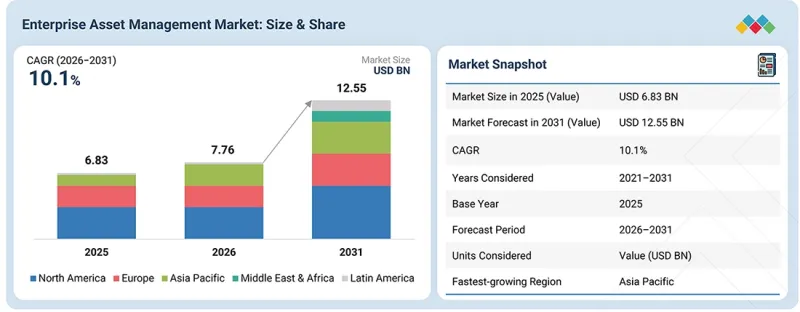
세계의 기업 자산 관리(EAM) 시장 규모는 2026년 77억 6,000만 달러에서 2031년에는 125억 5,000만 달러로 성장할 것으로 예상되며, 연평균 성장률(CAGR)은 10.1%에 달할 것으로 전망됩니다.
세계 기업 자산 관리(EAM) 시장은 자산 집약형 산업 전반에 걸쳐 클라우드 기반 EAM 소프트웨어, 통합된 자산 정보 관리, 디지털화된 유지보수 업무에 대한 수요가 증가함에 따라 꾸준히 확대되고 있습니다. 기업들은 자산 수명주기 관리, 규정 준수, 작업 지시서 관리, 점검, 자산 추적, MRO 재고, 규정 준수, 자산 성과 관리를 효율화하는 동시에 업무 효율과 자산의 신뢰성을 향상시키기 위해 클라우드 네이티브 EAM 플랫폼 도입을 점점 더 확대하고 있습니다.
| 조사 범위 | |
|---|---|
| 조사 대상 기간 | 2021-2031년 |
| 기준 연도 | 2025년 |
| 예측 기간 | 2026-2031년 |
| 단위 | 금액(달러) |
| 부문 | 제공, 용도, 자산 클래스, 전개 방식, 조직 규모, 산업별 |
| 대상 지역 | 북미, 유럽, 아시아태평양, 중동 및 아프리카, 라틴아메리카 |
데이터 기반 자산 관리에 대한 관심이 높아지는 가운데, AI를 활용한 자산 분석, 예측 유지보수, 상태 모니터링, 워크플로우 자동화, 기업 자산 계획(ERP), IoT, 현장 서비스 관리, 공급망, 분석 플랫폼과의 원활한 통합에 대한 수요가 가속화되고 있습니다. 그러나 레거시 EAM의 현대화, 복잡한 자산 데이터의 마이그레이션, 통합상의 과제, 도입 비용, 사이버 보안 요구 사항이 여전히 시장 성장을 저해하고 있습니다. 이러한 과제에도 불구하고, 산업의 디지털화, 커넥티드 자산, 클라우드를 통한 현대화, 상호 운용성, 안전한 EAM 아키텍처에 대한 투자가 증가하고 있으며, 커넥티드 자산을 광범위하게 활용하는 업무 전반에 걸쳐 EAM 소프트웨어의 전략적 중요성은 계속해서 높아지고 있습니다.
“전개 방식별로는 예측 기간 동안 클라우드 기반 부문이 가장 높은 성장률을 기록할 것으로 예상됩니다.”
전개 방식별로 살펴보면, 확장성이 뛰어나고 유연성이 높으며 원격 액세스가 가능한 EAM 플랫폼에 대한 수요가 증가함에 따라, 예측 기간 동안 클라우드 부문이 가장 높은 성장률을 기록할 것으로 예상됩니다. 클라우드 EAM을 통해 조직은 지리적으로 분산된 시설 전반에 걸쳐 자산 수명주기 관리, 유지보수 계획, 작업 지시서 관리, 자산 성과 관리, 예측 유지보수를 통합할 수 있을 뿐만 아니라, 온프레미스 인프라에 대한 의존도를 낮출 수 있습니다.
2025년 1월, IFS는 산업용 AI 기능을 확충하여 IFS Cloud를 강화함으로써, EAM을 포함한 자산 집약적 업무 전반에 걸쳐 AI를 통한 인사이트 제공 및 자동화 실현 능력을 높였습니다. 이러한 기능 강화를 통해 기업 및 조직은 통합된 클라우드 환경 내에서 자산 데이터, 유지보수 프로세스, 업무 관련 인텔리전스를 연계할 수 있습니다.
또한, 클라우드 도입은 IoT, ERP, 현장 서비스 관리, 공급망, 분석 플랫폼과의 통합을 촉진하여 실시간 자산 가시화와 표준화된 유지보수 워크플로우를 실현합니다. 구독형 소프트웨어의 보급 확대, 지속적인 플랫폼 기능 강화, 오픈 API, 구성 가능한 워크플로우, 통합된 사이버 보안은 기존의 온프레미스형 EAM 환경에서 클라우드로의 전환을 더욱 촉진하고 있습니다. 조직이 예측 유지보수, 자산 신뢰성, 운영 복원력, 종단간 자산 수명주기 최적화를 우선시함에 따라, 클라우드 기반 EAM은 현대의 연결된 자산 관리에서 점점 더 중요해지고 있습니다.
“산업별로는 예측 기간 동안 제조 부문이 가장 큰 시장 점유율을 차지할 것으로 예상됩니다.”
제조업은 해당 부문이 보유한 광범위한 생산 설비, 기계, 플랜트 인프라, 상호연결된 물리적 자산을 바탕으로 전 세계 기업 자산 관리 시장에서 가장 큰 점유율을 차지할 것으로 예상됩니다. 제조 기업들은 전체 생산 시설의 자산 수명주기 관리, 예방 정비 및 예측 정비, 작업 지시서, 점검, 예비 부품·유지보수·수리·운영(MRO) 자재 재고, 자산 신뢰성, 자산 성능을 관리하기 위해 EAM 소프트웨어에 대한 의존도를 높이고 있습니다. 산업용 IoT, 커넥티드 기기, 자동화, AI 도입이 확대됨에 따라 실시간 자산 모니터링 및 데이터 기반 유지보수에 대한 수요가 더욱 증가하고 있습니다.
2026년 5월, IFS는 유지보수 자재 관리, 안전 승인 워크플로우, AI를 활용한 고장 모드·영향·치명도 분석(FMECA) 지원 등 새로운 EAM 기능을 추가하여 IFS Cloud를 강화하고, 유지보수 업무 비중이 높은 산업 활동에 대한 지원을 확대했습니다. 이러한 기능을 통해 제조업체는 통합된 EAM 환경 내에서 유지보수 계획, 신뢰성 분석, 자산 성과, 재고, 운영 워크플로우를 연계할 수 있게 됩니다. 제조 기업들이 설비의 가동률, 생산의 연속성, 유지보수 효율, 자산 수명주기의 최적화를 우선시하는 가운데, EAM은 디지털로 연결된 제조 업무에서 점점 더 중심적인 역할을 수행하고 있습니다.
“북미는 성숙한 산업·자산 관리 인프라, 클라우드 기반 EAM 소프트웨어의 광범위한 도입, AI를 활용한 자산 성과 관리, 예측 유지보수, 커넥티드 자산 운영에 대한 강력한 수요로 인해 기업 자산 관리 시장을 선도하고 있습니다. 한편, 아시아태평양은 산업 디지털화의 가속화, 제조업 및 인프라 투자 확대, IoT를 활용한 자산 모니터링 도입 증가, 자산 집약형 산업 전반에 걸친 클라우드 기반 EAM 플랫폼의 급속한 확산에 힘입어 가장 빠르게 성장하고 있는 지역이 되었습니다.”
북미의 기업 자산 관리 시장은 클라우드 기반 EAM 플랫폼의 광범위한 도입, 성숙한 산업용 디지털 인프라, 통합된 자산 수명주기 관리, 자산 성과 관리, 디지털 유지보수 및 운영에 대한 강력한 수요에 힘입어 성장하고 있습니다. 미국 및 캐나다 전역의 자산 집약형 조직에서는 설비, 기계, 시설, 인프라, 작업 지시서, 예방 정비,점검, 재고, 규정 준수, 자산 성과를 관리하기 위한 안전한 EAM 소프트웨어가 필요하며, 이는 AI를 활용한 예측 유지보수, 상태 모니터링, 워크플로우 자동화, 커넥티드 자산 관리에 대한 수요를 견인하고 있습니다. 제조, 에너지·공공사업, 운송, 의료, 정부 기관 및 기타 자산 집약형 산업에서는 유지보수 및 운영 워크플로우를 효율화하기 위해 EAM 플랫폼과 기업 자원 계획(ERP), 산업용 사물인터넷(IIoT), 현장 서비스 관리, 공급망, 분석 애플리케이션 간의 통합이 점점 더 확대되고 있습니다.
이 지역에서는 주요 EAM 벤더와 기술 제공업체들이 강력한 입지를 보여주며 플랫폼의 지속적인 혁신을 주도하고 있습니다. 그 한 예로 2026년 6월에 출시된 IBM Maximo Application Suite 9.2가 있으며, 이를 통해 유지보수, 신뢰성, 현장 서비스,안전, 운영 등 각 워크플로우에서 AI 기능이 확충되었습니다. 산업의 디지털화, 자산의 신뢰성, 업무의 회복탄력성, 커넥티드 인프라에 대한 투자 확대 또한 성숙한 혁신 주도형 기업 자산 관리 시장으로서 북미의 위상을 한층 더 강화하고 있습니다. 이 시장에서는 예측 유지보수, 자산 최적화, 데이터 기반 의사결정, 자산 운영의 통합이 계속해서 전략적 우선순위로 자리 잡고 있습니다.
본 보고서에서는 전 세계 기업 자산 관리 시장을 조사하여, 시장 개요, 시장 성장에 영향을 미치는 각종 요인 분석, 기술 및 특허 동향, 법규제 환경, 사례 연구, 시장 규모 추정 및 전망, 각종 분류·지역/주요 국가별 상세 분석, 경쟁 구도, 주요 기업 개요 등을 정리하고 있습니다.
자주 묻는 질문
목차
제1장 소개
제2장 주요 요약
제3장 주요 인사이트
제4장 시장 개요
제5장 산업 동향
제6장 고객 상황과 구매 행동
제7장 규제 상황
제8장 기술, 특허, 디지털 기술, AI의 도입에 의한 전략적 디스럽션
제9장 기업 자산 관리 시장 : 제공별
제10장 기업 자산 관리 시장 : 용도별
제11장 기업 자산 관리 시장 : 전개 방식별
제12장 기업 자산 관리 시장 : 자산 클래스별
제13장 기업 자산 관리 시장 : 조직 규모별
제14장 기업 자산 관리 시장 : 산업별
제15장 기업 자산 관리 시장 : 지역별
제16장 경쟁 구도
제17장 기업 개요
제18장 조사 방법
제19장 부록
KSM 26.10.08The global enterprise asset management market is projected to grow from USD 7.76 billion in 2026 to USD 12.55 billion by 2031, at a CAGR of 10.1%. The global enterprise asset management market is expanding steadily, driven by increasing demand for cloud-based EAM software, centralized asset information management, and digital maintenance operations across asset-intensive industries. Organizations are increasingly adopting cloud-native EAM platforms to streamline asset lifecycle management, maintenance planning, work order management, inspections, asset tracking, MRO inventory, compliance, and asset performance management while improving operational efficiency and asset reliability.
| Scope of the Report | |
|---|---|
| Years Considered for the Study | 2021-2031 |
| Base Year | 2025 |
| Forecast Period | 2026-2031 |
| Units Considered | Value (USD Billion) |
| Segments | By Offering, Application, Asset Class, Deployment Type, Organization Size, & Vertical |
| Regions covered | North America, Europe, Asia Pacific, Middle East & Africa, Latin America |
Growing emphasis on data-driven asset management is accelerating demand for artificial intelligence-powered asset analytics, predictive maintenance, condition-based monitoring, workflow automation, and seamless integration with enterprise resource planning, IoT, field service management, supply chain, and analytics platforms. However, legacy EAM modernization, complex asset data migration, integration challenges, implementation costs, and cybersecurity requirements continue to restrain market growth. Despite these challenges, increasing investment in industrial digitalization, connected assets, cloud modernization, interoperability, and secure EAM architecture continues to strengthen the strategic importance of EAM software across connected asset-intensive operations.
"By deployment mode, the cloud-based segment is expected to record the fastest growth rate during the forecast period"
By deployment mode, cloud is expected to record the fastest growth rate in the enterprise asset management market during the forecast period, driven by increasing demand for scalable, flexible, and remotely accessible EAM platforms. Cloud EAM enables organizations to centralize asset lifecycle management, maintenance planning, work order management, asset performance management, and predictive maintenance across geographically distributed facilities while reducing dependence on on-premises infrastructure. In January 2025, IFS enhanced IFS Cloud with expanded Industrial AI capabilities, strengthening the platform's ability to deliver AI-powered insights and automation across asset-intensive operations, including EAM. The enhancement supports organizations in connecting asset data, maintenance processes, and operational intelligence within a unified cloud environment. Cloud deployment also facilitates integration with IoT, ERP, field service management, supply chain, and analytics platforms, enabling real-time asset visibility and standardized maintenance workflows. Increasing adoption of subscription-based software, continuous platform enhancements, open APIs, configurable workflows, and integrated cybersecurity is further supporting the shift from legacy on-premises EAM environments. As organizations prioritize predictive maintenance, asset reliability, operational resilience, and end-to-end asset lifecycle optimization, cloud-based EAM is becoming increasingly important for modern connected asset management.
"By vertical, the manufacturing segment is expected to hold the largest market share during the forecast period."
The manufacturing vertical is expected to hold the largest share of the global enterprise asset management market, driven by the sector's extensive base of production equipment, machinery, plant infrastructure, and interconnected physical assets. Manufacturing organizations increasingly rely on EAM software to manage asset lifecycle management, preventive and predictive maintenance, work orders, inspections, spare parts and MRO inventory, asset reliability, and asset performance across production facilities. The growing adoption of industrial IoT, connected equipment, automation, and artificial intelligence is further increasing demand for real-time asset monitoring and data-driven maintenance. In May 2026, IFS enhanced IFS Cloud with new EAM capabilities including maintenance material control, safety authorization workflows, and AI-assisted FMECA analysis, strengthening support for maintenance-intensive industrial operations. These capabilities enable manufacturers to connect maintenance planning, reliability analysis, asset performance, inventory, and operational workflows within a unified EAM environment. As manufacturing organizations prioritize equipment uptime, production continuity, maintenance efficiency, and asset lifecycle optimization, EAM is becoming increasingly central to digitally connected manufacturing operations.
"North America leads the enterprise asset management market with mature industrial and asset management infrastructure, widespread adoption of cloud-based EAM software, and strong demand for AI-powered asset performance management, predictive maintenance, and connected asset operations, while Asia Pacific is the fastest-growing region driven by accelerating industrial digitalization, expanding manufacturing and infrastructure investments, increasing adoption of IoT-enabled asset monitoring, and rapid deployment of cloud-based EAM platforms across asset-intensive industries."
The enterprise asset management market in North America is driven by widespread adoption of cloud-based EAM platforms, mature industrial digital infrastructure, and strong demand for centralized asset lifecycle management, asset performance management, and digital maintenance operations. Asset-intensive organizations across the United States and Canada require secure EAM software to manage equipment, machinery, facilities, infrastructure, work orders, preventive maintenance, inspections, inventory, compliance, and asset performance, driving demand for AI-powered predictive maintenance, condition monitoring, workflow automation, and connected asset management. Manufacturing, energy and utilities, transportation, healthcare, government, and other asset-intensive industries are increasingly integrating EAM platforms with enterprise resource planning, industrial IoT, field service management, supply chain, and analytics applications to streamline maintenance and operational workflows. The region benefits from the strong presence of leading EAM vendors and technology providers driving continuous platform innovation, including IBM Maximo Application Suite 9.2, introduced in June 2026, which expanded AI capabilities across maintenance, reliability, field service, safety, and operations workflows. Growing investment in industrial digitalization, asset reliability, operational resilience, and connected infrastructure further reinforces North America's position as a mature and innovation-driven enterprise asset management market where predictive maintenance, asset optimization, data-driven decision-making, and integrated asset operations remain strategic priorities.
Breakdown of Primaries
In-depth interviews were conducted with chief executive officers (CEOs), innovation and technology directors, system integrators, and executives from various key organizations operating in the enterprise asset management market.
- By Company: Tier 1 - 35%, Tier 2 - 45%, and Tier 3 - 20%
- By Designation: Directors - 35%, Managers - 25%, and Others - 40%
- By Region: North America - 45%, Europe - 20%, Asia Pacific - 25%, Middle East & Africa - 5%, and Latin America - 5%
The report includes a study of key players in the enterprise asset management market. It profiles major vendors in the enterprise asset management market. The major market players include IBM (US), Oracle (US), SAP (Germany), Octave Intelligence (Ireland), IFS (Sweden), Aptean (US), Trimble (US), ServiceNow (US), Hitachi Energy (Switzerland), Ramco Systems (India), Accruent (US), MaintainX (US), ABS Group (US), Central Square (US), KloudGin (US), Assetworks (US), Limble CMMS (US), Upkeep (US), Asset Panda (US), emaint (US), Asset Infinity (India), EZmaintain (India), Llumin (US), and IPS Intelligent Process Solutions (Germany).
Research Coverage
This research report categorizes the enterprise asset management market based on offering into solutions and services, by application into asset lifecycle management, operation management, maintenance management, compliance & safety, reporting & analytics, and other application, by deployment type into cloud, on-premises, by asset class into linear asset, production equipment, fleet & mobility assets, fixed/facility assets/ infrastructure and others, by organization size in to large enterprises, small and medium-sized enterprises, by vertical into manufacturing, energy & utilities, oil & gas, transportation & logistics, healthcare & life sciences, government & public sector, and other verticals, and Region (North America, Europe, Asia Pacific, Middle East & Africa, and Latin America). The report's scope covers detailed information regarding the major factors, such as drivers, restraints, challenges, and opportunities, influencing the growth of the enterprise asset management market. A detailed analysis of the key industry players was conducted to provide insights into their business overview, solutions, and services; key strategies; contracts, partnerships, agreements, product & service launches, and mergers & acquisitions; and recent developments associated with the enterprise asset management market. This report also covers the competitive analysis of upcoming startups in the enterprise asset management market ecosystem.
Reason to Buy This Report
The report would provide market leaders and new entrants with information on the closest approximations of the revenue numbers for the overall enterprise asset management market and its subsegments. It would help stakeholders understand the competitive landscape and gain more insights to position their businesses better and plan suitable go-to-market strategies. It also helps stakeholders understand the market's pulse and provides them with information on key market drivers, restraints, challenges, and opportunities.
The report provides insights on the following pointers:
- Analysis of key drivers (Rising demand for higher asset uptime, Pressing need for real-time asset insights), restraints (High upfront implementation costs, Complex integration and system modernization requirements), opportunities (Expansion of digital twins and lifecycle simulation, Growing adoption of remote maintenance), and challenges (Fragmented asset data and legacy systems, Shortage of skilled asset management professionals).
- Product Development/Innovation: Detailed insights on upcoming technologies, research & development activities, and product & service launches in the enterprise asset management market.
- Market Development: Comprehensive information about lucrative markets - the report analyzes the enterprise asset management market across varied regions.
- Market Diversification: Exhaustive information about new products & services, untapped geographies, recent developments, and investments in the enterprise asset management market.
- Competitive Assessment: In-depth assessment of market shares, growth strategies and service offerings of leading players such as IBM (US), Oracle (US), SAP (Germany), Octave Intelligence (Ireland), IFS (Sweden), Aptean (US), Trimble (US), ServiceNow (US), Hitachi Energy (Switzerland), Ramco Systems (India), Accruent (US), MaintainX (US), ABS Group (US), Central Square (US), KloudGin (US), Assetworks (US), Limble CMMS (US), Upkeep (US), Asset Panda (US), emaint (US), Asset Infinity (India), EZmaintain (India), Llumin (US), and IPS Intelligent Process Solutions (Germany). The report also helps stakeholders understand the enterprise asset management market's pulse and provides information on key market drivers, restraints, challenges, and opportunities.
TABLE OF CONTENTS
1 INTRODUCTION
- 1.1 STUDY OBJECTIVES
- 1.2 MARKET DEFINITION
- 1.3 MARKET SCOPE
- 1.3.1 MARKET SEGMENTATION AND REGIONAL SCOPE
- 1.3.2 INCLUSIONS AND EXCLUSIONS
- 1.3.3 YEARS CONSIDERED
- 1.4 CURRENCY CONSIDERED
- 1.5 LIMITATIONS
- 1.6 STAKEHOLDERS
- 1.7 SUMMARY OF CHANGES
2 EXECUTIVE SUMMARY
- 2.1 MARKET HIGHLIGHTS AND KEY INSIGHTS
- 2.2 KEY MARKET PARTICIPANTS: MAPPING OF STRATEGIC DEVELOPMENTS
- 2.3 DISRUPTIVE TRENDS IN ENTERPRISE ASSET MANAGEMENT MARKET
- 2.4 HIGH-GROWTH SEGMENTS
- 2.5 REGIONAL SNAPSHOT: MARKET SIZE, GROWTH RATE, AND FORECAST
3 PREMIUM INSIGHTS
- 3.1 ATTRACTIVE OPPORTUNITIES FOR PLAYERS IN ENTERPRISE ASSET MANAGEMENT MARKET
- 3.2 ENTERPRISE ASSET MANAGEMENT MARKET, BY OFFERING
- 3.3 ENTERPRISE ASSET MANAGEMENT MARKET, BY ASSET CLASS
- 3.4 ENTERPRISE ASSET MANAGEMENT MARKET, BY APPLICATION
- 3.5 ENTERPRISE ASSET MANAGEMENT MARKET, BY ORGANIZATION SIZE
- 3.6 ENTERPRISE ASSET MANAGEMENT MARKET, BY DEPLOYMENT TYPE
- 3.7 ENTERPRISE ASSET MANAGEMENT MARKET, BY VERTICAL
- 3.8 ENTERPRISE ASSET MANAGEMENT MARKET, BY REGION
4 MARKET OVERVIEW
- 4.1 INTRODUCTION
- 4.2 MARKET DYNAMICS
- 4.2.1 DRIVERS
- 4.2.1.1 Accelerating adoption of AI-driven, connected asset operation
- 4.2.1.2 Expansion of connected asset ecosystems is driving EAM adoption
- 4.2.1.3 Demand for industry-specific EAM solutions
- 4.2.1.4 EAM as tool for sustainable asset lifecycle management
- 4.2.2 RESTRAINTS
- 4.2.2.1 High implementation complexity and integration costs constrain EAM adoption
- 4.2.2.2 Managing compliance complexity across borders
- 4.2.3 OPPORTUNITIES
- 4.2.3.1 Expansion of digital twins and lifecycle simulation creates new EAM opportunities
- 4.2.3.2 Expansion of mobile and remote maintenance capabilities strengthens EAM adoption
- 4.2.3.3 Convergence of EAM with enterprise and asset lifecycle workflows
- 4.2.4 CHALLENGES
- 4.2.4.1 Fragmented asset data and legacy-system complexity constrain EAM modernization
- 4.2.4.2 Growing maintenance skills shortages and loss of workforce knowledge constrain EAM effectiveness
- 4.2.1 DRIVERS
- 4.3 UNMET NEEDS AND WHITE SPACES
- 4.3.1 UNMET NEEDS IN ENTERPRISE ASSET MANAGEMENT MARKET
- 4.3.2 WHITE SPACE OPPORTUNITIES
- 4.4 INTERCONNECTED MARKETS AND CROSS-SECTOR OPPORTUNITIES
- 4.4.1 INTERCONNECTED MARKETS
- 4.4.2 CROSS-SECTOR OPPORTUNITIES
- 4.5 EMERGING BUSINESS MODELS AND ECOSYSTEM SHIFTS
- 4.5.1 EMERGING BUSINESS MODELS
- 4.5.1.1 Enterprise Asset Management business models
- 4.5.2 ECOSYSTEM SHIFTS
- 4.5.1 EMERGING BUSINESS MODELS
- 4.6 STRATEGIC MOVES BY TIER-1/2/3 PLAYERS
- 4.6.1 KEY MOVES AND STRATEGIC FOCUS
5 INDUSTRY TRENDS
- 5.1 PORTER'S FIVE FORCES ANALYSIS
- 5.1.1 THREAT OF NEW ENTRANTS
- 5.1.2 THREAT OF SUBSTITUTES
- 5.1.3 BARGAINING POWER OF SUPPLIERS
- 5.1.4 BARGAINING POWER OF BUYERS
- 5.1.5 INTENSITY OF COMPETITIVE RIVALRY
- 5.2 MACROECONOMIC INDICATORS
- 5.2.1 INTRODUCTION
- 5.2.2 GDP TRENDS & FORECASTS
- 5.2.3 TRENDS IN GLOBAL HUMAN CAPITAL MANAGEMENT INDUSTRY
- 5.2.4 TRENDS IN GLOBAL WORKFORCE MANAGEMENT INDUSTRY
- 5.3 VALUE CHAIN ANALYSIS
- 5.4 ECOSYSTEM ANALYSIS
- 5.5 PRICING ANALYSIS
- 5.5.1 AVERAGE SELLING PRICE, BY REGION, 2024-2026
- 5.5.2 INDICATIVE PRICING, BY KEY PLAYER, 2024
- 5.6 KEY CONFERENCES AND EVENTS, 2026-2027
- 5.7 TRENDS/DISRUPTIONS IMPACTING CUSTOMER BUSINESS
- 5.8 INVESTMENT & FUNDING SCENARIO
- 5.9 CASE STUDY ANALYSIS
- 5.9.1 CASE STUDY 1: HUNGRANA UTILIZED SAP EAM FOR ASSET MAINTENANCE
- 5.9.2 CASE STUDY 2: RIYADH AIRPORTS COMPANY TRANSFORMING AIRPORT ASSET MANAGEMENT WITH IBM MAXIMO
- 5.9.3 CASE STUDY 3: STOCKHOLM EXERGI ESTABLISHED STANDALONE IT ENVIRONMENT WITH IFS CLOUD
- 5.9.4 CASE STUDY 4: L'OREAL ACHIEVED REAL-TIME ASSET VISIBILITY BY ADOPTING CMMS
- 5.9.5 CASE STUDY 5: DRIVING 900% ENGINEERING TEAM GROWTH IN SIX MONTHS WITH APTEAN EAM
- 5.10 IMPACT OF 2025 US TARIFF - ENTERPRISE ASSET MANAGEMENT MARKET
- 5.10.1 INTRODUCTION
- 5.10.2 KEY TARIFF RATES
- 5.10.3 PRICE IMPACT ANALYSIS
- 5.10.4 IMPACT ON REGIONS
- 5.10.4.1 North America
- 5.10.4.2 Europe
- 5.10.4.3 Asia Pacific
- 5.10.5 IMPACT ON VERTICALS
- 5.10.5.1 Manufacturing
- 5.10.5.2 Energy & Utilities
- 5.10.5.3 Oil & Gas
- 5.10.5.4 Transportation & Logistics
- 5.10.5.5 Government & Public Sector
- 5.10.5.6 Healthcare & Life Sciences
6 CUSTOMER LANDSCAPE AND BUYER BEHAVIOR
- 6.1 DECISION-MAKING PROCESS
- 6.2 BUYER STAKEHOLDERS AND BUYING EVALUATION CRITERIA
- 6.2.1 KEY STAKEHOLDERS IN BUYING PROCESS
- 6.2.2 BUYING CRITERIA
- 6.3 ADOPTION BARRIERS AND INTERNAL CHALLENGES
- 6.4 UNMET NEEDS IN VARIOUS END-USER INDUSTRIES
- 6.5 MARKET PROFITABILITY
- 6.5.1 REVENUE POTENTIAL
- 6.5.2 COST DYNAMICS
- 6.5.3 MARGIN OPPORTUNITIES IN KEY APPLICATIONS
7 REGULATORY LANDSCAPE
- 7.1 REGULATORY BODIES, GOVERNMENT AGENCIES, AND OTHER ORGANIZATIONS
- 7.1.1 KEY REGULATIONS, BY REGION
- 7.1.1.1 North America
- 7.1.1.2 Europe
- 7.1.1.3 Asia Pacific
- 7.1.1.4 Middle East & South Africa
- 7.1.1.5 Latin America
- 7.1.1 KEY REGULATIONS, BY REGION
8 STRATEGIC DISRUPTION THROUGH TECHNOLOGY, PATENTS, DIGITAL, AND AI ADOPTION
- 8.1 TECHNOLOGY ANALYSIS
- 8.1.1 KEY TECHNOLOGIES
- 8.1.1.1 Industrial Internet of Things (IIoT) and connected asset monitoring
- 8.1.1.2 Artificial Intelligence and Machine Learning
- 8.1.1.3 Digital Twin Technology
- 8.1.2 COMPLEMENTARY TECHNOLOGIES
- 8.1.2.1 Cloud Computing and SaaS
- 8.1.2.2 Mobile and Connected-Worker Technology
- 8.1.2.3 Geographic Information Systems (GIS) and Location Intelligence
- 8.1.3 ADJACENT TECHNOLOGIES
- 8.1.3.1 Augmented Reality and Mixed Reality
- 8.1.3.2 Drones and Robotic Inspection
- 8.1.1 KEY TECHNOLOGIES
- 8.2 TECHNOLOGY/PRODUCT ROADMAP
- 8.2.1 SHORT-TERM (2026-2028) | CLOUD MODERNIZATION & AI EMBEDDED ASSET MANAGEMENT
- 8.2.2 MID-TERM (2028-2031) | CONNECTED ASSET INTELLIGENCE & AUTONOMOUS MAINTENANCE ECOSYSTEMS
- 8.2.3 LONG-TERM (2031-2035+) | AUTONOMOUS & INTELLIGENT ASSET LIFECYCLE PLATFORMS
- 8.3 PATENT ANALYSIS
- 8.3.1 LIST OF MAJOR PATENTS, 2023-2024
- 8.4 FUTURE APPLICATIONS
- 8.4.1 CONNECTED CONDITION BASED MAINTENANCE
- 8.4.2 DIGITAL TWIN ENABLED ASSET LIFECYCLE MANAGEMENT
- 8.4.3 RISK-BASED ASSET INVESTMENT & REPLACEMENT PLANNING
- 8.4.4 GIS CENTRIC LINEAR & INFRASTRUCTURE ASSET MANAGEMENT
- 8.4.5 CLOSED LOOP FIELD TO ENTERPRISE ASSET OPERATIONS
- 8.5 IMPACT OF AI/GENERATIVE AI ON ENTERPRISE ASSET MANAGEMENT MARKET
- 8.5.1 TOP USE CASES AND MARKET POTENTIAL
- 8.5.2 BEST PRACTICES IN ENTERPRISE ASSET MANAGEMENT
- 8.5.3 CASE STUDY OF AI IMPLEMENTATION IN ENTERPRISE ASSET MANAGEMENT MARKET
- 8.5.3.1 EXCITEL BUILT PROACTIVE SUPPLY CHAIN WITH ASSET INSIDER
- 8.5.4 INTERCONNECTED ADJACENT ECOSYSTEM AND IMPACT ON MARKET PLAYERS
- 8.5.5 CLIENT READINESS TO ADOPT GENERATIVE AI IN THE ENTERPRISE ASSET MANAGEMENT MARKET
- 8.6 SUCCESS STORIES AND REAL-WORLD APPLICATIONS
- 8.6.1 IBM: MAXIMO APPLICATION SUITE
- 8.6.2 IFS: IFS CLOUD EAM
9 ENTERPRISE ASSET MANAGEMENT MARKET, BY OFFERING
- 9.1 INTRODUCTION
- 9.1.1 OFFERINGS: ENTERPRISE ASSET MANAGEMENT MARKET DRIVERS
- 9.2 SOLUTIONS
- 9.2.1 REDUCING DOWNTIME WITH INTEGRATED SOLUTIONS
- 9.2.2 STANDALONE SOLUTIONS
- 9.2.3 INTEGRATED PLATFORMS
- 9.3 SERVICES
- 9.3.1 EFFECTIVE IMPLEMENTATION OF EAM WITH SERVICES
- 9.3.2 TRAINING & CONSULTING SERVICES
- 9.3.3 DEPLOYMENT & INTEGRATION SERVICES
- 9.3.4 SUPPORT & MAINTENANCE SERVICES
10 ENTERPRISE ASSET MANAGEMENT MARKET, BY APPLICATION
- 10.1 INTRODUCTION
- 10.1.1 APPLICATIONS: ENTERPRISE ASSET MANAGEMENT MARKET DRIVERS
- 10.2 ASSET LIFECYCLE MANAGEMENT
- 10.2.1 FORECASTING FUTURE NEEDS WITH ASSET PLANNING & FORECASTING
- 10.2.2 ASSET TRACKING & UTILIZATION
- 10.2.3 ASSET DISPOSAL & REPLACEMENT
- 10.2.4 ASSET PLANNING & FORECASTING
- 10.3 OPERATIONS MANAGEMENT
- 10.3.1 RISING ADOPTION DUE TO NEED FOR ENHANCING OPERATIONAL VISIBILITY
- 10.3.2 INVENTORY MANAGEMENT
- 10.3.3 LABOR MANAGEMENT
- 10.3.4 WORK ORDER MANAGEMENT
- 10.4 MAINTENANCE MANAGEMENT
- 10.4.1 INTEGRATING MAINTENANCE WITH WORK ORDERS, LABOR, AND INVENTORY
- 10.4.2 PREVENTIVE MAINTENANCE
- 10.4.3 PREDICTIVE MAINTENANCE
- 10.4.4 CORRECTIVE MAINTENANCE
- 10.5 COMPLIANCE & SAFETY
- 10.5.1 MINIMIZING RISK THROUGH PROACTIVE COMPLIANCE MANAGEMENT
- 10.5.2 AUDIT MANAGEMENT
- 10.5.3 REGULATORY COMPLIANCE MANAGEMENT
- 10.5.4 RISK ASSESSMENT & MITIGATION
- 10.6 REPORT & ANALYTICS
- 10.6.1 TRANSFORMING ASSET DATA INTO ACTIONABLE INSIGHTS
- 10.6.2 PERFORMANCE ANALYTICS
- 10.6.3 KPI DASHBOARDS & ALERTS
- 10.6.4 SAFETY ANALYTICS
- 10.7 OTHER APPLICATIONS
11 ENTERPRISE ASSET MANAGEMENT MARKET, BY DEPLOYMENT TYPE
- 11.1 INTRODUCTION
- 11.1.1 DEPLOYMENT TYPES: ENTERPRISE ASSET MANAGEMENT MARKET DRIVERS
- 11.2 CLOUD
- 11.2.1 MAXIMIZING ASSET LIFECYCLE WITH CLOUD EAM
- 11.3 ON-PREMISES
- 11.3.1 REDUCING DOWNTIME WITH ROBUST ON-PREMISES SOLUTIONS
12 ENTERPRISE ASSET MANAGEMENT MARKET, BY ASSET CLASS
- 12.1 INTRODUCTION
- 12.1.1 ASSET CLASSES: ENTERPRISE ASSET MANAGEMENT MARKET DRIVERS
- 12.2 LINEAR ASSETS
- 12.2.1 REDUCING OPERATIONAL RISKS IN LINEAR ASSETS
- 12.2.2 ROADS
- 12.2.3 PIPELINE
- 12.2.4 RAILWAYS
- 12.3 PRODUCTION EQUIPMENT
- 12.3.1 PREDICTIVE MAINTENANCE FOR INDUSTRIAL MACHINERY
- 12.3.2 TURBINES
- 12.3.3 ROTARY PUMPS
- 12.3.4 COMPRESSORS
- 12.4 FLEET & MOBILE ASSETS
- 12.4.1 FUEL AND COST OPTIMIZATION FOR FLEET MANAGEMENT
- 12.4.2 VEHICLES
- 12.4.3 TRUCKS
- 12.4.4 AIRCRAFT
- 12.5 FIXED/FACILITY ASSETS/INFRASTRUCTURE
- 12.5.1 EXTENDING LIFESPAN OF FIXED ASSETS
- 12.5.2 BUILDINGS
- 12.5.3 PLANTS
- 12.5.4 WAREHOUSES
- 12.6 OTHER ASSET CLASSES
13 ENTERPRISE ASSET MANAGEMENT MARKET, BY ORGANIZATION SIZE
- 13.1 INTRODUCTION
- 13.1.1 ORGANIZATION SIZES: ENTERPRISE ASSET MANAGEMENT MARKET DRIVERS
- 13.2 LARGE ENTERPRISES
- 13.2.1 EAM REDUCING DOWNTIME & OPERATIONAL DISRUPTIONS FOR LARGE ENTERPRISES
- 13.3 SMALL & MEDIUM ENTERPRISES
- 13.3.1 USER-FRIENDLY EAM TOOLS FOR RESOURCE-LIMITED TEAMS
14 ENTERPRISE ASSET MANAGEMENT MARKET, BY VERTICAL
- 14.1 INTRODUCTION
- 14.1.1 VERTICALS: ENTERPRISE ASSET MANAGEMENT MARKET DRIVERS
- 14.2 MANUFACTURING
- 14.2.1 OPTIMIZE PRODUCTION EQUIPMENT PERFORMANCE
- 14.2.2 MANUFACTURING: USE CASES
- 14.2.2.1 Predictive maintenance for CNC machines
- 14.2.2.2 Real-time monitoring of production line
- 14.2.2.3 Managing inventory of critical spare parts
- 14.3 ENERGY & UTILITIES
- 14.3.1 OPTIMIZE ENERGY GENERATION AND DISTRIBUTION
- 14.3.2 ENERGY & UTILITIES: USE CASES
- 14.3.2.1 Transformer maintenance
- 14.3.2.2 Energy usage tracking
- 14.3.2.3 Grid monitoring
- 14.4 OIL & GAS
- 14.4.1 MINIMIZED UNPLANNED DOWNTIME WITH EAM
- 14.4.2 OIL & GAS: USE CASES
- 14.4.2.1 Regulatory compliance
- 14.4.2.2 Rig maintenance
- 14.4.2.3 Pipeline monitoring
- 14.5 TRANSPORTATION & LOGISTICS
- 14.5.1 IMPLEMENT PREDICTIVE VEHICLE MAINTENANCE
- 14.5.2 TRANSPORTATION & LOGISTICS: USE CASES
- 14.5.2.1 Fleet maintenance
- 14.5.2.2 Route optimization
- 14.5.2.3 Vehicle tracking
- 14.6 HEALTHCARE & LIFE SCIENCES
- 14.6.1 BETTER INSIGHTS, REDUCED COSTS, AND ENHANCED MANAGEMENT OF MEDICAL SUPPLIES
- 14.6.2 HEALTHCARE & LIFE SCIENCES: USE CASES
- 14.6.2.1 Device maintenance
- 14.6.2.2 Lab asset management
- 14.6.2.3 Facility asset tracking
- 14.7 GOVERNMENT & PUBLIC SECTOR
- 14.7.1 BETTER MONITORING OF PUBLIC INFRASTRUCTURE ASSETS
- 14.7.2 GOVERNMENT & PUBLIC SECTOR: USE CASES
- 14.7.2.1 Infrastructure monitoring
- 14.7.2.2 Public equipment tracking
- 14.7.2.3 Energy consumption monitoring
- 14.8 OTHER VERTICALS
15 ENTERPRISE ASSET MANAGEMENT MARKET, BY REGION
- 15.1 INTRODUCTION
- 15.2 NORTH AMERICA
- 15.2.1 NORTH AMERICA: ENTERPRISE ASSET MANAGEMENT MARKET DRIVERS
- 15.2.2 US
- 15.2.2.1 EAM Implementation for Long Island Railroad
- 15.2.3 CANADA
- 15.2.3.1 EAM solutions supporting operational efficiency in Canada
- 15.3 EUROPE
- 15.3.1 EUROPE: ENTERPRISE ASSET MANAGEMENT MARKET DRIVERS
- 15.3.2 UK
- 15.3.2.1 Rising demand for EAM solutions across UK asset-intensive industries
- 15.3.3 GERMANY
- 15.3.3.1 Innovations shaping EAM solutions in Germany
- 15.3.4 FRANCE
- 15.3.4.1 Digital transformation drives EAM adoption in France
- 15.3.5 ITALY
- 15.3.5.1 Government incentives accelerating EAM implementation
- 15.3.6 REST OF EUROPE
- 15.4 ASIA PACIFIC
- 15.4.1 ASIA PACIFIC: ENTERPRISE ASSET MANAGEMENT MARKET DRIVERS
- 15.4.2 CHINA
- 15.4.2.1 Baker Hughes and Sinochem lead enterprise-level EAM deployment
- 15.4.3 JAPAN
- 15.4.3.1 ServiceNow enhancing EAM solutions in Japan
- 15.4.4 AUSTRALIA & NEW ZEALAND
- 15.4.4.1 Government initiatives shaping EAM growth in Australia and New Zealand
- 15.4.5 REST OF ASIA PACIFIC
- 15.5 MIDDLE EAST & AFRICA
- 15.5.1 MIDDLE EAST & AFRICA: ENTERPRISE ASSET MANAGEMENT MARKET DRIVERS
- 15.5.2 GCC COUNTRIES
- 15.5.2.1 UAE
- 15.5.2.1.1 Strengthening industrial resilience via enterprise asset management
- 15.5.2.2 Saudi Arabia
- 15.5.2.2.1 Vision 2030 raises need for EAM solutions
- 15.5.2.3 Rest of GCC Countries
- 15.5.2.1 UAE
- 15.5.3 SOUTH AFRICA
- 15.5.3.1 Local and global EAM solutions powering South Africa's growth
- 15.5.4 REST OF MIDDLE EAST & AFRICA
- 15.6 LATIN AMERICA
- 15.6.1 LATIN AMERICA: ENTERPRISE ASSET MANAGEMENT MARKET DRIVERS
- 15.6.2 BRAZIL
- 15.6.2.1 Supporting industrial modernization with EAM solutions in Brazil
- 15.6.3 MEXICO
- 15.6.3.1 Reducing operational downtime with predictive maintenance in Mexico
- 15.6.4 REST OF LATIN AMERICA
16 COMPETITIVE LANDSCAPE
- 16.1 INTRODUCTION
- 16.2 KEY PLAYER STRATEGIES/RIGHT TO WIN, 2024-2026
- 16.3 REVENUE ANALYSIS, 2021-2025
- 16.4 MARKET SHARE ANALYSIS, 2025
- 16.5 PRODUCT COMPARISON
- 16.6 COMPANY EVALUATION MATRIX: KEY PLAYERS, 2026
- 16.6.1 STARS
- 16.6.2 EMERGING LEADERS
- 16.6.3 PERVASIVE PLAYERS
- 16.6.4 PARTICIPANTS
- 16.6.5 COMPANY FOOTPRINT: KEY PLAYERS, 2026
- 16.6.5.1 Company footprint
- 16.6.5.2 Regional footprint
- 16.6.5.3 Vertical footprint
- 16.6.5.4 Asset class footprint
- 16.7 COMPANY EVALUATION MATRIX: STARTUPS/SMES, 2026
- 16.7.1 PROGRESSIVE COMPANIES
- 16.7.2 RESPONSIVE COMPANIES
- 16.7.3 DYNAMIC COMPANIES
- 16.7.4 STARTING BLOCKS
- 16.7.5 COMPETITIVE BENCHMARKING: STARTUPS/SMES, 2026
- 16.7.5.1 Detailed list of key startups/SMEs
- 16.7.5.2 Competitive benchmarking of key startups/SMEs
- 16.8 COMPANY VALUATION AND FINANCIAL METRICS
- 16.8.1 COMPANY VALUATION OF KEY VENDORS
- 16.8.2 FINANCIAL METRICS OF KEY VENDORS
- 16.9 COMPETITIVE SCENARIO
- 16.9.1 PRODUCT LAUNCHES/ENHANCEMENTS
- 16.9.2 DEALS
17 COMPANY PROFILES
- 17.1 INTRODUCTION
- 17.2 KEY PLAYERS
- 17.2.1 IBM
- 17.2.1.1 Business overview
- 17.2.1.2 Products/Solutions/Services offered
- 17.2.1.3 Recent developments
- 17.2.1.3.1 Product launches/Product enhancements
- 17.2.1.3.2 Deals
- 17.2.1.4 MnM view
- 17.2.1.4.1 Right to win
- 17.2.1.4.2 Strategic choices
- 17.2.1.4.3 Weaknesses and competitive threats
- 17.2.2 IFS
- 17.2.2.1 Business overview
- 17.2.2.2 Products/Solutions/Services offered
- 17.2.2.3 Recent developments
- 17.2.2.3.1 Product launches/Product enhancements
- 17.2.2.3.2 Deals
- 17.2.2.4 MnM view
- 17.2.2.4.1 Right to win
- 17.2.2.4.2 Strategic choices
- 17.2.2.4.3 Weaknesses and competitive threats
- 17.2.3 SAP
- 17.2.3.1 Business overview
- 17.2.3.2 Products/Solutions/Services offered
- 17.2.3.3 Recent developments
- 17.2.3.3.1 Product launches/Product enhancements
- 17.2.3.3.2 Deals
- 17.2.3.4 MnM view
- 17.2.3.4.1 Right to win
- 17.2.3.4.2 Strategic choices
- 17.2.3.4.3 Weaknesses and competitive threats
- 17.2.4 HITACHI ENERGY
- 17.2.4.1 Business overview
- 17.2.4.2 Products/Solutions/Services offered
- 17.2.4.3 Recent developments
- 17.2.4.3.1 Product launches/Product enhancements
- 17.2.4.3.2 Deals
- 17.2.4.4 MnM view
- 17.2.4.4.1 Right to win
- 17.2.4.4.2 Strategic choices
- 17.2.4.4.3 Weaknesses and competitive threats
- 17.2.5 SERVICENOW
- 17.2.5.1 Business overview
- 17.2.5.2 Products/Solutions/Services offered
- 17.2.5.3 Recent developments
- 17.2.5.3.1 Product launches/Product enhancements
- 17.2.5.3.2 Deals
- 17.2.5.4 MnM view
- 17.2.5.4.1 Right to win
- 17.2.5.4.2 Strategic choices
- 17.2.5.4.3 Weaknesses and competitive threats
- 17.2.6 OCTAVE INTELLIGENCE
- 17.2.6.1 Business overview
- 17.2.6.2 Products/Solutions/Services offered
- 17.2.6.3 Recent developments
- 17.2.6.3.1 Deals
- 17.2.7 SIEMENS
- 17.2.7.1 Business overview
- 17.2.7.2 Products/Solutions/Services offered
- 17.2.7.3 Recent developments
- 17.2.7.3.1 Product launches/Product enhancements
- 17.2.7.3.2 Deals
- 17.2.8 TRIMBLE
- 17.2.8.1 Business overview
- 17.2.8.2 Products/Solutions/Services offered
- 17.2.8.3 Recent developments
- 17.2.8.3.1 Product launches/Product enhancements
- 17.2.8.3.2 Deals
- 17.2.9 ORACLE
- 17.2.9.1 Business overview
- 17.2.9.2 Products/Solutions/Services offered
- 17.2.9.3 Recent developments
- 17.2.9.3.1 Product launches/Product enhancements
- 17.2.9.3.2 Deals
- 17.2.10 CGI
- 17.2.10.1 Business overview
- 17.2.10.2 Products/Solutions/Services offered
- 17.2.1 IBM
- 17.3 OTHER PLAYERS
- 17.3.1 ACCRUENT
- 17.3.2 APTEAN
- 17.3.3 MAINTAINX
- 17.3.4 EPTURA
- 17.3.5 ABS GROUP
- 17.3.6 LIMBLE CMMS
- 17.3.7 ASSETWORKS
- 17.3.8 CENTRALSQUARE TECHNOLOGIES
- 17.3.9 PRAGMA
- 17.3.10 UPKEEP
- 17.3.11 RAMCO SYSTEMS
- 17.3.12 EMAINT
- 17.3.13 KLOUDGIN
- 17.3.14 IDEAGEN
- 17.3.15 IPS INTELLIGENT PROCESS SOLUTION
- 17.3.16 ASSET PANDA
- 17.3.17 LLUMIN
- 17.3.18 ASSET INFINITY
- 17.3.19 EZMAINTAIN
- 17.3.20 EPROMIS SOLUTIONS
18 RESEARCH METHODOLOGY
- 18.1 RESEARCH DATA
- 18.1.1 SECONDARY DATA
- 18.1.1.1 Data & list of key secondary sources
- 18.1.2 PRIMARY DATA
- 18.1.2.1 Breakdown of primary interviews
- 18.1.2.2 Key industry insights
- 18.1.1 SECONDARY DATA
- 18.2 MARKET SIZE ESTIMATION
- 18.3 DATA TRIANGULATION
- 18.4 FACTOR ANALYSIS
- 18.5 RESEARCH ASSUMPTIONS
19 APPENDIX
- 19.1 DISCUSSION GUIDE
- 19.2 KNOWLEDGESTORE: MARKETSANDMARKETS' SUBSCRIPTION PORTAL
- 19.3 CUSTOMIZATION OPTIONS
- 19.4 RELATED REPORTS
- 19.5 AUTHOR DETAILS


