

|
시장보고서
상품코드
2142609
공기 처리 기기 시장 : 제품별(공기청정기(휴대형, 덕트내 설치형), 가습기(초음파식, 증발식, 가열식), 제습기(흡착식, 정속식, 인버터식)), 센서별(습도, VOC, 멀티), 연결성별, 가격대별 - 세계 예측(-2032년)Air Treatment Appliance Market by Product [Air Purifier (Portable, In-duct), Humidifier (Ultrasonic, Evaporative, Warm), Dehumidifier (Desiccant, Fixed-speed, Inverter)], Sensor (Humidity, VOC, Multi), Connectivity, Price Range - Global Forecast to 2032 |
||||||

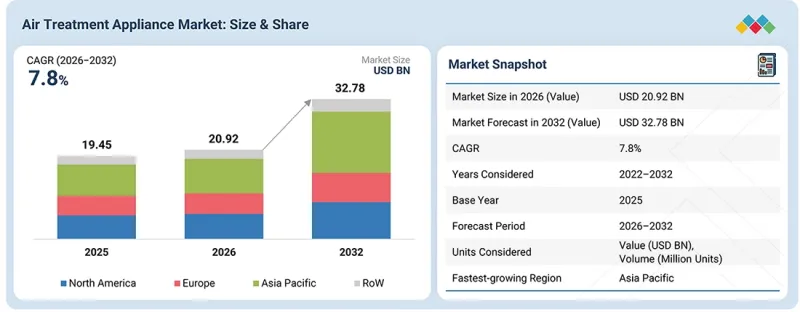
공기 처리 기기 시장 규모는 2026년 209억 2,000만 달러에서 2032년에는 327억 8,000만 달러에 달할 것으로 예측되며, 예측 기간 동안 CAGR은 7.8%가 될 전망입니다.
공기 처리 기기 시장은 공기청정기, 가습기, 제습기의 보급이 확대되고 있는 데다, 실내 공기질, 습도 관리, 보다 건강한 실내 환경에 대한 인식이 높아지는 것을 배경으로 예측 기간 동안 강력한 성장을 이룰 것으로 전망됩니다.
| 조사 범위 | |
|---|---|
| 조사 대상 기간 | 2022-2032년 |
| 기준 연도 | 2025년 |
| 예측 기간 | 2026-2032년 |
| 단위 | 금액(달러) |
| 부문 | 제품, 연결성, 유형, 지역별 |
| 대상 지역 | 북미, 유럽, 아시아태평양, 기타 지역 |
이 시장은 주거, 상업, 의료, 산업 각 분야에서 실내 공기 오염, 알레르기 유발 물질, 미세먼지, 과도한 습도, 실내 건조한 공기에 대한 우려가 높아짐에 힘입어 성장하고 있습니다. 도시화의 진전, 라이프스타일의 변화, 가처분 소득의 증가, 실내 환경의 질에 대한 소비자의 인식 제고로 인해 가정과 기업은 공기 처리 기기에 대한 투자를 적극적으로 추진하고 있습니다. 공기청정기는 여전히 주요 제품 카테고리이지만, 적절한 실내 습도 수준 유지가 중요한 지역이나 용도에서는 가습기나 제습기의 도입이 확대되고 있습니다.
각 제조사는 정화 성능 향상, 운전 자동화, 실내 환경의 실시간 모니터링을 실현하기 위해 HEPA 필터, 활성탄 필터, UV-C 살균, 첨단 습도 감지 기능, 멀티 센서 시스템, Wi-Fi 연결 기능, AI/IoT 대응 제어 기능 등을 잇달아 도입하고 있습니다. 커넥티드 홈 생태계의 발전은 공기질이나 습도 상황에 따라 원격 모니터링 및 자동 조정이 가능한 스마트 공기 처리 기기에 대한 수요를 더욱 부추기고 있습니다.
“공기질 센서 유형별로는 습도 센서 부문이 예측 기간 동안 가장 큰 시장 점유율을 차지할 것으로 전망됩니다.”
이는 습도 감지가 가습기와 제습기의 핵심 작동 기능과 직접적으로 관련되어 있으며, 주거, 상업 시설, 산업 시설 등 폭넓은 용도로 적용될 수 있기 때문입니다. 습도 센서는 상대 습도를 지속적으로 측정하여 기기가 목표하는 습도 수준을 유지하도록 작동을 자동으로 조정할 수 있게 합니다. 이를 통해 쾌적성이 향상되고, 과도한 습기를 방지하며, 에너지 소비를 절감합니다. 또한, 많은 첨단 공기 처리 기기에서는 습도 감지와 온도, 미세 입자, 가스 감지를 결합하여 실내 환경을 자동으로 관리하고 있습니다. 다이슨(Dyson)이나 샤프(Sharp)와 같은 주요 제조사의 제품에는 이미 공기 처리 기기에 습도 센서가 내장되어 있습니다. 따라서 스마트 기기, 센서 탑재 기기, 커넥티드 기기의 보급 확대에 따라 예측 기간 동안 습도 센서의 우위는 더욱 강화될 것으로 예상됩니다.
“유통 채널별로는 예측 기간 내내 오프라인 부문이 더 큰 시장 점유율을 차지할 것으로 예상됩니다.”
이는 특히 고가 모델이나 첨단 기술을 탑재한 모델의 경우, 소비자가 구매 전에 공기청정기, 가습기, 제습기의 성능을 직접 확인하고 싶어 하는 경향이 있기 때문입니다. 오프라인 매장에서는 고객이 제품을 비교하고, 필터 기능이나 습도 제어 기능을 이해하며, 판매원의 조언을 듣고, 제품의 품질을 직접 확인할 수 있습니다. 이는 첨단 공기 처리 기술에 익숙하지 않은 소비자에게 특히 중요합니다. 또한, 대형 가전·전자기기 소매점은 매장에 접근하기 쉽고, 상품을 즉시 구매할 수 있으며, 설치 지원 및 사후 서비스도 제공하여 소비자의 신뢰를 높이고 있습니다. 업계 데이터에 따르면, E-Commerce의 점유율은 확대되고 있지만, 가전·전자기기 전문점이 공기 처리 제품의 주요 유통 채널로 남아 있을 것으로 예상됩니다.
“예측 기간 동안 아시아태평양이 가장 빠른 성장을 이룰 시장으로 전망됩니다.”
아시아태평양은 급속한 도시화와 산업화, 대기 오염 수준 악화, 실내 공기질에 대한 소비자 인식 제고로 인해 가장 높은 연평균 성장률(CAGR)을 기록할 것으로 예상됩니다. 아시아에는 세계 최고 수준의 대기 오염에 노출된 지역이 있으며, 이로 인해 공기청정기 및 기타 실내 공기 처리 솔루션에 대한 강력한 수요가 발생하고 있습니다. 중국, 인도, 일본, 한국, 동남아시아 국가들의 급속한 경제 발전과 가처분 소득 증가 또한 주거 및 상업 시설에서의 공기청정기, 가습기, 제습기 보급을 촉진하고 있습니다. 또한, 스마트홈의 보급 확대와 기술적으로 진보된 네트워크 연결이 가능한 가전제품의 접근성 향상도 시장 성장을 뒷받침하고 있습니다. 대기질 관리와 더 건강한 실내 환경에 대한 정부의 관심 증가도 보급을 더욱 촉진하고 있으며, 이에 따라 아시아태평양은 예측 기간 동안 가장 빠르게 성장하는 지역 시장이 될 전망입니다.
본 보고서에서는 전 세계 공기 처리 기기 시장을 조사하여, 시장 개요, 시장 성장에 영향을 미치는 각종 요인에 대한 분석, 기술 및 특허 동향, 법규제 환경, 사례 연구, 시장 규모 추정 및 전망, 각종 분류·지역/주요 국가별 상세 분석, 경쟁 구도, 주요 기업 개요 등을 종합적으로 다루고 있습니다.
자주 묻는 질문
목차
제1장 소개
제2장 주요 요약
제3장 주요 인사이트
제4장 시장 개요
제5장 업계 동향
제6장 규제 상황
제7장 기술의 진보, AI의 영향, 특허, 혁신
제8장 고객 상황과 구매 행동
제9장 공기 처리 기기 시장 : 제품 유형별
제10장 공기 처리 기기 시장 : 연결성별
제11장 공기 처리 기기 시장 : 공기질 센서 유형별
제12장 공기 처리 기기 시장 : 유통 채널별
제13장 공기 처리 기기 시장 : 최종사용자별
제14장 공기 처리 기기 시장 : 지역별
제15장 경쟁 구도
제16장 기업 개요
제17장 조사 방법
제18장 부록
KSM 26.10.13According to MarketsandMarkets, the air treatment appliance market is projected to reach USD 32.78 billion by 2032 from USD 20.92 billion in 2026, at a CAGR of 7.8% during the forecast period. The air treatment appliance market is projected to witness strong growth during the forecast period, driven by the increasing adoption of air purifiers, humidifiers, and dehumidifiers, along with growing awareness of indoor air quality, humidity control, and healthier indoor environments.
| Scope of the Report | |
|---|---|
| Years Considered for the Study | 2022-2032 |
| Base Year | 2025 |
| Forecast Period | 2026-2032 |
| Units Considered | Value (USD Billion) |
| Segments | By Product, Connectivity, Type and Region |
| Regions covered | North America, Europe, APAC, RoW |
The market is being supported by rising concerns regarding indoor air pollution, allergens, particulate matter, excessive humidity, and dry indoor air across residential, commercial, healthcare, and industrial environments. Increasing urbanization, changing lifestyles, higher disposable incomes, and growing consumer awareness of indoor environmental quality are encouraging households and businesses to invest in air treatment appliances. Air purifiers remain a major product category, while humidifiers and dehumidifiers are gaining adoption in regions and applications where maintaining appropriate indoor humidity levels is important.
Manufacturers are increasingly introducing HEPA filtration, activated carbon filtration, UV-C sterilization, advanced humidity sensing, multi-sensor systems, Wi-Fi connectivity, and AI/IoT-enabled controls to improve purification performance, automate operation, and provide real-time monitoring of indoor conditions. The development of connected-home ecosystems is further supporting demand for smart air treatment appliances that can be remotely monitored and automatically adjusted according to air quality and humidity conditions.
" By air quality sensor type, the humidity sensor segment to capture the largest market share throughout forecast period"
The humidity sensor segment holds the largest share of the air treatment appliance market because humidity sensing is directly linked to the core operating function of both humidifiers and dehumidifiers, making it broadly applicable across residential, commercial, and industrial applications. Humidity sensors continuously measure relative humidity and enable appliances to automatically adjust operation to maintain desired humidity levels, improving comfort, preventing excessive moisture, and reducing energy consumption. In addition, many advanced air treatment appliances combine humidity sensing with temperature, particulate, or gas sensing for automated indoor environment management. Products from major manufacturers such as Dyson and Sharp already integrate humidity sensors into their air treatment appliances. The increasing adoption of smart, sensor-based, and connected appliances is, therefore, expected to further strengthen the dominance of humidity sensors during the forecast period.
"By distribution channel, the offline segment is expected to capture a larger market share over the forecast period"
Offline distribution channels hold a larger market share of the air treatment appliance market because consumers often prefer to evaluate the performance of air purifiers, humidifiers, and dehumidifiers before purchasing, particularly for higher-priced or technology-intensive models. Offline stores allow customers to compare products, understand filtration and humidity control capabilities, receive advice from sales personnel, and assess product quality directly. This is especially important for consumers who are less familiar with advanced air treatment technologies. Established appliance and electronics retailers also provide wider physical accessibility, immediate product availability, installation support, and after-sales services, strengthening consumer confidence. Industry evidence indicates that appliances and electronics specialists are expected to remain the dominant distribution channel for air treatment products, although e-commerce is gaining share.
" Asia Pacific is likely to be the fastest-growing market for air treatment appliances during the forecast period"
The Asia Pacific region is expected to witness the highest CAGR in the air treatment appliance market due to rapid urbanization and industrialization, rising pollution levels, and increasing consumer awareness of indoor air quality. Asia experiences some of the world's highest air-pollution exposure levels, creating strong demand for air purifiers and other indoor air treatment solutions. Rapid economic development and rising disposable incomes in countries such as China, India, Japan, South Korea, and Southeast Asian economies are also enabling greater adoption of air purifiers, humidifiers, and dehumidifiers across residential and commercial settings. Additionally, growing smart home adoption and availability of technologically advanced, connected appliances are supporting market expansion. Increasing government attention toward air quality management and healthier indoor environments is further encouraging adoption, making Asia Pacific the fastest-growing regional market during the forecast period.
Breakdown of Primaries
A variety of executives from key organizations operating in the air treatment appliance market were interviewed in-depth, including CEOs, marketing directors, and innovation and technology directors.
- By Company Type: Tier 1 - 38%, Tier 2 - 28%, and Tier 3 - 34%
- By Designation: C-level Executives - 40%, Directors - 30%, and Others - 30%
- By Region: North America - 35%, Europe - 35, Asia Pacific - 20%, and RoW - 10%
Major players profiled in this report are as follows: Xiaomi (China), Dyson (Singapore), LG Electronics Inc. (South Korea), Coway (South Korea), Midea Group (China), Condair Group (Switzerland), Panasonic Holdings Corporation (Japan), Munters (Sweden), GREE ELECTRIC APPLIANCES, INC. (China), SHARP CORPORATION (Japan), among others.
These companies compete by continuously enhancing air treatment performance, energy efficiency, smart connectivity, and user convenience, focusing on improved purification efficiency, humidity control, airflow performance, noise reduction, energy consumption, and coverage across diverse applications. Strategic emphasis is placed on developing advanced air purifiers, humidifiers, and dehumidifiers incorporating HEPA and multi-stage filtration, inverter technology, AI-enabled controls, IoT connectivity, smart sensors, UV-C technology, and real-time air quality monitoring. Market participants prioritize high-performance solutions tailored for residential, commercial, healthcare, hospitality, industrial, and other indoor environments. Strong focus is also placed on improving particulate and VOC removal, humidity regulation, odor control, energy efficiency, automated operation, and seamless integration with smart home and building management systems. Continued investments in sensor miniaturization, advanced filtration media, AI, IoT, inverter technologies, low-noise designs, sustainable refrigerants, and multifunctional air treatment platforms, along with collaborations with OEMs, technology providers, distributors, building operators, and end users, are expected to strengthen competition and accelerate the adoption of advanced air treatment appliances globally.
The study includes an in-depth competitive analysis of these key players in the air treatment appliance market, with their company profiles, recent developments, and key market strategies.
Study Coverage:
The report segments the air treatment appliance market and forecasts its market size by product type (air purifier, humidifier, dehumidifier), connectivity (conventional, Wi-Fi-enabled, Bluetooth-enabled, AI/IoT-enabled), air quality sensor type (PM sensor, VOC sensor, humidity sensor, multi-sensor, without sensor), distribution channel (offline, online), price range (economy, mid-range, premium) and end user (residential, commercial, industrial). The report also analyzes key market drivers, restraints, opportunities, and challenges influencing industry growth. It provides a detailed regional assessment across North America, Europe, Asia Pacific, and RoW, along with country-level insights for major markets. In addition, the study includes value chain analysis and competitive landscape assessment of leading players operating in the global air treatment appliance ecosystem.
Key Benefits of Buying the Report:
- Analysis of key drivers (increasing consumer spending on indoor air quality, rising investment in healthy building environments, expanding urban exposure to indoor air pollution), restraints (high recurring costs limiting adoption in price-sensitive markets, limited consumer awareness of air treatment benefits, rising energy costs limiting continuous appliance usage), opportunities (expanding institutional procurement across commercial buildings, growing smart home adoption, rising urbanization in emerging economies), and challenges (balancing air treatment performance with energy efficiency, managing recurring maintenance to sustain product performance, adapting products to diverse regional requirements)
- Product and Service Development/Innovation: Detailed insights on upcoming technologies, research and development activities, and new product launches in the air treatment appliance market
- Market Development: Comprehensive information about lucrative markets by analyzing the air treatment appliance market across varied regions
- Market Diversification: Exhaustive information about new products/services, untapped geographies, recent developments, and investments in the air treatment appliance market
- Competitive Assessment: In-depth assessment of market shares and growth strategies of leading players, such as Xiaomi (China), Dyson (Singapore), LG Electronics Inc. (South Korea), Coway (South Korea), Midea Group (China), Condair Group (Switzerland), Panasonic Holdings Corporation (Japan), Munters (Sweden), GREE ELECTRIC APPLIANCES, INC. (China), SHARP CORPORATION (Japan)
TABLE OF CONTENTS
1 INTRODUCTION
- 1.1 STUDY OBJECTIVES
- 1.2 MARKET DEFINITION
- 1.3 MARKET SCOPE
- 1.3.1 MARKET SEGMENTATION AND REGIONAL SCOPE
- 1.3.2 INCLUSIONS AND EXCLUSIONS
- 1.3.3 YEARS CONSIDERED
- 1.4 CURRENCY CONSIDERED
- 1.5 UNIT CONSIDERED
- 1.6 LIMITATIONS
- 1.7 STAKEHOLDERS
2 EXECUTIVE SUMMARY
- 2.1 MARKET HIGHLIGHTS AND KEY INSIGHTS
- 2.2 KEY MARKET PARTICIPANTS: MAPPING OF STRATEGIC DEVELOPMENTS
- 2.3 DISRUPTIVE TRENDS IN AIR TREATMENT APPLIANCE MARKET
- 2.4 HIGH-GROWTH SEGMENTS
- 2.5 REGIONAL SNAPSHOT: MARKET SIZE, GROWTH RATE, AND FORECAST
3 PREMIUM INSIGHTS
- 3.1 ATTRACTIVE OPPORTUNITIES FOR PLAYERS IN AIR TREATMENT APPLIANCE MARKET
- 3.2 AIR TREATMENT APPLIANCE MARKET, BY PRODUCT TYPE
- 3.3 AIR TREATMENT APPLIANCE MARKET, BY CONNECTIVITY
- 3.4 AIR TREATMENT APPLIANCE MARKET, BY AIR QUALITY SENSOR TYPE
- 3.5 AIR TREATMENT APPLIANCE MARKET, BY REGION
- 3.6 AIR TREATMENT APPLIANCE MARKET, BY COUNTRY
4 MARKET OVERVIEW
- 4.1 INTRODUCTION
- 4.2 MARKET DYNAMICS
- 4.2.1 DRIVERS
- 4.2.1.1 Increasing consumer spending on indoor air quality
- 4.2.1.2 Expanding urban exposure to indoor air pollution
- 4.2.1.3 Increasing investment in healthy building environments
- 4.2.1.4 Rising demand for protection during air quality events
- 4.2.2 RESTRAINTS
- 4.2.2.1 Increasing lifecycle costs limiting appliance adoption
- 4.2.2.2 Low consumer awareness restricting market penetration
- 4.2.2.3 Rising energy costs limiting continuous appliance usage
- 4.2.3 OPPORTUNITIES
- 4.2.3.1 Expanding institutional procurement across commercial buildings
- 4.2.3.2 Growing smart home adoption creating premium demand
- 4.2.3.3 Rising urbanization creating new emerging market demand
- 4.2.4 CHALLENGES
- 4.2.4.1 Balancing air treatment performance with energy consumption
- 4.2.4.2 Managing recurring maintenance to sustain product performance
- 4.2.4.3 Adapting products to diverse regional market requirements
- 4.2.1 DRIVERS
- 4.3 INTERCONNECTED MARKETS AND CROSS-SECTOR OPPORTUNITIES
- 4.4 STRATEGIC MOVES BY TIER-1/2/3 PLAYERS
5 INDUSTRY TRENDS
- 5.1 PORTER'S FIVE FORCES ANALYSIS
- 5.1.1 THREAT OF NEW ENTRANTS
- 5.1.2 THREAT OF SUBSTITUTES
- 5.1.3 BARGAINING POWER OF SUPPLIERS
- 5.1.4 BARGAINING POWER OF BUYERS
- 5.1.5 INTENSITY OF COMPETITIVE RIVALRY
- 5.2 MACROECONOMIC OUTLOOK
- 5.2.1 INTRODUCTION
- 5.2.2 GDP TRENDS AND FORECAST
- 5.2.3 TRENDS IN GLOBAL INDIVIDUAL HOMES INDUSTRY
- 5.2.4 TRENDS IN GLOBAL OFFICES INDUSTRY
- 5.3 VALUE CHAIN ANALYSIS
- 5.4 ECOSYSTEM ANALYSIS
- 5.5 PRICING ANALYSIS
- 5.5.1 AVERAGE SELLING PRICE OF AIR TREATMENT APPLIANCES OFFERED BY KEY PLAYERS, BY PRODUCT TYPE, 2025
- 5.5.2 AVERAGE SELLING PRICE TREND OF AIR TREATMENT APPLIANCES, BY REGION, 2022-2025
- 5.6 TRADE ANALYSIS
- 5.6.1 IMPORT SCENARIO (HS CODE 842139)
- 5.6.2 EXPORT SCENARIO (HS CODE 842139)
- 5.7 KEY CONFERENCES AND EVENTS, 2026-2027
- 5.8 TRENDS/DISRUPTIONS IMPACTING CUSTOMER BUSINESS
- 5.9 INVESTMENT AND FUNDING SCENARIO
- 5.10 CASE STUDY ANALYSIS
- 5.10.1 CAMFIL IMPROVES INDOOR AIR QUALITY AT KAROLINSKA UNIVERSITY HOSPITAL
- 5.10.2 PANASONIC IMPROVES AIR QUALITY AT GIFU HOSPITAL
- 5.10.3 DAIKIN PROVIDES AIR TREATMENT SOLUTION FOR GRANGE UNIVERSITY HOSPITAL
- 5.11 IMPACT OF 2025 US TARIFF ON AIR TREATMENT APPLIANCE MARKET
- 5.11.1 INTRODUCTION
- 5.11.2 KEY TARIFF RATES
- 5.11.3 PRICE IMPACT ANALYSIS
- 5.11.4 IMPACT ON COUNTRIES/REGIONS
- 5.11.4.1 North America
- 5.11.4.2 Europe
- 5.11.4.3 Asia Pacific
- 5.11.5 IMPACT ON INDUSTRIES
6 REGULATORY LANDSCAPE
- 6.1 REGIONAL REGULATIONS AND COMPLIANCE
- 6.1.1 REGULATORY BODIES, GOVERNMENT AGENCIES, AND OTHER ORGANIZATIONS
- 6.1.2 STANDARDS
7 TECHNOLOGICAL ADVANCEMENTS, AI-DRIVEN IMPACT, PATENTS, AND INNOVATIONS
- 7.1 KEY TECHNOLOGIES
- 7.1.1 AI-ENABLED AIR QUALITY MANAGEMENT
- 7.1.2 ADVANCED AIR PURIFICATION TECHNOLOGIES
- 7.1.3 SMART SENSOR-BASED AIR TREATMENT
- 7.2 COMPLEMENTARY TECHNOLOGIES
- 7.2.1 IOT AND SMART CONNECTIVITY
- 7.2.2 BUILDING MANAGEMENT SYSTEMS
- 7.2.3 ADVANCED HVAC CONTROLS AND SENSORS
- 7.3 ADJACENT TECHNOLOGIES
- 7.3.1 HEAT PUMP TECHNOLOGY
- 7.3.2 SMART BUILDING AND HOME AUTOMATION
- 7.3.3 ENERGY RECOVERY VENTILATION
- 7.4 TECHNOLOGY ROADMAP
- 7.4.1 SHORT-TERM (2025-2027): SMART CONNECTIVITY AND SENSOR-BASED AIR MANAGEMENT
- 7.4.2 MID-TERM (2027-2030): AI-DRIVEN AIR QUALITY MANAGEMENT AND INTEGRATED INDOOR ENVIRONMENTS
- 7.4.3 LONG-TERM (2030-2035+): AUTONOMOUS INDOOR ENVIRONMENT MANAGEMENT AND PREDICTIVE AIR CARE
- 7.5 PATENT ANALYSIS
- 7.6 IMPACT OF AI/GEN AI ON AIR TREATMENT APPLIANCE MARKET
- 7.6.1 TOP USE CASES AND MARKET POTENTIAL
- 7.6.2 BEST PRACTICES FOLLOWED BY OEMS IN AIR TREATMENT APPLIANCE MARKET
- 7.6.3 CASE STUDIES RELATED TO AI IMPLEMENTATION
- 7.6.4 INTERCONNECTED ECOSYSTEM AND IMPACT ON MARKET PLAYERS
- 7.6.5 CLIENTS' READINESS TO ADOPT AI-INTEGRATED AIR TREATMENT APPLIANCE MARKET
8 CUSTOMER LANDSCAPE AND BUYER BEHAVIOR
- 8.1 DECISION-MAKING PROCESS
- 8.2 KEY STAKEHOLDERS INVOLVED IN BUYING PROCESS AND THEIR EVALUATION CRITERIA
- 8.2.1 KEY STAKEHOLDERS IN BUYING PROCESS
- 8.2.2 BUYING CRITERIA
- 8.3 ADOPTION BARRIERS AND INTERNAL CHALLENGES
- 8.4 UNMET NEEDS OF VARIOUS INDUSTRIES
9 AIR TREATMENT APPLIANCE MARKET, BY PRODUCT TYPE
- 9.1 INTRODUCTION
- 9.2 AIR PURIFIERS
- 9.2.1 BY TYPE
- 9.2.1.1 Portable room air purifiers
- 9.2.1.1.1 Increasing consumer awareness and demand for flexible air quality solutions to drive adoption
- 9.2.1.2 Whole-house air purifiers (ducted)
- 9.2.1.2.1 Growing demand for centralized indoor air quality management to accelerate adoption
- 9.2.1.3 In-duct air purifiers
- 9.2.1.3.1 Increasing HVAC integration and indoor air quality requirements to support demand
- 9.2.1.4 Vehicle air purifiers
- 9.2.1.4.1 Rising cabin air quality awareness and automotive electrification to drive adoption
- 9.2.1.1 Portable room air purifiers
- 9.2.2 BY TECHNOLOGY
- 9.2.2.1 HEPA filtration
- 9.2.2.1.1 Rising demand for high-efficiency particle removal to strengthen adoption
- 9.2.2.2 Activated carbon filtration
- 9.2.2.2.1 Growing concerns over VOCs and household odors to increase demand for activated carbon filtration
- 9.2.2.3 Electrostatic precipitator (ESP)
- 9.2.2.3.1 Increasing demand for high-airflow particle removal to support electrostatic precipitator adoption
- 9.2.2.4 Ionizer
- 9.2.2.4.1 Growing demand for multi-stage air purification to support ionizer integration in air treatment appliances
- 9.2.2.5 UV-C sterilization
- 9.2.2.5.1 Increasing focus on airborne microbial control to drive UV-C sterilization integration
- 9.2.2.6 Photocatalytic oxidation (PCO)
- 9.2.2.6.1 Growing demand for advanced VOC and microbial treatment to support photocatalytic oxidation adoption
- 9.2.2.7 Plasma technology
- 9.2.2.7.1 Advancements in multi-pollutant treatment to increase plasma technology integration in air purifiers
- 9.2.2.1 HEPA filtration
- 9.2.3 BY COVERAGE CAPACITY
- 9.2.3.1 Small room (<250 Sq Ft)
- 9.2.3.1.1 Rising demand for compact and energy-efficient solutions to drive adoption
- 9.2.3.2 Medium room (250-500 Sq Ft)
- 9.2.3.2.1 Increasing demand for balanced coverage and smart air quality monitoring to support growth
- 9.2.3.3 Large room (500-1,000 Sq Ft)
- 9.2.3.3.1 Growing adoption of high-capacity smart purifiers to support market growth
- 9.2.3.4 Extra large (>1,000 Sq Ft)
- 9.2.3.4.1 Increasing demand for high-capacity and centralized purification solutions to drive adoption
- 9.2.3.1 Small room (<250 Sq Ft)
- 9.2.4 BY PRICE RANGE
- 9.2.4.1 Expanding product differentiation across price tiers is broadening air treatment appliance adoption
- 9.2.5 AIR PURIFIERS MARKET SHARE ANALYSIS, 2025
- 9.2.6 AIR PURIFIERS MARKET SHARE ANALYSIS, BY PRODUCT TYPE
- 9.2.7 AIR PURIFIERS MARKET SHARE ANALYSIS, BY COVERAGE CAPACITY
- 9.2.1 BY TYPE
- 9.3 HUMIDIFIERS
- 9.3.1 INCREASING INDOOR DRYNESS CONCERNS AND SMART HUMIDITY CONTROL TECHNOLOGIES TO DRIVE ADOPTION
- 9.3.2 BY TYPE
- 9.3.2.1 Ultrasonic
- 9.3.2.1.1 Advancements in quiet atomization and smart controls to strengthen ultrasonic humidifier demand
- 9.3.2.2 Evaporative
- 9.3.2.2.1 Growing demand for self-regulating humidification and lower-maintenance operation to support market growth
- 9.3.2.3 Warm mist/steam
- 9.3.2.3.1 Increasing focus on hygienic moisture delivery to support adoption of warm mist and steam humidifiers
- 9.3.2.4 Hybrid
- 9.3.2.4.1 Demand for year-round comfort to accelerate adoption of multi-mode hybrid humidifiers
- 9.3.2.1 Ultrasonic
- 9.3.3 BY COVERAGE CAPACITY
- 9.3.3.1 Up to 300 Sq Ft
- 9.3.3.1.1 Growing demand for compact humidity solutions to support adoption
- 9.3.3.2 300-600 Sq Ft
- 9.3.3.2.1 Rising demand for higher-capacity residential appliances to propel market
- 9.3.3.3 Above 600 Sq Ft
- 9.3.3.3.1 Growing adoption of whole-home humidity management to drive demand
- 9.3.3.1 Up to 300 Sq Ft
- 9.3.4 BY PRICE RANGE
- 9.3.4.1 Rising awareness of indoor air quality and growing demand for automated humidity control to accelerate humidifier adoption
- 9.3.5 HUMIDIFIERS MARKET SHARE ANALYSIS, 2025
- 9.3.6 HUMIDIFIERS MARKET SHARE ANALYSIS, BY TECHNOLOGY
- 9.3.7 HUMIDIFIERS MARKET SHARE ANALYSIS, BY COVERAGE CAPACITY
- 9.4 DEHUMIDIFIERS
- 9.4.1 RISING HUMIDITY LEVELS AND GROWING DEMAND FOR AUTOMATED MOISTURE CONTROL TO ACCELERATE DEHUMIDIFIER ADOPTION
- 9.4.2 BY TECHNOLOGY
- 9.4.2.1 Desiccant
- 9.4.2.1.1 Advanced moisture adsorption materials and energy-efficient designs to expand desiccant dehumidifier applications
- 9.4.2.2 Fixed-speed compressor
- 9.4.2.2.1 Demand for cost-effective moisture removal and reliable continuous operation to drive adoption
- 9.4.2.3 Inverter compressor
- 9.4.2.3.1 Growing energy-efficiency requirements and intelligent load management to accelerate adoption
- 9.4.2.1 Desiccant
- 9.4.3 BY CAPACITY TYPE
- 9.4.3.1 Up to 10 L/Day
- 9.4.3.1.1 Rising demand for compact moisture management to support adoption of low-capacity dehumidifiers
- 9.4.3.2 10-20 L/Day
- 9.4.3.2.1 Increasing residential humidity loads and demand for flexible room coverage to drive mid-capacity dehumidifier adoption
- 9.4.3.3 20-40 L/Day
- 9.4.3.3.1 Growing demand for higher moisture removal and laundry-drying applications to support market growth
- 9.4.3.4 Above 40 L/Day
- 9.4.3.4.1 Expanding industrial moisture-control requirements to drive demand for high-capacity dehumidification systems
- 9.4.3.1 Up to 10 L/Day
- 9.4.4 BY PRICE RANGE
- 9.4.4.1 Broadening product tiers to expand air treatment appliance access across consumer spending segments
- 9.4.5 DEHUMIDIFIERS MARKET SHARE ANALYSIS, 2025
- 9.4.6 DEHUMIDIFIERS MARKET SHARE ANALYSIS, BY TECHNOLOGY
- 9.4.7 DEHUMIDIFIERS MARKET SHARE ANALYSIS, BY CAPACITY TYPE
10 AIR TREATMENT APPLIANCE MARKET, BY CONNECTIVITY
- 10.1 INTRODUCTION
- 10.2 CONVENTIONAL
- 10.2.1 DEMAND FOR AFFORDABLE AND SIMPLIFIED AIR TREATMENT SOLUTIONS CONTINUES TO SUSTAIN CONVENTIONAL APPLIANCES
- 10.3 WI-FI-ENABLED
- 10.3.1 GROWING DEMAND FOR REMOTE APPLIANCE MANAGEMENT AND SMART HOME INTEGRATION TO DRIVE WI-FI ADOPTION
- 10.4 BLUETOOTH-ENABLED
- 10.4.1 INCREASING DEMAND FOR SEAMLESS DEVICE PAIRING AND LOCAL CONTROL TO SUPPORT BLUETOOTH INTEGRATION
- 10.5 AI/IOT-ENABLED
- 10.5.1 ADVANCEMENTS IN ENVIRONMENTAL SENSING AND AUTONOMOUS CONTROL TO ACCELERATE AI AND IOT ADOPTION
11 AIR TREATMENT APPLIANCE MARKET, BY AIR QUALITY SENSOR TYPE
- 11.1 INTRODUCTION
- 11.2 PM SENSORS
- 11.2.1 INCREASING AWARENESS OF FINE-PARTICULATE POLLUTION TO DRIVE PM SENSOR INTEGRATION IN AIR TREATMENT APPLIANCES
- 11.3 VOC SENSORS
- 11.3.1 GROWING CONCERNS OVER CHEMICAL POLLUTANTS AND HOUSEHOLD EMISSIONS TO INCREASE VOC SENSOR ADOPTION
- 11.4 HUMIDITY SENSORS
- 11.4.1 GROWING FOCUS ON BALANCED INDOOR HUMIDITY TO DRIVE MARKET
- 11.5 MULTI-SENSORS
- 11.5.1 INTEGRATION OF MULTIPLE ENVIRONMENTAL PARAMETERS TO ACCELERATE DEMAND FOR COMPREHENSIVE INDOOR AIR QUALITY MONITORING
- 11.6 WITHOUT SENSORS
- 11.6.1 PRICE-SENSITIVE DEMAND AND PREFERENCE FOR SIMPLIFIED OPERATIONS TO SUSTAIN DEMAND FOR SENSOR-FREE AIR TREATMENT APPLIANCES
12 AIR TREATMENT APPLIANCE MARKET, BY DISTRIBUTION CHANNEL
- 12.1 INTRODUCTION
- 12.2 OFFLINE
- 12.2.1 CONSUMER ELECTRONICS RETAILERS
- 12.2.1.1 Expanding electronics retail networks to increase consumer access to connected and smart air treatment appliances
- 12.2.2 HOME APPLIANCE STORES
- 12.2.2.1 Dedicated appliance stores strengthen assisted selling and expand air treatment reach beyond major cities
- 12.2.3 SPECIALTY IAQ DEALERS
- 12.2.3.1 Rising demand for application-specific air quality solutions to strengthen specialty IAQ dealer networks
- 12.2.4 HYPERMARKETS & SUPERMARKETS
- 12.2.4.1 High-footfall retail formats to broaden mainstream consumer exposure to air treatment appliances
- 12.2.5 DIRECT SALES
- 12.2.5.1 Manufacturers are increasing direct sales to strengthen customer relationships and capture end-to-end product value
- 12.2.1 CONSUMER ELECTRONICS RETAILERS
- 12.3 ONLINE
- 12.3.1 BRAND-OWNED WEBSITES
- 12.3.1.1 Growing direct-to-consumer strategies are giving manufacturers greater control over online air treatment sales
- 12.3.2 E-COMMERCE PLATFORMS
- 12.3.2.1 Broader digital assortment and faster fulfillment are strengthening E-commerce platforms as a key air treatment sales channel
- 12.3.1 BRAND-OWNED WEBSITES
13 AIR TREATMENT APPLIANCE MARKET, BY END USER
- 13.1 INTRODUCTION
- 13.2 RESIDENTIAL
- 13.2.1 INDIVIDUAL HOMES
- 13.2.1.1 Health-conscious households and increasing smart home adoption to drive air treatment demand
- 13.2.2 APARTMENTS
- 13.2.2.1 Urban apartment living and building-level IAQ requirements to increase demand for compact, integrated air treatment solutions
- 13.2.1 INDIVIDUAL HOMES
- 13.3 COMMERCIAL
- 13.3.1 OFFICES
- 13.3.1.1 Employee wellness and productivity priorities to increase need for air quality monitoring and purification across offices
- 13.3.2 HEALTHCARE FACILITIES
- 13.3.2.1 Infection control priorities and high air quality standards to expand specialized air treatment adoption
- 13.3.3 HOSPITALITY
- 13.3.3.1 Guest wellness and sustainability initiatives to increase air treatment integration across hotels and resorts
- 13.3.4 EDUCATIONAL INSTITUTIONS
- 13.3.4.1 Heat resilience and student well-being to increase investment in air treatment and climate-control systems across schools
- 13.3.5 RETAIL & SHOPPING CENTERS
- 13.3.5.1 High occupancy and customer experience priorities to increase indoor air quality investment across retail properties
- 13.3.6 GOVERNMENT BUILDINGS
- 13.3.6.1 Public sector indoor air quality programs to create institutional demand for certified air treatment equipment
- 13.3.7 AIRPORTS & TRANSPORTATION
- 13.3.7.1 Passenger health, cabin air quality, and emission reduction priorities to expand air treatment applications
- 13.3.8 DATA CENTERS
- 13.3.8.1 AI workloads and rising thermal densities to accelerate advanced cooling and air management deployment in data centers
- 13.3.9 LABORATORIES
- 13.3.9.1 Strict contamination and humidity control requirements to drive specialized air treatment demand in laboratories
- 13.3.10 OTHER COMMERCIAL END USERS
- 13.3.1 OFFICES
- 13.4 INDUSTRIAL
- 13.4.1 AUTOMOTIVE
- 13.4.1.1 Electrification and precision manufacturing to increase demand for controlled air and humidity conditions in automotive plants
- 13.4.2 PHARMACEUTICALS
- 13.4.2.1 Stringent moisture and contamination controls to increase advanced dehumidification adoption in pharmaceutical manufacturing
- 13.4.3 FOOD & BEVERAGE
- 13.4.3.1 Moisture-sensitive production and storage requirements to strengthen industrial dehumidification demand in food processing
- 13.4.4 POWER GENERATION
- 13.4.4.1 Rising thermal loads and reliability requirements to increase demand for advanced cooling and environmental control in power facilities
- 13.4.5 CONSTRUCTION
- 13.4.5.1 Stricter dust control requirements and growing environmental compliance to increase air treatment adoption at construction sites
- 13.4.6 OTHER INDUSTRIAL END USERS
- 13.4.1 AUTOMOTIVE
14 AIR TREATMENT APPLIANCE MARKET, BY REGION
- 14.1 INTRODUCTION
- 14.2 NORTH AMERICA
- 14.2.1 US
- 14.2.1.1 Smart home adoption to accelerate air purifier penetration
- 14.2.2 CANADA
- 14.2.2.1 Seasonal allergens and efficiency standards to support adoption
- 14.2.3 MEXICO
- 14.2.3.1 Urbanization, industrialization, and rising health awareness to create new growth opportunities
- 14.2.1 US
- 14.3 EUROPE
- 14.3.1 GERMANY
- 14.3.1.1 Energy-conscious consumers and strong indoor-air standards to drive adoption
- 14.3.2 UK
- 14.3.2.1 Airtight homes, seasonal allergens, and growing heat exposure to increase demand for indoor air management
- 14.3.3 FRANCE
- 14.3.3.1 Urban pollution awareness and energy-efficient appliance demand to drive adoption
- 14.3.4 ITALY
- 14.3.4.1 Growing consumer preference for multi-stage filtration to propel market
- 14.3.5 SPAIN
- 14.3.5.1 Urban air pollution and rising smart home adoption to offer growth opportunities
- 14.3.6 REST OF EUROPE
- 14.3.1 GERMANY
- 14.4 ASIA PACIFIC
- 14.4.1 CHINA
- 14.4.1.1 Severe urban pollution and smart home ecosystem expansion to drive market
- 14.4.2 JAPAN
- 14.4.2.1 Technology leadership and strong indoor-comfort awareness to propel market
- 14.4.3 INDIA
- 14.4.3.1 Rapid urbanization, pollution exposure, and rising disposable income to accelerate air treatment appliance adoption
- 14.4.4 SOUTH KOREA
- 14.4.4.1 Dense urban housing and strong smart appliance adoption to drive demand
- 14.4.5 MALAYSIA
- 14.4.5.1 Tropical humidity, haze events, and growing smart home adoption to support market growth
- 14.4.6 TAIWAN
- 14.4.6.1 Advanced electronics manufacturing and rising smart home adoption to drive market
- 14.4.7 VIETNAM
- 14.4.7.1 Industrialization and growing consumer health awareness to drive market
- 14.4.8 REST OF ASIA PACIFIC
- 14.4.1 CHINA
- 14.5 ROW
- 14.5.1 MIDDLE EAST
- 14.5.1.1 Smart building investment to drive market growth
- 14.5.2 AFRICA
- 14.5.2.1 Urban pollution, industrialization, and humidity challenges to create new growth opportunities
- 14.5.3 SOUTH AMERICA
- 14.5.3.1 Expanding consumer markets to support adoption
- 14.5.1 MIDDLE EAST
15 COMPETITIVE LANDSCAPE
- 15.1 OVERVIEW
- 15.2 KEY PLAYER STRATEGIES/RIGHT TO WIN, 2023-2026
- 15.3 REVENUE ANALYSIS, 2021-2025
- 15.4 MARKET SHARE ANALYSIS, 2025
- 15.5 BRAND COMPARISON
- 15.6 COMPANY EVALUATION MATRIX: KEY PLAYERS, 2025
- 15.6.1 STARS
- 15.6.2 EMERGING LEADERS
- 15.6.3 PERVASIVE PLAYERS
- 15.6.4 PARTICIPANTS
- 15.6.5 COMPANY FOOTPRINT: KEY PLAYERS, 2025
- 15.6.5.1 Company footprint
- 15.6.5.2 Region footprint
- 15.6.5.3 Product type footprint
- 15.6.5.4 Connectivity footprint
- 15.6.5.5 Air quality sensor type footprint
- 15.6.5.6 End-user footprint
- 15.7 COMPANY EVALUATION MATRIX: STARTUPS/SMES, 2025
- 15.7.1 PROGRESSIVE COMPANIES
- 15.7.2 RESPONSIVE COMPANIES
- 15.7.3 DYNAMIC COMPANIES
- 15.7.4 STARTING BLOCKS
- 15.7.5 COMPETITIVE BENCHMARKING: STARTUPS/SMES, 2025
- 15.7.5.1 Detailed list of key startups/SMEs
- 15.7.5.2 Competitive benchmarking of startups/SMEs
- 15.8 COMPANY VALUATION AND FINANCIAL METRICS
- 15.9 COMPETITIVE SCENARIO
- 15.9.1 PRODUCT LAUNCHES
- 15.9.2 DEALS
16 COMPANY PROFILES
- 16.1 KEY PLAYERS
- 16.1.1 LG ELECTRONICS INC.
- 16.1.1.1 Business overview
- 16.1.1.2 Products/Solutions/Services offered
- 16.1.1.3 MnM view
- 16.1.1.3.1 Key strengths/Right to win
- 16.1.1.3.2 Strategic choices
- 16.1.1.3.3 Weaknesses/Competitive threats
- 16.1.2 PANASONIC HOLDINGS CORPORATION
- 16.1.2.1 Business overview
- 16.1.2.2 Products/Solutions/Services offered
- 16.1.2.3 Recent developments
- 16.1.2.3.1 Product launches
- 16.1.2.4 MnM view
- 16.1.2.4.1 Key strengths/Right to win
- 16.1.2.4.2 Strategic choices
- 16.1.2.4.3 Weaknesses/Competitive threats
- 16.1.3 MIDEA GROUP
- 16.1.3.1 Business overview
- 16.1.3.2 Products/Solutions/Services offered
- 16.1.3.3 Recent developments
- 16.1.3.3.1 Deals
- 16.1.3.3.2 Expansions
- 16.1.3.4 MnM view
- 16.1.3.4.1 Key strengths/Right to win
- 16.1.3.4.2 Strategic choices
- 16.1.3.4.3 Weaknesses/Competitive threats
- 16.1.4 MUNTERS
- 16.1.4.1 Business overview
- 16.1.4.2 Products/Solutions/Services offered
- 16.1.4.3 Recent developments
- 16.1.4.3.1 Expansions
- 16.1.4.4 MnM view
- 16.1.4.4.1 Key strengths/Right to win
- 16.1.4.4.2 Strategic choices
- 16.1.4.4.3 Weaknesses/Competitive threats
- 16.1.5 DYSON
- 16.1.5.1 Business overview
- 16.1.5.2 Products/Solutions/Services offered
- 16.1.5.3 MnM view
- 16.1.5.3.1 Key strengths/Right to win
- 16.1.5.3.2 Strategic choices
- 16.1.5.3.3 Weaknesses/Competitive threats
- 16.1.6 XIAOMI
- 16.1.6.1 Business overview
- 16.1.6.2 Products/Solutions/Services offered
- 16.1.6.3 Recent developments
- 16.1.6.3.1 Product launches
- 16.1.6.3.2 Expansions
- 16.1.7 COWAY
- 16.1.7.1 Business overview
- 16.1.7.2 Products/Solutions/Services offered
- 16.1.7.3 Recent developments
- 16.1.7.3.1 Product launches
- 16.1.8 CONDAIR GROUP
- 16.1.8.1 Business overview
- 16.1.8.2 Products/Solutions/Services offered
- 16.1.8.3 Recent developments
- 16.1.8.3.1 Product launches
- 16.1.8.3.2 Expansions
- 16.1.9 GREE ELECTRIC APPLIANCES, INC.
- 16.1.9.1 Business overview
- 16.1.9.2 Products/Solutions/Services offered
- 16.1.9.3 Recent developments
- 16.1.9.3.1 Deals
- 16.1.10 DAIKIN INDUSTRIES, LTD.
- 16.1.10.1 Business overview
- 16.1.10.2 Products/Solutions/Services offered
- 16.1.1 LG ELECTRONICS INC.
- 16.2 OTHER PLAYERS
- 16.2.1 SHARP CORPORATION
- 16.2.2 VERSUNI
- 16.2.3 SAMSUNG
- 16.2.4 CARRIER
- 16.2.5 IQAIR
- 16.2.6 DE' LONGHI GROUP
- 16.2.7 CAREL INDUSTRIES S.P.A.
- 16.2.8 UNILEVER
- 16.2.9 VESYNC
- 16.2.10 HELEN OF TROY
- 16.2.11 STADLER FORM
- 16.2.12 AIR&ME
- 16.2.13 BEURER GMBH
- 16.2.14 WOOD'S
- 16.2.15 TROTEC
17 RESEARCH METHODOLOGY
- 17.1 RESEARCH DATA
- 17.1.1 SECONDARY AND PRIMARY RESEARCH
- 17.1.2 SECONDARY DATA
- 17.1.2.1 Major secondary sources
- 17.1.2.2 Secondary sources
- 17.1.3 PRIMARY DATA
- 17.1.3.1 Breakdown of primaries
- 17.1.3.2 Key data from primary sources
- 17.1.3.3 Key industry insights
- 17.2 MARKET SIZE ESTIMATION
- 17.2.1 BOTTOM-UP APPROACH
- 17.2.2 TOP-DOWN APPROACH
- 17.3 MARKET FORECAST APPROACH
- 17.3.1 SUPPLY-SIDE
- 17.3.2 DEMAND-SIDE
- 17.4 MARKET BREAKDOWN AND DATA TRIANGULATION
- 17.5 FACTOR ANALYSIS
- 17.5.1 DEMAND-SIDE ANALYSIS
- 17.6 RESEARCH ASSUMPTIONS
- 17.7 RESEARCH LIMITATIONS
- 17.8 RISK ASSESSMENT
18 APPENDIX
- 18.1 INSIGHTS FROM INDUSTRY EXPERTS
- 18.2 DISCUSSION GUIDE
- 18.3 KNOWLEDGESTORE: MARKETSANDMARKETS' SUBSCRIPTION PORTAL
- 18.4 CUSTOMIZATION OPTIONS
- 18.5 RELATED REPORTS
- 18.6 AUTHOR DETAILS


