

|
시장보고서
상품코드
2144543
회절 광학 소자 시장 : 빔 스플리터, 패턴 생성기, 디퓨저, 렌즈, 다층 DOE, AR/VR, LiDAR, 레이저 소재 가공, 생체의료기기, 홀로그래피, 분광법, 계측 및 산업 검사별 - 세계 예측(-2032년)Diffractive Optical Element Market by Beam Splitter, Pattern Generator, Diffuser, Lenses, Multilevel DOE, AR/VR, LiDAR, Laser Material Processing, Biomedical Devices, Holography, Spectroscopy, Metrology & Industrial Inspection - Global Forecast to 2032 |
||||||

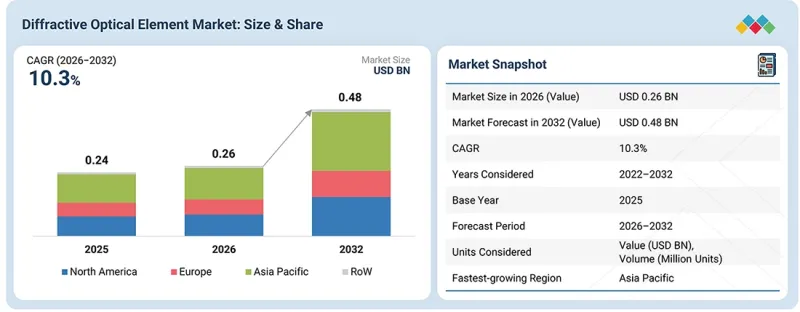
MarketsandMarkets에 따르면, 회절 광학 소자 시장은 2026년 2억 6,000만 달러에서 2032년에는 4억 8,000만 달러에 달할 것으로 예측되며, 예측 기간 동안 연평균 성장률(CAGR)은 10.3%를 기록할 것으로 전망됩니다.
회절 광학 소자 시장은 3D 센싱, LiDAR, AR/VR, 레이저 재료 가공, 이미징,계측 및 산업용 검사 등의 응용 분야에서 회절형 빔 스플리터, 패턴 생성기, 빔 셰이퍼/디퓨저 및 관련 광학 부품의 채택이 확대되고 있는 것을 배경으로, 예측 기간 동안 강력한 성장을 이룰 것으로 전망됩니다.
| 조사 범위 | |
|---|---|
| 조사 대상 기간 | 2021-2032년 |
| 기준 연도 | 2025년 |
| 예측 기간 | 2026-2032년 |
| 산정 단위 | 금액(10억 달러) |
| 부문 | 제품 유형, 구성요소, 용도, 지역별 |
| 대상 지역 | 북미, 유럽, 아시아태평양(APAC), 기타 지역(RoW) |
이 시장은 소비자 가전, 자동차, 반도체, 의료, 항공우주·방위 및 산업 분야에서 정밀한 빔 제어, 구조화된 빛, 균일한 빔 프로파일, 소형 광학 시스템 및 고효율 광 조작에 대한 수요 증가에 힘입어 성장하고 있습니다. 자동차 및 소비자 가전 분야에서 3D 센싱과 LiDAR의 도입이 확대되면서 회절 패턴 생성기 및 빔 스플리터의 수요가 증가하는 한편, 레이저를 이용한 제조 및 반도체 가공은 첨단 빔 성형 솔루션의 채택을 촉진하고 있습니다.
각 제조사들은 빔 제어, 광학 효율, 패턴 정밀도 및 시스템의 소형화를 향상시키기 위해 이진 및 다단계 DOE, 회절 렌즈, 확산 재료, 그레이팅의 개발을 점점 더 적극적으로 추진하고 있습니다. 정밀 마이크로 광학 소자 제조 기술, 맞춤형 DOE 설계, 다단계 구조 및 용도 특화형 광학 솔루션의 발전이 시장 성장을 더욱 뒷받침하고 있습니다. 자동차용 센서, AR/VR 기기, 레이저 가공 시스템, 생의학 기기, 광학 검사 장비 및 첨단 이미징 시스템에 DOE가 점차 통합됨에 따라, 고성능 회절 광학 소자에 대한 새로운 기회가 창출되고 있습니다.
“구성요소별로 보면 확산 재료 부문은 예측 기간 동안 가장 큰 시장 점유율을 차지할 것으로 전망됩니다.”
확산 재료 부문은 회절 광학 소자 시장에서 가장 큰 점유율을 차지할 것으로 예상됩니다. 이는 확산 재료가 광범위한 광학 응용 분야에서 제어된 광 분포, 빔 균일화 및 균일한 조명을 가능하게 하기 때문입니다. 이러한 소재는 균일하고 제어된 광 출력이 필요한 조명 시스템, 레이저 빔 성형, 이미징, 센싱, 자동차 조명, 소비자 가전, 의료기기 및 산업용 광학 시스템에서 점점 더 많이 사용되고 있습니다. 또한, 레이저 기술, 3D 센싱, LiDAR, 머신비전 및 첨단 조명 시스템의 채택이 확대됨에 따라 정확하고 일관된 광 분포를 실현하는 광학 확산재에 대한 수요가 증가하고 있습니다. 광학 소재, 표면 구조화, 마이크로 광학 제조 및 맞춤형 확산 기술의 발전은 자동차, 소비자 가전, 헬스케어, 반도체 및 산업용 애플리케이션 분야에서 확산 소재의 채택을 더욱 촉진하고 있습니다.
“용도별로는 예측 기간 동안 생체의료기기 부문이 가장 큰 시장 점유율을 차지할 것으로 예상됩니다.”
회절 광학 소자(DOE)는 첨단 의료 및 생체의료 시스템에 필요한 정밀한 빔 성형, 빔 분할, 배광 및 광학 패턴 생성을 가능하게 하므로, 생체의료기기 부문이 시장에서 가장 큰 점유율을 차지할 것으로 예상됩니다. 레이저를 이용한 의료기기, 생체의료 이미징,광학 진단, 현미경 및 치료 시스템의 채택 확대가 고정밀 회절 광학 소자(DOE)에 대한 수요를 견인하고 있습니다. DOE는 레이저 빔 제어 및 균일하거나 맞춤형 광학 패턴 생성에 도움이 되며, 안과, 피부과, 수술 시스템,진단 기기, 생체의료 영상 등의 용도를 뒷받침하고 있습니다. 또한, 의료기기에서 소형이며 고효율 및 고정밀 광학 시스템에 대한 수요가 증가함에 따라 회절 렌즈, 빔 셰이퍼, 패턴 생성기, 디퓨저의 통합이 진행되고 있습니다. 의료용 이미징, 레이저를 이용한 진단, 최소침습 기술의 발전 또한 생의학 분야에서의 회절 광학 소자 채택을 더욱 촉진하고 있습니다.
“예측 기간 동안 아시아태평양은 회절 광학 소자 시장에서 가장 빠른 성장을 이룰 것으로 전망됩니다.”
아시아태평양은 소비자용 전자기기, 반도체 제조, 자동차 기술, 레이저 가공 및 첨단 광학 시스템의 급속한 성장에 힘입어 회절 광학 소자 시장에서 가장 높은 연평균 성장률(CAGR)을 기록할 것으로 예상됩니다. 중국, 일본, 한국, 인도 등 각국에서 3D 센싱, LiDAR, AR/VR, 머신비전 및 정밀 광학 기술의 채택이 확대되고 있는 것이 회절형 빔 스플리터, 패턴 제너레이터, 빔 셰이퍼, 디퓨저 및 회절형 렌즈에 대한 수요를 견인하고 있습니다. 반도체 및 전자기기 제조의 급속한 확대, 포토닉스 및 정밀 제조에 대한 투자 증가, 그리고 레이저 기술 도입 확대가 이 지역의 시장 성장을 더욱 뒷받침하고 있습니다. 또한, 자동차용 센싱, 산업용 검사, 계측, 의료용 이미징 및 첨단 광학 시스템의 채택 확대에 따라 고정밀 회절 광학 소자에 대한 수요가 발생하고 있습니다. 확고한 입지를 갖춘 광학 부품 제조업체의 존재, 첨단 제조 역량, 그리고 광학 및 포토닉스 기술에 대한 투자 증가는 예측 기간 동안 아시아태평양이 가장 빠르게 성장하는 지역 시장으로서의 위상을 더욱 공고히 하고 있습니다.
주요 조사 대상의 세부 내역
회절 광학 소자 시장에서 사업을 전개하는 주요 조직의 경영진(CEO, 마케팅 이사, 혁신·기술 이사 등)을 대상으로 상세한 인터뷰를 실시했습니다.
- 기업 규모별 : Tier 1-45%, Tier 2-30%, Tier 3-25%
- 직책별 : C레벨 임원-40%, 디렉터-35%, 기타 - 25%
- 지역별 : 북미-45%, 유럽-25%, 아시아태평양-20%, 기타 지역-10%
이 기업들은 빔 성형, 빔 분할, 패턴 생성, 광 확산, 광 효율 및 다양한 용도에 걸친 통합성 향상에 중점을 두고, 광학 성능, 회절 효율, 빔 제어, 정밀도, 소형화 및 용도 특화 기능을 지속적으로 강화함으로써 경쟁하고 있습니다. 전략적 중점 분야는 3D 센싱, LiDAR, AR/VR, 레이저 소재 가공, 이미징,계측, 반도체 제조 및 생의학 기기 등의 응용 분야를 위한 첨단 바이너리 및 멀티레벨 DOE, 회절 렌즈, 확산 재료, 그레이팅, 빔 셰이퍼, 빔 스플리터, 패턴 생성기의 개발에 맞춰져 있습니다. 시장에 진출한 기업들은 소비자용 전자기기, 자동차, 항공우주·방위, 헬스케어, 반도체, IT·통신 및 산업용 분야에 최적화된 고성능 회절 솔루션을 우선시하고 있습니다. 또한, 회절 효율, 빔 균일성, 패턴 정밀도, 파장 성능, 열 안정성 및 소형화 개선에도 중점을 두고 있습니다. 정밀 마이크로 광학 소자 제조, 다층 DOE 구조, 첨단 광학 소재, 맞춤형 광학 설계, 홀로그래피 기술 및 고정밀 제조에 대한 지속적인 투자와 더불어, OEM, 레이저 기술 제공업체,광학 시스템 통합업체, 최종사용자와의 협력을 통해 경쟁이 심화되고, 전 세계적으로 첨단 회절 광학 솔루션의 도입이 가속화될 것으로 예상됩니다.
본 조사에서는 회절 광학 소자 시장의 주요 기업에 대해 기업 개요, 최근 동향 및 주요 시장 전략을 포함한 상세한 경쟁 분석을 수록하고 있습니다.
조사 범위:
본 보고서에서는 회절 광학 소자 시장을 세분화하여, 유형별(회절형 빔 스플리터, 회절형 패턴 생성기, 회절형 빔 셰이퍼/디퓨저), 구성요소별(2치/다치 DOE, 회절 렌즈, 확산 재료, 그레이팅),용도별(AR/VR, 광학 신속 프로토타이핑, 수차 보정, 경량 광학 시스템, 조명 시스템, 분광법, 이미징·센싱, 레이저 소재 가공, LiDAR, 생의학 기기, 홀로그래피, 계측·산업 검사 및 기타 용도), 그리고 최종 용도 분야(소비자용 전자기기, 자동차, 항공우주·방위, 헬스케어, 반도체, IT·통신, 산업용, 기타)별로 시장 규모를 예측하고 있습니다. 또한, 본 보고서에서는 업계 성장에 영향을 미치는 주요 시장 촉진요인, 시장 억제요인, 성장 기회, 과제에 대해서도 분석하고 있습니다. 북미, 유럽, 아시아태평양 및 기타 지역(RoW)에 걸친 상세한 지역별 평가와 더불어, 주요 시장에 대한 국가별 인사이트도 제공합니다. 또한, 본 조사에는 전 세계 회절 광학 소자 생태계에서 사업을 전개하는 주요 기업에 대한 밸류체인 분석 및 경쟁 구도 평가도 포함되어 있습니다.
본 보고서를 구매할 때의 주요 이점:
- 주요 촉진요인(레이저 기술의 발전, 의료기기에 대한 수요 증가, 통신 및 데이터센터에서의 광학 소자 활용 확대), 제약요인(대체 기술과의 경쟁, DOE의 설계·제조·맞춤화에 따른 복잡성),기회(증강 현실(AR) 및 가상현실(VR) 분야의 새로운 용도, 자동차용 헤드업 디스플레이(HUD)에 대한 수요 증가, LiDAR 및 3D 센싱 분야에서 DOE 채택 확대), 그리고 과제(DOE 제조의 불확실성, 높은 제조 비용)
- 제품 및 서비스 개발·혁신 : 회절 광학 소자 시장의 향후 기술, 연구 개발 활동, 첨단 광학 설계, 신제품 개발에 대한 상세한 인사이트. 여기에는 2치 및 다치 DOE, 회절 렌즈, 빔 셰이퍼, 빔 스플리터, 패턴 생성기, 디퓨저, 그레이팅 등이 포함됩니다.
- 시장 개발 : 다양한 지역의 회절 광학 소자 시장을 분석하고, 수익성이 높은 시장에 대한 종합적인 정보를 제공합니다.
- 시장 다각화 : 신제품 및 서비스, 미개척 지역, 최근 동향, 그리고 시장 투자에 관한 종합적인 정보
- 경쟁 평가 : ZEISS(독일), AGC Inc.(일본), Broadcom Inc.(미국), Coherent Corp.(미국), JENOPTIK AG(독일), HOLO/OR Ltd.(이스라엘), NALUX(일본), HOLOEYE Photonics AG(독일), Nissei Technology Corporation(일본), Edmund Optics(미국)와 같은 주요 기업의 경쟁 환경, 시장 전략, 제품 라인업 및 최근 동향에 대한 상세한 평가.
자주 묻는 질문
목차
제1장 서론
제2장 요약
제3장 주요 인사이트
- 회절 광학 소자 시장에서 사업자에게 주어지는 매력적인 기회
- 회절 광학 소자 시장 : 유형별
- 회절 광학 소자 시장 : 구성요소별
- 회절 광학 소자 시장 : 용도별
- 회절 광학 소자 시장 : 최종 용도 부문별
- 회절 광학 소자 시장 : 지역별
제4장 시장 개요
- 시장 역학
- 성장 촉진요인
- 성장 억제요인
- 기회
- 과제
- 미충족 수요와 미개척 분야
- 충족되지 않은 수요
- 미개척 분야의 기회
- 상호 연관된 시장과 부문 간 기회
- Tier 1/2/3 주요 기업들의 전략적 움직임
제5장 업계 동향
- Porter's Five Forces 분석
- 경쟁 기업 간의 적대적 관계
- 공급업체의 협상력
- 구매자의 협상력
- 대체품의 위협
- 신규 진입자의 위협
- 거시경제 전망
- GDP 동향 및 전망
- 세계 헬스케어 산업의 동향
- 세계 가전 산업의 동향
- 가치사슬 분석
- 생태계 분석
- 가격 분석
- 주요 기업이 제공하는 회절 광학 소자의 가격대(부품별, 2025년)
- 회절 광학 소자의 평균 판매 가격 동향(구성요소별, 2021-2025년)
- 지역별 DOE 구성요소의 평균 판매 가격 동향(2021-2025년)
- 무역 분석
- 수입 시나리오(HS 코드 9002)
- 수출 시나리오(HS 코드 9002)
- 주요 회의 및 행사(2026-2027년)
- 고객의 비즈니스에 영향을 미치는 동향/변화
- 투자 및 자금 조달 시나리오
- 사례 연구 분석
- 미용 레이저 치료의 정밀도 향상
- DLite 회절형 빔 스플리터를 활용한 획기적인 광범위 표면 텍스처링
- 초단펄스 레이저용 최적화된 집광 광학 시스템
- 미국 관세의 영향 - 회절 광학 소자 시장
- 주요 관세율
- 가격에 미치는 영향 분석
- 국가 및 지역에 미치는 영향
- 최종 용도 분야에 미치는 영향
제6장 기술 발전, AI의 영향, 특허 및 혁신
- 주요 기술
- 홀로그래피
- 나노임프린트 리소그래피(NIL)
- 보완 기술
- 관련 기술
- 기술 로드맵
- 특허 분석
- AI가 회절 광학 소자 시장에 미치는 영향
- 주요 활용 사례 및 시장 잠재력
- 회절 광학 소자 시장에서 OEM 기업들이 실천하고 있는 모범 사례
- 회절 광학 소자 시장에서 AI 도입에 관한 사례 연구
- 상호 연계된 생태계와 시장 참여자에 미치는 영향
- AI 통합형 회절 광학 소자 도입에 대한 고객의 준비 현황
제7장 규제 현황
- 지역별 규제 및 규정 준수
- 규제 기관, 정부 기관 및 기타 조직
- 업계 표준
- 규제
- 북미
- 유럽
- 아시아태평양
제8장 고객 현황과 구매 행동
- 의사결정 과정
- 구매 과정에 관여하는 주요 이해관계자와 그 평가 기준
- 구매 과정의 주요 이해관계자
- 구매 기준
- 도입 장벽 및 사내 과제
- 각 최종 용도 부문별 미충족 수요
제9장 회절 광학 소자 시장 : 유형별
- 회절형 빔 스플리터
- 회절 패턴 생성 소자
- 회절형 빔 셰이퍼/디퓨저
제10장 회절 광학 소자 시장 : 부품별
- 2치/다치 DOE
- 회절 렌즈
- 확산 재료
- 그레이팅
제11장 회절 광학 소자 시장 : 용도별
- AR/VR
- 광학 프로토타이핑
- 수차 보정
- 경량 광학 시스템
- 조명 시스템
- 분광법
- 이미징 및 센싱
- 레이저 재료 가공
- LiDAR
- 생체의료기기
- 홀로그래피
- 계측 및 산업 검사
- 기타 용도
제12장 회절 광학 소자 시장 : 최종 용도 부문별
- 소비자용 전자기기
- 자동차
- 항공우주·방위
- 헬스케어
- 반도체
- IT·통신
- 산업
- 기타 최종 용도 부문
제13장 회절 광학 소자 시장 : 지역별
- 북미
- 미국
- 캐나다
- 멕시코
- 유럽
- 독일
- 영국
- 프랑스
- 기타 유럽
- 아시아태평양
- 중국
- 일본
- 한국
- 기타 아시아태평양
- 기타 지역
- 중동 및 아프리카
- 남미
제14장 경쟁 현황
- 개요
- 주요 진입 기업의 전략/강점, 2023-2026년
- 수익 분석, 2021-2025년
- 시장 점유율 분석, 2025년
- 기업 평가 및 재무 지표
- 브랜드 및 제품 비교
- ZEISS GROUP(GERMANY)
- AGC INC.(JAPAN)
- COHERENT CORP.(US)
- JENOPTIK(GERMANY)
- BROADCOM(US)
- 기업 평가 매트릭스 : 주요 기업, 2025년
- 스타
- 신흥 리더
- 광범위한 기업
- 진출 기업
- 기업의 사업 전개 : 주요 기업, 2025년
- 기업 평가 매트릭스 : 스타트업/중소기업, 2025년
- 선도적인 기업
- 대응력이 뛰어난 기업
- 역동적인 기업
- 출발점
- 경쟁사 벤치마킹 : 스타트업/중소기업, 2025년
- 경쟁 시나리오
- 신제품 출시
제15장 기업 개요
- 주요 기업
- ZEISS GROUP
- AGC INC.
- COHERENT CORP.
- JENOPTIK
- BROADCOM
- HOLO/OR LTD.
- NALUX CO., LTD.
- HOLOEYE PHOTONICS AG
- NISSEI TECHNOLOGY CORPORATION
- SINTEC OPTRONICS PTE LTD
- 기타 주요 기업
- NIL TECHNOLOGY
- LASER COMPONENTS
- APOLLO OPTICAL SYSTEMS INC.
- HYPERION OPTICS
- VIAVI SOLUTIONS INC.
- LASER OPTICAL ENGINEERING LTD
- DIOPTIC GMBH
- FOCUSLIGHT TECHNOLOGIES INC.
- OPTIGRATE CORP.
- WUXI OPTONTECH LTD
- HOLOGRAPHIX LLC
- FRANKFURT LASER COMPANY
- AXETRIS AG
- WAVELENGTH OPTO-ELECTRONIC SINGAPORE
- EGISMOS CORP.
제16장 조사 방법론
제17장 부록
KSMAccording to MarketsandMarkets, the diffractive optical element market is projected to reach USD 0.48 billion by 2032 from USD 0.26 billion in 2026, at a CAGR of 10.3% during the forecast period. The diffractive optical element market is projected to witness strong growth during the forecast period, driven by the increasing adoption of diffractive beam splitters, pattern generators, beam shapers/diffusers, and related optical components across 3D sensing, LiDAR, AR/VR, laser material processing, imaging, metrology, and industrial inspection applications.
| Scope of the Report | |
|---|---|
| Years Considered for the Study | 2021-2032 |
| Base Year | 2025 |
| Forecast Period | 2026-2032 |
| Units Considered | Value (USD Billion) |
| Segments | By Product Type, Component, Application and Region |
| Regions covered | North America, Europe, APAC, RoW |
The market is being supported by rising demand for precise beam control, structured light, uniform beam profiles, compact optical systems, and high-efficiency light manipulation across consumer electronics, automotive, semiconductor, healthcare, aerospace & defense, and industrial environments. The growing deployment of 3D sensing and LiDAR in automotive and consumer electronics is driving demand for diffractive pattern generators and beam splitters, while laser-based manufacturing and semiconductor processing are supporting adoption of advanced beam-shaping solutions.
Manufacturers are increasingly developing binary and multi-level DOEs, diffractive lenses, diffusing materials, and gratings to improve beam control, optical efficiency, pattern accuracy, and system compactness. Advancements in precision micro-optics fabrication, customized DOE design, multi-level structures, and application-specific optical solutions are further supporting market growth. The growing integration of DOEs into automotive sensing, AR/VR devices, laser processing systems, biomedical devices, optical inspection equipment, and advanced imaging systems is creating additional opportunities for high-performance diffractive optical components.
"Based on component, the diffusing materials segment is likely to hold the largest market share throughout the forecast period."
The diffusing materials segment is expected to hold the largest share of the diffractive optical element market because diffusing materials enable controlled light distribution, beam homogenization, and uniform illumination across a wide range of optical applications. These materials are increasingly used in illumination systems, laser beam shaping, imaging, sensing, automotive lighting, consumer electronics, medical devices, and industrial optical systems that require uniform, controlled light output. In addition, the growing adoption of laser-based technologies, 3D sensing, LiDAR, machine vision, and advanced illumination systems is driving demand for optical diffusers that provide precise, consistent light distribution. Advancements in optical materials, surface structuring, micro-optics fabrication, and customized diffusion technologies are further supporting the adoption of diffusing materials across automotive, consumer electronics, healthcare, semiconductor, and industrial applications.
"Based on application, the biomedical devices segment is expected to account for the largest market share during the forecast period."
The biomedical devices segment is expected to account for the largest share of the market because diffractive optical elements enable precise beam shaping, beam splitting, light distribution, and optical pattern generation required in advanced medical and biomedical systems. Increasing adoption of laser-based medical devices, biomedical imaging, optical diagnostics, microscopy, and therapeutic systems is driving demand for high-precision diffractive optical components. DOEs help control laser beams and generate uniform or customized optical patterns, supporting applications such as ophthalmology, dermatology, surgical systems, diagnostic instruments, and biomedical imaging. In addition, the growing demand for compact, high-efficiency, and precise optical systems in medical devices is encouraging the integration of diffractive lenses, beam shapers, pattern generators, and diffusers. Advancements in medical imaging, laser-based diagnostics, and minimally invasive technologies are further supporting the adoption of diffractive optical elements in biomedical applications.
"Asia Pacific is projected to be the fastest-growing market for diffractive optical elements during the forecast period."
The Asia Pacific region is expected to witness the highest CAGR in the diffractive optical element market due to rapid growth in consumer electronics, semiconductor manufacturing, automotive technologies, laser processing, and advanced optical systems. Increasing adoption of 3D sensing, LiDAR, AR/VR, machine vision, and precision optical technologies across countries such as China, Japan, South Korea, and India is driving demand for diffractive beam splitters, pattern generators, beam shapers, diffusers, and diffractive lenses. Rapid expansion of semiconductor and electronics manufacturing, rising investments in photonics and precision manufacturing, and growing deployment of laser-based technologies are further supporting regional market growth. Additionally, increasing adoption of automotive sensing, industrial inspection, metrology, healthcare imaging, and advanced optical systems is creating demand for high-precision diffractive optical elements. The presence of established optical component manufacturers, advanced manufacturing capabilities, and increasing investments in optical and photonic technologies is further supporting Asia Pacific's position as the fastest-growing regional market during the forecast period.
Breakdown of Primaries
A variety of executives from key organizations operating in the diffractive optical element market were interviewed in-depth, including CEOs, marketing directors, and innovation and technology directors.
- By Company Type: Tier 1 - 45%, Tier 2 - 30%, and Tier 3 - 25%
- By Designation: C-level Executives - 40%, Directors - 35%, and Others - 25%
- By Region: North America - 45%, Europe - 25%, Asia Pacific - 20%, and RoW - 10%
Major players profiled in this report are ZEISS (Germany), AGC Inc. (Japan), Broadcom Inc. (US), Coherent Corp. (US), JENOPTIK AG (Germany), HOLO/OR Ltd. (Israel), NALUX CO., LTD. (Japan), HOLOEYE Photonics AG (Germany), Nissei Technology Corporation (Japan), and Edmund Optics (US), among others.
These companies compete by continuously enhancing optical performance, diffraction efficiency, beam control, precision, compactness, and application-specific functionality, focusing on improved beam shaping, beam splitting, pattern generation, light diffusion, optical efficiency, and integration across diverse applications. Strategic emphasis is placed on developing advanced binary and multi-level DOEs, diffractive lenses, diffusing materials, gratings, beam shapers, beam splitters, and pattern generators for applications such as 3D sensing, LiDAR, AR/VR, laser material processing, imaging, metrology, semiconductor manufacturing, and biomedical devices. Market participants prioritize high-performance diffractive solutions tailored for consumer electronics, automotive, aerospace & defense, healthcare, semiconductor, IT & telecommunications, and industrial applications. Strong focus is also placed on improving diffraction efficiency, beam uniformity, pattern accuracy, wavelength performance, thermal stability, and miniaturization. Continued investments in precision micro-optics fabrication, multi-level DOE structures, advanced optical materials, customized optical design, holographic technologies, and high-precision manufacturing, along with collaborations with OEMs, laser technology providers, optical system integrators, and end users, are expected to strengthen competition and accelerate the adoption of advanced diffractive optical solutions globally.
The study includes an in-depth competitive analysis of these key players in the diffractive optical element market, with their company profiles, recent developments, and key market strategies.
Study Coverage:
The report segments the diffractive optical element market and forecasts its market size by type (diffractive beam splitter, diffractive pattern generator, diffractive beam shaper/diffuser), component (binary/multi-level DOE, diffractive lenses, diffusing materials, gratings), application (AR/VR, rapid optical prototyping, aberration correction, lightweight optics, illumination systems, spectroscopy, imaging & sensing, laser material processing, LiDAR, biomedical devices, holography, metrology & industrial inspection, and other applications), and end-use sector (consumer electronics, automotive, aerospace & defense, healthcare, semiconductor, IT & telecommunications, industrial, and others). The report also analyzes key market drivers, restraints, opportunities, and challenges influencing industry growth. It provides a detailed regional assessment across North America, Europe, Asia Pacific, and RoW, along with country-level insights for major markets. In addition, the study includes value chain analysis and competitive landscape assessment of leading players operating in the global diffractive optical element ecosystem.
Key Benefits of Buying the Report:
- Analysis of key drivers (advancements in laser technology, increasing demand for medical devices, rising use of optical elements in telecommunications and data centers), restraints (competition from alternative technologies, complexity of DOE design, fabrication, and customization), opportunities (emerging applications in augmented reality (AR) and virtual reality (VR), rising demand for automotive head-up displays (HUDs), growing adoption of DOEs in LiDAR and 3D sensing), and challenges (uncertainties in DOE fabrication, high manufacturing costs)
- Product and Service Development/Innovation: Detailed insights into upcoming technologies, research and development activities, advanced optical designs, and new product developments in the diffractive optical element market, including binary and multi-level DOEs, diffractive lenses, beam shapers, beam splitters, pattern generators, diffusers, and gratings.
- Market Development: Comprehensive information about lucrative markets by analyzing the diffractive optical element market across varied regions
- Market Diversification: Exhaustive information about new products/services, untapped geographies, recent developments, and investments in the market
- Competitive Assessment: In-depth assessment of the competitive landscape, market strategies, product offerings, and recent developments of leading players, such as ZEISS (Germany), AGC Inc. (Japan), Broadcom Inc. (US), Coherent Corp. (US), JENOPTIK AG (Germany), HOLO/OR Ltd. (Israel), NALUX CO., LTD. (Japan), HOLOEYE Photonics AG (Germany), Nissei Technology Corporation (Japan), and Edmund Optics (US).
TABLE OF CONTENTS
1 INTRODUCTION
- 1.1 STUDY OBJECTIVES
- 1.2 MARKET DEFINITION
- 1.3 STUDY SCOPE
- 1.3.1 MARKETS COVERED AND REGIONAL SCOPE
- 1.3.2 YEARS CONSIDERED
- 1.3.3 INCLUSIONS AND EXCLUSIONS
- 1.4 CURRENCY CONSIDERED
- 1.5 UNIT CONSIDERED
- 1.6 LIMITATIONS
- 1.7 STAKEHOLDERS
- 1.8 SUMMARY OF CHANGES
2 EXECUTIVE SUMMARY
- 2.1 MARKET HIGHLIGHTS AND KEY INSIGHTS
- 2.2 KEY MARKET PARTICIPANTS: MAPPING OF STRATEGIC DEVELOPMENTS
- 2.3 DISRUPTIVE TRENDS IN DIFFRACTIVE OPTICAL ELEMENT MARKET
- 2.4 HIGH GROWTH SEGMENTS
- 2.5 REGIONAL SNAPSHOT: MARKET SIZE, GROWTH RATE, AND FORECAST
3 PREMIUM INSIGHTS
- 3.1 ATTRACTIVE OPPORTUNITIES FOR PLAYERS IN DIFFRACTIVE OPTICAL ELEMENT MARKET
- 3.2 DIFFRACTIVE OPTICAL ELEMENT MARKET, BY TYPE
- 3.3 DIFFRACTIVE OPTICAL ELEMENT MARKET, BY COMPONENT
- 3.4 DIFFRACTIVE OPTICAL ELEMENT MARKET, BY APPLICATION
- 3.5 DIFFRACTIVE OPTICAL ELEMENT MARKET, BY END-USE SECTOR
- 3.6 DIFFRACTIVE OPTICAL ELEMENT MARKET, BY GEOGRAPHY
4 MARKET OVERVIEW
- 4.1 INTRODUCTION
- 4.2 MARKET DYNAMICS
- 4.2.1 DRIVERS
- 4.2.1.1 Rapid advancements in laser technology
- 4.2.1.2 Increasing demand for medical devices
- 4.2.1.3 Rising use of optical elements in telecommunications and data centers
- 4.2.2 RESTRAINTS
- 4.2.2.1 Complexity of DOE design, fabrication, and customization
- 4.2.2.2 Competition from alternative technologies
- 4.2.3 OPPORTUNITIES
- 4.2.3.1 Growing adoption of DOEs in LiDAR and 3D sensing
- 4.2.3.2 Increasing use in augmented reality (AR) and virtual reality (VR) applications
- 4.2.3.3 Rising demand for automotive head-up displays
- 4.2.4 CHALLENGES
- 4.2.4.1 High precision requirements in DOE fabrication
- 4.2.4.2 High manufacturing costs
- 4.2.1 DRIVERS
- 4.3 UNMET NEEDS AND WHITE SPACES
- 4.3.1 UNMET NEEDS
- 4.3.1.1 Faster customization and shorter development cycles
- 4.3.1.2 Improved efficiency and optical performance across operating conditions
- 4.3.1.3 Scalable and cost-effective manufacturing of customized DOEs
- 4.3.1.4 Standardization across wavelengths and application requirements
- 4.3.1.5 Improved durability for high-power and harsh-environment applications
- 4.3.2 WHITE SPACE OPPORTUNITIES
- 4.3.2.1 Standardized DOE product platforms for faster commercialization
- 4.3.2.2 Cost-effective DOE solutions for high-volume applications
- 4.3.2.3 Application-specific DOEs for high-power laser processing
- 4.3.2.4 Integrated design-to-manufacturing services for customized DOEs
- 4.3.2.5 Durable DOE solutions for demanding operating environments
- 4.3.1 UNMET NEEDS
- 4.4 INTERCONNECTED MARKETS AND CROSS-SECTOR OPPORTUNITIES
- 4.5 STRATEGIC MOVES BY TIER 1/2/3 PLAYERS
5 INDUSTRY TRENDS
- 5.1 INTRODUCTION
- 5.2 PORTER'S FIVE FORCES ANALYSIS
- 5.2.1 INTENSITY OF COMPETITIVE RIVALRY
- 5.2.2 BARGAINING POWER OF SUPPLIERS
- 5.2.3 BARGAINING POWER OF BUYERS
- 5.2.4 THREAT OF SUBSTITUTES
- 5.2.5 THREAT OF NEW ENTRANTS
- 5.3 MACROECONOMIC OUTLOOK
- 5.3.1 INTRODUCTION
- 5.3.2 GDP TRENDS AND FORECAST
- 5.3.3 TRENDS IN GLOBAL HEALTHCARE INDUSTRY
- 5.3.4 TRENDS IN GLOBAL CONSUMER ELECTRONICS INDUSTRY
- 5.4 VALUE CHAIN ANALYSIS
- 5.5 ECOSYSTEM ANALYSIS
- 5.6 PRICING ANALYSIS
- 5.6.1 PRICING RANGE OF DIFFRACTIVE OPTICAL ELEMENTS OFFERED BY KEY PLAYERS, BY COMPONENT, 2025
- 5.6.2 AVERAGE SELLING PRICE TREND OF DIFFRACTIVE OPTICAL ELEMENTS, BY COMPONENT, 2021-2025
- 5.6.3 AVERAGE SELLING PRICE TREND OF DOE COMPONENTS, BY REGION, 2021-2025
- 5.7 TRADE ANALYSIS
- 5.7.1 IMPORT SCENARIO (HS CODE 9002)
- 5.7.2 EXPORT SCENARIO (HS CODE 9002)
- 5.8 KEY CONFERENCES AND EVENTS, 2026-2027
- 5.9 TRENDS/DISRUPTIONS IMPACTING CUSTOMER BUSINESS
- 5.10 INVESTMENT AND FUNDING SCENARIO
- 5.11 CASE STUDY ANALYSIS
- 5.11.1 ENHANCED PRECISION IN AESTHETIC LASER TREATMENTS
- 5.11.2 REVOLUTIONARY LARGE-AREA SURFACE TEXTURING WITH DLITE DIFFRACTIVE BEAM SPLITTERS
- 5.11.3 OPTIMIZED FOCUSING OPTICS FOR ULTRA-SHORT PULSED LASERS
- 5.12 IMPACT OF US TARIFFS - DIFFRACTIVE OPTICAL ELEMENT MARKET
- 5.12.1 INTRODUCTION
- 5.13 KEY TARIFF RATES
- 5.13.1 PRICE IMPACT ANALYSIS
- 5.13.2 IMPACT ON COUNTRIES/REGIONS
- 5.13.2.1 US
- 5.13.2.2 Europe
- 5.13.2.3 Asia Pacific
- 5.13.3 IMPACT ON END-USE SECTORS
6 TECHNOLOGICAL ADVANCEMENTS, AI-DRIVEN IMPACT, PATENTS, AND INNOVATIONS
- 6.1 KEY TECHNOLOGIES
- 6.1.1 HOLOGRAPHY
- 6.1.2 NANOIMPRINT LITHOGRAPHY (NIL)
- 6.1.3 COMPLEMENTARY TECHNOLOGIES
- 6.1.3.1 Photolithography
- 6.1.3.2 Integrated photonics
- 6.1.4 ADJACENT TECHNOLOGIES
- 6.1.4.1 Fresnel zone plates
- 6.1.4.2 Reactive ion etching (RIE)
- 6.2 TECHNOLOGY ROADMAP
- 6.3 PATENT ANALYSIS
- 6.4 IMPACT OF AI ON DIFFRACTIVE OPTICAL ELEMENT MARKET
- 6.4.1 TOP USE CASES AND MARKET POTENTIAL
- 6.4.2 BEST PRACTICES FOLLOWED BY OEMS IN DIFFRACTIVE OPTICAL ELEMENT MARKET
- 6.4.3 CASE STUDIES RELATED TO AI IMPLEMENTATION IN DIFFRACTIVE OPTICAL ELEMENT MARKET
- 6.4.4 INTERCONNECTED ECOSYSTEM AND IMPACT ON MARKET PLAYERS
- 6.4.5 CLIENTS' READINESS TO ADOPT AI-INTEGRATED DIFFRACTIVE OPTICAL ELEMENTS
7 REGULATORY LANDSCAPE
- 7.1 REGIONAL REGULATIONS AND COMPLIANCE
- 7.1.1 REGULATORY BODIES, GOVERNMENT AGENCIES, AND OTHER ORGANIZATIONS
- 7.2 INDUSTRY STANDARDS
- 7.3 REGULATIONS
- 7.3.1 NORTH AMERICA
- 7.3.1.1 US
- 7.3.1.1.1 IEC 60825-1: Safety of Laser Products
- 7.3.1.1.2 FDA 21 CFR 1040.10 and 1040.11: Laser Products
- 7.3.1.2 Canada
- 7.3.1.2.1 Health Canada - Radiation Emitting Devices Act (REDA) and Regulations
- 7.3.1.2.2 Canadian Standards Association (CSA) Standards for Laser and Electrical Safety
- 7.3.1.1 US
- 7.3.2 EUROPE
- 7.3.2.1 EU
- 7.3.2.1.1 Directive 2014/35/EU - Low Voltage Directive (LVD)
- 7.3.2.1.2 Directive 2014/30/EU - Electromagnetic Compatibility (EMC) Directive
- 7.3.2.1.3 Directive 2011/65/EU - Restriction of Hazardous Substances (RoHS)
- 7.3.2.2 Germany
- 7.3.2.2.1 German Product Safety Act (ProdSG)
- 7.3.2.2.2 German Ordinance on the Protection of Workers from Artificial Optical Radiation (OStrV)
- 7.3.2.3 UK
- 7.3.2.3.1 Product Safety and Metrology Regulations
- 7.3.2.3.2 Control of Artificial Optical Radiation at Work Regulations 2010
- 7.3.2.1 EU
- 7.3.3 ASIA PACIFIC
- 7.3.3.1 China
- 7.3.3.1.1 Regulations of the People's Republic of China on Certification and Accreditation
- 7.3.3.1.2 GB/T 7247.1 - Safety of Laser Products
- 7.3.3.2 Japan
- 7.3.3.2.1 Electrical Appliances and Materials Safety Act (DENAN)
- 7.3.3.2.2 JIS C 6802 - Safety of Laser Products
- 7.3.3.1 China
- 7.3.1 NORTH AMERICA
8 CUSTOMER LANDSCAPE AND BUYER BEHAVIOR
- 8.1 DECISION-MAKING PROCESS
- 8.2 KEY STAKEHOLDERS INVOLVED IN BUYING PROCESS AND THEIR EVALUATION CRITERIA
- 8.2.1 KEY STAKEHOLDERS IN BUYING PROCESS
- 8.2.2 BUYING CRITERIA
- 8.3 ADOPTION BARRIERS AND INTERNAL CHALLENGES
- 8.4 UNMET NEEDS OF VARIOUS END-USE SECTORS
9 DIFFRACTIVE OPTICAL ELEMENT MARKET, BY TYPE
- 9.1 INTRODUCTION
- 9.2 DIFFRACTIVE BEAM SPLITTERS
- 9.2.1 MULTI-BEAM ENERGY DISTRIBUTION ACROSS MANUFACTURING, MEDICAL, AND COMMUNICATION SYSTEMS TO ACCELERATE SEGMENTAL GROWTH
- 9.3 DIFFRACTIVE PATTERN GENERATORS
- 9.3.1 CONVERSION OF IRREGULAR HIGH-POWER BEAMS INTO UNIFORM GAUSSIAN PROFILES TO BOLSTER SEGMENTAL GROWTH
- 9.4 DIFFRACTIVE BEAM SHAPERS/DIFFUSERS
- 9.4.1 FLAT TOP
- 9.4.1.1 Demand for even irradiance with sharp edge cut-off in wafer and precision processing to spur segmental growth
- 9.4.2 LINE TOP
- 9.4.2.1 Single-axis beam uniformity in scribing and inspection lines to augment segmental growth
- 9.4.3 SPOT ARRAY
- 9.4.3.1 Throughput gains from 1D and 2D multi-spot drilling and structuring to spur demand
- 9.4.4 OTHER DIFFRACTIVE BEAM SHAPERS/DIFFUSERS
- 9.4.1 FLAT TOP
10 DIFFRACTIVE OPTICAL ELEMENT MARKET, BY COMPONENT
- 10.1 INTRODUCTION
- 10.2 BINARY/MULTI-LEVEL DOES
- 10.2.1 LOW-COST BINARY PATTERNING AND FINER MULTILEVEL PHASE PROFILES TO CREATE MARKET GROWTH OPPORTUNITIES
- 10.3 DIFFRACTIVE LENSES
- 10.3.1 THIN, FLAT FRESNEL ZONE PLATE DESIGNS WITH LOWER RADIUS SENSITIVITY TO FOSTER SEGMENTAL GROWTH
- 10.4 DIFFUSING MATERIALS
- 10.4.1 DURABLE ACRYLIC AND POLYCARBONATE DIFFUSERS IN LUMINAIRES, PANELS, AND SENSORS TO DRIVE MARKET
- 10.5 GRATINGS
- 10.5.1 WAVELENGTH DISPERSION FOR SPECTROMETERS, TELECOM, AND LASER SYSTEMS TO CONTRIBUTE TO SEGMENTAL GROWTH
11 DIFFRACTIVE OPTICAL ELEMENT MARKET, BY APPLICATION
- 11.1 INTRODUCTION
- 11.2 AR/VR
- 11.2.1 SHIFT FROM FLAT PANELS TO IMMERSIVE WAVEGUIDE DISPLAYS TO ACCELERATE SEGMENTAL GROWTH
- 11.3 RAPID OPTICAL PROTOTYPING
- 11.3.1 FASTER DESIGN ITERATION THROUGH 3D-PRINTED MICRO-OPTICS TO SHORTEN DOE PROTOTYPING TO EXPEDITE SEGMENTAL GROWTH
- 11.4 ABERRATION CORRECTION
- 11.4.1 RISING DEMAND FOR HIGH-PERFORMANCE OPTICAL SYSTEMS TO DRIVE MARKET
- 11.5 LIGHTWEIGHT OPTICS
- 11.5.1 ADVANCEMENTS IN MANUFACTURING AND MINIATURIZATION TO FUEL SEGMENTAL GROWTH
- 11.6 ILLUMINATION SYSTEMS
- 11.6.1 RAPID ADOPTION IN AUTOMOTIVE INDUSTRY TO BOOST SEGMENTAL GROWTH
- 11.7 SPECTROSCOPY
- 11.7.1 HARPER RESOLUTION AND SENSITIVITY IN WAVELENGTH SEPARATION TO FACILITATE SEGMENTAL GROWTH
- 11.8 IMAGING & SENSING
- 11.8.1 ADVANCEMENTS IN 3D SENSING AND MACHINE VISION TO CONTRIBUTE TO SEGMENTAL GROWTH
- 11.9 LASER MATERIAL PROCESSING
- 11.9.1 TAILORED INTENSITY PROFILES FOR FASTER CUTTING, DRILLING, AND ABLATION TO BOLSTER SEGMENTAL GROWTH
- 11.10 LIDAR
- 11.10.1 EXPANDING USE OF DOE-BASED BEAM CONTROL IN LIDAR TO SUPPORT SEGMENTAL GROWTH
- 11.11 BIOMEDICAL DEVICES
- 11.11.1 PRECISION BEAM CONTROL AND ADVANCED MEDICAL IMAGING TO FOSTER SEGMENTAL GROWTH
- 11.12 HOLOGRAPHY
- 11.12.1 INDUSTRIALIZATION OF HOLOGRAPHIC OPTICAL ELEMENTS TO ACCELERATE SEGMENTAL GROWTH
- 11.13 METROLOGY & INDUSTRIAL INSPECTION
- 11.13.1 COMPACT NON-CONTACT MEASUREMENT FOR INDUSTRY 4.0 QUALITY CONTROL TO FUEL SEGMENTAL GROWTH
- 11.14 OTHER APPLICATIONS
12 DIFFRACTIVE OPTICAL ELEMENT MARKET, BY END-USE SECTOR
- 12.1 INTRODUCTION
- 12.2 CONSUMER ELECTRONICS
- 12.2.1 RISING ADOPTION OF AUGMENTED AND VIRTUAL REALITY TO DRIVE MARKET
- 12.3 AUTOMOTIVE
- 12.3.1 RISING INTEGRATION OF LIDAR SYSTEMS IN ADAS TO FUEL SEGMENTAL GROWTH
- 12.4 AEROSPACE & DEFENSE
- 12.4.1 ADVANCEMENTS IN HIGH-ENERGY LASER AND HOLOGRAPHIC OPTICAL SYSTEMS TO BOOST SEGMENTAL GROWTH
- 12.5 HEALTHCARE
- 12.5.1 RISING CATARACT PROCEDURE VOLUMES USING DIFFRACTIVE MULTIFOCAL IOLS TO SUPPORT MARKET GROWTH
- 12.6 SEMICONDUCTOR
- 12.6.1 DIRECT-WRITE LITHOGRAPHY AND WAFER METROLOGY REQUIREMENTS TO STRENGTHEN MARKET GROWTH
- 12.7 IT & TELECOMMUNICATIONS
- 12.7.1 HIGH-SPEED DATA TRANSMISSION AND ADVANCEMENTS IN DOE TECHNOLOGY TO FUEL MARKET GROWTH
- 12.8 INDUSTRIAL
- 12.8.1 EXPANDING USE OF PRECISION LASER PROCESSING AND MACHINE VISION TO AUGMENT SEGMENTAL GROWTH
- 12.9 OTHER END-USE SECTORS
13 DIFFRACTIVE OPTICAL ELEMENT MARKET, BY REGION
- 13.1 INTRODUCTION
- 13.2 NORTH AMERICA
- 13.2.1 US
- 13.2.1.1 Advancements in laser technology and photonics applications to drive market
- 13.2.2 CANADA
- 13.2.2.1 Investments in renewable energy and photonics industries to fuel market growth
- 13.2.3 MEXICO
- 13.2.3.1 Increased funding in semiconductor and advanced infrastructure to boost market growth
- 13.2.1 US
- 13.3 EUROPE
- 13.3.1 GERMANY
- 13.3.1.1 Industry 4.0 programs and a mature photonics ecosystem to support market growth
- 13.3.2 UK
- 13.3.2.1 Holographic technology advances and AR growth to fuel market growth
- 13.3.3 FRANCE
- 13.3.3.1 Advancements in quantum computing and photonics to contribute to market growth
- 13.3.4 REST OF EUROPE
- 13.3.1 GERMANY
- 13.4 ASIA PACIFIC
- 13.4.1 CHINA
- 13.4.1.1 Technological advancement and strong government support to drive market
- 13.4.2 JAPAN
- 13.4.2.1 Rising demand for laser fusion technology and precision optical solutions to accelerate market growth
- 13.4.3 SOUTH KOREA
- 13.4.3.1 Advancements in semiconductor manufacturing and government support to propel market
- 13.4.4 REST OF ASIA PACIFIC
- 13.4.1 CHINA
- 13.5 ROW
- 13.5.1 MIDDLE EAST & AFRICA
- 13.5.1.1 GCC countries
- 13.5.1.1.1 Investments in medical devices and technology to fuel market growth
- 13.5.1.2 Rest of Middle East & Africa
- 13.5.1.1 GCC countries
- 13.5.2 SOUTH AMERICA
- 13.5.2.1 Investments in telecommunications and digital infrastructure to bolster market growth
- 13.5.1 MIDDLE EAST & AFRICA
14 COMPETITIVE LANDSCAPE
- 14.1 OVERVIEW
- 14.2 KEY PLAYER COMPETITIVE STRATEGIES/RIGHT TO WIN, 2023-2026
- 14.3 REVENUE ANALYSIS, 2021-2025
- 14.4 MARKET SHARE ANALYSIS, 2O25
- 14.5 COMPANY VALUATION AND FINANCIAL METRICS
- 14.6 BRAND/PRODUCT COMPARISON
- 14.6.1 ZEISS GROUP (GERMANY)
- 14.6.2 AGC INC. (JAPAN)
- 14.6.3 COHERENT CORP. (US)
- 14.6.4 JENOPTIK (GERMANY)
- 14.6.5 BROADCOM (US)
- 14.7 COMPANY EVALUATION MATRIX: KEY PLAYERS, 2025
- 14.7.1 STARS
- 14.7.2 EMERGING LEADERS
- 14.7.3 PERVASIVE PLAYERS
- 14.7.4 PARTICIPANTS
- 14.7.5 COMPANY FOOTPRINT: KEY PLAYERS, 2025
- 14.7.5.1 Company footprint
- 14.7.5.2 Region footprint
- 14.7.5.3 Type footprint
- 14.7.5.4 Component footprint
- 14.7.5.5 End-use sector footprint
- 14.8 COMPANY EVALUATION MATRIX: STARTUPS/SMES, 2025
- 14.8.1 PROGRESSIVE COMPANIES
- 14.8.2 RESPONSIVE COMPANIES
- 14.8.3 DYNAMIC COMPANIES
- 14.8.4 STARTING BLOCKS
- 14.8.5 COMPETITIVE BENCHMARKING: STARTUPS/SMES, 2025
- 14.8.5.1 Detailed list of key startups/SMEs
- 14.8.5.2 Competitive benchmarking of key startups/SMEs
- 14.9 COMPETITIVE SCENARIO
- 14.9.1 PRODUCT LAUNCHES
15 COMPANY PROFILES
- 15.1 KEY PLAYERS
- 15.1.1 ZEISS GROUP
- 15.1.1.1 Business overview
- 15.1.1.2 Products/Solutions/Services offered
- 15.1.1.3 Recent developments
- 15.1.1.3.1 Expansions
- 15.1.1.3.2 Deals
- 15.1.1.4 MnM view
- 15.1.1.4.1 Right to win
- 15.1.1.4.2 Strategic choices
- 15.1.1.4.3 Weaknesses and competitive threats
- 15.1.2 AGC INC.
- 15.1.2.1 Business overview
- 15.1.2.2 Products/Solutions/Services offered
- 15.1.2.3 Recent developments
- 15.1.2.3.1 Developments
- 15.1.2.4 MnM view
- 15.1.2.4.1 Right to win
- 15.1.2.4.2 Strategic choices
- 15.1.2.4.3 Weaknesses and competitive threats
- 15.1.3 COHERENT CORP.
- 15.1.3.1 Business overview
- 15.1.3.2 Products/Solutions/Services offered
- 15.1.3.3 Recent developments
- 15.1.3.3.1 Product launches
- 15.1.3.4 MnM view
- 15.1.3.4.1 Right to win
- 15.1.3.4.2 Strategic choices
- 15.1.3.4.3 Weaknesses and competitive threats
- 15.1.4 JENOPTIK
- 15.1.4.1 Business overview
- 15.1.4.2 Products/Solutions/Services offered
- 15.1.4.3 Recent developments
- 15.1.4.3.1 Expansions
- 15.1.4.4 MnM view
- 15.1.4.4.1 Right to win
- 15.1.4.4.2 Strategic choices
- 15.1.4.4.3 Weaknesses and competitive threats
- 15.1.5 BROADCOM
- 15.1.5.1 Business overview
- 15.1.5.2 Products/Solutions/Services offered
- 15.1.5.3 MnM view
- 15.1.5.3.1 Right to win
- 15.1.5.3.2 Strategic choices
- 15.1.5.3.3 Weaknesses and competitive threats
- 15.1.6 HOLO/OR LTD.
- 15.1.6.1 Business overview
- 15.1.6.2 Products/Solutions/Services offered
- 15.1.7 NALUX CO., LTD.
- 15.1.7.1 Business overview
- 15.1.7.2 Products/Solutions/Services offered
- 15.1.8 HOLOEYE PHOTONICS AG
- 15.1.8.1 Business overview
- 15.1.8.2 Products/Solutions/Services offered
- 15.1.8.3 Recent developments
- 15.1.8.3.1 Product launches
- 15.1.9 NISSEI TECHNOLOGY CORPORATION
- 15.1.9.1 Business overview
- 15.1.9.2 Products/Solutions/Services offered
- 15.1.10 SINTEC OPTRONICS PTE LTD
- 15.1.10.1 Business overview
- 15.1.10.2 Products/Solutions/Services offered
- 15.1.1 ZEISS GROUP
- 15.2 OTHER PLAYERS
- 15.2.1 NIL TECHNOLOGY
- 15.2.2 LASER COMPONENTS
- 15.2.3 APOLLO OPTICAL SYSTEMS INC.
- 15.2.4 HYPERION OPTICS
- 15.2.5 VIAVI SOLUTIONS INC.
- 15.2.6 LASER OPTICAL ENGINEERING LTD
- 15.2.7 DIOPTIC GMBH
- 15.2.8 FOCUSLIGHT TECHNOLOGIES INC.
- 15.2.9 OPTIGRATE CORP.
- 15.2.10 WUXI OPTONTECH LTD
- 15.2.11 HOLOGRAPHIX LLC
- 15.2.12 FRANKFURT LASER COMPANY
- 15.2.13 AXETRIS AG
- 15.2.14 WAVELENGTH OPTO-ELECTRONIC SINGAPORE
- 15.2.15 EGISMOS CORP.
16 RESEARCH METHODOLOGY
- 16.1 RESEARCH APPROACH
- 16.1.1 SECONDARY AND PRIMARY RESEARCH
- 16.1.2 SECONDARY DATA
- 16.1.2.1 List of key secondary sources
- 16.1.2.2 Key data from secondary sources
- 16.1.3 PRIMARY DATA
- 16.1.3.1 List of primary interview participants
- 16.1.3.2 Breakdown of primary interviews
- 16.1.3.3 Key data from primary sources
- 16.1.3.4 Key industry insights
- 16.2 MARKET SIZE ESTIMATION
- 16.2.1 BOTTOM-UP APPROACH
- 16.2.2 TOP-DOWN APPROACH
- 16.2.3 MARKET SIZE CALCULATION FOR BASE YEAR
- 16.3 MARKET FORECAST APPROACH
- 16.3.1 SUPPLY SIDE
- 16.3.2 DEMAND SIDE
- 16.4 DATA TRIANGULATION
- 16.5 RESEARCH ASSUMPTIONS
- 16.6 RESEARCH LIMITATIONS
- 16.7 RISK ANALYSIS
17 APPENDIX
- 17.1 DISCUSSION GUIDE
- 17.2 KNOWLEDGESTORE: MARKETSANDMARKETS' SUBSCRIPTION PORTAL
- 17.3 CUSTOMIZATION OPTIONS
- 17.4 RELATED REPORTS
- 17.5 AUTHOR DETAILS


