

|
시장보고서
상품코드
2146280
미세전자기계 시스템(MEMS) 시장 예측(-2032년) : 센서 유형, 액추에이터 유형, 업계별, 지역별Micro-Electro-Mechanical System (MEMS) Market by Sensor Type (Inertial Sensor, Pressure Sensor, Environmental Sensor, Optical Sensor), Actuator Type (Optical, Microfluidics, Inkjet Head, Radio Frequency), Vertical, and Region - Global Forecast to 2032 |
||||||

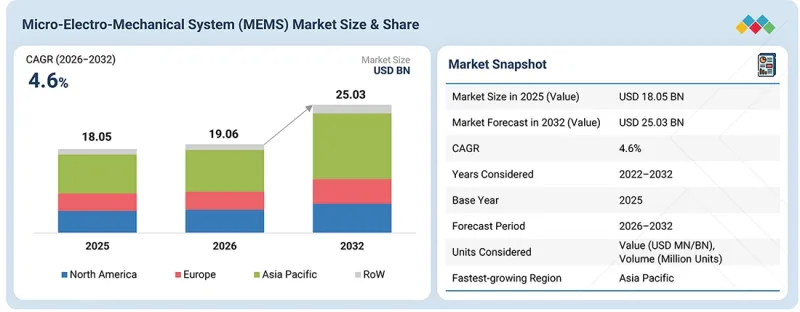
MarketsandMarkets에 따르면 미세전자기계 시스템(MEMS) 시장은 2026년 190억 6,000만 달러에서 2032년까지 250억 3,000만 달러에 달할 것으로 예측되고 있으며, 예측 기간 중 CAGR 4.6%를 기록할 전망입니다.
이 시장의 성장을 촉진하고 있는 요인은 소비자 전자제품, 자동차, 헬스케어, 산업, 항공우주, 방위, 통신 등 각 분야에서 관성 센서, 압력 센서, 마이크로폰, 마이크로 스피커, 환경 센서, 광학 센서 및 MEMS 액추에이터의 채택이 확대되고 있다는 점입니다. 또한 스마트폰, 웨어러블 기기, 자동차, 산업용 기기, 의료기기, 통신 시스템 분야에서 소형화·저전력·고정밀 센싱 및 액추에이션 기술에 대한 수요가 증가하고 있는 점도 시장 성장을 지원하고 있습니다.
| 조사 범위 | |
|---|---|
| 조사 대상 기간 | 2021-2032년 |
| 기준 연도 | 2025 |
| 예측 기간 | 2026-2032년 |
| 산정 단위 | 금액(10억 달러) |
| 부문 | 센서 유형, 액추에이터 유형, 산업별, 지역별 |
| 대상 지역 | 북미, 유럽, 아시아태평양(APAC), 기타 지역(RoW) |
자동차 분야에서 MEMS 기반 관성 센서 및 압력 센서의 도입 확대가 첨단 센싱 솔루션에 대한 수요를 견인하고 있는 한편, 소비자용 전자기기에서 마이크, 마이크로 스피커, 환경 센서의 활용 확대가 시장 성장을 지원하고 있습니다. 또한 통신, 항공우주·방위, 의료, 산업 분야에서의 RF MEMS, 광학 MEMS, 미세유체 기술의 채택 확대가 MEMS 제조업체에게 새로운 성장 기회를 창출하고 있습니다.
각 제조사들은 센싱 정밀도, 소형화, 전력 효율 및 시스템 성능 향상을 도모하기 위해 관성 센서, 압력 센서, 마이크로폰, 마이크로 스피커, 환경 센서, 광학 센서 및 MEMS 액추에이터의 개발을 더욱 적극적으로 추진하고 있습니다. MEMS 제조 기술, 웨이퍼 레벨 패키징, 센서 집적화, 소형화 아키텍처 및 용도 특화형 MEMS 솔루션의 발전이 시장 성장을 더욱 지원하고 있습니다. 자동차용 센서 및 ADAS, 스마트폰 및 웨어러블 기기, 산업용 기기, 의료기기, 항공우주·방위 시스템, 통신 인프라에 MEMS가 통합되면서 고성능 MEMS 센서 및 액추에이터에 대한 새로운 기회가 창출되고 있습니다.
"2026-2032년에 마이크로 스피커 부문이 가장 높은 연평균 성장률(CAGR)을 기록할 전망"
센서 유형별로 살펴보면, 예측 기간 중 마이크로 스피커 부문은 마이크로 전기기계 시스템(MEMS) 시장에서 가장 높은 연평균 성장률(CAGR)을 기록할 것으로 예상됩니다. 이 부문은 스마트폰, 히어러블, 웨어러블, 스마트홈 기기 및 기타 소비자용 전자기기에서 소형이며 고품질이면서 저전력인 오디오 솔루션에 대한 수요 증가에 힘입어 성장하고 있습니다. 트루 와이어리스 스테레오(TWS) 기기, 첨단 히어러블, 음성 지원 기기 및 소형화된 전자 제품의 보급이 확대됨에 따라 컴팩트한 폼팩터, 향상된 음향 성능 및 통합 유연성을 갖춘 MEMS 기반 마이크로 스피커에 대한 수요가 증가하고 있습니다. 또한 소형화된 음향 아키텍처, 디지털 오디오 처리, 저전력 설계 및 통합형 MEMS 제조 기술의 발전이 소비자용 전자기기 및 신흥 오디오 애플리케이션에서 마이크로 스피커의 채택을 촉진하고 있습니다.
"2032년에는 자동차 부문이 시장 점유율 2위를 차지할 전망"
산업별로 보면 안전, 파워트레인, 섀시, 차량용 전자기기 각 분야에서 첨단 센싱 기술의 통합이 진행되고 있으며, 2032년에는 자동차 분야가 미세전자기계 시스템(MEMS) 시장에서 두 번째로 큰 성장을 이룰 전망입니다. ADAS(첨단 운전자 보조 시스템) 및 자율주행 기능의 보급으로 인해 차량 안정화, 내비게이션, 동작 감지, 충돌 회피 시스템을 지원하는 MEMS 가속도계, 자이로스코프, 압력 센서, 관성측정장치(IMU)에 대한 수요가 증가하고 있습니다. 전동화 및 전기자동차(EV)로의 전환에 따라 배터리 관리, 열 모니터링, 파워트레인 제어 분야에서 MEMS 센서의 새로운 용도가 생겨나고 있습니다. 한편, 차량의 안전성, 커넥티비티, 지능형 콕핏 시스템에 대한 관심이 높아지는 가운데, 자동차 제조사들은 더욱 정교한 센싱 아키텍처 도입을 추진하고 있습니다. 센서의 소형화, 정밀도, 내구성, 비용 효율성 향상은 이러한 도입을 더욱 촉진하고 있으며, 각 OEM 업체들은 콤팩트한 전자 아키텍처를 유지하면서 여러 MEMS 장치를 통합할 수 있게 되었습니다.
"2032년에는 아시아태평양이 미세전자기계 시스템(MEMS) 시장에서 가장 큰 점유율을 차지할 것으로 전망됩니다."
지역별로는 아시아태평양이 소비자용 전자기기, 자동차, 반도체 제조, 통신, 산업용 자동화 및 헬스케어 기술의 급속한 성장에 힘입어 2032년에는 최대 시장 점유율을 차지할 것으로 예상됩니다. 중국, 일본, 한국, 대만, 인도 등의 국가에서 스마트폰, 웨어러블 기기, 히어러블 기기, ADAS(첨단 운전자 보조 시스템),커넥티드 카, 그리고 첨단 산업용 기기의 채택이 확대되고 있는 것이 MEMS 관성 센서, 압력 센서, 마이크로폰, 마이크로 스피커, 환경 센서 및 광학 센서에 대한 수요를 견인하고 있습니다. 반도체 및 전자기기 제조의 급속한 확대, 첨단 패키징 및 MEMS 제조에 대한 투자 증가, 그리고 커넥티드 기술 및 자동화 기술의 도입 확대가 해당 지역의 시장 성장을 더욱 지원하고 있습니다. 또한 자동차 시스템, 소비자 가전, 산업용 장비, 의료기기, 항공우주·방위 시스템, 통신 인프라 분야에서 MEMS 기반 센싱 및 액추에이션 기술의 채택 확대가 소형화 및 저전력 MEMS 솔루션에 대한 수요를 창출하고 있습니다. 확고한 입지를 갖춘 반도체 및 전자기기 제조업체의 존재, 첨단 제조 역량, 그리고 MEMS 및 센서 기술에 대한 투자 확대가 예측 기간 중 이 지역이 가장 빠르게 성장하는 시장으로서의 위상을 더욱 공고히 하고 있습니다.
주요 조사 대상의 세부 내역
미세전자기계 시스템(MEMS) 시장에서 사업을 운영하는 주요 조직의 CEO, 마케팅 이사, 혁신·기술 이사 등 다양한 임원들을 대상으로 상세한 인터뷰를 시행했습니다.
- 기업 규모별: Tier 1-40%, Tier 2-35%, Tier 3-25%
- 직책별: C레벨 임원-45%, 이사-35%, 기타-20%
- 지역별: 북미-35%, 유럽-18%, 아시아태평양-40%, 기타 지역-7%
이 보고서에서 다루고 있는 주요 기업은 다음과 같습니다. : 이 보고서에서 다루고 있는 주요 기업은 Robert Bosch GmbH(독일), Broadcom(미국), STMicroelectronics(스위스), Texas Instruments Incorporated(미국), TDK Corporation(일본), Goertek(중국), Infineon Technologies AG(독일), Honeywell International Inc.(미국), Analog Devices, Inc.(미국), TE Connectivity plc(아일랜드) 등입니다. 이 기업은 다양한 애플리케이션에 걸친 첨단 모션 센싱,압력 감지, 음성 캡처, 음성 출력, 환경 모니터링, 광학 감지 및 MEMS 기반 구동 기술에 중점을 두고, 감지 성능, 정확도, 감도, 소형화, 전력 효율, 신뢰성 및 애플리케이션별 기능을 지속적으로 개선함으로써 경쟁을 펼치고 있습니다. 전략적 중점 분야는 자동차용 센싱, 소비자 가전, 산업용 자동화, 헬스케어,항공우주·방위, 통신 등의 용도를 위한 첨단 관성 센서, 압력 센서, 마이크로폰, 마이크로 스피커, 환경 센서, 광학 센서, 광학 MEMS, 미세유체 장치, 잉크젯 헤드 및 RF MEMS 개발에 맞춰져 있습니다. 시장에 진출한 기업은 자동차, 소비자용 전자기기, 방위, 항공우주, 산업, 헬스케어, 통신 등 각 응용 분야에 최적화된 고성능 MEMS 솔루션을 우선시하고 있습니다. 또한 감지 정밀도, 감도, 응답 시간, 전력 소비, 내구성, 열 안정성, 집적화 및 디바이스 소형화의 향상에도 중점을 두고 있습니다. MEMS 제조, 웨이퍼 레벨 패키징,첨단 소재, 센서 퓨전, 반도체 제조, 소형화 아키텍처 및 통합형 MEMS 솔루션에 대한 지속적인 투자와 더불어, OEM, 반도체 기업, 기술 제공업체, 시스템 통합사업자, 최종사용자와의 협력을 통해 경쟁이 심화되고 전 세계 MEMS 기술의 보급이 가속화될 것으로 예상됩니다.
본 조사에서는 미세전자기계 시스템(MEMS) 시장의 주요 기업에 대해 기업 개요, 최근 동향 및 주요 시장 전략을 포함한 상세한 경쟁 분석을 수록하고 있습니다.
조사 범위:
이 보고서에서는 마이크로 전기기계 시스템(MEMS) 시장을 세분화하여, 센서 유형(관성 센서[가속도계, 자이로스코프, 자력계 및 콤보 센서], 압력 센서, 마이크로폰, 마이크로 스피커, 환경 센서,광학 센서[마이크로볼로미터, 수동 적외선 및 서모파일], 기타 센서 유형), 액추에이터 유형(광학, 미세유체, 잉크젯 헤드, 고주파[스위치, 필터, 발진기]),및 산업별(자동차, 소비자 가전, 방위, 항공우주, 산업, 헬스케어, 통신)로 시장 규모를 예측하고 있습니다. 또한 이 보고서에서는 업계 성장에 영향을 미치는 주요 시장 촉진요인, 억제요인, 기회, 과제에 대해서도 분석하고 있습니다. 북미, 유럽, 아시아태평양, 기타 지역(RoW)에 걸친 상세한 지역별 평가와 더불어, 주요 시장에 대한 국가별 인사이트도 제공합니다. 또한 본 조사에는 전 세계 MEMS 생태계에서 사업을 운영하는 주요 기업의 밸류체인 분석 및 경쟁 구도 평가도 포함되어 있습니다.
이 보고서를 구매할 때의 주요 이점:
- 시장 역학: 주요 촉진요인(소비자 가전 및 LTE 네트워크에서의 응용 분야 확대, 소형 디바이스 수요 증가, IoT 디바이스 및 스마트홈 기술의 보급, 다양한 산업에서의 IoT 기술 채택 확대), 억제요인(막대한 설비 투자, 표준화된 제조 공정 기술의 부재),기회(다양한 산업 분야의 센서 퓨전 기술 도입, 서로 다른 용도의 특정 요구 사항을 충족하는 유연성, 첨단 패키징 동향의 부상), 그리고 과제(숙련된 설계자 부족) 등, 미세전자기계 시스템(MEMS) 시장의 성장에 영향을 미치는 요인
- 제품 및 서비스 개발·혁신: 관성 센서, 압력 센서, 마이크로폰, 마이크로 스피커, 환경 센서, 광학 센서, MEMS 액추에이터 등, 시장의 향후 기술, 연구개발 활동, 첨단 MEMS 설계 및 신제품 개발에 대한 상세 인사이트
- 시장 개발: 다양한 지역에 걸친 시장 분석을 통해 수익성이 높은 시장에 대한 포괄적인 정보를 제공합니다
- 시장 다각화: 시장의 신제품 및 서비스, 미개발 지역, 최근 동향 및 투자에 관한 포괄적인 정보
- 경쟁 환경 평가: Robert Bosch GmbH(독일), Broadcom(미국), STMicroelectronics(스위스), Texas Instruments Incorporated(미국), TDK Corporation(일본), Goertek(중국), Infineon Technologies AG(독일), Honeywell International Inc.(미국),Analog Devices, Inc.(미국), TE Connectivity plc(아일랜드), NXP Semiconductors N.V.(네덜란드), Murata Manufacturing(일본), SiTime(미국) 등 주요 기업의 경쟁 환경, 시장 전략, 제품 라인업 및 최근 동향에 대해 상세히 평가합니다.
목차
제1장 서론
제2장 요약
제3장 주요 인사이트
- MEMS 시장에서 사업자에게 매력적인 기회
- 센서 유형별 MEMS 시장
- 액추에이터 유형별 MEMS 시장
- MEMS 시장(산업별)
- 국가·지역별 MEMS 시장
제4장 시장 개요
- 시장 역학
- 촉진요인
- 억제요인
- 기회
- 과제
- 미충족 수요와 미개발 분야
- 미충족 수요
- 미개발 시장의 기회
- 상호 연관된 시장 및 부문 간 기회
- Tier 1/2/3 주요 기업의 전략적 움직임
제5장 업계 동향
- Porter's Five Forces 분석
- 신규 진입자의 위협
- 대체품의 위협
- 공급업체의 협상력
- 구매자의 협상력
- 경쟁 기업간 경쟁 관계의 격렬함
- 거시경제 전망
- GDP 동향 및 전망
- 세계 가전 산업의 동향
- 세계 자동차 산업의 동향
- 밸류체인 분석
- 생태계 분석
- 가격 분석
- 주요 기업의 센서 평균 판매 가격(2025년)
- 지역별 MEMS 평균 판매 가격 동향
- 무역 분석
- 수입 시나리오(HS 코드 902690)
- 수출 시나리오(HS 코드 902690)
- 2026-2027년 주요 회의 및 행사
- 고객의 비즈니스에 영향을 미치는 동향/파괴적 변화
- 투자 및 자금 조달 시나리오
- 사례 연구 분석
- 파나소닉, 내성적인 시장 조사를 통해 성능과 신뢰성 향상
- 오리건 주립대학교 부교수, MEMS 설계 가속화를 위해 ‘MOKU:GO’ 활용
- 무인 시스템 기술 기업, 무인수상정에 탑재하기 위한 MEMS 센서의 정확도와 신뢰성 검증
- ARRB 시스템즈, GNSS 신호가 약해지는 환경에서 고정밀 항법을 실현하기 위해 공간 듀얼 MEMS GNSS/INS 채택
- LIMNTECH SCIENTIFIC, CERTUS MEMS INS를 활용하여 가혹한 환경에서의 자동 도로 표지판 내비게이션 성능 향상
- 2025년 미국 관세가 MEMS 시장에 미치는 영향
- 주요 관세율
- 가격에 미치는 영향 분석
- 국가·지역별 영향
- 최종 용도 분야에 미치는 영향
제6장 기술 발전, AI의 영향, 특허 및 혁신
- MEMS 소자에 사용되는 첨단 소재
- 2D 소재 및 나노 소재
- 압전 재료 및 강유전체 재료
- 유연하고 생체 적합성이 있는 소재
- 첨단 제조 기술
- MEMS와 CMOS 및 포토닉스의 통합
- 심도 반응성 이온 에칭(DRIE)
- 웨이퍼 본딩 및 패키징
- 주요 기술
- 정전용량형 마이크로머신 가공 초음파 변환기 및 압전형 마이크로머신 가공 초음파 변환기
- 플렉서블 RF MEMS
- 3D 프린팅된 미세유체 MEMS
- 피에조 MEMS
- 보완 기술
- MEMS 마이크로 미러
- AI 및 ML
- 나노테크놀러지
- 관련 기술
- 센서 융합
- MEMS 및 MOEMS
- 기술 로드맵
- 특허 분석
- AI가 MEMS 시장에 미치는 영향
- 주요 활용 사례 및 시장 잠재력
- MEMS 시장에서 OEM 기업이 실천하고 있는 베스트 프랙티스
- MEMS 시장내 AI 도입에 관한 사례 연구
- 상호 연계된 생태계와 시장 참여자에 미치는 영향
- AI 통합형 MEMS 도입에 대한 고객의 준비 현황
제7장 규제 현황
- 지역별 규제 및 규정 준수
- 규제기관, 정부 기관 및 기타 조직
- 업계 표준
- 규제
- 북미
- 유럽
- 아시아태평양
제8장 고객 현황과 구매 행동
- 의사결정 과정
- 구매 과정에 관여하는 주요 이해관계자와 그 평가 기준
- 구매 과정의 주요 이해관계자
- 구매 기준
- 도입 장벽과 사내 과제
- 각 업계의 미충족 수요
제9장 MEMS 시장: 센서 유형별
- 관성 센서
- 압력 센서
- 마이크
- 마이크로 스피커
- 환경 센서
- 광학 센서
- 기타 센서 유형
제10장 MEMS 시장: 액추에이터 유형별
- 광학
- 미세유체
- 잉크젯 헤드
- 무선 주파수
제11장 MEMS 시장: 산업별
- 자동차
- 소비자용 전자기기
- 국방
- 항공우주
- 산업
- 헬스케어
- 통신
제12장 MEMS 시장: 지역별
- 북미
- 미국
- 캐나다
- 멕시코
- 유럽
- 독일
- 프랑스
- 영국
- 이탈리아
- 스페인
- 북유럽 국가들
- 네덜란드
- 기타 유럽
- 아시아태평양
- 중국
- 일본
- 한국
- 인도
- 호주
- 인도네시아
- 말레이시아
- 태국
- 베트남
- 기타 아시아태평양
- 기타 지역
- 중동
- 아프리카
- 남미
제13장 경쟁 현황
- 개요
- 주요 진입 기업의 전략/강점
- 수익 분석(2021-2025년)
- 시장 점유율 분석(2025년)
- 기업 가치 평가 및 재무 지표
- 브랜드 비교
- 기업 평가 매트릭스: 주요 기업, 2025년
- 스타 기업
- 신흥 리더
- 광범위한 영향력을 가진 기업
- 진출 기업
- 기업의 사업 전개: 주요 기업, 2025년
- 기업 평가 매트릭스: 스타트업/중소기업, 2025년
- 선도적인 기업
- 대응력이 뛰어난 기업
- 역동적인 기업
- 출발점
- 경쟁사 벤치마킹: 스타트업/중소기업, 2025년
- 경쟁 시나리오
- 제품 출시
- 거래
- 기타 동향
제14장 기업 개요
- 주요 기업
- ROBERT BOSCH GMBH
- BROADCOM
- STMICROELECTRONICS
- TEXAS INSTRUMENTS INCORPORATED
- TDK CORPORATION
- GOERTEK
- HP DEVELOPMENT COMPANY, L.P.
- INFINEON TECHNOLOGIES AG
- HONEYWELL INTERNATIONAL INC.
- ANALOG DEVICES, INC.
- 기타 주요 기업
- TE CONNECTIVITY
- NXP SEMICONDUCTORS
- PANASONIC GROUP
- MURATA MANUFACTURING CO., LTD.
- AAC TECHNOLOGIES
- AMPHENOL CORPORATION
- SENSATA TECHNOLOGIES
- MELEXIS
- SITIME CORP.
- ALPS ALPINE CO., LTD.
- COLLINS AEROSPACE
- TELEDYNE TECHNOLOGIES INCORPORATED
- FLUSSO LIMITED
- USOUND
- MERIT MEDICAL SYSTEMS
- MIKROSENS ELEKTRONIK SAN. VE TIC. A.S.
- FIBERSYSTEM
- MENLO MICROSYSTEMS, INC.
- ZHENGZHOU WINSEN ELECTRONICS TECHNOLOGY CO., LTD.
- SAFRAN
제15장 조사 방법론
제16장 부록
KSAAccording to MarketsandMarkets, the micro-electro-mechanical system (MEMS) market is projected to reach USD 25.03 billion by 2032 from USD 19.06 billion in 2026, recording a CAGR of 4.6% during the forecast period. The market is driven by the increasing adoption of inertial sensors, pressure sensors, microphones, microspeakers, environmental sensors, optical sensors, and MEMS actuators across consumer electronics, automotive, healthcare, industrial, aerospace, defense, and telecom applications. The market growth is also supported by rising demand for miniaturized, low-power, high-precision sensing and actuation technologies in smartphones, wearables, vehicles, industrial equipment, medical devices, and communication systems.
| Scope of the Report | |
|---|---|
| Years Considered for the Study | 2021-2032 |
| Base Year | 2025 |
| Forecast Period | 2026-2032 |
| Units Considered | Value (USD Billion) |
| Segments | By Sensor Type, Actuator Type, Vertical and Region |
| Regions covered | North America, Europe, APAC, RoW |
Increasing deployment of MEMS-based inertial and pressure sensors in automotive applications is encouraging the demand for advanced sensing solutions, while the growing use of microphones, microspeakers, and environmental sensors in consumer electronics is supporting market expansion. In addition, increasing adoption of RF MEMS, optical MEMS, and microfluidic technologies in telecom, aerospace & defense, healthcare, and industrial applications is creating new growth opportunities for MEMS manufacturers.
Manufacturers are increasingly developing inertial sensors, pressure sensors, microphones, microspeakers, environmental sensors, optical sensors, and MEMS actuators to improve sensing accuracy, miniaturization, power efficiency, and system performance. Advancements in MEMS fabrication, wafer-level packaging, sensor integration, miniaturized architectures, and application-specific MEMS solutions are further supporting market growth. The growing integration of MEMS into automotive sensing and ADAS, smartphones and wearables, industrial equipment, medical devices, aerospace and defense systems, and telecom infrastructure is creating additional opportunities for high-performance MEMS sensors and actuators.
"Microspeakers segment to register the highest CAGR between 2026 and 2032"
By sensor type, the microspeakers segment is expected to record the highest CAGR in the micro-electro-mechanical system (MEMS) market during the forecast period. The segment is driven by increasing demand for compact, high-quality, and low-power audio solutions in smartphones, hearables, wearables, smart home devices, and other consumer electronics. The growing adoption of true wireless stereo (TWS) devices, advanced hearables, voice-enabled devices, and miniaturized electronic products is increasing the demand for MEMS-based microspeakers that offer compact form factors, improved acoustic performance, and integration flexibility. In addition, advancements in miniaturized acoustic architectures, digital audio processing, low-power designs, and integrated MEMS manufacturing are supporting the adoption of microspeakers across consumer electronics and emerging audio applications.
"Automotive segment to capture the second-largest market share in 2032"
By vertical, the automotive segment is likely to be the second-largest-growing in the micro-electro-mechanical system (MEMS) market in 2032, due to the increasing integration of advanced sensing technologies across safety, powertrain, chassis, and in-vehicle electronics. The proliferation of ADAS and autonomous driving functions is driving demand for MEMS accelerometers, gyroscopes, pressure sensors, and inertial measurement units (IMUs) to support vehicle stabilization, navigation, motion detection, and collision-avoidance systems. The shift toward electrification and electric vehicles (EVs) is creating additional applications for MEMS sensors in battery management, thermal monitoring, and powertrain control. Meanwhile, growing emphasis on vehicle safety, connectivity, and intelligent cockpit systems is encouraging automakers to deploy more sophisticated sensing architectures. Advances in sensor miniaturization, accuracy, durability, and cost efficiency are further supporting adoption, enabling OEMs to integrate multiple MEMS devices while maintaining compact electronic architectures
"Asia Pacific to hold the largest share of the micro-electro-mechanical system (MEMS) market in 2032"
By region, Asia Pacific is expected to account for the largest market share in 2032 due to rapid growth in consumer electronics, automotive, semiconductor manufacturing, telecommunications, industrial automation, and healthcare technologies. Increasing adoption of smartphones, wearables, hearables, ADAS, connected vehicles, and advanced industrial equipment across countries such as China, Japan, South Korea, Taiwan, and India is driving the demand for MEMS inertial sensors, pressure sensors, microphones, microspeakers, environmental sensors, and optical sensors. Rapid expansion of semiconductor and electronics manufacturing, rising investments in advanced packaging and MEMS fabrication, and growing deployment of connected and automated technologies are further supporting regional market growth. Additionally, increasing adoption of MEMS-based sensing and actuation in automotive systems, consumer devices, industrial equipment, healthcare devices, aerospace & defense systems, and telecom infrastructure is creating demand for miniaturized and low-power MEMS solutions. The presence of established semiconductor and electronics manufacturers, advanced manufacturing capabilities, and increasing investments in MEMS and sensor technologies is further supporting its position as the fastest-growing regional market during the forecast period.
Breakdown of Primaries
A variety of executives from key organizations operating in the micro-electro-mechanical system (MEMS) market were interviewed in-depth, including CEOs, marketing directors, and innovation and technology directors.
- By Company Type: Tier 1 - 40%, Tier 2 - 35%, and Tier 3 - 25%
- By Designation: C-level Executives - 45%, Directors - 35%, and Others - 20%
- By Region: North America - 35%, Europe - 18%, Asia Pacific - 40%, and RoW - 7%
Major players profiled in this report are as follows: Major players profiled in this report are as follows: Robert Bosch GmbH (Germany), Broadcom (US), STMicroelectronics (Switzerland), Texas Instruments Incorporated (US), TDK Corporation (Japan), Goertek (China), Infineon Technologies AG (Germany), Honeywell International Inc. (US), Analog Devices, Inc. (US), and TE Connectivity plc (Ireland), among others. These companies compete by continuously enhancing sensing performance, accuracy, sensitivity, miniaturization, power efficiency, reliability, and application-specific functionality, focusing on advanced motion sensing, pressure sensing, audio capture, audio output, environmental monitoring, optical sensing, and MEMS-based actuation across diverse applications. Strategic emphasis is placed on developing advanced inertial sensors, pressure sensors, microphones, microspeakers, environmental sensors, optical sensors, optical MEMS, microfluidic devices, inkjet heads, and RF MEMS for applications such as automotive sensing, consumer electronics, industrial automation, healthcare, aerospace & defense, and telecommunications. Market participants prioritize high-performance MEMS solutions tailored for automotive, consumer electronics, defense, aerospace, industrial, healthcare, and telecom applications. Strong focus is also placed on improving sensing accuracy, sensitivity, response time, power consumption, durability, thermal stability, integration, and device miniaturization. Continued investments in MEMS fabrication, wafer-level packaging, advanced materials, sensor fusion, semiconductor manufacturing, miniaturized architectures, and integrated MEMS solutions, along with collaborations with OEMs, semiconductor companies, technology providers, system integrators, and end users, are expected to strengthen competition and accelerate the adoption of MEMS technologies globally.
The study includes an in-depth competitive analysis of these key players in the micro-electro-mechanical system (MEMS) market, with their company profiles, recent developments, and key market strategies.
Study Coverage:
The report segments the micro-electro-mechanical system (MEMS) market and forecasts its market size by sensor type (inertial sensors [accelerometers, gyroscopes, magnetometers, and combo sensors], pressure sensors, microphones, microspeakers, environmental sensors, optical sensors [microbolometers and passive infrared & thermopiles], and other sensor types), actuator type (optical, microfluidics, inkjet head, and radio frequency [switch, filter, and oscillator]), and vertical (automotive, consumer electronics, defense, aerospace, industrial, healthcare, and telecom). The report also analyzes key market drivers, restraints, opportunities, and challenges influencing industry growth. It provides a detailed regional assessment across North America, Europe, Asia Pacific, and RoW, along with country-level insights for major markets. In addition, the study includes value chain analysis and competitive landscape assessment of leading players operating in the global MEMS ecosystem.
Key Benefits of Buying the Report:
- Market Dynamics: Analysis of key drivers (Increasing applications in consumer electronics and LTE networks, Rising demand for miniaturized devices, Proliferation of IoT devices and smart home technologies, Growing adoption of IoT technology across various industries), restraints (High capital investment, Lack of standardized fabrication process technologies), opportunities (Implementation of sensor fusion technology in various industries, Flexibility to meet specific requirements of different applications, Advent of advanced packaging trend), and challenges (Shortage of skilled designers) influencing the growth of the micro-electro-mechanical system (MEMS) market
- Product and Service Development/Innovation: Detailed insights into upcoming technologies, research and development activities, advanced MEMS designs, and new product developments in the market, including inertial sensors, pressure sensors, microphones, microspeakers, environmental sensors, optical sensors, and MEMS actuators
- Market Development: Comprehensive information about lucrative markets by analyzing the market across varied regions
- Market Diversification: Exhaustive information about new products/services, untapped geographies, recent developments, and investments in the market
- Competitive Assessment: In-depth assessment of the competitive landscape, market strategies, product offerings, and recent developments of leading players, such as Robert Bosch GmbH (Germany), Broadcom (US), STMicroelectronics (Switzerland), Texas Instruments Incorporated (US), TDK Corporation (Japan), Goertek (China), Infineon Technologies AG (Germany), Honeywell International Inc. (US), Analog Devices, Inc. (US), TE Connectivity plc (Ireland), NXP Semiconductors N.V. (Netherlands), Murata Manufacturing Co., Ltd. (Japan), and SiTime Corporation (US)
TABLE OF CONTENTS
1 INTRODUCTION
- 1.1 STUDY OBJECTIVES
- 1.2 MARKET DEFINITION
- 1.3 MARKET SCOPE
- 1.3.1 MARKET SEGMENTATION AND REGIONAL SCOPE
- 1.3.2 YEARS CONSIDERED
- 1.3.3 INCLUSIONS AND EXCLUSIONS
- 1.4 CURRENCY CONSIDERED
- 1.5 UNIT CONSIDERED
- 1.6 LIMITATIONS
- 1.7 STAKEHOLDERS
- 1.8 SUMMARY OF CHANGES
2 EXECUTIVE SUMMARY
- 2.1 MARKET HIGHLIGHTS AND KEY INSIGHTS
- 2.2 KEY MARKET PARTICIPANTS: MAPPING OF STRATEGIC DEVELOPMENTS
- 2.3 DISRUPTIVE TRENDS IN MEMS MARKET
- 2.4 HIGH-GROWTH SEGMENTS
- 2.5 REGIONAL SNAPSHOT: MARKET SIZE, GROWTH RATE, AND FORECAST
3 PREMIUM INSIGHTS
- 3.1 ATTRACTIVE OPPORTUNITIES FOR PLAYERS IN MEMS MARKET
- 3.2 MEMS MARKET, BY SENSOR TYPE
- 3.3 MEMS MARKET, BY ACTUATOR TYPE
- 3.4 MEMS MARKET, BY VERTICAL
- 3.5 MEMS MARKET, BY COUNTRY/REGION
4 MARKET OVERVIEW
- 4.1 INTRODUCTION
- 4.2 MARKET DYNAMICS
- 4.2.1 DRIVERS
- 4.2.1.1 Increasing applications in consumer electronics and LTE networks
- 4.2.1.2 Rising demand for miniaturized devices
- 4.2.1.3 Proliferation of IoT devices and smart home technologies
- 4.2.1.4 Growing adoption of IoT technology across various industries
- 4.2.2 RESTRAINTS
- 4.2.2.1 High capital investment
- 4.2.2.2 Lack of standardized fabrication process technologies
- 4.2.3 OPPORTUNITIES
- 4.2.3.1 Implementation of sensor fusion technology in various industries
- 4.2.3.2 Flexibility to meet specific requirements of different applications
- 4.2.3.3 Advent of advanced packaging trend
- 4.2.4 CHALLENGES
- 4.2.4.1 Shortage of skilled designers
- 4.2.1 DRIVERS
- 4.3 UNMET NEEDS AND WHITE SPACES
- 4.3.1 UNMET NEEDS
- 4.3.1.1 Higher integration and miniaturization
- 4.3.1.2 Improved performance and reliability across operating conditions
- 4.3.1.3 Lower power consumption for battery-operated devices
- 4.3.1.4 Scalable manufacturing and cost optimization
- 4.3.2 WHITE-SPACE OPPORTUNITIES
- 4.3.2.1 MEMS sensor fusion for multifunctional applications
- 4.3.2.2 MEMS solutions for emerging healthcare and industrial applications
- 4.3.2.3 Advanced packaging for harsh environment MEMS
- 4.3.2.4 Localized MEMS manufacturing and supply-chain development
- 4.3.2.5 Expansion of MEMS actuators in precision applications
- 4.3.1 UNMET NEEDS
- 4.4 INTERCONNECTED MARKETS AND CROSS-SECTOR OPPORTUNITIES
- 4.5 STRATEGIC MOVES BY TIER 1/2/3 PLAYERS
5 INDUSTRY TRENDS
- 5.1 INTRODUCTION
- 5.2 PORTER'S FIVE FORCES ANALYSIS
- 5.2.1 THREAT OF NEW ENTRANTS
- 5.2.2 THREAT OF SUBSTITUTES
- 5.2.3 BARGAINING POWER OF SUPPLIERS
- 5.2.4 BARGAINING POWER OF BUYERS
- 5.2.5 INTENSITY OF COMPETITIVE RIVALRY
- 5.3 MACROECONOMIC OUTLOOK
- 5.3.1 INTRODUCTION
- 5.3.2 GDP TRENDS AND FORECAST
- 5.3.3 TRENDS IN GLOBAL CONSUMER ELECTRONICS INDUSTRY
- 5.3.4 TRENDS IN GLOBAL AUTOMOTIVE INDUSTRY
- 5.4 VALUE CHAIN ANALYSIS
- 5.5 ECOSYSTEM ANALYSIS
- 5.6 PRICING ANALYSIS
- 5.6.1 AVERAGE SELLING PRICE OF SENSORS OFFERED BY KEY PLAYERS, 2025
- 5.6.2 AVERAGE SELLING PRICE TREND OF MEMS, BY REGION
- 5.7 TRADE ANALYSIS
- 5.7.1 IMPORT SCENARIO (HS CODE 902690)
- 5.7.2 EXPORT SCENARIO (HS CODE 902690)
- 5.8 KEY CONFERENCES AND EVENTS, 2026-2027
- 5.9 TRENDS/DISRUPTIONS IMPACTING CUSTOMER BUSINESS
- 5.10 INVESTMENT AND FUNDING SCENARIO
- 5.11 CASE STUDY ANALYSIS
- 5.11.1 PANASONIC IMPROVES PERFORMANCE AND RELIABILITY THROUGH INTROSPECTIVE MARKET RESEARCH
- 5.11.2 ASSOCIATE PROFESSOR AT OREGON STATE UNIVERSITY USES MOKU: GO TO ACCELERATE MEMS DESIGN
- 5.11.3 UNMANNED SYSTEMS TECHNOLOGY VALIDATES ACCURACY AND RELIABILITY OF MEMS SENSORS FOR INTEGRATION INTO UNMANNED SURFACE VEHICLES
- 5.11.4 ARRB SYSTEMS USES SPATIAL DUAL MEMS GNSS/INS FOR ACCURATE NAVIGATION IN GNSS-DEGRADED ENVIRONMENTS
- 5.11.5 LIMNTECH SCIENTIFIC IMPROVES NAVIGATION FOR AUTOMATED ROAD MARKING IN CHALLENGING ENVIRONMENTS THROUGH CERTUS MEMS INS
- 5.12 IMPACT OF 2025 US TARIFF - MEMS MARKET
- 5.12.1 INTRODUCTION
- 5.12.2 KEY TARIFF RATES
- 5.12.3 PRICE IMPACT ANALYSIS
- 5.12.4 IMPACT ON COUNTRIES/REGIONS
- 5.12.4.1 North America
- 5.12.4.2 Europe
- 5.12.4.3 Asia Pacific
- 5.12.5 IMPACT ON END-USE VERITICALS
6 TECHNOLOGICAL ADVANCEMENTS, AI-DRIVEN IMPACT, PATENTS, AND INNOVATIONS
- 6.1 ADVANCED MATERIALS USED IN MEMS DEVICES
- 6.1.1 2D MATERIALS AND NANOMATERIALS
- 6.1.2 PIEZOELECTRIC AND FERROELECTRIC MATERIALS
- 6.1.3 SOFT AND BIOCOMPATIBLE MATERIALS
- 6.2 ADVANCED FABRICATION TECHNIQUES
- 6.2.1 INTEGRATION OF MEMS WITH CMOS AND PHOTONICS
- 6.2.2 DEEP REACTIVE ION ETCHING (DRIE)
- 6.2.3 WAFER BONDING AND PACKAGING
- 6.3 KEY TECHNOLOGIES
- 6.3.1 CAPACITIVE MICROMACHINED ULTRASONIC TRANSDUCERS AND PIEZOELECTRIC MICROMACHINED ULTRASONIC TRANSDUCERS
- 6.3.2 FLEXIBLE RF MEMS
- 6.3.3 3D-PRINTED MICROFLUIDIC MEMS
- 6.3.4 PIEZOMEMS
- 6.4 COMPLEMENTARY TECHNOLOGIES
- 6.4.1 MEMS MICROMIRRORS
- 6.4.2 AI AND ML
- 6.4.3 NANOTECHNOLOGY
- 6.5 ADJACENT TECHNOLOGIES
- 6.5.1 SENSOR FUSION
- 6.5.2 MEMS AND MOEMS
- 6.6 TECHNOLOGY ROADMAP
- 6.7 PATENT ANALYSIS
- 6.8 IMPACT OF AI ON MEMS MARKET
- 6.8.1 TOP USE CASES AND MARKET POTENTIAL
- 6.8.2 BEST PRACTICES FOLLOWED BY OEMS IN MEMS MARKET
- 6.8.3 CASE STUDIES RELATED TO AI IMPLEMENTATION IN MEMS MARKET
- 6.8.4 INTERCONNECTED ECOSYSTEM AND IMPACT ON MARKET PLAYERS
- 6.8.5 CLIENTS' READINESS TO ADOPT AI-INTEGRATED MEMS
7 REGULATORY LANDSCAPE
- 7.1 REGIONAL REGULATIONS AND COMPLIANCE
- 7.1.1 REGULATORY BODIES, GOVERNMENT AGENCIES, AND OTHER ORGANIZATIONS
- 7.1.2 INDUSTRY STANDARDS
- 7.2 REGULATIONS
- 7.2.1 NORTH AMERICA
- 7.2.1.1 US
- 7.2.1.1.1 FCC Regulations: Electromagnetic Compatibility and Radio Frequency Devices
- 7.2.1.1.2 RoHS and Environmental Material Requirements
- 7.2.1.2 Canada
- 7.2.1.2.1 Innovation, Science and Economic Development (ISED) Canada: Radio Frequency and Wireless Equipment Requirements
- 7.2.1.2.2 Canadian Environmental Protection Act (CEPA), 1999
- 7.2.1.1 US
- 7.2.2 EUROPE
- 7.2.2.1 EU
- 7.2.2.1.1 RoHS Directive 2011/65/EU: Restriction of Hazardous Substances
- 7.2.2.1.2 REACH Regulation (EC) No. 1907/2006: Chemical Substances
- 7.2.2.1.3 EMC Directive 2014/30/EU: Electromagnetic Compatibility
- 7.2.2.2 Germany
- 7.2.2.2.1 Elektro- und Elektronikgerategesetz (ElektroG): Electrical and Electronic Equipment
- 7.2.2.2.2 Batteriegesetz (BattG): Battery Requirements
- 7.2.2.3 UK
- 7.2.2.3.1 Restriction of Hazardous Substances (RoHS) Regulations 2012
- 7.2.2.3.2 UK REACH: Regulation of Chemical Substances
- 7.2.2.1 EU
- 7.2.3 ASIA PACIFIC
- 7.2.3.1 China
- 7.2.3.1.1 China RoHS: Administrative Measures for the Restriction of the Use of Hazardous Substances in Electrical and Electronic Products
- 7.2.3.1.2 Regulations on Certification and Accreditation: China Compulsory Certification (CCC)
- 7.2.3.2 Japan
- 7.2.3.2.1 Act on the Control of Electrical Appliances and Materials (PSE)
- 7.2.3.2.2 Radio Act: Radio Equipment Requirements
- 7.2.3.1 China
- 7.2.1 NORTH AMERICA
8 CUSTOMER LANDSCAPE AND BUYER BEHAVIOR
- 8.1 DECISION-MAKING PROCESS
- 8.2 KEY STAKEHOLDERS INVOLVED IN BUYING PROCESS AND THEIR EVALUATION CRITERIA
- 8.2.1 KEY STAKEHOLDERS IN BUYING PROCESS
- 8.2.2 BUYING CRITERIA
- 8.3 ADOPTION BARRIERS AND INTERNAL CHALLENGES
- 8.4 UNMET NEEDS OF VARIOUS INDUSTRIES
9 MEMS MARKET, BY SENSOR TYPE
- 9.1 INTRODUCTION
- 9.2 INERTIAL SENSORS
- 9.2.1 ACCELEROMETERS
- 9.2.1.1 INCREASING DEMAND FOR VEHICLE SAFETY AND ADAS APPLICATIONS TO DRIVE MARKET
- 9.2.2 GYROSCOPES
- 9.2.2.1 REAL-TIME ANGULAR MOTION SENSING ENHANCES VEHICLE STABILITY AND SUPPORTS GYROSCOPE DEMAND
- 9.2.3 MAGNETOMETERS
- 9.2.3.1 EXPANDING USE OF MAGNETIC FIELD SENSING IN COMPACT DEVICES OPENS NEW APPLICATION AVENUES
- 9.2.4 COMBO SENSORS
- 9.2.5 MULTI-SENSING CAPABILITIES ENABLE COMPACT AND FEATURE-RICH MOBILE AND WEARABLE DEVICES
- 9.2.1 ACCELEROMETERS
- 9.3 PRESSURE SENSORS
- 9.3.1 PRECISION PRESSURE MONITORING EXPANDS ROLE OF MEMS SENSORS IN HEALTHCARE AND AUTOMOTIVE SYSTEMS
- 9.4 MICROPHONES
- 9.4.1 ADVANCES IN LOW-POWER, HIGH-SNR AUDIO SENSING BROADEN MEMS MICROPHONE APPLICATIONS
- 9.5 MICROSPEAKERS
- 9.5.1 AUTOMATED ASSEMBLY AND SCALABLE PRODUCTION STRENGTHEN CASE FOR MEMS MICROSPEAKERS
- 9.6 ENVIRONMENTAL SENSORS
- 9.6.1 GROWING INTEGRATION INTO SMARTPHONES AND WEARABLE EQUIPMENT TO DRIVE MARKET
- 9.7 OPTICAL SENSORS
- 9.7.1 MICROBOLOMETERS
- 9.7.1.1 Growing need to improve nighttime safety in automobiles to drive market
- 9.7.2 PASSIVE INFRARED & THERMOPILES
- 9.7.2.1 Vibration-resistant, self-heating-immune thermal sensing expands MEMS applications
- 9.7.1 MICROBOLOMETERS
- 9.8 OTHER SENSOR TYPES
10 MEMS MARKET, BY ACTUATOR TYPE
- 10.1 INTRODUCTION
- 10.2 OPTICAL
- 10.2.1 RISING APPLICATION IN PORTABLE CONSUMER ELECTRONICS TO BOOST DEMAND
- 10.3 MICROFLUIDICS
- 10.3.1 GROWING ADOPTION IN LIFE SCIENCES TO DRIVE MARKET
- 10.4 INKJET HEAD
- 10.4.1 ABILITY TO ASSIST DRUG DELIVERY SYSTEMS IN DISPENSING MEDICATIONS ACCURATELY TO ACCELERATE DEMAND
- 10.5 RADIO FREQUENCY
- 10.5.1 SWITCH
- 10.5.1.1 Increasing need for enhanced mobile connectivity to boost demand
- 10.5.2 FILTER
- 10.5.2.1 Development of miniaturized filters with megahertz and gigahertz frequencies to drive market
- 10.5.3 OSCILLATOR
- 10.5.3.1 Increasing applications in wearable technology due to small size to boost demand
- 10.5.1 SWITCH
11 MEMS MARKET, BY VERTICAL
- 11.1 INTRODUCTION
- 11.2 AUTOMOTIVE
- 11.2.1 ADVANCING ADAS AND AUTONOMOUS DRIVING SYSTEMS TO EXPAND MEMS SENSOR DEPLOYMENT
- 11.3 CONSUMER ELECTRONICS
- 11.3.1 ABILITY TO OFFER ENHANCED ELECTRICAL PERFORMANCE AT HIGH FREQUENCIES TO BOOST DEMAND
- 11.4 DEFENSE
- 11.4.1 ADVANCING INERTIAL NAVIGATION AND POSITIONING SYSTEMS TO STRENGTHEN MEMS DEPLOYMENT IN DEFENSE
- 11.5 AEROSPACE
- 11.5.1 ONGOING R&D FOR MULTIFUNCTIONAL SENSORS TO OFFER LUCRATIVE GROWTH OPPORTUNITIES FOR MARKET PLAYERS
- 11.6 INDUSTRIAL
- 11.6.1 INTEGRATION WITH IOT AND COLLABORATIVE ROBOTS TO DRIVE MARKET
- 11.7 HEALTHCARE
- 11.7.1 GROWING USE IN ECG PATIENT MONITORING AND MEASUREMENT TO DRIVE MARKET
- 11.8 TELECOM
- 11.8.1 PROLIFERATION OF 5G NETWORK STRUCTURE TO BOOST DEMAND
12 MEMS MARKET, BY REGION
- 12.1 INTRODUCTION
- 12.2 NORTH AMERICA
- 12.2.1 US
- 12.2.1.1 Increasing adoption of smart devices, electric vehicles, and advanced electronics to drive market
- 12.2.2 CANADA
- 12.2.2.1 Increasing investments in advanced technologies by automobile manufacturers to accelerate demand
- 12.2.3 MEXICO
- 12.2.3.1 Thriving consumer electronics industry to drive market
- 12.2.1 US
- 12.3 EUROPE
- 12.3.1 GERMANY
- 12.3.1.1 Rising investment by automobile manufacturers in EVs and connected cars to boost demand
- 12.3.2 FRANCE
- 12.3.2.1 Proliferation of smart home devices to drive market
- 12.3.3 UK
- 12.3.3.1 Thriving market for wearable electronics and connected devices to accelerate demand
- 12.3.4 ITALY
- 12.3.4.1 Growing focus on offering personalized medicines to drive market
- 12.3.5 SPAIN
- 12.3.5.1 Rising adoption of robotics solutions in manufacturing sector to boost demand
- 12.3.6 NORDICS
- 12.3.6.1 Innovation through strong automotive and R&D ecosystem to drive market
- 12.3.7 NETHERLANDS
- 12.3.7.1 Growing demand for smart transportation solutions to fuel market growth
- 12.3.8 REST OF EUROPE
- 12.3.1 GERMANY
- 12.4 ASIA PACIFIC
- 12.4.1 CHINA
- 12.4.1.1 Vast ecosystem of connected devices and smart technologies to drive market
- 12.4.2 JAPAN
- 12.4.2.1 Presence of technologically advanced manufacturing industries to boost demand
- 12.4.3 SOUTH KOREA
- 12.4.3.1 Thriving consumer electronics industry to accelerate demand
- 12.4.4 INDIA
- 12.4.4.1 Government-led initiatives to enhance electronics and semiconductor manufacturing to boost demand
- 12.4.5 AUSTRALIA
- 12.4.5.1 Growing adoption of advanced sensing in defense and smart mining to drive market
- 12.4.6 INDONESIA
- 12.4.6.1 Growth in consumer electronics and IoT to drive market
- 12.4.7 MALAYSIA
- 12.4.7.1 Growing industrial upgradation to accelerate market growth
- 12.4.8 THAILAND
- 12.4.8.1 Growing focus on EV production to boost market growth
- 12.4.9 VIETNAM
- 12.4.9.1 Electronics manufacturing, IoT adoption, and talent-driven R&D to spur market growth
- 12.4.10 REST OF ASIA PACIFIC
- 12.4.1 CHINA
- 12.5 ROW
- 12.5.1 MIDDLE EAST
- 12.5.1.1 Growing adoption of MEMS sensors in oil & gas, automotive, and consumer electronics to drive market
- 12.5.1.2 GCC countries
- 12.5.1.3 Rest of Middle East
- 12.5.2 AFRICA
- 12.5.2.1 Rising per capita income and growing urbanization to offer lucrative growth opportunities for market players
- 12.5.3 SOUTH AMERICA
- 12.5.3.1 Investments in digital infrastructure and electronics to support market growth
- 12.5.1 MIDDLE EAST
13 COMPETITIVE LANDSCAPE
- 13.1 OVERVIEW
- 13.2 KEY PLAYER STRATEGIES/RIGHT TO WIN
- 13.3 REVENUE ANALYSIS, 2021-2025
- 13.4 MARKET SHARE ANALYSIS, 2025
- 13.5 COMPANY VALUATION AND FINANCIAL METRICS
- 13.6 BRAND COMPARISON
- 13.7 COMPANY EVALUATION MATRIX: KEY PLAYERS, 2025
- 13.7.1 STARS
- 13.7.2 EMERGING LEADERS
- 13.7.3 PERVASIVE PLAYERS
- 13.7.4 PARTICIPANTS
- 13.7.5 COMPANY FOOTPRINT: KEY PLAYERS, 2025
- 13.7.5.1 Company footprint
- 13.7.5.2 Region footprint
- 13.7.5.3 Sensor type footprint
- 13.7.5.4 Actuator type footprint
- 13.7.5.5 Vertical footprint
- 13.8 COMPANY EVALUATION MATRIX: STARTUPS/SMES, 2025
- 13.8.1 PROGRESSIVE COMPANIES
- 13.8.2 RESPONSIVE COMPANIES
- 13.8.3 DYNAMIC COMPANIES
- 13.8.4 STARTING BLOCKS
- 13.8.5 COMPETITIVE BENCHMARKING: STARTUPS/SMES, 2025
- 13.8.5.1 Detailed list of key startups/SMEs
- 13.8.5.2 Competitive benchmarking of key startups/SMEs
- 13.9 COMPETITIVE SCENARIO
- 13.9.1 PRODUCT LAUNCHES
- 13.9.2 DEALS
- 13.9.3 OTHER DEVELOPMENTS
14 COMPANY PROFILES
- 14.1 KEY PLAYERS
- 14.1.1 ROBERT BOSCH GMBH
- 14.1.1.1 Business overview
- 14.1.1.2 Products/Solutions/Services offered
- 14.1.1.3 Recent developments
- 14.1.1.3.1 Product launches
- 14.1.1.3.2 Deals
- 14.1.1.3.3 Other developments
- 14.1.1.4 MnM view
- 14.1.1.4.1 Key strengths
- 14.1.1.4.2 Strategic choices
- 14.1.1.4.3 Weaknesses and competitive threats
- 14.1.2 BROADCOM
- 14.1.2.1 Business overview
- 14.1.2.2 Products/Solutions/Services offered
- 14.1.2.3 Recent developments
- 14.1.2.3.1 Deals
- 14.1.2.4 MnM view
- 14.1.2.4.1 Key strengths
- 14.1.2.4.2 Strategic choices
- 14.1.2.4.3 Weaknesses and competitive threats
- 14.1.3 STMICROELECTRONICS
- 14.1.3.1 Business overview
- 14.1.3.2 Products/Solutions/Services offered
- 14.1.3.3 Recent developments
- 14.1.3.3.1 Product launches
- 14.1.3.3.2 Deals
- 14.1.3.3.3 Expansions
- 14.1.3.3.4 Other developments
- 14.1.3.4 MnM view
- 14.1.3.4.1 Key strengths
- 14.1.3.4.2 Strategic choices
- 14.1.3.4.3 Weaknesses and competitive threats
- 14.1.4 TEXAS INSTRUMENTS INCORPORATED
- 14.1.4.1 Business overview
- 14.1.4.2 Products/Solutions/Services offered
- 14.1.4.3 Recent developments
- 14.1.4.3.1 Product launches
- 14.1.4.3.2 Deals
- 14.1.4.4 MnM view
- 14.1.4.4.1 Key strengths
- 14.1.4.4.2 Strategic choices
- 14.1.4.4.3 Weaknesses and competitive threats
- 14.1.5 TDK CORPORATION
- 14.1.5.1 Business overview
- 14.1.5.2 Products/Solutions/Services offered
- 14.1.5.3 Recent developments
- 14.1.5.3.1 Product launches
- 14.1.5.3.2 Deals
- 14.1.5.4 MnM view
- 14.1.5.4.1 Key strengths
- 14.1.5.4.2 Strategic choices
- 14.1.5.4.3 Weaknesses and competitive threats
- 14.1.6 GOERTEK
- 14.1.6.1 Business overview
- 14.1.6.2 Products/Solutions/Services offered
- 14.1.6.3 Recent developments
- 14.1.6.3.1 Product launches
- 14.1.7 HP DEVELOPMENT COMPANY, L.P.
- 14.1.7.1 Business overview
- 14.1.7.2 Products/Solutions/Services offered
- 14.1.7.3 Recent developments
- 14.1.7.3.1 Deals
- 14.1.7.3.2 Expansions
- 14.1.8 INFINEON TECHNOLOGIES AG
- 14.1.8.1 Business overview
- 14.1.8.2 Products/Solutions/Services offered
- 14.1.8.3 Recent developments
- 14.1.8.3.1 Product launches
- 14.1.8.3.2 Deals
- 14.1.9 HONEYWELL INTERNATIONAL INC.
- 14.1.9.1 Business overview
- 14.1.9.2 Products/Solutions/Services offered
- 14.1.9.3 Recent developments
- 14.1.9.3.1 Product launches
- 14.1.9.3.2 Deals
- 14.1.10 ANALOG DEVICES, INC.
- 14.1.10.1 Business overview
- 14.1.10.2 Products/Solutions/Services offered
- 14.1.10.3 Recent developments
- 14.1.10.3.1 Product launches
- 14.1.10.3.2 Deals
- 14.1.10.3.3 Expansions
- 14.1.10.3.4 Other developments
- 14.1.1 ROBERT BOSCH GMBH
- 14.2 OTHER PLAYERS
- 14.2.1 TE CONNECTIVITY
- 14.2.2 NXP SEMICONDUCTORS
- 14.2.3 PANASONIC GROUP
- 14.2.4 MURATA MANUFACTURING CO., LTD.
- 14.2.5 AAC TECHNOLOGIES
- 14.2.6 AMPHENOL CORPORATION
- 14.2.7 SENSATA TECHNOLOGIES
- 14.2.8 MELEXIS
- 14.2.9 SITIME CORP.
- 14.2.10 ALPS ALPINE CO., LTD.
- 14.2.11 COLLINS AEROSPACE
- 14.2.12 TELEDYNE TECHNOLOGIES INCORPORATED
- 14.2.13 FLUSSO LIMITED
- 14.2.14 USOUND
- 14.2.15 MERIT MEDICAL SYSTEMS
- 14.2.16 MIKROSENS ELEKTRONIK SAN. VE TIC. A.S.
- 14.2.17 FIBERSYSTEM
- 14.2.18 MENLO MICROSYSTEMS, INC.
- 14.2.19 ZHENGZHOU WINSEN ELECTRONICS TECHNOLOGY CO., LTD.
- 14.2.20 SAFRAN
15 RESEARCH METHODOLOGY
- 15.1 RESEARCH APPROACH
- 15.1.1 SECONDARY AND PRIMARY RESEARCH
- 15.1.2 SECONDARY DATA
- 15.1.2.1 List of key secondary sources
- 15.1.2.2 Key data from secondary sources
- 15.1.3 PRIMARY DATA
- 15.1.3.1 List of primary interview participants
- 15.1.3.2 Breakdown of primary interviews
- 15.1.3.3 Key data from primary sources
- 15.1.3.4 Key industry insights
- 15.2 MARKET SIZE ESTIMATION
- 15.2.1 BOTTOM-UP APPROACH
- 15.2.2 TOP-DOWN APPROACH
- 15.2.3 MARKET SIZE CALCULATION FOR BASE YEAR
- 15.3 MARKET FORECAST APPROACH
- 15.3.1 SUPPLY SIDE
- 15.3.2 DEMAND SIDE
- 15.4 DATA TRIANGULATION
- 15.5 RESEARCH ASSUMPTIONS
- 15.6 RESEARCH LIMITATIONS
- 15.7 RISK ANALYSIS
16 APPENDIX
- 16.1 DISCUSSION GUIDE
- 16.2 KNOWLEDGESTORE: MARKETSANDMARKETS' SUBSCRIPTION PORTAL
- 16.3 CUSTOMIZATION OPTIONS
- 16.4 RELATED REPORTS
- 16.5 AUTHOR DETAILS


