

|
시장보고서
상품코드
2149758
PCR 기술 시장 : 기술별, 제품별, 용도별, 최종사용자별, 지역별 - 세계 예측(-2031년)PCR Technologies Market by Technology, Product, Application, End User and Region - Global forecast to 2031 |
||||||

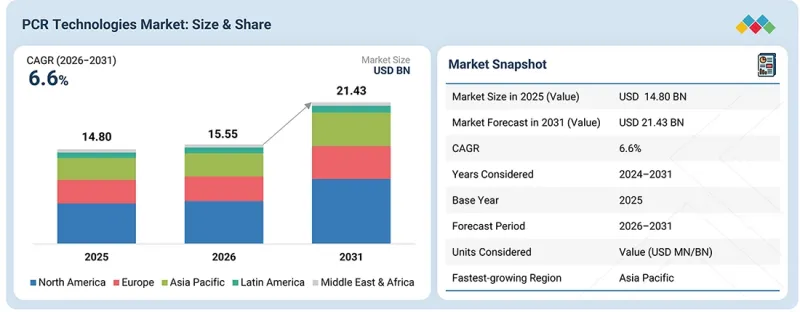
PCR 기술 시장은 2026년 155억 5,000만 달러에서 2031년까지 214억 3,000만 달러에 달할 것으로 예상되며, 2026년부터 2031년까지 연평균 성장률(CAGR) 6.6%로 확대될 것으로 전망됩니다.
| 조사 범위 | |
|---|---|
| 조사 기간 | 2026-2031년 |
| 기준 연도 | 2025년 |
| 예측 기간 | 2026-2031년 |
| 산정 단위 | 금액(10억 달러) |
| 부문 | 제품, 기술, 용도, 최종사용자 및 지역 |
| 대상 지역 | 북미, 유럽, 아시아태평양, 라틴아메리카, 중동 및 아프리카 |
PCR 기술 시장은 첨단 장비와 고신뢰도 효소의 발전에 힘입어 더 높은 효율, 정확도, 감도 및 범용성으로 진화하고 있습니다. 실시간 PCR(qPCR)은 실시간 모니터링 및 정량 분석을 가능하게 하는 반면, RT-PCR은 RNA 분석, 유전자 발현 연구 및 바이러스 검출을 지원합니다. 디지털 PCR(dPCR)은 매우 높은 정확도와 민감도를 요구하는 절대 정량 분야에서 그 중요성이 커지고 있으며, 연구 및 진단 분야에서 PCR의 응용 범위를 더욱 넓히고 있습니다.
“2025년에는 qPCR이 가장 큰 시장 점유율을 차지할 것으로 전망됩니다.”
qPCR은 정밀한 정량이 요구되는 진단 및 조사 분야에서 확립된 활용 실적이 있으므로, PCR 기술 시장에서 최대의 점유율을 차지할 것으로 예상됩니다. PCR 증폭과 형광 염료 및 프로브를 이용한 실시간 모니터링을 결합함으로써, qPCR은 각 사이클마다 표적 DNA의 정량 분석을 가능하게 합니다. 이러한 폭넓은 유용성과 분자진단 및 조사 분야에서 확립된 역할이 qPCR의 광범위한 보급을 뒷받침하고 있습니다.
“진단 검사실이 시장에서 가장 큰 점유율을 차지할 것으로 전망됩니다.”
신속하고 고감도이며 정확한 분자 검사에 대한 수요가 증가하는 것을 배경으로, 진단 검사실은 계속해서 PCR 기술의 최대 최종사용자가 될 전망입니다. PCR은 감염병 검출, 유전자 검사, 종양학, 질환 모니터링 등에서 널리 활용되고 있습니다. 검사 건수의 증가와 고처리량 워크플로우에 대한 수요 증가가 그 보급을 더욱 뒷받침하고 있습니다. 또한, 자동화·표준화·통합화된 분자 검사 시스템으로의 전환도 진단 검사실에서의 PCR 활용을 강화하고 있습니다.
북미는 선진적인 의료 인프라, 분자진단의 적극적인 도입, 그리고 유전체학, 정밀 의학, 생명과학 연구에 대한 막대한 투자를 바탕으로 2026년에도 PCR 기술 시장에서 최대 점유율을 유지할 것으로 예상됩니다. 이 지역은 주요 PCR 기술 공급업체의 존재와 임상 진단, 감염병 검사, 종양학, 유전자 검사 분야에서 PCR이 광범위하게 활용되고 있는 점에서도 혜택을 보고 있습니다. 강력한 연구 역량과 첨단 PCR 플랫폼의 지속적인 개발이 북미 시장의 리더십을 더욱 공고히 하고 있습니다.
본 보고서에서 언급된 주요 기업의 내역은 다음과 같습니다:
- 기업 유형별 : Tier 1 - 30%, Tier 2 - 42%, Tier 3 - 28%
- 직책별 : C레벨 - 10%, 디렉터 레벨- 14%, 기타 - 76%
- 지역별 : 북미 - 40%, 유럽 - 30%, 아시아태평양 - 22%, 기타 지역 - 8%
조사 범위
본 조사 보고서에서는 제품, 소재의 최종사용자 및 지역별로 시장을 분석하고 있습니다. 본 조사에서는 시장 확장을 주도하는 요인을 포괄적으로 다루고, 현재 업계의 전망과 과제를 분석하는 한편, 시장을 선도하는 기업 및 중소기업을 포함한 경쟁 구도에 대한 상세한 정보를 제공합니다. 또한, 5개 지역 및 마이크로마켓 분석을 고려하여 각 시장 부문의 매출을 추정하고 있습니다.
본 보고서를 구매해야 하는 이유
본 보고서는 시장 선도 기업 및 신규 진입 기업에게 시장 전체 및 그 하위 부문의 시장 수익 추정과 관련된 귀중한 정보를 제공합니다. 이 보고서는 이해관계자들이 경쟁 구도를 이해하고, 자사의 비즈니스를 보다 효과적으로 포지셔닝하며, 적절한 시장 진입 전략을 수립하는 데 도움이 됩니다. 또한, 본 보고서는 주요 시장 촉진요인과 과제를 포함한 시장 역학에 대한 인사이트를 제공합니다.
본 보고서는 다음 사항에 대해 통찰력 있는 데이터를 제공합니다:
- 시장 침투율 : PCR 기술 시장의 주요 기업이 제공하는 제품 포트폴리오에 대한 상세한 분석
- 제품 개발/혁신 : PCR 기술 시장의 주요 기업이 제공하는 제품 포트폴리오에 대한 상세한 분석
- 시장 개발 : 수익성이 높은 성장 분야에 대한 유용한 데이터
- 시장 다각화 : PCR 기술 시장의 최근 동향 및 발전에 대한 상세 정보
- 경쟁 분석 : 주요 경쟁사의 제품, 성장 전략, 수익 예측 및 시장 카테고리에 대한 종합적인 평가
자주 묻는 질문
목차
제1장 서론
제2장 요약
제3장 주요 인사이트
- PCR 기술 시장의 개요
- 지역별 PCR 기술 시장
- 아시아태평양 : 국가별·제품별 PCR 기술 시장
- PCR 기술 시장의 지역별 개요
제4장 시장 개요
- 시장 역학
- 성장 촉진요인
- 성장 억제요인
- 기회
- 과제
- 미충족 수요와 미개척 분야
- Tier 1/2/3 주요 기업들의 전략적 움직임
제5장 업계 동향
- Porter's Five Forces 분석
- 신규 진입자의 위협
- 대체품의 위협
- 공급업체의 협상력
- 구매자의 협상력
- 경쟁 기업 간의 적대적 관계
- 거시경제 전망
- 거시경제 지표
- GDP 동향 및 전망
- 세계 PCR 기술 시장의 동향
- 밸류체인 분석
- 연구 개발
- 원자재 조달 및 제조
- 유통, 마케팅·판매 및 사후 서비스
- 생태계 분석
- 가격 분석
- 주요 기업별 실시간 PCR 장비 참고 가격(2025년)
- 지역별, PCR 기술 기반 제품의 참고 가격(2023-2025년)
- 무역 데이터 분석
- HS 코드 3822의 수입 데이터
- 수출 데이터(HS 코드 3822)
- 주요 회의 및 행사(2026-2027년)
- 고객의 비즈니스에 영향을 미치는 동향 및 변화
- 투자 및 자금 조달 시나리오
- 사례 연구 분석
- 디지털 PCR을 이용한 무세포 DNA 내 KRAS 돌연변이의 다중 검출
- PCR에 기반한 아시네토박터 바우마니의 동정은 표적화된 감염병 관리를 지원
- 미국 관세의 영향 - PCR 기술 시장
- 주요 관세율
- 가격에 미치는 영향 분석
제6장 기술 발전, AI의 영향, 특허, 혁신 및 향후 응용
- 주요 기술
- 열 사이클러
- 실시간 정량 PCR
- 휴대용 및 현장 진단(POC) PCR
- 보완 기술
- 차세대 염기서열 분석
- 마이크로어레이
- 랩온어칩 장치
- 로보틱스 및 자동화
- 특허 분석
- AI/생성형 AI가 PCR 기술 시장에 미치는 영향
- 주요 사용 사례 및 시장 잠재력
- PCR 기술 시장에서 기업의 모범 사례
- PCR 기술 시장에서 AI/생성형 AI 도입에 관한 사례 연구
- 상호 연계된 생태계와 시장 참여자에 미치는 영향
- PCR 기술 시장에서 AI/생성형 AI 도입에 대한 고객의 준비 현황
- 성공 사례 및 실제 사회에서의 응용 사례
제7장 고객 동향과 구매 행동
- 의사결정 과정
- 구매 과정의 주요 이해관계자와 평가 기준
- 구매 과정의 주요 이해관계자
- 주요 구매 기준
- 도입 장벽 및 사내 과제
- 다양한 용도에서의 미충족 수요
- 규제 현황
- 규제 분석
제8장 PCR 기술 시장 : 제품별
- 시약 및 소모품
- 장비
- 소프트웨어 및 서비스
제9장 PCR 기술 시장 : 기법별
- 실시간 PCR
- 기존형 PCR
- 디지털 PCR
- 역전사 PCR
- 핫스타트 PCR
- 멀티플렉스 PCR
- 기타 PCR 기술
제10장 PCR 기술 시장 : 용도별
- 진단 용도
- 유전자형 판정
- 핵산 검출
- 유전자 발현 분석
- 핵산 합성
- 유전자 염기서열 결정
- 환경 분야로의 응용
- 표준 물질의 타당성 확인 및 검증
- 기타 용도
제11장 PCR 기술 시장 : 최종사용자별
- 병원 검사실
- 진단 검사실
- 학술 기관 및 정부 기관
- 제약 및 생명공학 기업
- 기타 최종사용자
제12장 PCR 기술 시장 : 지역별
- 북미
- 미국
- 캐나다
- 유럽
- 독일
- 프랑스
- 영국
- 이탈리아
- 스페인
- 기타 유럽
- 아시아태평양
- 중국
- 일본
- 인도
- 호주
- 한국
- 기타 아시아태평양
- 라틴아메리카
- 브라질
- 멕시코
- 기타 라틴아메리카
- 중동 및 아프리카
- GCC 국가들
- 기타 중동 및 아프리카
제13장 경쟁 현황
- 주요 진입 기업의 전략/강점
- PCR 기술 시장에서 주요 업체들이 채택하고 있는 전략 개요
- 수익 분석(2022-2025년)
- 시장 점유율 분석(2025년)
- 주요 기업별 PCR 장비 시장 점유율(2025년)
- PCR 시약 및 소모품 시장 점유율(주요 기업별, 2025년)
- 2025년 주요 기업별 전 세계 PCR 소프트웨어 및 서비스 시장 점유율
- 기업 평가 매트릭스 : 주요 기업별, 2025년
- 스타 기업
- 신흥 리더
- 광범위한 업체
- 진입 기업
- 기업의 사업 전개 : 주요 기업, 2025년
- 기업 평가 매트릭스 : 스타트업/중소기업, 2025년
- 선도적인 기업
- 대응력이 뛰어난 기업
- 역동적인 기업
- 출발점
- 기업 벤치마크 : 스타트업/중소기업, 2025년
- 기업 평가 및 재무 지표, 2025년
- 제품·브랜드 비교
- 경쟁 시나리오
- 제품 출시 및 승인
- 거래
- 사업 확장
제14장 기업 개요
- 주요 기업
- THERMO FISHER SCIENTIFIC INC.
- F. HOFFMANN-LA ROCHE LTD.
- AGILENT TECHNOLOGIES, INC.
- BIO-RAD LABORATORIES, INC.
- QIAGEN
- DANAHER CORPORATION
- BBOTT
- TAKARA BIO INC.
- ANALYTIK JENA GMBH+CO. KG
- EPPENDORF SE
- MERCK KGAA
- BIONEER CORPORATION
- REVVITY
- BECTON, DICKINSON AND COMPANY
- BIOMERIEUX
- STANDARD BIOTOOLS
- HOLOGIC, INC.
- LONZA
- ILLUMINA, INC.
- SANSURE BIOTECH INC.
- 기타 주요 기업
- PROMEGA CORPORATION
- LIMING BIO
- TRANSGEN BIOTECH CO., LTD.
- DAAN GENE CO., LTD.
- BIOBASE GROUP
- NIPPON GENETICS EUROPE
- STILLA
- GENSCRIPT
- NEW ENGLAND BIOLABS
제15장 조사 방법론
제16장 부록
KSM 26.10.23The PCR technologies market is projected to reach USD 21,430 million by 2031, up from USD 15,550 million in 2026, at a CAGR of 6.6% during 2026-2031.
| Scope of the Report | |
|---|---|
| Years Considered for the Study | 2026-2031 |
| Base Year | 2025 |
| Forecast Period | 2026-2031 |
| Units Considered | Value (USD billion) |
| Segments | Product, Technique, Application, End User, and Region |
| Regions covered | North America, Europe, Asia Pacific, Latin America, and Middle East & Africa |
The PCR technologies market is evolving toward higher efficiency, accuracy, sensitivity, and versatility, driven by advances in sophisticated instrumentation and high-fidelity enzymes. Real-time PCR (qPCR) enables real-time monitoring and quantitative analysis, while RT-PCR supports RNA analysis, gene expression studies, and viral detection. Digital PCR (dPCR) is gaining importance for applications requiring highly precise and sensitive absolute quantification, further broadening PCR's applications across research and diagnostics.
"qPCR to account for largest market share in 2025."
qPCR is expected to hold the largest share of the PCR technologies market due to its established use in diagnostics and research, where precise quantification is required. By combining PCR amplification with real-time monitoring using fluorescent dyes or probes, qPCR enables quantitative analysis of target DNA at each cycle. Its broad utility and established role in molecular diagnostics and research support its widespread adoption.
"Diagnostic laboratories to hold largest share in the market."
Diagnostic laboratories are expected to remain the largest end users of PCR technologies, driven by the growing need for rapid, sensitive, and accurate molecular testing. PCR is widely used for infectious disease detection, genetic testing, oncology, and disease monitoring. Rising testing volumes and demand for high-throughput workflows further support adoption. The shift toward automated, standardized, and integrated molecular testing systems is also strengthening PCR utilization in diagnostic laboratories.
North America is expected to retain the largest share of the PCR technologies market in 2026, supported by advanced healthcare infrastructure, strong adoption of molecular diagnostics, and substantial investments in genomics, precision medicine, and life-science research. The region also benefits from major PCR technology providers and the widespread use of PCR in clinical diagnostics, infectious disease testing, oncology, and genetic testing. Strong research capabilities and ongoing development of advanced PCR platforms further reinforce North America's market leadership.
A breakdown of the primary participants referred to for this report is provided below:
- By Company Type: Tier 1-30%, Tier 2-42%, and Tier 3- 28%
- By Designation: C-level-- 10%, Director-level-14%, and Others-76%
- By Region: North America-40%, Europe-30%, Asia Pacific-22%, Rest of the World - 8%.
Prominent players in the PCR technologies market include F. Hoffman-La Roche Ltd. (Switzerland), Thermo Fisher Scientific, Inc. (US), Bio-Rad Laboratories, Inc. (US), QIAGEN (Germany), Sansure Biotech Inc. (China), Becton, Dickinson and Company (US), Analytik Jena AG (Germany), Takara Bio, Inc. (Japan), Agilent Technologies, Inc. (US), Standard Biotools (US), Danaher Corporation (US), Abbott Laboratories (US), Merck KGaA (Germany), Illumina, Inc. (US), Bioneer Corporation (South Korea), PerkinElmer Inc. (US), and Hologic Inc. (US).
Research Coverage
The research report examines the market by product, material end-users, and geography. This research covers factors that are driving market expansion, analyzes current industry prospects and challenges, and provides specifics on the competitive landscape, including market leaders and small and medium enterprises. This research also estimates the revenue of different market segments by considering five regions and micro-market analysis.
Reasons to Buy the Report
The report will provide market leaders and new entrants with valuable information on revenue estimates for the overall market and its subsegments. It will help stakeholders understand the competitive landscape, enabling them to position their businesses more effectively and develop appropriate go-to-market strategies. Additionally, the report offers insights into market dynamics, including key drivers, restraints, challenges, and opportunities.
This report provides insightful data on the following pointers:
- Market Penetration: In-depth coverage of product portfolios offered by the top players in the PCR technologies market
- Product Development/Innovation: In-depth coverage of product portfolios offered by the top players in the PCR technologies market
- Market Development: Insightful data on profitable developing areas
- Market Diversification: Details about recent developments and advancements in the PCR technologies market
- Competitive Assessment: Extensive assessment of the products, growth tactics, revenue projections, and market categories of the top competitors
TABLE OF CONTENTS
1 INTRODUCTION
- 1.1 STUDY OBJECTIVES
- 1.2 MARKET DEFINITION
- 1.3 STUDY SCOPE
- 1.3.1 SEGMENTS CONSIDERED
- 1.3.2 INCLUSIONS & EXCLUSIONS
- 1.3.3 YEARS CONSIDERED
- 1.3.4 CURRENCY CONSIDERED
- 1.4 STAKEHOLDERS
- 1.5 SUMMARY OF CHANGES
2 EXECUTIVE SUMMARY
- 2.1 MARKET HIGHLIGHTS AND KEY INSIGHTS
- 2.2 KEY MARKET PARTICIPANTS: MAPPING OF STRATEGIC DEVELOPMENTS
- 2.3 DISRUPTIVE TRENDS IN PCR TECHNOLOGIES MARKET
- 2.4 HIGH-GROWTH SEGMENTS
3 PREMIUM INSIGHTS
- 3.1 PCR TECHNOLOGIES MARKET OVERVIEW
- 3.2 PCR TECHNOLOGIES MARKET, BY REGION
- 3.3 ASIA PACIFIC: PCR TECHNOLOGIES MARKET, BY COUNTRY AND PRODUCT
- 3.4 GEOGRAPHIC SNAPSHOT OF PCR TECHNOLOGIES MARKET
4 MARKET OVERVIEW
- 4.1 INTRODUCTION
- 4.2 MARKET DYNAMICS
- 4.2.1 DRIVERS
- 4.2.1.1 Laboratories Increasing outbreaks of infectious diseases/viral persistence
- 4.2.1.2 Development of miniaturized and portable point-of-care testing devices
- 4.2.1.3 High demand for technologically advanced molecular diagnostics
- 4.2.2 RESTRAINTS
- 4.2.2.1 Premium product pricing
- 4.2.2.2 Dearth of skilled healthcare professionals
- 4.2.3 OPPORTUNITIES
- 4.2.3.1 Increased investments in laboratory infrastructure
- 4.2.3.2 Rising number of applications in rare sequence detection
- 4.2.4 CHALLENGES
- 4.2.4.1 Technical limitations
- 4.2.4.2 Increased pricing pressure on market players
- 4.2.1 DRIVERS
- 4.3 UNMET NEEDS AND WHITE SPACES
- 4.4 STRATEGIC MOVES BY TIER-1/2/3 PLAYERS
5 INDUSTRY TRENDS
- 5.1 PORTER'S FIVE FORCES ANALYSIS
- 5.1.1 THREAT OF NEW ENTRANTS
- 5.1.2 THREAT OF SUBSTITUTES
- 5.1.3 BARGAINING POWER OF SUPPLIERS
- 5.1.4 BARGAINING POWER OF BUYERS
- 5.1.5 INTENSITY OF COMPETITIVE RIVALRY
- 5.2 MACROECONOMIC OUTLOOK
- 5.2.1 INTRODUCTION
- 5.2.2 MACROECONOMIC INDICATORS
- 5.2.3 GDP TRENDS AND FORECAST
- 5.2.4 TRENDS IN GLOBAL PCR TECHNOLOGIES MARKET
- 5.3 VALUE CHAIN ANALYSIS
- 5.3.1 RESEARCH & DEVELOPMENT
- 5.3.2 RAW MATERIAL PROCUREMENT AND MANUFACTURING
- 5.3.3 DISTRIBUTION, MARKETING & SALES, AND POST-SALES SERVICES
- 5.4 ECOSYSTEM ANALYSIS
- 5.5 PRICING ANALYSIS
- 5.5.1 INDICATIVE PRICING REAL-TIME PCR INSTRUMENTS, BY KEY PLAYER, 2025
- 5.5.2 INDICATIVE PRICING OF PCR TECHNOLOGY-BASED PRODUCTS, BY REGION, 2023-2025
- 5.5.2.1 North America
- 5.5.2.2 Europe
- 5.5.2.3 Asia Pacific
- 5.5.2.4 Rest of the World
- 5.6 TRADE DATA ANALYSIS
- 5.6.1 IMPORT DATA FOR HS CODE 3822
- 5.6.2 EXPORT DATA (HS CODE 3822)
- 5.7 KEY CONFERENCES & EVENTS, 2026-2027
- 5.8 TRENDS/DISRUPTIONS IMPACTING CUSTOMER BUSINESS
- 5.9 INVESTMENT AND FUNDING SCENARIO
- 5.10 CASE STUDY ANALYSIS
- 5.10.1 MULTIPLEX DETECTION OF KRAS MUTATIONS IN CELL-FREE DNA USING DIGITAL PCR
- 5.10.2 PCR-BASED IDENTIFICATION OF ACINETOBACTER BAUMANNII SUPPORTS TARGETED INFECTION MANAGEMENT
- 5.11 IMPACT OF US TARIFFS - PCR TECHNOLOGIES MARKET
- 5.11.1 INTRODUCTION
- 5.11.2 KEY TARIFF RATES
- 5.11.3 PRICE IMPACT ANALYSIS
- 5.11.3.1 Impact on countries/regions
- 5.11.3.2 Impact on end-users
6 TECHNOLOGICAL ADVANCEMENTS, AI-DRIVEN IMPACTS, PATENTS, INNOVATIONS, AND FUTURE APPLICATIONS
- 6.1 KEY TECHNOLOGIES
- 6.1.1 THERMAL CYCLERS
- 6.1.2 REAL-TIME QUANTITATIVE PCR
- 6.1.3 PORTABLE AND POINT-OF-CARE PCR
- 6.2 COMPLEMENTARY TECHNOLOGIES
- 6.2.1 NEXT-GENERATION SEQUENCING
- 6.2.2 MICROARRAYS
- 6.2.3 LAB-ON-A-CHIP DEVICES
- 6.2.4 ROBOTICS AND AUTOMATION
- 6.3 PATENT ANALYSIS
- 6.4 IMPACT OF AI/GEN AI ON PCR TECHNOLOGIES MARKET
- 6.4.1 TOP USE CASES AND MARKET POTENTIAL
- 6.4.2 BEST PRACTICES FOLLOWED BY COMPANIES IN PCR TECHNOLOGIES MARKET
- 6.4.3 CASE STUDIES RELATED TO AI/GEN AI IMPLEMENTATION IN PCR TECHNOLOGIES MARKET
- 6.4.4 INTERCONNECTED ECOSYSTEM AND IMPACT ON MARKET PLAYERS
- 6.4.5 CLIENT'S READINESS TO ADOPT AI/GEN AI IN PCR TECHNOLOGIES MARKET
- 6.5 SUCCESS STORIES AND REAL-WORLD APPLICATIONS
7 CUSTOMER LANDSCAPE AND BUYER BEHAVIOR
- 7.1 DECISION-MAKING PROCESS
- 7.2 KEY STAKEHOLDERS IN BUYING PROCESS AND EVALUATION CRITERIA
- 7.2.1 KEY STAKEHOLDERS IN BUYING PROCESS
- 7.2.2 KEY BUYING CRITERIA
- 7.3 ADOPTION BARRIERS AND INTERNAL CHALLENGES
- 7.4 UNMET NEEDS OF VARIOUS APPLICATIONS
- 7.5 REGULATORY LANDSCAPE
- 7.5.1 REGULATORY ANALYSIS
- 7.5.1.1 North America
- 7.5.1.1.1 US
- 7.5.1.1.2 Canada
- 7.5.1.2 Europe
- 7.5.1.3 Asia Pacific
- 7.5.1.3.1 Japan
- 7.5.1.3.2 China
- 7.5.1.3.3 India
- 7.5.1.1 North America
- 7.5.1 REGULATORY ANALYSIS
8 PCR TECHNOLOGIES MARKET, BY PRODUCT
- 8.1 INTRODUCTION
- 8.2 REAGENTS AND CONSUMABLES
- 8.2.1 INCREASING USE OF DPCR-BASED ANALYTICAL PROCEDURES IN GENETIC RESEARCH AND FORENSICS TO DRIVE MARKET
- 8.3 INSTRUMENTS
- 8.3.1 RISING AVAILABILITY OF TECHNOLOGICALLY ADVANCED AND INNOVATIVE PCR INSTRUMENTS TO FUEL MARKET GROWTH
- 8.4 SOFTWARE AND SERVICES
- 8.4.1 GROWING DEMAND FOR SPECIALIZED PCR ANALYSIS SOFTWARE IN ONCOLOGY STUDIES AND FORENSICS TO SPUR MARKET GROWTH
9 PCR TECHNOLOGIES MARKET, BY TECHNIQUE
- 9.1 INTRODUCTION
- 9.2 REAL-TIME PCR
- 9.2.1 RISING ADOPTION OF REAL-TIME PCR AMONG RESEARCHERS AND HEALTHCARE PROFESSIONALS TO PROPEL MARKET GROWTH
- 9.3 CONVENTIONAL PCR
- 9.3.1 COST-EFFECTIVENESS AND EASE OF USAGE IN ROUTINE CLONING, GENOTYPING, AND MUTATION ANALYSIS TO FUEL MARKET GROWTH
- 9.4 DIGITAL PCR
- 9.4.1 FASTER RESULTS WITH LOWER MARGIN ERRORS TO DRIVE ADOPTION
- 9.5 REVERSE TRANSCRIPTION PCR
- 9.5.1 HIGHER SENSITIVITY FOR MEASURING CHANGES IN GENE EXPRESSION TO AUGMENT MARKET GROWTH
- 9.6 HOT-START PCR
- 9.6.1 BETTER REACTION SPECIFICITY WITH LOWER ERROR RATES TO FAVOR MARKET GROWTH
- 9.7 MULTIPLEX PCR
- 9.7.1 COST-EFFECTIVENESS AND HIGH THROUGHPUT TO AID MARKET GROWTH
- 9.8 OTHER PCR TECHNIQUES
10 PCR TECHNOLOGIES MARKET, BY APPLICATION
- 10.1 INTRODUCTION
- 10.2 DIAGNOSTIC APPLICATIONS
- 10.2.1 UNAVAILABILITY OF REIMBURSEMENTS FOR CLINICAL DIAGNOSTIC TESTS TO LIMIT MARKET GROWTH
- 10.3 GENOTYPING
- 10.3.1 LARGE TARGET PATIENT POPULATION FOR CANCER DIAGNOSIS TO AUGMENT MARKET GROWTH
- 10.4 NUCLEIC ACID DETECTION
- 10.4.1 RISING PREVALENCE OF INFECTIOUS DISEASES TO BOOST MARKET GROWTH
- 10.5 GENE EXPRESSION ANALYSIS
- 10.5.1 INCREASED R&D FUNDING AND GRANTS FOR PCR TO FAVOR MARKET GROWTH
- 10.6 NUCLEIC ACID SYNTHESIS
- 10.6.1 INCREASED FOCUS ON PERSONALIZED AND PRECISE MEDICINES TO SUPPORT MARKET GROWTH
- 10.7 GENETIC SEQUENCING
- 10.7.1 TECHNOLOGICAL IMPROVEMENTS AND REDUCED COSTS OF SEQUENCING TO FUEL MARKET GROWTH
- 10.8 ENVIRONMENTAL APPLICATIONS
- 10.8.1 STRICT GOVERNMENT ENVIRONMENTAL POLICIES TO PROMOTE USE OF PCR
- 10.9 STANDARD VALIDATION/VERIFICATION
- 10.9.1 NEED FOR REGIONAL/GLOBAL VALIDATION FOR COMMERCIAL/NON-COMMERCIAL GUIDELINE FRAMING TO DRIVE MARKET
- 10.10 OTHER APPLICATIONS
11 PCR TECHNOLOGIES MARKET, BY END USER
- 11.1 INTRODUCTION
- 11.2 HOSPITAL LABORATORIES
- 11.2.1 RISING PUBLIC AWARENESS OF ROUTINE CHECKUPS TO SUPPORT MARKET GROWTH
- 11.3 DIAGNOSTIC LABORATORIES
- 11.3.1 ESTABLISHMENT OF INDEPENDENT SPECIALIZED DIAGNOSTIC LABORATORIES TO PROPEL MARKET GROWTH
- 11.4 ACADEMIC AND GOVERNMENT ORGANIZATIONS
- 11.4.1 INCREASED GOVERNMENT SUPPORT FOR GENOME-BASED RESEARCH TO DRIVE MARKET
- 11.5 PHARMA-BIOTECH COMPANIES
- 11.5.1 INCREASING R&D INITIATIVES BY PHARMA-BIOTECH COMPANIES TO DRIVE ADOPTION OF PCR TECHNOLOGIES
- 11.6 OTHER END USERS
12 PCR TECHNOLOGIES MARKET, BY REGION
- 12.1 INTRODUCTION
- 12.2 NORTH AMERICA
- 12.2.1 US
- 12.2.1.1 US to dominate North American PCR technologies market during study period
- 12.2.2 CANADA
- 12.2.2.1 Supportive government initiatives for genomics research to aid market growth
- 12.2.1 US
- 12.3 EUROPE
- 12.3.1 GERMANY
- 12.3.1.1 Presence of well-established pharmaceutical and R&D industry to augment market growth
- 12.3.2 FRANCE
- 12.3.2.1 Increasing investments in life science R&D for infrastructural development to favor market growth
- 12.3.3 UK
- 12.3.3.1 Rising acceptance of genome-based diagnosis by clinicians and healthcare professionals to spur market growth
- 12.3.4 ITALY
- 12.3.4.1 Supportive government policies and high healthcare expenditure to boost market growth
- 12.3.5 SPAIN
- 12.3.5.1 Increasing funding for life science research and pharmaceutical drug development to boost market growth
- 12.3.6 REST OF EUROPE
- 12.3.1 GERMANY
- 12.4 ASIA PACIFIC
- 12.4.1 CHINA
- 12.4.1.1 Improved public access to modern healthcare facilities and advanced genomics research to fuel market growth
- 12.4.2 JAPAN
- 12.4.2.1 Well-established healthcare infrastructure and advanced cancer research activities to support market growth
- 12.4.3 INDIA
- 12.4.3.1 Presence of large target patient population and high government healthcare expenditure to support market growth
- 12.4.4 AUSTRALIA
- 12.4.4.1 High healthcare expenditure to drive adoption of advanced PCR technologies
- 12.4.5 SOUTH KOREA
- 12.4.5.1 Improved medical tourism and prevalence of chronic diseases to propel market growth
- 12.4.6 REST OF ASIA PACIFIC
- 12.4.1 CHINA
- 12.5 LATIN AMERICA
- 12.5.1 BRAZIL
- 12.5.1.1 Growing focus on proteomics and genomics research to drive market
- 12.5.2 MEXICO
- 12.5.2.1 Favorable trade agreements to support imports and improve accessibility to PCR instruments
- 12.5.3 REST OF LATIN AMERICA
- 12.5.1 BRAZIL
- 12.6 MIDDLE EAST & AFRICA
- 12.6.1 GCC COUNTRIES
- 12.6.1.1 Advancements in healthcare infrastructure and increased focus on personalized medicines to fuel market growth
- 12.6.2 REST OF MIDDLE EAST & AFRICA
- 12.6.1 GCC COUNTRIES
13 COMPETITIVE LANDSCAPE
- 13.1 INTRODUCTION
- 13.2 KEY PLAYER STRATEGY/RIGHT TO WIN
- 13.2.1 OVERVIEW OF STRATEGIES ADOPTED BY KEY PLAYERS IN PCR TECHNOLOGIES MARKET
- 13.3 REVENUE ANALYSIS, 2022-2025
- 13.4 MARKET SHARE ANALYSIS, 2025
- 13.4.1 PCR INSTRUMENTS MARKET SHARE, BY KEY PLAYER, 2025
- 13.4.2 PCR REAGENTS AND CONSUMABLES MARKET SHARE, BY KEY PLAYER, 2025
- 13.4.3 GLOBAL PCR SOFTWARE AND SERVICES MARKET SHARE, BY KEY PLAYER, 2025
- 13.5 COMPANY EVALUATION MATRIX: KEY PLAYERS, 2025
- 13.5.1 STARS
- 13.5.2 EMERGING LEADERS
- 13.5.3 PERVASIVE PLAYERS
- 13.5.4 PARTICIPANTS
- 13.5.5 COMPANY FOOTPRINT: KEY PLAYERS, 2025
- 13.5.5.1 Company footprint
- 13.5.5.2 Product footprint
- 13.5.5.3 Application footprint
- 13.5.5.4 Technique footprint
- 13.5.5.5 End user footprint
- 13.5.5.6 Region footprint
- 13.6 COMPANY EVALUATION MATRIX: STARTUPS/SMES, 2025
- 13.6.1 PROGRESSIVE COMPANIES
- 13.6.2 RESPONSIVE COMPANIES
- 13.6.3 DYNAMIC COMPANIES
- 13.6.4 STARTING BLOCKS
- 13.6.5 COMPANY BENCHMARKING: STARTUPS/SMES, 2025
- 13.6.5.1 Detailed list of key startups/SMEs players
- 13.6.5.2 Competitive benchmarking of key startups/SMEs
- 13.7 COMPANY VALUATION AND FINANCIAL METRICS, 2025
- 13.8 PRODUCT/BRAND COMPARISON
- 13.9 COMPETITIVE SCENARIO
- 13.9.1 PRODUCT LAUNCHES AND APPROVALS
- 13.9.2 DEALS
- 13.9.3 EXPANSIONS
14 COMPANY PROFILES
- 14.1 KEY PLAYERS
- 14.1.1 THERMO FISHER SCIENTIFIC INC.
- 14.1.1.1 Business overview
- 14.1.1.2 Products/Services/Solutions offered
- 14.1.1.3 Recent developments
- 14.1.1.3.1 Product launches and approvals
- 14.1.1.3.2 Deals
- 14.1.1.4 MnM view
- 14.1.1.4.1 Key strengths
- 14.1.1.4.2 Strategic choices
- 14.1.1.4.3 Weaknesses and competitive threats
- 14.1.2 F. HOFFMANN-LA ROCHE LTD.
- 14.1.2.1 Business overview
- 14.1.2.2 Products/Services/Solutions offered
- 14.1.2.3 Recent developments
- 14.1.2.3.1 Product launches and approvals
- 14.1.2.3.2 Deals
- 14.1.2.4 MnM view
- 14.1.2.4.1 Key strengths
- 14.1.2.4.2 Strategic choices
- 14.1.2.4.3 Weaknesses and competitive threats
- 14.1.3 AGILENT TECHNOLOGIES, INC.
- 14.1.3.1 Business overview
- 14.1.3.2 Products/Services/Solutions offered
- 14.1.3.3 Recent developments
- 14.1.3.3.1 Deals
- 14.1.3.3.2 Other developments
- 14.1.3.4 MnM view
- 14.1.3.4.1 Key strengths
- 14.1.3.4.2 Strategic choices
- 14.1.3.4.3 Weaknesses and competitive threats
- 14.1.4 BIO-RAD LABORATORIES, INC.
- 14.1.4.1 Business overview
- 14.1.4.2 Products/Services/Solutions offered
- 14.1.4.3 Recent developments
- 14.1.4.3.1 Product launches
- 14.1.4.3.2 Deals
- 14.1.4.4 MnM view
- 14.1.4.4.1 Key strengths
- 14.1.4.4.2 Strategic choices
- 14.1.4.4.3 Weaknesses and competitive threats
- 14.1.5 QIAGEN
- 14.1.5.1 Business overview
- 14.1.5.2 Products/Services/Solutions offered
- 14.1.5.3 Recent developments
- 14.1.5.3.1 Product launches and approvals
- 14.1.5.3.2 Deals
- 14.1.5.3.3 Expansions
- 14.1.5.4 MnM view
- 14.1.5.4.1 Key strengths
- 14.1.5.4.2 Strategic choices
- 14.1.5.4.3 Weaknesses and competitive threats
- 14.1.6 DANAHER CORPORATION
- 14.1.6.1 Business overview
- 14.1.6.2 Products/Services/Solutions offered
- 14.1.6.3 Recent developments
- 14.1.6.3.1 Product approvals
- 14.1.6.3.2 Deals
- 14.1.6.3.3 Expansions
- 14.1.7 BBOTT
- 14.1.7.1 Business overview
- 14.1.7.2 Products/Services/Solutions offered
- 14.1.7.3 Recent developments
- 14.1.7.3.1 Deals
- 14.1.8 TAKARA BIO INC.
- 14.1.8.1 Business overview
- 14.1.8.2 Products/Services/Solutions offered
- 14.1.8.3 Recent developments
- 14.1.8.3.1 Product launches
- 14.1.8.3.2 Deals
- 14.1.9 ANALYTIK JENA GMBH+CO. KG
- 14.1.9.1 Business overview
- 14.1.9.2 Products/Services/Solutions offered
- 14.1.9.3 Recent developments
- 14.1.9.3.1 Product launches
- 14.1.9.3.2 Deals
- 14.1.10 EPPENDORF SE
- 14.1.10.1 Business overview
- 14.1.10.2 Products/Services/Solutions offered
- 14.1.10.3 Recent developments
- 14.1.10.3.1 Product launches and approvals
- 14.1.10.3.2 Deals
- 14.1.11 MERCK KGAA
- 14.1.11.1 Business overview
- 14.1.11.2 Products/Services/Solutions offered
- 14.1.11.2.1 Deals
- 14.1.11.2.2 Expansions
- 14.1.12 BIONEER CORPORATION
- 14.1.12.1 Business overview
- 14.1.12.2 Products/Services/Solutions offered
- 14.1.12.3 Recent developments
- 14.1.12.3.1 Other developments
- 14.1.13 REVVITY
- 14.1.13.1 Business overview
- 14.1.13.2 Products/Services/Solutions offered
- 14.1.13.3 Recent developments
- 14.1.13.3.1 Product launches
- 14.1.13.3.2 Other developments
- 14.1.14 BECTON, DICKINSON AND COMPANY
- 14.1.14.1 Business overview
- 14.1.14.2 Products/Services/Solutions offered
- 14.1.14.3 Recent developments
- 14.1.14.3.1 Product launches and approvals
- 14.1.14.3.2 Deals
- 14.1.15 BIOMERIEUX
- 14.1.15.1 Business overview
- 14.1.15.2 Products/Services/Solutions offered
- 14.1.15.3 Recent developments
- 14.1.15.3.1 Product launches and approvals
- 14.1.16 STANDARD BIOTOOLS
- 14.1.16.1 Business overview
- 14.1.16.2 Products/Services/Solutions offered
- 14.1.17 HOLOGIC, INC.
- 14.1.17.1 Business overview
- 14.1.17.2 Products/Services/Solutions offered
- 14.1.17.3 Recent developments
- 14.1.17.3.1 Product launches
- 14.1.18 LONZA
- 14.1.18.1 Business overview
- 14.1.18.2 Products/Services/Solutions offered
- 14.1.19 ILLUMINA, INC.
- 14.1.19.1 Business overview
- 14.1.19.2 Products/Services/Solutions offered
- 14.1.20 SANSURE BIOTECH INC.
- 14.1.20.1 Business overview
- 14.1.20.2 Products/Services/Solutions offered
- 14.1.1 THERMO FISHER SCIENTIFIC INC.
- 14.2 OTHER PLAYERS
- 14.2.1 PROMEGA CORPORATION
- 14.2.2 LIMING BIO
- 14.2.3 TRANSGEN BIOTECH CO., LTD.
- 14.2.4 DAAN GENE CO., LTD.
- 14.2.5 BIOBASE GROUP
- 14.2.6 NIPPON GENETICS EUROPE
- 14.2.7 STILLA
- 14.2.8 GENSCRIPT
- 14.2.9 NEW ENGLAND BIOLABS
15 RESEARCH METHODOLOGY
- 15.1 RESEARCH DATA
- 15.2 RESEARCH DESIGN
- 15.2.1 SECONDARY RESEARCH
- 15.2.1.1 Key secondary sources
- 15.2.1.2 Key objectives of secondary research
- 15.2.1.3 Key data from secondary sources
- 15.2.2 PRIMARY RESEARCH
- 15.2.2.1 Key primary sources
- 15.2.2.2 Key objectives of primary research
- 15.2.2.3 Key industry insights
- 15.2.2.4 Breakdown of primaries
- 15.2.1 SECONDARY RESEARCH
- 15.3 MARKET SIZE ESTIMATION
- 15.3.1 BOTTOM-UP APPROACH
- 15.3.1.1 Company revenue estimation approach
- 15.3.1.2 Customer-based market estimation
- 15.3.1.3 Top-down approach
- 15.3.1.4 Primary interviews
- 15.3.2 GROWTH FORECAST
- 15.3.1 BOTTOM-UP APPROACH
- 15.4 DATA TRIANGULATION
- 15.5 MARKET SHARE ASSESSMENT
- 15.6 STUDY ASSUMPTIONS
- 15.7 GROWTH ASSUMPTIONS
- 15.8 RISK ASSESSMENT
- 15.9 RESEARCH LIMITATIONS
16 APPENDIX
- 16.1 DISCUSSION GUIDE
- 16.2 KNOWLEDGESTORE: MARKETSANDMARKETS' SUBSCRIPTION PORTAL
- 16.3 CUSTOMIZATION OPTIONS
- 16.4 RELATED REPORTS
- 16.5 AUTHOR DETAILS


