

|
시장보고서
상품코드
2149764
효소 시장 : 제품 유형별, 원료별, 유형, 산업용 효소 용도별, 특수 효소 용도별, 반응 유형별, 지역별 - 세계 예측(-2031년)Enzymes Market by Product Type (Industrial Enzymes and Specialty Enzymes), Source (Microorganism, Plant, and Animal), Type, Industrial Enzyme Application, Specialty Enzymes Application, Reaction Type, and Region - Global Forecast to 2031 |
||||||

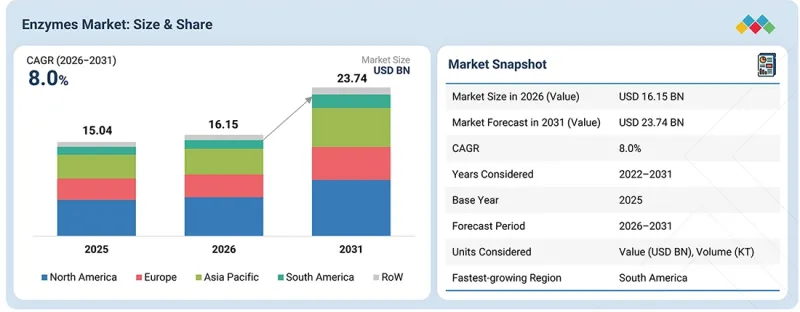
효소 시장은 2026년 161억 5,000만 달러에서 2031년에는 237억 4,000만 달러로 성장할 것으로 예상되며, 2026년부터 2031년까지의 연평균 성장률(CAGR)은 8.0%에 달할 것으로 전망됩니다. 이는 식품·음료, 동물 사료, 바이오연료, 세제, 섬유, 펄프·제지, 의약품, 생명공학 등 각 분야에서 효율적이고 지속가능하며 비용 대비 효과가 뛰어난 처리 솔루션에 대한 수요가 증가하고 있는 것이 그 배경입니다.
가공식품 소비 확대, 바이오연료 생산 증가, 그리고 에너지·물·화학제품 사용량을 줄이면서 공정 효율을 향상시켜야 할 필요성 등의 요인이 다양한 산업 분야에서 효소의 도입을 촉진하고 있습니다.
| 조사 범위 | |
|---|---|
| 조사 대상 기간 | 2022-2031년 |
| 기준 연도 | 2025년 |
| 예측 기간 | 2026-2031년 |
| 산정 단위 | 금액(10억 달러) 및 수량(천 톤) |
| 부문 | 유형, 제품 유형, 원료, 산업용 효소 용도, 특수 효소 용도, 반응 유형 및 지역 |
| 대상 지역 | 북미, 유럽, 아시아태평양, 남미 및 기타 지역 |
각 제조사는 진화하는 업계의 요구에 대응하기 위해 효소 공학, 안정성 및 특이성 향상, 클린 라벨 솔루션, 그리고 첨단 생체 촉매 기술에 점점 더 집중하고 있습니다. 합성 화학제품의 대체재로 효소의 활용이 확대되고 있는 데 더해, 생명공학, 헬스케어, 폐수처리 및 지속가능한 제조 분야에서의 용도 확대가 시장 진입 기업들에게 새로운 기회를 창출하고 있습니다.
“유형별로는 예측 기간 동안 프로테아제가 가장 높은 성장률을 보일 것으로 예상됩니다.”
프로테아제는 예측 기간 동안 가장 높은 연평균 성장률(CAGR)을 기록할 것으로 예상됩니다. 이러한 성장은 식품 가공, 동물 사료, 세제 및 산업용 분야의 수요 증가에 의해 주도되고 있으며, 이러한 분야에서 단백질 분해 효소는 가공 효율 향상, 제품 품질 개선, 그리고 지속가능한 생산 공정을 지원하는 데 기여하고 있습니다. 이러한 용도에서 효소 기반 솔루션의 채택이 확대됨에 따라, 예측 기간 동안 프로테아제 수요가 더욱 촉진될 것으로 예상됩니다.
“원료별로는 식물 유래가 예측 기간 동안 가장 높은 성장률을 보일 것으로 예상됩니다.”
식물 유래 효소는 예측 기간 동안 가장 높은 연평균 성장률(CAGR)을 기록할 것으로 전망됩니다. 천연 및 식물 유래 가공 솔루션에 대한 수요 증가가 식품 가공, 영양 보조제 및 기타 산업용 분야에서 식물 유래 효소의 채택을 뒷받침하고 있습니다. 클린 라벨 및 천연 유래 원료에 대한 소비자의 선호도 증가와 더불어, 식물 유래 효소의 추출 및 가공 기술 발전이 맞물려 이 부문의 성장을 뒷받침할 것으로 예상됩니다.
“예측 기간 동안 효소 시장에서 남미가 가장 높은 성장률을 보일 것으로 예상됩니다.”
남미는 해당 지역의 식품·음료, 동물 사료, 바이오연료 및 농업 가공 산업의 확대에 힘입어 예측 기간 동안 가장 높은 연평균 성장률(CAGR)을 기록할 것으로 예상됩니다. 효율적이고 지속가능한 가공 솔루션에 대한 수요 증가와 더불어, 산업 전반에 걸친 효소 기반 기술의 채택 확대가 해당 지역의 시장 성장을 뒷받침할 것으로 전망됩니다.
- 기업 유형별 : Tier 1 - 30%, Tier 2 - 25%, Tier 3 - 45%
- 직책별 : CXO - 25%, 관리자 - 35%, 기타 - 40%
- 지역별 : 북미 - 20%, 유럽 - 30%, 아시아태평양 - 35%, 남미 - 10%, 기타 지역 - 5%
시장의 주요 기업으로는 BASF SE(독일), International Flavors & Fragrances Inc.(미국), DSM-Firmenich(스위스), Associated British Foods plc(영국) 등이 있습니다.
조사 범위
본 조사 보고서에서는 효소 시장을 제품 유형별(산업용 효소 및 특수 효소), 원료별(미생물, 식물, 동물), 산업용 효소의 용도별(식품·음료, 바이오에탄올, 섬유·가죽, 세제, 제지·펄프, 폐수처리, 사료, 토양 처리, 석유 처리 및 기타 용도), 특수 효소를 용도별(의약품, 연구·생명공학, 진단 및 바이오촉매), 종류별(탄수화물 분해 효소, 단백질 분해 효소, 지방 분해 효소, 중합효소·핵산분해효소 및 기타 효소), 반응 유형별(하이드롤라제, 산화환원효소, 트랜스퍼라제, 리아제 및 기타), 그리고 지역별(북미, 유럽, 아시아태평양, 남미 및 기타 지역)으로 분류되어 있습니다.
본 보고서에서는 효소 산업의 성장에 영향을 미치는 주요 요인(촉진요인, 억제요인, 과제 및 기회 등)에 대한 상세한 정보를 포괄하고 있습니다. 주요 업계 플레이어에 대한 철저한 분석을 통해 각 기업의 사업, 서비스, 주요 전략, 계약, 파트너십, 합의 사항, 제품 출시, 합병 및 인수, 그리고 효소 시장의 최근 동향에 대한 인사이트를 제공합니다. 본 보고서에서는 효소 시장 생태계에서 두각을 나타내고 있는 스타트업 기업의 경쟁 분석도 수록하고 있습니다. 또한, 본 조사에서는 기술 분석, 생태계 및 시장 매핑, 특허·규제 현황 등 업계 특유의 동향에 대해서도 포괄적으로 다루고 있습니다.
본 보고서를 구매해야 하는 이유
본 보고서는 시장 선도 기업 및 신규 진입 기업에게 효소 시장 전체 및 그 하위 부문의 매출에 대한 가장 정확한 추정치를 제공합니다. 이를 통해 이해관계자는 경쟁 구도를 이해하고, 더 깊은 인사이트를 얻어 자사의 비즈니스를 적절히 포지셔닝하며, 적절한 시장 진입 전략을 수립하는 데 도움을 받을 수 있습니다. 또한, 본 보고서는 이해관계자가 시장 동향을 파악할 수 있도록 지원하며, 주요 시장 촉진요인, 억제요인, 과제 및 기회에 대한 정보를 제공합니다.
본 보고서는 다음 사항에 대한 인사이트를 제공합니다:
- 효소 시장의 성장에 영향을 미치는 주요 촉진요인(환경 문제에 대한 관심 증가 및 바이오연료 수요 증가), 제약요인(엄격한 규제 체계), 기회(합성 화학제품 대체품에 대한 수요), 그리고 과제(원자재의 높은 비용)에 대한 분석
- 제품 개발/혁신 : 효소 시장의 연구개발 활동 및 신제품 출시에 대한 상세한 인사이트
- 시장 개발 : 다양한 지역의 효소 시장에 대한 수익성 분석에 관한 종합적인 정보
- 시장 다각화 : 효소 시장의 신제품 유형, 미개척 지역, 최근 동향 및 투자에 대한 종합적인 정보
- 경쟁 분석 : 효소 시장의 주요 기업에 대한 시장 점유율, 성장 전략, 제품 라인업, 브랜드/제품 비교 및 제품 풋프린트에 대한 상세한 평가
자주 묻는 질문
목차
제1장 서론
제2장 요약
제3장 주요 인사이트
- 효소 시장에서 사업자에게 매력적인 기회
- 제품 유형 및 지역별 효소 시장
- 효소 시장 : 원료별
- 효소 시장 : 종류별
- 국가별 효소 시장
제4장 시장 개요
- 시장 역학
- 성장 촉진요인
- 성장 억제요인
- 기회
- 과제
제5장 업계 동향
- Porter's Five Forces 분석
- 경쟁 기업 간의 적대적 관계
- 공급업체의 협상력
- 구매자의 협상력
- 대체품의 위협
- 신규 진입자의 위협
- 거시경제 지표
- 소매 판매 증가
- 아시아태평양 및 남미의 성장 기회
- 밸류체인 분석
- 연구 개발
- 조달
- 생산 및 가공
- 유통
- 마케팅·판매
- 생태계/시장 지도 분석
- 공급 측면
- 수요 측면
- 가격 분석
- 효소 유형별, 주요 기업의 평균 판매 가격
- 제품 유형별 평균 판매 가격 동향
- 평균 판매 가격 동향 분석
- 평균 판매 가격 동향 분석
- 무역 분석
- 특수 효소의 수입 동향
- 2026-2027년 주요 회의 및 행사
- 고객의 사업에 영향을 미치는 동향 및 변화
- 투자 및 자금 조달 시나리오
- 사례 연구 분석
- 효소 생산 공정 최적화
- 한 헬스케어 기업이 양조 보조 원료를 활용한 양조를 지원하는 새로운 효소를 출시했습니다
- CODEXIS사(미국)는 고효율이며 입체 특이적인 케토 환원효소를 개발하기 위해 자사의 CODEEVOLVER 플랫폼을 도입했습니다
- 인터내셔널 플레이버즈 앤 프래그런스(미국)는 유제품용 새로운 효소를 출시하여 유당 함량을 낮추는 동시에 균형 잡힌 단맛을 구현했습니다
- 2025년 미국 관세가 효소 시장에 미치는 영향
- 가격에 미치는 영향 분석
- 국가·지역에 미치는 영향
- 최종 이용 산업에 미치는 영향
제6장 기술 발전, AI의 영향, 특허, 혁신 및 향후 응용
- 기술 분석
- 주요 기술
- 보완 기술
- 인접 기술
- 기술·제품 로드맵
- 특허 분석
- 미래 응용
- 지향적 진화와 고처리량 스크리닝 : 효소 최적화 가속화
- 고정화 효소 기술 : 재사용 가능한 생체 촉매 구현
- 효소의 제형화 및 안정화 : 제품 성능 향상
- AI 및 컴퓨터를 활용한 효소 설계 : 효소 발견 가속화
- 효소를 통한 바이오매스의 가치 창출 : 지속가능한 바이오프로세싱 지원
- 생성형 AI가 효소 시장에 미치는 영향
- 효소 시장에서의 AI 도입 사례 연구
- 상호 연관된 인접 생태계 및 시장 관계자에 미치는 영향
제7장 지속가능성과 규제 현황
- 지역별 규제 및 규정 준수
- 규제 기관, 정부 기관 및 기타 조직
- 업계 기준
- 표시 요건 및 표시 내용
- 향후 5-10년 동안 예상되는 규제 변화
- 지속가능성 노력
- 지속가능한 조달
- 탄소발자국 감축 노력
- 순환 경제를 위한 노력
- 규제 정책이 지속가능성 활동에 미치는 영향
- 인증, 표시, 환경 기준
제8장 고객 동향과 구매 행동
- 의사결정 과정
- 구매 과정에 관여하는 주요 이해관계자와 그 평가 기준
- 구매 과정의 주요 이해관계자
- 구매 기준
- 도입 장벽과 사내 과제
- 전체 공급망에서 다양한 응용 산업의 미충족 수요
- 시장의 수익성
- 수익 창출 가능성
- 비용 동향
- 제품 유형별 이익률 기회
제9장 효소 시장 : 원료별
- 미생물
- 식물
- 동물
제10장 효소 시장 : 제품 유형별
- 산업용 효소
- 특수 효소
제11장 효소 시장 : 유형별
- 탄수화물 분해 효소
- 프로테아제
- 리파제
- 폴리메라제 및 뉴클레아제
- 기타 효소 유형
제12장 산업용 효소 시장 : 용도별
- 식품·음료
- 바이오에탄올
- 섬유·가죽
- 세제
- 종이·펄프
- 폐수처리
- 사료
- 토양 처리
- 유분 처리
- 기타 용도
제13장 특수 효소 시장 : 용도별
- 의약품
- 연구·생명공학
- 진단
- 바이오 촉매
제14장 효소 시장 : 반응 유형별
- 가수분해 효소
- 산화환원 효소
- 트랜스퍼라제
- 리아제
- 기타 반응 유형
제15장 효소 시장 : 지역별
- 북미
- 미국
- 캐나다
- 멕시코
- 유럽
- 독일
- 영국
- 프랑스
- 이탈리아
- 스페인
- 덴마크
- 네덜란드
- 기타 유럽
- 아시아태평양
- 중국
- 인도
- 일본
- 한국
- 호주 및 뉴질랜드
- 기타 아시아태평양
- 남미
- 브라질
- 아르헨티나
- 기타 남미
- 세계의 기타 지역
- 중동
- 아프리카
제16장 경쟁 현황
- 개요
- 주요 참여 기업의 전략/강점, 2021-2026년
- 수익 분석,2023-2025년
- 시장 점유율 분석(2025년)
- 브랜드 비교
- 기업 평가 매트릭스 : 주요 기업, 2025년
- 스타 기업
- 신흥 리더
- 광범위한 업체
- 진입 기업
- 기업의 사업 전개 : 주요 기업, 2025년
- 기업 평가 매트릭스 : 스타트업/중소기업, 2025년
- 선도적인 기업
- 대응력이 뛰어난 기업
- 역동적인 기업
- 출발점
- 경쟁사 벤치마킹 : 주요 스타트업/중소기업, 2025년
- 기업 평가 및 재무 지표
- 기업 평가
- EV/EBITDA
- 경쟁 시나리오
- 제품 출시
- 거래
- 사업 확장
제17장 기업 개요
- 주요 기업
- BASF SE
- INTERNATIONAL FLAVORS &FRAGRANCES INC.
- ASSOCIATED BRITISH FOODS PLC
- DSM-FIRMENICH
- NOVONESIS GROUP
- KERRY GROUP PLC
- DYADIC APPLIED BIOSOLUTIONS
- ADVANCED ENZYME TECHNOLOGIES
- AUMGENE BIOSCIENCES PVT. LTD.
- AMANO ENZYME INC.
- F. HOFFMANN-LA ROCHE LTD
- CODEXIS, INC.
- SANOFI
- MERCK KGAA
- ADISSEO
- 기타 주요 기업
- LESAFFRE CORPORATION
- CREATIVE ENZYMES
- ENZYME SOLUTIONS INC.
- ENZYMATIC DEINKING TECHNOLOGIES, LLC
- TEX BIOSCIENCES
- DENYKEM
- METGEN
- BIOVET S.A.
- BIOCATALYSTS
- ALLTECH
제18장 조사 방법론
제19장 인접 시장 및 관련 시장
- 본 조사의 한계
- 산업용 효소 시장
- 시장의 정의
- 시장 개요
- 식품용 효소 시장
- 시장의 정의
- 시장 개요
- 식품용 효소 시장 : 용도별
- 식품용 효소 시장 : 지역별
제20장 부록
KSMThe enzymes market is estimated to grow from USD 16.15 billion in 2026 to USD 23.74 billion by 2031, at a CAGR of 8.0% from 2026 to 2031, driven by increasing demand for efficient, sustainable, and cost-effective processing solutions across food & beverages, animal feed, biofuels, detergents, textiles, pulp & paper, pharmaceuticals, and biotechnology. Growing consumption of processed foods, rising biofuel production, and the need to improve process efficiency while reducing energy, water, and chemical usage are supporting enzyme adoption across industries.
| Scope of the Report | |
|---|---|
| Years Considered for the Study | 2022-2031 |
| Base Year | 2025 |
| Forecast Period | 2026-2031 |
| Units Considered | Value (USD Billion) and Volume (KT) |
| Segments | Type, Product Type, Source, Industrial Enzyme Application, Specialty Enzymes Application, Reaction Type, and Region |
| Regions covered | North America, Europe, Asia Pacific, South America, and RoW |
Manufacturers are increasingly focusing on enzyme engineering, improved stability and specificity, clean-label solutions, and advanced biocatalysis to address evolving industry requirements. The growing use of enzymes as alternatives to synthetic chemicals, together with expanding applications in biotechnology, healthcare, wastewater treatment, and sustainable manufacturing, is creating new opportunities for market participants.
"By type, proteases are expected to be the fastest-growing segment during the forecast period."
Proteases are expected to register the highest CAGR during the forecast period. Growth is driven by rising demand across food processing, animal feed, detergents, and industrial applications, where proteolytic enzymes improve processing efficiency, enhance product quality, and support sustainable production processes. Growing adoption of enzyme-based solutions across these applications is expected to further drive demand for proteases during the forecast period.
"By source, plant is expected to be the fastest-growing segment during the forecast period."
Plant-derived enzymes are expected to register the highest CAGR during the forecast period. Increasing demand for natural and plant-based processing solutions is driving the adoption of plant-derived enzymes across food processing, nutraceuticals, and other industrial applications. Growing consumer preference for clean-label and naturally sourced ingredients, coupled with advances in plant-based enzyme extraction and processing technologies, is expected to support growth in this segment.
"South America is expected to be the fastest-growing region in the enzymes market during the forecast period."
South America is expected to register the highest CAGR during the forecast period, driven by the region's expanding food & beverage, animal feed, biofuel, and agricultural processing industries. Rising demand for efficient and sustainable processing solutions, along with increasing adoption of enzyme-based technologies across industrial applications, is expected to support market growth in the region.
In-depth interviews have been conducted with chief executive officers (CEOs), directors, and other executives from various key organizations operating in the Enzymes Market.
- By Company Type: Tier 1 - 30%, Tier 2 - 25%, and Tier 3 - 45%
- By Designation: CXOs - 25%, Managers - 35%, Others - 40%
- By Region: North America - 20%, Europe - 30%, Asia Pacific - 35%, South America - 10%, and Rest of the World - 5%
Prominent companies in the market include BASF SE (Germany), International Flavors & Fragrances Inc. (US), dsm-firmenich (Switzerland), and Associated British Foods plc (UK), among others.
Research Coverage
This research report categorizes the Enzymes Market by Product Type (Industrial Enzymes and Specialty Enzymes), Source (Microorganism, Plant, and Animal), Industrial Enzyme by Application (Food & Beverages, Bioethanol, Textiles & Leather, Detergents, Paper & Pulp, Wastewater Treatment, Feed, Soil Treatment, Oil Treatment, and Other Applications), Specialty Enzyme by Application (Pharmaceuticals, Research & Biotechnology, Diagnostics, and Biocatalysts), Type (Carbohydrases, Proteases, Lipases, Polymerases & Nucleases, and Other Enzymes), Reaction Type (Hydrolases, Oxidoreductases, Transferases, Lyases, and Others), and Region (North America, Europe, Asia Pacific, South America, and Rest of the World).
The report covers detailed information on the major factors, including drivers, restraints, challenges, and opportunities, that influence the growth of the enzymes industry. A thorough analysis of key industry players provides insights into their business, services, key strategies, contracts, partnerships, agreements, product launches, mergers & acquisitions, and recent developments in the enzymes market. This report provides a competitive analysis of emerging startups in the enzymes market ecosystem. The study also covers industry-specific trends, including technology analysis, ecosystem & market mapping, and the patent & regulatory landscape, among others.
Reasons to Buy This Report
The report provides market leaders/new entrants with information on the closest approximations of revenue numbers for the overall Enzymes Market and its subsegments. It will help stakeholders understand the competitive landscape and gain more insights to better position their businesses and plan suitable go-to-market strategies. The report also helps stakeholders understand the pulse of the market and provides them with information on key market drivers, restraints, challenges, and opportunities.
The report provides insights into the following pointers:
- Analysis of key drivers (growing environmental concerns and increasing demand for biofuels), restraints (stringent regulatory framework), opportunities (demand for alternatives to synthetic chemicals), and challenges (high cost of raw materials) influencing the growth of the enzymes market
- Product Development/Innovation: Detailed insights into research & development activities and new product launches in the enzymes market
- Market Development: Comprehensive information about lucrative market analysis of enzymes across varied regions
- Market Diversification: Exhaustive information about new product types, untapped geographies, recent developments, and investments in the enzymes market
- Competitive Assessment: In-depth assessment of market shares, growth strategies, product offerings, brand/product comparison, and product footprints of leading players such as BASF SE (Germany), International Flavors & Fragrances Inc. (US), dsm-firmenich (Switzerland), Associated British Foods plc (UK), Novonesis Group (Denmark), Kerry Group plc (Ireland), Dyadic International Inc. (US), Advanced Enzyme Technologies (India), Aumgene Biosciences (India), Amano Enzyme Inc. (Japan), F. Hoffmann-La Roche Ltd (Switzerland), Codexis, Inc. (US), Sanofi (France), Merck KGaA (Germany), Adisseo (France) in the enzymes market
TABLE OF CONTENTS
1 INTRODUCTION
- 1.1 STUDY OBJECTIVES
- 1.2 MARKET DEFINITION
- 1.3 STUDY SCOPE
- 1.3.1 YEARS CONSIDERED
- 1.4 CURRENCY CONSIDERED
- 1.5 UNIT CONSIDERED
- 1.6 STAKEHOLDERS
- 1.7 SUMMARY OF CHANGES
2 EXECUTIVE SUMMARY
- 2.1 MARKET HIGHLIGHTS AND KEY INSIGHTS
- 2.2 KEY MARKET PARTICIPANTS: MAPPING OF STRATEGIC DEVELOPMENTS
- 2.3 DISRUPTIVE TRENDS IN ENZYMES MARKET
- 2.4 HIGH-GROWTH SEGMENTS
- 2.5 REGIONAL SNAPSHOT: MARKET SIZE, GROWTH RATE, AND FORECAST
3 PREMIUM INSIGHTS
- 3.1 ATTRACTIVE OPPORTUNITIES FOR PLAYERS IN ENZYMES MARKET
- 3.2 ENZYMES MARKET, BY PRODUCT TYPE AND REGION
- 3.3 ENZYMES MARKET, BY SOURCE
- 3.4 ENZYMES MARKET, BY TYPE
- 3.5 ENZYMES MARKET, BY COUNTRY
4 MARKET OVERVIEW
- 4.1 INTRODUCTION
- 4.2 MARKET DYNAMICS
- 4.2.1 DRIVERS
- 4.2.1.1 Growing environmental concerns and increasing demand for biofuels
- 4.2.1.2 Advancements in R&D activities for technical enzymes
- 4.2.1.3 Shift toward green energy
- 4.2.1.4 Multifunctionality of enzymes
- 4.2.2 RESTRAINTS
- 4.2.2.1 Stringent regulatory framework
- 4.2.2.2 Influence of environmental factors on enzyme structure and functions
- 4.2.2.3 High cost incurred by SMEs in adapting to new technologies
- 4.2.3 OPPORTUNITIES
- 4.2.3.1 Demand for alternatives to synthetic chemicals
- 4.2.3.2 Technological innovations and wide industry scope
- 4.2.3.3 Emergence of encapsulation to enhance enzyme shelf life
- 4.2.4 CHALLENGES
- 4.2.4.1 High cost of raw materials
- 4.2.4.2 Concerns over enzyme quality in food & beverage and feed industries
- 4.2.4.3 Lack of transparency in patent protection laws
- 4.2.1 DRIVERS
5 INDUSTRY TRENDS
- 5.1 PORTER'S FIVE FORCES ANALYSIS
- 5.1.1 INTENSITY OF COMPETITIVE RIVALRY
- 5.1.2 BARGAINING POWER OF SUPPLIERS
- 5.1.3 BARGAINING POWER OF BUYERS
- 5.1.4 THREAT OF SUBSTITUTES
- 5.1.5 THREAT OF NEW ENTRANTS
- 5.2 MACROECONOMIC INDICATORS
- 5.2.1 INCREASE IN RETAIL SALES
- 5.2.2 GROWTH OPPORTUNITIES IN ASIA PACIFIC AND SOUTH AMERICA
- 5.3 VALUE CHAIN ANALYSIS
- 5.3.1 RESEARCH & PRODUCT DEVELOPMENT
- 5.3.2 SOURCING
- 5.3.3 PRODUCTION & PROCESSING
- 5.3.4 DISTRIBUTION
- 5.3.5 MARKETING & SALES
- 5.4 ECOSYSTEM/MARKET MAP ANALYSES
- 5.4.1 SUPPLY SIDE
- 5.4.2 DEMAND SIDE
- 5.5 PRICING ANALYSIS
- 5.5.1 INTRODUCTION
- 5.5.2 AVERAGE SELLING PRICE OF KEY PLAYERS, BY ENZYME TYPE
- 5.5.3 AVERAGE SELLING PRICE TRENDS, BY PRODUCT TYPE
- 5.5.4 AVERAGE SELLING PRICE TREND ANALYSIS
- 5.5.5 AVERAGE SELLING PRICE TREND ANALYSIS
- 5.6 TRADE ANALYSIS
- 5.6.1 IMPORT SCENARIO OF SPECIALTY ENZYMES
- 5.7 KEY CONFERENCES AND EVENTS, 2026-2027
- 5.8 TRENDS/DISRUPTIONS IMPACTING CUSTOMER BUSINESS
- 5.9 INVESTMENT AND FUNDING SCENARIO
- 5.10 CASE STUDY ANALYSIS
- 5.10.1 PROCESS OPTIMIZATION IN ENZYME PRODUCTION
- 5.10.2 HEALTH COMPANY LAUNCHED NEW ENZYME TO AID BREWERS IN ADJUNCT BREWING
- 5.10.3 CODEXIS INC (US) DEPLOYED ITS CODEEVOLVER PLATFORM TO DEVELOP A HIGHLY EFFICIENT AND STEREOSPECIFIC KETOREDUCTASE ENZYME
- 5.10.4 INTERNATIONAL FLAVORS & FRAGRANCES INC. (US) LAUNCHED NEW ENZYME FOR DAIRY PRODUCTS TO REDUCE LACTOSE LEVELS AND BRING BALANCED SWEETNESS
- 5.11 IMPACT OF 2025 US TARIFF -ENZYMES MARKET
- 5.11.1 INTRODUCTION
- 5.11.2 PRICE IMPACT ANALYSIS
- 5.11.3 IMPACT ON COUNTRIES/REGIONS
- 5.11.4 IMPACT ON END USE INDUSTRIES
6 TECHNOLOGY ADVANCEMENTS, AI-DRIVEN IMPACT, PATENTS, INNOVATIONS, AND FUTURE APPLICATIONS
- 6.1 TECHNOLOGY ANALYSIS
- 6.1.1 KEY TECHNOLOGIES
- 6.1.1.1 Precision fermentation
- 6.1.1.2 Enzyme engineering
- 6.1.2 COMPLEMENTARY TECHNOLOGIES
- 6.1.2.1 Directed evolution and high-throughput screening
- 6.1.2.2 Immobilized enzyme technology
- 6.1.3 ADJACENT TECHNOLOGIES
- 6.1.3.1 Solid-state fermentation
- 6.1.4 TECHNOLOGY/PRODUCT ROADMAP
- 6.1.4.1 Short-term | Process optimization & enzyme formulation
- 6.1.4.2 Mid-term | Precision fermentation & enzyme engineering
- 6.1.4.3 Long-term | AI-enabled enzyme design & next-generation biocatalysis
- 6.1.1 KEY TECHNOLOGIES
- 6.2 PATENT ANALYSIS
- 6.3 FUTURE APPLICATIONS
- 6.3.1 DIRECTED EVOLUTION & HIGH-THROUGHPUT SCREENING: ACCELERATING ENZYME OPTIMIZATION
- 6.3.2 IMMOBILIZED ENZYME TECHNOLOGY: ENABLING REUSABLE BIOCATALYSIS
- 6.3.3 ENZYME FORMULATION & STABILIZATION: IMPROVING PRODUCT PERFORMANCE
- 6.3.4 AI & COMPUTATIONAL ENZYME DESIGN: ACCELERATING ENZYME DISCOVERY
- 6.3.5 ENZYMATIC BIOMASS VALORIZATION: SUPPORTING SUSTAINABLE BIOPROCESSING
- 6.4 IMPACT OF GENERATIVE AI ON ENZYMES MARKET
- 6.4.1 INTRODUCTION
- 6.4.2 CASE STUDIES OF AI IMPLEMENTATION IN THE ENZYMES MARKET
- 6.4.3 INTERCONNECTED ADJACENT ECOSYSTEM AND IMPACT ON MARKET PLAYERS
7 SUSTAINABILITY AND REGULATORY LANDSCAPE
- 7.1 REGIONAL REGULATIONS AND COMPLIANCE
- 7.1.1 REGULATORY BODIES, GOVERNMENT AGENCIES, AND OTHER ORGANIZATIONS
- 7.1.2 INDUSTRY STANDARDS
- 7.1.3 LABELING REQUIREMENTS AND CLAIMS
- 7.1.4 ANTICIPATED REGULATORY CHANGES IN NEXT 5-10 YEARS
- 7.1.4.1 Enhanced traceability and supply chain transparency
- 7.1.4.2 Greater harmonization of global enzyme standards
- 7.1.4.3 Stricter safety and responsible production requirements
- 7.1.4.4 Digital compliance, traceability, and quality management
- 7.1.4.5 Expanded regulation of novel enzyme sources and production technologies
- 7.1.4.6 Strengthened labeling and consumer transparency requirements
- 7.2 SUSTAINABILITY INITIATIVES
- 7.2.1 SUSTAINABLE SOURCING
- 7.2.2 CARBON FOOTPRINT REDUCTION INITIATIVES
- 7.2.3 CIRCULAR ECONOMY APPROACHES
- 7.3 IMPACT OF REGULATORY POLICIES ON SUSTAINABILITY INITIATIVES
- 7.4 CERTIFICATIONS, LABELING, ECO-STANDARDS
8 CUSTOMER LANDSCAPE AND BUYER BEHAVIOR
- 8.1 DECISION-MAKING PROCESS
- 8.2 KEY STAKEHOLDERS INVOLVED IN BUYING PROCESS AND THEIR EVALUATION CRITERIA
- 8.2.1 KEY STAKEHOLDERS IN BUYING PROCESS
- 8.2.2 BUYING CRITERIA
- 8.3 ADOPTION BARRIERS AND INTERNAL CHALLENGES
- 8.4 UNMET NEEDS OF VARIOUS APPLICATION INDUSTRIES ACROSS SUPPLY CHAIN
- 8.5 MARKET PROFITABILITY
- 8.6 REVENUE POTENTIAL
- 8.6.1 COST DYNAMICS
- 8.6.2 MARGIN OPPORTUNITIES, BY PRODUCT TYPE
9 ENZYMES MARKET, BY SOURCE
- 9.1 INTRODUCTION
- 9.2 MICROORGANISMS
- 9.2.1 HUGE PRODUCTION IN LESS TIME TO BOOST INDUSTRIAL USE OF MICROBIAL ENZYMES
- 9.3 PLANTS
- 9.3.1 VERSATILITY ACROSS TEMPERATURES TO DRIVE DEMAND FOR PLANT-BASED ENZYMES
- 9.4 ANIMALS
- 9.4.1 TEMPERATURE SENSITIVITY TO DISCOURAGE INDUSTRIAL USE OF ANIMAL-BASED ENZYMES
10 ENZYMES MARKET, BY PRODUCT TYPE
- 10.1 INTRODUCTION
- 10.2 INDUSTRIAL ENZYMES
- 10.2.1 GROWTH IN FOOD & FEED PROCESSING INDUSTRIES TO DRIVE MARKET
- 10.3 SPECIALTY ENZYMES
- 10.3.1 RISING CLINICAL IN VITRO DIAGNOSTIC INDUSTRY TO DRIVE MARKET
11 ENZYMES MARKET, BY TYPE
- 11.1 INTRODUCTION
- 11.2 CARBOHYDRASES
- 11.2.1 AMYLASES
- 11.2.1.1 Rising demand from food & beverage and textile industries to drive market
- 11.2.2 CELLULASES
- 11.2.2.1 Complex nature to boost demand in industrial and specialty applications
- 11.2.3 OTHER CARBOHYDRASES
- 11.2.3.1 Stability in Enzyme Activity Drives Demand in Various Industrial Applications
- 11.2.1 AMYLASES
- 11.3 PROTEASES
- 11.3.1 COMPETENT CHARACTERISTICS TO HYDROLYZE PROTEINS TO BOOST INDUSTRIAL USE
- 11.4 LIPASES
- 11.4.1 COMMERCIALIZATION OF BIOFUEL PRODUCTION FROM ENZYMATIC PROCESSES TO DRIVE MARKET
- 11.5 POLYMERASES & NUCLEASES
- 11.5.1 DEMAND FOR POLYMERASES & NUCLEASES IN NUCLEIC ACID PROCESSES
- 11.6 OTHER ENZYME TYPES
12 INDUSTRIAL ENZYMES MARKET, BY APPLICATION
- 12.1 INTRODUCTION
- 12.2 FOOD & BEVERAGES
- 12.2.1 MEAT PROCESSING
- 12.2.1.1 Enzymes tenderize meat through protein modification
- 12.2.2 DAIRY PRODUCTS
- 12.2.2.1 Increasing use of enzymes for cheese production and flavoring
- 12.2.3 BEVERAGES
- 12.2.3.1 Increasing use of enzymes to improve yield and quality
- 12.2.4 BAKERY & CONFECTIONERY PRODUCTS
- 12.2.4.1 Growing use of enzymes to increase shelf-life
- 12.2.5 NUTRACEUTICALS
- 12.2.5.1 Use of enzymes as digestive aid to fuel demand
- 12.2.6 OTHER FOOD & BEVERAGES
- 12.2.1 MEAT PROCESSING
- 12.3 BIOETHANOL
- 12.3.1 INCREASING USE OF ENZYMES AS BIOLOGICAL CATALYSTS TO DRIVE DEMAND
- 12.4 TEXTILES & LEATHER
- 12.4.1 SUSTAINABILITY INITIATIVES IN TEXTILES & LEATHER TO DRIVE DEMAND
- 12.5 DETERGENTS
- 12.5.1 LAUNDRY DETERGENTS
- 12.5.1.1 Use of enzymes associated with reduced time, energy, and water consumption
- 12.5.2 AUTOMATIC DISHWASHING DETERGENTS
- 12.5.2.1 Use of enzymes to increase user-friendliness by lowering alkalinity
- 12.5.3 OTHER DETERGENTS
- 12.5.1 LAUNDRY DETERGENTS
- 12.6 PAPER & PULP
- 12.6.1 NEED FOR ENHANCED BLEACHING EFFICACY AND CHLORINE CONSUMPTION REDUCTION TO DRIVE DEMAND
- 12.7 WASTEWATER TREATMENT
- 12.7.1 DEMAND FOR ENZYMES TO BREAK DOWN ORGANIC WASTES AND ENHANCE WATER QUALITY
- 12.8 FEED
- 12.8.1 RUMINANT FEED
- 12.8.1.1 Inclusion of enzymes to improve feed efficiency ratio for beef cattle
- 12.8.2 SWINE FEED
- 12.8.2.1 Use of sow feed enzymes to ensure health of piglets
- 12.8.3 POULTRY FEED
- 12.8.3.1 Demand for feed enzymes to improve nutrient digestibility and improve gut performance in poultry
- 12.8.4 AQUAFEED
- 12.8.4.1 Enzymes in fish feed promote eco-friendliness and allow for cheaper feed use
- 12.8.5 OTHER FEED
- 12.8.1 RUMINANT FEED
- 12.9 SOIL TREATMENT
- 12.9.1 USE OF BIO-ENZYMES TO CREATE OPPORTUNITY FOR IMPROVED SOIL STABILITY
- 12.10 OIL TREATMENT
- 12.10.1 NEED FOR OIL EXTRACTION EFFICIENCY TO BOOST MARKET
- 12.11 OTHER APPLICATIONS
13 SPECIALTY ENZYMES MARKET, BY APPLICATION
- 13.1 INTRODUCTION
- 13.2 PHARMACEUTICALS
- 13.2.1 ENZYMES ACT AS ALTERNATIVES TO TRADITIONAL ANTIBIOTICS
- 13.3 RESEARCH & BIOTECHNOLOGY
- 13.3.1 USE OF ENZYMES IN DNA SEQUENCING TO REDUCE COST OF SEQUENCING TECHNIQUES
- 13.4 DIAGNOSTICS
- 13.4.1 GROWING INTEREST FROM PHARMACEUTICAL COMPANIES IN DEVELOPING RAPID DIAGNOSTIC TESTS TO BOOST DEMAND
- 13.5 BIOCATALYSTS
- 13.5.1 BIOCATALYSIS TO DRIVE DEMAND FOR ENZYMES IN WASTE MATERIAL TREATMENT
14 ENZYMES MARKET, BY REACTION TYPE
- 14.1 INTRODUCTION
- 14.2 HYDROLASES
- 14.3 OXIDOREDUCTASES
- 14.4 TRANSFERASES
- 14.5 LYASES
- 14.5.1 APPLICATION AND DEMAND
- 14.6 OTHER REACTION TYPES
15 ENZYMES MARKET, BY REGION
- 15.1 INTRODUCTION
- 15.2 NORTH AMERICA
- 15.2.1 US
- 15.2.1.1 Increased production of bioethanol to drive market
- 15.2.2 CANADA
- 15.2.2.1 Increasing use of enzymes as meat tenderizers and feed additives to drive market
- 15.2.3 MEXICO
- 15.2.3.1 Rise of textile industry to drive market
- 15.2.1 US
- 15.3 EUROPE
- 15.3.1 GERMANY
- 15.3.1.1 Rising biofuel consumption for transportation to drive market
- 15.3.2 UK
- 15.3.2.1 Government initiatives to reduce carbon emissions and produce fuel from renewable sources to boost market
- 15.3.3 FRANCE
- 15.3.3.1 Government investments for technological advancements in biofuel production to drive market
- 15.3.4 ITALY
- 15.3.4.1 Multifunctionality of enzymes in various application sectors to fuel demand
- 15.3.5 SPAIN
- 15.3.5.1 Rising demand for meat and meat products to drive market
- 15.3.6 DENMARK
- 15.3.6.1 Growing exports of enzymes to drive market
- 15.3.7 NETHERLANDS
- 15.3.7.1 Rising demand for processed food to drive market
- 15.3.8 REST OF EUROPE
- 15.3.1 GERMANY
- 15.4 ASIA PACIFIC
- 15.4.1 CHINA
- 15.4.1.1 Shift of manufacturing operations from Europe and North America to China to drive market
- 15.4.2 INDIA
- 15.4.2.1 Rising trend of industrialization in animal husbandry to drive demand for feed enzymes
- 15.4.3 JAPAN
- 15.4.3.1 Focus on expanding apparel & home textile chemical businesses to drive market
- 15.4.4 SOUTH KOREA
- 15.4.4.1 Increased application of naturally derived enzymes in skin care products to drive market
- 15.4.5 AUSTRALIA AND NEW ZEALAND
- 15.4.5.1 Government initiatives and policies on ethanol biofuel production and use to drive market
- 15.4.6 REST OF ASIA PACIFIC
- 15.4.1 CHINA
- 15.5 SOUTH AMERICA
- 15.5.1 BRAZIL
- 15.5.1.1 Growing research and advancement in starch processing technology to reduce cost to boost market
- 15.5.2 ARGENTINA
- 15.5.2.1 Increasing use of starch processing and advancements in meat processing and dairy industries to drive market
- 15.5.3 REST OF SOUTH AMERICA
- 15.5.1 BRAZIL
- 15.6 REST OF THE WORLD
- 15.6.1 MIDDLE EAST
- 15.6.1.1 Growing demand for food enzymes to prevent and recycle food waste to drive market
- 15.6.2 AFRICA
- 15.6.2.1 Approval of Biofuels Regulatory Framework and growth of paper and pulp industry to drive market
- 15.6.1 MIDDLE EAST
16 COMPETITIVE LANDSCAPE
- 16.1 OVERVIEW
- 16.2 KEY PLAYER COMPETITIVE STRATEGIES/RIGHT TO WIN, 2021-2026
- 16.3 REVENUE ANALYSIS, 2023-2025
- 16.4 MARKET SHARE ANALYSIS, 2025
- 16.4.1 BRAND COMPARISON
- 16.5 COMPANY EVALUATION MATRIX: KEY PLAYERS, 2025
- 16.5.1 STARS
- 16.5.2 EMERGING LEADERS
- 16.5.3 PERVASIVE PLAYERS
- 16.5.4 PARTICIPANTS
- 16.5.5 COMPANY FOOTPRINT: KEY PLAYERS, 2025
- 16.5.5.1 Company footprint
- 16.5.5.2 Region footprint
- 16.5.5.3 Type footprint
- 16.5.5.4 Industrial enzymes, by application footprint
- 16.5.5.5 Specialty enzymes, by application footprint
- 16.6 COMPANY EVALUATION MATRIX: STARTUPS/SMES, 2025
- 16.6.1 PROGRESSIVE COMPANIES
- 16.6.2 RESPONSIVE COMPANIES
- 16.6.3 DYNAMIC COMPANIES
- 16.6.4 STARTING BLOCKS
- 16.6.5 COMPETITIVE BENCHMARKING: KEY STARTUPS/SMES, 2025
- 16.6.5.1 Detailed list of key startups/SMEs
- 16.6.5.2 Competitive benchmarking of key startups/SMEs
- 16.7 COMPANY VALUATION AND FINANCIAL METRICS
- 16.7.1 COMPANY VALUATION
- 16.7.2 EV/EBITDA
- 16.8 COMPETITIVE SCENARIO
- 16.8.1 PRODUCT LAUNCHES
- 16.8.2 DEALS
- 16.8.3 EXPANSIONS
17 COMPANY PROFILES
- 17.1 KEY PLAYERS
- 17.1.1 BASF SE
- 17.1.1.1 Business overview
- 17.1.1.2 Products/Solutions/Services offered
- 17.1.1.3 Recent developments
- 17.1.1.3.1 Product launches
- 17.1.1.3.2 Deals
- 17.1.1.3.3 Expansions
- 17.1.1.3.4 Other developments
- 17.1.1.4 MnM view
- 17.1.1.4.1 Right to win
- 17.1.1.4.2 Strategic choices
- 17.1.1.4.3 Weaknesses and competitive threats
- 17.1.2 INTERNATIONAL FLAVORS & FRAGRANCES INC.
- 17.1.2.1 Business overview
- 17.1.2.2 Products/Solutions/Services offered
- 17.1.2.3 Recent developments
- 17.1.2.3.1 Product launches
- 17.1.2.3.2 Deals
- 17.1.2.3.3 Expansions
- 17.1.2.4 MnM view
- 17.1.2.4.1 Right to win
- 17.1.2.4.2 Strategic choices
- 17.1.2.4.3 Weaknesses and competitive threats
- 17.1.3 ASSOCIATED BRITISH FOODS PLC
- 17.1.3.1 Business overview
- 17.1.3.2 Products/Solutions/Services offered
- 17.1.3.3 Recent developments
- 17.1.3.3.1 Product launches
- 17.1.3.3.2 Deals
- 17.1.3.4 MnM view
- 17.1.3.4.1 Right to win
- 17.1.3.4.2 Strategic choices
- 17.1.3.4.3 Weaknesses and competitive threats
- 17.1.4 DSM-FIRMENICH
- 17.1.4.1 Business overview
- 17.1.4.2 Products/Solutions/Services offered
- 17.1.4.3 Recent developments
- 17.1.4.3.1 Product launches
- 17.1.4.4 MnM view
- 17.1.4.4.1 Right to win
- 17.1.4.4.2 Strategic choices
- 17.1.4.4.3 Weaknesses and competitive threats
- 17.1.5 NOVONESIS GROUP
- 17.1.5.1 Business overview
- 17.1.5.2 Products/Solutions/Services offered
- 17.1.5.3 Recent developments
- 17.1.5.3.1 Product launches
- 17.1.5.3.2 Deals
- 17.1.5.3.3 Expansions
- 17.1.5.3.4 Other developments
- 17.1.5.4 MnM view
- 17.1.5.4.1 Right to win
- 17.1.5.4.2 Strategic choices
- 17.1.5.4.3 Weaknesses and competitive threats
- 17.1.6 KERRY GROUP PLC
- 17.1.6.1 Business overview
- 17.1.6.2 Products/Solutions/Services offered
- 17.1.6.3 Recent developments
- 17.1.6.3.1 Product launches
- 17.1.6.3.2 Deals
- 17.1.6.3.3 Expansions
- 17.1.6.4 MnM view
- 17.1.7 DYADIC APPLIED BIOSOLUTIONS
- 17.1.7.1 Business overview
- 17.1.7.2 Products/Solutions/Services offered
- 17.1.7.3 Recent developments
- 17.1.7.3.1 Deals
- 17.1.7.4 MnM view
- 17.1.8 ADVANCED ENZYME TECHNOLOGIES
- 17.1.8.1 Business overview
- 17.1.8.2 Products/Solutions/Services offered
- 17.1.8.3 Recent developments
- 17.1.8.3.1 Deals
- 17.1.8.4 MnM view
- 17.1.9 AUMGENE BIOSCIENCES PVT. LTD.
- 17.1.9.1 Business overview
- 17.1.9.2 Products/Solutions/Services offered
- 17.1.9.3 Recent developments
- 17.1.9.4 MnM view
- 17.1.10 AMANO ENZYME INC.
- 17.1.10.1 Business overview
- 17.1.10.2 Products/Solutions/Services offered
- 17.1.10.3 Recent developments
- 17.1.10.3.1 Product launches
- 17.1.10.3.2 Deals
- 17.1.10.3.3 Expansions
- 17.1.10.4 MnM view
- 17.1.11 F. HOFFMANN-LA ROCHE LTD
- 17.1.11.1 Business overview
- 17.1.11.2 Products/Solutions/Services offered
- 17.1.11.3 Recent developments
- 17.1.11.3.1 Deals
- 17.1.11.4 MnM view
- 17.1.12 CODEXIS, INC.
- 17.1.12.1 Business overview
- 17.1.12.2 Products/Solutions/Services offered
- 17.1.12.3 Recent developments
- 17.1.12.3.1 Product Launches
- 17.1.12.3.2 Deals
- 17.1.12.4 MnM view
- 17.1.13 SANOFI
- 17.1.13.1 Business overview
- 17.1.13.2 Products/Solutions/Services offered
- 17.1.13.3 Recent developments
- 17.1.13.3.1 Product launches
- 17.1.13.3.2 Deals
- 17.1.13.4 MnM view
- 17.1.14 MERCK KGAA
- 17.1.14.1 Business overview
- 17.1.14.2 Products/Solutions/Services offered
- 17.1.14.3 Recent developments
- 17.1.14.3.1 Deals
- 17.1.14.3.2 Expansions
- 17.1.14.4 MnM view
- 17.1.15 ADISSEO
- 17.1.15.1 Business overview
- 17.1.15.2 Products/Solutions/Services offered
- 17.1.15.3 Recent developments
- 17.1.15.3.1 Product launches
- 17.1.15.3.2 Deals
- 17.1.15.4 MnM view
- 17.1.1 BASF SE
- 17.2 OTHER PLAYERS
- 17.2.1 LESAFFRE CORPORATION
- 17.2.1.1 Business overview
- 17.2.1.2 Products/Solutions/Services offered
- 17.2.1.3 Recent developments
- 17.2.1.3.1 Deals
- 17.2.1.4 MnM view
- 17.2.2 CREATIVE ENZYMES
- 17.2.2.1 Business overview
- 17.2.2.2 Products/Solutions/Services offered
- 17.2.2.3 Recent developments
- 17.2.2.3.1 Product launches
- 17.2.2.4 MnM view
- 17.2.3 ENZYME SOLUTIONS INC.
- 17.2.3.1 Business overview
- 17.2.3.2 Products/Solutions/Services offered
- 17.2.3.3 Recent developments
- 17.2.3.4 MnM view
- 17.2.4 ENZYMATIC DEINKING TECHNOLOGIES, LLC
- 17.2.4.1 Business overview
- 17.2.4.2 Products/Solutions/Services offered
- 17.2.4.3 Recent developments
- 17.2.4.4 MnM view
- 17.2.5 TEX BIOSCIENCES
- 17.2.5.1 Business overview
- 17.2.5.2 Products/Solutions/Services offered
- 17.2.5.3 Recent developments
- 17.2.5.4 MnM view
- 17.2.6 DENYKEM
- 17.2.7 METGEN
- 17.2.8 BIOVET S.A.
- 17.2.9 BIOCATALYSTS
- 17.2.10 ALLTECH
- 17.2.1 LESAFFRE CORPORATION
18 RESEARCH METHODOLOGY
- 18.1 RESEARCH DATA
- 18.1.1 SECONDARY DATA
- 18.1.1.1 Key data from secondary research
- 18.1.2 PRIMARY DATA
- 18.1.2.1 Key data from primary sources
- 18.1.2.2 Key industry insights
- 18.1.2.3 Breakdown of primary interviews
- 18.1.1 SECONDARY DATA
- 18.2 FACTOR ANALYSIS
- 18.2.1 INTRODUCTION
- 18.2.2 DEMAND-SIDE ANALYSIS
- 18.2.3 SUPPLY-SIDE ANALYSIS
- 18.3 MARKET SIZE ESTIMATION
- 18.3.1 APPROACH ONE (BASED ON INDUSTRY AND PRODUCT TYPE, BY REGION)
- 18.3.2 APPROACH TWO (BASED ON GLOBAL MARKET)
- 18.4 DATA TRIANGULATION
- 18.5 RESEARCH ASSUMPTIONS
- 18.6 RESEARCH LIMITATIONS
19 ADJACENT AND RELATED MARKETS
- 19.1 INTRODUCTION
- 19.2 LIMITATIONS
- 19.3 INDUSTRIAL ENZYMES MARKET
- 19.3.1 MARKET DEFINITION
- 19.3.2 MARKET OVERVIEW
- 19.4 FOOD ENZYMES MARKET
- 19.4.1 MARKET DEFINITION
- 19.4.2 MARKET OVERVIEW
- 19.4.3 FOOD ENZYMES MARKET, BY APPLICATION
- 19.4.4 FOOD ENZYMES MARKET, BY REGION
- 19.4.4.1 Introduction
20 APPENDIX
- 20.1 DISCUSSION GUIDE
- 20.2 KNOWLEDGESTORE: MARKETSANDMARKETS' SUBSCRIPTION PORTAL
- 20.3 CUSTOMIZATION OPTIONS
- 20.4 RELATED REPORTS
- 20.5 AUTHOR DETAILS


