

|
시장보고서
상품코드
2151259
AI 어시스턴트 시장 : 제공 방식, 용도별 - 세계 예측(-2031년)AI Assistant Market by Offering, Application - Global Forecast to 2031 |
||||||

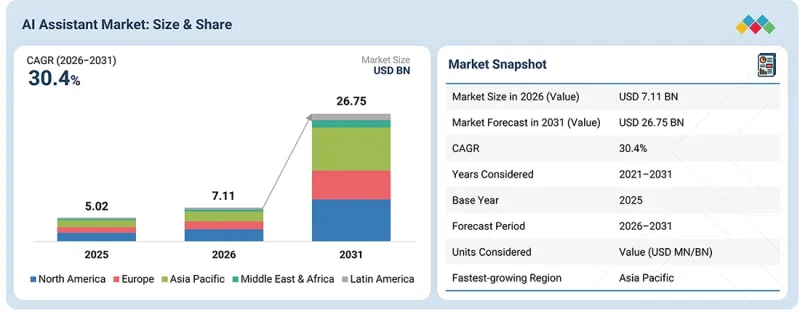
전 세계 AI 어시스턴트 시장은 2026년 71억 1,000만 달러에서 2031년까지 267억 5,000만 달러로 연평균 성장률(CAGR) 30.4%를 기록하며 확대될 것으로 전망됩니다.
플러그인, API, 통합 마켓플레이스의 급증으로 인해 AI 어시스턴트가 CRM, ERP 및 수많은 틈새 SaaS 도구와 원활하게 연동될 수 있게 되면서, AI 어시스턴트 시장은 급속히 확대되고 있습니다. 이러한 오케스트레이션 기능의 향상으로 기업은 파편화된 워크플로우를 통합하고, 반복적인 작업을 보다 효과적으로 자동화할 수 있게 됩니다.
| 조사 범위 | |
|---|---|
| 조사 기간 | 2021-2031년 |
| 기준 연도 | 2025년 |
| 예측 기간 | 2026-2031년 |
| 산정 단위 | 금액(10억 달러) |
| 부문 | 제공 형태, 통합 유형, 용도 및 최종사용자별 |
| 대상 지역 | 북미, 유럽, 아시아태평양, 중동 및 아프리카, 라틴아메리카 |
그러나 이러한 성장은 상호연결되지 않은 레거시 기술 스택에 의해 제약을 받고 있으며, 고가의 맞춤형 통합 없이는 여러 시스템 간에 원활하게 작동하는 AI 어시스턴트를 배포하기 어렵습니다. 견고한 플러그인 생태계와 원활한 상호 운용성 간의 균형을 유지하는 것은 진정한 전사적 도입을 추진하는 데 있어 여전히 매우 중요합니다.
“BFSI 부문이 AI 어시스턴트 도입을 주도하며, 규정 준수, 효율성, 고객 중심 운영을 촉진하고 있습니다.”
은행·금융 서비스·보험(BFSI) 부문은 방대한 양의 데이터, 복잡한 규정 준수 프로세스, 그리고 고객과의 상호작용을 보다 효율적으로 관리해야 하는 업계의 요구에 힘입어, 2026년에는 AI 어시스턴트 시장의 기업 최종사용자 부문에서 가장 큰 점유율을 차지할 것으로 예상됩니다. 대형 은행과 보험사들은 기존에 막대한 수작업을 필요로 했던 부정 탐지, 거래 모니터링, 규제 보고 등의 업무를 자동화하기 위해 지능형 어시스턴트 도입을 빠르게 추진하고 있습니다. 현재 많은 금융 기관이 AI 코파일럿을 도입하여 관계 관리자의 업무를 지원하거나, 고객 온보딩을 효율화하거나, 자산 운용 및 자문 서비스를 위해 맞춤화된 인사이트를 생성하고 있습니다. 디지털 퍼스트 뱅킹, 모바일 앱, 원격 자문 모델의 성장에 따라 일상적인 문의 대응, 안전한 거래 지원, 개인화된 추천 제공을 수행하는 대화형 AI에 대한 수요가 더욱 가속화되고 있습니다. AI 기반 어시스턴트는 감사 추적을 자동화하고 분산된 팀 전반에 걸쳐 규정 준수 일관성을 유지함으로써, 기업이 엄격한 개인정보 보호, 보안 및 규제 요건을 준수할 수 있도록 지원합니다. BFSI(은행·금융·보험) 업계의 조직들이 디지털 전환과 고객 중심 혁신에 대한 투자를 지속함에 따라, AI 어시스턴트는 서비스 품질, 업무 회복력, 생산성 향상에 필수적인 요소로 자리 잡고 있으며, 궁극적으로 더 광범위한 엔터프라이즈 AI 어시스턴트 시장에서 해당 부문이 최대 도입자로서의 입지를 공고히 하는 결과로 이어지고 있습니다.
“API 기반 AI 어시스턴트는 기업 워크플로우 전반에 걸친 유연하고 확장 가능한 통합을 통해 급속한 성장을 주도하고 있습니다.”
API 기반 AI 어시스턴트는 예측 기간 동안 가장 높은 연평균 성장률(CAGR)을 기록할 것으로 예상됩니다. 이는 조직들이 다양한 디지털 워크플로우에 인텔리전스를 통합하기 위해 유연하고 모듈식 통합 프레임워크를 점점 더 우선시하고 있기 때문입니다. 임베디드형이나 독립형 어시스턴트와 달리, API 우선 모델에서는 기업이 비용이 많이 드는 아키텍처 재구축 없이도 대화형 및 생성형 기능을 기존 애플리케이션, 맞춤형 포털 또는 자체 플랫폼에 직접 통합할 수 있습니다. 이러한 접근 방식은 복잡한 다중 벤더 기술 스택을 운영하는 중견 및 대기업 사이에서 특히 인기를 얻고 있습니다. 이는 CRM, ERP, 문서 관리 시스템, 산업별 전용 소프트웨어 간에 원활한 상호 운용성을 보장할 수 있기 때문입니다. 주요 기술 제공업체와 스타트업은 IT 팀이 문맥 검색, 실시간 요약, 개인화된 작업 자동화 등의 사용 사례를 위해 어시스턴트를 쉽게 도입하고 확장할 수 있도록 API 마켓플레이스와 개발자용 툴킷을 확충하고 있습니다. 헤드리스 아키텍처 및 마이크로서비스로의 전환에 따라 API 기반 어시스턴트에 대한 수요는 더욱 증가하고 있으며, 기업들은 인텔리전스를 어디에, 어떻게 적용할지 세밀하게 제어할 수 있게 되었습니다. 또한 BFSI(은행·금융·보험), 헬스케어, 전문 서비스 등의 업계에서는 규정 준수 요건을 충족하면서 대규모 사용자 경험 맞춤화를 실현하기 위해 API 기반 AI를 빠르게 도입하고 있습니다.
“아시아태평양에서는 혁신과 신흥 기술의 견인 아래 AI 어시스턴트 시장이 급속히 성장하는 한편, 2026년에는 북미가 시장 규모 면에서 선두를 유지할 전망입니다.”
아시아태평양은 대규모 디지털 투자, 확대되는 기술 인재 풀, 그리고 지역 내 각국의 지원적인 국가 AI 전략에 힘입어 예측 기간 동안 AI 어시스턴트 시장에서 가장 빠른 성장을 이룰 것으로 전망됩니다. 은행, 소매, 의료 등 다양한 분야의 조직들은 업무 흐름 자동화, 다국어 커뮤니케이션 개선, 그리고 기존 채널을 넘어선 고객 참여 확대를 위해 AI 어시스턴트 활용을 적극적으로 시도하고 있습니다. 스타트업과 현지 기술 혁신 기업들의 급속한 확대 또한 고유한 언어, 규정 준수, 문화적 뉘앙스에 대응하는 지역 맞춤형 AI 어시스턴트의 개발을 촉진하고 있습니다. 대조적으로, 북미는 2026년에도 AI 어시스턴트의 최대 시장으로 남아 있을 것으로 전망됩니다. 그 배경에는 기업 내 클라우드 도입의 성숙, AI 연구 개발에 대한 강력한 투자, 그리고 SaaS 생태계에 대한 AI 통합을 지속적으로 심화시키고 있는 주요 벤더들의 존재가 있습니다. 또한 북미 기업들은 생산성 제품군, CRM 플랫폼, 지식 관리 도구에 통합된 산업별 맞춤형 ‘코파일럿’을 조기에 도입하여 복잡한 업무와 의사결정의 최적화에 기여하고 있습니다. 책임 있는 AI에 대한 강력한 집중과 거버넌스 체계의 지속적인 개선을 통해 북미 기업들은 대규모의 분산된 팀과 하이브리드 근무 환경 전반에 걸쳐 AI 어시스턴트 도입을 가속화하고 있습니다. 이러한 요인들이 복합적으로 작용하여 아시아태평양은 가장 빠르게 성장하는 시장으로서의 역할을 강화하고 있으며, 북미는 대규모 기업을 대상으로 한 AI 어시스턴트 도입에서 주도적인 위치를 확립하고 있습니다.
주요 응답자 구성
- 기업 규모별 : Tier 1 - 38%, Tier 2 - 47%, Tier 3 - 15%
- 직책별 : C레벨 임원 - 31%, 이사 - 46%, 기타 - 23%
- 지역별 : 북미 - 39%, 유럽 - 22%, 아시아태평양 - 28%, 중동 및 아프리카 - 4%, 라틴아메리카 - 7%
참고 : ‘기타’에는 영업, 마케팅 및 제품 관리자가 포함됩니다.
Tier 1 기업의 매출은 5억 달러 이상, Tier 2 기업의 매출은 5억 달러에서 1억 달러 사이, Tier 3 기업의 매출은 1억 달러 이하입니다.
조사 범위
본 조사 보고서에서는 AI 어시스턴트 시장을 제공 기능, 통합 유형, 용도 및 최종사용자별로 분류하고 있습니다. 제공 기능(글쓰기·콘텐츠 어시스턴트, 회의·협업 어시스턴트, 지식·리서치 어시스턴트, 일정 관리·캘린더 최적화 어시스턴트, 영업·잠재 고객 발굴 어시스턴트, 개발자용 생산성 향상 어시스턴트, 프레젠테이션·디자인 어시스턴트, 분석·스프레드시트 어시스턴트), 통합 유형(독립형 어시스턴트, SaaS 네이티브형 어시스턴트, 브라우저 확장 기능/플러그인, API 기반 어시스턴트, 워크스페이스 애드온), 용도(AI를 활용한 집필·편집, 녹취·후속 조치, 지식 검색·문서 검색, 일정 관리·업무 우선순위 지정, 잠재 고객과의 소통·이메일 시퀀스, 코드 완성·검토, 프레젠테이션·내러티브 디자인, 데이터 탐색·스프레드시트 AI, 기타 용도), 최종사용자(개인 사용자 및 기업. 기업에는 BFSI, 헬스케어·생명과학, 소매·E-Commerce, 기술 제공업체, 전문 서비스 제공업체, 교육, 통신, 정부·공공 부문, 여행·호스피탈리티 및 기타 기업이 포함됨), 그리고 지역(북미, 유럽, 아시아태평양, 중동 및 아프리카 및 라틴아메리카)입니다. 본 보고서는 AI 어시스턴트 시장의 성장에 영향을 미치는 주요 요인(촉진요인, 제약요인, 과제, 기회 등)에 대한 상세한 정보를 포괄하고 있습니다. 또한 주요 업계 플레이어에 대해 사업 개요, 솔루션 및 서비스, 주요 전략, 계약, 파트너십, 합의 사항, 제품·서비스 출시, 합병·인수, AI 어시스턴트 시장의 최근 동향 등을 포함한 상세한 분석을 제공합니다. 또한, AI 어시스턴트 시장 생태계에서 두각을 나타내고 있는 스타트업 기업의 경쟁 분석에 대해서도 다루고 있습니다.
본 보고서를 구매해야 하는 이유
본 보고서는 시장 선도 기업 및 신규 진입 기업에게 AI 어시스턴트 시장 전체 및 그 하위 부문에 대해 입수 가능한 정보 중 가장 정확한 시장 매출 추정치를 제공합니다. 이를 통해 이해관계자는 경쟁 구도를 이해하고, 자사의 비즈니스를 최적의 위치로 이끌며, 적절한 시장 진입 전략을 수립하기 위한 인사이트를 얻을 수 있습니다. 또한 시장 동향을 파악하는 데 도움이 되며, 주요 시장 촉진요인, 억제요인, 과제 및 기회에 대한 정보를 제공합니다.
본 보고서에서는 다음 사항에 대한 인사이트를 제공합니다:
- 주요 촉진요인 분석(SaaS 플랫폼 내 AI 어시스턴트의 모듈형 도입이 기업 내 채택을 가속화하고 있음, 실시간 행동 데이터 및 컨텍스트 데이터가 고도로 개인화된 사용자 지원을 가능하게 하고 있음, AI가 생성한 인사이트를 기업 도구에 통합함으로써 지속적인 가치 창출이 실현됨, 상황인식형 어시스턴트가 지능형 업무 지원에 대한 기업의 증가하는 수요를 충족시키고 있음), 제약요인(분산된 디지털 생태계가 도구 간 통합된 AI 어시스턴트 경험을 저해하고 있음, 비정형 데이터에 대한 이해가 여전히 어시스턴트의 지능과 적응성을 제한하고 있음), 기회(로우 코드를 통한 맞춤화와 다국어 지원이 더 광범위한 기업 내 도입을 촉진한다는 점, 사용자의 요구를 예측하는 선제적 어시스턴트가 지능적인 업무 조정을 실현한다는 점, 페더레이티드 러닝이 기업의 데이터 프라이버시를 훼손하지 않으면서 AI 어시스턴트의 개인화를 가능하게 한다는 점), 및 과제(역할과 워크플로우를 초월한 일반화 능력의 한계가 AI 어시스턴트의 장기적인 확장성을 제약할 것, AI 기능의 급속한 진화가 직원의 적응이나 조직의 준비 태세를 앞지를 가능성이 있음)
- 제품 개발/혁신 : AI 어시스턴트 시장의 향후 기술, 연구 개발 활동 및 제품·서비스 출시에 대한 상세한 인사이트
- 시장 개발 : 수익성이 높은 시장에 대한 종합적인 정보 및 다양한 지역에 걸친 AI 어시스턴트 시장 분석
- 시장 다각화 : AI 어시스턴트 시장의 새로운 솔루션 및 서비스, 미개척 지역, 최근 동향 및 투자에 대한 종합적인 정보
- 경쟁 분석 : 본 보고서는 주요 시장 촉진요인, 억제요인, 과제 및 기회에 대한 정보를 제공함으로써, 이해관계자들이 AI 어시스턴트 시장의 동향을 파악하는 데 도움을 줍니다.
자주 묻는 질문
목차
제1장. 서론
제2장 요약
제3장 주요 인사이트
- AI 어시스턴트 시장의 매력적인 비즈니스 기회
- AI 어시스턴트 시장 : 지역별
- AI 어시스턴트 시장 : 통합 유형별 상위 3개
- AI 어시스턴트 시장 : 북미(제공 형태 및 통합 유형별)
- AI 어시스턴트 시장 : 지역별
제4장 시장 개요
- 시장 역학
- 성장 촉진요인
- 성장 억제요인
- 기회
- 과제
- 미충족 수요와 미개척 분야
- AI 어시스턴트 시장의 미충족 수요
- AI 어시스턴트 시장의 미개척 기회
- 상호 연관된 시장 및 부문 간 기회
- 상호 연관된 시장
- 부문 간 기회
- Tier 1/2/3 주요 기업들의 전략적 움직임
- 주요 동향 및 전략적 초점
제5장 업계 동향
- AI 어시스턴트의 진화
- Porter's Five Forces 분석
- 신규 진입자의 위협
- 대체품의 위협
- 공급업체의 협상력
- 구매자의 협상력
- 경쟁 기업 간의 적대적 관계
- 거시경제 지표
- GDP 동향 및 전망
- 공급망 분석
- 생태계 분석
- 라이팅·콘텐츠 지원 서비스 제공업체
- 회의 및 협업 지원 서비스 제공업체
- 지식·조사 지원 서비스 제공업체
- 영업 및 잠재 고객 발굴 지원 서비스 제공업체
- 개발자 생산성 향상 지원 서비스 제공업체
- 프레젠테이션·디자인 지원 서비스 제공업체
- 일정 관리·캘린더 최적화 어시스턴트 서비스 제공업체
- 분석 및 스프레드시트 지원 서비스 제공업체
- 가격 분석
- 주요 기업별 제품·서비스의 평균 판매 가격(2025년)
- 2025년 용도별 평균 판매 가격
- 주요 컨퍼런스 및 행사
- 고객의 비즈니스에 영향을 미치는 동향/변화
- 투자 및 자금 조달 시나리오
- 사례 연구 분석
- JASPER 도입을 통해 Cushman &Wakefield는 부동산 콘텐츠 제작 규모를 확대했습니다
- REGIE.AI는 Crunchbase가 잠재 고객 발굴의 개인화 및 아웃리치를 강화할 수 있도록 지원했습니다
- REPLIT은 ZINUS의 개발 주기 단축과 협업 가속화를 실현했습니다
- SCRIBE는 D300의 프로세스 문서화 및 지식 공유를 혁신했습니다
- DESCRIPT는 HUBSPOT의 음성 및 동영상 콘텐츠 제작 효율화를 지원하고 있습니다
제6장 기술의 진보, AI가 가져오는 영향, 특허, 혁신, 그리고 미래의 응용
- 기술 분석
- 주요 기술
- 보완 기술
- 인접 기술
- 기술 로드맵
- 단기(2026-2027년) | 상황인식형 멀티모달 어시스턴트, 엔터프라이즈 그라운딩 및 도구 통합
- 중기(2027-2030년) | 에이전틱 AI 어시스턴트, 애플리케이션 간 실행 및 엔터프라이즈 컨텍스트 인텔리전스
- 장기(2030-2035년 이후) | 자율적이고, 신뢰성이 높으며, 유비쿼터스한 AI 어시스턴트
- 특허 분석
- 조사 방법
- 어시스턴트 유형별 출원 특허 수
- 혁신과 특허 출원
- 미래의 응용
- 자율형 ‘워크 투 액션(Work-to-Action)’ 어시스턴트
- 미래를 내다보는 개인용 엔터프라이즈 어시스턴트
- 애플리케이션 간 워크플로우 오케스트레이션
- 다중 에이전트 협업 시스템
- 상황인식형 엔터프라이즈 지식 어시스턴트
제7장 규제 현황
- 지역별 규제 및 규정 준수
- 규제 기관, 정부 기관 및 기타 조직
- 규제
- 업계 표준
제8장 고객 현황과 구매 행동
- 의사결정 과정
- 전략적 평가와 비즈니스 케이스의 일관성
- 기술적 검증과 공급업체의 차별화
- 조달, 변경 관리 및 장기적 가치 실현
- 구매 프로세스의 주요 이해관계자 및 평가 기준
- 구매 프로세스의 주요 이해관계자
- 구매 기준
- 도입 장벽 및 사내 과제
- 다양한 최종사용자 산업별 미충족 수요
- 시장의 수익성
제9장 AI 어시스턴트 시장 : 제공 유형별
- 글쓰기·콘텐츠 어시스턴트
- 회의 및 협업 어시스턴트
- 지식·조사 어시스턴트
- 일정 관리·캘린더 최적화 어시스턴트
- 영업·잠재 고객 발굴 어시스턴트
- 개발자 생산성 향상 어시스턴트
- 프레젠테이션·디자인 어시스턴트
- 분석·스프레드시트 어시스턴트
제10장 AI 어시스턴트 시장 : 통합 유형별
- 독립형 어시스턴트
- SaaS 네이티브형 어시스턴트
- 브라우저 확장 기능/플러그인
- API 기반 어시스턴트
- 워크스페이스용 애드온
제11장 AI 어시스턴트 시장 : 용도별
- AI를 활용한 집필 및 편집
- 회의 녹취 및 후속 조치
- 지식 검색 및 문서 검색
- 일정 관리 및 업무 우선순위 설정
- 잠재 고객과의 소통 및 이메일 시퀀스
- 코드 자동 완성 및 검토
- 프레젠테이션 및 내러티브 설계
- 데이터 탐색 및 스프레드시트 AI
- 기타 활용 사례
제12장 AI 어시스턴트 시장 : 최종사용자별
- 개인 최종사용자
- 기업
제13장 AI 어시스턴트 시장 : 지역별
- 북미
- 북미 : AI 어시스턴트 시장의 성장 촉진요인
- 북미 : 거시경제 전망
- 미국
- 캐나다
- 유럽
- 유럽 : AI 어시스턴트 시장의 성장 촉진요인
- 유럽 : 거시경제 전망
- 영국
- 독일
- 프랑스
- 이탈리아
- 스페인
- 네덜란드
- 기타 유럽
- 아시아태평양
- 아시아태평양 : AI 어시스턴트 시장의 촉진요인
- 아시아태평양 : 거시경제 전망
- 중국
- 인도
- 일본
- 한국
- 싱가포르
- 호주·뉴질랜드
- 기타 아시아태평양
- 중동 및 아프리카
- 중동 및 아프리카 : AI 어시스턴트 시장의 성장 촉진요인
- 중동 및 아프리카 : 거시경제 전망
- 사우디아라비아
- 아랍에미리트
- 카타르
- 튀르키예
- 남아프리카
- 기타 중동 및 아프리카
- 라틴아메리카
- 라틴아메리카 : AI 어시스턴트 시장의 성장 촉진요인
- 라틴아메리카 : 거시경제 전망
- 브라질
- 멕시코
- 아르헨티나
- 기타 라틴아메리카
제14장 경쟁 현황
- 개요
- 주요 진입 기업의 전략/강점, 2022-2026년
- 수익 분석, 2021-2025년
- 시장 점유율 분석(2025년)
- 시장 순위 분석(2025년)
- 제품 비교
- 라이팅 및 콘텐츠 어시스턴트 제공업체별 제품 비교 분석
- 회의 및 협업 지원 서비스 제공업체별 제품 비교 분석
- 기업 평가 매트릭스 : 주요 기업, 2025년
- 스타 기업
- 신흥 리더
- 광범위한 업체
- 진출 기업
- 기업 사업 전개 : 주요 기업, 2025년
- 기업 평가 매트릭스 : 스타트업/중소기업, 2025년
- 선도적인 기업
- 대응력이 뛰어난 기업
- 역동적인 기업
- 출발점
- 경쟁사 벤치마킹 : 스타트업/중소기업, 2025년
- 기업 평가 및 재무 지표
- 경쟁 시나리오
- 제품 출시
- 거래
제15장 기업 개요
- 주요 기업
- MICROSOFT
- SALESFORCE
- SAP
- ORACLE
- ADOBE
- AMAZON(AWS)
- CISCO
- SERVICENOW
- DROPBOX
- OPENAI
- ANTHROPIC
- ZOOM
- BOX
- ATLASSIAN
- NOTION
- ASANA
- MONDAY.COM
- CLICKUP
- MIRO
- SUPERHUMAN(GRAMMARLY)
- DOCUSIGN
- LUCID SOFTWARE
- GAMMA
- CANVA
- STARTUPS/SMES
- GLEAN
- OTTER.AI
- FIREFLIES.AI
- FATHOM
- SCRIBE AI
- JASPER
- FULLCAST(COPY.AI)
- WRITER.COM
- SYNTHESIA
- BEAUTIFUL.AI
- HIVER
- SUPERNORMAL
- HYPERWRITE
- LEARNEO(QUILLBOT)
- COPYSMITH
- ABRIDGE
- DESCRIPT
- LUMEN5
- RUNWAY
- PERPLEXITY AI
- REGIE.AI
제16장 조사 방법론
제17장 인접 시장 및 관련 시장
- AI 에이전트 시장 - 2030년까지의 세계 전망
- 시장 정의
- 시장 개요
- 인공지능 시장 - 2032년까지의 세계 전망
- 시장 정의
- 시장 개요
제18장 부록
KSM 26.10.26The global AI assistant market is projected to grow from USD 7.11 billion in 2026 to USD 26.75 billion by 2031, at a CAGR of 30.4%. The AI assistant market is rapidly expanding as a surge in plug-ins, APIs, and integration marketplaces empowers assistants to connect seamlessly with CRMs, ERPs, and countless niche SaaS tools. This growing orchestration capability helps enterprises unify fragmented workflows and automate repetitive tasks more effectively.
| Scope of the Report | |
|---|---|
| Years Considered for the Study | 2021-2031 |
| Base Year | 2025 |
| Forecast Period | 2026-2031 |
| Units Considered | Value (USD Billion) |
| Segments | By Offering, Integration Type, Application, and End User |
| Regions covered | North America, Europe, Asia Pacific, Middle East & Africa, Latin America |
However, this growth is constrained by disconnected, legacy tech stacks that make it hard to deploy AI assistants that operate smoothly across multiple systems without costly custom integrations. Balancing robust plug-in ecosystems with seamless interoperability remains crucial for driving true enterprise-wide adoption.
"BFSI sector leads AI assistant adoption to drive compliance, efficiency, and customer-centric operations"
The Banking, Financial Services, and Insurance (BFSI) sector is expected to capture the largest share of the enterprise end user segment in the AI assistant market in 2026, driven by the industry's need to manage vast volumes of data, complex compliance processes, and customer interactions with greater efficiency. Leading banks and insurers are rapidly integrating intelligent assistants to automate tasks such as fraud detection, transaction monitoring, and regulatory reporting, which traditionally demand extensive manual effort. Many financial institutions are now deploying AI co-pilots to support relationship managers, streamline client onboarding, and generate tailored insights for wealth management and advisory services. The growth of digital-first banking, mobile apps, and remote advisory models has further accelerated the demand for conversational AI to handle routine queries, support secure transactions, and deliver personalized recommendations. AI-powered assistants help firms navigate strict privacy, security, and regulatory requirements by automating audit trails and maintaining compliance consistency across distributed teams. As BFSI organizations continue to invest in digital transformation and customer-centric innovations, AI assistants are becoming integral to improving service quality, operational resilience, and productivity, ultimately strengthening the sector's position as the largest adopter within the broader enterprise AI assistant market.
"API-based AI assistants drive rapid growth with flexible, scalable integration across enterprise workflows"
API-based AI assistants are projected to record the highest compound annual growth rate during the forecast period, as organizations increasingly prioritize flexible, modular integration frameworks to embed intelligence into diverse digital workflows. Unlike embedded or standalone assistants, API-first models allow enterprises to integrate conversational and generative capabilities directly into existing applications, custom portals, or proprietary platforms without costly re-architecture. This approach is especially popular among mid-to-large enterprises operating complex multi-vendor tech stacks, as it ensures seamless interoperability across CRMs, ERPs, document management systems, and industry-specific software. Leading technology providers and startups alike are expanding API marketplaces and developer toolkits that make it easier for IT teams to deploy and scale assistants for use cases such as contextual search, real-time summarization, and personalized task automation. The shift toward headless architecture and microservices has further strengthened the demand for API-based assistants, giving businesses granular control over where and how intelligence is applied. Additionally, sectors like BFSI, healthcare, and professional services are rapidly embracing API-driven AI to meet compliance requirements while customizing user experiences on a scale.
"Asia Pacific to witness rapid AI assistant growth fueled by innovation and emerging technologies, while North America leads in market size in 2026"
Asia Pacific is poised to witness the fastest growth in the AI assistant market during the forecast period, driven by massive digital investments, growing tech talent pools, and supportive national AI strategies across countries in the region. Organizations across sectors such as banking, retail, and healthcare are actively experimenting with AI assistants to automate workflows, improve multilingual communication, and extend customer engagement beyond traditional channels. The rapid expansion of startups and local tech innovators is also fueling the development of regionally relevant AI assistants that address unique language, compliance, and cultural nuances. In contrast, North America is set to remain the largest market for AI assistants in 2026, driven by mature enterprise cloud adoption, strong investment in AI R&D, and leading technology vendors that continue to deepen AI integration in SaaS ecosystems. Companies in North America are also early adopters of industry-specific co-pilots embedded within productivity suites, CRM platforms, and knowledge management tools, helping to optimize complex operations and decision-making. With a strong focus on responsible AI and continuous improvement in governance frameworks, North American enterprises are accelerating the deployment of AI assistants across large, distributed teams and hybrid work environments. Together, these factors reinforce Asia Pacific's role as the fastest-growing market and North America's leadership in large-scale enterprise AI assistant deployment.
Breakdown of Primaries
In-depth interviews were conducted with chief executive officers (CEOs), innovation and technology directors, system integrators, and executives from various key organizations operating in the AI assistant market.
- By Company: Tier 1 - 38%, Tier 2 - 47%, and Tier 3 - 15%
- By Designation: C-level Executives - 31%, Directors - 46%, and Others - 23%
- By Region: North America - 39%, Europe - 22%, Asia Pacific - 28%, - Middle East & Africa - 4%, and Latin America - 7%
Note: Others include sales, marketing, and product managers.
Tier 1 companies' revenues are more than USD 500 million, tier 2 companies' revenues range between USD 500 million and 100 million, and tier 3 companies' revenues are USD 100 million or less.
The report includes a study of key players offering AI assistant solutions and services. It profiles major vendors in the AI assistant market. The major players in the AI assistant market include Microsoft (US), Google (US), OpenAI (US), Anthropic (US), Zoom (US), Salesforce (US), SAP (Germany), Oracle (US), Adobe (US), Dropbox (US), Box (US), Atlassian (Australia), Notion (US), Amazon (US), Cisco (US), ServiceNow (US), Asana (US), Monday.com (Israel), ClickUp (US), Miro (US), Grammarly (US), DocuSign (US), Lucid Software (US), Glean (US), Otter.ai (US), Fireflies.ai (US), Fathom (US), Scribe (US), Regie.ai (US), Tome (US), Gamma (US), Jasper (US), Copy.ai (US), Writer.com (US), Synthesia (UK), Beautiful.ai (US), Canva (Australia), Superhuman AI (US), Hiver (India), Supernormal (Sweden), HyperWrite (US), QuillBot (US), CopySmith (Canada), Abridge (US), Descript (US), Lumen5 (Canada), Runway (US), and Perplexity AI (US).
Research Coverage
This research report categorizes the AI assistant market by offering, integration type, application, and end user. By offering (writing & content assistants, meeting & collaboration assistants, knowledge & research assistants, scheduling & calendar optimization assistants, sales & prospecting assistants, developer productivity assistants, presentation & design assistants, and analytical & spreadsheet assistants), integration type (standalone assistants, SaaS-native assistants, browser extensions/plug-ins, API-based assistants, and workspace add-ons), application (AI-powered writing & editing, transcription & follow-up, knowledge retrieval & document search, scheduling & work prioritization, lead engagement & email sequencing, code completion & review, presentation & narrative design, data exploration & spreadsheet AI, and other applications), end user (individual users and enterprises, which consist of BFSI, healthcare & life sciences, retail & ecommerce, technology providers, professional service providers, education, telecommunications, government & public sector, travel & hospitality, and other enterprises), and region (North America, Europe, Asia Pacific, Middle East & Africa, and Latin America). The report covers detailed information on major factors, such as drivers, restraints, challenges, and opportunities, influencing the growth of the AI assistant market. This report provides a detailed analysis of key industry players, including their business overview, solutions and services, key strategies, contracts, partnerships, agreements, product and service launches, mergers and acquisitions, and recent developments in the AI assistant market. This report also covers a competitive analysis of upcoming startups in the AI assistant market ecosystem.
Reasons to Buy This Report
The report provides market leaders and new entrants with the closest available revenue estimates for the overall AI assistant market and its subsegments. It helps stakeholders understand the competitive landscape and gain insights to better position their business and plan suitable go-to-market strategies. It also helps stakeholders understand the market pulse and provides information on key market drivers, restraints, challenges, and opportunities.
The report provides insights into the following pointers:
- Analysis of key drivers (modular deployment of AI assistants within SaaS platforms accelerating enterprise adoption, real-time behavioral and contextual data enables highly personalized user support, embedding AI-generated insights into enterprise tools unlocks continuous value creation, and context-aware assistants meet rising enterprise demand for intelligent task support), restraints (fragmented digital ecosystems hinder unified AI assistant experiences across tools, understanding unstructured data continues to limit assistant intelligence and adaptability), opportunities (low-code customization and multilingual support unlock broader enterprise adoption, proactive assistants that anticipate user needs unlock intelligent work orchestration, federated learning enables AI assistant personalization without compromising enterprise data privacy), and challenges (limits in generalization across roles and workflows restrict long-term scalability of AI assistants, rapid evolution of AI capabilities may outpace employee adaptation and organizational readiness)
- Product development/innovation: Detailed insights into upcoming technologies, research & development activities, and product and service launches in the AI assistant market
- Market development: Comprehensive information about lucrative markets, analysis of the AI assistant market across varied regions
- Market Diversification: Exhaustive information about new solutions and services, untapped geographies, recent developments, and investments in the AI assistant market
- Competitive Assessment: In-depth assessment of market shares, growth strategies and offerings of the major players in AI assistant market like, Microsoft (US), Google (US), OpenAI (US), Anthropic (US), Zoom (US), Salesforce (US), SAP (Germany), Oracle (US), Adobe (US), Dropbox (US), Box (US), Atlassian (Australia), Notion (US), Amazon (US), Cisco (US), ServiceNow (US), Asana (US), Monday.com (Israel), ClickUp (US), Miro (US), Grammarly (US), DocuSign (US), Lucid Software (US), Glean (US), Otter.ai (US), Fireflies.ai (US), Fathom (US), Scribe (US), Regie.ai (US), Tome (US), Gamma (US), Jasper (US), Copy.ai (US), Writer.com (US), Synthesia (UK), Beautiful.ai (US), Canva (Australia), Superhuman AI (US), Hiver (India), Supernormal (Sweden), HyperWrite (US), QuillBot (US), CopySmith (Canada), Abridge (US), Descript (US), Lumen5 (Canada), Runway (US), and Perplexity AI (US). The report also helps stakeholders understand the pulse of the AI assistant market by providing information on key market drivers, restraints, challenges, and opportunities.
TABLE OF CONTENTS
1 INTRODUCTION
- 1.1 STUDY OBJECTIVES
- 1.2 MARKET DEFINITION
- 1.3 MARKET SCOPE
- 1.3.1 INCLUSIONS AND EXCLUSIONS
- 1.3.2 YEARS CONSIDERED
- 1.4 CURRENCY CONSIDERED
- 1.5 STAKEHOLDERS
- 1.6 SUMMARY OF CHANGES
2 EXECUTIVE SUMMARY
- 2.1 MARKET HIGHLIGHTS AND KEY INSIGHTS
- 2.2 KEY MARKET PARTICIPANTS: MAPPING OF STRATEGIC EVELOPMENTS
- 2.3 DISRUPTIVE TRENDS IN AI ASSISTANT MARKET
- 2.4 HIGH GROWTH SEGMENTS
- 2.5 REGIONAL SNAPSHOT: MARKET SIZE, GROWTH RATE, AND FORECAST
3 PREMIUM INSIGHTS
- 3.1 ATTRACTIVE OPPORTUNITIES IN AI ASSISTANT MARKET
- 3.2 AI ASSISTANT MARKET, BY REGION
- 3.3 AI ASSISTANT MARKET: TOP THREE INTEGRATION TYPE
- 3.4 NORTH AMERICA: AI ASSISTANT MARKET, BY OFFERING AND INTEGRATION TYPE
- 3.5 AI ASSISTANT MARKET, BY REGION
4 MARKET OVERVIEW
- 4.1 INTRODUCTION
- 4.2 MARKET DYNAMICS
- 4.2.1 DRIVERS
- 4.2.1.1 Modular deployment of AI assistants within SaaS platforms accelerating enterprise adoption
- 4.2.1.2 Real-time behavioral and contextual data enables highly personalized user support
- 4.2.1.3 Embedding AI-generated insights into enterprise tools unlocks continuous value creation
- 4.2.1.4 Context-aware assistants meet rising enterprise demand for intelligent task support
- 4.2.2 RESTRAINTS
- 4.2.2.1 Fragmented digital ecosystems hinder unified AI assistant experiences across tools
- 4.2.2.2 Understanding unstructured data continues to limit assistant intelligence and adaptability
- 4.2.3 OPPORTUNITIES
- 4.2.3.1 Low-code customization and multilingual support unlock broader enterprise adoption
- 4.2.3.2 Proactive assistants that anticipate user needs unlock intelligent work orchestration
- 4.2.3.3 Federated learning enables AI assistant personalization without compromising enterprise data privacy
- 4.2.4 CHALLENGES
- 4.2.4.1 Limits in generalization across roles and workflows restrict long-term scalability of AI assistants
- 4.2.4.2 Rapid evolution of AI capabilities may outpace employee adaptation and organizational readiness
- 4.2.1 DRIVERS
- 4.3 UNMET NEEDS AND WHITE SPACES
- 4.3.1 UNMET NEEDS IN AI ASSISTANT MARKET
- 4.3.2 WHITE-SPACE OPPORTUNITIES IN AI ASSISTANT MARKET
- 4.4 INTERCONNECTED MARKETS AND CROSS-SECTOR OPPORTUNITIES
- 4.4.1 INTERCONNECTED MARKETS
- 4.4.2 CROSS-SECTOR OPPORTUNITIES
- 4.5 STRATEGIC MOVES BY TIER-1/2/3 PLAYERS
- 4.5.1 KEY MOVES AND STRATEGIC FOCUS
5 INDUSTRY TRENDS
- 5.1 EVOLUTION OF AI ASSISTANTS
- 5.2 PORTER'S FIVE FORCES ANALYSIS
- 5.2.1 THREAT OF NEW ENTRANTS
- 5.2.2 THREAT OF SUBSTITUTES
- 5.2.3 BARGAINING POWER OF SUPPLIERS
- 5.2.4 BARGAINING POWER OF BUYERS
- 5.2.5 INTENSITY OF COMPETITIVE RIVALRY
- 5.3 MACROECONOMIC INDICATORS
- 5.3.1 INTRODUCTION
- 5.3.2 GDP TRENDS AND FORECAST
- 5.4 SUPPLY CHAIN ANALYSIS
- 5.5 ECOSYSTEM ANALYSIS
- 5.5.1 WRITING & CONTENT ASSISTANT PROVIDERS
- 5.5.2 MEETING & COLLABORATION ASSISTANT PROVIDERS
- 5.5.3 KNOWLEDGE & RESEARCH ASSISTANT PROVIDERS
- 5.5.4 SALES & PROSPECTING ASSISTANT PROVIDERS
- 5.5.5 DEVELOPER PRODUCTIVITY ASSISTANT PROVIDERS
- 5.5.6 PRESENTATION & DESIGN ASSISTANT PROVIDERS
- 5.5.7 SCHEDULING & CALENDAR OPTIMIZATION ASSISTANTS PROVIDERS
- 5.5.8 ANALYTICS & SPREADSHEET ASSISTANTS PROVIDERS
- 5.6 PRICING ANALYSIS
- 5.6.1 AVERAGE SELLING PRICE OF OFFERING, BY KEY PLAYER, 2025
- 5.6.2 AVERAGE SELLING PRICE, BY APPLICATION, 2025
- 5.7 KEY CONFERENCES AND EVENTS
- 5.8 TRENDS/DISRUPTIONS IMPACTING CUSTOMER BUSINESS
- 5.9 INVESTMENT AND FUNDING SCENARIO
- 5.10 CASE STUDY ANALYSIS
- 5.10.1 JASPER EMPOWERED CUSHMAN & WAKEFIELD TO SCALE REAL ESTATE CONTENT CREATION
- 5.10.2 REGIE.AI HELPED CRUNCHBASE BOOST PROSPECTING PERSONALIZATION AND OUTREACH
- 5.10.3 REPLIT ENABLED ZINUS TO ACCELERATE DEVELOPMENT CYCLES AND COLLABORATION
- 5.10.4 SCRIBE TRANSFORMED D300'S PROCESS DOCUMENTATION AND KNOWLEDGE SHARING
- 5.10.5 DESCRIPT SUPPORTS HUBSPOT IN STREAMLINING AUDIO AND VIDEO CONTENT PRODUCTION
6 TECHNOLOGICAL ADVANCEMENTS, AI-DRIVEN IMPACT, PATENTS, INNOVATIONS, AND FUTURE APPLICATIONS
- 6.1 TECHNOLOGY ANALYSIS
- 6.1.1 KEY TECHNOLOGIES
- 6.1.1.1 Large Language Models (LLMs)
- 6.1.1.2 Natural Language Processing (NLP)
- 6.1.1.3 Prompt Engineering & Optimization
- 6.1.1.4 Context Management Systems
- 6.1.1.5 Retrieval-augmented Generation (RAG)
- 6.1.1.6 Embedding Models
- 6.1.2 COMPLEMENTARY TECHNOLOGIES
- 6.1.2.1 Vector Databases
- 6.1.2.2 Automated Speech Recognition (ASR)
- 6.1.2.3 Fine-tuning and Adapter Training
- 6.1.2.4 Function Calling Interfaces
- 6.1.3 ADJACENT TECHNOLOGIES
- 6.1.3.1 Human-computer Interaction (HCI)
- 6.1.3.2 Semantic Search Algorithms
- 6.1.3.3 Conversational Memory Architectures
- 6.1.3.4 Latent Attention Mechanisms
- 6.1.1 KEY TECHNOLOGIES
- 6.2 TECHNOLOGY ROADMAP
- 6.2.1 SHORT-TERM (2026-2027) | CONTEXT-AWARE MULTIMODAL ASSISTANTS, ENTERPRISE GROUNDING & TOOL INTEGRATION
- 6.2.2 MID-TERM (2027-2030) | AGENTIC AI ASSISTANTS, CROSS-APPLICATION EXECUTION & ENTERPRISE CONTEXT INTELLIGENCE
- 6.2.3 LONG-TERM (2030-2035+) | AUTONOMOUS, TRUSTED & UBIQUITOUS AI ASSISTANTS
- 6.3 PATENT ANALYSIS
- 6.3.1 METHODOLOGY
- 6.3.2 PATENTS FILED, BY ASSISTANT TYPE
- 6.3.3 INNOVATION AND PATENT APPLICATIONS
- 6.4 FUTURE APPLICATIONS
- 6.4.1 AUTONOMOUS WORK-TO-ACTION ASSISTANTS
- 6.4.2 PROACTIVE PERSONAL & ENTERPRISE ASSISTANTS
- 6.4.3 CROSS-APPLICATION WORKFLOW ORCHESTRATION
- 6.4.4 MULTI-AGENT COLLABORATION SYSTEMS
- 6.4.5 CONTEXT-AWARE ENTERPRISE KNOWLEDGE ASSISTANTS
7 REGULATORY LANDSCAPE
- 7.1 REGIONAL REGULATIONS AND COMPLIANCE
- 7.1.1 REGULATORY BODIES, GOVERNMENT AGENCIES, AND OTHER ORGANIZATIONS
- 7.1.2 REGULATIONS
- 7.1.2.1 North America
- 7.1.2.1.1 California Consumer Privacy Act (CCPA)
- 7.1.2.1.2 California Privacy Rights Act (CPRA)
- 7.1.2.1.3 Children's Online Privacy Protection Act (COPPA)
- 7.1.2.1.4 Artificial Intelligence and Data Act (AIDA) (Canada)
- 7.1.2.1.5 Personal Information Protection and Electronic Documents Act (PIPEDA)
- 7.1.2.1.6 Algorithmic Accountability Act (proposed)
- 7.1.2.2 Europe
- 7.1.2.2.1 General Data Protection Regulation (GDPR)
- 7.1.2.2.2 EU Artificial Intelligence Act
- 7.1.2.2.3 Digital Services Act (DSA)
- 7.1.2.2.4 Digital Markets Act (DMA)
- 7.1.2.2.5 AI Liability Directive (proposed)
- 7.1.2.3 Asia Pacific
- 7.1.2.3.1 Personal Information Protection Law (PIPL)
- 7.1.2.3.2 Administrative Provisions on Deep Synthesis Internet Information Services
- 7.1.2.3.3 Algorithmic Recommendation Regulation
- 7.1.2.3.4 Act on the Protection of Personal Information (APPI)
- 7.1.2.3.5 Personal Data Protection Act (PDPA)
- 7.1.2.3.6 Singapore Model AI Governance Framework
- 7.1.2.3.7 Digital Personal Data Protection Act (DPDP Act, 2023)
- 7.1.2.4 Middle East & Africa
- 7.1.2.4.1 UAE Federal Data Protection Law (2021)
- 7.1.2.4.2 UAE AI Ethics Guidelines
- 7.1.2.4.3 Personal Data Protection Law (PDPL) - Saudi Arabia
- 7.1.2.4.4 Protection of Personal Information Act (POPIA) - South Africa
- 7.1.2.5 Latin America
- 7.1.2.5.1 General Data Protection Law (LGPD)
- 7.1.2.5.2 Federal Law on Protection of Personal Data Held by Private Parties (LFPDPPP)
- 7.1.2.5.3 Personal Data Protection Law (PDPL)
- 7.1.2.1 North America
- 7.1.3 INDUSTRY STANDARDS
8 CUSTOMER LANDSCAPE AND BUYER BEHAVIOR
- 8.1 DECISION-MAKING PROCESS
- 8.1.1 STRATEGIC EVALUATION AND BUSINESS CASE ALIGNMENT
- 8.1.2 TECHNICAL VALIDATION AND VENDOR DIFFERENTIATION
- 8.1.3 PROCUREMENT, CHANGE MANAGEMENT, AND LONG-TERM VALUE REALIZATION
- 8.2 KEY STAKEHOLDERS IN BUYING PROCESS AND THEIR EVALUATION CRITERIA
- 8.2.1 KEY STAKEHOLDERS IN BUYING PROCESS
- 8.2.2 BUYING CRITERIA
- 8.3 ADOPTION BARRIERS AND INTERNAL CHALLENGES
- 8.4 UNMET NEEDS FROM VARIOUS END-USER VERTICALS
- 8.5 MARKET PROFITABILITY
9 AI ASSISTANT MARKET, BY OFFERING
- 9.1 INTRODUCTION
- 9.1.1 DRIVERS: AI ASSISTANT MARKET, BY OFFERING
- 9.2 WRITING & CONTENT ASSISTANTS
- 9.2.1 AI CONTENT ASSISTANTS TO DRAFT, REFINE, AND ALIGN TONE ACROSS WRITING PLATFORMS
- 9.3 MEETING & COLLABORATION ASSISTANTS
- 9.3.1 AI MEETING ASSISTANTS TO TRANSCRIBE CONVERSATIONS AND EXTRACT ACTION ITEMS
- 9.4 KNOWLEDGE & RESEARCH ASSISTANTS
- 9.4.1 AI RESEARCH ASSISTANTS TO RETRIEVE AND SYNTHESIZE KNOWLEDGE ACROSS ENTERPRISE REPOSITORIES
- 9.5 SCHEDULING & CALENDAR OPTIMIZATION ASSISTANTS
- 9.5.1 AI SCHEDULING ASSISTANTS TO COORDINATE MEETINGS ACROSS CALENDARS THROUGH NATURAL LANGUAGE
- 9.6 SALES & PROSPECTING ASSISTANTS
- 9.6.1 AI SALES ASSISTANTS TO QUALIFY LEADS AND ACCELERATE PIPELINE FROM CALL AND EMAIL SIGNALS
- 9.7 DEVELOPER PRODUCTIVITY ASSISTANTS
- 9.7.1 AI DEVELOPER ASSISTANTS TO COMPLETE CODE AND ACCELERATE IDE WORKFLOWS
- 9.8 PRESENTATION & DESIGN ASSISTANTS
- 9.8.1 AI PRESENTATION ASSISTANTS TO TURN BRIEFS INTO DESIGNED SLIDE DECKS
- 9.9 ANALYTICAL & SPREADSHEET ASSISTANTS
- 9.9.1 AI SPREADSHEET ASSISTANTS TO ANSWER NATURAL-LANGUAGE QUERIES WITH FORMULAS AND CHARTS
10 AI ASSISTANT MARKET, BY INTEGRATION TYPE
- 10.1 INTRODUCTION
- 10.1.1 DRIVERS: AI ASSISTANT MARKET, BY INTEGRATION TYPE
- 10.2 STANDALONE ASSISTANTS
- 10.2.1 STANDALONE ASSISTANTS TO DELIVER INDEPENDENT AI THROUGH DEDICATED APPS AND PORTALS
- 10.3 SAAS-NATIVE ASSISTANTS
- 10.3.1 SAAS-NATIVE ASSISTANTS TO EMBED CONTEXT-AWARE AI INSIDE CLOUD PLATFORMS
- 10.4 BROWSER EXTENSIONS/PLUG-INS
- 10.4.1 BROWSER EXTENSIONS AND PLUG-INS TO INJECT AI INTO EXISTING WEB APPS
- 10.5 API-BASED ASSISTANTS
- 10.5.1 API-BASED ASSISTANTS TO EXPOSE AI THROUGH DEVELOPER ENDPOINTS AND FUNCTION CALLS
- 10.6 WORKSPACE ADD-ONS
- 10.6.1 WORKSPACE ADD-ONS TO BRING AI INTO SLACK, TEAMS, AND GOOGLE WORKSPACE
11 AI ASSISTANT MARKET, BY APPLICATION
- 11.1 INTRODUCTION
- 11.1.1 DRIVERS: AI ASSISTANT MARKET, BY APPLICATION
- 11.2 AI-POWERED WRITING & EDITING
- 11.2.1 CONTEXT TRACKING TO MAINTAIN GRAMMAR, STYLE, AND CONSISTENCY WHILE EDITING
- 11.3 MEETING TRANSCRIPTION & FOLLOW-UP
- 11.3.1 RETRIEVAL-AUGMENTED GENERATION TO GROUND MEETING SUMMARIES IN SOURCE DOCUMENTS
- 11.4 KNOWLEDGE RETRIEVAL & DOCUMENT SEARCH
- 11.4.1 SEMANTIC SEARCH TO PERSONALIZE RETRIEVAL FROM USER PROFILES AND PAST QUERIES
- 11.5 SCHEDULING & WORK PRIORITIZATION
- 11.5.1 PREDICTIVE SCHEDULING TO BUILD SELF-OPTIMIZING, PRIORITIZED AGENDAS
- 11.6 LEAD ENGAGEMENT & EMAIL SEQUENCING
- 11.6.1 FUNCTION-CALLING APIS TO AUTOMATE CRM LOGGING AND EMAIL SEQUENCING
- 11.7 CODE COMPLETION & REVIEW
- 11.7.1 CODE ASSISTANTS TO SCAFFOLD TESTS AND FLAG PERFORMANCE AND SECURITY ISSUES
- 11.8 PRESENTATION & NARRATIVE DESIGN
- 11.8.1 VISION-LANGUAGE MODELS TO APPLY DESIGN PRINCIPLES ACROSS TYPOGRAPHY, LAYOUT, AND COLOR
- 11.9 DATA EXPLORATION & SPREADSHEET AI
- 11.9.1 EMBEDDED LLMS TO CONVERT NATURAL-LANGUAGE QUERIES INTO FORMULAS, PIVOTS, AND CHARTS
- 11.10 OTHER APPLICATIONS
12 AI ASSISTANT MARKET, BY END USER
- 12.1 INTRODUCTION
- 12.1.1 DRIVERS: AI ASSISTANT MARKET, BY END USER
- 12.2 INDIVIDUAL END USERS
- 12.3 ENTERPRISES
- 12.3.1 BFSI
- 12.3.1.1 AI assistants to automate workflows and modernize compliance across financial operations
- 12.3.2 TELECOMMUNICATIONS
- 12.3.2.1 AI assistants to automate support and optimize network operations across telecom environments
- 12.3.3 GOVERNMENT & PUBLIC SECTOR
- 12.3.3.1 AI assistants to streamline citizen services and automate workflows across public sector agencies
- 12.3.4 HEALTHCARE & LIFE SCIENCES
- 12.3.4.1 AI assistants to support clinical decisions and reduce documentation burden across healthcare operations
- 12.3.5 MANUFACTURING
- 12.3.5.1 AI assistants to optimize frontline operations and enable predictive maintenance across production workflows
- 12.3.6 MEDIA & ENTERTAINMENT
- 12.3.6.1 AI assistants to accelerate content creation and personalize audience engagement across media workflows
- 12.3.7 RETAIL & E-COMMERCE
- 12.3.7.1 AI assistants to personalize customer journeys and automate operations across retail and e-commerce
- 12.3.8 TECHNOLOGY PROVIDERS
- 12.3.8.1 AI assistants to accelerate development and strengthen product support across technology providers
- 12.3.9 PROFESSIONAL SERVICE PROVIDERS
- 12.3.9.1 AI assistants to automate documentation and accelerate research across professional services firms
- 12.3.10 EDUCATION
- 12.3.10.1 AI assistants to personalize learning and automate administration across educational institutions
- 12.3.11 OTHER ENTERPRISES
- 12.3.1 BFSI
13 AI ASSISTANT MARKET, BY REGION
- 13.1 INTRODUCTION
- 13.2 NORTH AMERICA
- 13.2.1 NORTH AMERICA: AI ASSISTANT MARKET DRIVERS
- 13.2.2 NORTH AMERICA: MACROECONOMIC OUTLOOK
- 13.2.3 US
- 13.2.3.1 Strong Enterprise AI Investment and Rapid Integration of Contextual AI Assistants Across Workflows
- 13.2.4 CANADA
- 13.2.4.1 Growing Enterprise and Public-Sector Adoption of Bilingual, Privacy-Compliant AI Assistants
- 13.3 EUROPE
- 13.3.1 EUROPE: AI ASSISTANT MARKET DRIVERS
- 13.3.2 EUROPE: MACROECONOMIC OUTLOOK
- 13.3.3 UK
- 13.3.3.1 Growing Adoption of AI Assistants Across Financial Services, Government, and Knowledge-Intensive Workflows
- 13.3.4 GERMANY
- 13.3.4.1 Industrial Digitalization and Data Sovereignty Driving Enterprise AI Assistant Adoption
- 13.3.5 FRANCE
- 13.3.5.1 Public-Sector AI Initiatives and Enterprise Automation Accelerating AI Assistant Deployment
- 13.3.6 ITALY
- 13.3.6.1 Digital Transformation Across Banking, Telecom, and Manufacturing Supporting AI Assistant Adoption
- 13.3.7 SPAIN
- 13.3.7.1 Enterprise Digitalization and Multilingual Customer Engagement Driving AI Assistant Demand
- 13.3.8 NETHERLANDS
- 13.3.8.1 Strong Digital Infrastructure and AI-First Work Models Accelerating Assistant Adoption
- 13.3.9 REST OF EUROPE
- 13.4 ASIA PACIFIC
- 13.4.1 ASIA PACIFIC: AI ASSISTANT MARKET DRIVERS
- 13.4.2 ASIA PACIFIC: MACROECONOMIC OUTLOOK
- 13.4.3 CHINA
- 13.4.3.1 Government-Led AI Expansion and Domestic Technology Ecosystem Driving Assistant Adoption
- 13.4.4 INDIA
- 13.4.4.1 Digital Transformation and Multilingual AI Demand Accelerating Assistant Deployment Across Sectors
- 13.4.5 JAPAN
- 13.4.5.1 Enterprise Automation and Aging Workforce Needs Driving Context-Aware AI Assistant Adoption
- 13.4.6 SOUTH KOREA
- 13.4.6.1 Advanced Digital Infrastructure and Government AI Strategy Accelerating Assistant Adoption
- 13.4.7 SINGAPORE
- 13.4.7.1 Strong Digital Infrastructure and Government AI Initiatives Supporting Enterprise Assistant Deployment
- 13.4.8 AUSTRALIA & NEW ZEALAND
- 13.4.8.1 Public-Sector AI Frameworks and Enterprise Automation Driving Trusted Assistant Adoption
- 13.4.9 REST OF ASIA PACIFIC
- 13.5 MIDDLE EAST & AFRICA
- 13.5.1 MIDDLE EAST & AFRICA: AI ASSISTANT MARKET DRIVERS
- 13.5.2 MIDDLE EAST & AFRICA: MACROECONOMIC OUTLOOK
- 13.5.3 SAUDI ARABIA
- 13.5.3.1 Vision 2030 and Government AI Programs Accelerating Arabic-Language Assistant Adoption
- 13.5.4 UAE
- 13.5.4.1 Smart Government Initiatives and Enterprise Automation Driving Multilingual AI Assistant Adoption
- 13.5.5 QATAR
- 13.5.5.1 National AI Strategy and Smart-City Investments Supporting Context-Aware Assistant Deployment
- 13.5.6 TURKEY
- 13.5.6.1 Government Digitalization and Local Language AI Development Driving Assistant Adoption
- 13.5.7 SOUTH AFRICA
- 13.5.7.1 Enterprise Digitalization and Multilingual AI Demand Expanding Assistant Adoption Across Sectors
- 13.5.8 REST OF MIDDLE EAST & AFRICA
- 13.6 LATIN AMERICA
- 13.6.1 LATIN AMERICA: AI ASSISTANT MARKET DRIVERS
- 13.6.2 LATIN AMERICA: MACROECONOMIC OUTLOOK
- 13.6.3 BRAZIL
- 13.6.3.1 Rapid Digitalization and Portuguese-Language AI Adoption Driving Assistant Expansion Across Consumer and Public Services
- 13.6.4 MEXICO
- 13.6.4.1 Customer Service Automation and Spanish-Language AI Demand Accelerating Assistant Adoption Across Enterprises
- 13.6.5 ARGENTINA
- 13.6.5.1 Strong AI Talent Base and Spanish-Language Innovation Supporting Domain-Specific Assistant Development
- 13.6.6 REST OF LATIN AMERICA
14 COMPETITIVE LANDSCAPE
- 14.1 OVERVIEW
- 14.2 KEY PLAYER STRATEGIES/RIGHT TO WIN, 2022-2026
- 14.3 REVENUE ANALYSIS, 2021-2025
- 14.4 MARKET SHARE ANALYSIS, 2025
- 14.4.1 MARKET RANKING ANALYSIS, 2025
- 14.5 PRODUCT COMPARISON
- 14.5.1 PRODUCT COMPARATIVE ANALYSIS, BY WRITING & CONTENT ASSISTANT PROVIDERS
- 14.5.2 PRODUCT COMPARATIVE ANALYSIS, BY MEETING & COLLABORATION ASSISTANT PROVIDERS
- 14.6 COMPANY EVALUATION MATRIX: KEY PLAYERS, 2025
- 14.6.1 STARS
- 14.6.2 EMERGING LEADERS
- 14.6.3 PERVASIVE PLAYERS
- 14.6.4 PARTICIPANTS
- 14.6.5 COMPANY FOOTPRINT: KEY PLAYERS, 2025
- 14.6.5.1 Company footprint
- 14.6.5.2 Regional footprint
- 14.6.5.3 Offering footprint
- 14.6.5.4 Application footprint
- 14.6.5.5 End user footprint
- 14.7 COMPANY EVALUATION MATRIX: STARTUPS/SMES, 2025
- 14.7.1 PROGRESSIVE COMPANIES
- 14.7.2 RESPONSIVE COMPANIES
- 14.7.3 DYNAMIC COMPANIES
- 14.7.4 STARTING BLOCKS
- 14.7.5 COMPETITIVE BENCHMARKING: STARTUPS/SMES, 2025
- 14.7.5.1 Detailed list of key startups/SMEs
- 14.7.5.2 Competitive benchmarking of key startups/SMEs
- 14.8 COMPANY VALUATION AND FINANCIAL METRICS
- 14.9 COMPETITIVE SCENARIO
- 14.9.1 PRODUCT LAUNCHES
- 14.9.2 DEALS
15 COMPANY PROFILES
- 15.1 INTRODUCTION
- 15.2 KEY PLAYERS
- 15.2.1 MICROSOFT
- 15.2.1.1 Business overview
- 15.2.1.2 Products/Solutions/Services offered
- 15.2.1.3 Recent developments
- 15.2.1.3.1 Product launches and enhancements
- 15.2.1.3.2 Deals
- 15.2.1.4 MnM view
- 15.2.1.4.1 Key strengths
- 15.2.1.4.2 Strategic choices
- 15.2.1.4.3 Weaknesses and competitive threats
- 15.2.2 SALESFORCE
- 15.2.2.1 Business overview
- 15.2.2.2 Products/Solutions/Services offered
- 15.2.2.3 Recent developments
- 15.2.2.3.1 Product launches & enhancements
- 15.2.2.3.2 Deals
- 15.2.2.4 MnM view
- 15.2.2.4.1 Key strengths
- 15.2.2.4.2 Strategic choices
- 15.2.2.4.3 Weaknesses and competitive threats
- 15.2.3 GOOGLE
- 15.2.3.1 Business overview
- 15.2.3.2 Products/Solutions/Services offered
- 15.2.3.3 Recent developments
- 15.2.3.3.1 Product launches & enhancements
- 15.2.3.3.2 Deals
- 15.2.3.4 MnM view
- 15.2.3.4.1 Key strengths
- 15.2.3.4.2 Strategic choices
- 15.2.3.4.3 Weaknesses and competitive threats
- 15.2.4 SAP
- 15.2.4.1 Business overview
- 15.2.4.2 Products/Solutions/Services offered
- 15.2.4.3 Recent developments
- 15.2.4.3.1 Product launches & enhancements
- 15.2.4.3.2 Deals
- 15.2.4.4 MnM view
- 15.2.4.4.1 Key strengths
- 15.2.4.4.2 Strategic choices
- 15.2.4.4.3 Weaknesses and competitive threats
- 15.2.5 ORACLE
- 15.2.5.1 Business overview
- 15.2.5.2 Products/Solutions/Services offered
- 15.2.5.3 Recent developments
- 15.2.5.3.1 Product launches & enhancements
- 15.2.5.3.2 Deals
- 15.2.5.4 MnM view
- 15.2.5.4.1 Key strengths
- 15.2.5.4.2 Strategic choices
- 15.2.5.4.3 Weaknesses and competitive threats
- 15.2.6 ADOBE
- 15.2.6.1 Business overview
- 15.2.6.2 Products/Solutions/Services offered
- 15.2.6.3 Recent developments
- 15.2.6.3.1 Product launches & enhancements
- 15.2.6.3.2 Deals
- 15.2.7 AMAZON (AWS)
- 15.2.7.1 Business overview
- 15.2.7.2 Products/Solutions/Services offered
- 15.2.7.3 Recent developments
- 15.2.7.3.1 Product launches
- 15.2.7.3.2 Deals
- 15.2.8 CISCO
- 15.2.8.1 Business overview
- 15.2.8.2 Products/Solutions/Services offered
- 15.2.8.3 Recent developments
- 15.2.8.3.1 Product launches
- 15.2.8.3.2 Deals
- 15.2.9 SERVICENOW
- 15.2.9.1 Business overview
- 15.2.9.2 Products/Solutions/Services offered
- 15.2.9.3 Recent developments
- 15.2.9.3.1 Product launches
- 15.2.9.3.2 Deals
- 15.2.10 DROPBOX
- 15.2.10.1 Business overview
- 15.2.10.2 Products/Solutions/Services offered
- 15.2.10.3 Recent developments
- 15.2.10.3.1 Product launches
- 15.2.10.3.2 Deals
- 15.2.11 OPENAI
- 15.2.12 ANTHROPIC
- 15.2.13 ZOOM
- 15.2.14 BOX
- 15.2.15 ATLASSIAN
- 15.2.16 NOTION
- 15.2.17 ASANA
- 15.2.18 MONDAY.COM
- 15.2.19 CLICKUP
- 15.2.20 MIRO
- 15.2.21 SUPERHUMAN (GRAMMARLY)
- 15.2.22 DOCUSIGN
- 15.2.23 LUCID SOFTWARE
- 15.2.24 GAMMA
- 15.2.25 CANVA
- 15.2.1 MICROSOFT
- 15.3 STARTUPS/SMES
- 15.3.1 GLEAN
- 15.3.2 OTTER.AI
- 15.3.3 FIREFLIES.AI
- 15.3.4 FATHOM
- 15.3.5 SCRIBE AI
- 15.3.6 JASPER
- 15.3.7 FULLCAST (COPY.AI)
- 15.3.8 WRITER.COM
- 15.3.9 SYNTHESIA
- 15.3.10 BEAUTIFUL.AI
- 15.3.11 HIVER
- 15.3.12 SUPERNORMAL
- 15.3.13 HYPERWRITE
- 15.3.14 LEARNEO (QUILLBOT)
- 15.3.15 COPYSMITH
- 15.3.16 ABRIDGE
- 15.3.17 DESCRIPT
- 15.3.18 LUMEN5
- 15.3.19 RUNWAY
- 15.3.20 PERPLEXITY AI
- 15.3.21 REGIE.AI
16 RESEARCH METHODOLOGY
- 16.1 RESEARCH DATA
- 16.1.1 SECONDARY DATA
- 16.1.2 PRIMARY DATA
- 16.2 DATA TRIANGULATION
- 16.3 MARKET SIZE ESTIMATION
- 16.3.1 TOP-DOWN APPROACH
- 16.3.2 BOTTOM-UP APPROACH
- 16.4 MARKET FORECAST
- 16.5 RESEARCH ASSUMPTIONS
- 16.6 RESEARCH LIMITATIONS
17 ADJACENT AND RELATED MARKETS
- 17.1 INTRODUCTION
- 17.2 AI AGENTS MARKET - GLOBAL FORECAST TO 2030
- 17.2.1 MARKET DEFINITION
- 17.2.2 MARKET OVERVIEW
- 17.2.2.1 AI agents market, by offering
- 17.2.2.2 AI agents market, by agent system
- 17.2.2.3 AI agents market, by product type
- 17.2.2.4 AI agents market, by agent role
- 17.2.2.5 AI agents market, by end user
- 17.2.2.6 AI agents market, by region
- 17.3 ARTIFICIAL INTELLIGENCE MARKET - GLOBAL FORECAST TO 2032
- 17.3.1 MARKET DEFINITION
- 17.3.2 MARKET OVERVIEW
- 17.3.2.1 Artificial intelligence (AI) market, by business function
- 17.3.2.2 Artificial intelligence (AI) market, by end user
- 17.3.2.3 Artificial intelligence (AI) market, by region
18 APPENDIX
- 18.1 DISCUSSION GUIDE
- 18.2 KNOWLEDGESTORE: MARKETSANDMARKETS' SUBSCRIPTION PORTAL
- 18.3 CUSTOMIZATION OPTIONS
- 18.4 RELATED REPORTS
- 18.5 AUTHOR DETAILS


