

|
시장보고서
상품코드
2151264
확장형 탐지 및 대응(XDR) 시장 : 플랫폼/소프트웨어, 서비스, 공격 표면별 - 세계 예측(-2031년)Extended Detection and Response (XDR) Market by Platform/Software (Native XDR, Open/Multi-vendor XDR), Service (Managed XDR/XDR-as-a-Service), Attack Surface (Endpoint Detection, Network Detection, Cloud Workload Detection) - Global Forecast to 2031 |
||||||

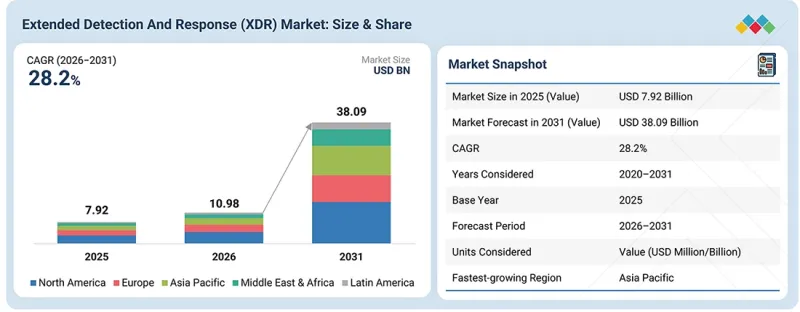
확장형 탐지 및 대응(XDR) 시장은 예측 기간 동안 연평균 성장률(CAGR) 28.2%로 확대되어, 2026년 109억 8,000만 달러에서 2031년에는 380억 9,000만 달러에 달할 것으로 전망됩니다.
이러한 성장은 조직이 애플리케이션, 데이터, ID 및 컴퓨팅 리소스를 클라우드 및 하이브리드 환경 전반에 분산함에 따라 클라우드 및 워크로드의 공격 표면이 확대되고 있는 데 기인합니다.
| 조사 범위 | |
|---|---|
| 조사 기간 | 2020-2031년 |
| 기준 연도 | 2025년 |
| 예측 기간 | 2026-2031년 |
| 산정 단위 | 금액(백만 달러/십억 달러) |
| 부문 | 제공, 공격 표면 범위, 전개 방식, 조직 규모, 산업 및 지역 |
| 대상 지역 | 북미, 유럽, 아시아태평양, 중동 및 아프리카, 라틴아메리카 |
Microsoft 위협 인텔리전스는 보안 조치가 미흡한 워크로드의 ID 및 컨테이너화된 환경과 관련된 위험을 지적하고 있습니다. 이러한 환경에서는 동적 인프라로 인해 이상 탐지 및 사고 조사가 복잡해질 수 있습니다. XDR은 클라우드, 엔드포인트, ID 및 애플리케이션 텔레메트리를 통합하여 보안 팀이 기존 환경과 클라우드 네이티브 환경을 아우르며 활동에 대한 상관 분석을 수행할 수 있도록 지원합니다. 기업 인프라의 분산화가 진행됨에 따라 이러한 광범위한 가시성으로 인해 XDR에 대한 수요가 증가하고 있습니다.
“플랫폼/소프트웨어별로는 오픈/멀티벤더형 XDR 부문이 예측 기간 동안 가장 높은 연평균 성장률(CAGR)을 기록할 것으로 전망됩니다.”
오픈/멀티벤더 XDR 부문은 대규모 기술 교체를 피하면서 기존 보안 투자를 최대한 활용하려는 조직의 수요에 힘입어, 예측 기간 동안 XDR 시장에서 가장 높은 연평균 성장률(CAGR)을 기록할 것으로 예상됩니다. 오픈 XDR 플랫폼은 타사 엔드포인트, 네트워크, 클라우드, 이메일, ID 및 SIEM 솔루션에서 수집된 텔레메트리 데이터를 통합 및 상관 분석하여, 이기종 보안 환경 전반에 걸친 광범위한 가시성을 실현합니다. 이러한 접근 방식은 상호 운용성을 향상시키고, 유연한 보안 아키텍처를 지원하며, 독점적 생태계에 대한 의존도를 줄여줍니다. SentinelOne, Cisco, Sophos 및 Trellix는 각사의 XDR 플랫폼 전반에 걸쳐 개방형 통합 기능을 확대하고 있으며, 이를 통해 조직은 다양한 보안 도구를 연동하여 도메인을 초월한 탐지, 조사 및 대응을 강화할 수 있게 됩니다.
“조직 규모별로 보면 2026년에는 대기업 부문이 가장 큰 시장 점유율을 차지할 것으로 예측됩니다.”
대기업 부문은 엔드포인트, 네트워크, 클라우드 워크로드, ID, 애플리케이션 및 지리적으로 분산된 운영을 아우르는 복잡한 IT 환경을 배경으로, 2026년에는 XDR 시장에서 가장 큰 점유율을 차지할 것으로 예측됩니다. 이러한 조직은 방대한 양의 보안 텔레메트리 데이터를 생성하고 있으며, 이기종 인프라 전반에 걸친 통합된 위협 탐지, 조사, 상관 분석 및 자동 대응이 필요합니다. Microsoft Defender XDR은 엔드포인트, ID, 이메일, 애플리케이션, 클라우드 환경에 걸친 보호 기능을 연계하여 통합된 가시성과 대응을 실현합니다. 또한 대기업은 보안 도구의 분산, 경보량 증가, 정교한 공격 체인 등의 과제에 직면해 있으며, 분산된 환경 전반에 걸쳐 보안 신호를 통합하고, 조사를 효율화하며, 사고 대응을 신속화하는 확장 가능한 XDR 플랫폼에 대한 수요가 높아지고 있습니다.
“산업별로는 에너지·공공사업 부문이 예측 기간 동안 가장 높은 연평균 성장률(CAGR)을 기록할 것으로 전망됩니다.”
에너지·공공사업 부문은 운영 기술(OT)의 디지털화 진전, IT와 OT의 융합, 그리고 중요 인프라의 사이버 위협 노출 증가에 힘입어 예측 기간 동안 XDR 시장에서 가장 높은 연평균 성장률(CAGR)을 기록할 것으로 전망됩니다. 에너지·공공사업 조직은 엔드포인트, 네트워크, 클라우드 시스템, ID, OT 자산에 걸쳐 분산된 환경을 운영하고 있어, 통합된 가시성과 협업적인 위협 탐지의 필요성이 높아지고 있습니다. XDR을 통해 보안 팀은 이러한 영역 전반에 걸친 신호를 상호 연관성 분석하여 공격 패턴을 식별하고, 조사 및 대응을 신속하게 수행할 수 있습니다. 핵심 인프라를 표적으로 하는 랜섬웨어 및 무단 접근 위험의 증가는 에너지 및 공공 서비스 운영 전반에 걸친 통합적인 탐지 및 대응 기능에 대한 수요를 더욱 높이고 있습니다.
응답자 구성
본 조사에서는 부품 공급업체, Tier 1 기업, OEM 등 폭넓은 업계의 전문가들로부터 인사이트를 얻었습니다. 주요 응답자의 구성은 다음과 같습니다:
- 기업 유형별 : Tier 1 - 40%, Tier 2 - 35%, Tier 3 - 25%
- 직책별 : C레벨 임원 - 50%, 매니저 및 기타 직책 - 50%
- 지역별 : 북미 - 30%, 유럽 - 20%, 아시아태평양 - 35%, 중동 및 아프리카 - 10%, 라틴아메리카 - 5%
본 조사에는 XDR 시장의 주요 기업에 대한 상세한 경쟁 분석, 각 기업 개요, 최근 동향 및 주요 시장 전략이 포함되어 있습니다.
조사 범위
본 보고서에서는 XDR 시장을 세분화하여, 제공 제품[플랫폼/소프트웨어(네이티브 XDR(단일 벤더 XDR), 오픈/멀티 벤더 XDR)], 서비스[전문 서비스(컨설팅·자문, 구축·통합, 교육·역량 강화), 매니지드 서비스], 공격 표적 영역의 커버리지(엔드포인트 탐지, 네트워크 탐지, 클라우드 워크로드 탐지, ID·액세스 탐지, IoT/OT/CPS 탐지), 도입 형태(온프레미스, 클라우드, 하이브리드), 조직 규모[대기업, 중소기업(중견기업, 소규모 기업)], 업종[BFSI(은행·금융기관, 보험기관), 정부 기관, 제조업, 에너지·공공사업, 소매·E-Commerce, 의료, IT·ITeS, 교육, 기타 업종], 및 지역(북미, 유럽, 아시아태평양, 중동 및 아프리카, 라틴아메리카)입니다.
또한, 본 조사에서는 시장의 주요 업체에 대한 상세한 경쟁 분석, 각 기업 개요, 제품 및 사업 제공과 관련된 주요 관찰 사항, 최근 동향, 그리고 주요 시장 전략에 대해서도 다루고 있습니다.
본 보고서를 구매할 때의 주요 이점
본 보고서는 XDR 시장 전체 및 그 하위 부문의 매출에 대한 가장 정확한 추정치를 제공함으로써, 시장을 선도하는 기업과 신규 진입 기업을 지원합니다. 본 보고서는 이해관계자들이 경쟁 구도를 이해하고, 자사의 비즈니스를 더 나은 위치로 이끌며, 적절한 시장 진입 전략을 수립하는 데 필요한 귀중한 인사이트를 얻는 데 도움이 됩니다. 또한, 본 보고서는 이해관계자들이 시장 동향을 파악하는 데 도움을 주며, 주요 시장 촉진요인, 억제요인, 과제 및 기회에 대한 정보를 제공합니다.
본 보고서는 다음 사항에 대한 인사이트를 제공합니다:
- 주요 촉진요인(진화하는 사이버 위협 상황/사이버 공격 증가, 하이브리드 근무 모델에 따른 공격 표면 확대, 보안 기술의 통합 플랫폼으로의 통합, EDR에서 XDR로의 전환 필요성) 및 제약요인(XDR 공급업체에 시스템 아키텍처에 대한 완전한 통제권을 위임하는 것에 대한 기업의 신뢰 부족, XDR 도입 시 과제, XDR과 관련된 개인정보 보호 및 규정 준수 우려, 풀스택 XDR 솔루션의 높은 초기 도입 비용)에 대한 분석, 기회(AI 및 자동화 통합, 중소기업의 XDR 수요 증가, 보안 운영 센터(SOC)로의 XDR 통합, 매니지드 XDR에 대한 수요 증가) 및 과제(XDR에 대한 낮은 인지도와 벤더 락인 기간, 경보 피로 및 데이터 과다에 대한 대응)
- 제품 개발/혁신 : XDR 시장의 향후 기술, 연구개발 활동, 신제품 및 서비스 출시에 대한 상세한 인사이트
- 시장 개발 : 수익성이 높은 시장에 대한 종합적인 정보 - 본 보고서는 다양한 지역에 걸친 XDR 시장을 분석합니다
- 시장 다각화 : XDR 시장의 신제품 및 서비스, 미개척 지역, 최근 동향 및 투자에 대한 종합적인 정보
- 경쟁 분석 : XDR 시장의 주요 기업들의 시장 점유율, 성장 전략, 서비스 제공 내용에 대한 상세한 평가
자주 묻는 질문
목차
제1장 서론
제2장 요약
제3장 주요 인사이트
- 확장형 탐지 및 대응(EDR) 시장에서 사업자에게 매력적인 기회
- 확장형 탐지 및 대응(EDR) 시장 : 제공 유형별
- 확장형 탐지 및 대응(EDR) 시장 : 공격 표면 범위별
- 확장형 탐지 및 대응(EDR) 시장 : 산업별
- 확장형 탐지 및 대응(EDR) 시장 : 지역별
제4장 시장 개요
- 시장 역학
- 성장 촉진요인
- 성장 억제요인
- 기회
- 과제
- 미충족 수요와 미개척 분야
- 상호 연관된 시장 및 부문 간 기회
- 상호 연관된 시장
- 부문 간 기회
- Tier 1/2/3 주요 기업들의 전략적 움직임
- 티어를 아우르는 전략적 패턴
- 전략적 동향
제5장 업계 동향
- Porter's Five Forces 분석
- 신규 진입자의 위협
- 대체품의 위협
- 공급업체의 협상력
- 구매자의 협상력
- 경쟁 기업 간의 적대 관계의 격렬함
- 거시경제 지표
- GDP 동향 및 전망
- 세계 ICT 산업의 동향
- 세계 사이버 보안 산업의 동향
- 가치사슬 분석
- 기획 및 설계
- XDR 솔루션 제공업체
- 시스템 통합
- 컨설팅
- 최종사용자
- 생태계
- 주요 컨퍼런스 및 행사(2026-2027년)
- 고객의 비즈니스에 영향을 미치는 동향 및 파괴적 변화
- 투자 및 자금 조달 시나리오
- 사례 연구 분석
- 시스코의 지원으로 일론 대학교는 위협 대응을 효율화했습니다
- Unit 42의 지원으로 SABRE의 사이버 보안 방어 체계가 획기적으로 강화되었습니다
- 쿠웨이트 크레딧 뱅크는 Microsoft Defender XDR을 활용하여 위협 탐지 및 대응을 강화했습니다
- 표준화된 리스크 관리를 실현하기 위해 사모펀드 포트폴리오 전반에 XDR이 도입되었습니다
- 2025년 미국 관세가 XDR 시장에 미치는 영향
- 주요 관세율
- 가격에 미치는 영향 분석
- 국가 및 지역에 미치는 영향
- 산업별
- 미국 - 이란 전쟁이 XDR 시장에 미치는 영향
제6장 기술 발전, AI의 영향, 특허, 혁신 및 향후 응용
- 기술 분석
- 주요 신흥 기술
- 보완 기술
- 인접 기술
- 기술·제품 로드맵
- 단기(2026-2027년) | 기반 구축 및 초기 상용화
- 중기(2027-2030년) | 규모 확대, 지속적인 보증 및 에이전트에 의한 거버넌스
- 장기(2030-2035년 이후) | 자율형 AI 거버넌스 및 지속적인 신뢰 보장
- 특허 분석
- 2024-2026년 XDR 시장의 주요 특허 목록
- 가격 분석
- 주요 기업의 솔루션별 평균 판매 가격
- 도입 형태별 참고 가격 분석
- 향후 응용 분야
- 물리 AI 및 로보틱스 분야의 AI 거버넌스
- OT 및 산업 보안
- IoT 및 커넥티드 디바이스 보안
- ID 및 비인간 ID 보호
- 클라우드 네이티브 애플리케이션 보안
- AI/생성형 AI가 XDR 시장에 미치는 영향
- XDR 시장의 모범 사례
- XDR 시장에서의 AI 도입 사례 연구
- 상호 연계되는 인접 생태계와 시장 참여자에 미치는 영향
- XDR 시장에서 생성형 AI 도입에 대한 고객의 준비 현황
- 마이크로소프트 : 액센츄어-Microsoft Defender XDR을 통한 보안 조사 가속화
- 팔로알토 네트웍스 : 빈치(Vinci) - Cortex XDR을 통한 20만 개의 엔드포인트에 걸친 보안 표준화
제7장 규제 현황
- 지역별 규제 및 규정 준수
- 규제 기관, 정부 기관 및 기타 조직
- 업계 표준
제8장 소비자 동향과 구매 행동
- 의사결정 과정
- 주요 이해관계자와 구매 기준
- 구매 과정에서 주요 이해관계자
- 구매 기준
- 도입 장벽 및 사내 과제
- 각 최종사용자 산업 분야의 미충족 수요
제9장 확장형 탐지 및 대응(XDR) 시장 : 제공 내용별
- 플랫폼/소프트웨어
- 서비스
제10장 확장형 탐지 및 대응(XDR) 시장 : 공격 표면 범위별
- 엔드포인트 탐지
- 네트워크 탐지
- 클라우드 워크로드 탐지
- ID 및 액세스 탐지
- IoT/OT용 탐지
제11장 확장형 탐지 및 대응(XDR) 시장 : 배포 방식별
- 클라우드
- 온프레미스
- 하이브리드/멀티 클라우드형 XDR
제12장 확장형 탐지 및 대응(XDR) 시장 : 조직 규모별
- 대기업
- 중소기업(SME)
제13장 확장형 탐지 및 대응(XDR) 시장 : 산업별
- 은행, 금융 서비스, 보험
- 정부
- 제조업
- 에너지·공공사업
- 소매·E-Commerce
- 의료
- IT·ITES
- 기타 산업
제14장 확장형 탐지 및 대응(EDR) 시장 : 지역별
- 북미
- 북미 : 시장 촉진요인
- 북미 : 거시경제 전망
- 미국
- 캐나다
- 유럽
- 유럽 : 시장 촉진요인
- 영국
- 독일
- 프랑스
- 이탈리아
- 기타 유럽
- 아시아태평양
- 아시아태평양 : 시장 촉진요인
- 중국
- 일본
- 인도
- 호주
- 기타 아시아태평양
- 중동 및 아프리카
- 중동 및 아프리카 : 시장 촉진요인
- GCC 국가들
- 남아프리카
- 기타 중동 및 아프리카
- 라틴아메리카
- 라틴아메리카 : 시장 촉진요인
- 브라질
- 멕시코
- 기타 라틴아메리카
제15장 경쟁 현황
- 기존 기업의 전략/유력 기업이 되기 위한 조건
- 수익 분석
- 시장 점유율 분석
- 브랜드·제품 비교
- 기업 가치 평가 및 재무 지표
- 기업 가치 평가
- EV/EBITDA를 활용한 재무 지표
- 주요 기업 대상 기업 평가 매트릭스(2025년)
- 스타 기업
- 신흥 리더
- 광범위한 참여 기업
- 진입 기업
- 기업의 사업 전개 : 주요 기업
- 스타트업/중소기업 대상 기업 평가 매트릭스(2025년)
- 선도적인 기업
- 대응력이 뛰어난 기업
- 역동적인 기업
- 출발점
- 경쟁사 벤치마킹 : 스타트업/중소기업
- 경쟁 시나리오 및 동향
- 신제품 출시
- 거래
- 사업 확장
제16장 기업 개요
- 주요 기업
- PALO ALTO NETWORKS
- MICROSOFT
- CROWDSTRIKE
- TREND MICRO
- CISCO
- SENTINELONE
- CHECK POINT
- IBM
- FORTINET
- BITDEFENDER
- TRELLIX
- QUALYS
- BROADCOM
- SOPHOS
- STELLAR CYBER
- INTELLITHREAT
- RAPID7
- EXABEAM
- CYNET SECURITY
- LMNTRIX
- NOPALCYBER
- PURPLESEC
- LEVELBLUE
- ESENTIRE
- ELASTIC
- FIDELIS SECURITY
제17장 조사 방법론
제18장 부록
KSM 26.10.26The extended detection and response (XDR) market is projected to grow from USD 10.98 billion in 2026 to USD 38.09 billion by 2031 at a CAGR of 28.2% during the forecast period. This growth is driven by the expanding cloud and workload attack surfaces, as organizations distribute applications, data, identities, and computing resources across cloud and hybrid environments.
| Scope of the Report | |
|---|---|
| Years Considered for the Study | 2020-2031 |
| Base Year | 2025 |
| Forecast Period | 2026-2031 |
| Units Considered | Value (USD Million/USD Billion) |
| Segments | Offering, Attack Surface Coverage, Deployment Mode, Organization Size, Vertical, and Region |
| Regions covered | North America, Europe, Asia Pacific, Middle East & Africa, Latin America |
Microsoft Threat Intelligence has highlighted risks involving unsecured workload identities and containerized environments, where dynamic infrastructure can complicate anomaly detection and incident investigation. XDR brings cloud, endpoint, identity, and application telemetry together, enabling security teams to correlate activity across traditional and cloud-native environments. This broader visibility is increasing demand for XDR as enterprise infrastructure becomes more distributed.
"By platform/software, the open/multi-vendor XDR segment is expected to witness the highest CAGR during the forecast period."
The open/multi-vendor XDR segment is expected to register the fastest CAGR in the XDR market during the forecast period, driven by organizations seeking to maximize existing security investments while avoiding extensive technology replacement. Open XDR platforms integrate and correlate telemetry from third-party endpoint, network, cloud, email, identity, and SIEM solutions, enabling broader visibility across heterogeneous security environments. This approach also improves interoperability, supports flexible security architectures, and reduces dependence on proprietary ecosystems. SentinelOne, Cisco, Sophos, and Trellix are expanding open integration capabilities across their XDR platforms, enabling organizations to connect diverse security tools and strengthen cross-domain detection, investigation, and response.
"By organization size, the large enterprises segment is projected to hold the largest market share in 2026."
The large enterprises segment is projected to hold the largest share of the XDR market in 2026, driven by complex IT environments spanning endpoints, networks, cloud workloads, identities, applications, and geographically distributed operations. These organizations generate substantial security telemetry and require centralized threat detection, investigation, correlation, and automated response across heterogeneous infrastructures. Microsoft Defender XDR coordinates protection across endpoints, identities, email, applications, and cloud environments, enabling unified visibility and response. Large enterprises also face fragmented security tools, growing alert volumes, and sophisticated attack chains, increasing demand for scalable XDR platforms that consolidate security signals, streamline investigations, and accelerate incident response across distributed environments.
"By vertical, the energy & utilities segment is expected to grow at the highest CAGR during the forecast period."
The energy & utilities segment is expected to grow fastest, at the highest CAGR in the XDR market during the forecast period, driven by increasing digitization of operational technology (OT), IT-OT convergence, and rising exposure of critical infrastructure to cyber threats. Energy and utility organizations operate distributed environments spanning endpoints, networks, cloud systems, identities, and OT assets, increasing the need for unified visibility and coordinated threat detection. XDR enables security teams to correlate signals across these domains, identify attack patterns, and accelerate investigation and response. Growing ransomware and unauthorized-access risks targeting critical infrastructure are further increasing demand for integrated detection and response capabilities across energy and utility operations.
Breakdown of Primaries
The study draws insights from a range of industry experts, including component suppliers, Tier 1 companies, and OEMs. The breakdown of the primaries is as follows:
- By Company Type: Tier 1 - 40%, Tier 2 - 35%, and Tier 3 - 25%
- By Designation: C-level Executives - 50%, Managers and Other Levels - 50%
- By Region: North America - 30%, Europe - 20%, Asia Pacific - 35%, Middle East & Africa - 10%, Latin America - 5%
Major vendors in the XDR market include CrowdStrike (US), Palo Alto Networks (US), SentinelOne (US), Cisco (US), Microsoft (US), Check Point Software (Israel), IBM (US), Fortinet (US), Bitdefender (Romania), Trellix (US), Trend Micro (Japan), Qualys (US), Broadcom (US), Sophos (UK), Stellar Cyber (US), Blueshift (US), Rapid7 (US), Exabeam (US), Cynet Security (US), LMNTRIX (US), XM Cyber (Schwarz Group) (Israel), NopalCyber (India), PurpleSec (US), Levelblue (US), eSentire (Canada), and Fidelis Security (US).
The study includes an in-depth competitive analysis of the key players in the XDR market, their company profiles, recent developments, and key market strategies.
Research Coverage
The report segments the XDR market and forecasts its size based on offerings [platform/software (native XDR (single vendor XDR), open/multi-vendor XDR)], services [professional services (consulting & advisory, deployment & integration, training & enablement), managed services], attack surface coverage (endpoint detection, network detection, cloud workload detection, identity & access detection, IoT/OT/CPS detection), deployment mode (on-premises, cloud, hybrid), organization size [large enterprises, SMEs (Mid-sized Enterprises, Small Enterprises)], vertical [BFSI (Banking & Financial Institutes, Insurance Institutes), government, manufacturing, energy & utilities, retail & e-commerce, healthcare, IT & ITeS, education, other verticals], and region (North America, Europe, Asia Pacific, Middle East & Africa, and Latin America).
The study also includes an in-depth competitive analysis of the market's key players, their company profiles, key observations related to product and business offerings, recent developments, and key market strategies.
Key Benefits of Buying the Report
The report will help market leaders/new entrants with information on the closest approximations of revenue numbers for the overall XDR market and its subsegments. This report will help stakeholders understand the competitive landscape and gain valuable insights to better position their businesses and plan suitable go-to-market strategies. The report also helps stakeholders understand the market pulse and provides information on key market drivers, restraints, challenges, and opportunities.
The report provides insights on the following pointers:
- Analysis of critical drivers (evolving cyber threat landscape/Increasing cyber-attacks, expanded attack surface from hybrid work models, integration of security technologies into unified platform, need for shift from EDR to XDR), restraints (lack of trust among enterprises to provide complete control of system architecture to XDR providers, XDR deployment issues, privacy and compliance concerns with XDR, high initial deployment costs for full-stack XDR solutions), opportunities (AI and automation integration, growing XDR needs in small and mid-sized businesses, the integration of XDR into security operations centers, increasing demand for managed XDR), and challenges (lack of awareness about XDR and vendor lock-in period, managing alert fatigue and data overload)
- Product Development/Innovation: Detailed insights on upcoming technologies, research & development activities, new products, and service launches in the XDR market
- Market Development: Comprehensive information about lucrative markets - the report analyses the XDR market across varied regions
- Market Diversification: Exhaustive information about new products and services, untapped geographies, recent developments, and investments in the XDR market
- Competitive Assessment: In-depth assessment of market shares, growth strategies, and service offerings of leading players, such as CrowdStrike (US), Palo Alto Networks (US), SentinelOne (US), Cisco (US), Microsoft (US), among others, in the XDR market strategies
TABLE OF CONTENTS
1 INTRODUCTION
- 1.1 STUDY OBJECTIVES
- 1.2 MARKET DEFINITION
- 1.3 STUDY SCOPE
- 1.3.1 MARKET SEGMENTATION & REGION COVERAGE
- 1.3.2 INCLUSIONS AND EXCLUSIONS
- 1.3.3 YEARS CONSIDERED
- 1.4 CURRENCY CONSIDERED
- 1.5 STAKEHOLDERS
- 1.6 SUMMARY OF CHANGES
2 EXECUTIVE SUMMARY
- 2.1 KEY INSIGHTS AND MARKET HIGHLIGHTS
- 2.2 KEY MARKET PARTICIPANTS: MAPPING OF STRATEGIC DEVELOPMENTS
- 2.3 DISRUPTIONS SHAPING MARKET
- 2.4 HIGH-GROWTH SEGMENTS
- 2.5 SNAPSHOT: GLOBAL MARKET SIZE, GROWTH RATE, AND FORECAST
3 PREMIUM INSIGHTS
- 3.1 ATTRACTIVE OPPORTUNITIES FOR PLAYERS IN EXTENDED DETECTION AND RESPONSE MARKET
- 3.2 EXTENDED DETECTION AND RESPONSE MARKET, BY OFFERING
- 3.3 EXTENDED DETECTION AND RESPONSE MARKET, BY ATTACK SURFACE COVERAGE
- 3.4 EXTENDED DETECTION AND RESPONSE MARKET, BY VERTICAL
- 3.5 EXTENDED DETECTION AND RESPONSE MARKET, BY REGION
4 MARKET OVERVIEW
- 4.1 INTRODUCTION
- 4.2 MARKET DYNAMICS
- 4.2.1 DRIVERS
- 4.2.1.1 Evolving Cyber Threat Landscape/Increasing Cyber Attacks
- 4.2.1.2 Expanded Attack Surface from Hybrid Work Models
- 4.2.1.3 Integration of Security Technologies into Unified Platforms
- 4.2.1.4 Need for Shift from EDR to XDR
- 4.2.1.5 Rising Zero-Trust Adoption
- 4.2.2 RESTRAINTS
- 4.2.2.1 Lack of Trust Among Enterprises to Provide Complete Control of System Architecture to XDR Providers
- 4.2.2.2 XDR Deployment Issues
- 4.2.2.3 Privacy and Compliance Concerns with XDR
- 4.2.2.4 High Initial Deployment Costs for Full-Stack XDR Solutions
- 4.2.3 OPPORTUNITIES
- 4.2.3.1 AI and Automation Integration
- 4.2.3.2 Growing XDR Needs in Small and Mid-Sized Businesses
- 4.2.3.3 Integration of XDR into Security Operations Centers
- 4.2.3.4 Increasing Demand for Managed XDR
- 4.2.4 CHALLENGES
- 4.2.4.1 Lack of Awareness About XDR and Vendor Lock-In Period
- 4.2.4.2 Managing Alert Fatigue and Data Overload
- 4.2.1 DRIVERS
- 4.3 UNMET NEEDS AND WHITE SPACES
- 4.4 INTERCONNECTED MARKETS AND CROSS-SECTOR OPPORTUNITIES
- 4.4.1 INTERCONNECTED MARKETS
- 4.4.2 CROSS-SECTOR OPPORTUNITIES
- 4.5 STRATEGIC MOVES BY TIER-1/2/3 PLAYERS
- 4.5.1 CROSS-TIER STRATEGIC PATTERNS
- 4.5.2 STRATEGIC TRENDS
- 4.5.2.1 XDR Evolving Toward Autonomous Security Operations
- 4.5.2.2 Convergence of XDR and SIEM into Unified Security Operations Platforms
- 4.5.2.3 XDR Expanding Beyond Traditional Endpoint and Network Telemetry
5 INDUSTRY TRENDS
- 5.1 PORTER'S FIVE FORCES ANALYSIS
- 5.1.1 THREAT OF NEW ENTRANTS
- 5.1.2 THREAT OF SUBSTITUTES
- 5.1.3 BARGAINING POWER OF SUPPLIERS
- 5.1.4 BARGAINING POWER OF BUYERS
- 5.1.5 INTENSITY OF COMPETITIVE RIVALRY
- 5.2 MACROECONOMIC INDICATORS
- 5.2.1 INTRODUCTION
- 5.2.2 GDP TRENDS AND FORECAST
- 5.2.3 TRENDS IN GLOBAL ICT INDUSTRY
- 5.2.4 TRENDS IN GLOBAL CYBERSECURITY INDUSTRY
- 5.3 VALUE CHAIN ANALYSIS
- 5.3.1 PLANNING AND DESIGNING
- 5.3.2 XDR SOLUTION PROVIDERS
- 5.3.3 SYSTEM INTEGRATION
- 5.3.4 CONSULTATION
- 5.3.5 END USERS
- 5.4 ECOSYSTEM
- 5.5 KEY CONFERENCES & EVENTS, 2026-2027
- 5.6 TRENDS AND DISRUPTIONS IMPACTING CUSTOMER BUSINESS
- 5.7 INVESTMENT AND FUNDING SCENARIO
- 5.8 CASE STUDY ANALYSIS
- 5.8.1 CISCO ENABLED ELON UNIVERSITY TO STREAMLINE THREAT RESPONSE
- 5.8.2 SABRE'S CYBERSECURITY DEFENSES TAKE OFF, FUELED BY UNIT 42
- 5.8.3 KUWAIT CREDIT BANK BOOSTED THREAT DETECTION AND RESPONSE WITH MICROSOFT DEFENDER XDR
- 5.8.4 XDR ADOPTION ACROSS PRIVATE EQUITY PORTFOLIO FOR STANDARDIZED RISK MANAGEMENT
- 5.9 IMPACT OF 2025 US TARIFF - XDR MARKET
- 5.9.1 INTRODUCTION
- 5.9.2 KEY TARIFF RATES
- 5.9.3 PRICE IMPACT ANALYSIS
- 5.9.4 IMPACT ON COUNTRY/REGION
- 5.9.4.1 North America
- 5.9.4.1.1 United States
- 5.9.4.1.2 Canada
- 5.9.4.1.3 Mexico
- 5.9.4.2 Europe
- 5.9.4.2.1 Germany
- 5.9.4.2.2 France
- 5.9.4.2.3 United Kingdom
- 5.9.4.3 APAC
- 5.9.4.3.1 China
- 5.9.4.3.2 India
- 5.9.4.3.3 Japan
- 5.9.4.1 North America
- 5.9.5 INDUSTRIES
- 5.10 IMPACT OF US-IRAN WAR ON XDR MARKET
6 TECHNOLOGICAL ADVANCEMENTS, AI-DRIVEN IMPACT, PATENTS, INNOVATIONS, AND FUTURE APPLICATIONS
- 6.1 TECHNOLOGY ANALYSIS
- 6.1.1 KEY EMERGING TECHNOLOGIES
- 6.1.1.1 Endpoint Detection & Response (EDR)
- 6.1.1.2 Network Detection & Response (NDR)
- 6.1.1.3 Cloud Workload Protection Platforms (CWPP)
- 6.1.2 COMPLEMENTARY TECHNOLOGIES
- 6.1.2.1 Security Information and Event Management (SIEM)
- 6.1.2.2 User and Entity Behavior Analytics (UEBA)
- 6.1.2.3 Threat Intelligence Feeds
- 6.1.3 ADJACENT TECHNOLOGIES
- 6.1.3.1 Next-Generation Firewalls (NGFW)/Intrusion Detection & Prevention Systems (IDS/IPS)
- 6.1.3.2 Vulnerability Management
- 6.1.3.3 Security Orchestration, Automation, and Response (SOAR)
- 6.1.1 KEY EMERGING TECHNOLOGIES
- 6.2 TECHNOLOGY/PRODUCT ROADMAP
- 6.2.1 SHORT-TERM (2026-2027) | FOUNDATION & EARLY COMMERCIALIZATION
- 6.2.2 MID-TERM (2027-2030) | SCALING, CONTINUOUS ASSURANCE & AGENTIC GOVERNANCE
- 6.2.3 LONG-TERM (2030-2035+) | AUTONOMOUS AI GOVERNANCE & CONTINUOUS TRUST ASSURANCE
- 6.3 PATENT ANALYSIS
- 6.3.1 LIST OF TOP PATENTS IN XDR MARKET, 2024-2026
- 6.4 PRICING ANALYSIS
- 6.4.1 AVERAGE SELLING PRICE OF KEY PLAYERS, BY SOLUTION
- 6.4.2 INDICATIVE PRICING ANALYSIS, BY DEPLOYMENT MODE
- 6.5 FUTURE APPLICATIONS
- 6.5.1 AI GOVERNANCE FOR PHYSICAL AI & ROBOTICS
- 6.5.2 OT & INDUSTRIAL SECURITY
- 6.5.3 IOT & CONNECTED DEVICE SECURITY
- 6.5.4 IDENTITY & NON-HUMAN IDENTITY PROTECTION
- 6.5.5 CLOUD-NATIVE APPLICATION SECURITY
- 6.6 IMPACT OF AI/GENAI ON XDR MARKET
- 6.6.1 BEST PRACTICES IN XDR MARKET
- 6.6.2 CASE STUDIES OF AI IMPLEMENTATION IN XDR MARKET
- 6.6.3 INTERCONNECTED ADJACENT ECOSYSTEM AND IMPACT ON MARKET PLAYERS
- 6.6.4 CLIENTS' READINESS TO ADOPT GENERATIVE AI IN XDR MARKET
- 6.6.5 MICROSOFT: ACCENTURE - ACCELERATING SECURITY INVESTIGATIONS WITH MICROSOFT DEFENDER XDR
- 6.6.6 PALO ALTO NETWORKS: VINCI - STANDARDIZING SECURITY ACROSS 200,000 ENDPOINTS WITH CORTEX XDR
7 REGULATORY LANDSCAPE
- 7.1 REGIONAL REGULATIONS AND COMPLIANCE
- 7.1.1 REGULATORY BODIES, GOVERNMENT AGENCIES, AND OTHER ORGANIZATIONS
- 7.1.2 INDUSTRY STANDARDS
8 CONSUMER LANDSCAPE & BUYER BEHAVIOR
- 8.1 DECISION-MAKING PROCESS
- 8.2 KEY STAKEHOLDERS AND BUYING CRITERIA
- 8.2.1 KEY STAKEHOLDERS IN BUYING PROCESS
- 8.2.2 BUYING CRITERIA
- 8.3 ADOPTION BARRIERS & INTERNAL CHALLENGES
- 8.4 UNMET NEEDS IN VARIOUS END-USE INDUSTRIES
9 EXTENDED DETECTION AND RESPONSE (XDR) MARKET, BY OFFERING
- 9.1 INTRODUCTION
- 9.1.1 OFFERING: EXTENDED DETECTION AND RESPONSE (XDR) MARKET DRIVERS
- 9.2 PLATFORMS/SOFTWARE
- 9.2.1 NATIVE XDR (SINGLE VENDOR XDR)
- 9.2.1.1 Rising advanced threats such as targeted attacks, ransomware, and APTs driving market growth
- 9.2.2 OPEN/MULTI-VENDOR XDR
- 9.2.2.1 Open XDR integrates with SIEM, SOAR, and threat intelligence via APIs, giving enterprises customization and vendor-neutral interoperability
- 9.2.1 NATIVE XDR (SINGLE VENDOR XDR)
- 9.3 SERVICES
- 9.3.1 PROFESSIONAL SERVICES
- 9.3.1.1 Rising compliance demands prompting enterprises to rely on professional services for proper XDR setup and maintenance
- 9.3.1.1.1 Consulting and deployment
- 9.3.1.1.2 Training & education
- 9.3.1.1.3 Integration and support services
- 9.3.1.1 Rising compliance demands prompting enterprises to rely on professional services for proper XDR setup and maintenance
- 9.3.2 MANAGED SERVICES
- 9.3.2.1 Managed security services and consulting driving adoption of tailored security strategies and continuous risk assessments
- 9.3.1 PROFESSIONAL SERVICES
10 EXTENDED DETECTION AND RESPONSE (XDR) MARKET, BY ATTACK SURFACE COVERAGE
- 10.1 INTRODUCTION
- 10.1.1 ATTACK SURFACE COVERAGE: EXTENDED DETECTION AND RESPONSE (XDR) MARKET DRIVERS
- 10.2 ENDPOINT DETECTION
- 10.2.1 SURGE IN RANSOMWARE TARGETING ENDPOINTS, WITH MOST ATTACKS ORIGINATING FROM COMPROMISED USER DEVICES, ACCELERATING ENDPOINT-FOCUSED XDR ADOPTION
- 10.3 NETWORK DETECTION
- 10.3.1 PROLIFERATION OF IOT AND EDGE DEVICES TO EXPAND EAST-WEST TRAFFIC, DEMANDING NETWORK-CENTRIC DETECTION INTEGRATED INTO XDR
- 10.4 CLOUD WORKLOAD DETECTION
- 10.4.1 GROWTH OF MULTI-CLOUD AND HYBRID DEPLOYMENTS INCREASES COMPLEXITY, DRIVING ADOPTION OF XDR TO UNIFY VISIBILITY ACROSS ENVIRONMENTS
- 10.5 IDENTITY & ACCESS DETECTION
- 10.5.1 CREDENTIAL THEFT TO REMAIN LEADING INITIAL ACCESS VECTOR IN GLOBAL BREACHES, MAKING IDENTITY DETECTION WITHIN XDR CRITICAL
- 10.6 IOT/OT SPECIFIC DETECTION
- 10.6.1 INCREASING ATTACKS ON OT SYSTEMS IN MANUFACTURING, ENERGY, AND UTILITIES DRIVING CROSS-DOMAIN MONITORING NEEDS
11 EXTENDED DETECTION AND RESPONSE (XDR) MARKET, BY DEPLOYMENT MODE
- 11.1 INTRODUCTION
- 11.1.1 DEPLOYMENT MODE: EXTENDED DETECTION AND RESPONSE (XDR) MARKET DRIVERS
- 11.2 CLOUD
- 11.2.1 COST-EFFECTIVENESS AND EASE OF SECURING APPLICATIONS ON CLOUD TO BOOST MARKET
- 11.3 ON-PREMISES
- 11.3.1 COMPLETE CONTROL OVER PLATFORMS, SYSTEMS, AND DATA TO BOOST DEMAND FOR ON-PREMISES SOLUTIONS
- 11.4 HYBRID/MULTI-CLOUD XDR
- 11.4.1 HYBRID XDR ENABLES PHASED MIGRATION, ENSURING BUSINESS CONTINUITY AND CONSISTENT SECURITY AS ENTERPRISES SHIFT LEGACY WORKLOADS TO CLOUD
12 EXTENDED DETECTION AND RESPONSE (XDR) MARKET, BY ORGANIZATION SIZE
- 12.1 INTRODUCTION
- 12.1.1 ORGANIZATION SIZE: EXTENDED DETECTION AND RESPONSE (XDR) MARKET DRIVERS
- 12.2 LARGE ENTERPRISES
- 12.2.1 SOPHISTICATED ATTACKERS TARGET HIGH-VALUE INTELLECTUAL PROPERTY AND SENSITIVE CUSTOMER DATA, DRIVING LARGE FIRMS TOWARD PROACTIVE, AI-DRIVEN THREAT DETECTION
- 12.3 SMALL & MEDIUM-SIZED ENTERPRISES (SMES)
- 12.3.1 SMES FACE RISING RANSOMWARE AND PHISHING CAMPAIGNS, WITH LIMITED IN-HOUSE SOC EXPERTISE, MAKING XDR'S MANAGED AND AUTOMATED DETECTION HIGHLY ATTRACTIVE
13 EXTENDED DETECTION AND RESPONSE (XDR) MARKET, BY VERTICAL
- 13.1 INTRODUCTION
- 13.1.1 VERTICAL: EXTENDED DETECTION AND RESPONSE (XDR) MARKET DRIVERS
- 13.2 BANKING, FINANCIAL SERVICES, AND INSURANCE
- 13.2.1 RISING FRAUD, PHISHING, AND RANSOMWARE CAMPAIGNS AGAINST FINANCIAL INSTITUTIONS DRIVING ADOPTION OF XDR
- 13.3 GOVERNMENT
- 13.3.1 GOVERNMENTS FACE STATE-SPONSORED CYBERATTACKS AIMED AT CRITICAL INFRASTRUCTURE, DEFENSE, AND CITIZEN DATA, ACCELERATING XDR ADOPTION FOR NATIONAL RESILIENCE
- 13.4 MANUFACTURING
- 13.4.1 SUPPLY CHAIN VULNERABILITIES AND THIRD-PARTY RISKS PUSHING MANUFACTURERS TO DEPLOY ADVANCED DETECTION SOLUTIONS
- 13.5 ENERGY & UTILITIES
- 13.5.1 NATIONAL SECURITY CONCERNS AND CRITICAL INFRASTRUCTURE PROTECTION POLICIES PROMPTING LARGE-SCALE INVESTMENT IN DETECTION SOLUTIONS
- 13.6 RETAIL & E-COMMERCE
- 13.6.1 INCREASING E-COMMERCE GROWTH EXPANDS ATTACK SURFACE WITH CLOUD AND CUSTOMER-FACING PLATFORMS, REQUIRING XDR-LEVEL CORRELATION AND MONITORING
- 13.7 HEALTHCARE
- 13.7.1 ADOPTION OF TELEHEALTH, IOT DEVICES, AND CONNECTED MEDICAL SYSTEMS WIDENS VULNERABILITIES, DRIVING DEMAND FOR XDR'S HOLISTIC VISIBILITY
- 13.8 IT & ITES
- 13.8.1 INCREASING DEMAND FOR MITIGATION OF FRAUDULENT ACTIVITIES AND PROTECTION OF CUSTOMER INTERESTS TO FOSTER MARKET GROWTH
- 13.9 OTHER VERTICALS
14 EXTENDED DETECTION AND RESPONSE MARKET, BY REGION
- 14.1 INTRODUCTION
- 14.2 NORTH AMERICA
- 14.2.1 NORTH AMERICA: MARKET DRIVERS
- 14.2.2 NORTH AMERICA: MACROECONOMIC OUTLOOK
- 14.2.3 US
- 14.2.3.1 Presence of several XDR vendors to drive adoption of XDR solutions
- 14.2.4 CANADA
- 14.2.4.1 Government initiatives to drive adoption of XDR for defending against cyberattacks within networks
- 14.3 EUROPE
- 14.3.1 EUROPE: MARKET DRIVERS
- 14.3.2 UK
- 14.3.2.1 UK being prone to most cybersecurity attacks in Europe to drive XDR market
- 14.3.3 GERMANY
- 14.3.3.1 High cybersecurity maturity and advanced digital infrastructure driving XDR adoption
- 14.3.4 FRANCE
- 14.3.4.1 Rising cyberattacks, including ransomware and data breaches, driving adoption of advanced security solutions
- 14.3.5 ITALY
- 14.3.5.1 Italy's push toward digitalization in public and private sectors increases exposure to cyber threats, driving need for advanced security solutions
- 14.3.6 REST OF EUROPE
- 14.4 ASIA PACIFIC
- 14.4.1 ASIA PACIFIC: MARKET DRIVERS
- 14.4.2 CHINA
- 14.4.2.1 Technological advancements in China to drive XDR adoption
- 14.4.3 JAPAN
- 14.4.3.1 Initial adoption of high-end technology, such as XDR, to help cybersecurity developments in Japan
- 14.4.4 INDIA
- 14.4.4.1 Increasing losses due to cyberattacks to boost demand for XDR solutions
- 14.4.5 AUSTRALIA
- 14.4.5.1 Stringent regulations and mandates to drive market growth
- 14.4.6 REST OF ASIA PACIFIC
- 14.5 MIDDLE EAST & AFRICA
- 14.5.1 MIDDLE EAST & AFRICA: MARKET DRIVERS
- 14.5.2 GCC COUNTRIES
- 14.5.2.1 KSA
- 14.5.2.2 UAE
- 14.5.2.3 Rest of GCC countries
- 14.5.3 SOUTH AFRICA
- 14.5.3.1 Rising ransomware attacks to drive demand for advanced cybersecurity solutions
- 14.5.4 REST OF MIDDLE EAST & AFRICA
- 14.6 LATIN AMERICA
- 14.6.1 LATIN AMERICA: MARKET DRIVERS
- 14.6.2 BRAZIL
- 14.6.2.1 Cyberattacks in Brazil driving cybersecurity demand, which, in turn, will drive demand for XDR solutions
- 14.6.3 MEXICO
- 14.6.3.1 Various global XDR vendors making efforts to grow in Mexican market
- 14.6.4 REST OF LATIN AMERICA
15 COMPETITIVE LANDSCAPE
- 15.1 ESTABLISHED PLAYER STRATEGIES/RIGHT TO WIN
- 15.2 REVENUE ANALYSIS
- 15.3 MARKET SHARE ANALYSIS
- 15.4 BRAND/PRODUCT COMPARISON
- 15.5 COMPANY VALUATION AND FINANCIAL METRICS
- 15.5.1 COMPANY VALUATION
- 15.5.2 FINANCIAL METRICS USING EV/EBIDTA
- 15.6 COMPANY EVALUATION MATRIX FOR KEY PLAYERS, 2025
- 15.6.1 STARS
- 15.6.2 EMERGING LEADERS
- 15.6.3 PERVASIVE PLAYERS
- 15.6.4 PARTICIPANTS
- 15.6.5 COMPANY FOOTPRINT: KEY PLAYERS
- 15.6.5.1 Company footprint
- 15.6.5.2 Offering footprint
- 15.6.5.3 Deployment mode footprint
- 15.6.5.4 Vertical footprint
- 15.6.5.5 Regional footprint
- 15.7 COMPANY EVALUATION MATRIX FOR STARTUPS/SMES, 2025
- 15.7.1 PROGRESSIVE COMPANIES
- 15.7.2 RESPONSIVE COMPANIES
- 15.7.3 DYNAMIC COMPANIES
- 15.7.4 STARTING BLOCKS
- 15.7.5 COMPETITIVE BENCHMARKING: STARTUPS/SMES
- 15.7.5.1 Detailed list of Startups/SMEs
- 15.7.5.2 Competitive benchmarking of startups/SMEs
- 15.7.5.2.1 Offering footprint
- 15.7.5.2.2 Deployment mode footprint
- 15.7.5.2.3 Vertical footprint
- 15.7.5.2.4 Regional footprint
- 15.8 COMPETITIVE SCENARIO AND TRENDS
- 15.8.1 PRODUCT LAUNCHES
- 15.8.2 DEALS
- 15.8.3 EXPANSIONS
16 COMPANY PROFILES
- 16.1 KEY PLAYERS
- 16.1.1 PALO ALTO NETWORKS
- 16.1.1.1 Business overview
- 16.1.1.2 Products/Solutions/Services offered
- 16.1.1.3 Recent developments
- 16.1.1.3.1 Product launches/Enhancements
- 16.1.1.3.2 Deals
- 16.1.1.3.3 Expansions
- 16.1.1.4 MnM view
- 16.1.1.4.1 Key strengths
- 16.1.1.4.2 Strategic choices
- 16.1.1.4.3 Weaknesses and competitive threats
- 16.1.2 MICROSOFT
- 16.1.2.1 Business overview
- 16.1.2.2 Products/Solutions/Services offered
- 16.1.2.3 Recent developments
- 16.1.2.3.1 Product launches/Enhancements
- 16.1.2.3.2 Deals
- 16.1.2.4 MnM view
- 16.1.2.4.1 Key strengths
- 16.1.2.4.2 Strategic choices
- 16.1.2.4.3 Weaknesses and competitive threats
- 16.1.3 CROWDSTRIKE
- 16.1.3.1 Business overview
- 16.1.3.2 Products/Solutions/Services offered
- 16.1.3.3 Recent developments
- 16.1.3.3.1 Product launches/Enhancements
- 16.1.3.3.2 Deals
- 16.1.3.3.3 Expansions
- 16.1.3.4 MnM view
- 16.1.3.4.1 Key strengths
- 16.1.3.4.2 Strategic choices
- 16.1.3.4.3 Weaknesses and competitive threats
- 16.1.4 TREND MICRO
- 16.1.4.1 Business overview
- 16.1.4.2 Products/Solutions/Services offered
- 16.1.4.3 Recent developments
- 16.1.4.3.1 Product launches/Enhancements
- 16.1.4.3.2 Deals
- 16.1.4.4 MnM view
- 16.1.4.4.1 Key strengths
- 16.1.4.4.2 Strategic choices
- 16.1.4.4.3 Weaknesses and competitive threats
- 16.1.5 CISCO
- 16.1.5.1 Business overview
- 16.1.5.2 Products/Solutions/Services offered
- 16.1.5.3 Recent developments
- 16.1.5.3.1 Product launches/Enhancements
- 16.1.5.3.2 Deals
- 16.1.5.4 MnM view
- 16.1.5.4.1 Key strengths
- 16.1.5.4.2 Strategic choices
- 16.1.5.4.3 Weaknesses and competitive threats
- 16.1.6 SENTINELONE
- 16.1.6.1 Business overview
- 16.1.6.2 Products/Solutions/Services offered
- 16.1.6.3 Recent developments
- 16.1.6.3.1 Product launches/Enhancements
- 16.1.6.3.2 Deals
- 16.1.7 CHECK POINT
- 16.1.7.1 Business overview
- 16.1.7.2 Products/Solutions/Services offered
- 16.1.7.3 Recent developments
- 16.1.7.3.1 Product launches/Enhancements
- 16.1.7.3.2 Deals
- 16.1.8 IBM
- 16.1.8.1 Business overview
- 16.1.8.2 Products/Solutions/Services offered
- 16.1.8.3 Recent developments
- 16.1.8.3.1 Product launches/Enhancements
- 16.1.8.3.2 Deals
- 16.1.9 FORTINET
- 16.1.9.1 Business overview
- 16.1.9.2 Products/Solutions/Services offered
- 16.1.9.3 Recent developments
- 16.1.9.3.1 Product launches/Enhancements
- 16.1.9.3.2 Deals
- 16.1.10 BITDEFENDER
- 16.1.10.1 Business overview
- 16.1.10.2 Products/Solutions/Services offered
- 16.1.10.3 Recent developments
- 16.1.10.3.1 Product launches/Enhancements
- 16.1.10.3.2 Deals
- 16.1.11 TRELLIX
- 16.1.11.1 Business overview
- 16.1.11.2 Products/Solutions/Services offered
- 16.1.11.3 Recent developments
- 16.1.11.3.1 Product launches/Enhancements
- 16.1.11.3.2 Deals
- 16.1.12 QUALYS
- 16.1.12.1 Business overview
- 16.1.12.2 Products/Solutions/Services offered
- 16.1.12.3 Recent developments
- 16.1.12.3.1 Product launches/Enhancements
- 16.1.12.3.2 Deals
- 16.1.13 BROADCOM
- 16.1.13.1 Business overview
- 16.1.13.2 Products/Solutions/Services offered
- 16.1.13.3 Recent developments
- 16.1.13.3.1 Product launches/Enhancements
- 16.1.14 SOPHOS
- 16.1.14.1 Business overview
- 16.1.14.2 Products/Solutions/Services offered
- 16.1.14.3 Recent developments
- 16.1.14.3.1 Product launches/Enhancements
- 16.1.14.3.2 Deals
- 16.1.15 STELLAR CYBER
- 16.1.15.1 Business overview
- 16.1.15.2 Products/Solutions/Services offered
- 16.1.15.3 Recent developments
- 16.1.15.3.1 Product launches/Enhancements
- 16.1.15.3.2 Deals
- 16.1.16 INTELLITHREAT
- 16.1.17 RAPID7
- 16.1.18 EXABEAM
- 16.1.19 CYNET SECURITY
- 16.1.20 LMNTRIX
- 16.1.21 NOPALCYBER
- 16.1.22 PURPLESEC
- 16.1.23 LEVELBLUE
- 16.1.24 ESENTIRE
- 16.1.25 ELASTIC
- 16.1.26 FIDELIS SECURITY
- 16.1.1 PALO ALTO NETWORKS
17 RESEARCH METHODOLOGY
- 17.1 RESEARCH DATA
- 17.1.1 SECONDARY DATA
- 17.1.2 PRIMARY DATA
- 17.1.2.1 Breakup of primary profiles
- 17.1.2.2 Key industry insights
- 17.2 DATA TRIANGULATION
- 17.3 MARKET SIZE ESTIMATION
- 17.3.1 TOP-DOWN APPROACH
- 17.3.2 BOTTOM-UP APPROACH
- 17.3.3 REVENUE ANALYSIS
- 17.4 MARKET FORECAST
- 17.5 RESEARCH ASSUMPTIONS
- 17.6 RESEARCH LIMITATIONS
18 APPENDIX
- 18.1 DISCUSSION GUIDE
- 18.2 KNOWLEDGESTORE: MARKETSANDMARKETS' SUBSCRIPTION PORTAL
- 18.3 CUSTOMIZATION OPTIONS
- 18.4 RELATED REPORTS
- 18.5 AUTHOR DETAILS


