

|
시장보고서
상품코드
2152968
산소 흡수제 시장 : 유형, 형태, 최종 이용 산업, 지역별 - 세계 예측(-2031년)Oxygen Scavenger Market by Type (Inorganic, Organic), Form (Films & Laminates, Sachets, Canisters, Liquid, Resin), End Use Industry (Food & Beverage, Pharmaceutical, Power, Oil & Gas, Chemical, Pulp & Paper), and Region - Global Forecast to 2031 |
||||||

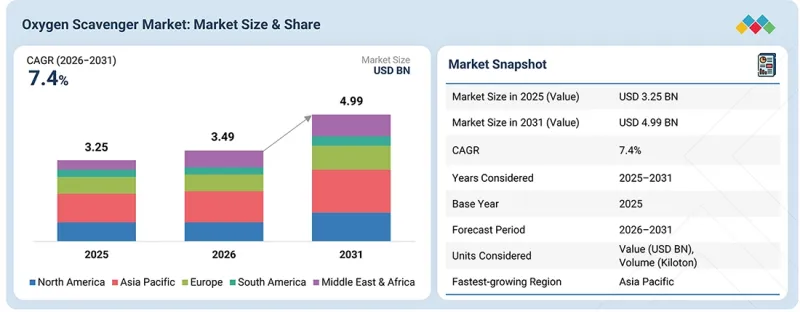
산소 흡수제 시장은 2026년 34억 9,000만 달러에서 2031년까지 49억 9,000만 달러에 달할 것으로 예상되며, 예측 기간 동안 연평균 성장률(CAGR)은 7.4%를 기록할 전망입니다.
| 조사 범위 | |
|---|---|
| 조사 대상 기간 | 2025-2031년 |
| 기준 연도 | 2025년 |
| 예측 기간 | 2026-2031년 |
| 산정 단위 | 금액(백만/십억 달러), 킬로톤 |
| 부문 | 유형, 형태, 최종 이용 산업 및 지역 |
| 대상 지역 | 북미, 아시아태평양, 유럽, 중동 및 아프리카, 남미 |
식품·음료, 제약, 전력, 석유·가스, 화학, 펄프·제지 업계에서 제품 보호의 일관성과 유통 기한 연장을 보장하기 위한 산소 관리의 필요성에 힘입어 산소 흡수제에 대한 수요가 꾸준히 증가하고 있습니다. 이 시장은 포장 식품 소비 확대, 의약품 생산 증가, 산업 인프라 개발에 더해 첨단 포장 및 가공 기술에 대한 투자를 배경으로 성장하고 있습니다. 또한, 포장 식품·음료, 의약품 및 산업용 분야에서 산소 흡수제의 사용 증가도 산소 흡수제에 대한 시장 수요에 기여하고 있습니다. 산업 공정 외에도 산소에 민감한 제품은 산화, 열화, 부패 또는 부식을 방지하기 위해 산소 관리가 필요합니다. 게다가 제품 품질 보증 및 유통 기한 연장, 공정 개선에 대한 수요가 높아지고 있어, 이는 시장 성장의 여지를 만들어내고 있습니다. 다양한 최종 이용 산업에서 첨단 산소 흡수제 기술의 적용은 전 세계 산소 흡수제 소비량의 지속적인 증가로 나타나고 있습니다.
“예측 기간 동안 산소 흡수제 시장에서 무기계 제품이 가장 큰 유형 부문이 될 것으로 전망됩니다.”
산소 흡수제 시장에서 무기 부문은 오랜 기간에 걸친 채택 실적, 신속한 산소 흡수 능력, 그리고 비용 효율적인 성능에 힘입어 가장 큰 점유율을 차지할 것으로 예상됩니다. 또한, 유통 기한 연장, 식품 폐기물 감소, 그리고 지속가능한 포장에 대한 수요 증가가 산소 제어 시장의 성장을 견인하고 있습니다. 기능성 포장의 개선, 용도에 따른 산소 흡수 기술의 혁신, 재활용 가능한 고차단 필름, 그리고 용도 특화형 산소 흡수 기술에 대한 수요가 높아지고 있는 점이 무기계 산소 흡수제의 성장을 더욱 뒷받침하고 있습니다. 의약품 포장에 대한 수요 증가와 식품·음료 업계 및 산업 분야에서 신뢰할 수 있는 산소 차단에 대한 수요 확대가 무기계 산소 흡수제 시장의 성장을 견인하는 주요 요인으로 작용하고 있습니다.
“예측 기간 동안 산소 흡수제 시장에서 액상 타입이 가장 큰 형태 부문이 될 것으로 전망됩니다.”
예측 기간 동안 액체 산소 흡수제는 신속한 산소 제거 능력, 사용 편의성, 그리고 연속 공정 산업에 대한 적합성으로 인해 가장 큰 시장 점유율을 차지할 것으로 예측됩니다. 액체 산소 흡수제는 발전, 화학 처리, 석유·가스 및 기타 산업에서 사용 가능하며, 이러한 산업에서는 부식을 방지하고 공정을 효율적으로 가동하기 위해 용존 산소의 제어가 필수적입니다. 일관된 산소 제어제에 대한 산업 수요 증가, 산업 활동의 활성화, 그리고 물을 사용하는 집약적 용도에서의 효율적인 부식 방지 필요성 등이 최종 이용 산업에서 액체 산소 흡수제 채택에 영향을 미치는 요인으로 작용하고 있습니다.
“예측 기간 동안 산소 흡수제 시장에서 식품 및 음료 산업이 가장 큰 최종 이용 산업 부문이 될 것으로 전망됩니다.”
예측 기간 동안 식품·음료 업계는 산소 흡수제 시장에서 가장 큰 점유율을 차지할 것으로 예측됩니다. 이는 유통 기한 연장, 식품 부패 방지 및 식품 품질 유지에 대한 수요가 이 부문에서 산소 흡수제 수요의 주요 촉진요인이 되고 있기 때문입니다. 제빵 제품, 육류, 유제품, 스낵, 기타 산소에 민감한 제품 등 포장 식품에 포함된 산소 흡수제는 산소를 제거하거나 감소시켜 산화에 의한 부패를 방지하는 데 도움이 됩니다. 생활 방식의 변화, 포장 식품 소비 증가, 식품 폐기물에 대한 인식 제고, 그리고 액티브 포장 및 고차단 포장 솔루션의 활용 확대에 따라 식품·음료 업계에서 산소 흡수제 솔루션의 사용이 증가할 것으로 예상됩니다.
“아시아태평양은 예측 기간 동안 산소 흡수제 시장에서 가장 큰 지역이 될 것으로 전망됩니다.”
아시아태평양의 산소 흡수제 시장은 2031년까지 매출이 크게 증가할 것으로 예상됩니다. 이는 주로 급속한 산업화, 생산능력 확대, 그리고 식품·음료, 제약, 전력, 석유·가스, 화학, 펄프·제지 산업에 대한 투자에 기인합니다. 산소 흡수제에 대한 수요는 중국, 인도, 일본, 한국 등의 국가들에 의해 뒷받침되고 있습니다. 의약품 생산, 식품 가공, 산업 부문 및 포장 용도에서의 급속한 성장이 산소 흡수제 수요를 끌어올리고 있습니다. 의약품·화학제품 제조, 포장 식품 생산, 산업 인프라, 그리고 현대적인 포장 기법에 대한 투자가 확대되고 있는 것은 이 지역 전체의 산소 흡수제 시장의 추가적인 성장을 촉진하는 추세입니다.
기업 규모별 : Tier 1 : 40%, Tier 2 : 30%, Tier 3 : 30%
직책별 : 이사 : 30%, 관리자 : 20%, 기타 : 50%
지역별 : 북미 : 20%, 유럽 : 10%, 아시아태평양 : 40%, 남미 : 10%, 중동 및 아프리카 : 20%
참고 : ‘기타’에는 영업, 마케팅 및 제품 관리자가 포함됩니다.
Tier 1 : 10억 달러 초과, Tier 2 : 5억 달러-10억 달러, Tier 3 : 5억 달러 미만
본 조사에서는 산소 흡수제 시장의 주요 기업들에 대해 기업 개요, 최근 동향 및 주요 시장 전략을 포함한 상세한 경쟁 분석을 수록하고 있습니다.
조사 범위
본 조사 보고서에서는 산소 흡수제 시장을 ‘유형(무기, 유기)’, ‘형태(필름·라미네이트, 소포장, 캐니스터, 액체, 수지, 기타)’, 그리고 ‘최종 이용 산업(식품·음료, 제약, 전력, 석유·가스, 화학, 펄프·제지, 기타)」로 분류하고 있습니다. 본 보고서에서는 산소 흡수제 시장의 성장에 영향을 미치는 시장 촉진요인, 제약요인, 과제 및 기회에 대한 상세한 정보를 포괄하고 있습니다. 주요 업계 기업에 대한 상세한 분석을 통해 각 기업의 사업 개요, 제공 제품, 그리고 산소 흡수제 시장 내 합병·인수, 신제품 출시, 제휴, 사업 확장 등의 주요 전략에 대한 인사이트를 제공합니다. 또한, 본 보고서에서는 산소 흡수제 시장의 생태계에서 두각을 나타내고 있는 스타트업 기업에 대한 경쟁 분석도 다루고 있습니다.
본 보고서를 구매해야 하는 이유
본 보고서는 시장 선도 기업 및 신규 진입 기업에게 산소 흡수제 시장 전체 및 그 하위 부문에 대해 입수 가능한 가장 정확한 시장 수익 추정치를 제공합니다. 본 보고서는 이해관계자가 경쟁 구도를 이해하고, 자사의 비즈니스를 더 나은 위치에 놓을 수 있는 인사이트를 얻어 적절한 시장 진입 전략을 수립하는 데 도움이 됩니다. 또한, 시장 동향을 파악하고 주요 시장 촉진요인, 시장 억제요인, 과제 및 기회에 대한 정보를 제공합니다.
본 보고서는 다음 사항에 대한 인사이트를 제공합니다:
- 주요 촉진요인(유통 기한 연장 및 산화 억제에 대한 수요 증가, 산소 흡수형 활성 포장의 채택 확대, 산소에 민감한 식품에 대한 산소 흡수제 사용 증가)에 대한 분석, 제약요인(규제 및 식품 접촉 안전 요건, 포장용 폴리머와의 호환성 제한, 안정성 및 조기 활성화 문제), 기회(비금속계 및 바이오 기반 산소 흡수제 개발, 필름·코팅·폴리머 포장에 스캐빈저 통합, 수분 및 자극에 의해 활성화되는 스캐빈저 시스템 개발), 및 과제(신흥 스캐빈저 기술의 상업적 규모 생산, 스캐빈저가 통합된 포장의 재활용 가능성, 그리고 실제 보관 조건 하에서 스캐빈저 성능 유지)에 대해 인사이트를 제공합니다.
- 제품 개발/혁신 : 산소 흡수제 시장의 향후 기술, 연구 개발 활동, 그리고 제품 및 서비스 출시에 대한 상세한 인사이트.
- 시장 개발 : 수익성이 높은 시장에 대한 종합적인 정보 - 본 보고서는 다양한 지역의 산소 흡수제 시장을 분석합니다.
- 시장 다각화 : 산소 흡수제 시장의 신제품 및 서비스, 미개척 지역, 최근 동향 및 투자에 관한 종합적인 정보.
- 경쟁 평가 : 미쓰비시 가스 케미컬(일본), 클라리언트(스위스), 에콜랩(미국), 바스프(독일), 아비언트 코퍼레이션(미국), 베올리아(프랑스), 링 컨테이너 테크놀로지스(미국), 이스트만 케미컬 컴퍼니(미국), 인도라마 벤처스 퍼블릭 컴퍼니 리미티드(태국), 아르케마(프랑스) 등 주요 기업들의 시장 점유율, 성장 전략 및 서비스 포트폴리오에 대한 심층 분석.
자주 묻는 질문
목차
제1장 서론
제2장 요약
제3장 주요 인사이트
- 산소 흡수제 시장에서 사업자에게 매력적인 기회
- 산소 흡수제 시장 : 유형별
- 산소 흡수제 시장 : 형태별
- 산소 흡수제 시장 : 최종 이용 산업별
- 산소 흡수제 시장 : 국가별
제4장 시장 개요
- 시장 역학
- 성장 촉진요인
- 성장 억제요인
- 기회
- 과제
- Porter's Five Forces 분석
- 신규 진입자의 위협
- 대체품의 위협
- 공급업체의 협상력
- 구매자의 협상력
- 경쟁 기업 간의 적대 관계의 격렬함
- 거시경제 지표
- 세계 GDP 동향
- 가치사슬 분석
- 생태계 분석
- 가격 책정 분석
- 지역별 평균 판매 가격 동향
- 품목별 평균 판매 가격 동향
- 무역 분석
- 수입 시나리오(HS 코드 2821)
- 수출 시나리오(HS 코드 2821)
- 2026-2027년 주요 회의 및 행사
- 고객의 비즈니스에 영향을 미치는 동향 및 변화
- 투자 및 자금 조달 시나리오
- 사례 연구 분석
- 첨단 포장 기술을 통한 코코넛 워터의 유통기한 및 안정성 향상
- 천연가스 시스템에서의 산소 제거
- 수소에 최적화된 산소 흡수제를 통한 유통기한 연장
- 2025년 미국 관세가 산소 흡수제 시장에 미치는 영향
- 주요 관세율
- 가격에 미치는 영향 분석
- 지역별 영향
- 최종 이용 산업에 미치는 영향
제5장 기술 발전, AI의 영향, 특허 및 혁신
- 주요 신흥 기술
- 재활용이 가능하며 RPET에 대응하는 산소 흡수성 수지
- 수분 활성화형 및 비철계 산소 흡수제
- 첨단 철계 산소 흡수제 조성물
- 보완 기술
- 산소 흡수 필름 및 능동형 포장 시스템
- 고차단성 및 단일 소재 포장 기술
- 관련 기술
- 산업용 수처리에서의 흡착식 산소 제거
- 전기화학 및 나노버블을 이용한 탈산소 기술
- 기술·제품 로드맵
- 단기(2026-2027년) | 최적화 및 성능 향상
- 중기(2027-2030년) | 확대 및 표준화
- 장기(2030-2035년 이후) | 고도화된 기능 및 지속가능한 혁신
- 특허 분석
- 특허의 법적 현황
- 관할권 분석
- 미래 응용
- 첨단 산소 흡수제 및 고효율 산소 제거 기술
- 자동 산소 흡수제 투여 및 첨단 처리 기술
- 스마트 산소 흡수제 성능 모니터링 시스템
- 디지털 제조 및 산소 흡수제 통합 플랫폼
- 첨단 산소 흡수제 및 고성능 산소 제어 기술
- AI/생성형 AI가 산소 흡수제 시장에 미치는 영향
- 주요 사용 사례 및 시장 잠재력
- 산소 흡수제 시장의 모범 사례
- 산소 흡수제 시장에서 AI 도입 사례 연구
- 상호 연관된 인접 생태계 및 시장 참여자에 미치는 영향
- 생성형 AI 도입에 대한 고객의 준비 현황 : 산소 흡수제 시장
제6장 규제 현황 및 지속가능성 노력
- 규제 현황
- 규제 기관, 정부 기관 및 기타 조직
- 업계 기준
- 규제 정책 추진
- 안전 프로토콜
- 지속가능한 개발
- 표준화
- 순환 경제
- 지속가능성 관련 노력
- 탈산소 성능, 환경 및 안전에 관한 노력
- 지속가능성에 미치는 영향 및 규제 정책에 대한 노력
- 인증, 표시 및 환경 기준
제7장 고객 동향과 구매 행동
- 의사결정 과정
- 주요 이해관계자와 구매 기준
- 구매 과정의 주요 이해관계자
- 구매 기준
- 도입 장벽 및 사내 과제
- 각 최종 이용 산업별 미충족 수요
- 시장의 수익성
- 수익 창출 가능성
- 비용 동향
- 주요 최종 이용 산업에서의 이익률 향상 기회
제8장 산소 흡수제 시장 : 유형별
- 무기계 산소 흡수제
- 유기계 산소 흡수제
제9장 산소 흡수제 시장 : 형태별
- 소형 파우치
- 캐니스터
- 액체
- 필름 및 라미네이트
- 수지
- 기타 형태
제10장 산소 흡수제 시장 : 최종 이용 산업별
- 식품·음료
- 의약품
- 전력
- 석유·가스
- 화학
- 펄프·제지
- 기타 최종 이용 산업
제11장 산소 흡수제 시장 : 지역별
- 북미
- 미국
- 캐나다
- 멕시코
- 유럽
- 독일
- 프랑스
- 스페인
- 영국
- 이탈리아
- 러시아
- 기타 유럽
- 아시아태평양
- 중국
- 일본
- 인도
- 호주
- 한국
- 기타 아시아태평양
- 중동 및 아프리카
- GCC 국가들
- 남아프리카
- 기타 중동 및 아프리카
- 남미
- 브라질
- 아르헨티나
- 기타 남미
제12장 경쟁 현황
- 주요 진입 기업의 전략/강점
- 수익 분석(2021-2025년)
- 시장 점유율 분석(2025년)
- 제품 비교
- 기업 평가 매트릭스 : 주요 기업, 2025년
- 스타 기업
- 신흥 리더
- 광범위한 업체
- 진입 기업
- 기업 사업 전개 : 주요 기업, 2025년
- 기업 평가 매트릭스 : 스타트업/중소기업, 2025년
- 선도적인 기업
- 대응력이 뛰어난 기업
- 역동적인 기업
- 출발점
- 경쟁사 벤치마킹 : 스타트업/중소기업, 2025년
- 기업 평가 및 재무 지표
- 재무 지표
- 기업 가치 평가
- 기업 가치 평가
- 경쟁 시나리오
- 제품 출시
- 거래
- 사업 확장
제13장 기업 개요
- 주요 기업
- MITSUBISHI GAS CHEMICAL COMPANY, INC.
- CLARIANT
- ECOLAB
- BASF
- AVIENT CORPORATION
- VEOLIA
- INDORAMA VENTURES PUBLIC COMPANY LIMITED
- THE SHERWIN-WILLIAMS COMPANY
- PROFUSION INDUSTRIES
- RING CONTAINER TECHNOLOGIES
- EASTMAN CHEMICAL COMPANY
- MULTISORB
- ARKEMA
- 기타 주요 기업
- PLASTIPAK HOLDINGS, INC.
- KHS GROUP
- DESICCARE, INC.
- SLB
- ADVANCION CORPORATION
- CHEMTEX SPECIALITY LIMITED
- THERMAX LIMITED
- ACCEPTA WATER TREATMENT
- HYDRITE CHEMICAL
- WILHELMSEN
- UMICORE
- SHAKTI CHEMICALS
제14장 조사 방법론
제15장 부록
KSM 26.10.26The oxygen scavenger market is expected to reach USD 4.99 billion by 2031 from USD 3.49 billion in 2026, at a CAGR of 7.4% during the forecast period.
| Scope of the Report | |
|---|---|
| Years Considered for the Study | 2025-2031 |
| Base Year | 2025 |
| Forecast Period | 2026-2031 |
| Units Considered | Value (USD Million/Billion), Volume (Kiloton) |
| Segments | Type, Form, End-use Industry, and Region |
| Regions covered | North America, Asia Pacific, Europe, Middle East & Africa, and South America |
Demand for oxygen scavengers has been increasing steadily, driven by the need for oxygen control to ensure consistent product protection and longer shelf life in the food & beverage, pharmaceutical, power, oil & gas, chemical, and pulp & paper industries. The market is expanding with rising packaged food consumption, pharmaceutical production, and industrial infrastructure development, coupled with investments in advanced packaging and processing technologies. The increased use of oxygen scavengers in packaged food and beverage, pharmaceutical, and industrial applications also contributes to market demand for oxygen scavengers. Products sensitive to oxygen, beyond industrial processes, need oxygen control to prevent oxidation, deterioration, spoilage, or corrosion. Further, escalated needs for quality assurance of products as well as renewed shelf life and process improvement are on the rise, giving scope for the growth of the market. The application of advanced oxygen scavenger technologies in various end-use industries is reflected in the continued increase in worldwide oxygen scavenger consumption.
"Inorganic is projected to be the largest type segment in the oxygen scavenger market during the forecast period."
In the oxygen scavenger market, the inorganic segment is expected to hold the largest share, supported by long-term adoption, rapid oxygen uptake, and cost-effective performance. Also, rising demand for longer shelf life, reduced food waste, and sustainable packaging is driving growth in oxygen control. The need for improved active packaging, application-based oxygen-scavenging innovations, recyclable high-barrier films, and application-specific oxygen-scavenging technologies is further fueling growth in inorganic oxygen scavengers. Rising demand for pharmaceutical packaging and growing demand from the food & beverage and industrial sectors for reliable oxygen protection are the main drivers of growth in the inorganic oxygen scavenger market.
"Liquid is projected to be the largest form segment in the oxygen scavenger market during the forecast period."
During the forecast period, liquid oxygen scavengers are projected to hold the largest share because of their quick oxygen-removal capability, ease of use, and suitability for continuous-process industries. Liquid oxygen scavengers can be used in power generation, chemical processing, oil & gas, and other industries, where dissolved-oxygen control is essential to combat corrosion and operate processes efficiently. Growing industry demand for consistent oxygen-control agents, rising industrial activity, and the need for efficient corrosion protection in intensive water applications are among the factors influencing the adoption of liquid oxygen scavengers in end-use industries.
"Food & beverage is projected to be the largest end-use industry segment in the oxygen scavenger market during the forecast period."
During the forecast period, food & beverage in the end-use industry segment is projected to hold the largest share in oxygen scavengers because the need to extend shelf life, prevent food spoilage, and preserve food quality is the major driver of oxygen scavenger demand in this segment. Oxygen scavengers in packaged foods like bakery, meat, dairy, snacks, and other oxygen-sensitive products help eliminate or reduce oxygen and prevent oxidative spoilage. Changing lifestyles, rising packaged food consumption, growing awareness of food wastage, and increased use of active and high-barrier packaging solutions are expected to increase the use of oxygen scavenger solutions in the end-use food & beverage industry.
"Asia Pacific is projected to be the largest region in the oxygen scavenger market during the forecast period."
The oxygen scavenger market in Asia Pacific is expected to experience a considerable rise in revenue by 2031. This is largely due to rapid industrialization, increased manufacturing capacity, and investments in the food & beverage, pharmaceutical, power, oil & gas, chemicals, and pulp & paper industries. Demand for oxygen scavengers is supported by countries such as China, India, Japan, and South Korea. The rapid growth in pharmaceutical production, food processing, the industrial sector, and packaging applications has increased demand for oxygen scavengers. Escalating investments in pharmaceutical & chemical manufacturing, packaged food production, industrial infrastructure, and modern packaging methods tend to further foster market growth for oxygen scavengers across this region.
By Company Type: Tier 1: 40%, Tier 2: 30%, and Tier 3: 30%
By Designation: Directors: 30%, Managers: 20%, and Others: 50%
By Region: North America: 20%, Europe: 10%, Asia Pacific: 40%, South America: 10%, and Middle East & Africa: 20%
Notes: Others include sales, marketing, and product managers.
Tier 1: >USD 1 billion; Tier 2: USD 500 million-1 billion; and Tier 3: <USD 500 million
Companies Covered: Mitsubishi Gas Chemical Company, Inc. (Japan), Clariant (Switzerland), Ecolab (US), BASF (Germany), Avient Corporation (US), Veolia (France), Ring Container Technologies (US), Eastman Chemical Company (US), Indorama Ventures Public Company Limited (Thailand), and Arkema (France) are covered in the report.
The study includes an in-depth competitive analysis of these key players in the oxygen scavenger market, with their company profiles, recent developments, and key market strategies.
Research Coverage
This research report categorizes the oxygen scavenger market based on Type (Inorganic, Organic), Form (Films & Laminates, Sachets, Canisters, Liquid, Resin, Others), and End-use Industry (Food & Beverage, Pharmaceutical, Power, Oil & Gas, Chemical, Pulp & Paper, and Others). The report covers detailed information on the drivers, restraints, challenges, and opportunities influencing the growth of the oxygen scavenger market. A detailed analysis of key industry players provides insights into their business overview, products offered, and key strategies, such as mergers, acquisitions, product launches, partnerships, and expansions, in the oxygen scavenger market. This report covers a competitive analysis of upcoming startups in the oxygen scavenger market ecosystem.
Reasons to Buy the Report
The report will provide market leaders/new entrants with the closest available revenue estimates for the overall oxygen scavenger market and its subsegments. This report will help stakeholders understand the competitive landscape, gain insights into better positioning their businesses, and plan suitable go-to-market strategies. The report will help stakeholders understand the pulse of the market and provide them with information on key market drivers, restraints, challenges, and opportunities.
The report provides insights into the following points:
- Analysis of key drivers (increasing demand for extended shelf life and oxidation control, rising adoption of oxygen-scavenging active packaging, and the growing use of oxygen scavengers for oxygen-sensitive food products), restraints (regulatory and food-contact safety requirements, compatibility limitations with packaging polymers, and stability and premature-activation issues), opportunities (development of non-metallic and bio-based oxygen scavengers, integration of scavengers into films, coatings, and polymer packaging, and the development of moisture- and stimulus-activated scavenging systems), and challenges (commercial-scale production of emerging scavenger technologies, recyclability of scavenger-integrated packaging, and maintaining scavenging performance under real storage conditions).
- Product Development/Innovation: Detailed insights into upcoming technologies, research & development activities, and product & service launches in the oxygen scavenger market.
- Market Development: Comprehensive information about profitable markets - the report analyzes the oxygen scavenger market across varied regions.
- Market Diversification: Exhaustive information about new products & services, untapped geographies, recent developments, and investments in the oxygen scavenger market.
- Competitive Assessment: In-depth assessment of market shares, growth strategies, and service offerings of leading players such as Mitsubishi Gas Chemical Company, Inc. (Japan), Clariant (Switzerland), Ecolab (US), BASF (Germany), Avient Corporation (US), Veolia (France), Ring Container Technologies (US), Eastman Chemical Company (US), Indorama Ventures Public Company Limited (Thailand), and Arkema (France), among others.
TABLE OF CONTENTS
1 INTRODUCTION
- 1.1 STUDY OBJECTIVES
- 1.2 MARKET DEFINITION
- 1.3 STUDY SCOPE
- 1.3.1 MARKET SEGMENTATION AND REGIONAL SPREAD
- 1.3.2 INCLUSIONS & EXCLUSIONS
- 1.3.3 YEARS CONSIDERED
- 1.3.4 CURRENCY CONSIDERED
- 1.3.5 UNITS CONSIDERED
- 1.4 STAKEHOLDERS
- 1.5 SUMMARY OF CHANGES
2 EXECUTIVE SUMMARY
- 2.1 KEY INSIGHTS AND MARKET HIGHLIGHTS
- 2.2 KEY MARKET PARTICIPANTS: MAPPING OF STRATEGIC DEVELOPMENTS
- 2.3 DISRUPTIVE TRENDS SHAPING OXYGEN SCAVENGER MARKET
- 2.4 HIGH GROWTH SEGMENTS
- 2.5 SNAPSHOT: GLOBAL MARKET SIZE, GROWTH RATE, AND FORECAST
3 PREMIUM INSIGHTS
- 3.1 ATTRACTIVE OPPORTUNITIES FOR PLAYERS IN OXYGEN SCAVENGER MARKET
- 3.2 OXYGEN SCAVENGER MARKET, BY TYPE
- 3.3 OXYGEN SCAVENGER MARKET, BY FORM
- 3.4 OXYGEN SCAVENGER MARKET, BY END-USE INDUSTRY
- 3.5 OXYGEN SCAVENGER MARKET, BY COUNTRY
4 MARKET OVERVIEW
- 4.1 INTRODUCTION
- 4.2 MARKET DYNAMICS
- 4.2.1 DRIVERS
- 4.2.1.1 Growing consumer concerns to reduce food wastage and demand for advanced packaging
- 4.2.1.2 Increasing demand for fresh and quality packaged foods
- 4.2.1.3 Growing need for oxygen control in industrial boiler systems to prevent corrosion and improve operational efficiency
- 4.2.2 RESTRAINTS
- 4.2.2.1 Environmental and disposal concerns of by-products
- 4.2.2.2 Limited awareness and understanding of oxygen scavengers
- 4.2.2.3 Stringent food contact regulations
- 4.2.3 OPPORTUNITIES
- 4.2.3.1 Rising demand for pharmaceuticals and medical devices
- 4.2.3.2 Changing consumer preference for convenience, premium quality, and wellness-focused ready-to-drink beverages
- 4.2.3.3 Adoption of PET and rPET in food & beverage sector
- 4.2.4 CHALLENGES
- 4.2.4.1 Incorporation of oxygen scavenging systems into polymer matrices
- 4.2.4.2 Challenges in processing oxygen-scavenging films
- 4.2.4.3 Effects of different food processing methods on films
- 4.2.4.4 Health concerns associated with oxygen scavengers
- 4.2.1 DRIVERS
- 4.3 PORTER'S FIVE FORCES ANALYSIS
- 4.3.1 THREAT OF NEW ENTRANTS
- 4.3.2 THREAT OF SUBSTITUTES
- 4.3.3 BARGAINING POWER OF SUPPLIERS
- 4.3.4 BARGAINING POWER OF BUYERS
- 4.3.5 INTENSITY OF COMPETITIVE RIVALRY
- 4.4 MACROECONOMIC INDICATORS
- 4.4.1 GLOBAL GDP TRENDS
- 4.5 VALUE CHAIN ANALYSIS
- 4.6 ECOSYSTEM ANALYSIS
- 4.7 PRICING ANALYSIS
- 4.7.1 AVERAGE SELLING PRICE TREND, BY REGION
- 4.7.2 AVERAGE SELLING PRICE TREND, BY TYPE
- 4.8 TRADE ANALYSIS
- 4.8.1 IMPORT SCENARIO (HS CODE 2821)
- 4.8.2 EXPORT SCENARIO (HS CODE 2821)
- 4.9 KEY CONFERENCES AND EVENTS, 2026-2027
- 4.10 TRENDS AND DISRUPTIONS IMPACTING CUSTOMER BUSINESS
- 4.11 INVESTMENT AND FUNDING SCENARIO
- 4.12 CASE STUDY ANALYSIS
- 4.12.1 ENHANCING SHELF LIFE AND STABILITY OF COCONUT WATER THROUGH ADVANCED PACKAGING SOLUTIONS
- 4.12.2 OXYGEN REMOVAL IN NATURAL GAS SYSTEMS
- 4.12.3 IMPROVING SHELF LIFE WITH HYDROGEN-OPTIMIZED OXYGEN SCAVENGERS
- 4.13 IMPACT OF 2025 US TARIFF - OXYGEN SCAVENGER MARKET
- 4.13.1 INTRODUCTION
- 4.13.2 KEY TARIFF RATES
- 4.13.3 PRICE IMPACT ANALYSIS
- 4.13.4 IMPACT ON REGIONS
- 4.13.4.1 North America
- 4.13.4.2 Europe
- 4.13.4.3 Asia Pacific
- 4.13.5 IMPACT ON END-USE INDUSTRIES
5 TECHNOLOGICAL ADVANCEMENTS, AI-DRIVEN IMPACT, PATENTS, AND INNOVATIONS
- 5.1 KEY EMERGING TECHNOLOGIES
- 5.1.1 RECYCLABLE AND RPET-COMPATIBLE OXYGEN-SCAVENGING RESINS
- 5.1.2 MOISTURE-ACTIVATED AND NON-IRON OXYGEN SCAVENGERS
- 5.1.3 ADVANCED IRON-BASED OXYGEN SCAVENGER COMPOSITIONS
- 5.2 COMPLEMENTARY TECHNOLOGIES
- 5.2.1 OXYGEN SCAVENGING FILMS AND ACTIVE PACKAGING SYSTEMS
- 5.2.2 HIGH-BARRIER AND MONO-MATERIAL PACKAGING TECHNOLOGIES
- 5.3 ADJACENT TECHNOLOGIES
- 5.3.1 ADSORPTION-BASED OXYGEN REMOVAL FOR INDUSTRIAL WATER TREATMENT
- 5.3.2 ELECTROCHEMICAL AND NANOBUBBLE-BASED DEOXYGENATION TECHNOLOGIES
- 5.4 TECHNOLOGY/PRODUCT ROADMAP
- 5.4.1 SHORT-TERM (2026-2027) | OPTIMIZATION & PERFORMANCE ENHANCEMENT
- 5.4.2 MID-TERM (2027-2030) | EXPANSION & STANDARDIZATION
- 5.4.3 LONG-TERM (2030-2035+) | ADVANCED FUNCTIONALITY & SUSTAINABLE INNOVATION
- 5.5 PATENT ANALYSIS
- 5.5.1 LEGAL STATUS OF PATENTS
- 5.5.2 JURISDICTION ANALYSIS
- 5.6 FUTURE APPLICATIONS
- 5.6.1 ADVANCED OXYGEN SCAVENGER & HIGH-EFFICIENCY OXYGEN REMOVAL TECHNOLOGIES
- 5.6.2 AUTOMATED OXYGEN SCAVENGER DOSING & ADVANCED TREATMENT TECHNOLOGIES
- 5.6.3 SMART OXYGEN SCAVENGER PERFORMANCE MONITORING SYSTEMS
- 5.6.4 DIGITAL MANUFACTURING & OXYGEN SCAVENGER INTEGRATION PLATFORMS
- 5.6.5 ADVANCED OXYGEN SCAVENGER & HIGH-PERFORMANCE OXYGEN CONTROL TECHNOLOGIES
- 5.7 IMPACT OF AI/GEN AI ON OXYGEN SCAVENGER MARKET
- 5.7.1 TOP USE CASES AND MARKET POTENTIAL
- 5.7.2 BEST PRACTICES IN OXYGEN SCAVENGER MARKET
- 5.7.3 CASE STUDIES OF AI IMPLEMENTATION IN OXYGEN SCAVENGER MARKET
- 5.7.4 INTERCONNECTED ADJACENT ECOSYSTEM AND IMPACT ON MARKET PLAYERS
- 5.7.5 CLIENTS' READINESS TO ADOPT GENERATIVE AI OXYGEN SCAVENGER MARKET
6 REGULATORY LANDSCAPE AND SUSTAINABILITY INITIATIVES
- 6.1 REGULATORY LANDSCAPE
- 6.1.1 REGULATORY BODIES, GOVERNMENT AGENCIES, AND OTHER ORGANIZATIONS
- 6.1.2 INDUSTRY STANDARDS
- 6.2 REGULATORY POLICY INITIATIVES
- 6.2.1 SAFETY PROTOCOLS
- 6.2.2 SUSTAINABLE DEVELOPMENT
- 6.2.3 STANDARDIZATION
- 6.2.4 CIRCULAR ECONOMY
- 6.3 SUSTAINABILITY INITIATIVES
- 6.3.1 OXYGEN-REMOVAL PERFORMANCE, ENVIRONMENTAL, AND SAFETY INITIATIVES
- 6.3.1.1 Low-carbon materials and sustainable product strategies
- 6.3.1.2 Green Industrial & Sustainable Applications
- 6.3.1 OXYGEN-REMOVAL PERFORMANCE, ENVIRONMENTAL, AND SAFETY INITIATIVES
- 6.4 SUSTAINABILITY IMPACT & REGULATORY POLICY INITIATIVES
- 6.5 CERTIFICATIONS, LABELING, AND ECO-STANDARDS
7 CUSTOMER LANDSCAPE & BUYER BEHAVIOR
- 7.1 DECISION-MAKING PROCESS
- 7.2 KEY STAKEHOLDERS AND BUYING CRITERIA
- 7.2.1 KEY STAKEHOLDERS IN BUYING PROCESS
- 7.2.2 BUYING CRITERIA
- 7.3 ADOPTION BARRIERS & INTERNAL CHALLENGES
- 7.4 UNMET NEEDS IN VARIOUS END-USE INDUSTRIES
- 7.5 MARKET PROFITABILITY
- 7.5.1 REVENUE POTENTIAL
- 7.5.2 COST DYNAMICS
- 7.5.3 MARGIN OPPORTUNITIES IN KEY END-USE INDUSTRIES
8 OXYGEN SCAVENGER MARKET, BY TYPE
- 8.1 INTRODUCTION
- 8.2 INORGANIC OXYGEN SCAVENGERS
- 8.2.1 HIGH DEMAND IN COMMERCIAL INDUSTRY TO FUEL MARKET
- 8.2.2 IRON-BASED
- 8.2.3 SULFITE-BASED
- 8.2.4 OTHER INORGANIC OXYGEN SCAVENGERS
- 8.3 ORGANIC OXYGEN SCAVENGERS
- 8.3.1 LOW CORROSIVITY AND ENVIRONMENTALLY FRIENDLY CHARACTERISTICS TO DRIVE MARKET
- 8.3.2 CARBOHYDRAZIDE
- 8.3.3 DIETHYLHYDROXYLAMINE
- 8.3.4 OTHER ORGANIC OXYGEN SCAVENGERS
9 OXYGEN SCAVENGER MARKET, BY FORM
- 9.1 INTRODUCTION
- 9.2 SACHETS
- 9.2.1 DEMAND FROM FOOD AND PHARMACEUTICAL INDUSTRIES TO BOOST MARKET
- 9.3 CANISTERS
- 9.3.1 OFFERS CONTROLLED AND SUSTAINED ABSORPTION OF OXYGEN OVER EXTENDED PERIODS
- 9.4 LIQUID
- 9.4.1 PRECISE CONTROL OVER OXYGEN LEVELS AND OPTIMAL PROTECTION AGAINST CORROSION TO PROPEL MARKET
- 9.5 FILMS & LAMINATES
- 9.5.1 BARRIER AGAINST PERMEATION AND REMOVAL OF OXYGEN ENTERING PACKAGES TO BOOST DEMAND
- 9.6 RESINS
- 9.6.1 OFFERS OPTIMAL EFFICIENCY OF OXYGEN REMOVAL
- 9.7 OTHER FORMS
10 OXYGEN SCAVENGER MARKET, BY END-USE INDUSTRY
- 10.1 INTRODUCTION
- 10.2 FOOD & BEVERAGE
- 10.2.1 PRESERVATION OF FOOD PRODUCTS TO BOOST MARKET
- 10.3 PHARMACEUTICALS
- 10.3.1 PREVENTION OF DEGRADATION OF PHARMACEUTICAL PRODUCTS TO FUEL DEMAND
- 10.4 POWER
- 10.4.1 EQUIPMENT LONGEVITY, LOWER OPERATIONAL COSTS, AND IMPROVED ENERGY OUTPUT TO PROPEL MARKET
- 10.5 OIL & GAS
- 10.5.1 NEED FOR REDUCING DEGRADATION RISKS TO DRIVE MARKET GROWTH
- 10.6 CHEMICALS
- 10.6.1 MAINTENANCE OF EFFICACY OF CHEMICAL FORMULATIONS TO BOOST DEMAND
- 10.7 PULP & PAPER
- 10.7.1 ENHANCEMENT OF EFFICIENCY IN PRODUCTION PROCESSES AND QUALITY OF PAPER PRODUCTS TO DRIVE MARKET
- 10.8 OTHER END-USE INDUSTRIES
11 OXYGEN SCAVENGER MARKET, BY REGION
- 11.1 INTRODUCTION
- 11.2 NORTH AMERICA
- 11.2.1 US
- 11.2.1.1 Growing dairy and processed products industries to boost market
- 11.2.2 CANADA
- 11.2.2.1 Demand from growing food & beverage industry to propel market
- 11.2.3 MEXICO
- 11.2.3.1 Growth of wastewater treatment and packaged food sectors to drive market
- 11.2.1 US
- 11.3 EUROPE
- 11.3.1 GERMANY
- 11.3.1.1 Rising population and demand for product quality to fuel market growth
- 11.3.2 FRANCE
- 11.3.2.1 Growth of agri-food and chemical sectors to boost market
- 11.3.3 SPAIN
- 11.3.3.1 Demand in food and pharma packaging to fuel market growth
- 11.3.4 UK
- 11.3.4.1 Increasing demand for sustainability and smart packaging in food & beverage industry to drive market
- 11.3.5 ITALY
- 11.3.5.1 Growth of chemicals, pharmaceuticals, and food & beverage industries to boost demand
- 11.3.6 RUSSIA
- 11.3.6.1 Growing dairy consumption and expansion of pharmaceutical sector to propel market
- 11.3.7 REST OF EUROPE
- 11.3.1 GERMANY
- 11.4 ASIA PACIFIC
- 11.4.1 CHINA
- 11.4.1.1 Evolving food preservation standards to drive demand for oxygen scavenger
- 11.4.2 JAPAN
- 11.4.2.1 High regulatory standards in pharmaceutical and food industries to drive market
- 11.4.3 INDIA
- 11.4.3.1 Growing food processing sector to increase demand
- 11.4.4 AUSTRALIA
- 11.4.4.1 Advanced manufacturing and innovation in food & beverage and pharma sectors to drive growth
- 11.4.5 SOUTH KOREA
- 11.4.5.1 Surge in demand for specialty foods to drive market
- 11.4.6 REST OF ASIA PACIFIC
- 11.4.1 CHINA
- 11.5 MIDDLE EAST & AFRICA
- 11.5.1 GCC COUNTRIES
- 11.5.1.1 UAE
- 11.5.1.1.1 Significantly expanding food sector to propel market growth
- 11.5.1.2 Saudi Arabia
- 11.5.1.2.1 High growth potential in various sectors to drive demand
- 11.5.1.3 Rest of GCC countries
- 11.5.1.1 UAE
- 11.5.2 SOUTH AFRICA
- 11.5.2.1 Economic diversification to accelerate market expansion
- 11.5.3 REST OF MIDDLE EAST & AFRICA
- 11.5.1 GCC COUNTRIES
- 11.6 SOUTH AMERICA
- 11.6.1 BRAZIL
- 11.6.1.1 Large food & beverage industry and sustainable energy policies to drive growth
- 11.6.2 ARGENTINA
- 11.6.2.1 Growing pharmaceutical sector to support market growth
- 11.6.3 REST OF SOUTH AMERICA
- 11.6.1 BRAZIL
12 COMPETITIVE LANDSCAPE
- 12.1 INTRODUCTION
- 12.2 KEY PLAYERS' STRATEGIES/RIGHT TO WIN
- 12.3 REVENUE ANALYSIS, 2021-2025
- 12.4 MARKET SHARE ANALYSIS, 2025
- 12.5 PRODUCT COMPARISON
- 12.6 COMPANY EVALUATION MATRIX: KEY PLAYERS, 2025
- 12.6.1 STARS
- 12.6.2 EMERGING LEADERS
- 12.6.3 PERVASIVE PLAYERS
- 12.6.4 PARTICIPANTS
- 12.6.5 COMPANY FOOTPRINT: KEY PLAYERS, 2025
- 12.6.5.1 Company footprint
- 12.6.5.2 Region footprint
- 12.6.5.3 Type footprint
- 12.6.5.4 Form footprint
- 12.6.5.5 End-use industry footprint
- 12.7 COMPANY EVALUATION MATRIX: STARTUPS/SMES, 2025
- 12.7.1 PROGRESSIVE COMPANIES
- 12.7.2 RESPONSIVE COMPANIES
- 12.7.3 DYNAMIC COMPANIES
- 12.7.4 STARTING BLOCKS
- 12.7.5 COMPETITIVE BENCHMARKING: STARTUPS/SMES, 2025
- 12.7.5.1 Detailed list of key startups/SMEs
- 12.7.5.2 Competitive benchmarking of key startups/SMEs
- 12.8 COMPANY VALUATION & FINANCIAL METRICS
- 12.8.1 FINANCIAL METRICS
- 12.8.2 COMPANY VALUATION
- 12.8.3 ENTERPRISE VALUATION
- 12.9 COMPETITIVE SCENARIO
- 12.9.1 PRODUCT LAUNCHES
- 12.9.2 DEALS
- 12.9.3 EXPANSIONS
13 COMPANY PROFILES
- 13.1 KEY PLAYERS
- 13.1.1 MITSUBISHI GAS CHEMICAL COMPANY, INC.
- 13.1.1.1 Business overview
- 13.1.1.2 Products/Solutions/Services offered
- 13.1.1.3 Recent developments
- 13.1.1.3.1 Deals
- 13.1.1.4 MnM view
- 13.1.1.4.1 Right to win
- 13.1.1.4.2 Strategic choices
- 13.1.1.4.3 Weaknesses and competitive threats
- 13.1.2 CLARIANT
- 13.1.2.1 Business overview
- 13.1.2.2 Products/Solutions/Services offered
- 13.1.2.3 MnM view
- 13.1.2.3.1 Right to win
- 13.1.2.3.2 Strategic choices
- 13.1.2.3.3 Weaknesses and competitive threats
- 13.1.3 ECOLAB
- 13.1.3.1 Business overview
- 13.1.3.2 Products/Solutions/Services offered
- 13.1.3.3 Recent developments
- 13.1.3.3.1 Deals
- 13.1.3.4 MnM view
- 13.1.3.4.1 Right to win
- 13.1.3.4.2 Strategic choices
- 13.1.3.4.3 Weaknesses and competitive threats
- 13.1.4 BASF
- 13.1.4.1 Business overview
- 13.1.4.2 Products/Solutions/Services offered
- 13.1.4.3 Recent developments
- 13.1.4.3.1 Deals
- 13.1.4.4 MnM view
- 13.1.4.4.1 Right to win
- 13.1.4.4.2 Strategic choices
- 13.1.4.4.3 Weaknesses and competitive threats
- 13.1.5 AVIENT CORPORATION
- 13.1.5.1 Business overview
- 13.1.5.2 Products/Solutions/Services offered
- 13.1.5.3 Recent developments
- 13.1.5.3.1 Product launches
- 13.1.5.4 MnM view
- 13.1.5.4.1 Right to win
- 13.1.5.4.2 Strategic choices
- 13.1.5.4.3 Weaknesses and competitive threats
- 13.1.6 VEOLIA
- 13.1.6.1 Business overview
- 13.1.6.2 Products/Solutions/Services offered
- 13.1.6.3 Recent developments
- 13.1.6.3.1 Deals
- 13.1.6.4 MnM view
- 13.1.7 INDORAMA VENTURES PUBLIC COMPANY LIMITED
- 13.1.7.1 Business overview
- 13.1.7.2 Products/Solutions/Services offered
- 13.1.7.3 Recent developments
- 13.1.7.3.1 Deals
- 13.1.7.4 MnM view
- 13.1.8 THE SHERWIN-WILLIAMS COMPANY
- 13.1.8.1 Business overview
- 13.1.8.2 Products/Solutions/Services offered
- 13.1.8.3 Recent developments
- 13.1.8.3.1 Deals
- 13.1.8.4 MnM view
- 13.1.9 PROFUSION INDUSTRIES
- 13.1.9.1 Business overview
- 13.1.9.2 Products/Solutions/Services offered
- 13.1.9.3 MnM view
- 13.1.10 RING CONTAINER TECHNOLOGIES
- 13.1.10.1 Business overview
- 13.1.10.2 Products/Solutions/Services offered
- 13.1.10.3 MnM view
- 13.1.11 EASTMAN CHEMICAL COMPANY
- 13.1.11.1 Business overview
- 13.1.11.2 Products/Solutions/Services offered
- 13.1.11.3 MnM view
- 13.1.12 MULTISORB
- 13.1.12.1 Business overview
- 13.1.12.2 Products/Solutions/Services offered
- 13.1.12.3 MnM view
- 13.1.13 ARKEMA
- 13.1.13.1 Business overview
- 13.1.13.2 Products/Solutions/Services offered
- 13.1.13.3 MnM view
- 13.1.1 MITSUBISHI GAS CHEMICAL COMPANY, INC.
- 13.2 OTHER PLAYERS
- 13.2.1 PLASTIPAK HOLDINGS, INC.
- 13.2.2 KHS GROUP
- 13.2.3 DESICCARE, INC.
- 13.2.4 SLB
- 13.2.5 ADVANCION CORPORATION
- 13.2.6 CHEMTEX SPECIALITY LIMITED
- 13.2.7 THERMAX LIMITED
- 13.2.8 ACCEPTA WATER TREATMENT
- 13.2.9 HYDRITE CHEMICAL
- 13.2.10 WILHELMSEN
- 13.2.11 UMICORE
- 13.2.12 SHAKTI CHEMICALS
14 RESEARCH METHODOLOGY
- 14.1 RESEARCH DATA
- 14.1.1 SECONDARY DATA
- 14.1.1.1 List of key secondary sources
- 14.1.1.2 Key data from secondary sources
- 14.1.2 PRIMARY DATA
- 14.1.2.1 Key data from primary sources
- 14.1.2.2 List of primary participants
- 14.1.2.3 Key industry insights
- 14.1.2.4 Breakdown of interviews with experts
- 14.1.1 SECONDARY DATA
- 14.2 MARKET SIZE ESTIMATION
- 14.2.1 BOTTOM-UP APPROACH
- 14.2.2 TOP-DOWN APPROACH
- 14.3 DATA TRIANGULATION
- 14.4 RESEARCH ASSUMPTIONS
- 14.5 LIMITATIONS & RISKS
15 APPENDIX
- 15.1 DISCUSSION GUIDE
- 15.2 KNOWLEDGESTORE: MARKETSANDMARKETS' SUBSCRIPTION PORTAL
- 15.3 CUSTOMIZATION OPTIONS
- 15.4 RELATED REPORTS
- 15.5 AUTHOR DETAILS


