|
시장보고서
상품코드
1440246
세계 디지털 농업 시장 : 점유율 분석, 업계 동향과 통계, 성장 예측(2024-2029년)Digital Agriculture - Market Share Analysis, Industry Trends & Statistics, Growth Forecasts (2024 - 2029) |
||||||
 Mordor Intelligence
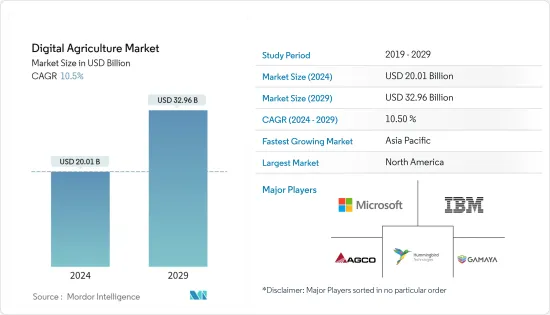
디지털 농업 시장 규모는 2024년 200억 1,000만 달러로 추정되고, 2029년까지 329억 6,000만 달러에 이를 것으로 예측되며, 예측 기간 동안 복합 연간 성장률(CAGR) 10.5%로 성장할 전망입니다.
농업 생산 최적화에서 디지털 농업의 이점에 대한 인식이 높아짐에 따라 농업 시장은 큰 붐을 일으키고 있습니다. 인구 증가로 인한 식량 수요가 증가함에 따라 디지털 농업 도구의 도입은 불가피합니다.
식량 안보와 영양에 대한 우려가 증가함에 따라 업계가 번창할 수 있는 여러 기회가 제공될 것으로 예상됩니다. 미국은 미래의 식량 생태계를 홍보하기 위해 많은 투자를할 것으로 기대됩니다. '농장부터 식탁까지 신선한 상태'에 대한 소비자 인사이트이 더욱 발전함에 따라 미국에서는 소매점 전체에서 채취한 야채를 입수할 수 있는 기회가 늘어날 것으로 예상됩니다. 예를 들어 2021년 6월 미국 과학재단의 사이버 물리 시스템 프로그램과 USDA의 국립식량농업연구소(NIFA)는 아이오와 주립대학과 일리노이대학 어바나대학 엔지니어가 이끄는 연구자들에게 700만 달러의 보조금을 제공했습니다. - 개별 작물 수준에서의 센싱, 모델링, 의사 결정 등 농장 관리 업무를 강화합니다.
영국 정부는 산업전략 가운데 작물 생산성 향상을 목적으로 인공지능(AI)을 도입했습니다. 이 나라는 2027년까지 연구개발 지출을 GDP의 2.4%까지 끌어올릴 것을 약속했습니다. 게다가 캠브리지에서는 새로운 5억 유로의 프로젝트가 발표되어 성장하는 아그리텍 산업에서 혁신자로서 영국의 지위를 강화하려고 하고 있습니다. 이 개발은 최대 4,000명의 직원을 수용할 수 있어 농업 기업과 기술 기업을 통합하여 세계 농업의 혁신과 생산성 중심지의 선두에 서게 됩니다.
각국의 정밀농업에 관한 전략적 정책 결정은 농가들이 관련 기술을 도입하는 것을 촉진할 것으로 기대됩니다. 농장 권고 서비스는 과학과 실천 사이의 교량을하고 있습니다. 이러한 서비스는 농민들이 시장의 최신 동향인 새로운 혁신적인 기술을 도입하는 데 도움이 됩니다. 이들은 사용 가능한 리소스를 보다 효율적으로 활용하고 비용 효율적이고 과제를 해결하는 데 도움이 됩니다.
기술의 진보와 혁신은 디지털 농업 시장을 추진하는 주요 요인 중 하나이며, 농부들이 자원을 효율적으로 사용하여 수율을 극대화하고 손실을 최소화하는 데 도움이 됩니다. 따라서 천연자원의 제한된 부족과 더불어 증가하는 인구 수요를 충족시킬 필요성이 높아짐에 따라 예측기간 동안 세계적으로 디지털농업시장이 추진될 것으로 예상됩니다.
디지털 농업 시장 동향
생산성 향상과 작물 건강 상태 개선을 위한 압력 증가
농부들은 보다 적은 화학물질로 더 많은 식량과 사료를 생산하도록 항상 압력을 받고 있습니다. 동시에 환경의 토지와 물 관리를 개선하면서 에너지와 노동력 사용을 줄이는 것이 필수적입니다. 인구가 급속히 증가함에 따라 증가하는 인구에 식품을 공급하는 것이 매우 어려워지고 농업 생산성을 높이는 높은 압력이 발생합니다. 정밀 농업과 같은 소프트웨어 및 사물 인터넷(IoT) 도구의 사용은 이러한 모든 요구 사항에 대한 해결책입니다.
FAO 데이터에 따르면 쌀, 밀, 보리, 옥수수 및 기타 곡물과 같은 주요 곡물 수율은 밀에 대해 2019년 41,079 hg/ha에서 2020년 40,708 hg/ha로 크게 감소했습니다. 보리와 다른 거친 곡물에서도 비슷한 감소 경향이 관찰되었습니다. 정밀 농업은 농부가 심어야 하는 씨앗, 적용해야 하는 비료의 수, 작물을 수확하는 최적의 시기, 예상 생산량을 알 수 있도록 도와줍니다.
유럽과 북미의 기술 도입으로 작물 생산성이 향상되었습니다. 예를 들어, 2022년 6월 프랑스의 Idele(Institut d'Elevage)은 농업 생태 지표를 결정하기 위해 프로그램에 30세트의 활동 데이터를 입력한 CAP'2ER라는 데이터베이스의 온라인 용도을 개발했습니다. 했습니다. 이 애플리케이션은 연간 총 연료 소비량, 동물 생산성(번식력, 성장, 판매 연령), 구입 한 사료, 비료의 양과 관리, 농장의 나무와 덤불, 관목, 헤지, 잔디, 벽돌 및 이시가키, 수역의 수.
브라질 농업 조사 공사가 설립한 브라질 정밀 농업 조사 네트워크(엠브라파)는 콩, 옥수수, 밀, 쌀, 면화, 초원, 유칼립투스, 소나무 및 기타 작물을 위한 다양한 도구를 개발해 왔습니다. 브라질에서 정밀 농업을 사용하면 작물 수율을 향상시키고 환경 보호를 이끌어 냈습니다. 예를 들어, 2022년 6월 상파울루 주립대학과 제휴하여 산카를로스의 와이너리 Terras Altas(리베이란 프레트, SP)에서 이중 전정 시스템에 의한 정밀 농업에 의해 우수한 와인을 생산하는 연구가 실시되었습니다. 했습니다. 및 기타 관리 관행.
그러므로 MapShots, AgDNA, AgroSense와 같은 정밀 농업 소프트웨어의 사용은 작물 생산성을 향상시키는 데 도움이 되어 토양의 건강 상태를 개선하고 세계 기타 지역에서 디지털 농업에 대한 수요를 촉진합니다.
아시아태평양은 가장 급성장하는 시장
중국의 농업 부문은 최근 스마트 농업 실천의 도입과 관련하여 획기적인 혁명을 경험하고 있습니다. 사물인터넷(IoT) 휴대폰 장치, 기어 센서 기반 관개 및 시비 장치, 밸브 위치 센서 등 센서 기반 기술의 출현은 이 분야에서 비교적 새로운 것이지만, 이 나라에서는 센서에 대한 새로운 수요 하지만 발견되었지만, 이것은 주로 농민들이 채택하는 기계화율 증가와 스마트 농업 관행 때문입니다.
중국의 농업 과학 기술의 진보에 대한 기여율은 농업 근대화에서 중국의 활성화 전략을 보여줍니다. 2020년 중국 중앙정부는 '디지털 마을'로 명명된 시험 프로젝트를 시작하여 정보기술 이용을 촉진하여 국내 소비를 자극하며 모바일 인터넷 주도 경제 붐으로 이어졌습니다.
마찬가지로 인도의 농업에서 디지털화에 대한 수요가 증가하는 것은 잘 알려져 있으며, 일반적인 밸류체인의 디지털화를 위한 노력이 이루어지고 있습니다. 2021년 9월 연합농업,농민복지대신은 CISCO, Ninjacart, Jio Platforms Limited, ITC Limited, NCDEX e-Markets Limited와 5개의 각서(MoU)를 체결함과 동시에 2021년부터 2025년의 디지털 농업 미션 시작하기 시작했습니다.(NeML), 파일럿 프로젝트를 통해 디지털 농업을 추진합니다. 디지털 농업 미션 2021-2025는 AI, 블록체인, 원격 감지, GIS 기술, 드론 및 로봇 사용과 같은 신기술 기반 프로젝트를 지원하고 가속화하는 것을 목표로 합니다.
2020년 2월, Jio Agri(JioKrishi) 플랫폼은 밸류체인 전반에 걸쳐 농업 생태계를 디지털화하고 농부에 힘을 주기 위해 릴라이언스 그룹 오브 컴퍼니에 의해 시작되었습니다. 플랫폼의 핵심 기능은 독립형 용도 데이터를 사용하여 권고 서비스를 제공합니다. 고급 기능은 다양한 소스의 데이터를 사용하여 데이터를 인공지능(AI)/머신러닝(ML) 알고리즘에 공급하고 정확하고 개인화된 조언을 제공합니다. 이 이니셔티브의 조종사 프로젝트는 자르나와 나식(마하라슈트라 주)에서 진행됩니다. 이와 같이 기술이 주도하는 농업기계의 가용성 증가와 기술기업 설립에 대한 정부자금 증가가 아시아태평양의 디지털농업시장을 견인하고 있습니다.
디지털 농업 산업 개요
디지털 농업 시장은 매우 세분화되어 있으며, 다양한 소규모 기업들이 시장 점유율을 얻기 위해 거대 기업과 경쟁하고 있습니다. 시장에서 수익을 올리는 주요 기업으로는 AGCO Corporation, HummingBird Technologies, IBM Corporation, Gamaya SA, Bayer Cropscience AG, Microsoft Corporation, Trimble Inc 등이 있습니다.
대기업이 합병,인수, 확장, 파트너십, 제품 출시 등 다양한 전략을 채택하여 사업을 확대하고 투자를 하고 있으며, 시장은 앞으로 더욱 통합될 것으로 예상됩니다. 양사는 디지털 농업 사업을 다각화하기 위해 새로운 제품 라인을 도입하고 다른 기업과 제휴 할 가능성이 높습니다.
기타 혜택
- 엑셀 형식 시장 예측(ME) 시트
- 3개월의 애널리스트 서포트
목차
제1장 서론
- 조사의 전제조건과 시장의 정의
- 조사 범위
제2장 조사 방법
제3장 주요 요약
제4장 시장 역학
- 시장 개요
- 시장 성장 촉진요인
- 시장 성장 억제요인
- Porter's Five Forces 분석
- 구매자의 협상력
- 공급기업의 협상력
- 대체 제품의 위협
- 신규 참가업체의 위협
- 경쟁 기업간 경쟁 관계의 격렬
제5장 시장 세분화
- 작물 감시
- 기술
- 가이던스 시스템
- 리모트 센싱
- 가변 레이트 기술
- 솔루션
- 하드웨어
- 소프트웨어
- 서비스
- 기타 솔루션
- 용도
- 필드 매핑
- 토양 모니터링
- 작물 조사
- 수확량 모니터링
- 변동 금리 적용
- 기타 용도
- 기술
- 인공지능
- 용도
- 날씨 추적
- 정밀농업
- 드론 분석
- 배포
- 클라우드
- 온프레미스
- 하이브리드
- 용도
- 정밀농업
- 용도
- 작물 관리
- 재무관리
- 농장 재고 관리
- 인사관리
- 날씨 추적 및 예보
- 기타 용도
- 유형
- 로컬/웹 기반
- 클라우드 기반
- 용도
- 지역
- 북미
- 미국
- 캐나다
- 멕시코
- 기타 북미
- 유럽
- 독일
- 영국
- 프랑스
- 이탈리아
- 스페인
- 기타 유럽
- 아시아태평양
- 인도
- 호주
- 중국
- 일본
- 호주
- 기타 아시아태평양
- 남미
- 브라질
- 아르헨티나
- 기타 남미
- 아프리카
- 남아프리카
- 기타 아프리카
- 북미
제6장 경쟁 구도
- 가장 채용된 전략
- 시장 점유율 분석
- Company Profile
- Gamaya SA
- Easytosee Agtech
- AGCO Corporation
- Small Robot Company
- Microsoft Corporation
- IBM Corporation
- Hummingbird Technologies Limited
- Deere &Company
- AgEagle Aerial Systems Inc.
- Bayer CropScience AG
- Case IH Agriculture(CNH Industrial America LLC.)
- DTN(CLEAR AG SOLUTIONS)
- Conservis Corporation
- Raven Industries
- Topcon Positioning Systems
- Trimble Inc.
제7장 시장 기회와 미래 동향
BJH 24.03.11The Digital Agriculture Market size is estimated at USD 20.01 billion in 2024, and is expected to reach USD 32.96 billion by 2029, growing at a CAGR of 10.5% during the forecast period (2024-2029).
The increasing awareness about the benefits of digital agriculture in optimizing agricultural production has resulted in a great boom in the agriculture market. With the growing food demand, owing to the increasing population, the adoption of digital agriculture tools is inevitable.
Growing concerns regarding food security and nutrition are anticipated to provide several opportunities for the industry to prosper. The United States is expected to invest a significant share in facilitating the ecosystem for future foods. As more consumer insights are developed in terms of 'fresh-from-farm-to-table,' the availability of freshly harvested vegetables across retail outlets is expected to increase in the United States. For instance, in June 2021, the National Science Foundation's Cyber-Physical Systems program and the USDA's National Institute of Food and Agriculture (NIFA) provided USD 7 million in grants to researchers led by engineers from the Iowa State University and the University of Illinois Urbana-Champaign on operations of farm managing, like sensing, modeling, and decision-making at the level of individual crops.
The United Kingdom government, in its industrial strategy, has put artificial intelligence (AI) aimed at escalating crop productivity. The country has committed to boosting R&D spending to 2.4% of the GDP by 2027. Furthermore, a new EUR 500 million project has been announced in Cambridge, which seeks to cement Britain's position as an innovator in the growing agri-tech industry. The development will accommodate up to 4,000 employees and will bring together agricultural and tech companies to spearhead a center of global agricultural innovation and productivity.
Strategic policymaking for precision farming by the countries is expected to encourage farmers to adopt the related technologies. Farm advisory services are bridging the gap between science and practice. These services help farmers in adopting new innovative technologies, which is the latest trend in the market. They are more efficient in utilizing the available resources, are cost-effective, and can help face challenges.
Technological advancements and innovations are among the major factors driving the digital agriculture market, helping farmers maximize their yield and minimize losses with efficient use of resources. Hence, the increased need to meet the demand of the growing population, along with the limited scarcity of natural resources, is anticipated to drive the market for digital farming globally during the forecast period.
Digital Agriculture Market Trends
Increasing Pressure for Higher Productivity and Improved Crop Health
There is constant pressure on the farmers to produce more food and animal feed with lesser amounts of chemicals. At the same time, it is essential to use less energy and labor while improving the management of environmental land and water. With the population growing rapidly, it is becoming very difficult to feed the increasing population, thereby creating high pressure to increase agricultural productivity. The use of software such as precision farming, along with the Internet of Things (IoT) tools, is a solution to all these requirements.
According to the FAO data, the yield for major cereal crops like rice, wheat, barley, corn, and other grains reduced considerably from 41,079 hg/ha in 2019 to 40,708 hg/ha in 2020 for wheat; a similar reduced trend for barley and other coarse grains was observed. Precision farming helps farmers know the seeds that have to be planted, the number of fertilizers that need to be applied, the best time to harvest the crops, and the expected output.
The adoption of technology in Europe and North America has increased crop productivity. For instance, in June 2022, Idele (Institut d'Elevage), France, developed a data-based online application called CAP'2ER, with thirty sets of activity data entered into the program to determine agro-ecological indicators. This application analyzes five sets of databases, such as livestock, manure management, fields, feed, and energy consumption, by analyzing total annual fuel consumption, animal productivity (fertility, growth, and marketing age), feed purchased, manure quantities and management, number of trees and thickets, shrubs, hedges, grass strips, stone piles and stone walls, and water bodies on the farm.
The Brazilian Precision Agriculture Research Network (Embrapa), established by Brazil Agricultural Research Corporation, has generated various tools for soybean, maize, wheat, rice, cotton, pasture, eucalyptus, pines, and other crops. The use of precision agriculture in Brazil has led to improvements in crop yields as well as environmental protection. For instance, in June 2022, a study was conducted by Embrapa instrumentation, Sao Carlos, in the winery Terras Altas (Ribeirao Preto, SP), in partnership with the Sao Paulo State University, to produce distinguished wines by precision farming by double pruning systems and other management practices.
Thus, the use of precision farming software, such as MapShots, AgDNA, AgroSense, and others, will help increase crop productivity, thereby improving soil health and driving the demand for digital agriculture in other regions of the world.
Asia-Pacific is the Fastest-growing Market
The Chinese agricultural sector has undergone a groundbreaking revolution with respect to the adoption of smart farming practices in recent years. Although the advent of sensor-based technologies, such as Internet of Things (IoT) cellular devices, gear tooth sensor-based irrigation and fertilization equipment, and valve position sensors, among others, is relatively new in the domain, the country has been witnessing a new-found demand for sensors, primarily due to the increased rate of mechanization and smart agricultural practices adopted by the farmers.
China's contribution rate to its agricultural science and technology progress indicates the country's revitalization strategy in terms of agricultural modernization. In 2020, the Chinese central government launched a pilot project named ''digital village', promoting the use of information technology to stimulate domestic consumption, leading to a boom in the mobile internet-driven economy.
Similarly, the rising demand for digitization in Indian agriculture is well acknowledged, with efforts being made toward digitizing the prevailing value chain. In September 2021, the Union Minister of Agriculture & Farmers Welfare launched the initiation of the Digital Agriculture Mission 2021-2025 while signing five memoranda of understanding (MoUs) with CISCO, Ninjacart, Jio Platforms Limited, ITC Limited, and NCDEX e-Markets Limited (NeML), to forward digital agriculture through pilot projects. The Digital Agriculture Mission 2021-2025 aims to support and accelerate projects based on new technologies, like AI, blockchain, remote sensing, and GIS technology and the use of drones and robots.
In February 2020, the Jio Agri (JioKrishi) platform was launched by Reliance Group of Company to digitize the agricultural ecosystem along the entire value chain to empower farmers. The core function of the platform uses stand-alone application data to provide advisory services. The advanced functions use data from various sources, feed the data into artificial intelligence (AI)/machine learning (ML) algorithms, and provide accurate, personalized advice. The pilot project for this initiative will take place at Jalna and Nashik (Maharashtra). Thus, the rise in technology-driven agricultural equipment availability and an increase in government funding for the establishment of tech firms are driving the digital agriculture market in the Asia-Pacific region.
Digital Agriculture Industry Overview
The digital agriculture market is highly fragmented, with various small players competing against giant firms to occupy market share. Some of the major revenue-generating companies in the market include AGCO Corporation, HummingBird Technologies, IBM Corporation, Gamaya SA, Bayer Cropscience AG, Microsoft Corporation, and Trimble Inc.
The market is expected to be more consolidated in the future, with the major players expanding and investing in their businesses by adopting various strategies, such as mergers and acquisitions, expansions, partnerships, and product launches. The companies are likely to introduce new product lines and partner with other firms to diversify their digital agriculture businesses.
Additional Benefits:
- The market estimate (ME) sheet in Excel format
- 3 months of analyst support
TABLE OF CONTENTS
1 INTRODUCTION
- 1.1 Study Assumptions and Market Definition
- 1.2 Scope of the Study
2 RESEARCH METHODOLOGY
3 EXECUTIVE SUMMARY
4 MARKET DYNAMICS
- 4.1 Market Overview
- 4.2 Market Drivers
- 4.3 Market Restraints
- 4.4 Porter's Five Forces Analysis
- 4.4.1 Bargaining Power of Buyers
- 4.4.2 Bargaining Power of Suppliers
- 4.4.3 Threat of Substitute Products
- 4.4.4 Threat of New Entrants
- 4.4.5 Intensity of Competitive Rivalry
5 MARKET SEGMENTATION
- 5.1 Crop Monitoring
- 5.1.1 Technology
- 5.1.1.1 Guidance System
- 5.1.1.2 Remote Sensing
- 5.1.1.3 Variable Rate Technology
- 5.1.2 Solution
- 5.1.2.1 Hardware
- 5.1.2.2 Software
- 5.1.2.3 Services
- 5.1.2.4 Other Solutions
- 5.1.3 Application
- 5.1.3.1 Field Mapping
- 5.1.3.2 Soil Monitoring
- 5.1.3.3 Crop Scouting
- 5.1.3.4 Yield Monitoring
- 5.1.3.5 Variable Rate Application
- 5.1.3.6 Other Applications
- 5.1.1 Technology
- 5.2 Artificial Intelligence
- 5.2.1 Application
- 5.2.1.1 Weather Tracking
- 5.2.1.2 Precision Farming
- 5.2.1.3 Drone Analytics
- 5.2.2 Deployment
- 5.2.2.1 Cloud
- 5.2.2.2 On-premise
- 5.2.2.3 Hybrid
- 5.2.1 Application
- 5.3 Precision Farming
- 5.3.1 Application
- 5.3.1.1 Crop Management
- 5.3.1.2 Financial Management
- 5.3.1.3 Farm Inventory Management
- 5.3.1.4 Personnel Management
- 5.3.1.5 Weather Tracking and Forecasting
- 5.3.1.6 Other Applications
- 5.3.2 Type
- 5.3.2.1 Local/Web-based
- 5.3.2.2 Cloud-based
- 5.3.1 Application
- 5.4 Geography
- 5.4.1 North America
- 5.4.1.1 United States
- 5.4.1.2 Canada
- 5.4.1.3 Mexico
- 5.4.1.4 Rest of North America
- 5.4.2 Europe
- 5.4.2.1 Germany
- 5.4.2.2 United Kingdom
- 5.4.2.3 France
- 5.4.2.4 Italy
- 5.4.2.5 Spain
- 5.4.2.6 Rest of Europe
- 5.4.3 Asia-Pacific
- 5.4.3.1 India
- 5.4.3.2 Australia
- 5.4.3.3 China
- 5.4.3.4 Japan
- 5.4.3.5 Australia
- 5.4.3.6 Rest of Asia-Pacific
- 5.4.4 South America
- 5.4.4.1 Brazil
- 5.4.4.2 Argentina
- 5.4.4.3 Rest of South America
- 5.4.5 Africa
- 5.4.5.1 South Africa
- 5.4.5.2 Rest of Africa
- 5.4.1 North America
6 COMPETITIVE LANDSCAPE
- 6.1 Most Adopted Strategies
- 6.2 Market Share Analysis
- 6.3 Company Profile
- 6.3.1 Gamaya SA
- 6.3.2 Easytosee Agtech
- 6.3.3 AGCO Corporation
- 6.3.4 Small Robot Company
- 6.3.5 Microsoft Corporation
- 6.3.6 IBM Corporation
- 6.3.7 Hummingbird Technologies Limited
- 6.3.8 Deere & Company
- 6.3.9 AgEagle Aerial Systems Inc.
- 6.3.10 Bayer CropScience AG
- 6.3.11 Case IH Agriculture (CNH Industrial America LLC.)
- 6.3.12 DTN (CLEAR AG SOLUTIONS)
- 6.3.13 Conservis Corporation
- 6.3.14 Raven Industries
- 6.3.15 Topcon Positioning Systems
- 6.3.16 Trimble Inc.