


|
시장보고서
상품코드
1435918
해군 레이더 시스템 : 시장 점유율 분석, 업계 동향과 통계, 성장 예측(2024-2029년)Naval Radar Systems - Market Share Analysis, Industry Trends & Statistics, Growth Forecasts (2024 - 2029) |
||||||
 Mordor Intelligence
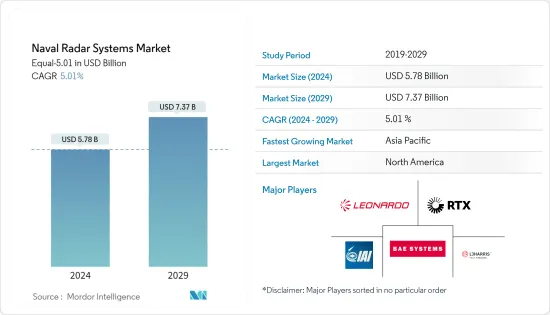
해군 레이더 시스템 시장 규모는 2024년에 57억 8,000만 달러로 추정되고 2029년까지 73억 7,000만 달러에 달할 것으로 예측되고 있으며, 예측 기간(2024-2029년) 중 5.01%의 CAGR로 성장합니다.
해상에서의 국경 문제와 영토 분쟁이 증가함에 따라 최근 수년간 새로운 호위함의 개발과 조달이 더욱 중요해지고 있습니다. 전 세계적인 지정학적 긴장이 고조되면서 해군의 전략적 중요성이 부각되고 있으며, 이에 따라 군용 호위함에 대한 수요가 증가하고 있습니다. 각국은 중요한 항로를 확보하고 영해를 보호하며 진화하는 지정학적 도전에 효과적으로 대응하기 위해 해양 역량을 강화하기 위해 노력하고 있으며, 이는 호위함의 조달을 촉진하고 있습니다.
군적 현대화 노력의 급증은 군용 호위함 시장을 촉진하는 데 있으며, 매우 중요한 역할을 하고 있습니다. 각국이 국방력 강화에 우선순위를 두고 있는 가운데, 감시가 종합적인 해군 현대화 프로그램의 필수 요소로 부상하고 있습니다. 최첨단 레이더 시스템의 통합은 광범위한 군 전략과 일치하며 시장의 지속적인 수요에 기여할 것입니다.
지정학적 긴장이 고조되고 해상 국경의 긴장과 대잠수함전의 중요성이 증가함에 따라 중국, 인도, 미국, 영국, 스페인 등 국가들은 감시 능력을 강화하기 위해 투자를 늘리고 있습니다.
감시용 첨단 레이더 시스템(대 스텔스 기술)을 개발하기 위한 기업의 투자 증가는 향후 시장 성장을 가속할 것으로 예상됩니다.
해군 레이더 시스템 시장 동향
모니터링 부문이 예측 기간 중 시장을 독점
감시 부문은 지상 및 공중 위협을 포함한 종합적인 위협 탐지 기능을 제공합니다. 조기 경보와 위협 식별이 점점 더 중요해짐에 따라 해군은 상황 인식 및 대응 능력을 강화하기 위해 감시 레이더 시스템을 우선시하고 있습니다. 감시 레이더 시스템은 외해, 연안, 혼잡한 수로 등 다양한 해양 환경에서 효과적으로 작동하도록 설계되었습니다. 이러한 적응성으로 인해 다양한 시나리오에서 해군 작전에 필수적인 요소로 자리 잡으며 시장 보급에 기여하고 있습니다.
또한 감시 레이더 시스템과 첨단 지휘통제 시스템의 통합은 해군 작전의 전반적인 효율성을 향상시킬 수 있습니다. 이러한 시스템이 제공하는 실시간 데이터를 통해 해군 사령관은 정보에 입각한 의사 결정을 내리고, 대응을 조정하고, 자원 배분을 최적화할 수 있으며, 시장에서 감시 부문의 중요성을 강화할 수 있습니다. 예를 들어 2022년 3월 미 해군은 RTX 코퍼레이션과 6억 5,100만 달러 규모의 SPY-6 레이더 계약을 체결한 바 있습니다. 계획에 따라 미 해군은 함대의 새로운 수상 함정에 적의 미사일과 비행기를 동시에 발견하고 추적할 수 있는 새로운 레이더를 장착하고 있습니다. 이번 계약으로 Raytheon Technologies의 사업은 SPY-6 레이더 제품군의 하드웨어, 생산 및 정비를 제공하게 됩니다. SPY-6 레이더를 통해 해군 함정은 더 먼 거리에서 극초음속 무기를 포함한 위협을 발견하고 더 빠르게 대응할 수 있게 됩니다. 해군은 2021년 하이테크 이지스 비행 III, USS 잭 H. 루카스(DDG125)에 첫 번째 SPY-6 레이더를 설치하기 시작했습니다.
아시아태평양은 예측 기간 중 괄목할 만한 성장세를 보일 것으로 예상
남중국해에서 중국의 지배력 확대로 인해 이 지역 국가들 간의 긴장이 고조되면서 해군 함대 조달과 현대화를 위한 주변국들의 해군 투자가 증가하고 있습니다. 한국, 호주, 인도, 중국, 인도네시아 등 국가들은 주로 새로운 해군 함정 개발 및 조달에 투자하고 있습니다. 중국 해군은 해군의 대규모 확장을 추진하고 있으며, 이로 인해 중국은 가까운 미래에 호위함과 잠수함 측면에서 러시아를 제치고 세계 최대 해군이 될 것으로 예상됩니다. 중국은 해안 방어에서 대잠수함전(ASW) 능력 강화를 지속적으로 강조하고 있습니다. 마찬가지로 2023-2024 회계연도 인도 해군 현대화 예산은 인도 총 자본 지출 예산의 30.35%, 즉 58억 8,000만 달러가 배정되었습니다. 인도 해군의 현대화 예산은 2022-2023 회계연도 예산 대비 13.25% 증가했습니다. 차세대 해군 함정 조달에 대한 투자가 증가함에 따라 예측 기간 중 해군 레이더 시장의 성장이 가속화 될 것으로 예상됩니다.
해군 레이더 시스템 산업 개요
해군 레이더 시스템 시장은 경쟁이 치열하며, 많은 주요 방산업체들이 다양한 해군 계획의 레이더 요구 사항을 충족시키기 위해 노력하고 있습니다. 해군 레이더 시스템 시장의 주요 업체로는 RTX Corporation, L3Harris Technologies Inc., Israel Aerospace Industries Ltd, Leonardo SpA, BAE Systems PLC 등이 있습니다. 이들 회사는 다양한 해군 프로그램에서 협력하고 있으며, 다양한 지역에서 입지를 강화하는 데 도움을 주고 있습니다. 또한 레이더 제조업체들은 새로운 레이더 솔루션을 개발하기 위해 협력하고 있습니다.
예를 들어 2021년 9월 헨솔트는 해군 감시 및 표적 포착을 위해 Quadome 레이더 시스템을 도입했습니다. 차세대 기술은 HENSOLDT의 주요 레이더 제품 라인 중 하나를 현대화하고 그룹의 광범위한 레이더 포트폴리오를 더욱 강화할 것입니다. 마찬가지로 2021년 6월 미 해군 구축함 폴 이그나티우스(Paul Ignatius)는 탈레스의 SMART-L Naval Multi-Mission(SMART-L MM/N) 레이더의 데이터를 사용하여 원격으로 표준 미사일 3(SM-3) 발사 테스트를 수행했습니다. 이러한 발전은 기업이 향후 수년간 시장 점유율을 확대하고 현금 흐름을 늘리는 데 도움이 될 것으로 예상됩니다. 마찬가지로 영국 해군 레이더 기술이 세계 시장의 리더로 남을 수 있도록 영국 국방부(MoD)와 BAE Systems plc는 영국 해군이 탄도 미사일과 드론과 같은 새로운 위협에 대응하기 위해 필요한 차세대 레이더 기술 개발에 5,500만 달러를 투자했습니다.
기타 혜택
- 엑셀 형식의 시장 예측(ME) 시트
- 3개월간의 애널리스트 지원
목차
제1장 서론
- 조사의 전제조건
- 조사 범위
제2장 조사 방법
제3장 주요 요약
제4장 시장 역학
- 시장 개요
- 시장 촉진요인
- 시장 억제요인
- Porter's Five Forces 분석
- 신규 진출업체의 위협
- 구매자의 교섭력
- 공급 기업의 교섭력
- 대체품의 위협
- 경쟁 기업간 경쟁의 강도
제5장 시장 세분화
- 응용
- 감시
- 미사일 유도
- 지역
- 북미
- 미국
- 캐나다
- 유럽
- 영국
- 독일
- 프랑스
- 러시아
- 기타 유럽
- 아시아태평양
- 중국
- 인도
- 일본
- 한국
- 호주
- 대만
- 기타 아시아태평양
- 라틴아메리카
- 브라질
- 멕시코
- 기타 라틴아메리카
- 중동 및 아프리카
- 터키
- 사우디아라비아
- 남아프리카공화국
- 기타 중동 및 아프리카
- 북미
제6장 경쟁 구도
- 벤더의 시장 점유율
- 기업 개요
- RTX Corporation
- Terma Group
- Leonardo SpA
- Israel Aerospace Industries Ltd
- THALES
- BAE Systems PLC
- HENSOLDT AG
- Saab AB
- Rosoboronexport
- L3Harris Technologies Inc.
- Bharat Electronics Limited(BEL)
- Northrop Grumman Corporation
제7장 시장 기회와 향후 동향
KSA 24.03.07The Naval Radar Systems Market size is estimated at USD 5.78 billion in 2024, and is expected to reach USD 7.37 billion by 2029, growing at a CAGR of 5.01% during the forecast period (2024-2029).
Development and procurement of new frigates have gained importance in the past few years due to the increasing border issues and territorial conflicts at sea. Escalating geopolitical tensions globally underscores the strategic importance of naval forces, fostering a heightened demand for military frigates. Nations seek to bolster their maritime capabilities to secure vital sea routes, protect territorial waters, and respond effectively to evolving geopolitical challenges, thereby driving the procurement of frigates.
The surge in military modernization initiatives plays a pivotal role in driving the market for military frigates. As nations prioritize upgrading their defense capabilities, surveillance emerges as an integral component of comprehensive naval modernization programs. The incorporation of state-of-the-art radar systems aligns with broader military strategies, contributing to sustained demand in the market.
Due to growth in geopolitical tensions, maritime border tension, and the growing importance of anti-submarine warfare, countries like China, India, the United States, the United Kingdom, Spain, etc., are increasing their investments towards strengthening their surveillance capabilities.
The increasing investments by the companies to develop new and advanced radar systems for surveillance (counter-stealth technologies) are anticipated to bolster the growth of the market in the coming future.
Naval Radar Systems Market Trends
Surveillance Segment Will Dominate the Market During the Forecast Period
The surveillance segment provides comprehensive threat detection capabilities, encompassing both surface and airborne threats. With an increasing emphasis on early warning and threat identification, naval forces prioritize surveillance radar systems to enhance their situational awareness and response capabilities. Surveillance radar systems are designed to operate effectively in diverse maritime environments, including open seas, littoral zones, and congested waterways. Their adaptability makes them indispensable for naval operations across a spectrum of scenarios, contributing to their prevalence in the market.
Moreover, the integration of surveillance radar systems with advanced command and control systems enhances the overall effectiveness of naval operations. Real-time data provided by these systems enables naval commanders to make informed decisions, coordinate responses, and optimize the allocation of resources, reinforcing the significance of the surveillance segment in the market. For instance, in March 2022, The US Navy awarded a USD 651 million contract to RTX corporation for SPY-6 radars. As per the plans, the US Navy is outfitting new surface ships in its fleet with new radars that can find and track enemy missiles and planes simultaneously. With the award, Raytheon Technologies' business will provide hardware, production, and sustainment for the SPY-6 family of radars. The SPY-6 radars will allow naval vessels to find threats, including hypersonic weapons, at greater distances and to react faster to them. The Navy began installing the first SPY-6 radar on its high-tech Aegis Flight III, the USS Jack H. Lucas (DDG 125), in 2021.
Asia-Pacific is Expected Show Remarkable Growth During the Forecast Period
The escalating tensions between the various countries in this region due to the increasing dominance of China in the South China Sea have led to an increase in naval investments by the neighboring countries to procure and modernize their naval fleet. Countries like South Korea, Australia, India, China, and Indonesia are primarily investing in the development and procurement of new naval vessels. China's navy is undergoing a huge naval fleet expansion, which is projected to help China surpass Russia as the largest navy in the world in terms of frigates and submarines in the near future. China is continually emphasizing increasing its anti-submarine warfare (ASW) capabilities from coastal defense to blue-water operations. Similarly, out of the total modernization budget as a percentage of India's capital outlay budget, the Indian Navy was allocated 30.35%, i.e., USD 5.88 billion, for the fiscal year 2023-2024. The Indian Navy's modernization budget has seen a 13.25% increase from the FY 2022-2023 budget. Increasing investments into the procurement of new-generation naval vessels are expected to accelerate the growth of the naval radars market during the forecast period.
Naval Radar Systems Industry Overview
The naval radar systems market is highly competitive, with many major defense manufacturers catering to the radar requirements of various naval programs. Some of the prominent players in the market of naval radar systems are RTX Corporation, L3Harris Technologies Inc., Israel Aerospace Industries Ltd, Leonardo SpA, and BAE Systems PLC. The companies are partnering for various naval programs, which are helping the companies increase their presence in various regions. Also, the radar manufacturers are collaborating to develop new radar solutions.
For instance, in September 2021, HENSOLDT introduced the Quadome radar system for naval surveillance and target acquisition. The new-generation technology modernizes one of HENSOLDT's key radar product lines and further enhances the group's extensive radar portfolio. Similarly, in June 2021, the US Navy's destroyer, USS Paul Ignatius, conducted a Standard Missile 3 (SM-3) Launch on Remote test using data from Thales' SMART-L Naval Multi-Mission (SMART-L MM/N) radar. Such developments are anticipated to help the companies increase their share in the market as well as increase their cashflows in the coming years. Similarly, to ensure that British naval radar technology remains a global market leader, the UK Ministry of Defence (MoD) and BAE Systems plc invested USD 55 million to develop the next generation of radar technology which the Royal Navy requires to tackle emerging threats, including ballistic missiles and drones.
Additional Benefits:
- The market estimate (ME) sheet in Excel format
- 3 months of analyst support
TABLE OF CONTENTS
1 INTRODUCTION
- 1.1 Study Assumptions
- 1.2 Scope of the Study
2 RESEARCH METHODOLOGY
3 EXECUTIVE SUMMARY
4 MARKET DYNAMICS
- 4.1 Market Overview
- 4.2 Market Drivers
- 4.3 Market Restraints
- 4.4 Porter's Five Forces Analysis
- 4.4.1 Threat of New Entrants
- 4.4.2 Bargaining Power of Buyers/Consumers
- 4.4.3 Bargaining Power of Suppliers
- 4.4.4 Threat of Substitute Products
- 4.4.5 Intensity of Competitive Rivalry
5 MARKET SEGMENTATION
- 5.1 Application
- 5.1.1 Surveillance
- 5.1.2 Missile Guidance
- 5.2 Geography
- 5.2.1 North America
- 5.2.1.1 United States
- 5.2.1.2 Canada
- 5.2.2 Europe
- 5.2.2.1 United Kingdom
- 5.2.2.2 Germany
- 5.2.2.3 France
- 5.2.2.4 Russia
- 5.2.2.5 Rest of Europe
- 5.2.3 Asia-Pacific
- 5.2.3.1 China
- 5.2.3.2 India
- 5.2.3.3 Japan
- 5.2.3.4 South Korea
- 5.2.3.5 Australia
- 5.2.3.6 Taiwan
- 5.2.3.7 Rest of Asia-Pacific
- 5.2.4 Latin America
- 5.2.4.1 Brazil
- 5.2.4.2 Mexico
- 5.2.4.3 Rest of Latin America
- 5.2.5 Middle-East and Africa
- 5.2.5.1 Turkey
- 5.2.5.2 Saudi Arabia
- 5.2.5.3 South Africa
- 5.2.5.4 Rest of Middle-East and Africa
- 5.2.1 North America
6 COMPETITIVE LANDSCAPE
- 6.1 Vendor Market Share
- 6.2 Company Profiles
- 6.2.1 RTX Corporation
- 6.2.2 Terma Group
- 6.2.3 Leonardo SpA
- 6.2.4 Israel Aerospace Industries Ltd
- 6.2.5 THALES
- 6.2.6 BAE Systems PLC
- 6.2.7 HENSOLDT AG
- 6.2.8 Saab AB
- 6.2.9 Rosoboronexport
- 6.2.10 L3Harris Technologies Inc.
- 6.2.11 Bharat Electronics Limited (BEL)
- 6.2.12 Northrop Grumman Corporation


