|
시장보고서
상품코드
1521625
티슈페이퍼 가공 기계 : 시장 점유율 분석, 산업 동향 및 통계, 성장 예측(2024-2029년)Tissue Paper Converting Machines - Market Share Analysis, Industry Trends & Statistics, Growth Forecasts (2024 - 2029) |
||||||
 Mordor Intelligence
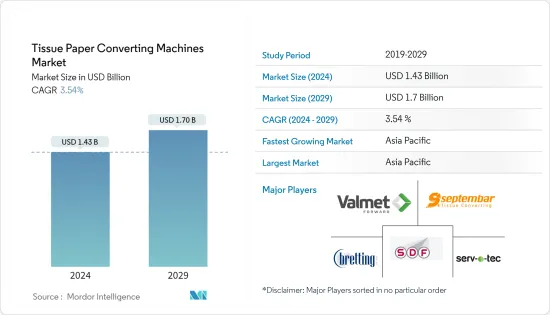
티슈페이퍼 가공 기계 시장 규모는 2024년에 14억 3,000만 달러로 추정되며, 2029년에는 17억 달러에 달할 것으로 예상되며, 예측 기간(2024-2029) 동안 3.54%의 CAGR로 성장할 것으로 예상됩니다.
휴지 생산은 환경에 큰 영향을 미칩니다. 티슈페이퍼는 재생 폐지와 버진 펄프로 만들어져 온실 가스 배출에 기여합니다(추정에 따르면 버진 펄프의 기여도는 폐지보다 30 % 더 높습니다). 환경 지속가능성에 대한 우려가 높아지면서 티슈페이퍼 가공 기계 제조업체는 다양한 녹색 제조 모델을 도입하고 있습니다. 여기에는 재생 재료 사용, 물과 에너지 소비 감소, 환경에 미치는 영향을 최소화하는 공정 채택 등이 포함됩니다.
주요 하이라이트
- 티슈페이퍼 제조에서는 에너지 절약, 섬유 절약, 최종 제품 품질, 기계 가동 능력 등 몇 가지 주요 분야에 연구 개발의 초점이 맞춰져 있습니다. 접근 흐름과 헤드 박스는 티슈 제조에서 가장 에너지 집약적인 단계입니다. 제조업체들은 이 영역을 최적화하기 위해 새로운 스마트 옵션을 적극적으로 모색하고 있으며, 더 나은 재고 균질화를 달성하고, 빠른 등급 변경을 촉진하고, 헤드박스 내에서 더 높은 일관성을 달성하기 위해 노력하고 있습니다. 이러한 노력은 전체 공정의 효율성을 개선하고 에너지 소비를 줄이며 티슈페이퍼 제품의 품질을 향상시키는 데 필수적입니다.
- 스마트 기술과 자동화의 통합이 증가하고 있으며, 이는 전반적인 작업 효율을 높이고, 낭비를 줄이며, 정확도를 높이는 데 도움이 되고 있습니다. 또한, 인건비 상승과 효율성에 대한 요구와 함께 고속 전자동 가공 라인에 대한 수요가 증가하고 있습니다. 전자동 가공 기계는 권선 및 포장과 같은 서로 다른 공정을 연결하여 낭비를 없애고 사람의 개입 필요성을 줄입니다. 주요 기업들은 새로운 제조 분야로의 진출에 따라 최첨단 로봇, 비전, 인공지능을 활용한 최적화에 많은 투자를 하고 있습니다.
- 혁신적인 가공 기술은 원료, 특히 종이 섬유의 효율적인 사용을 촉진합니다. 정밀 절단 및 엠보싱 기술은 재료의 낭비를 줄이는 방법의 한 예이며, 고급 제어 시스템은 생산 과정에서 물과 화학제품의 소비를 최적화합니다.
- 티슈 가공 공장 설립에 필요한 초기 투자는 토지 조달, 건물 건설 및 개조, 기계 구입 및 설치, 인프라 구축 등의 비용에 해당합니다. 대부분의 자금은 운전 자금으로 필요하지만, 기계 및 장비 비용은 총 투자 금액의 25% 이상에 달합니다. 이러한 비용에 대한 충분한 자본을 확보하는 것은 특히 소규모 사업이나 신규 사업자에게는 어려운 일입니다. 한정된 재원, 위험에 대한 인식, 규제 준수 등의 요인이 자금 조달 과정을 더욱 복잡하게 만들고 있습니다. 이러한 문제를 해결하기 위해 기업은 파트너십을 모색하고, 정부 지원 프로그램을 검토하고, 면밀한 사업 계획을 수립하고, 재무적 실행 가능성을 높이기 위해 비용을 최적화하는 등 다양한 방법을 모색할 수 있습니다.
- AFRY(제지 산업 전문가)와 수자노(세계 주요 제지 및 펄프 제조업체)가 발표한 보고서에 따르면 전 세계 종이 소비량은 2021년 4,100만 톤에서 2032년 5,500만 톤으로 크게 증가할 것으로 예상됩니다. 이처럼 전 세계적으로 티슈페이퍼에 대한 수요가 증가함에 따라 많은 중소규모의 생산업체들이 티슈페이퍼 제조업에 진출할 수 있는 기회가 생겨 가공 기계에 대한 수요가 증가할 것으로 보입니다.
티슈페이퍼 가공 기계 시장 동향
화장지 롤 가공 라인이 가장 큰 기계 유형 부문이 될 것
- 화장지를 포함한 일반 티슈 제품은 가공 기계 시장의 대부분을 차지합니다. 화장지 수요는 인구 증가, 도시화, 위생 수준 향상 등의 요인으로 인해 꾸준히 증가할 것으로 예상됩니다.
- 인구문제연구소에 따르면 2023년 세계 도시화율은 57%입니다. 북미, 라틴아메리카, 카리브해 지역이 가장 도시화가 진행된 지역으로 인구의 5분의 4 이상이 도시에 거주하고 있습니다.
- 또한 젖은 종이 타월 응용 분야를 대상으로하는 가공 기계 제조업체는 고품질의 내 습성 종이 타월을 효율적으로 생산할 수있는 기계를 개발함으로써 이익을 얻을 수 있습니다. 또한 젖은 종이 타월 포장 및 디스펜서 시스템의 혁신은 제조업체가 제공하는 기계를 차별화하고 진화하는 시장 요구에 대응할 수있는 기회를 제공합니다.
- 환경에 대한 관심이 높아지고 지속가능성 문제에 대한 소비자의 인식이 높아지면서 화장지 업계에서 친환경적인 관행의 채택을 촉진하고 있습니다. 제조업체들은 재생 섬유를 처리하고 폐기물을 줄이며 에너지 소비를 최소화할 수 있는 가공 기계에 투자하고 있습니다. 생분해성 및 친환경 화장지 제품에 대한 수요로 인해 제조업체들은 자재 취급을 처리할 수 있는 기계에 투자하고 있습니다.
- 또한, 개인화되고 혁신적인 화장지 제품에 대한 소비자의 선호도가 높아지면서 제조업체들은 유연한 가공 기계에 대한 투자를 늘리고 있습니다. 다양한 시트 크기, 플라이 구성, 엠보싱 패턴, 포장 옵션 등 다양한 제품을 생산할 수 있는 기계가 요구되고 있습니다. 커스터마이징 기능을 통해 제조업체는 틈새 시장에 대응하고 경쟁 환경에서 제품을 차별화할 수 있습니다. 또한, 가처분 소득이 높은 소비자는 고급스러운 엠보싱 화장지를 구매하고 더 많은 투자를 하는 경향이 있습니다.
- 티슈 제품 제조업체는 소비자들이 엠보싱 티슈에 대한 미적 이미지를 가지고 있다는 것을 알고 있습니다. 브랜드는 일반적으로 엠보싱을 사용하여 독특한 패턴, 로고 및 기타 특수 기능을 강화하여 소비자의 충성도와 일관된 구매 의욕을 높이기 위해 엠보싱을 사용합니다. 엠보싱 화장지는 미적 매력과 기타 소비자 취향에 특히 적합하지만, 제품의 품질을 간과하지 않는 것이 중요합니다.
- 엠보싱은 특히 기계적 강도와 경도와 같은 티슈의 특성에 영향을 미칠 수 있습니다. 적절한 엠보싱 패턴과 공정을 설계하면 적절한 조합으로 라미네이션을 촉진하여 고객이 고품질을 느낄 수 있는 다층 완제품을 생산할 수 있습니다. 엠보싱 기계 전문가와 협력하면 화장지 제품을 질적으로나 미학적으로 차별화할 수 있습니다.
아시아태평양이 큰 시장 점유율을 차지할 것으로 예상
- 일본은 나리타 국제공항 화장실에 스마트폰 클리닝 페이퍼라는 독특한 시설을 도입하여 청결에 대한 명성을 높였습니다. 대중의 편의성을 향상시키는 참신한 접근 방식으로 화장지 옆에 있는 디스펜서에서 종이 한 장을 꺼내 스마트폰 화면을 소독할 수 있도록 장려하고 있습니다. 이 클리닝 페이퍼의 도입은 스마트폰 화면이 변기보다 더 많은 세균이 번식하기 쉽다는 조사 결과에 따른 것입니다. 해외 관광객들은 일본 공중화장실의 청결함과 적응력에 항상 놀란다는 조사결과가 있습니다. 이는 타깃 시장에 영향을 미칠 것으로 예상됩니다.
- 인도 티슈페이퍼 부문은 현재 기술 혁신과 인수를 통한 통합이 진행되고 있습니다. 이를 통해 각 업체들은 시장 지위를 높이고, 제품 범위를 넓히고, 수요 증가에 대응하기 위해 첨단 전환 기술에 투자하고 있습니다. 도시화의 진전, Swachh Bharat와 같은 정부 이니셔티브에 따른 위생에 대한 관심 증가, 의료 및 접객업의 수요 증가는 티슈페이퍼, 냅킨, 화장지 및 타월의 소비를 촉진할 것으로 예상됩니다.
- 2024년 1월, 제지 및 펄프 업계 선두 기업인 안도라 제지(APL)는 이사회로부터 카디얌 공장에 최신식 티슈페이퍼 머신을 설치하는 것을 승인받았습니다. 이 기계는 최신 기술을 채택하여 하루 100톤의 생산능력을 갖추고 있으며, 회사의 제품 포트폴리오를 다양화할 수 있게 해줍니다. 생산능력 증설안은 페이셜, 화장지, 냅킨, 타월 등 다양한 등급의 티슈페이퍼를 생산하기 위해 연간 35,000톤(TPA)의 생산량으로 설정되어 있습니다. 회사는 15개월 이내에 생산을 시작하는 것을 목표로 하고 있습니다.
- 중국 국내 시장에서의 생산능력을 강화하기 위해 최신 TAD 기술을 포함한 고급 티슈 기계를 수입했습니다. 예를 들어, Hengan은 주로 우수한 페이셜 티슈와 키친 타월 생산에 사용되는 Valmet Hybrid 티슈 머신 2 대를 추가로 도입했습니다.
- 그 전에 헨간은 토스코텍의 TAD 티슈 머신 2대를 도입한 바 있습니다. 첫 번째 단계는 사용 중인 제품의 성능을 향상시키기 위해 첨단 기술과 장비를 사용하여 차별화 된 제품을 개발하는 것이었습니다. 예를 들어, 새로운 티슈 머신 기술과 컨버팅 머신을 도입하여 두께를 개선한 제품이 등장했습니다. 마인드 액트 어폰 마인드의 클라우드 시리즈 티슈, 빈다의 캐시미어 센서리 시리즈 화장실 롤, 빌조이의 TAD 기술이 적용된 온풍 키친타월 등이 대표적인 제품 출시 사례입니다.
- 인도네시아는 제지 산업이 활발하여 티슈페이퍼 기계 시장의 성장이 예상됩니다. 이러한 성장은 티슈페이퍼 제품에 대한 수요 급증, 제조 능력에 대한 투자, 기술 발전 및 환경 보호에 대한 인식의 진화에 의해 촉진될 것입니다.
- 티슈페이퍼 머신 공급업체는 혁신적인 솔루션을 제공하고 제지 제조업체의 구체적인 요구를 충족시킴으로써 이러한 기회를 활용할 수 있습니다. 2023년 11월 인도네시아 자카르타의 JIEXPO 전시 센터에서 인도네시아 국제 종이 체인 산업 전시회(Paper Chain Indonesia)가 시작되었습니다. 체인 산업 전시회(Paper Chain Indonesia)가 시작되었습니다.
티슈페이퍼 가공 기계 산업의 개요
티슈페이퍼 가공 기계 시장은 매우 세분화되어 있으며, C.G. Bretting Manufacturing Company, Inc, Valmet Oyj, 9 September Tissue Converting, Serv-o-Tec GmbH, SDF, SDF. Schnitt-Druck-Falz Spezialmaschinen GmbH와 같은 주요 업체들이 있습니다. 이 시장의 기업들은 제품 라인업을 강화하고 지속가능한 경쟁 우위를 확보하기 위해 제휴 및 인수와 같은 전술을 채택하고 있습니다.
기타 혜택
- 엑셀 형식의 시장 예측(ME) 시트
- 3개월간의 애널리스트 지원
목차
제1장 소개
- 조사 가정과 시장 정의
- 조사 범위
제2장 조사 방법
제3장 주요 요약
제4장 시장 인사이트
- 시장 개요
- 업계의 매력 - Porter's Five Forces 분석
- 업계 생태계 분석 - 공급업체, 소재 제조업체 등
제5장 시장 역학
- 시장 성장 촉진요인
- 티슈 제조 업계의 자동화 동향 상승
- 지속가능성 향상을 위한 가공 기술 혁신
- 시장 성장 억제요인
- 티슈페이퍼 가공 플랜트 고설비 비용
- 주요 기술 혁신과 발전 - 티슈페이퍼 가공 장비와 보조 장비
- 업계 표준과 규제
제6장 시장 세분화
- 기술별
- 자동
- 반자동
- 기계 유형별
- 화장실 롤 가공 라인
- 주방 롤
- 접이식 티슈 제조 라인
- 페이퍼 냅킨 가공 라인
- 독립형 시스템
- 지역별
- 북미
- 미국
- 캐나다
- 유럽
- 독일
- 프랑스
- 이탈리아
- 영국
- 아시아
- 일본
- 인도
- 중국
- 인도네시아
- 호주·뉴질랜드
- 라틴아메리카
- 중동 및 아프리카
- 북미
제7장 티슈페이퍼 수요 동향과 생산 설비 시장에 대한 영향
제8장 티슈 가공기 시장 동향
- 향후 시장 동향과 주요 성장기대
- 제조업체에 대한 주요 과제 대 OMET의 주요 경쟁사에 의한 혁신
- 비교 분석 - OMET Srl 대 OMET Srl 주요 경쟁사
- 기술적 인사이트 - 티슈 가공기
제9장 경쟁 상황
- 기업 개요
- C.G. Bretting Manufacturing Company, Inc.
- Valmet Oyj
- 9.Septembar Tissue Converting
- SERV-O-TEC GMBH
- SDF Schnitt-Druck-Falz Spezialmaschinen GmbH
- ZAMBAK KAGIT
- Omet Srl
- Kawanoe Zoki Co. Ltd
- MTorres Disenos Industriales S.A.U
- Baosuo Paper Machinery Manufacture Co. Ltd(Baosuo Enterprise)
- A.Celli Paper SpA(italia Technology Alliance SpA)
- United Converting Tissue SRL
- Futura SpA
- Paper Converting Machine Company(PCMC)
- Fujian Tmx Machinery Manufacturing Co. Ltd
- Chan Li Machinery Co. Ltd
- Unimax Group Engineering & Development Corporation
- ICM Makina
제10장 고객 리스트
ksm 24.08.01The Tissue Paper Converting Machines Market size is estimated at USD 1.43 billion in 2024, and is expected to reach USD 1.70 billion by 2029, growing at a CAGR of 3.54% during the forecast period (2024-2029).
Tissue paper production has a significant impact on the environment. Tissue paper is made from recycled wastepaper and virgin pulp, contributing to greenhouse gas emissions (estimates state that virgin pulp contributes 30% more than wastepaper). With the escalating concerns about environmental sustainability, tissue paper converting equipment manufacturers are extensively implementing green manufacturing models. This includes using recycled materials, reducing water and energy consumption, and adopting processes that minimize environmental impact.
Key Highlights
- In tissue paper manufacturing, research and development efforts remain focused on several key areas, including energy saving, fiber saving, final product quality, and the ability to run the machine. The approach flow and headbox area are some of the most energy-intensive stages in tissue-making. Manufacturers are actively exploring new smart options to optimize this area, aiming to achieve better stock homogenization, facilitate quick grade changes, and work toward higher consistencies in the headbox. These efforts are essential for improving overall process efficiency, reducing energy consumption, and enhancing the quality of tissue paper products.
- The integration of smart technology and automation is on the rise, helping to improve overall operational efficiency, reduce waste, and enhance accuracy. Also, the demand for high-speed, fully automated converting lines is expanding, along with rising labor costs and efficiency demands. The fully automatic converting machines reduce waste and the need for human intervention by connecting different processes, such as winding and packaging. Major companies spend heavily on cutting-edge robots, vision, and artificial intelligence-driven optimization as they expand into new manufacturing areas.
- Innovative converting technologies facilitate the efficient utilization of raw materials, particularly paper fibers. Precision cutting and embossing techniques are examples of methods that reduce material waste, while advanced control systems optimize the consumption of water and chemicals during manufacturing.
- The initial investment needed to establish a tissue-converting plant can be substantial, covering expenses like land procurement, building construction or renovation, machinery purchase and installation, and infrastructure development. Much of the capital will be required as working capital, while the cost of machinery and equipment can be as high as 25% or more of the total investment. Securing enough capital for these costs can be tough, especially for small or new businesses. Factors like limited financial resources, perceived risk, and regulatory compliance further complicate the funding process. To address these challenges, businesses may seek partnerships, explore government support programs, develop thorough business plans, and optimize costs to enhance financial viability.
- According to a report published by AFRY (Paper industry specialist) and Suzano (a key global paper and pulp producer), the global consumption of paper is expected to rise to a massive 55 million tons in 2032 from 41 million tons in 2021. This rising demand for tissue paper across the globe would open opportunities for many small and medium-scale producers to enter the tissue paper manufacturing industry, thereby increasing the demand for converting equipment.
Tissue Paper Converting Machines Market Trends
Toilet Roll Converting Lines to be the Largest Machine Type Segment
- Regular tissue products, including toilet paper, constitute a significant portion of the market for converting machinery. The demand for toilet paper is expected to rise steadily due to factors such as population growth, urbanization, and improving hygiene standards.
- According to the Population Reference Bureau, in 2023, the degree of urbanization worldwide was 57 %. North America, Latin America, and the Caribbean were the regions with the highest level of urbanization, with over four-fifths of the population residing in urban areas.
- Moreover, manufacturers of converting machinery targeting wet paper towel applications can capitalize by developing machinery capable of efficiently producing high-quality, moisture-resistant paper towels. Additionally, innovations in packaging and dispensing systems for wet paper towels present opportunities for manufacturers to differentiate their machinery offerings and cater to evolving market needs.
- Growing environmental concerns and increasing consumer awareness of sustainability issues are driving the adoption of eco-friendly practices in the toilet paper industry. Manufacturers invest in converting machinery capable of processing recycled fibers, reducing waste, and minimizing energy consumption. Demand for biodegradable and environmentally friendly toilet paper products prompts manufacturers to invest in machinery capable of handling recycled material.
- Furthermore, consumer preferences for personalized and innovative toilet paper products are driving manufacturers to invest in flexible converting machinery. Machinery capable of producing a variety of products, including different sheet sizes, ply configurations, embossing patterns, and packaging options, are in high demand. Customization capabilities enable manufacturers to cater to niche markets and segregate their products in a competitive landscape. In addition, consumers with higher disposable incomes often are more inclined to buy and invest more in luxurious embossed toilet tissue.
- Manufacturers of tissue products are aware of consumers' aesthetic associations with embossed tissue. Brands commonly utilize embossing to reinforce unique patterns, logos, or other special features to drive consumer loyalty and purchases consistently. Embossed toilet tissue is especially well-suited for aesthetic appeal and other consumer preferences; however, it is important not to overlook product quality.
- The embossing process can impact certain tissue attributes, particularly mechanical strength, and stiffness. By designing an appropriate embossing pattern and process, the correct combination can facilitate lamination, resulting in multi-ply finished products that customers perceive as high quality. By partnering with embossing machinery experts, toilet tissue products can be qualitatively and aesthetically distinguished.
Asia Pacific is Expected to Hold Significant Market Share
- Japan enhanced its reputation for cleanliness by introducing a unique addition to the toilets at Narita International Airport: smartphone cleaning paper. In a fresh approach to public convenience, individuals are encouraged to tear off a paper sheet from a dispenser beside the regular toilet paper roll to sanitize their phone screens. This introduction of cleaning paper was a response to research indicating that smartphone screens tend to harbor more germs than toilet seats. Surveys have consistently shown that tourists from other countries are consistently amazed by the cleanliness and adaptability of Japan's public restrooms. This is expected to impact the target market.
- The tissue paper sector in India is currently experiencing consolidation through innovation and acquisitions. This has allowed companies to enhance their market position, broaden their product range, and invest in advanced converting technologies to meet the growing demand. The escalating urbanization, increased focus on hygiene resulting from government initiatives like Swachh Bharat, and a significant rise in the demand from the healthcare and hospitality industries are projected to drive the consumption of tissue paper, napkins, and toilet and towel-grade paper.
- In January 2024, Andhra Paper Limited (APL), a top player in the paper and pulp industry, received approval from its Board of Directors to install a cutting-edge tissue paper machine at its Kadiyam manufacturing facility. The machine will employ state-of-the-art technology and have a daily production capacity of 100 tons, allowing diversification of the company's product portfolio. The proposed capacity addition is set at 35,000 Tons Per Annum (TPA) for producing various grades of tissue paper, including facial, toilet, napkin, and towel-grade tissue. The company aims to commence production within an estimated 15 months.
- To enhance production capacity within China's domestic market, high-end tissue machines, including the latest TAD technology, have been imported. For instance, Hengan incorporated two additional Valmet Hybrid tissue machines primarily used to produce superior facial tissue and kitchen towels.
- Before this, Hengan had implemented two Toscotec TAD tissue machines. The initial step involved the development of differentiated products using advanced technology and equipment to enhance the performance of products during usage. For instance, products with improved thickness were introduced by implementing novel tissue machine technology and converting machines. Cloud series tissue by Mind Act Upon Mind, cashmere sensory series toilet roll by Vinda, and hot air kitchen towels with TAD technology by Virjoy are some examples of such product launches.
- The proliferation of the paper industry in Indonesia is poised to drive growth in the tissue paper machine market. This growth will be fueled by surging demand for tissue paper products, investments in manufacturing capacity, technological advancements, and evolving environmental considerations.
- Tissue paper machine suppliers can capitalize on these opportunities by offering innovative solutions and addressing the specific needs of paper manufacturers. In November 2023, the Indonesia International Paper Chain Industry Exhibition (Paper Chain Indonesia) was launched at the JIEXPO Exhibition Center in Jakarta, Indonesia.
Tissue Paper Converting Machines Industry Overview
The tissue paper converting machines market is highly fragmented. There is the presence of major players like C.G. Bretting Manufacturing Company, Inc., Valmet Oyj, 9 September Tissue Converting, Serv-o-Tec GmbH, and SDF Schnitt-Druck-Falz Spezialmaschinen GmbH. Players in the market are adopting tactics such as partnerships and acquisitions in order to enhance their product offerings as well as gain a sustainable competitive advantage.
- January 2024 - United Converting Tissue SRL announced its collaboration with Lila Kagit in Turkey to supply a new Nexus Series Automatic Converting Line.
- January 2024 - Valmet will provide Suzano Papel e Celulose in Brazil with a comprehensive tissue line comprising a tissue-making line, converting equipment, and a biomass boiler. Although the total order value is undisclosed, such an order typically amounts to around EUR 100 million (USD 108 million).
- November 2023 - Valmet's acquisition of Korber Group's Business area tissue represents a strategic move aimed at expanding its market presence and diversifying its product portfolio in the tissue industry. The acquisition provides Valmet access to innovative converting and packaging technologies and services tailored to the tissue sector.
Additional Benefits:
- The market estimate (ME) sheet in Excel format
- 3 months of analyst support
TABLE OF CONTENTS
1 INTRODUCTION
- 1.1 Study Assumptions and Market Definition
- 1.2 Scope of the Study
2 RESEARCH METHODOLOGY
3 EXECUTIVE SUMMARY
4 MARKET INSIGHTS
- 4.1 Market Overview
- 4.2 Industry Attractiveness - Porter's Five Forces Analysis
- 4.3 Industry Ecosystem Analysis - Suppliers, Material Manufacturers, Etc.
5 MARKET DYNAMICS
- 5.1 Market Drivers
- 5.1.1 Growing Trend of Automation in Tissue Manufacturing Industry
- 5.1.2 Innovation in the Converting Technologies to Improve Sustainability
- 5.2 Market Restraints
- 5.2.1 High Setup Cost for Tissue-converting Plant
- 5.3 Key Innovations and Developments - Tissue-converting and Auxiliary Equipment
- 5.4 Industry Standards and Regulations
6 MARKET SEGMENTATION
- 6.1 By Technology
- 6.1.1 Automatic
- 6.1.2 Semi-automatic
- 6.2 By Machine Type
- 6.2.1 Toilet Roll Converting Lines
- 6.2.2 Kitchen Roll Converting Lines
- 6.2.3 Folded Tissue Converting Lines
- 6.2.4 Paper Napkin Converting Lines
- 6.2.5 Standalone Systems
- 6.3 By Geography***
- 6.3.1 North America
- 6.3.1.1 United States
- 6.3.1.2 Canada
- 6.3.2 Europe
- 6.3.2.1 Germany
- 6.3.2.2 France
- 6.3.2.3 Italy
- 6.3.2.4 United Kingdom
- 6.3.3 Asia
- 6.3.3.1 Japan
- 6.3.3.2 India
- 6.3.3.3 China
- 6.3.3.4 Indonesia
- 6.3.4 Australia and New Zealand
- 6.3.5 Latin America
- 6.3.6 Middle East and Africa
- 6.3.1 North America
7 TISSUE PAPER DEMAND TRENDS AND IMPACT ON THE PRODUCTION & EQUIPMENT MARKET
8 MARKET TRENDS IN THE TISSUE CONVERTING MACHINES INDUSTRY
- 8.1 Future Market Trends and Key Growth Expectations
- 8.2 Key Challenges for Manufacturers Vs. Innovations By Key Competitors of OMET
- 8.3 Comparative Analysis - OMET Srl Vs. Key Competitors
- 8.4 Technology Insights - Tissue Converting Machines
9 COMPETITIVE LANDSCAPE
- 9.1 Company Profiles*
- 9.1.1 C.G. Bretting Manufacturing Company, Inc.
- 9.1.2 Valmet Oyj
- 9.1.3 9.Septembar Tissue Converting
- 9.1.4 SERV-O-TEC GMBH
- 9.1.5 SDF Schnitt-Druck-Falz Spezialmaschinen GmbH
- 9.1.6 ZAMBAK KAGIT
- 9.1.7 Omet Srl
- 9.1.8 Kawanoe Zoki Co. Ltd
- 9.1.9 MTorres Disenos Industriales S.A.U
- 9.1.10 Baosuo Paper Machinery Manufacture Co. Ltd (Baosuo Enterprise)
- 9.1.11 A.Celli Paper SpA (italia Technology Alliance SpA)
- 9.1.12 United Converting Tissue SRL
- 9.1.13 Futura SpA
- 9.1.14 Paper Converting Machine Company (PCMC)
- 9.1.15 Fujian Tmx Machinery Manufacturing Co. Ltd
- 9.1.16 Chan Li Machinery Co. Ltd
- 9.1.17 Unimax Group Engineering & Development Corporation
- 9.1.18 ICM Makina