|
시장보고서
상품코드
1521874
의약품 가격 조사 툴 시장 : 시장 점유율 분석, 산업 동향 및 통계, 성장 예측(2024-2029년)Pharma Pricing Research Tools - Market Share Analysis, Industry Trends & Statistics, Growth Forecasts (2024 - 2029) |
||||||
 Mordor Intelligence
의약품 가격 조사 툴 시장 규모는 2024년에 16억 4,000만 달러로 추정되고, 2034년에는 20억 7,000만 달러에 이를 것으로 예측되며, 예측 기간 중(2024-2034년) CAGR은 4.80%로 성장할 전망입니다.
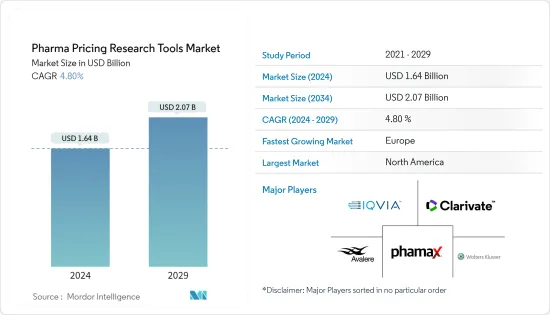
복잡한 의약품 가격 설정에 대한 수요 증가와 가치 기반 가격의 채택 확대가 의약품 가격 조사 툴 시장 확대를 뒷받침할 것으로 예상됩니다. 제약 업계에서는 의약품 가격의 복잡성과 가치 기반 가격 관련 문제가 꾸준히 증가하고 있습니다. 기존 비용 기반 가격 설정에서 벗어나 가치 기반 가격 설정 모델을 채택하는 제약 기업이 늘고 있습니다. 이는 의약품이 환자나 의료 시스템에 제공하는 임상적 및 경제적 가치를 고려한 것으로, 시장 간의 가격 변동도 포함되며, 이들 가격은 특정 환자 집단, 의료 시스템, 결제 의욕에 좌우됩니다. 선발 의약품의 약가는 수십년동안 일반적인 인플레이션을 초과하는 속도로 계속 증가하고 있으며, 제약 회사는 수익 확대로 인해 이러한 약가의 상승에 점점 의존하게 되었습니다. 예를 들어, AARP 공공정책연구소가 2023년 8월에 발표한 데이터에 따르면, 상위 25개 의약품의 현재 정가의 절반 이상이 미국에서 최초로 출시된 이후 가격 인상되고 있습니다. 따라서 의약품은 복잡한 가격으로 설정됩니다. 최고 의약품 가격 상승은 의약품 가격 조사 툴 수요에 박차를 가하고 있습니다. 이러한 툴은 제조업체가 복잡한 가격 설정 환경을 극복하고 충분한 정보를 바탕으로 의사 결정을 내릴 수 있는 힘이 되고 예측 기간 동안 시장 성장을 가속할 것으로 예상됩니다.
또한 가치 기반 가격(VBP)은 생산 비용에서 환자 결과, 비용 절감 및 사회적 이익을 향상시키는 약물 가치의 입증에 중점을 둡니다. 가격 조사 툴은 이 측면에 대한 데이터 수집 및 분석을 지원하고 증거별 가치 제안을 작성합니다. 기업은 의약품의 가치(수명 연신, 비용 절감)를 측정 및 정량화하는 툴이 필요합니다. 입증된 가치 증거를 바탕으로, 가치 기반 가격(VBP)은 데이터를 기반으로 하는 보고서를 작성하고 지불자와의 협상을 지원합니다. 예를 들어, 2022년 12월 JAMA Health Forum이 발표한 논문에서 가치 기반 가격(VBP)은 비용 효과적인 벤치마크를 충족하는 데 성공했으며, Quality-Adjusted Life-Year(QALY)당 10만 달러와 15만 달러를 밑돌지 않고 얻은 품질 조정 생존년(Quality-Adjusted Life Year)의 관점에서 제공되는 가치를 가격에 반영했습니다. 제조업체가 가치 기반 가격 설정에 초점을 맞추면 조사 기간 동안 의약품 가격 조사 툴 시장에 대한 수요가 증가했습니다.
복잡한 의약품 가격 설정에 대한 수요 증가와 밸류베이스 프라이싱의 채용 증가 등 앞서 언급한 요인으로부터, 이 시장은 앞으로도 성장을 계속할 것으로 예측됩니다.
그러나 저개발 국가에서는 의료 데이터의 다양한 측면에서 표준화가 부족하거나 의약품 가격 조사 툴의 도입과 효과에 대한 장애물이 예측 기간 동안 시장 성장을 방해하는 것으로 예상됩니다.
의약품 가격 조사 툴 시장 동향
시판 약물 부문은 예측 기간 동안 건전한 성장을 나타낼 전망
시판약(OTC)은 의료용 의약품에 비해 가격이 저렴하고 제조가 용이하고 규제 시나리오가 완만하기 때문에 조달에 편리합니다. 따라서 초기 단계 조사 및 가격 전략 테스트에 매력적입니다. 일반적으로 OTC 의약품은 저렴하고 구입하기 쉽기 때문에 대부분의 사람들이 OTC 의약품을 선택합니다. 예를 들어 KFF의 건강 추적이 2023년 1월 발표한 데이터에 따르면 성인의 85%가 처방약 결제에 의료보험을 이용하고 있다고 응답하고 있으며 성인 5명 중 1명이 필요한 처방약을 구입하기가 어렵다고 대답합니다. 이러한 접근법은 OTC 의약품에 대한 수요를 초래하여 예측 기간 동안 의약품 가격 조사 툴 시장에 대한 수요를 더욱 높여줍니다.
시판약은 시장에서 쉽게 이용할 수 있으며, 가격 민감도에 대한 소비자의 직접 피드백을 통해 제약 회사는 다양한 가격 모델을 실시간으로 평가하고 그에 따라 전략을 조정할 수 있습니다. 규제 당국과 소비자로부터 가격 설정의 투명성을 추구하는 압력이 높아지기 때문에 기업은 자사의 시판약의 가격 설정 전략을 정당화할 필요가 있으며, 견고한 조사 툴의 필요성이 더욱 높아지고 있습니다. 예를 들어 2023년 10월 유럽연합법에 따르면 EMIR은 매장 파생상품 계약, 중앙거래참가자(CCP), 거래보관기관에 관한 규제를 제정하고 미국 피츠버그에서 행해진 G20의 공약과 정합시킵니다. 복잡하고 복잡한 가격 규제를 준수해야 하는 의약품 제조업체에 대한 압력 증가는 전문적인 툴와 전문 지식에 대한 수요를 만들어 내고 예측 기간 동안 시장 확대를 더욱 가속화할 것으로 예상됩니다.
AI와 빅데이터 분석과 같은 새로운 기술은 OTC 가격 설정 상황을 변화시키고 있습니다. 기업은 이러한 툴을 활용하여 더 깊은 인사이트를 얻고 더 많은 정보를 기반으로 가격을 결정할 수 있습니다. 예를 들어 DataToBiz에 따르면 2023년 5월 통계에서 제약 산업은 2025년까지 창약 AI에 약 30억 달러를 소비한다고 합니다. 이러한 툴은 소비자 행동, 경쟁업체 가격, 시장 동향에 대한 귀중한 인사이트를 제공하며 제조업체가 충분한 정보를 바탕으로 가격을 결정하는 데 도움이 됩니다. 소프트웨어 개발을 위한 이러한 신흥국 시장은 예측 기간 동안 확대될 것으로 예상됩니다.
따라서 가격 감도 상승과 AI 주도 분석 등 시장세력은 향후 수년간 계속 성장할 것으로 예상됩니다.
예측기간 중 북미가 시장에서 큰 점유율을 차지할 전망
북미는 연구개발비 증가, 높은 약물비 부담, 엄격한 규제로 중요한 시장을 유지할 것으로 예상됩니다. 북미 제약회사는 연구개발에 많은 투자를 하고 있으며, 빈번한 약의 상시와 복잡한 가격설정의 검토로 이어지고 있습니다. 조사 툴은 다양한 의약품에 걸쳐 다양한 가격 전략을 관리하는 데 매우 중요합니다. 또한 북미에는 의약품 가격 설정 및 마케팅에 대한 엄격한 규정이 있습니다. 상환이 치료 성과와 연동되는 가치 기반 가격을 추진하는 규제는 실세계에서의 효능과 비용 효과를 평가하기 위한 견고한 분석이 필요합니다. 이로 인해 고급 가격 조사 툴에 대한 수요가 증가하고 있습니다.
기업은 이러한 복잡한 상황을 극복하고 법적 요구 사항을 확실하게 준수하기 위해 고급 조사 툴이 필요합니다. 북미 규제기관은 가격 설정의 투명성을 점점 더 중시하고 있으며 기업이 가격 전략을 분석하고 정당성을 주장하고 전달하기 위해서는 견고한 조사 툴이 필요합니다. 미국에서는 연방법 및 인플레이션 감소법의 처방약 가격 개혁 조항에 따라 특정 연방 제도의 가격 제도가 크게 변경되어 약가와 상환이 크게 변화하고 있습니다. 예를 들어, Pharmacy Journal(MDPI)이 2023년 10월에 발표한 논문에서 2022년 인플레이션 억제법(IRA)은 미국 제약회사에게 일부 의약품의 수익성에 큰 과제를 붙이고 있습니다. 이 법은 메디케어에게 가격 협상을 직접 할 권한을 부여하고, 과도한 가격 상승에 대해서는 리베이트를 의무화하는 것으로, 영향을 받는 제품의 이익률을 압박합니다. IRA에는 메디케어 약가의 인하를 목적으로 한 조항이 포함되어 있으며, 그 중에는 특정 고비용 의약품이나 특정 고비용 의약품에 대한 협상 허가, 과도한 가격 상승분의 환불을 제조업체에 의무화 등이 포함되어 있습니다. 이 법은 메디케어에게 특정 의약품의 가격 협상을 인정하고 제약회사는 인플레이션율을 초과하는 가격 상승분의 환불을 요구하고 있습니다. 따라서 IRA의 가격 협상과 인플레 리베이트는 의약품 가격에 복잡성을 가져왔습니다. 따라서 의약품 가격 조사 툴에 대한 수요가 증가하고 있습니다. 이러한 툴은 새로운 상황을 극복하고 약물 비용에 대한 충분한 정보를 기반으로 의사 결정을 내리는 데 필수적입니다.
캐나다 국민은 약가 상승으로 약을 구입하는 데 어려움을 겪고 있습니다. 이것은 의료 시스템을 압박합니다. 약가 조사 툴은 보다 저렴한 치료법을 찾는 데 도움이 됩니다. 이는 투명성과 공정한 가격 설정에 대한 요구를 높이고 제조업체에게 가격 결정을 정당화하도록 압박합니다. 특허약가리뷰위원회(PMPRB)와 같은 정부기관은 국민의 우려에 대처하기 위해 보다 엄격한 규제와 가격통제를 실시했습니다. 예를 들어 캐나다 정부가 2023년 5월에 발표한 데이터에서 프린스 에드워드 아일랜드(PEI)는 주 의약품 보험을 확대하고, 서민이 상용하는 의약품의 거의 60%의 자기 부담액을 줄이고, 주 고액 의약품 프로그램에 대한 액세스가 증가했습니다. 이 프로그램은 고령자용 의약품, 가족용 의료 급여금, 제네릭 의약품, 당뇨병 치료 프로그램의 대상이 되는 주민을 대상으로, 일반적으로 처방되는 대상이 되는 의약품의 자기 부담액을 5 USD로 인하하는 것입니다. 여기에는 정신 건강, 심혈관 질환 및 당뇨병 관리에 사용되는 약물이 포함되며 아일랜드 주민이 상용하는 처방전의 약 60%에 해당합니다. 의약품 등급별 비용 부담 증가는 제약 회사에게 복잡한 상황을 만들어내고 있으며, 제약 회사는 약가를 낮추고 시장 성장을 높이기 위해 더욱 전문적인 가격 설정 수단이 필요합니다.
따라서, 약제비 상승과 시장에서의 약제 승인을 위한 정부의 엄격한 규제 등 앞서 언급한 요인은 예측기간 중 시장의 성장을 가속할 것으로 예상됩니다.
의약품 가격 조사 툴 산업 개요
의약품 가격 조사 툴 시장은 세계 및 지역적으로 사업을 전개하는 제한된 기업의 존재로 인해 본질적으로 적당하게 통합됩니다. 경쟁 구도에는 다양한 의약품 가격 책정 툴에 중점을 둔 국제 기업 및 현지 기업의 분석, 세계 시장의 존재를 확대하기 위한 의약품 가격 설정 분석 등이 포함됩니다. 의약품 가격 조사 툴 기업에는 IQVIA, Clarivate Analytics, Phamax, Wolters Kluwer NV, Veeva Systems, Avalere Health, LLC, Infharmation, Elsevier 등이 포함됩니다.
기타 혜택 :
- 엑셀 형식 시장 예측(ME) 시트
- 3개월간의 애널리스트 서포트
목차
제1장 서론
- 조사의 전제조건 및 시장 정의
- 조사 범위
제2장 조사 방법
제3장 주요 요약
제4장 시장 역학
- 시장 개요
- 시장 성장 촉진요인
- 의약품 가격 설정의 복잡화
- 의료에 있어서의 가격조사 및 분석 수요의 고조
- 시장 성장 억제요인
- 저개발국에서의 표준화의 부족
- Porter's Five Forces 분석
- 신규 참가업체의 위협
- 구매자 및 소비자의 협상력
- 공급기업의 협상력
- 대체품의 위협
- 경쟁 기업간 경쟁 관계의 강도
제5장 시장 세분화(시장 규모-달러)
- 용도별
- 처방약
- 시판약
- 유형별
- 시장 기반 가격
- 가치 기반 가격
- 비용 기반 가격
- 지역별
- 북미
- 미국
- 캐나다
- 멕시코
- 유럽
- 독일
- 영국
- 프랑스
- 이탈리아
- 스페인
- 기타 유럽
- 기타
- 북미
제6장 경쟁 구도
- 기업 프로파일
- IQVIA
- Clarivate Anlaytics
- phamax
- Wolters Kluwer NV
- Veeva Systems
- Avalere Health, LLC
- Inpharmation
- Elsevier
제7장 시장 기회 및 향후 동향
AJY 24.08.08The Pharma Pricing Research Tools Market size is estimated at USD 1.64 billion in 2024, and is expected to reach USD 2.07 billion by 2034, growing at a CAGR of 4.80% during the forecast period (2024-2034).
The rising demand for the complexity of pharmaceutical pricing and the growing adoption of value-based pricing is expected to boost market expansion for the pharma pricing research tools market. The pharmaceutical industry has seen a steady increase in the complexity of drug pricing and value-based pricing-related challenges. Moving away from traditional cost-based pricing, pharmaceutical companies are increasingly adopting value-based pricing models. This considers the clinical and economic value a drug delivers to patients and healthcare systems, including variable pricing across markets, and these prices depend on specific patient populations, healthcare systems, and willingness to pay. Brand-name drug prices have been increasing faster than the rate of general inflation for decades, and drug companies have increasingly relied on such price increases for revenue growth. For instance, the data published by the AARP Public Policy Institute in August 2023 shows that more than half the current list prices of the top 25 drugs have hiked since their initial release in the United States. Thus, this creates a complex pricing landscape for pharmaceuticals. The increasing price hikes of top drugs fuel the demand for pharma pricing research tools. These tools empower manufacturers to navigate the complex pricing environment and make informed decisions that will be anticipated to drive the market's growth in the forecast period.
Furthermore, value-based pricing (VBP) shifts the focus from production cost to demonstrating drug value improved patient outcomes, cost saving, and societal benefits. Pricing research tools help collect and analyze data on this aspect, creating an evidence-based value proposition. Companies need tools to measure and quantify the value of their drugs (increase lifespan cost savings). Based on proven value evidence, value-based pricing (VBP) generates data-driven reports to support negotiations with payers. For instance, in an article published by JAMA Health Forum in December 2022, value-based pricing (VBP) successfully met cost-effectiveness benchmarks, with prices reflecting the value delivered in terms of quality-adjusted life-year gained, staying below USD 100,000 and USD 150,000 per Quality-Adjusted Life-Year (QALY). Manufacturers' focus on value-based pricing increased the demand for the pharma pricing research tools market over the study period.
Due to the aforementioned factors, such as the increasing demand for the complexity of pharmaceutical pricing and the rising adoption of value-based pricing, the market is expected to continue to grow in the coming years.
However, in underdeveloped countries, the lack of standardization in various aspects of healthcare data and hurdles in the adoption and effectiveness of pharma pricing research tools will hinder the market growth in the forecast period.
Pharma Pricing Research Tools Market Trends
The Over-the-Counter Segment is Expected to Show Healthy Growth Over the Forecast Period
Over-the-counter (OTC) medications are more convenient to procure than prescription drugs because of their affordability, ease of production, and lenient regulatory scenarios. This makes them more attractive for early-stage research and testing of pricing strategies. Most people generally opted OTC drugs due to their less expensive and easy affordability. For instance, according to data published by KFF's Health Tracking in January 2023, 85% of adults reported using healthcare insurance to pay for their prescription drugs, and 1 in 5 adults reported difficulty affording needed prescription medicines. This approach leads to the demand for OTC drugs, further boosting the demand for the pharma pricing research tools market in the forecast period.
Over-the-counter drugs are readily available in the market, and direct consumer feedback on pricing sensitivity allows pharmaceutical companies to evaluate the different pricing models in real-time and adjust their strategies accordingly. Increasing pressure for pricing transparency from regulators and consumers requires companies to justify their OTC pricing strategies, further highlighting the need for robust research tools. For instance, according to European Union Law in October 2023, EMIR establishes regulations for over-the-counter (OTC) derivative contracts, central counterparties (CCPs), and trade repositories, aligning with G20 commitments made in Pittsburgh, United States. Increased pressure on drug manufacturers to comply with complex and involving pricing regulations creates a demand for specialized tools and expertise that will further increase the market expansion in the forecast period.
Emerging technologies like AI and big data analytics are transforming the OTC pricing landscape. Companies utilize these tools to gain deeper insights and make more informed pricing decisions. For instance, according to DataToBiz, in May 2023, statistics show that the pharma industry will spend around USD 3 billion on AI in drug discovery by 2025. These tools can provide valuable insights into consumer behavior, competitor pricing, and market trends, helping manufacturers make informed pricing decisions. These emerging technologies to develop software will expand the market in the forecast period.
Hence, market forces like rising price sensitivity and AI-driven analytics are expected to continue to grow in the coming years.
North America is Expected to Show Significant Share in the Market Over the Forecast Period
North America is expected to hold a significant market due to rising R&D expenditure, high drug cost burden, and strict regulations. North American pharmaceutical companies invest heavily in R&D, leading to frequent drug launches and complex pricing considerations. Research tools are crucial for managing diverse pricing strategies across various drugs. Additionally, North America has stringent regulations around pharmaceutical pricing and drug marketing. Regulations promoting value-based pricing, where reimbursement is linked to therapeutic outcomes, require robust analytics to assess real-world effectiveness and cost-effectiveness. This fuels the demand for advanced pricing research tools.
Companies require advanced research tools to navigate these complexities and ensure compliance with legal requirements. Regulatory bodies in North America increasingly emphasize pricing transparency, necessitating robust research tools for companies to analyze, justify, and communicate their pricing strategies. The United States drug pricing and reimbursement are undergoing significant changes, with federal legislation and the prescription drug pricing reform provisions of the Inflation Reduction Act significantly altering the pricing regime under certain federal programs. For instance, in an article published by Pharmacy Journal (MDPI) in October 2023, the Inflation Reduction Act of 2022 (IRA) poses a significant challenge to the profitability of select drugs for United States pharmaceutical companies. The act empowers Medicare to negotiate prices directly and mandates rebates for excessive price increases, compressing profit margins on affected products. The IRA includes provisions that aim to lower medicare drug prices, including allowing negotiations for certain high-cost drugs and certain high-cost drugs and requiring manufacturers to deduct excessive price increases. The law allows Medicare to negotiate prices on selected drugs and requires pharmaceutical companies to rebate price increases exceeding inflation. Hence, IRA's price negotiation and inflation rebates introduce complexities in drug pricing. This, in turn, fuels the demand for pharma pricing research tools. These tools become crucial for navigating the new landscape and making informed decisions about drug costs.
Canadians are struggling to afford medications due to high drug prices. This puts pressure on the healthcare system. Pharma pricing research tools can help find more affordable treatment options. This raises demand for transparency and fairer pricing, putting pressure on manufacturers to justify their pricing decisions. Government agencies like the Patented Medicine Prices Review Board (PMPRB) are implementing stricter regulations and price controls to address public concerns. For instance, in data published by the Government of Canada in May 2023, Prince Edward Island (PEI) expanded its provincial drug coverage to reduce copays for almost 60% of medications regularly used by Island residents and increase access to the provincial High-Cost Drug Program. This program reduces copays for commonly prescribed, eligible medications to USD 5 for residents covered under the seniors drug, the family health benefit, as well as the generic drug and diabetes drug programs. This includes medications used to manage mental health, cardiovascular disease, and diabetes and represents about 60% of prescriptions that Island residents use regularly. The rising cost burden of the drug class creates a complex situation for pharma companies, which will further need specialized pricing tools to lower drug prices and increase the market's growth.
Therefore, the aforementioned factors, like the rising cost of drugs and strict regulations by the government for drug approval in the market, are anticipated to fuel the market's growth over the forecast period.
Pharma Pricing Research Tools Industry Overview
The pharma pricing research tools market is moderately consolidated in nature due to the presence of limited companies operating globally as well as regionally. The competitive landscape includes an analysis of international and local companies that focus on the pricing tools for different drugs and an analysis of the pricing of drugs to expand their presence in the global market. The pharma pricing research tools companies include IQVIA, Clarivate Analytics, Phamax, Wolters Kluwer N.V., Veeva Systems, Avalere Health, LLC, Inpharmation, Elsevier, and others.
Additional Benefits:
- The market estimate (ME) sheet in Excel format
- 3 months of analyst support
TABLE OF CONTENTS
1 INTRODUCTION
- 1.1 Study Assumptions and Market Definition
- 1.2 Scope of the Study
2 RESEARCH METHODOLOGY
3 EXECUTIVE SUMMARY
4 MARKET DYNAMICS
- 4.1 Market Overview
- 4.2 Market Drivers
- 4.2.1 Increasing Complexity of Pharmaceutical Pricing
- 4.2.2 Rising Demand for Pricing Research & Analytics in Healthcare
- 4.3 Market Restraints
- 4.3.1 Lack of Standardization in Underdeveloped Countries
- 4.4 Porter's Five Force Analysis
- 4.4.1 Threat of New Entrants
- 4.4.2 Bargaining Power of Buyers/Consumers
- 4.4.3 Bargaining Power of Suppliers
- 4.4.4 Threat of Substitute Products
- 4.4.5 Intensity of Competitive Rivalry
5 MARKET SEGMENTATION (Market Size by Value - USD)
- 5.1 By Application
- 5.1.1 Prescription Drugs
- 5.1.2 Over-the-counter Drugs
- 5.2 By Type
- 5.2.1 Market-Based Pricing
- 5.2.2 Value-Based Pricing
- 5.2.3 Cost-based pricing
- 5.3 Geography
- 5.3.1 North America
- 5.3.1.1 United States
- 5.3.1.2 Canada
- 5.3.1.3 Mexico
- 5.3.2 Europe
- 5.3.2.1 Germany
- 5.3.2.2 United Kingdom
- 5.3.2.3 France
- 5.3.2.4 Italy
- 5.3.2.5 Spain
- 5.3.2.6 Rest of Europe
- 5.3.3 Rest of the World
- 5.3.1 North America
6 COMPETITIVE LANDSCAPE
- 6.1 Company Profiles
- 6.1.1 IQVIA
- 6.1.2 Clarivate Anlaytics
- 6.1.3 phamax
- 6.1.4 Wolters Kluwer N.V.
- 6.1.5 Veeva Systems
- 6.1.6 Avalere Health, LLC
- 6.1.7 Inpharmation
- 6.1.8 Elsevier