|
시장보고서
상품코드
1522863
자동차 배터리 시장 : 시장 점유율 분석, 산업 동향 및 통계, 성장 예측(2024-2029년)Automotive Battery - Market Share Analysis, Industry Trends & Statistics, Growth Forecasts (2024 - 2029) |
||||||
 Mordor Intelligence
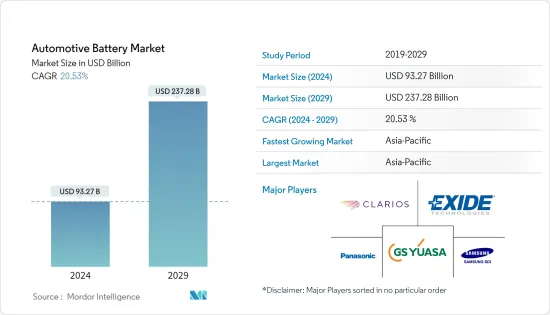
자동차 배터리 시장 규모는 2024년에 932억 7,000만 달러로 추정되고, 2029년에는 2,372억 8,000만 달러에 이를 것으로 예측되며, 예측 기간 중(2024-2029년)의 CAGR은 20.53%로 성장할 것으로 예상됩니다.
자동차 배터리는 전기 에너지를 저장 및 생성할 수 있는 전기화학 디바이스입니다. 엔진을 시동할 때 자동차 배터리는 시동 모터와 점화 시스템에 전원을 공급하기 위해 전류를 공급합니다. 교류 발전기가 부하를 지원하지 않을 때는 조명, 라디오 및 기타 전기 액세서리에 전류를 공급하여 전압 안정기 역할을 합니다.
지속가능한 운송과 더 깨끗한 에너지에 대한 세계 수요가 증가함에 따라 배터리 전기자동차 수요가 증가하고 있습니다. 차량의 항속 거리, 높은 초기 가격, 한정된 모델의 가용성, 지식 부족 등 소비자의 제약은 판매 촉진 활동과 정부의 법규제에 의해 해결되고 있습니다. 이러한 변수는 전기자동차 수요에 영향을 미치고 대상 시장을 견인하게 됩니다. 이 외에도 세계 배터리 생산 능력 증가는 자동차 배터리 산업에서 규모의 경제를 달성하는 데 도움이 되었으며, 이는 시장 성장의 주요 촉진요인이되었습니다.
자동차 배터리 시장 동향
시장을 견인할 것으로 예상되는 전기자동차 부문
세계 각국 정부는 배출량 저감을 위한 야심적인 목표를 설정하고 있으며, 전기차 이용 촉진은 이러한 목표를 달성하기 위한 한 가지 방법으로 여겨지고 있습니다. 예를 들어 유럽연합(EU)은 2030년까지 온실가스 배출량을 55% 삭감하는 것을 목표로 하고 있으며, 중국은 2025년까지 신차 판매 대수의 25%를 전기차로 삼겠다는 목표를 내걸고 있습니다. 대부분의 전기자동차에 사용되는 리튬 이온 배터리는 에너지 밀도, 충전 시간 및 전반적인 성능 측면에서 상당한 개선을 볼 수 있습니다. 이로 인해 전기자동차는 더 실용적이었고 소비자에게 매력적이었습니다.
전기자동차 수요 증가는 배터리 화학 및 재료의 기술적 진보로 이어지고 안전성과 성능을 보장하기 위해 보다 고도로 효율적인 자동차 배터리가 필요합니다. 많은 유명한 자동차 제조업체들은 자동차 배터리 제조 업체와 장기적인 거래 관계 구축에 주력하고 있습니다. 예를 들면
2023년 6월 Panasonic Holdings 담당자에 따르면 일본 기업은 Tesla와 공동으로 관리하는 네바다 공장에서 3년 이내에 전기자동차 배터리의 생산량을 10% 늘릴 의향입니다. Panasonic Energy는 기가팩토리 네바다에 15번째 생산 라인을 추가할 계획입니다. Panasonic Energy는 회의에서 2026년 3월까지 네바다 공장의 생산 능력을 10% 향상시키는 방안을 발표했습니다.
전기자동차 시장의 확대에 따라 많은 기업들이 상용차용 자동차 배터리의 개발 및 제조에도 종사하고 있습니다. Stellantis NV와 삼성SDI는 2022년 5월 인디애나주 코코모의 새로운 합작전지 공장에 25억 달러 이상을 투자할 것이라고 발표했습니다.
전기자동차 시장이 급성장하고 있는 가운데, 자동차 배터리 수요도 연동하여 증가할 것으로 예상되고, 이 부문으로 사업을 전개하는 기업에 있어서 큰 기회가 됩니다.
아시아태평양이 자동차 배터리 시장을 독점하는 전망
아시아태평양은 승용차와 상용차의 전기자동차 수요가 증가함에 따라 자동차 배터리의 금액이 가장 빠르게 성장할 것으로 예상됩니다. 이 지역에는 배터리 제조업체와 자동차 제조업체의 대부분이 진출하고 있습니다. 중국은 세계 최대의 전기자동차 제조 및 소비국입니다. 판매 목표, 유리한 법률 및 지자체의 대기질 목표가 국내 수요를 지원합니다. 예를 들어 중국은 전기자동차나 하이브리드차 제조업체에게 할당을 부과하고 있으며 신차 판매량의 10% 이상을 차지해야 합니다. 또, 베이징시에서는 시민에게 전기자동차로의 환승을 촉구하기 위해, 내연 엔진차의 등록 허가증을 월에 1만 대 밖에 발행하지 않습니다.
중국은 세계의 리튬 이온 제조 능력의 약 80%를 가지고 있으며, 배터리 경쟁에서 압도적인 최고 러너입니다. 또, 전지에 사용되는 중요한 광물의 하나인 리튬과 흑연의 추출 및 가공 등, 배터리 공급망의 다른 측면도 지배하고 있습니다. 이 지역의 일부 진출 기업은 시장 제공 제품을 얻기 위해 다양한 비즈니스 전략을 수립했습니다. 예를 들면
- 2023년 6월 일본 자동차 제조업체인 Mazda Motor와 Panasonic Corporation은 급속히 확대되는 시장에서 배터리 전기자동차 및 자동차 배터리 수요에 대응하기 위해 중장기 파트너십을 확립하기 위한 협의를 시작하기로 합의했습니다.
- 2023년 5월, Orano 그룹과 XTC New Energy 그룹은 전기자동차 배터리의 중요한 재료 생산을 전문으로 하는 2개의 합작회사를 설립하기 위한 계약을 체결했습니다.
한국, 인도, 말레이시아, 인도네시아를 포함한 다양한 국가에서 자동차 용도의 제품 수요 증가가 2024년부터 2030년까지 같은 지역의 성장에 영향을 미칠 것으로 보입니다.
자동차 배터리 산업 개요
자동차 배터리 시장은 통합되어 있습니다. 주요 기업으로는 Panasonic Corporation, Exide Technologies, Clarios, GS Yuasa Corporation, Samsung SDI, LG Chem Ltd 등이 있습니다. 시장의 일부 기업은 고객 기반을 확대하기 위해 제품 및 서비스 포트폴리오 개선에 주력하고 있습니다. 기타 주요 기업 중 일부는 제품 및 서비스 출시, 제공 제품 확대, 합병, 타사와의 제휴를 통해 시장에서의 존재감 확대를 목표로 하는 기업도 있습니다. 예를 들어, 2023년 3월 미국과 일본은 배터리 재료 공급을 보장하기 위해 EV 전지에 사용되는 중요한 광물의 거래에 관한 합의에 도달했습니다.
2023년 3월 Li-Cycle Holdings Corp.은 KION Group과 세계 리튬 이온 배터리 재활용 파트너십에 대한 공식 계약을 체결하고 프랑스에 새로운 리튬 이온 배터리 재활용 시설을 개발할 계획을 발표했습니다.
2023년 3월 Morrow Batteries(Morrow)는 한국에서 인산철 리튬(LFP) 배터리 셀 생산에 2,000만 유로를 투자했습니다.
기타 혜택 :
- 엑셀 형식 시장 예측(ME) 시트
- 애널리스트에 의한 3개월간의 지원
목차
제1장 서론
- 조사의 전제조건
- 조사 범위
제2장 조사 방법
제3장 주요 요약
제4장 시장 역학
- 시장 성장 촉진요인
- 전기차 수요 증가가 시장을 밀어올릴 것으로 예측
- 시장 성장 억제요인
- 전기차와 관련된 고비용이 시장 성장을 억제할 것으로 예측
- 업계의 매력-Porter's Five Forces 분석
- 공급기업의 협상력
- 소비자의 협상력
- 신규 참가업체의 위협
- 대체품의 위협
- 경쟁 기업간 경쟁 관계
제5장 시장 세분화
- 배터리 유형별
- 납축전지
- 리튬 이온
- 기타 전지 유형
- 차종별
- 승용차
- 상용차
- 구동 유형별
- 내연기관
- 전기자동차
- 지역별
- 북미
- 미국
- 캐나다
- 기타 북미
- 유럽
- 독일
- 프랑스
- 영국
- 기타 유럽
- 아시아태평양
- 중국
- 인도
- 일본
- 한국
- 기타 아시아태평양
- 기타
- 남미
- 중동 및 아프리카
- 북미
제6장 경쟁 구도
- 벤더의 시장 점유율
- 기업 프로파일
- A123 Systems
- Panasonic Corporation
- Exide Technologies
- VARTA
- Clarios
- GS Yuasa Corporation
- Hitachi Group Ltd
- Robert Bosch GmbH
- China Aviation Lithium Battery Co. Ltd
- Contemporary Amperex Technology Co. Limited
- SAMSUNG SDI Co. Ltd
- East Penn Manufacturing Co.
- LG Chem Ltd
제7장 시장 기회 및 향후 동향
AJY 24.08.08The Automotive Battery Market size is estimated at USD 93.27 billion in 2024, and is expected to reach USD 237.28 billion by 2029, growing at a CAGR of 20.53% during the forecast period (2024-2029).
An automotive battery is an electrochemical device that can store and generate electrical energy. When starting the engine, the automotive battery provides electric current to power the starting motor and ignition system. When the alternator is not handling the load, it works as a voltage stabilizer by giving current to the lights, radio, and other electrical accessories.
Globally rising demand for sustainable transportation and cleaner energy has engaged the demand for battery electric vehicles. Consumer constraints such as vehicle range, greater upfront prices, limited model availability, and lack of knowledge are being solved by promotional activities and government legislation. These variables will have an impact on the demand for electric vehicles, which will drive the target market. In addition to this, an increase in the global battery production capacity has helped achieve economies of scale in the automotive battery industry, another major driver for market growth.
Automotive Battery Market Trends
The Electric Vehicles Segment is Anticipated to Drive the Market
Governments around the world are setting ambitious targets to reduce emissions, and promoting the use of electric vehicles is seen as one way to achieve these goals. For instance, the European Union aims to reduce its greenhouse gas emissions by 55% by 2030, and China has set a target of having 25% of new cars sold by 2025 to be electric. Lithium-ion batteries, which are used in most electric vehicles, have seen significant improvements in terms of energy density, charging time, and overall performance. This has made electric vehicles more practical and appealing to consumers.
The increasing demand for EVs will lead to technological advancements in battery chemistry and materials, which will require more sophisticated and efficient automotive batteries to ensure safety and performance. Many prominent automobile manufacturers are focusing on building long-term business relationships with automotive battery manufacturing companies. For instance,
In June 2023, according to a Panasonic Holdings representative, the Japanese corporation intends to increase the output of electric vehicle batteries at a Nevada factory jointly managed with Tesla by 10% within three years. Panasonic Energy plans to add a 15th production line to the Gigafactory Nevada. At a meeting, Panasonic Energy announced a proposal to boost the Nevada factory's manufacturing capacity by 10% by March 2026.
As the electric vehicle market is growing, many companies are involved in the development and manufacturing of automotive batteries for commercial vehicles as well. Stellantis NV and Samsung SDI announced in May 2022 that they would invest more than USD 2.5 billion in a new joint-venture battery plant in Kokomo, Indiana.
With the electric vehicle market set to continue its rapid growth, the demand for automotive batteries is expected to rise in tandem, presenting significant opportunities for companies operating in this space.
Asia-Pacific is Expected to Dominate the Automotive Battery Market
Asia-Pacific is expected to have the fastest growth in the value of automotive batteries, owing to the increasing demand for electric passenger and commercial vehicles. The region has most of the battery manufacturers' presence and automobile vehicle manufacturers. China is the largest manufacturer and consumer of electric vehicles in the world. Sales targets, favorable laws, and municipal air-quality targets are supporting domestic demand. For instance, China has imposed a quota on manufacturers of electric or hybrid vehicles, which must represent at least 10% of total new sales. Also, the city of Beijing only issues 10,000 permits for the registration of combustion engine vehicles per month to encourage its inhabitants to switch to electric vehicles.
China has approximately 80% of the world's Li-ion manufacturing capacity, and it is by far the front-runner in the battery race. The nation also controls other facets of the battery supply chain, such as the extraction and processing of lithium and graphite, two of the crucial minerals used in batteries. Several players in the region are establishing various business strategies to gain market offerings. For instance,
- In June 2023, Mazda Motor, a Japan-based vehicle manufacturer, and Panasonic Corporation agreed to enter discussions on establishing a medium- to long-term partnership to meet the demand for battery electric vehicles and automotive batteries in a rapidly expanding market.
- In May 2023, the Orano group and the XTC New Energy group signed agreements to create two joint ventures devoted to the production of critical materials for electric vehicle batteries.
Increasing product demand for automotive applications in various countries, including South Korea, India, Malaysia, and Indonesia, is likely to influence the region's growth between 2024 and 2030.
Automotive Battery Industry Overview
The automotive battery market is consolidated. A few prominent companies include Panasonic Corporation, Exide Technologies, Clarios, GS Yuasa Corporation, Samsung SDI Co. Ltd, and LG Chem Ltd. Several companies in the market are focusing on improving their products and service portfolios to widen their customer base. Some other key players aim to expand their presence in the market through product and service launches, offerings expansion, mergers, and collaborations with other companies. For instance, in March 2023, the United States and Japan reached an agreement regarding the trade of critical minerals used for EV batteries to secure the supplies of battery materials.
In March 2023, Li-Cycle Holdings Corp. signed a definitive agreement for a global lithium-ion battery recycling partnership with the KION Group and announced plans to develop a new lithium-ion battery recycling facility in France.
In March 2023, Morrow Batteries (Morrow) invested EUR 20 million in the production of Lithium iron phosphate (LFP) battery cells in South Korea.
Additional Benefits:
- The market estimate (ME) sheet in Excel format
- 3 months of analyst support
TABLE OF CONTENTS
1 INTRODUCTION
- 1.1 Study Assumptions
- 1.2 Scope of the Study
2 RESEARCH METHODOLOGY
3 EXECUTIVE SUMMARY
4 MARKET DYNAMICS
- 4.1 Market Drivers
- 4.1.1 Increasing Demand For Electric Vehicles is Anticipated to Boost the Market
- 4.2 Market Restraints
- 4.2.1 High Cost Associated with Electric Vehicles is Anticipated to Restrain the Growth of the Market
- 4.3 Industry Attractiveness - Porter's Five Forces Analysis
- 4.3.1 Bargaining Power of Suppliers
- 4.3.2 Bargaining Power of Consumers
- 4.3.3 Threat of New Entrants
- 4.3.4 Threat of Substitute Products
- 4.3.5 Intensity of Competitive Rivalry
5 MARKET SEGMENTATION
- 5.1 Battery Type
- 5.1.1 Lead-Acid
- 5.1.2 Lithium-Ion
- 5.1.3 Other Battery Types
- 5.2 Vehicle Type
- 5.2.1 Passenger Cars
- 5.2.2 Commercial Vehicles
- 5.3 Drive Type
- 5.3.1 Internal Combustion Engine
- 5.3.2 Electric Vehicles
- 5.4 Geography
- 5.4.1 North America
- 5.4.1.1 United States
- 5.4.1.2 Canada
- 5.4.1.3 Rest of North America
- 5.4.2 Europe
- 5.4.2.1 Germany
- 5.4.2.2 France
- 5.4.2.3 United Kingdom
- 5.4.2.4 Rest of Europe
- 5.4.3 Asia-Pacific
- 5.4.3.1 China
- 5.4.3.2 India
- 5.4.3.3 Japan
- 5.4.3.4 South Korea
- 5.4.3.5 Rest of Asia-Pacific
- 5.4.4 Rest of the World
- 5.4.4.1 South America
- 5.4.4.2 Middle East and Africa
- 5.4.1 North America
6 COMPETITIVE LANDSCAPE
- 6.1 Vendor Market Share
- 6.2 Company Profiles*
- 6.2.1 A123 Systems
- 6.2.2 Panasonic Corporation
- 6.2.3 Exide Technologies
- 6.2.4 VARTA
- 6.2.5 Clarios
- 6.2.6 GS Yuasa Corporation
- 6.2.7 Hitachi Group Ltd
- 6.2.8 Robert Bosch GmbH
- 6.2.9 China Aviation Lithium Battery Co. Ltd
- 6.2.10 Contemporary Amperex Technology Co. Limited
- 6.2.11 SAMSUNG SDI Co. Ltd
- 6.2.12 East Penn Manufacturing Co.
- 6.2.13 LG Chem Ltd