|
시장보고서
상품코드
1523379
브루셀라병 백신 시장 : 시장 점유율 분석, 산업 동향, 통계, 성장 예측(2024-2029년)Global Brucellosis Vaccines - Market Share Analysis, Industry Trends & Statistics, Growth Forecasts (2024 - 2029) |
||||||
 Mordor Intelligence
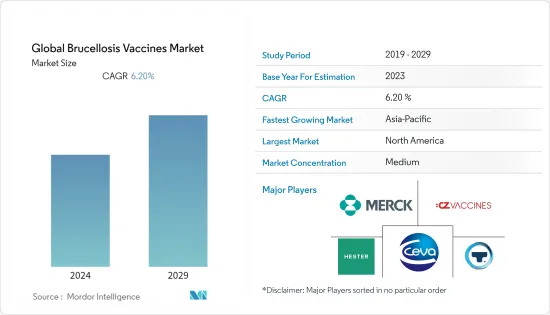
브루셀라병 백신 시장 규모는 2024년에는 2억 5,735만 달러로 추정되고, 2029년에는 3억 4,765만 달러에 이를 것으로 예측되며, 예측 기간 동안 복합 연간 성장률(CAGR)은 6.20%로 성장할 전망입니다.

브루셀라병은 동물이 매개하는 짐승 공통 감염 중에서 가장 만연한 감염 중 하나이며, 유행 지역에서는 인간의 브루셀라병이 공중 보건에 심각한 영향을 미칩니다. 축산업과 도시화의 확대와 축산과 식품 취급에서 위생 대책의 부족은 브루셀라병이 공중 보건 위험으로 남아있는 원인입니다. 예를 들어, 2023년 9월 미국 질병 예방 관리 센터(CDC)는 브루셀라병의 세계적 발생률을 210만 명으로 추정했습니다. 2023년 11월, Frontiers in Microbiology에 다른 연구가 발표되어 중국에서는 인간의 브루셀라병이 30세부터 69세의 연령층에서 더 많이 보인다고 보고되었습니다. 따라서 브루셀라병 백신 수요는 예측 기간 동안 증가할 것으로 예상됩니다. 그러나 브루셀라병의 경우는 보고 수가 적고, 비특이적인 증상, 의사의 이해 부족, 불충분한 진단 검사 능력 때문에 오진되는 경우가 많기 때문에 이 수는 과소평가되고 있을 가능성 높습니다.
B. 메리텐시스는 세계에서 가장 자주 보고된 인간 감염의 원인이지만, 가장 널리 잠재적인 감염원인 B. 아볼타스입니다. 따라서 이 질병의 유병률 증가는 백신 수요를 증가시키고 예측 기간 동안 시장 성장을 가속할 것으로 예상됩니다.
동물의 질병, 건강, 보호에 대한 인식을 높이기 위한 정부,비정부 조직의 다양한 노력이 예측 기간 동안 연구 시장의 성장을 가속할 것으로 예상됩니다. 각국 정부는 동물복지에 대한 계획과 지침을 도입하고 있습니다. 예를 들어 2022년 10월 영국의 연구개발은 풍토병이나 감염증과 싸우고 동물의 건강을 개선하기 위한 개입 전략을 개발하기 위한 연구 프로젝트에 대하여 생물공학,생물과학연구평의회(BBSRS)에서 250만 달러의 자금을 받았습니다. 이러한 노력은 동물의 건강에 대한 인식을 높이고 시장 성장을 뒷받침합니다. 또한 2023년 11월에는 호주 동물 복지 과제 그룹이 소와 양 동물 복지 기준과 지침을 수립했습니다. 전국 가축식별시스템(National Livestock Identification System : NLIS)은 각 동물에 무선태그를 붙이는 전자식별시스템으로 소용으로 개발되었습니다.
이와 같이 조사된 시장은 위의 요인에 따라 예측기간 동안 성장을 나타낼 것으로 기대됩니다. 그러나 엄격한 동물 백신 규제는 시장 성장을 방해할 수 있습니다.
세계 브루셀라병 백신 시장 동향
예측 기간 동안 축우 부문이 큰 시장 점유율을 차지할 전망
- 암소의 갯수 증가와 시장 진출기업의 인수와 같은 주요 발전으로 부문 성장이 기대됩니다. 예를 들어, 미국 농무부(USDA)의 2022년 1월 보고서에 따르면 미국에는 약 9,190만 마리의 암소와 송아지가 있습니다. 마찬가지로 미국 농무부(USDA)의 2022년 3월 보고서에 따르면 미국 과학자 연맹(FAS)의 뉴델리에서는 소 총수가 3억 690만 마리로 증가하여 전년보다 증가하 . 따라서 가축 두수 증가는 더 많은 브루셀라병 백신 수요를 촉진하고 이 부문의 성장을 뒷받침할 것으로 예상됩니다.
- 게다가 세계의 많은 정부들이 브루셀라병 박멸로 인해 암소 및 기타 동물에 대한 브루셀라병 예방접종 프로그램을 시작하고 있으며, 이는 시장 조사에 더 큰 영향을 미칠 것으로 예상됩니다. 예를 들어 인도 정부는 구제역(FMD)과 브루셀라병을 제압하기 위해 2019년부터 2024년 사이에 소, 물소, 양, 염소, 돼지 개체수의 100%에 FMD 백신을 접종 4-8개월 소의 암소의 100%에 브루셀라병 백신을 접종하는 국가동물질병제압프로그램(NADCP)으로 불리는 기함계획을 16억120만 달러(13,343캐롤인도루피) 예산으로 실시 하고 있습니다. 따라서 위의 요인들로 인해 예측 기간 동안 암소 부문은 브루셀라병 백신 시장에서 큰 점유율을 차지할 것으로 예상됩니다.
예측기간 중 북미가 시장을 독점할 전망
- 북미는 대규모 동물 집단의 존재, 브루셀라병의 높은 부담, 동물의 건강에 대한 의식 증가, 이 지역에서 주요 시장 기업의 존재 등의 요인에 의해 브루셀라병 백신 시장에서 큰 점유율을 차지할 것으로 예상됩니다. 예를 들어, 2023년 1월 Statistique Canada에 따르면 캐나다 농부는 1,130만 마리의 암소와 송아지를 사육하고 있으며, 2022년 1,110만 마리에서 증가하고 있습니다.
- 또한 2023년 9월 미국 농무부의 발표에 따르면 미국에서 2023년 상업용 쇠고기 생산량은 344억 5,000만 달러(269억 4,100만 파운드)로 추정되고 2024년에는 증가할 것으로 전망되고 있습니다. 이 데이터는 높은 생산량과 육류 제품에 대한 수요 증가를 보여주며 조사된 시장에 큰 영향을 미칠 것으로 예상되었습니다. 또한 이 분야에서 진행 중인 R&D 활동과 주요 시장 기업의 새로운 발전이 시장 성장을 뒷받침할 것으로 예상됩니다. 예를 들어, 2022년 12월 수의학부가 발표한 연구 조사에 따르면 플로리다 대학은 브루셀라병으로부터 마우스를 보호하는 새로운 점막 백신 프로토타입을 개발했습니다. 따라서 백신 개발과 연구 활동은 시장 성장에 영향을 미칠 것으로 예상됩니다.
- 따라서 축우 인구 증가, 육류 제품 수요 증가, 연구 활동 등의 요인으로 인해 브루셀라병 백신 시장은 북미 예측 기간 동안 성장할 것으로 예상됩니다.
세계의 브루셀라병 백신 산업 개요
대규모 동물 기지와 농업 환경이 존재하기 때문에 대부분의 선수들은 개발 도상국을 기반으로합니다. 시장이 부분적으로 단편화되기 때문에 경쟁은 완만합니다. 현재 시장을 독점하고 있는 기업은 Merck&Co.Inc., Ceva, CZ Vaccines, Laboratories Tornel, Hester Biosciences Limited 등입니다.
기타 혜택
- 엑셀 형식 시장 예측(ME) 시트
- 3개월간의 애널리스트,지원
목차
제1장 서론
- 조사의 전제조건과 시장 정의
- 조사 범위
제2장 조사 방법
제3장 주요 요약
제4장 시장 역학
- 시장 개요
- 시장 성장 촉진요인
- 브루셀라병의 부담 증가
- 동물 위생에 대한 의식의 고조
- 시장 성장 억제요인
- 동물용 백신에 대한 엄격한 규제
- Porter's Five Forces 분석
- 신규 진입업자의 위협
- 구매자/소비자의 협상력
- 공급기업의 협상력
- 대체품의 위협
- 경쟁 기업간 경쟁 관계의 강도
제5장 시장 세분화(시장 규모 : 달러 기준)
- 백신 유형별
- DNA 백신
- 아단위 백신
- 벡터 백신
- 재조합 백신
- 용도별
- 소
- 양,염소
- 기타 용도
- 최종 사용자별
- 동물병원 및 클리닉
- 동물 관리 센터
- 기타 최종 사용자
- 지역별
- 북미
- 유럽
- 아시아태평양
- 중동 및 아프리카
- 남미
제6장 경쟁 구도
- 기업 프로파일
- Ceva
- Colorado Serum Company
- CZ Vaccines
- Fivet Animal Health
- Hester Biosciences Limited
- Indian Immunologicals Ltd
- Jordan Bio-industries Center
- Laboratories Tornel
- Merck & Co. Inc.
- Veterinary Technologies Corporation
제7장 시장 기회와 앞으로의 동향
BJH 24.08.09The Global Brucellosis Vaccines Market size is estimated at USD 257.35 million in 2024, and is expected to reach USD 347.65 million by 2029, growing at a CAGR of 6.20% during the forecast period (2024-2029).
Brucellosis is one of the most widespread zoonoses transmitted by animals, and in endemic areas, human brucellosis has serious public health consequences. The expansion of animal industries and urbanization and the lack of hygienic measures in animal husbandry and food handling partly account for brucellosis remaining a public health hazard. For instance, in September 2023, the Centers for Disease Control and Prevention (CDC) estimated the global incidence of brucellosis was 2.1 million. In November 2023, another study was published in Frontiers in Microbiology, which reported that human brucellosis was more prevalent in the age group of 30 to 69 years old in China. Thus, the demand for brucellosis vaccines is expected to increase during the forecast period. However, this number is likely underestimated, as brucellosis cases are underreported and often misdiagnosed because of nonspecific symptoms, lack of understanding among doctors, and insufficient diagnostic laboratory capability.
B. melitensis is the most frequently reported cause of human illnesses worldwide, while the most widespread potential source of infection is B. abortus. Hence, the increasing prevalence of the disease is expected to increase the demand for a vaccine, thereby fueling the market's growth during the forecast period.
Various government and non-government organizations' initiatives to raise awareness about animal diseases, health, and protection are expected to propel the growth of the market studied during the forecast period. The governments of different nations are introducing plans and guidelines for animal welfare. For instance, in October 2022, the UK Research and Innovation was funded with USD 2.5 million by the Biotechnology and Biological Sciences Research Council (BBSRS) for research projects to develop intervention strategies for combating endemic and infectious diseases and improving animal health. Such initiatives raise awareness about animal health and, thus, boost the market's growth. Furthermore, in November 2023, the Animal Welfare Task Group in Australia developed animal welfare standards and guidelines for cattle and sheep. The National Livestock Identification System (NLIS), an electronic identification system in which each animal is tagged with a radiofrequency identification device, has been developed for cattle.
Thus, the market studied is expected to witness growth during the forecast period due to the abovementioned factors. However, stringent animal vaccine regulation may hinder the market's growth.
Global Brucellosis Vaccines Market Trends
Cattles Segment is Expected to Hold a Significant Market Share During the Forecast Period
- Increasing cattle population and key developments like acquisitions by market players are expected to increase segmental growth. For instance, according to the January 2022 report of the US Department of Agriculture (USDA), there were about 91.9 million cattle and calves in the United States. Similarly, according to the March 2022 report by the USDA, Federation of American Scientists (FAS), New Delhi increased the total number of cattle to 306.9 million heads, an increase from the previous year. Hence, the increasing livestock population is expected to drive demand for more brucellosis vaccines, which is anticipated to boost the segment's growth.
- Furthermore, many governments worldwide are launching a brucellosis vaccination program for cattle and other animals to eradicate brucellosis, which is further expected to impact the market studied significantly. For example, the Government of India is running a flagship scheme called the National Animal Disease Control Program (NADCP) to control foot and mouth disease (FMD) and brucellosis by vaccinating 100% of cattle, buffalo, sheep, goat, and pig population for FMD and 100% bovine female calves aged 4 to 8 months for brucellosis during 2019-2024 with a budget of USD 1,601.2 million (INR 13,343 crore). Therefore, owing to the abovementioned factors, the cattle segment is expected to have a significant share in the brucellosis vaccines market during the forecast period.
North America is Expected to Dominate the Market During the Forecast Period
- North America is expected to register a significant share in the brucellosis vaccines market owing to factors such as the presence of a large animal population, the high burden of brucellosis, increasing awareness about animal health, and the presence of key market players in the region. For instance, in January 2023, as per the Statistique Canada, Canadian farmers had 11.3 million cattle and calves, which increased from 11.1 million in 2022.
- Further, in September 2023, as per the US Department of Agriculture, commercial beef production in the United States was estimated at USD 34.45 billion (GBP 26.941 billion) in 2023 and was expected to increase in 2024. This data showed high output and growing demand for meat products, which was expected to impact the market studied significantly. Further, the ongoing research and development activities and new developments from the key market players in the area are expected to boost the market's growth. For instance, in December 2022, according to a research study published by the College of Veterinary Medicine, the University of Florida developed a new mucosal vaccine prototype that protects mice from brucellosis. Thus, developing vaccines and research activities are expected to impact the market's growth.
- Therefore, owing to factors such as the growing cattle population, increasing demands for meat products, and research activities, the brucellosis vaccine market is expected to grow during the forecast period in North America.
Global Brucellosis Vaccines Industry Overview
Most players are based in developing countries due to the presence of large animal bases and agricultural environments. The market is partially fragmented, which makes it moderately competitive. Some companies currently dominating the market are Merck & Co. Inc., Ceva, CZ Vaccines, Laboratories Tornel, and Hester Biosciences Limited.
Additional Benefits:
- The market estimate (ME) sheet in Excel format
- 3 months of analyst support
TABLE OF CONTENTS
1 INTRODUCTION
- 1.1 Study Assumptions and Market Definition
- 1.2 Scope of the Study
2 RESEARCH METHODOLOGY
3 EXECUTIVE SUMMARY
4 MARKET DYNAMICS
- 4.1 Market Overview
- 4.2 Market Drivers
- 4.2.1 Increasing Burden of Brucellosis
- 4.2.2 Increasing Awareness about Animal Health
- 4.3 Market Restraints
- 4.3.1 Stringent Regulation for Animal Vaccines
- 4.4 Porter's Five Forces Analysis
- 4.4.1 Threat of New Entrants
- 4.4.2 Bargaining Power of Buyers/Consumers
- 4.4.3 Bargaining Power of Suppliers
- 4.4.4 Threat of Substitute Products
- 4.4.5 Intensity of Competitive Rivalry
5 MARKET SEGMENTATION (Market Size by Value USD)
- 5.1 By Vaccine Type
- 5.1.1 DNA Vaccine
- 5.1.2 Subunit Vaccine
- 5.1.3 Vector Vaccine
- 5.1.4 Recombinant Vaccine
- 5.2 By Application
- 5.2.1 Cattle
- 5.2.2 Sheep & Goat
- 5.2.3 Other Applications
- 5.3 By End User
- 5.3.1 Veterinary Hospitals & Clinics
- 5.3.2 Animal Care Centers
- 5.3.3 Other End Users
- 5.4 By Geography
- 5.4.1 North America
- 5.4.2 Europe
- 5.4.3 Asia-Pacific
- 5.4.4 Middle East and Africa
- 5.4.5 South America
6 COMPETITIVE LANDSCAPE
- 6.1 Company Profiles
- 6.1.1 Ceva
- 6.1.2 Colorado Serum Company
- 6.1.3 CZ Vaccines
- 6.1.4 Fivet Animal Health
- 6.1.5 Hester Biosciences Limited
- 6.1.6 Indian Immunologicals Ltd
- 6.1.7 Jordan Bio-industries Center
- 6.1.8 Laboratories Tornel
- 6.1.9 Merck & Co. Inc.
- 6.1.10 Veterinary Technologies Corporation