|
시장보고서
상품코드
1626338
유럽의 의약품 포장 : 시장 점유율 분석, 산업 동향, 통계 및 성장 예측(2025-2030년)Europe Pharmaceutical Packaging - Market Share Analysis, Industry Trends & Statistics, Growth Forecasts (2025 - 2030) |
||||||
 Mordor Intelligence
유럽의 의약품 포장 시장은 예측 기간 동안 CAGR 7.3%를 나타낼 것으로 예상됩니다.

유럽의 의약품 포장 시장은 2021-2026년의 예측 기간 동안 약 7.3%의 연평균 복합 성장률(CAGR)로 성장할 것으로 예상됩니다. 유럽의 제약 산업은 라이프스타일의 변화, 다양한 질병 진단을 받는 인구 증가, 정부 기관의 의료비 지출 증가로 인해 급격한 성장과 끊임없는 혼란을 경험하고 있습니다. 그러나 의약품 공급의 세계화, 만성적인 생활습관 증가, 위조 의약품에 대한 위협의 진화 등의 도전에 계속 직면하고 있습니다.
이 지역의 제약 포장 산업은 진화하는 제약 산업이 시장 전반에 걸쳐 느끼는 도전과 관련된 영향을 해결하고 물리적 손상, 열화, 생물학적 오염으로 인한 모든 유형의 특성 변화로부터 의약품을 보호하고 수익을 높이는 데 중요한 역할을 하고 있습니다.
지난 몇 년동안 이 지역의 포장 분야는 IoMT, 유전체학 및 기타 커넥티드 의료기기 등의 플랫폼 개발로 인한 개인화 접근 방식, 중소기업 시장 진입 증가에 따른 맞춤형 의약품의 현지 생산, 대마초 기반 의약품에 대한 수요 증가, 혁신가들의 다양화 등 등 업계의 초점이 바뀌면서 큰 변화를 경험하고 있습니다.
또한, BFS(Blow-Fill-Seal)링 기술과 같은 혁신 기술의 도입과 위조 방지 기술에 대한 요구가 높아지면서 시장도 크게 변화하고 있습니다. 세계화의 진전으로 인해 전 세계에 제조 공장이 설립되고, 사용되는 원료가 개선되고, 공급망이 길어지고 있습니다.
또한, 최근 의약품 일련번호를 의무화하는 유럽연합(EU) 규정이 미국의 의약품 공급망 보안법(Drug Supply Chain Security Act)에 추가되어 2023년까지 준수 기한이 연장됨에 따라 일련번호와 추적 및 추적 노력이 더욱 강화될 것으로 예상됩니다. 추적 및 추적 노력을 촉진하여 이 지역에서 의약품의 추적 가능성과 진위성을 촉진하고 있습니다. 마찬가지로, EU의 다른 규정은 현재 제품 식별 및 진위 여부를 확인하기 위해 의료용 포장에 치수 코드를 요구하고 있으며, 스마트폰 기술을 활용하여 포장 산업의 디지털화를 촉진하고 있습니다.
유엔이 실시한 조사에 따르면 항체가 환경으로 방출되면 내성균의 출현을 가속화하고 항생제 오염에 영향을 미칩니다고 합니다. 이러한 사례에 따라 의약품 포장 제조업체는 재활용 및 생분해가 가능한 포장재, 탄소 발자국 감소, 수명주기 분석 등을 고려하며 지속가능성을 더욱 중요하게 여기고 있습니다.
유럽은 북미에 이어 세계 시장의 3분의 1 이상을 차지하고 있지만, 중국을 비롯한 아시아태평양 국가들의 부상으로 위협을 받고 있으며, 더 빠른 생산과 보존성 향상에 대한 요구가 증가하면서 시장을 주도하고 있습니다. 유럽 각국 정부의 의약품 포장에 대한 엄격한 규제, 플라스틱 사용에 대한 환경 문제, 원자재 가격 상승 등이 이 시장에 대한 우려로 작용하고 있습니다.
코로나19가 전 세계적으로 확산되기 전에는 전자상거래 산업의 성장, 지속 가능한 소재에 대한 관심 증가, 스마트 기술 통합 등이 성장을 이끌었습니다. 하지만 코로나19 이후 펌프, 플렉서블 블리스 터 호일과 같은 헬스케어 포장에 대한 수요가 급증하고 있습니다. 또한 생물학적 제제 및 백신의 필요성에 따라 기업들은 현재 무균 포맷에 투자하고 생산 능력을 확장하고 있습니다.
유럽의 의약품 포장 시장 동향
유럽의 의약품 포장 시장 동향지속가능한 포장재, 시장 성장을 주도합니다.
- 제약 산업은 자동차 산업이 배출하는 온실가스보다 55%나 더 많은 온실가스를 배출하는 것으로 알려져 있어 전 세계적으로 심각한 오염물질로 알려져 있습니다.
- 또한 유럽의 의약품 포장 기업의 조제 시스템에 대한 연구 개발 노력의 대부분은 지속가능성, 규정 준수 개선, 어린이 안전에 대한 고려와 같은 요인에 초점을 맞추었습니다.
- 예를 들어, Ramaco Siebler와 Huhtamaki와 같은 대기업은 폴리올레핀 라미네이트와 같은 재활용 가능한 재료로 만든 신뢰할 수 있는 의약품용 재활용 가능한 단위 용량 포장을 출시할 계획을 발표했습니다. 이 포장 부품은 90%가 폴리프로필렌 또는 폴리에틸렌으로 만들어지며, 제품의 70% 이상이 재활용될 예정입니다. 또한 각 회사는 수년 동안 배출량을 크게 줄였습니다.
- 또한 2020년 2월, 유럽에 본사를 둔 Natupharma A/S는 플라스틱 첨가제와 사탕수수로 구성된 완전히 재활용 가능한 새로운 생분해성 플라스틱 포장 솔루션을 개발했습니다.
- 분명히 제약 포장은 업계가 전통적으로 설계 및 제조에 크게 의존해 온 플라스틱에서 벗어나 보다 지속 가능한 재료로 전환할 것으로 예상됩니다. 또한 폴리에틸렌 테레프탈레이트(PET)는 분자 수준에서 분해하여 PET로 되돌릴 수 있기 때문에 업계는 폴리에틸렌 테레프탈레이트(PET)를 계속 적용할 것으로 예상됩니다.
독일이 큰 시장 점유율을 차지합니다.
- 독일은 유럽 제약 및 포장 산업에서 큰 기여를 하고 있고, Gerresheimer AG, Schott AG와 같은 유명 업체들이 이 지역에 존재하며, 이 지역의 최대 화학 및 플라스틱 생산국 중 하나이기 때문에 이 지역에서 큰 시장 점유율을 차지할 것으로 예상됩니다. 를 차지할 것으로 예상됩니다.
- 예를 들어, CPhI 월드와이드가 실시한 조사에 따르면 CPhl의 연례 보고서와 350개 이상의 세계 제약회사의 의견을 통해 얻은 데이터에 따르면 독일은 유럽에서 가장 우수한 제약 산업으로 선정되었습니다. 또한 이 결과는 독일을 엘리트 제약 시장으로 확고히 자리매김했습니다.
- 이러한 사례에 따라 이 지역의 유명 업체들은 시장에서의 전략적 지위를 유지하기 위해 이 지역에 대한 투자를 시작하고 있습니다. 예를 들어, Schott AG는 2020년 2월 독일 Mullheim에 위치한 기존 공장에 새로운 생산 공장을 건설하여 정맥 내 치료 및 고점도 약물에 사용되는 프리필러블 무균 폴리머 주사기 수요 증가에 대응하기 위한 확장 계획을 발표했습니다. 이 공장은 2021년 말까지 완공될 예정입니다.
- 이 공장은 고급 고분자 의약품 포장에 대한 수요 증가에 대응하는 것으로, 가까운 미래에 제약 시장에서 Shot AG의 지위를 향상시킬 것으로 예상됩니다. 또한 2020년 4월에는 2025년까지 10억 달러를 투자하여 의약품 포장 사업을 확장할 계획을 발표했습니다.
- 또한, 제약 및 의료기기 산업은 규제가 엄격하고 제조 및 포장 공정의 안전과 지속가능성 측면이 강조되고 있습니다. 더 나은 첨단 의료 인프라의 개발과 제휴 및 파트너십을 통한 제약회사의 성장은 포장 시장의 성장을 가속할 것으로 보입니다.
유럽의 의약품 포장 산업 개요
유럽의 제약 포장 시장은 Amcor, CCL Industries, Intrapac, Rexam Plc, Schott AG와 같은 기업들이 유럽 포장 산업의 지속가능성과 디지털화를 촉진하고 막대한 연구 개발 투자를 통해 시장을 확대함에 따라 적당히 단편화되어 있습니다. 시장.
- 2020년 2월-암코는 플라스틱 제품의 재활용성을 향상시키기 위해 헬스케어 플라스틱 재활용 협의회와 제휴를 맺었습니다고 발표했습니다.
- 2020년6월- Amcor와 Espoma Organic은 지속 가능한 플라스틱 포장을 혁신하기 위해 파트너십을 맺고 새로운 바이오 폴리머 포장을 발표했으며, PE(폴리에틸렌) 필름에는 25%의 사탕 수수에서 추출한 바이오 재료가 포함되어 있습니다.
- 2021년 11월 - Gerreshmeir와 Midas Pharma가 혁신적인 자동 주사기 제휴를 발표했습니다. 자체 IP 제품에 점점 더 집중하고 있는 Gerreshmeir는 이 카트리지형 자동 주사기를 통해 자사의 광범위한 장치 및 1차 의약품 포장 포트폴리오를 강화할 예정입니다.
기타 혜택 :
기타 혜택- 엑셀 형식 시장 예측(ME) 시트
- 3개월간의 애널리스트 지원
목차
제1장 서론
- 조사의 전제조건과 시장 정의
- 조사 범위
제2장 조사 방법
제3장 주요 요약
제4장 시장 역학
- 시장 개요
- 시장 성장 촉진요인
- 신흥 국가 제약 산업 성장
- 약물전달 디바이스와 블리스터 포장 시장 수요 증가
- 유럽의 의약품 포장 성장 나노테크놀러지 기여
- 일반용 의약품 시장 성장
- 지속가능포장재료와 스마트 기술 통합에 대한 관심 개발
- 시장 성장 억제요인
- 포장 비용 증가
- 건강 규제 준수 기준 엄격화, 환경에 대한 우려
- 밸류체인/공급망 분석
- Porter의 Five Forces 분석
- 신규 진출업체의 위협
- 바이어의 교섭력
- 공급 기업의 교섭력
- 대체품의 위협
- 경쟁 기업간 경쟁 관계
제5장 시장 세분화
- 재료 유형별
- 플라스틱
- 유리
- 기타 소재(종이 및 판지, 금속)
- 제품 유형별
- 보틀
- 바이알·앰플
- 파우치
- 주사기
- 투약 튜브
- 캡과 마개
- 라벨
- 기타 제품 유형
- 국가별
- 영국
- 독일
- 프랑스
- 스페인
- 이탈리아
- 기타 유럽
제6장 경쟁 구도
- 기업 개요
- Gerresheimer AG
- CCL Industries Inc.
- Intr 아시아태평양 Group
- Schott AG
- Nipro Corporation
- Vetter Pharma Packaging
- Ardagh Group SA
- Origin Pharma Packaging
- Gaplast GmbH
- Aptargroup Inc.
- Nolato AB
- APG Europe
- SGD Pharma
- Piramal Glass Ltd
- Amcor Ltd.
제7장 투자 분석
제82장 시장의 미래
LSH 25.01.15The Europe Pharmaceutical Packaging Market is expected to register a CAGR of 7.3% during the forecast period.
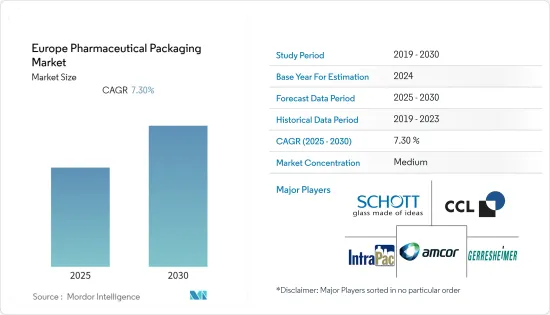
The Europe Pharmaceutical Packaging Market is estimated to grow at a CAGR of about 7.3% over the forecast period 2021 to 2026. The pharmaceutical Industry industry in Europe is experiencing constant disruption as it experiences exponential growth with the changing lifestyle and more and more people being diagnosed with various diseases and increased spending on healthcare by the government bodies. However, it continues to face challenges such as globalization of drug supply, rise in chronic lifestyle, and evolving threat concerning counterfeit medicine, among others.
The pharmaceutical packaging industry in the region plays a vital role in helping the evolving pharma industry to address the impact associated with challenges being felt across the market, ensuring the protection of drugs against all sorts of alteration in the properties caused as a result of physical damage, degradation, biological contamination while driving boost in profits.
Over the period last few years, the packaging sector in the region has been experiencing a great deal of transformation with the industry-changing focus towards personalized approaches with development of platforms such as IoMT, genomics, and other connected medical devices, localized production of customized medicines added with the increase in the number of SMEs entering the market, increasing demand for cannabis-based medicinal products and diversification of the innovators.
Also, the introduction of innovative techniques like Blow-Fill-Seal technology and the increasing need for anti-counterfeiting technologies are changing the market drastically. The increasing globalization has resulted in the setting up of manufacturing plants all across the world, thereby improving the raw materials used and lengthening the supply chains.
Additionally, with the recent European Union (EU) regulations mandating pharmaceutical serialization is added with the US Drug Supply Chain Security Act, compliance extended to 2023 is driving the serialization and track-and-trace efforts, thereby are promoting pharmaceutical traceability and authenticity in the region. Similarly, other EU regulation now requires dimensional codes on the medical packaging to help identify the product and verify their authenticity; leveraging smartphone technology drives the digitalization of the packaging industry.
According to a study conducted by the UN, the release of antibodies into the environment will accelerate the emergence of resistant strains and will impact antibiotic pollution, which continues to be the topic of global discussion in 2020. Owing to such instances, the manufacturers of pharmaceutical packaging are showcasing greater emphasis on sustainability by considering recyclable and biodegradable packaging materials, reduction in their carbon footprint, and lifecycle analyses.
However, Europe has been the second, just behind North America with more than a third of the global market, but with the emergence of China and other Asia-Pacific nations remains a threat, the increasing need for faster production and enhanced shelf appeal are driving the market ahead. Some concerns to this market are the stringent regulations to pharmaceutical packaging by the governments across Europe, environmental concerns regarding the use of plastics, and the rising costs of raw materials used.
Before the global pandemic COVID-19, the industry was driving growth concerning the growth of the e-commerce industry, increased interest in sustainable materials, and integration of smart technologies. Still, later the pandemic, there has been a surge in demand for healthcare packaging such as pumps, flexible blister foils, among others. Also, with the need for biologics and vaccines, the companies are now investing in the sterile format and are expanding their production capacity.
Europe Pharmaceutical Packaging Market Trends
Sustainable packaging materials to drive the market growth
- The pharmaceuticals industry is known to be a significant global polluter as it is responsible for generating the greenhouse gas emissions, i.e., 55% greater than that of the gas emitted by the automotive industry owing to the growing number of regulations and compliance such as the Paris agreement added with raising concern of people against the non-recyclable packaging materials is enabling the manufacturers to switch to sustainable materials.
- Also, Most of the R&D efforts by Europe's pharma packaging companies concerning drug dispensing systems are focused on factors such as sustainability, increasing compliance, and child safety considerations, among others.
- For instance, major players such as Ramaco Siebler, Huhtamaki announced their plans to launch a range of recyclable unit dose packaging for reliable pharmaceutical products to be made from recyclable material such as polyolefin laminate. The packaging component is expected to be made from 90% of either polypropylene or polyethylene, with more than 70% of the product would be recycled. Also, the companies have significantly reduced their emissions over the years.
- Furthermore, In February 2020, Natupharma A/S, based in Europe, developed a novel completely recyclable, biodegradable plastic packaging solution made of plastic additive and sugarcane, which is aimed to be used in the pharmaceutical industry owing to its biodegradability nature that does not alter the product' shelf life.
- Evidently, It is expected that pharma packaging will shift towards more sustainable materials by moving away from plastic, which the industry traditionally has been heavily dependent on for design and manufacturing. Also, the industry would continue the application of polyethylene terephthalate (PET) owing to its capability of breaking down its molecular level back into PET.
Germany to hold major market share
- Germany is expected to hold a significant market share in the region owing to factors such as its significant contribution in the European pharmaceutical & packaging industry, the presence of a few prominent vendors in the region, including Gerresheimer AG and Schott AG, among others, and also being one of the largest producers of chemicals and plastics in the region.
- For instance, According to the research conducted by CPhI Worldwide, Germany ranks as Europe's preeminent pharma industry as per the data drawn from CPhl Annual report and opinions from over 350 global pharma companies. Also, the results consolidate Germany as an elite pharmaceutical market.
- Owing to such instances, the Prominent vendors in the region have started to invest in the region to maintain their strategic position in the market. For instance, In February 2020, Schott AG announced its plan for expansion by building a new production plant at its existing site in Mullheim, Germany, to meet the increasing demand for pre-fillable sterile polymer syringes are used in intravenous therapies and highly viscous medications. The construction is expected to be completed by the end of 2021.
- The plant will help the company leverage the rising demand for pharmaceutical packaging made out of high-end polymer and is expected to enhance Schott AG's position in the pharmaceutical market in the near future. Also, In April 2020, the company further announced its plan to expand its pharmaceutical packaging business by investing USD 1 billion until the year 2025.
- Moreover, the pharmaceutical and medical device industries are highly regulated and have been emphasizing the safety and sustainability aspects of manufacturing and packaging processes. The development of better and more advanced healthcare infrastructure, coupled with the growth of pharmaceutical companies through alliances and partnerships, is set to boost the growth of the packaging market.
Europe Pharmaceutical Packaging Industry Overview
The European Pharmaceutical Packaging Market is moderately fragmented due to the presence of players like Amcor, CCL Industries, Intrapac, Rexam Plc, and Schott AG upscaling the market with substantial R&D investments, driving towards the sustainability and digitization of the packaging industry in Europe.
- February 2020 - Amcor announced the partnership with the Healthcare Plastics Recycling Council to improve the recyclability of plastic products.
- June 2020- Amcor and Espoma Organic partnered together and innovated sustainable plastic packaging and even launched a new bio-based polymer packaging. The PE (Polyethylene) film contains 25% bio-based material that is derived from sugarcane.
- November 2021 - Gerreshmeir and Midas Pharma announced a partnership for an innovative autoinjector is an important milestone to be a solution provider offering leading and innovative medical devices. With an increasing focus on its own-IP products, the company enhances the broad portfolio of devices and primary pharmaceutical packaging with this cartridge-based autoinjector.
Additional Benefits:
- The market estimate (ME) sheet in Excel format
- 3 months of analyst support
TABLE OF CONTENTS
1 INTRODUCTION
- 1.1 Study Assumptions and Market Definition
- 1.2 Scope of the Study
2 RESEARCH METHODOLOGY
3 EXECUTIVE SUMMARY
4 MARKET DYNAMICS
- 4.1 Market Overview
- 4.2 Market Drivers
- 4.2.1 Growth in Pharmaceutical industries in Emerging economies
- 4.2.2 Growing demand for drug delivery devices & Blister packaging market
- 4.2.3 Contribution of Nano-technology in the growth of Europe Pharmaceutical packaging
- 4.2.4 Growth in over-the-counter market
- 4.2.5 Developing interest in sustainable packaging materials, and integration of smart technologies
- 4.3 Market Restraints
- 4.3.1 Increaing Packaging costs
- 4.3.2 Stricter health regulatory compliance standards, Environmental concerns
- 4.4 Value Chain / Supply Chain Analysis
- 4.5 Porter's Five Forces Analysis
- 4.5.1 Threat of New Entrants
- 4.5.2 Bargaining Power of Buyers
- 4.5.3 Bargaining Power of Suppliers
- 4.5.4 Threat of Substitute Products
- 4.5.5 Intensity of Competitive Rivalry
5 MARKET SEGMENTATION
- 5.1 By Material Type
- 5.1.1 Plastic
- 5.1.2 Glass
- 5.1.3 Others Materials (Paper and Paperboard And Metal)
- 5.2 By Product Type
- 5.2.1 Bottles
- 5.2.2 Vials and Ampoules
- 5.2.3 Pouches
- 5.2.4 Syringes
- 5.2.5 Medication Tubes
- 5.2.6 Caps and Closures
- 5.2.7 Labels
- 5.2.8 Others Product Types
- 5.3 By Country
- 5.3.1 United Kingdom
- 5.3.2 Germany
- 5.3.3 France
- 5.3.4 Spain
- 5.3.5 Italy
- 5.3.6 Rest of Europe
6 COMPETITIVE LANDSCAPE
- 6.1 Company Profiles
- 6.1.1 Gerresheimer AG
- 6.1.2 CCL Industries Inc.
- 6.1.3 Intrapac Group
- 6.1.4 Schott AG
- 6.1.5 Nipro Corporation
- 6.1.6 Vetter Pharma Packaging
- 6.1.7 Ardagh Group SA
- 6.1.8 Origin Pharma Packaging
- 6.1.9 Gaplast GmbH
- 6.1.10 Aptargroup Inc.
- 6.1.11 Nolato AB
- 6.1.12 APG Europe
- 6.1.13 SGD Pharma
- 6.1.14 Piramal Glass Ltd
- 6.1.15 Amcor Ltd.