|
시장보고서
상품코드
1639357
차세대 바이오메트릭스 시장 : 점유율 분석, 산업 동향 및 통계, 성장 예측(2025-2030년)Next Generation Biometrics - Market Share Analysis, Industry Trends & Statistics, Growth Forecasts (2025 - 2030) |
||||||
 Mordor Intelligence
차세대 바이오메트릭스 시장은 예측 기간 동안 17.01%의 연평균 복합 성장률(CAGR)로 추이할 전망입니다.

차세대 바이오메트릭 시장에서 발견되는 주요 동향 중 하나는 보다 프라이버시를 중시하고 보안 위협을 줄이는 방향으로 향하는 비즈니스 패러다임 변화입니다. 최종 사용자는 전통적인 방법에 의존하지 않고 통합 솔루션을 찾습니다.
주요 하이라이트
- 차세대 바이오메트릭스 시장은 테러 활동 증가와 더불어 중요한 데이터와 정보의 도난 행위 증가로 국가 안보에 대한 우려가 높아지고 있기 때문에 큰 성장률이 전망되고 있습니다. 예를 들어, 2022년 8월, 칠레는 조직 범죄에 대항하기 위해 자동 생체 인증 시스템(ABIS)을 도입합니다. 시민경찰(PDI), 시민등록, 인터폴의 생체인식 기록을 비교함으로써, 이 시스템은 인지된 범죄자, 불법이민, 신원불명의 사망자를 즉시 식별합니다.
- 전 세계적으로 증가하는 ID 사기가 세계 시장의 성장을 제한하고 있습니다. 온피도에 따르면 ID 사기는 전년 동기 대비 43% 증가했고, 범죄자가 보다 교묘한 수법을 이용해 리얼한 2D/3D 마스크를 이용하거나 디스플레이 공격(예를 들어 화면에 인물의 사진을 표시)을 전개하거나 인증 시스템을 사칭하려고 했기 때문에 교묘한 사기 또한 10명 중 9명의 소비자가 디지털 서비스에 편안하게 액세스하고 있기 때문에 사기꾼의 기회가 더욱 증가하고 있습니다.
- 차세대 바이오메트릭스 산업은 전자 카드와 바이오메트릭스 여권 증가로 이익을 얻고 있습니다. 예를 들어 코스타리카는 2021년 9월, 2022년 생체인증 여권을 출시할 예정입니다. 이 새로운 여권은 사기 시도를 거부하는 최첨단 보안 기술을 사용하여 만들어졌습니다. 또한 국제민간항공기관이 정하는 요구에도 준거하고 있습니다. 예상되는 기간 동안 이러한 진보는 시장 개척의 성장 기회를 창출할 수 있습니다.
- COVID-19의 발생은 특히 건강 관리 분야에서 터치리스 바이오메트릭스 솔루션 수요를 크게 증가시켜 다양한 산업 분야에 큰 혼란과 조정을 가져왔습니다. 고급 다요소 및 멀티모달 생체인증 솔루션은 정확성과 COVID-19의 사회적 분리 규범에 대한 적합성으로 점점 더 중요해지고 있습니다.
- 기업은 물리적 접촉과 바이러스 전송을 최소화하기 위해 지문, 장문, 핸드 키 스캐너 사용을 삼가야합니다. 이러한 행동은 얼굴 인증 장비와 사용자 친화적인 홍채 스캔의 기초를 구축하고 있습니다. 이 감염의 발생은 정확한 식별을 위해 얼굴, 보행, 음성 인식을 평가하는 비접촉식 생체 인식 기술에 대한 경향을 가져오고, 이는 시장 성장에 혜택을 줄 수 있으며 예측 기간 동안 성장할 것으로 예상됩니다.
차세대 바이오메트릭스 시장 동향
은행 및 금융업계가 가장 급성장하는 분야
- 중앙은행은 바이오메트릭스 인증의 도입을 진행하고 있습니다. Bank of America, JP Morgan Chase, Wells Fargo는 고객이 지문 인증으로 모바일 뱅킹에 로그인할 수 있도록 합니다. 또한 은행 콜센터에서는 고객을 식별하기 위해 음성 인증이 도입되었습니다. 차세대 생체인식 인증은 비밀번호의 필요성을 없애 고객 만족도를 높여 은행 부문에서 생체인식 수요를 높일 수 있습니다.
- 2022년 5월에 열린 Visa의 여론조사에 따르면 이용자의 86%가 결제 시 본인 확인에 생체인식 활용을 열망하고 있는 것으로 나타났습니다. 바이오메트릭스를 이용한 응답자의 70%는 바이오메트릭스가 단순하다고 대답하고, 46%는 자격증명이나 비밀번호보다 안전하다고 대답하고 있습니다. 따라서 인터넷 뱅킹과 모바일 결제에서 생체 인식 보안의 채택은 은행 사기 증가로 시장 성장에 기여할 것으로 예상됩니다.
- IDEMIA에 따르면 2021년 7월 세계 바이오메트릭 솔루션의 선구자인 인도 은행 업계는 현재 포스트 COVID 시대에 안전하고 실용적인 바이오메트릭 기술을 도입하기 위해 보다 열심히 노력하고 있습니다. IDEMIA는 다양한 최첨단 바이오메트릭 보호 및 트랜잭션 솔루션 제공을 모색하고 있습니다. BFSI 부문에서의 이러한 개발은 향후 수년간 차세대 생체 인식 시장을 추진할 것으로 예상됩니다.
- BFSI 부문에서의 디지털 기술의 이용 확대에 의해 인터넷 금융이나 디지털 업무는 최근 몇 년간 점점 보급되고 있습니다. 현재, 많은 은행이 ATM을 통한 계좌 접근에 생체인증 얼굴 인증을 이용하고 있어 카드를 투입하는 과정을 생략하고 있습니다. 예를 들어, 2022년 5월 Mastercard는 스마트폰, 스마트카드, 암기한 비밀번호 대신 얼굴인식 생체인증에 의존하는 실제 매장을 위한 생체인증 결제 방법을 도입했습니다.
아시아태평양은 예측기간 동안 크게 성장할 전망
- 이 지역 시장은 예측기간 동안 안정적으로 성장할 것으로 추정되는 신흥경제권에서 큰 성장이 예상됩니다. 소비자 일렉트로닉스나 정부 부문과는 별도로, 이 지역에서는 헬스케어 부문이 차세대 바이오메트릭스의 응용으로 성장을 이룰 것으로 예측되고 있습니다.
- 이 지역은 기술 혁신의 진전과 이 지역에서 바이오메트릭스 디바이스가 적당한 가격으로 널리 사용되고 있기 때문에 성장이 전망되고 있습니다. 게다가 차세대 바이오메트릭스 산업은 정부와 여러 비즈니스 부문이 개인을 식별하기 위해 이 기술 혁신을 활용함으로써 증가하고 있습니다.
- 생체인증 기술의 요구는 게임 소매, 은행 및 금융 업계, 병원 등 최종 사용자들 사이에서 높아지고 있습니다. 이 수요는 전국 시장의 확대에 큰 영향을 미쳤습니다. 예를 들어, 2021년 6월, IDEX Biometrics와 공동으로 중국 건설 은행(CCB)은 디지털 위안화 개념에 생체인식 정보를 채택하기로 결정했습니다. 동행은 이전에 디지털 위안화 지갑에 대한 앱을 제공했습니다. NFC 지원 바이오메트릭스 스마트 카드 덕분에 사용자는 가상 화폐를 이용하기 위해 스마트폰이 필요하지 않습니다.
- 아시아태평양 국가 시장 확대는 신흥국의 경제 개척, 여행에 대한 관심 증가, IoT 디바이스의 이용 증가 등의 요인에 의해 촉진되고 있습니다. 예를 들어, 2021년 11월, 'Mantra Softech'와 우타르 프라데시 주 행정부는 바이오메트릭스를 이용한 분배 배포에서 합의에 도달했습니다. 또한 2021년 12월 인도 정부는 'DIGI YATRA SCHEME'의 일환으로 여행자 등록에 '얼굴 인증 기술'(FRT)을 도입했습니다. 이러한 최근 사건은 이 분야에서 생체인식 산업의 확대를 가속할 것으로 예상됩니다.
- 2022년 9월, 아시아태평양의 지속적인 성장으로 차세대 신원 확인 플랫폼인 Incode는 인도네시아 시장에 ID 솔루션인 Incode Omni를 제공하는 대행사로서 TOTM Technologies와 제휴했다는 것을 밝혔습니다. TOTM Technologies는 세계 최고 수준의 안전과 고객 지향을 갖춘 Incode의 생체 인증 솔루션을 이 지역에 도입하여 인도네시아의 비즈니스 폭을 넓히는 데 전념하고 있습니다. 이와 같이 아시아태평양에서의 이러한 개발은 예측기간에 걸쳐 차세대 바이오메트릭 시장을 추진할 것으로 기대됩니다.
차세대 바이오메트릭스 산업 개요
차세대 바이오메트릭 시장은 수많은 시장 기업들이 시장 요구에 맞는 기술 혁신에 투자하기 때문에 매우 단편화되고 있습니다. 게다가 차세대 바이오메트릭스 시장은 향후 수요가 예상되기 때문에 경쟁이 심합니다. 이 시장의 주요 기업으로는 Idemia, Fujitsu Ltd., NEC Corporation, Thales Group, Siemens AG 등이 있습니다.
- 2022년 9월: 세계 최고의 디지털 ID 검증 및 인증 공급업체인 Onfido는 리얼 아이덴티티 플랫폼을 개선하는 바이오메트릭스의 최첨단 실시간 솔루션인 Motion을 발표했습니다. Motion은 iBeta 레벨 2로 인증되어 부드럽고 안전하며 종합적인 소비자 인증을 제공합니다.
- 2022년 8월: IDEX Biometrics ASA와 Realtime AS는 콜드 스토리지와 디지털 재산 지갑을 갖춘 세계 최초의 Web3 생체 인식 트랜잭션 카드 및 디지털 신원를 만들고 상용화하기 위한 전략적 협력을 시작했습니다. 2023년 상반기에는 EMV 표준을 준수하는 올인원 바이오메트릭 결제 카드가 시장에 등장할 것으로 예상됩니다.
기타 혜택:
- 엑셀 형식 시장 예측(ME) 시트
- 3개월간의 애널리스트·지원
목차
제1장 서론
- 조사의 전제조건과 시장의 정의
- 조사 범위
제2장 조사 방법
제3장 주요 요약
제4장 시장 역학
- 시장 개요
- 시장 성장 촉진요인
- 전자 여권 프로그램으로 성장 경사
- 스마트폰에 생체인증 통합이 성장을 가속
- 시장 성장 억제요인
- 프라이버시 침해에 대한 우려가 성장의 과제
- 시스템의 높은 초기 비용이 성장을 억제
- 업계의 매력 - Porter's Five Forces 분석
- 공급기업의 협상력
- 구매자의 협상력
- 신규 진입업자의 위협
- 대체품의 위협
- 경쟁 기업간 경쟁 관계
- 기술 스냅샷
제5장 시장 세분화
- 솔루션 유형별
- 얼굴인증
- 지문인증
- 홍채 인증
- 장문인증
- 서명인식
- 기타 솔루션
- 업계별
- 정부기관
- 방어
- 여행 및 출입국 관리
- 홈 보안
- 은행 및 금융 서비스
- 헬스케어
- 기타 최종 사용자 업계별
- 지역별
- 북미
- 유럽
- 아시아태평양
- 중동 및 아프리카
- 라틴아메리카
제6장 경쟁 구도
- 기업 프로파일
- IDEMIA
- NEC Corporation
- Fujitsu Ltd
- Siemens AG
- Thales Group
- Cross Match Technologies
- Fingerprint Cards AB
- Suprema Inc.
- RCG Holdings Limited
- Safran SA
제7장 투자 분석
제8장 시장 기회와 앞으로의 동향
JHS 25.02.14The Next Generation Biometrics Market is expected to register a CAGR of 17.01% during the forecast period.
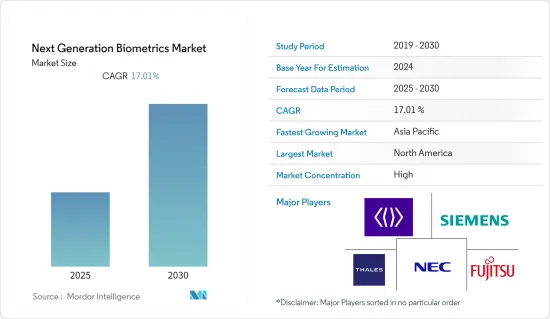
One of the key trends witnessed in the next-generation biometrics market is a paradigm shift in business discourse toward more privacy and fewer security threats. The end-users are increasingly looking for integrated solutions rather than depending on conventional methods.
Key Highlights
- The next-generation biometric market is anticipated to grow at a significant growth rate due to the rising number of terrorist activities, coupled with the increasing theft activities on the part of crucial data and information that have raised concerns regarding national security. For instance, in August 2022, Chile is implementing an automatic biometric identification system (ABIS) to combat organized crime. By comparing the biometric records of the civil police (PDI), the civil registry, and Interpol, the system would instantaneously identify recognized criminals, illegal migrants, and the deceased who lack any identity.
- The rising identity fraud across the globe is restricting market growth globally. According to Onfido, Identity fraud rose 43% YoY, with sophisticated fraud increasing 57% as criminals employed smarter tactics, utilizing realistic 2D/3D masks and deploying display attacks (for instance, showing a picture of a person on a screen) to try to spoof verification systems. And with 9 out of 10 consumers comfortable accessing digital services, the opportunities for fraudsters are further increasing.
- The next-generation biometric industry benefits from the increase in electronic cards and biometric passports. Costa Rica, for example, in September 2021, is slated to launch its biometric passport in 2022. The new passport was created using the most advanced security technology to reject fraudulent attempts. It also complies with the demands the International Civil Aviation Organization sets forth. Throughout the projected term, these advances may generate growth opportunities for market development.
- The COVID-19 outbreak significantly increased demand for touchless biometrics solutions, particularly in the healthcare sector, and created substantial disturbances and adjustments in various industries. Advanced multifactor and multimodal biometrics solutions are becoming increasingly important due to their accuracy and conformance with COVID-19's social separation norms.
- Companies must refrain from using fingerprint, palm print, and hand-key scanners to minimize physical touch and virus transmission. These actions are laying the groundwork for facial identification equipment and user-friendly iris scanning, which will be applied in several contexts. The outbreak brought about a trend toward contactless biometric technologies that assess face, gait, and speech recognition for accurate identification, which benefitted the market growth and is expected to grow over the forecast period.
Next Generation Biometric Market Trends
Banking and Financial Industry to be the Fastest Growing Sector
- Central Banks are rolling out biometric authentication. Bank of America, JP Morgan Chase, and Wells Fargo allow customers to log in to mobile banking via fingerprint authentication. Voice authentication is also deployed in bank call centres to identify customers. Next-generation biometric authentication can improve customer satisfaction by eliminating the need for passwords and increasing the demand for biometrics in the banking sector.
- A Visa poll from May 2022 found that 86% of users are eager to utilize biometrics to verify their identification while making payments. 70% of respondents who used biometrics said it was simpler to use them, and 46% said they were safer than credentials or PINs. Thus, increasing the adoption of biometric security for internet banking and mobile payments is expected to contribute to the market growth due to increasing banking fraud.
- According to IDEMIA, in July 2021, a pioneer in biometric solutions worldwide, the Indian banking industry is now more eager to implement safe and practical biometric technologies in the post-Covid era. IDEMIA is seeking to provide various cutting-edge biometric protection and transaction solutions. These developments in the BFSI sector are expected to propel next generation biometrics market over the coming years.
- Internet finance and digital operations have become increasingly popular over the past few years due to the increased use of digital technology in the BFSI sector. Many banks now use biometric facial recognition to access accounts through ATMs, eliminating the requirement to punch a card. For instance, in May 2022, Mastercard introduced a biometric payment method for physical establishments that relies on face recognition biometrics instead than smartphones, smart cards, or memorized PINs.
Asia-Pacific to Witness a Significant Growth Rate over the Forecast Period
- The market in the region is expected to witness significant growth in emerging economies, estimated to grow steadily over the forecast period. Apart from the consumer electronics and government sectors, the healthcare sector is expected to experience growth in the application of next-generation biometrics in this region.
- The region is expected to grow with innovation advancement and the region's widespread use of biometric devices at an affordable price. Additionally, the next-generation biometrics industry is increasing as the government and several business sectors use this innovation to identify individuals.
- The need for biometric identification technologies is rising among end-users, such as gaming retail, the banking and financial industry, hospitals, etc. This demand is having a substantial impact on the market's expansion nationwide. For instance, in June 2021, in conjunction with IDEX Biometrics, the China Construction Bank (CCB) chose to employ biometric credentials in its digital renminbi initiatives. The institution previously made available an app for digital yuan wallets. Users will not require a smartphone to utilize virtual currency owing to the NFC-enabled biometrics smart card.
- The rise of the market in the Asia Pacific countries is fuelled by factors including the economic development of developing nations, rising interest in travel, and increased use of IoT devices. For instance, in November 2021, "Mantra Softech" and the administration of Uttar Pradesh reached an agreement to distribute rations using biometrics. Furthermore, in December 2021. the Indian government implemented "Facial Recognition Technology" (FRT) for traveler registration as part of the "DIGI YATRA SCHEME." These recent events are anticipated to accelerate the expansion of the biometric industry in this area.
- In September 2022, as a continuation of its Asia Pacific growth, Incode, the next-generation identity confirmation platform, revealed that it partnered with TOTM Technologies as a distributor to provide identification solutions, Incode Omni, to the Indonesian market. By introducing world-class, safe, and customer-focused biometric solutions from Incode to the area, TOTM Technologies is dedicated to widening the scope of Indonesian businesses. Thus, these developments in the Asia-Pacific region are expected to propel the next-generation biometric market over the forecast period.
Next Generation Biometric Industry Overview
The next-generation biometrics market is highly fragmented due to numerous market players investing in technological innovation aligned with the market need. Moreover, the next-generation biometric market is highly competitive due to the expected demand in the future. Some of the key players in the market are Idemia, Fujitsu Ltd., NEC Corporation, Thales Group, and Siemens AG.
- September 2022: Onfido, the top worldwide digital identity validation, and authentication supplier launched Motion, a cutting-edge liveness solution for biometrics that will improve its Real Identity Platform. Motion is iBeta Level 2 approved and offers smooth, secure, and inclusive consumer verification.
- August 2022: IDEX Biometrics ASA and Realtime AS launched strategic cooperation to create and commercialize the world's inaugural Web3 biometric transaction card with cold storing and digital property wallets, as well as digital identity. In the first half of 2023, the marketplace is predicted to get these all-in-one biometrics payment card that complies with EMV standards.
Additional Benefits:
- The market estimate (ME) sheet in Excel format
- 3 months of analyst support
TABLE OF CONTENTS
1 INTRODUCTION
- 1.1 Study Assumptions and Market Definitions
- 1.2 Scope of the Study
2 RESEARCH METHODOLOGY
3 EXECUTIVE SUMMARY
4 MARKET DYNAMICS
- 4.1 Market Overview
- 4.2 Market Drivers
- 4.2.1 Inclination of Growth toward E-Passport Program
- 4.2.2 Integration of Biometrics in Smartphones Driving Growth
- 4.3 Market Restraints
- 4.3.1 Fear of Privacy Invasion Challenging Growth
- 4.3.2 High Initial Cost of Systems Restricting Growth
- 4.4 Industry Attractiveness - Porter's Five Forces Analysis
- 4.4.1 Bargaining Power of Suppliers
- 4.4.2 Bargaining Power of Buyers
- 4.4.3 Threat of New Entrants
- 4.4.4 Threat of Substitute Products
- 4.4.5 Intensity of Competitive Rivalry
- 4.5 Technology Snapshot
5 MARKET SEGMENTATION
- 5.1 By Type of Solution
- 5.1.1 Face Recognition
- 5.1.2 Fingerprint Recognition
- 5.1.3 Iris Recognition
- 5.1.4 Palm Print Recognition
- 5.1.5 Signature Recognition
- 5.1.6 Other Types of Solutions
- 5.2 By End-user Vertical
- 5.2.1 Government
- 5.2.2 Defense
- 5.2.3 Travel and Immigration
- 5.2.4 Home Security
- 5.2.5 Banking and Financial Service
- 5.2.6 Healthcare
- 5.2.7 Other End-user Verticals
- 5.3 Geography
- 5.3.1 North America
- 5.3.2 Europe
- 5.3.3 Asia-Pacific
- 5.3.4 Middle East & Africa
- 5.3.5 Latin America
6 COMPETITIVE LANDSCAPE
- 6.1 Company Profiles
- 6.1.1 IDEMIA
- 6.1.2 NEC Corporation
- 6.1.3 Fujitsu Ltd
- 6.1.4 Siemens AG
- 6.1.5 Thales Group
- 6.1.6 Cross Match Technologies
- 6.1.7 Fingerprint Cards AB
- 6.1.8 Suprema Inc.
- 6.1.9 RCG Holdings Limited
- 6.1.10 Safran SA