|
시장보고서
상품코드
1640583
무인운반차 : 시장 점유율 분석, 산업 동향 및 통계, 성장 예측(2025-2030년)AGV - Market Share Analysis, Industry Trends & Statistics, Growth Forecasts (2025 - 2030) |
||||||
 Mordor Intelligence
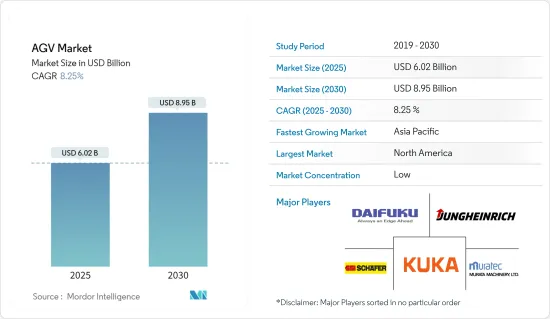
무인운반차 시장 규모는 2025년에 60억 2,000만 달러로 추정됩니다. 예측기간(2025-2030년)의 CAGR은 8.25%로, 2030년에는 89억 5,000만 달러에 달할 것으로 예상됩니다.
주요 하이라이트
- 기술 진보가 높아지고, 산업에서의 자동화 수요 증가, 제조·창고 시설에서의 로봇 수요 증가, 신흥 시장의 성장이 자동 반송차 시장의 성장을 가속하는 주요 요인입니다.
- 최근 자동화는 제조업에 혁명을 일으켜 생산성, 효율성, 안전성을 향상시키고 있습니다. 자동화 기술의 최신 혁신은 무인운반차입니다. AGV는 인간의 안전을 보장하고 최적의 효율성 요구를 충족시키는 능력으로 제조 시설에서 상당한 인지도를 얻고 있습니다. 기술이 발전함에 따라 제조업체는 자체 운영 요구 사항에 맞는 AGV를 만들고 다양한 용도에 효과적으로 도입할 수 있습니다.
- 자동차 업계에서는 자동화와 AGV의 제조 현장으로의 도입이 진행되고 있습니다. 예를 들어, 스페인 말트렐에 있는 SEAT 공장은 디지털화된 스마트 공장으로 변모하고 있습니다. 이 회사는 SLAM 네비게이션, 4G 연결 및 유도 배터리 충전을 갖춘 AGV를 도입했습니다. 이 설비에는 8대의 옥외 작업용 AGV와 200대 이상의 AGV가 있으며, 마르트렐 공장과 바르셀로나 공장의 조립 작업장에서 부품을 운반하는 AGV가 있습니다.
- 세계의 노동 시장은 매우 타이트하고, 이것이 자동 지게차의 성장의 주된 이유가 되었습니다. 실업률이 지난 50년간 최저 수준임에도 불구하고 물류센터와 창고에서는 신뢰할 수 있는 근로자를 찾기가 어렵습니다. 자동화는 24시간 체제에서 지속적이고 신뢰성 있는 성능을 제공하여 노동력 격차를 해소하는 데 도움이 될 수 있습니다.
- 게다가 이 시장에서는 여러 벤더가 빌딩 내 주차장용 AGV의 발매에 주력하고 있으며, 시장의 성장을 더욱 뒷받침하고 있습니다. 예를 들어 오텍 오티스 파킹 시스템즈는 2024년 4월 인공지능(AI) 기술을 활용한 무인운반차 주차 로봇을 출시했습니다. 이것은 AI와 사물인터넷(IoT) 기술을 결합한 자율주행 시스템입니다. 그 목적은 자동 운전 주차장의 최적 경로를 자동으로 찾아 무인 주차를 용이하게하는 것입니다.
- 지속적으로 증가하는 연구개발비와 세계 생산사업소는 중견산업, 특히 식품가공 및 제약분야에서 세계의 자동화 수요를 견인하고 있습니다.
- 또한 공급망과 제조 공정을 AGV로 자동화하는 기업은 많은 투자를 해야 합니다. 이를 통해 작업 공간을 보다 AGV 친화적으로 만들기 위한 구매, 설정 및 조정 비용을 처리할 수 있습니다. 또한 제조업체는 AGV의 비용이 높기 때문에 AGV의 사용을 꺼릴 수 있습니다. 중소기업은 자동화 시스템을 구입할 여유가 없으며 대신 기존의 수동 지게차를 사용해야하기 때문에 AGV를 채택하기가 어렵다고 느낄 수 있습니다.
- 또한 경기침체, 인플레이션, 전쟁, 기후 변화, 무역분쟁, 에너지 접근, 산업 스파이 등의 다른 위협은 최종 사용자 부문에서 AGV의 역할을 직접 형성하는 요인의 일부입니다.
무인운반차 시장 동향
보다 높은 효율을 요구하는 전자상거래의 급성장
- 제조업의 성장에도 불구하고 창고 및 물류 부문의 상당한 수요는 전자상거래 활동에 바쳐지고 있습니다. 예를 들어, 캐나다의 창고 포트폴리오는 주로 전자상거래로 구성되어 있으며, 이 나라의 창고 사업의 50% 이상을 차지할 것으로 추정됩니다.
- AGV의 도입은 전자상거래의 다양한 분야에 기회를 제공합니다. 특히, AGV는 넓은 창고 영역에 퍼지는 대형 SKU 범위의 대량의 소량 주문을 포함한 완성 작업에 적합합니다. 수평 주행을 위해 자율형 로봇을 사용하여 주문 처리 효율을 높일 수 있습니다.
- 항상 연결되는 전자상거래 소개, 신속한 대응 요구, 적은 오류로 더 많은 재고 관리 단위를 관리할 필요성으로 인해 창고는 규모를 확장하고 지능적이고 효율적인 자동 창고 기준을 충족해야 합니다. 이러한 세계화의 진전, 온라인 소매 및 대량 소매의 상승은 소매 업계에서 AGV 수요를 증가시키고 있습니다.
- 선진국이든 신흥국이든 늘어나는 1일 배달 주문에 대응하는 전자상거래 기업 수요가 증가하고 있기 때문에 이러한 계획의 상업적 실행 가능성으로 효율성이 크게 향상되고 있습니다. 전자상거래 창고는 AGV의 도움으로 1일 배송을 실시했습니다.
- 전자상거래 산업의 성장은 전 세계의 효율적인 창고 관리 및 재고 관리의 필요성과 함께 조사된 시장을 견인하고 있습니다. 예를 들어 미국 상무부 인구조사국에 따르면 2023년 4분기 미국 소매 매출 전체에서 차지하는 전자상거래 비율은 15.6%로 전분기부터 상승했습니다. 2023년 10월부터 12월까지 미국 소매 전자상거래 매출은 2,850억 달러를 넘어 분기 기준으로 사상 최고를 기록했습니다.
- 급변하는 소매 시장으로 물류센터는 전자상거래 주문 처리에 대한 혁신적이고 유연하며 자동화된 접근법을 모색하고 도입할 필요가 있습니다. 이러한 전자상거래 구매 증가는 부드러운 워크플로우를 강화하기 위해 기업이 자동 자재관리 장비를 운영 프로세스에 도입할 것을 뒷받침할 것으로 예상됩니다.
- 또한 공급망은 전자상거래 수요 증가에 대응하여 물류센터에서 AGV를 사용하기 시작하여 산업이 높은 생산성으로 작동할 수 있도록 합니다. 의약품 등의 분야에서는 수요에 대한 대응과 위생 유지를 위해 AGV의 이용이 확대되고 있습니다. 병원 및 기타 건강 관리 시설에서는 식품, 휴지통, 린넨 및 무균 소모품의 비접촉 이송에 AGV가 활용됩니다.
상당한 성장이 기대되는 아시아태평양
- 중국의 AGV 시장은 주로 동국의 제조업 성장에 의해 견인되고 있습니다. 중국은 세계 최대의 제조업을 보유하고 있으며, 국가 경제 성장에도 크게 기여하고 있습니다.
- 소매업이 확대되고 투자가 증가함에 따라 중국은 자동 반송차에 중요한 시장이 될 것으로 예상됩니다. 소비율의 상승과 창고의 대형화 수요 증가도 무인 반송차의 필요성을 높이고 있습니다.
- 또한 중국은 Industry 4.0의 주요 도입국으로 유럽연합, 미국, 일본 등의 지역을 억제하고 있으며, 이 지역에는 세계에서 가장 선진적인 제조 시설이 있습니다.
- 세계경제포럼에 따르면 현재 Industry 4.0 기술을 사용하고 있는 세계 69개 공장 중 중국은 20개 공장이 있으며 EU 19개, 미국 7개, 일본 5개가 이어지고 있습니다. 공장 전체의 자동화의 기반일 뿐만 아니라, 자동 보관·검색 시스템도 인더스트리 4.0의 기반이 되고 있습니다.
- 또한 인도, 중국, 인근 국가 등 신흥국에서 전자상거래 수요가 증가함에 따라 전자상거래 기업은 창고에 AGV를 대폭 도입하고 있습니다. IBEF에 따르면 인도의 전자상거래는 27%의 연평균 복합 성장률(CAGR)을 기록했으며 2026년까지 1,630억 달러에 이를 것으로 예상됩니다. 마찬가지로 23년도에는 인도의 전자상거래 상품 총액(GMV)은 600억 달러에 달하고, 전년 대비 22% 증가했습니다.
- 또한, 여러 기업이 업무 자동화를 지원하기 위해 AGV를 채택하고 시장을 더욱 견인하고 있습니다. 예를 들어 2024년 4월에는 부산뉴포트 동원세계터미널(DGT)이 정식 낙성식을 진행했습니다. 이것은 한국 항만 자동화 여행에서 중요한 이정표이며, 이 터미널은 수평 운송에 AGV를 사용하는 국내 최초의 터미널입니다. 부산신항에서는 DGT가 7번째 컨테이너 터미널이 됩니다. 일명 "전송 크레인"이라고도 불리는 자동 야드 크레인은 부산 신항의 다른 6개 터미널 모두에 설치되어 있습니다. 그러나 AGV를 사용하는 것은 DGT가 처음입니다.
- 마찬가지로 2023년 8월 웨스트포트 말레이시아는 미래의 터미널 개발 계획에서 전동 무인 운송 차량을 사용할 가능성을 조사할 계획을 발표했습니다.
무인운반차 산업 개요
세계의 무인운반차 시장은 세분화되어 있어 수많은 기업이 시장 점유율을 다투고 있습니다. 이 업계는 디지털 변환과 인더스트리 4.0과 IoT의 통합과 같은 요인에 의해 큰 성장 기회를 목격하고 있습니다. 업계를 선도하는 것은 Kuka AG, 다이후쿠, SSI Schaefer AG, 무라타 기계, 융하인리히 AG 등 유력 기업입니다.
- 2024년 3월 FFT는 유도 충전 기술을 제공하는 Wiferion과 제휴해 새로운 무인 반송차 시스템으로 포트폴리오를 확대하는 것을 발표했습니다. FFTigv와 Wiferion 충전 시스템은 라이프치히에 있는 BMW 그룹 공장에 도입되었습니다. FFT는 새로운 제조 시설을 건설하고 무선 충전과 AGV를 활용하여 생산량과 효율을 향상시켰습니다.
- 2024년 3월 Cypher Robotics는 효율적이고 정확한 사이클 카운트와 산업용 스캐닝을 실현하는 Captis AGV(자율형 지상 주행차)의 발매를 발표했습니다. Captis AGV는 창고 내에서 자체 추진할 수 있습니다. 인프라를 변경할 필요가 없으며 사람이나 물건에 충돌하지 않습니다.
기타 혜택 :
- 엑셀 형식 시장 예측(ME) 시트
- 3개월의 애널리스트 서포트
목차
제1장 서론
- 조사의 전제조건과 시장 정의
- 조사 범위
제2장 조사 방법
제3장 주요 요약
제4장 시장 인사이트
- 시장 개요
- 산업 밸류체인 분석
- 업계의 매력도 - Porter's Five Forces 분석
- 공급기업의 협상력
- 구매자/소비자의 협상력
- 신규 진입업자의 위협
- 대체품의 위협
- 경쟁 기업 간 경쟁 관계의 강도
- COVID-19의 영향과 기타 거시 경제 요인이 시장에 미치는 영향
제5장 시장 역학
- 시장 성장 촉진요인
- 보다 높은 효율성을 요구하는 전자상거래의 급성장
- 기술과 로봇에 대한 투자 증가
- 시장 성장 억제요인
- 통신 지연에 의한 실시간 무선 제어의 한계
제6장 시장 세분화
- 제품 유형별
- 자동 지게차
- 자동 견인/트랙터/예인
- 유닛로드
- 조립 라인
- 특수용도
- 최종 사용자 산업별
- 음식
- 자동차
- 소매
- 전자 및 전기
- 일반 제조업
- 제약
- 기타 최종 사용자 산업
- 지역별
- 북미
- 유럽
- 아시아
- 호주 및 뉴질랜드
- 라틴아메리카
- 중동 및 아프리카
제7장 경쟁 구도
- 기업 프로파일
- KUKA AG
- Jungheinrich AG
- Murata Machinery Ltd
- Daifuku Co. Ltd
- SSI Schaefer Systems International DWC LLC
- Swisslog Holding
- Dematic Corp.
- Toyota Material Handling
- Scott Technology Limited
- John Bean Technologies(JBT) Corporation
- Systems Logistics SPA
- Seegrid Corporation
제8장 투자 분석
제9장 시장의 미래
KTH 25.02.19The AGV Market size is estimated at USD 6.02 billion in 2025, and is expected to reach USD 8.95 billion by 2030, at a CAGR of 8.25% during the forecast period (2025-2030).
Key Highlights
- Rising technological advancements, increased demand for automation in industries, increased demand for robots in manufacturing and warehousing facilities, and growing emerging markets are the key factors driving the growth of the automated guided vehicles market.
- In recent years, automation has revolutionized the manufacturing sector, resulting in enhanced productivity, efficiency, and safety. Among the latest breakthroughs in automation technology are automated guided vehicles (AGVs). AGVs have gained considerable recognition in manufacturing facilities due to their ability to ensure human safety and meet the demand for optimal efficiency. Technological advancements have empowered manufacturers to create AGVs tailored to their operational requirements and effectively implement them for various applications.
- The automotive industry is increasingly incorporating automation and AGVs into its manufacturing floors. For instance, the SEAT plant in Martorell, Spain, is transforming into a digitalized and smart factory. The company implemented AGVs with SLAM navigation, 4G connectivity, and induction battery charging. The facility has eight AGVs for outdoor operation and over 200 AGVs that deliver parts inside the assembly workshops at the Martorell and Barcelona factories.
- The global labor market is extremely tight, which is the primary reason for the growth of automated forklifts. Despite the fact that unemployment is at its lowest level in fifty years, distribution centers and warehouses find it difficult to find and keep trustworthy workers. Automation could provide continuous, reliable performance around the clock, helping to close the labor gap.
- Furthermore, several vendors in the market are focusing on launching AGVs for parking in the buildings, further supporting the market's growth. For instance, in April 2024, Autech-Otis Parking Systems launched an automatic guided vehicle (AGV) parking robot utilizing artificial intelligence (AI) technology. It is an autonomous driving system that combines AI and Internet of Things (IoT) technologies. Its goal is to automatically find the best routes for self-driving parking lots so that unmanned parking can be made easier.
- The continuously increasing R&D expenditure and the rising number of production establishments worldwide are driving the demand for automation worldwide in mid-range industries, especially in the food processing and pharmaceutical sectors.
- Moreover, companies that automate their supply chains or manufacturing processes with AGVs have to invest a lot of money. This takes care of the price of buying, setting up, and adjusting the workspace to make it more AGV-friendly. Moreover, manufacturers might be dissuaded from using AGVs due to their high cost. Smaller businesses may find it difficult to adopt AGVs since they cannot afford automated systems and must instead use traditional, manual forklift trucks.
- Furthermore, other threats such as recession, inflation, war, climate change, trade disputes, energy access, and industrial espionage are some of the factors that are responsible for directly shaping the role of AGVs in end-user sectors.
Automated Guided Vehicles Market Trends
Rapid Growth of E-commerce Demanding Higher Efficency
- Despite growth in the manufacturing industry, considerable demand from the warehousing and logistics sector is dedicated to e-commerce activity. For instance, the Canadian warehouse portfolio is mainly comprised of e-commerce, which is estimated to make up more than 50% of the country's warehouse business.
- The deployment of AGVs provides an opportunity for different areas in e-commerce. Specifically, the AGVs are suited for fulfillment operations involving large quantities of small orders for large SKU ranges spread across large warehouse areas. Using autonomous robots to perform horizontal traveling can increase order fulfillment efficiency.
- With the introduction of always-on e-commerce, the demand for faster responses, and the need to manage a more significant number of stock-keeping units with fewer errors, warehouses need to scale up and meet the standards of an intelligent, efficient, and automated warehouse. Such increasing globalization and the rise of online retail and bulk retail have increased demand for AGVs in the retail industry.
- The rising demand for e-commerce companies to cater to the increasing number of single-day delivery orders, both in advanced and emerging economies, has resulted in a significant increase in efficiency owing to the commercial viability of these schemes. E-commerce warehouses carry out the single-day delivery method with the aid of AGVs.
- The growth in the e-commerce industry, along with the need for efficient warehousing and inventory management across the world, are driving the market studied. For instance, according to the Census Bureau of the Department of Commerce, in the fourth quarter of 2023, the share of e-commerce in total US retail sales stood at 15.6%, up from the previous quarter. From October to December 2023, retail e-commerce sales in the United States hit over USD 285 billion, the highest quarterly revenue in history.
- The rapidly changing retail market compels distribution centers to seek out and implement innovative, flexible, and automated approaches to e-commerce order fulfillment. Such a rise in e-commerce purchases is expected to push companies to deploy automated material handling equipment in their operation process to enhance smooth workflow.
- Moreover, supply chains began using AGVs in distribution centers in response to increased e-commerce demand, allowing industries to function at high productivity. AGVs' use has expanded in sectors like pharmaceuticals to keep up with demand and maintain sanitation. Hospitals and other healthcare facilities utilize AGVs to undertake the contactless transfer of food, trash bins, linens, and sterile supplies.
Asia-Pacific Expected to Witness Significant Growth
- The AGV market in China is primarily driven by the country's proliferating manufacturing industry. China has the largest manufacturing industry in the world, and it is also a key contributor to the country's economic growth.
- China is anticipated to be a crucial market for automated guided vehicles, given the expanding retail sector and increased investments. Rising consumption rates and the growing demand for larger warehouses are also driving the need for AGVs.
- Moreover, China is a major adopter of Industry 4.0, and the region is home to some of the most advanced manufacturing facilities in the world, ahead of regions like the European Union, the United States, and Japan.
- According to the World Economic Forum, of the 69 factories around the world now considered leaders using Industry 4.0 technologies, China is now home to 20, followed by 19 in the European Union, 7 in the United States, and 5 in Japan. Besides being the foundation for plant-wide automation, the automated storage and retrieval system also serves as a foundation for Industry 4.0.
- Moreover, with the increasing demand for e-commerce in emerging countries, such as India, China, and neighboring countries, e-commerce companies have been deploying AGVs at warehouses significantly. According to the IBEF, Indian e-commerce is projected to witness a CAGR of 27% to reach USD 163 billion by 2026. Similarly, in FY23, the gross merchandise value (GMV) of e-commerce in India reached USD 60 billion, increasing 22% over the previous year.
- In addition, several companies are adopting AGVs to support automation in the business, further driving the market. For instance, in April 2024, Busan Newport's Dongwon Global Terminal (DGT) held its formal inauguration ceremony. This was a significant milestone in Korea's port automation journey, as the terminal is the first in the country to use AGVs for horizontal transportation. At Busan Newport, DGT is the seventh container terminal. Automated yard cranes, also known as "transfer cranes," are present in all six of the other terminals at Busan New Port. However, DGT is the first to use AGVs.
- Similarly, in August 2023, Westports Malaysia announced plans to investigate the potential of using electric automated guided vehicles in future terminal development plans.
Automated Guided Vehicle Industry Overview
The global automated guided vehicle market is fragmented, with numerous players vying for market share. The industry is witnessing significant growth opportunities, driven by factors like digital transformation and the integration of Industry 4.0 with IoT. Leading the pack are prominent players, including Kuka AG, Daifuku Co. Ltd, SSI Schaefer AG, Murata Machinery Ltd, and Jungheinrich AG.
- March 2024: FFT announced the expansion of its portfolio with a new automated guided vehicle system by partnering with inductive charging tech provider Wiferion, which automaker BMW is now using. The charging systems from FFTigv and Wiferion have been implemented at the BMW Group plant in Leipzig. FFT created a new manufacturing facility, thereby utilizing wireless charging and AGVs to increase output and efficiency.
- March 2024: Cypher Robotics announced the release of the Captis Autonomous Ground Vehicle (AGV) for efficient and accurate cycle counting and industrial scanning. The Captis AGV is capable of navigating warehouses by itself. It does not require any changes to the infrastructure and will not collide with people or objects.
Additional Benefits:
- The market estimate (ME) sheet in Excel format
- 3 months of analyst support
TABLE OF CONTENTS
1 INTRODUCTION
- 1.1 Study Assumptions and Market Definition
- 1.2 Scope of the Study
2 RESEARCH METHODOLOGY
3 EXECUTIVE SUMMARY
4 MARKET INSIGHTS
- 4.1 Market Overview
- 4.2 Industry Value Chain Analysis
- 4.3 Industry Attractiveness - Porter's Five Forces Analysis
- 4.3.1 Bargaining Power of Suppliers
- 4.3.2 Bargaining Power of Buyers/Consumers
- 4.3.3 Threat of New Entrants
- 4.3.4 Threat of Substitute Products
- 4.3.5 Intensity of Competitive Rivalry
- 4.4 Impact of COVID-19 Aftereffects and Other Macroeconomic Factors on the Market
5 MARKET DYNAMICS
- 5.1 Market Drivers
- 5.1.1 Rapid Growth of E-commerce Demanding Higher Efficiency
- 5.1.2 Increasing Investments in Technology and Robotics
- 5.2 Market Restraints
- 5.2.1 Limitation of Real-Time Wireless Control Due to Communication Delays
6 MARKET SEGMENTATION
- 6.1 By Product Type
- 6.1.1 Automated Fork Lift
- 6.1.2 Automated Tow/Tractor/Tugs
- 6.1.3 Unit Load
- 6.1.4 Assembly Line
- 6.1.5 Special Purpose
- 6.2 By End-User Industry
- 6.2.1 Food & Beverage
- 6.2.2 Automotive
- 6.2.3 Retail
- 6.2.4 Electronics & Electrical
- 6.2.5 General Manufacturing
- 6.2.6 Pharmaceuticals
- 6.2.7 Other End User Industries
- 6.3 By Geography
- 6.3.1 North America
- 6.3.2 Europe
- 6.3.3 Asia
- 6.3.4 Australia and New Zealand
- 6.3.5 Latin America
- 6.3.6 Middle East and Africa
7 COMPETITIVE LANDSCAPE
- 7.1 Company Profiles
- 7.1.1 KUKA AG
- 7.1.2 Jungheinrich AG
- 7.1.3 Murata Machinery Ltd
- 7.1.4 Daifuku Co. Ltd
- 7.1.5 SSI Schaefer Systems International DWC LLC
- 7.1.6 Swisslog Holding
- 7.1.7 Dematic Corp.
- 7.1.8 Toyota Material Handling
- 7.1.9 Scott Technology Limited
- 7.1.10 John Bean Technologies (JBT) Corporation
- 7.1.11 Systems Logistics SPA
- 7.1.12 Seegrid Corporation