|
시장보고서
상품코드
1640701
공중 풍력 터빈 - 시장 점유율 분석, 산업 동향 및 통계, 성장 예측(2025-2030년)Airborne Wind Turbines - Market Share Analysis, Industry Trends & Statistics, Growth Forecasts (2025 - 2030) |
||||||
 Mordor Intelligence
공중 풍력 터빈 시장 규모는 2025년에 1억 5,448만 달러로 추정되며, 예측 기간(2025-2030년)의 CAGR은 9.09%로, 2030년에는 2억 3,867만 달러에 달할 것으로 예측됩니다.

풍력에너지 기술의 유지보수 비용이 낮고 세계 공중풍력에너지 시스템을 이용하는 기업이 증가하고 있는 점 등이 2024-2029년에 걸쳐 시장을 견인할 것으로 예상됩니다.
한편, 터빈의 건설 및 설치 비용이 높거나 적절한 개발자가 없다는 점이 시장의 성장을 방해할 것으로 예상됩니다.
공중풍력에너지(AWE) 기술과 같은 기술적 진보는 기본적으로 새롭고 더욱 큰 시장 개척이 필요하기 때문에 2024-2029년에 걸쳐 몇 가지 미래 시장 기회를 창출할 것으로 예상됩니다.
유럽은 2024-2029년에 걸쳐 세계의 공중 풍력에너지 시장에서 가장 크고 가장 빠른 성장 지역이 될 전망입니다.
공중 풍력 터빈 시장 동향
공중풍력에너지 강화에 주력하는 기업이 시장을 견인
- 세계 각국은 공중 풍력 발전의 설비 용량을 증설하는 추세에 있습니다. AWE 기술에 투자함으로써 각국은 에너지원을 다양화하고 보다 깨끗하고 지속 가능한 미래에 기여할 수 있습니다. 또한 공중 풍력 발전 시스템의 확장성과 유연성은 오지 등의 오프 그리드 커뮤니티에 전력을 공급하는 것부터 대규모 그리드 통합을 지원하는 것까지 다양한 용도에 적합합니다.
- 예를 들어, BVG Associates에 따르면 세계 공중 풍력 발전 설치 용량은 2030년에는 0.25GW인 반면 2025년에는 0.02GW에 이를 것으로 예상됩니다.
- 또한, 세계 주요 기업들은 가스 저장 시설에 전력을 공급하기 위해 공중 풍력 발전 시스템을 이용합니다. 발전에 AWE 시스템을 활용함으로써 기업은 기존의 화석 연료 기반 전원에 대한 의존도를 줄이고 이산화탄소 배출량을 줄일 수 있습니다. AWE 시스템은 풍속이 빠른 높은 고도에서 안정적으로 가동할 수 있기 때문에 오지 및 오프 그리드 지역의 가스 저장 시설에 전력을 공급하는 매력적인 선택입니다.
- 예를 들어, 2024년 2월, ENGIE 그룹과 SkySails Power GmbH는 높은 고도의 바람을 신재생에너지로 활용하는 합작 사업에서 큰 진전을 이루었습니다. 양사는 가스저장시설 Peckensen에 공중풍력발전(AWE)과 태양광발전에 의한 지속가능 에너지를 공급하는 것을 목표로 하는 파일럿 프로젝트에 대해 현지 당국으로부터 긍정적인 평가를 받았습니다.
- 연처럼 작동하는 공중 풍력에너지 장치 개발에 종사하는 주요 조직은 시스템의 효율성, 신뢰성 및 확장성 향상에 주력하고 있으며 보다 긴 비행시간과 보다 큰 출력을 달성하는 것을 목표로 디바이스의 설계와 성능을 최적화하기 위한 조사와 검사를 실시했습니다.
- 예를 들어, 2023년 5월 노르웨이의 재생 가능 에너지 기업인 Kitemill은 회사의 KM1 파일럿 시스템이 중요한 이정표를 달성했다고 발표했습니다. 이 시스템은 5시간 연속 운전으로 500km 이상을 커버해, 공중 풍력에너지(AWE) 부문의 신기록을 수립했습니다.
- 위의 요인에 따라 공중풍력에너지 강화에 주력하는 기업이 2024-2029년에 걸쳐 시장을 견인할 것으로 예상됩니다.
유럽이 공중풍력 터빈 시장을 독점
- 유럽에는 207GW의 육상 풍력 발전 용량이 있으며, 유럽 위원회는 넷 제로 비전의 일환으로 2050년까지 이를 1,000GW까지 늘릴 계획입니다. 이 수요에 대응하기 위해 더 많은 풍력 발전소를 개발하는 것이 이 지역의 공중 풍력 터빈 시장의 성장을 가속할 것입니다.
- 이 지역의 기업들은 비용 절감과 성능 향상이 가능한 공중 풍력 발전 시스템에 점점 매력을 느끼고 있습니다. 이러한 혁신적인 기술 도입에 주력함으로써 기업은 화석 연료에 대한 의존도를 줄이고 지속 가능한 에너지의 미래에 기여할 수 있습니다. 이 효율의 향상은 평준화 발전 단가(LCOE)의 저하로 이어지고, 재생 가능 에너지에 대한 투자를 고려하고 있는 기업들에게 공중 풍력 발전 시스템은 매력적인 선택이 될 것입니다. 예를 들어 BVG Associates에 따르면 2025년에는 공중풍력발전의 평준화 발전 단가(LCOE)는 99유로/MWh에 달했으나 2030년에는 45유로/MWh로 예상됩니다.
- AWE는 기존의 풍력 발전 기술보다 저렴한 비용으로 에너지를 공급할 수 있습니다. 2030년대 초반까지 AWE는 기존 풍력발전 기술보다 낮은 평균 가격으로 경쟁할 수 있을 것으로 보입니다. 300-500미터까지의 잠재적인 풍력 자원을 보다 많이 수확함으로써 AWE는 기존의 풍력 기술로는 실현 불가능한 보다 많은 장소에 적용할 수 있습니다.
- 유럽을 중심으로 약 20개의 소규모 기업이 AWE용 장치를 개발하고 있으며, 2025년까지 지상 시스템을 상업적으로 운용하려는 목표를 가진 기업도 있습니다.
- 노르웨이에서는 이 지역의 풍부한 풍력 자원을 활용하기 위해 유틸리티급 공중 풍력 시스템을 개발하기 위해 적극적으로 노력하고 있는 기업이 존재합니다. 신재생에너지 솔루션에 대한 수요 증가에 대응하려는 기업의 노력으로 이러한 시스템의 제조가 빠르게 진행되고 있습니다.
- 예를 들어 2023년 7월 공중풍력발전시스템 전문기업인 Kitemill은 회사 최초의 유틸리티급 공중풍력발전시스템 출시를 발표했습니다. 이 이정표는 EU 이노베이션 기금이 총 842만 달러를 투자하고 지원하는 '노르웨이 공중 풍력에너지 프로젝트'에 회사가 참여함으로써 달성되었습니다. 이 이니셔티브의 일환으로 Kitemill은 노르웨이의 홀탈렌에 위치한 시설에 최소 12대의 KM2 유닛을 설치할 예정입니다.
- 위와 같이 2024-2029년에 걸쳐 유럽이 공중 풍력 터빈 시장을 독점할 것으로 예상됩니다.
공중 풍력 터빈 산업 개요
항공기 탑재형 풍력 터빈 시장은 GE Power, Enercon GmbH, Nordex SE, Vestas Wind Systems AS, Siemens AG 등 주요 기업으로 인해 부분 통합되어 있습니다.
2023년 1월 독일 감사 및 인증 서비스 회사인 TUV SUD는 인도의 풍력에너지 회사에 서비스를 제공하는 계약을 Ventus Group과 체결했습니다. 이 계약의 일환으로 두 회사는 인도의 에너지 기업에게 풍력 발전기(WTG)를 이용한 풍력 발전소나 풍력 터빈의 성능을 측정, 분석, 최적화하는 기술을 지원합니다. 고객은 기존과 미래의 풍력에너지 투자로부터 안전과 생산량을 극대화하기 위한 지침을 얻게 됩니다.
기타 혜택
- 엑셀 형식 시장 예측(ME) 시트
- 3개월간의 애널리스트 서포트
목차
제1장 서론
- 조사 범위
- 시장의 정의
- 조사의 전제
제2장 주요 요약
제3장 조사 방법
제4장 시장 개요
- 소개
- 2029년까지 시장 규모와 수요 예측(단위 : 10억 달러)
- 최근 동향과 개발
- 정부의 규제와 시책
- 시장 역학
- 촉진요인
- 공중풍력에너지 강화에 주력하는 기업
- 풍력에너지 기술의 낮은 유지 보수 비용
- 억제요인
- 터빈의 건설·설치 비용
- 촉진요인
- 공급망 분석
- PESTLE 분석
- 산업의 매력 - Porter's Five Forces 분석
- 공급기업의 협상력
- 소비자의 협상력
- 신규 참가업체의 위협
- 대체품의 위협 제품 및 서비스
- 경쟁 기업간 경쟁 관계
제5장 시장 세분화
- 기술 부문
- 대형 터빈(3MW 이상)
- 소형 터빈(3MW 이하)
- 용도
- 해상
- 육상
- 2028년까지 시장 규모 및 수요 예측(지역별)
- 북미
- 미국
- 캐나다
- 기타 북미
- 유럽
- 독일
- 프랑스
- 영국
- 이탈리아
- 스페인
- 터키
- 북유럽
- 기타 유럽
- 아시아태평양
- 중국
- 인도
- 일본
- 한국
- 호주
- 태국
- 말레이시아
- 인도네시아
- 베트남
- 기타 아시아태평양
- 남미
- 브라질
- 아르헨티나
- 칠레
- 콜롬비아
- 기타 남미
- 중동 및 아프리카
- 사우디아라비아
- 아랍에미리트(UAE)
- 남아프리카
- 카타르
- 니제이라
- 이집트
- 기타 중동 및 아프리카
- 북미
제6장 경쟁 구도
- M&A, 합작사업, 제휴, 협정
- 주요 기업의 전략
- 기업 프로파일
- Vestas Wind Systems AS
- Nordex SE
- Enercon GmbH
- GE Power
- Siemens AG
- Senvion SA
- Goldwind
- United Power Inc.
- Envision Energy
- Suzlon Energy Ltd
- 기타 주요 기업 일람
- 시장 순위/점유율 분석
제7장 시장 기회와 앞으로의 동향
- 기술의 진보
The Airborne Wind Turbines Market size is estimated at USD 154.48 million in 2025, and is expected to reach USD 238.67 million by 2030, at a CAGR of 9.09% during the forecast period (2025-2030).
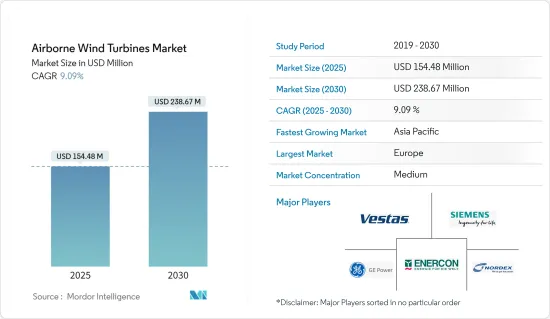
Factors such as low maintenance costs for wind energy technologies and the rise of companies using airborne wind energy systems across the world are expected to drive the market between 2024 and 2029.
On the other hand, the high cost of building and installing turbines and the lack of proper developers are expected to hinder the market's growth.
Nevertheless, technological advancements like airborne wind energy (AWE) technologies, which are fundamentally new and require significant further development, are expected to create several future market opportunities from 2024 to 2029.
Europe is expected to be the largest and fastest-growing region in the global airborne wind energy market between 2024 and 2029.
Airborne Wind Turbines Market Trends
Companies Focused on Enhance Airborne Wind Energy are Driving the Market
- Countries worldwide are trying to increase the installed capacity of airborne wind energy. By investing in AWE technology, nations can diversify their energy sources and contribute to a cleaner and more sustainable future. Additionally, the scalability and flexibility of airborne wind energy systems make them suitable for a wide range of applications, from powering remote off-grid communities to supporting large-scale grid integration.
- For instance, according to BVG Associates, the globally installed capacity of airborne wind energy is expected to reach 0.02 GW in 2025, compared to 0.25 GW in 2030.
- Furthermore, leading companies worldwide are also enabling the use of airborne wind energy systems to power gas storage facilities. By utilizing AWE systems to generate electricity, companies can reduce reliance on traditional fossil fuel-based power sources and lower their carbon footprint. The ability of AWE systems to operate at higher altitudes where wind speeds are more significant and consistent makes them an attractive option for powering gas storage facilities in remote or off-grid locations.
- For instance, in February 2024, ENGIE Group and SkySails Power GmbH made significant progress in their joint venture to utilize high-altitude winds for renewable energy. The partners have garnered favorable initial responses from local authorities for a pilot initiative aimed at supplying the gas storage facility Peckensen with sustainable energy derived from Airborne Wind Energy (AWE) and solar photovoltaic energy.
- The leading organizations involved in the development of kite-like devices for airborne wind energy are focusing on improving the efficiency, reliability, and scalability of their systems. They are conducting research and testing to optimize the design and performance of these devices, with the goal of achieving longer flight durations and greater power output.
- For instance, in May 2023, Kitemill, a Norwegian renewable energy company, announced that its KM1 pilot system achieved a significant milestone. The system covered more than 500 kilometers during five hours of continuous operation, setting a new record in the field of Airborne Wind Energy (AWE).
- Therefore, owing to the above factors, companies focused on enhancing airborne wind energy are expected to drive the market between 2024 and 2029.
Europe Dominates the Airborne Wind Turbines Market
- Europe has 207 GW of onshore wind capacity, and the European Commission plans to increase it to 1,000 GW by 2050 as part of its net-zero vision. Developing more wind sites to cater to this demand will drive the growth of the airborne wind turbine market in the region.
- Companies across the region are increasingly attracted to airborne wind energy systems due to their potential for cost savings and improved performance. By focusing on implementing these innovative technologies, companies can reduce their reliance on fossil fuels and contribute to a more sustainable energy future. This increased efficiency leads to a lower levelized cost of energy (LCOE), making airborne wind energy systems an attractive option for companies looking to invest in renewable energy sources. For instance, according to BVG Associates, in 2025, the levelized cost of energy (LCOE) for airborne wind power reached 99 EUR/MWh, whereas it was 45 EUR/MWh in 2030.
- AWE can provide energy at a lower cost than established wind technology. By the early 2030s, AWE could compete at an average price lower than established wind technology. By harvesting more wind resource potential up to 300-500 meters, AWE is viable in more locations that are not viable for established wind technology.
- About 20 small companies, most located in Europe, are developing devices for AWE, and some hope to have commercially operational ground systems by 2025.
- In Norway, companies are actively involved in developing utility-scale airborne wind systems to capitalize on the abundant wind resources available in the region. The manufacturing process for these systems is progressing rapidly as companies strive to meet the increasing demand for renewable energy solutions.
- For instance, in July 2023, Kitemill, a company specializing in airborne wind energy systems, announced the launch of its first utility-scale airborne wind system. This milestone was achieved through the company's participation in the Norse Airborne Wind Energy Project, which the EU Innovation Fund supports with a total investment of USD 8.42 million. As part of this initiative, Kitemill will be installing at most minuscule 12 KM2 units in an array located in Holtalen, Norway.
- Therefore, owing to the above factors, Europe is expected to dominate the airborne wind turbines market between 2024 and 2029.
Airborne Wind Turbines Industry Overview
The airborne wind turbine market is semi-consolidated with key players such as GE Power, Enercon GmbH, Nordex SE, Vestas Wind Systems AS, and Siemens AG. These companies are investing in various applications to gain market share and expand the scope of their service offerings. Businesses have remained competitive in the market by utilizing joint ventures, mergers, and acquisitions.
In January 2023, TUV SUD, the German Audit and certification service provider, signed a deal with Ventus Group to provide services to a wind energy company in India. As part of the deal, the duo will assist energy companies in India with technologies for measuring, analyzing, and optimizing the performance of wind farms and wind turbines utilizing wind turbine generators (WTG). The clients would get guidance on maximizing safety and production from their existing and future wind energy investments.
Additional Benefits:
- The market estimate (ME) sheet in Excel format
- 3 months of analyst support
TABLE OF CONTENTS
1 INTRODUCTION
- 1.1 Scope of the Study
- 1.2 Market Definition
- 1.3 Study Assumptions
2 EXECUTIVE SUMMARY
3 RESEARCH METHODOLOGY
4 MARKET OVERVIEW
- 4.1 Introduction
- 4.2 Market Size and Demand Forecast in USD billion, till 2029
- 4.3 Recent Trends and Developments
- 4.4 Government Policies and Regulations
- 4.5 Market Dynamics
- 4.5.1 Drivers
- 4.5.1.1 Companies Focused to Enhance Airborne Wind Energy
- 4.5.1.2 Low Maintenance Costs of Wind Energy Technologies
- 4.5.2 Restraints
- 4.5.2.1 Cost of Building and Installing Turbines
- 4.5.1 Drivers
- 4.6 Supply Chain Analysis
- 4.7 PESTLE Analysis
- 4.8 Industry Attractiveness - Porter's Five Forces Analysis
- 4.8.1 Bargaining Power of Suppliers
- 4.8.2 Bargaining Power of Consumers
- 4.8.3 Threat of New Entrants
- 4.8.4 Threat of Substitutes Products and Services
- 4.8.5 Intensity of Competitive Rivalry
5 MARKET SEGMENTATION
- 5.1 Technology
- 5.1.1 Larger Turbines (above 3 MW)
- 5.1.2 Smaller Turbines (Less than 3 MW)
- 5.2 Application
- 5.2.1 Offshore
- 5.2.2 Onshore
- 5.3 Geography [Market Size and Demand Forecast till 2028 (for regions only)]
- 5.3.1 North America
- 5.3.1.1 United States
- 5.3.1.2 Canada
- 5.3.1.3 Rest of North America
- 5.3.2 Europe
- 5.3.2.1 Germany
- 5.3.2.2 France
- 5.3.2.3 United Kingdom
- 5.3.2.4 Italy
- 5.3.2.5 Spain
- 5.3.2.6 Turkey
- 5.3.2.7 Nordic
- 5.3.2.8 Rest of Europe
- 5.3.3 Asia-Pacific
- 5.3.3.1 China
- 5.3.3.2 India
- 5.3.3.3 Japan
- 5.3.3.4 South Korea
- 5.3.3.5 Australia
- 5.3.3.6 Thailand
- 5.3.3.7 Malaysia
- 5.3.3.8 Indonesia
- 5.3.3.9 Vietnam
- 5.3.3.10 Rest of Asia-Pacific
- 5.3.4 South America
- 5.3.4.1 Brazil
- 5.3.4.2 Argentina
- 5.3.4.3 Chile
- 5.3.4.4 Colombia
- 5.3.4.5 Rest of South America
- 5.3.5 Middle East and Africa
- 5.3.5.1 Saudi Arabia
- 5.3.5.2 United Arab Emirates
- 5.3.5.3 South Africa
- 5.3.5.4 Qatar
- 5.3.5.5 Nigeira
- 5.3.5.6 Egypt
- 5.3.5.7 Rest of Middle East and Africa
- 5.3.1 North America
6 COMPETITIVE LANDSCAPE
- 6.1 Mergers and Acquisitions, Joint Ventures, Collaborations, and Agreements
- 6.2 Strategies Adopted by Leading Players
- 6.3 Company Profiles
- 6.3.1 Vestas Wind Systems AS
- 6.3.2 Nordex SE
- 6.3.3 Enercon GmbH
- 6.3.4 GE Power
- 6.3.5 Siemens AG
- 6.3.6 Senvion SA
- 6.3.7 Goldwind
- 6.3.8 United Power Inc.
- 6.3.9 Envision Energy
- 6.3.10 Suzlon Energy Ltd
- 6.4 List of Other Prominent Companies
- 6.5 Market Ranking/ Share Analysis
7 MARKET OPPORTUNITIES AND FUTURE TRENDS
- 7.1 Technological Advancements