|
시장보고서
상품코드
1684008
베트남의 살균제 시장 : 점유율 분석, 산업 동향과 통계, 성장 예측(2025-2030년)Vietnam Fungicide - Market Share Analysis, Industry Trends & Statistics, Growth Forecasts (2025 - 2030) |
||||||
 Mordor Intelligence
■ 보고서에 따라 최신 정보로 업데이트하여 보내드립니다. 배송일정은 문의해 주시기 바랍니다.
가격
※ 부가세 별도
한글목차
영문목차
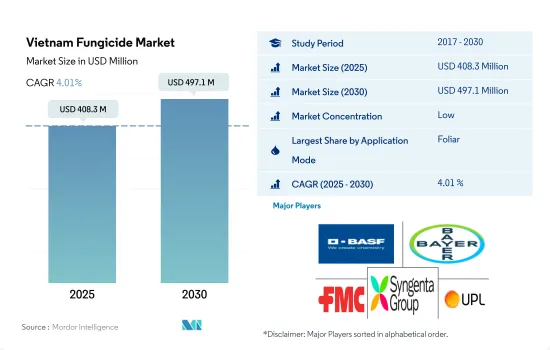
베트남의 살균제 시장 규모는 2025년에 4억 830만 달러로 추정되고, 2030년에는 4억 9,710만 달러에 이를 것으로 예측되며, 예측 기간 중(2025-2030년) CAGR은 4.01%를 나타낼 것으로 예측됩니다.
해충의 증가로 다양한 적용 방법의 살충제 수요가 증가하고 있습니다.
- 베트남의 살균제 시장은 화학 처리, 잎 표면 살포, 훈증, 토양 처리 등 다양한 용도로 분류됩니다. 이러한 다양한 적용 방법은 베트남 내 다양한 농업 상황에서 살균제를 효과적으로 적용하는 중요한 수단으로 작용합니다.
- 잎 표면 살포가 시장을 지배하고 있습니다. 이 부문에서 살균제의 시장 가치는 잎이 질병 발생의 주요 부위 인 곡물, 곡물, 과일 및 채소를 포함한 다양한 작물에 널리 적용되기 때문에 예측 기간 (2023-2029년) 동안 4.3 %의 CAGR을 나타낼 것으로 예상됩니다.
- 베트남에서는 식물의 건강과 생산성에 심각한 위협이 되는 토양 매개성 곰팡이로부터 보호하기 위해 토양 처리가 일반적으로 사용됩니다. 이 시장은 작물 손실을 피하기 위한 예방 조치로 종자 처리 화학 물질의 채택이 증가함에 따라 4.0%의 연평균 성장률을 나타낼 것으로 예상됩니다.
- 화학 처리 방법은 과일 및 채소와 같이 일관되고 통제된 적용이 필요한 작물에도 베트남에서 일반적으로 사용됩니다. 이 부문은 예측 기간(2023-2029년) 동안 3.8%의 연평균 성장률을 기록하며 성장할 것으로 예상되는데, 이는 더 많은 농부들이 농작물에 살균제를 효율적으로 전달하기 위한 수단으로 이 방법을 채택하고 있기 때문입니다.
- 훈증은 토양의 건강을 유지하고 취약한 작물에 대한 병원균의 확산을 방지하는 데 도움이 되기 때문에 베트남의 농업 관행에서 특히 중요합니다. 훈증 기술 및 장비의 발전과 살균제의 제형 개선은 새로운 기술과 향상된 훈증 적용 방법으로 살균제의 효율성이 향상됨에 따라 시장 성장에 기여할 것으로 예상됩니다.
베트남 살균제 시장 동향
변화하는 기후와 증가하는 질병 압력은 살균제 소비를 촉진할 것으로 예상됩니다.
- 베트남에서 살균제의 사용량은 2019년에서 2022년 사이에 헥타르당 31.2g으로 현저하게 증가했습니다. 이는 농업 관행과 식물 보호에 대한 살균제 수요 증가에 기여한 몇 가지 요인에 기인합니다.
- 베트남의 농업 면적은 2022년 전년 대비 1.7% ha 증가했습니다. 농업 생산의 확대와 작물 수확량 및 품질 향상에 대한 열망은 살균제 사용량을 증가시킬 것으로 예상됩니다. 베트남의 농부들은 증가하는 식량 수요를 충족하고 작물의 생산성을 향상시키기 위해 노력하고 있습니다.
- 변화하는 기후 조건과 환경 요인도 베트남에서 살균제 소비를 촉진할 것으로 예상됩니다. 온도와 습도 수준의 변화는 곰팡이병의 발생과 확산에 유리한 조건을 만들 수 있습니다. 따라서 농부들은 이러한 질병과 관련된 위험을 완화하고 농작물을 보호하기 위해 살균제에 점점 더 의존할 것으로 예상됩니다.
- 질병 관리와 작물 보호의 중요성에 대한 인식과 지식이 높아지면서 베트남 농부들 사이에서 살균제 사용이 증가하고 있습니다. 질병 예방 및 관리에 대한 사고방식의 변화는 베트남에서 살균제에 대한 수요를 촉진했습니다.
- 게다가, 살균제 제형의 발전과 다양한 효과적이고 표적화된 살균제 제품의 출시도 사용량 증가에 기여했습니다. 효능과 안전성 프로파일이 개선된 혁신적인 살균제의 개발은 농부들에게 질병 방제를 위한 더 많은 옵션을 제공했습니다. 이는 통합 해충 관리 전략의 일환으로 살균제를 채택하는 것을 더욱 장려했습니다.
곰팡이병의 증가와 함께 이러한 활성 성분에 대한 수입 의존도가 높아지면서 이러한 활성 성분의 가격이 상승할 수 있습니다.
- 베트남에는 다양한 농업 기후 지역이 있습니다. 예를 들어, 중부와 북부 지방은 온대성 병원균이 서식하기 좋은 서늘하고 추운 겨울을 경험합니다. 낮은 기온은 일부 작물의 성장을 억제하여 묘목 및 기타 질병에 더 취약하게 만듭니다. 또한 연간 날씨 주기에는 매우 습하고 건조한 기간이 포함됩니다. 이러한 날씨는 작물에 스트레스를 주고 특히 병원균에 의해 뿌리와 줄기에 발생하는 일부 질병에 유리하게 작용할 수 있습니다. 테부코나졸, 아족시스트로빈, 메탈락실은 베트남에서 일반적으로 사용되는 살균제 활성 성분입니다.
- 테부코나졸은 2022년 1톤당 8,700달러로 평가되는 계통 살균제를 사용합니다. 테부코나졸은 녹병, 시스마름병, 잎마름병, 탄저병 등을 치료하는 것으로 알려져 있습니다. 베트남은 대부분의 테부코나졸을 중국, 독일, 인도에서 수입하고 있습니다.
- 아족시스트로빈은 진균류, 아스코마이세테스, 담자균류, 바시디마이세테스에 속하는 곰팡이 병원균에 활성인 광범위 살균제입니다. 푸사리움, 트리코더마 등의 곰팡이 감염 증가로 인해 아족시스트로빈의 가격은 2017년 1톤당 4,000달러에서 2022년에는 톤당 4,600달러로 상승했습니다. 유사하게, 메탈락실은 2022년에 미터톤당 4,400달러로 평가된 곰팡이로 인한 식물 병해를 방제하는 데 사용되는 침투성 살균제입니다.
- 베트남에서 곰팡이병의 증가와 이러한 활성 성분에 대한 수입 의존도가 높아지면 이러한 활성 성분의 가격이 상승할 수 있습니다.
베트남 살균제 산업 개요
베트남의 살균제 시장은 세분화되어 상위 5개사에서 29.06%를 차지하고 있습니다. 이 시장 주요 기업은 다음과 같습니다. BASF SE, Bayer AG, FMC Corporation, Syngenta Group and UPL Limited(알파벳 순서).
기타 혜택
- 엑셀 형식 시장 예측(ME) 시트
- 3개월의 애널리스트 지원
목차
제1장 주요 요약과 주요 조사 결과
제2장 보고서 제안
제3장 소개
- 조사의 전제조건과 시장 정의
- 조사 범위
- 조사 방법
제4장 주요 산업 동향
- 헥타르당 농약 소비량
- 유효성분의 가격 분석
- 규제 프레임워크
- 베트남
- 밸류체인과 유통채널 분석
제5장 시장 세분화
- 적용 모드
- 화학 처리
- 잎 표면 살포
- 훈증
- 종자 처리
- 토양 처리
- 작물 유형
- 상업 작물
- 과일 및 채소
- 곡물
- 콩류 및 유지종자
- 잔디 및 관상용
제6장 경쟁 구도
- 주요 전략 동향
- 시장 점유율 분석
- 기업 상황
- 기업 프로파일(세계 수준 개요, 시장 수준 개요, 주요 사업 부문, 재무, 직원 수, 주요 정보, 시장 순위, 시장 점유율, 제품 및 서비스, 최근 동향 분석 포함)
- ADAMA Agricultural Solutions Ltd
- BASF SE
- Bayer AG
- Corteva Agriscience
- FMC Corporation
- Nufarm Ltd
- Syngenta Group
- UPL Limited
- Wynca Group(Wynca Chemicals)
제7장 CEO에 대한 주요 전략적 질문
제8장 부록
- 세계의 개요
- 개요
- Five Forces 분석 프레임워크
- 세계의 밸류체인 분석
- 시장 역학(DROs)
- 출처 및 참고문헌
- 도표 일람
- 주요 인사이트
- 데이터 팩
- 용어집
The Vietnam Fungicide Market size is estimated at 408.3 million USD in 2025, and is expected to reach 497.1 million USD by 2030, growing at a CAGR of 4.01% during the forecast period (2025-2030).
The rising pest pressure is driving the demand for insecticides in various application methods
- The fungicide market in Vietnam is categorized by various applications, including chemigation, foliar application, fumigation, and soil treatment. These different application methods serve as important means of effectively applying fungicides in diverse agricultural contexts within the country.
- Foliar application dominates the market. Fungicide's market value in this segment is expected to register a CAGR of 4.3% during the forecast period (2023-2029) because it is widely applied in various crops, including grains, cereals, fruits, and vegetables, where the foliage is the primary site of disease occurrence.
- Soil treatment is commonly used in Vietnam to protect from soil-borne fungi that pose a significant threat to the plant's health and productivity. The market is expected to register a CAGR of 4.0% due to the rising adoption of seed treatment chemicals as a preventive measure to avoid crop losses.
- The chemigation method is also commonly used in Vietnam for crops that require a consistent and controlled application, such as fruits and vegetables. The segment is expected to grow, registering a CAGR of 3.8% during the forecast period (2023-2029) because more farmers are adopting this practice as a means to efficiently deliver fungicides to their crops.
- Fumigation is particularly important in Vietnam's agricultural practices, as it helps maintain soil health and prevent the spread of pathogens to vulnerable crops. Advancements in fumigation technologies and equipment, along with improved formulations of fungicides, are expected to contribute to the growth of the market as new technologies and improved fumigation application methods are enhancing the efficiency of fungicides.
Vietnam Fungicide Market Trends
The changing climate and rising disease pressure are expected to drive the consumption of fungicides
- The usage of fungicides in Vietnam experienced a notable increase of 31.2 grams per hectare between 2019 and 2022. This can be attributed to several factors that have contributed to the growing demand for fungicides in agricultural practices and plant protection.
- Vietnam's agricultural acreage increased by 1.7% ha in 2022 from the previous year. The expansion of agricultural production and the desire to enhance crop yields and quality are expected to increase the usage of fungicides. Farmers in Vietnam are striving to meet the growing demand for food and improve the productivity of their crops.
- Changing climatic conditions and environmental factors are also expected to drive the consumption of fungicides in Vietnam. Shifts in temperature and humidity levels can create favorable conditions for the development and spread of fungal diseases. As a result, farmers are expected to increasingly rely on fungicides to mitigate the risks associated with these diseases and safeguard their crops.
- The increasing awareness and knowledge about the importance of disease management and crop protection have driven the adoption of fungicides among farmers in Vietnam. The shift in mindset toward disease prevention and management has fueled the demand for fungicides in the country.
- Additionally, advancements in fungicide formulations and the availability of a wide range of effective and targeted fungicide products have also contributed to increased usage. The development of innovative fungicides with improved efficacy and safety profiles has provided farmers with more options for disease control. This has further encouraged the adoption of fungicides as part of their integrated pest management strategies.
Increase in the fungal diseases, coupled with the dependence on imports for these active ingredients in the country, may drive the prices of these active ingredients
- Vietnam has a wide range of agroclimatic regions. For example, the central and northern provinces experience a cool to cold winter that favors temperate pathogens. The low temperatures inhibit the growth of some crops, making them more susceptible to seedlings and other diseases. Additionally, the yearly weather cycle includes very wet and dry periods. Such weather can also lead to crop stress and favor some diseases, especially of the roots and stems caused by pathogens. Tebuconazole, azoxystrobin, and metalaxyl are commonly used fungicide-active ingredients in Vietnam.
- Tebuconazole uses a systematic fungicide valued at USD 8.7 thousand per metric ton in 2022. Tebuconazole is known to treat rust fungus, sheath blight, leaf spot, and anthracnose. Vietnam imports most of its tebuconazole from China, Germany, and India.
- Azoxystrobin is a broad-spectrum fungicide active against fungal pathogens belonging to oomycetes, ascomycetes, deuteromycetes, and basidiomycetes. Owing to the increase in infestation of fungi like Fusarium and Trichoderma, the price of azoxystrobin increased from USD 4.0 thousand per metric ton in 2017 to USD 4.6 thousand per metric ton by 2022. Similarly, metalaxyl is a systemic fungicide used to control plant diseases caused by Oomycete fungi, valued at USD 4.4 thousand per metric ton in 2022.
- An increase in fungal diseases, coupled with dependence on imports for these active ingredients, in the country may drive the prices of these active ingredients.
Vietnam Fungicide Industry Overview
The Vietnam Fungicide Market is fragmented, with the top five companies occupying 29.06%. The major players in this market are BASF SE, Bayer AG, FMC Corporation, Syngenta Group and UPL Limited (sorted alphabetically).
Additional Benefits:
- The market estimate (ME) sheet in Excel format
- 3 months of analyst support
TABLE OF CONTENTS
1 EXECUTIVE SUMMARY & KEY FINDINGS
2 REPORT OFFERS
3 INTRODUCTION
- 3.1 Study Assumptions & Market Definition
- 3.2 Scope of the Study
- 3.3 Research Methodology
4 KEY INDUSTRY TRENDS
- 4.1 Consumption Of Pesticide Per Hectare
- 4.2 Pricing Analysis For Active Ingredients
- 4.3 Regulatory Framework
- 4.3.1 Vietnam
- 4.4 Value Chain & Distribution Channel Analysis
5 MARKET SEGMENTATION (includes market size in Value in USD and Volume, Forecasts up to 2030 and analysis of growth prospects)
- 5.1 Application Mode
- 5.1.1 Chemigation
- 5.1.2 Foliar
- 5.1.3 Fumigation
- 5.1.4 Seed Treatment
- 5.1.5 Soil Treatment
- 5.2 Crop Type
- 5.2.1 Commercial Crops
- 5.2.2 Fruits & Vegetables
- 5.2.3 Grains & Cereals
- 5.2.4 Pulses & Oilseeds
- 5.2.5 Turf & Ornamental
6 COMPETITIVE LANDSCAPE
- 6.1 Key Strategic Moves
- 6.2 Market Share Analysis
- 6.3 Company Landscape
- 6.4 Company Profiles (includes Global level Overview, Market level overview, Core Business Segments, Financials, Headcount, Key Information, Market Rank, Market Share, Products and Services, and analysis of Recent Developments)
- 6.4.1 ADAMA Agricultural Solutions Ltd
- 6.4.2 BASF SE
- 6.4.3 Bayer AG
- 6.4.4 Corteva Agriscience
- 6.4.5 FMC Corporation
- 6.4.6 Nufarm Ltd
- 6.4.7 Syngenta Group
- 6.4.8 UPL Limited
- 6.4.9 Wynca Group (Wynca Chemicals)
7 KEY STRATEGIC QUESTIONS FOR CROP PROTECTION CHEMICALS CEOS
8 APPENDIX
- 8.1 Global Overview
- 8.1.1 Overview
- 8.1.2 Porter's Five Forces Framework
- 8.1.3 Global Value Chain Analysis
- 8.1.4 Market Dynamics (DROs)
- 8.2 Sources & References
- 8.3 List of Tables & Figures
- 8.4 Primary Insights
- 8.5 Data Pack
- 8.6 Glossary of Terms