|
시장보고서
상품코드
1685806
벼 종자 처리 시장(2025-2030년) : 시장 점유율 분석, 산업 동향 및 성장 예측Rice Seed Treatment - Market Share Analysis, Industry Trends & Statistics, Growth Forecasts (2025 - 2030) |
||||||
 Mordor Intelligence
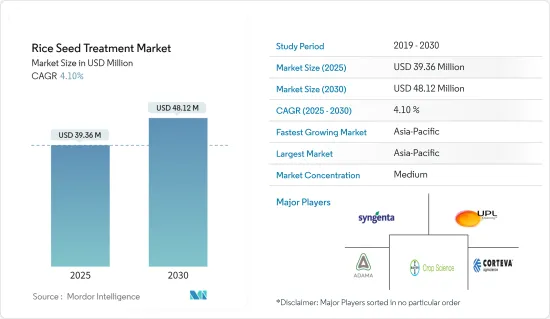
벼 종자 처리 시장 규모는 2025년에 3,936만 달러로 예상되며, 2030년에는 4,812만 달러에 이를 것으로 예측되고, 예측 기간(2025-2030년)의 CAGR은 4.10%로 추정됩니다.
종자 처리는 종자와 토양을 매개로 하는 질병과 해충으로부터 종자와 모종을 보호하고 작물의 발아와 성장에 영향을 미칩니다. 벼농사에서 이러한 치료를 세계적으로 채용하기 위해서는 적절한 화학 농약 또는 바이오 농약이나 기기에 대한 접근, 종자 처리방법 및 처리후 절차에 대한 지식 등 효과적인 보급 전략이 필요합니다. 벼농사에서 화학적 종자 처리는 주로 종자의 강화와 보호를 위해 사용됩니다.
종자 처리는 발아로부터 작물 주기 전반에 걸쳐 병해충으로부터 보호하는 제품을 사용하여 병해충이 없는 종자를 생산하기 위해 세계적으로 수행됩니다. 미국 농무부의 데이터에 따르면 2023-2024년도의 쌀 총 생산량은 5억 2,270만 톤에 달했습니다. 중국이 이 생산량의 28%를 차지였으며 다음으로 인도가 26%, 방글라데시가 7%, 인도네시아가 6%, 베트남이 5%를 차지하였습니다.
미국 농무부의 보고에 따르면 2024-2025년 회계연도의 세계 쌀 생산량은 최고 5억 3,370만 톤(정미 기준)에 이를 전망이며 1,100만 톤 증가할 것으로 예측되고 있습니다. 아르헨티나, 브라질 및 대만 생산량이 상향 조정되었지만 호주, 코스타리카, 쿠바, 유럽 연합, 온두라스, 네팔, 파나마, 필리핀 및 한국의 예측 생산량이 하향 조정되었습니다. 벼 종자 처리 시장의 성장은 쌀 주식 소비 증가, 고품질 종자 채용률 증가, 종자 산업의 정부 지원, 그리고 쌀 질병과 해충 침입을 줄이기 위한 종자 처리의 기술 진보에 의해 발생합니다.
벼 종자 처리 시장 동향
고품질 종자 수요와 채용 증가
농가는 양질의 종자에 대한 고액의 투자를 보호하는 방법으로 종자 처리를 받아들이고 있습니다. 원하는 농학적 형질을 갖춘 고품질의 종자에 대한 수요 증가에 의해 종자의 비용은 상승하고 있습니다. 기업과 농가도 고가의 고품질 종자를 보존하기 위해 종자 처리 솔루션에 투자하고 있습니다.
유전자 변형(GM) 종자의 도입은 종자에 높은 부가가치를 부여하므로 종자의 비용은 상승하고 때로는 비GM 종자의 2배에 달하기도 합니다. 종자 처리를 통해 100%의 종자 출아를 기대하게 되었기 때문에 종자 처리는 필수 불가결해졌습니다.
시장의 주요 기업은 현대적 육종 기술에 의한 우수한 품질의 종자 개발에 주력하고 있으며, 이로 인해 종자 비용이 상승하고 있습니다. 식량농업기구에 따르면 2022년 곡물의 총 수율은 4,182.4kg/ha였으며 전년의 4,152.2kg/ha를 상회했습니다.
아프리카 국가들은 쌀을 충분히 생산하지 않고 수입에 의존하고 있으며 이러한 상황을 해결하기 위해 NERICA(New Rice of Africa)와 같은 고수량 품종이 보급되고 있습니다. 그러나 현재의 추정에서는 아프리카 농민의 2%만이 NERICA를 사용하고 있습니다. 이러한 하이브리드 품종은 비용이 높기 때문에 농가에서는 저렴한 비용으로 처리 종자를 사용할 가능성이 있습니다.
아시아태평양이 시장을 독점
아시아태평양은 벼가 주요 주식이며 주요 재배 작물인 점에 의해 2023년 벼 종자 처리 분야에서 가장 큰 시장 점유율을 차지했습니다. 중국은 세계 2위의 종자 시장이며, 2021년의 연간 종자량은 1,200만 톤, 시장 가치는 190억 달러에 달했습니다.
중국 농업부의 보고에 따르면, 벼의 종자 산업에서는 특히 도열병 저항성에 대해 현재의 고수량 저저항성 품종의 한계에 대처하기 위해, 차별화된 상업 품종을 우선시하고 있습니다. 쌀은 여전히 중국의 주요 작물이며 FAO의 데이터에 따르면 2022년 생산량은 2,970만 헥타르로 2억 1,000만 톤에 달했습니다.
인도는 세계 2위의 생산국이며 주요 쌀 수출국이기도 합니다. Map의 데이터에 따르면 인도는 2023년에 1,050만 톤의 쌀을 수출해 세계 수출량의 32.5%를 차지면서 세계 유수의 쌀 수출국으로 자리매김했고 이는 벼 종자 처리제 수요를 강화하고 있습니다. 지역의 벼 종자 처리 시장은 식품 수요 증가와 혁신적인 제품을 개발하기 위한 지속적인 연구 개발 노력에 의해 안정된 성장을 유지할 것으로 예측됩니다.
벼 종자 처리 산업 개요
벼 종자 처리 시장은 통합되었으며 2023년에는 소수의 선도적인 기업이 시장 점유율을 독점했습니다. Bayer AG, Syngenta International AG, UPL Limited, Adama Agricultural Solutions Ltd, 그리고 Corteva Agriscience는 시장에서 사업을 전개하는 주요 기업이며 주로 신제품의 출시, 제휴, 그리고 인수에 주력하고 있습니다.
기타 혜택
- 엑셀 형식 시장 예측(ME) 시트
- 3개월간의 애널리스트 지원
목차
제1장 서론
- 조사의 전제조건과 시장 정의
- 조사 범위
제2장 조사 방법
제3장 주요 요약
제4장 시장 역학
- 시장 개요
- 시장 성장 촉진요인
- 고품질 종자 수요 증가와 채용
- 작물 보호 산업의 기술 개발
- 종자 처리에 대한 정부 지원 증가
- 시장 성장 억제요인
- 환경 문제 증가
- 농장 수준에서의 종자 처리의 한계
- Porter's Five Forces 분석
- 공급자의 협상력
- 구매자의 협상력
- 신규 참가업체의 위협
- 대체품의 위협
- 경쟁 기업간 경쟁 관계의 강도
제5장 시장 세분화
- 처리
- 화학적
- 비화학적/바이오
- 기능
- 종자 보호
- 종자 강화
- 기타 기능
- 처리 기술
- 종자 코팅
- 종자 펠렛화
- 종자 드레싱
- 기타 처리 기술
- 지역
- 북미
- 미국
- 캐나다
- 멕시코
- 기타 북미
- 유럽
- 스페인
- 영국
- 프랑스
- 독일
- 러시아
- 이탈리아
- 기타 유럽
- 아시아태평양
- 중국
- 일본
- 인도
- 호주
- 기타 아시아태평양
- 남미
- 브라질
- 아르헨티나
- 기타 남미
- 아프리카
- 남아프리카
- 기타 지역 및 아프리카
- 북미
제6장 경쟁 구도
- 가장 채용률이 높은 전략
- 시장 점유율 분석
- 기업 프로파일
- Adama Agricultural Solutions Ltd
- Yara International ASA
- Bayer AG
- Indofill Industries Limited
- Dhanuka Agritech Limited
- Corteva Agriscience
- Croda International(INCOTEC)
- Crystal Crop Protection Limited
- UPL Limited
- Nufarm Limited
- Syngenta AG
제7장 시장 기회와 미래 동향
CSM 25.04.22The Rice Seed Treatment Market size is estimated at USD 39.36 million in 2025, and is expected to reach USD 48.12 million by 2030, at a CAGR of 4.10% during the forecast period (2025-2030).
Seed treatment protects seeds and seedlings from seed and soil-borne diseases and insect pests that affect crop emergence and growth. The global adoption of this practice among rice farmers requires effective extension strategies, including access to appropriate chemical pesticides/bio-pesticides and equipment, along with knowledge of seed treatment methods and post-treatment handling procedures. In rice cultivation, chemical seed treatment is primarily used for seed enhancement and protection.
Seed treatment is implemented globally to produce pest and disease-free seeds using products that protect against pests and diseases throughout germination and the crop cycle. According to USDA data, total rice production reached 522.7 million metric tons during MY 2023-2024. China contributed 28% of this production, followed by India at 26%, Bangladesh at 7%, Indonesia at 6%, and Vietnam at 5%.
USDA reports indicate that global rice production for MY 2024-2025 is projected to reach a record 533.7 million metric tons (milled basis), an increase of 11 million metric tons. While Argentina, Brazil, and Taiwan received upward production revisions, forecasts were reduced for Australia, Costa Rica, Cuba, the European Union, Honduras, Nepal, Panama, the Philippines, and South Korea. Global rice consumption and residual use in MY 2024-2025 is anticipated to reach 530.3 million metric tons, increasing by 6.2 million metric tons from the previous year. The rice seed treatment market growth is driven by increasing rice consumption as a staple food, higher adoption of high-quality seeds, government support in the seed industry, and technological advancements in seed treatment for reducing rice diseases and pest infestation.
Rice Seed Treatment Market Trends
Increasing Demand and Adoption of High-Quality Seeds
Farmers are increasingly acknowledging seed treatment as a mode to protect high investments made in good quality seeds. Owing to the increasing demand for high-quality seeds with desirable agronomic traits, the cost of seeds is increasing. Both companies and farmers are ready to spend extra on seed treatment solutions to save costly high-quality seeds.
The introduction of GM seeds added high value to seeds, with the cost of seeds being high and sometimes being twice as much as that of non-GM seeds. Earlier, a growth of 85% was anticipated by farmers as some seeds would rot or be destroyed by insects. With changing trends and 100% seed emergence expectations by growers even in unfavorable conditions, seed treatment has become a necessity. The key players in the market are constantly focusing on developing superior-quality seeds through modern breeding techniques, thereby increasing the cost of the seeds.
Top players in the market are focusing on the development of superior quality seeds through modern breeding techniques, thereby increasing the seed cost. Replanting seeds due to poor germination and insect attack is expensive. Moreover, the high cost of labor requirements is associated with overall cost. According to the Food and Agriculture Organization, the total crop yield of cereals accounted for 4,182.4 kg/ha in 2022, which is higher than the previous year at 4,152.2 kg/ha. Hence to meet the growing demand, farmers need quality seeds that are well-treated to enhance the yield in limited harvested areas.
African countries do not produce enough rice and are reliant on imports. One such country is Sierra Leone. Hence, to become self-sufficient, the country's government is adopting a few strategies. A promising solution is the dissemination of high-yielding rice varieties, such as the New Rice of Africa (NERICA), which have become known as the miracle crop for African rice farmers because they combine the genetic qualities of Asian rice (high yielding) and African rice (high resistance to drought and disease). However, current estimates suggest only 2% of farmers in the country use NERICAs. This is due to the cost of improved varieties that cost 40-100% more than traditional ones, representing a significant barrier to adoption among poor farmers. Hence, due to the high cost of these hybrid varieties, there is an opportunity for paddy farmers to use treated seeds at an affordable cost. This, in turn, is anticipated to lead to the positive growth of the rice seed treatment market in the coming years.
Asia-Pacific Dominates the Market
The Asia-Pacific region held the largest market share in the rice seed treatment sector in 2023, driven by rice being the primary staple food and most cultivated crop. China emerged as the region's largest and fastest-growing market, followed by India and Japan. China represents the world's second-largest seed market after the United States, with an annual seed planting volume of 12 million metric tons and a market value of USD 19 billion in 2021. According to USDA data, global hybrid rice seed production reached 168,000 metric tons in 2022, with an average yield of 2,160 kg/ha.
The Chinese Ministry of Agriculture reports that the rice seed industry is prioritizing differentiated commercial varieties to address the limitations of current high-yield, low-resistance varieties, particularly regarding rice blast resistance. China's emphasis on seed value enhancement has resulted in increased hybrid rice variety development. Rice remains China's primary crop, with FAO data showing production of 210 million metric tons in 2022 across 29.7 million hectares. The country's expanding rice production and growing food demand continue to drive the rice seed treatment market growth.
India maintains its position as the world's second-largest producer and primary rice exporter. The country's diverse altitude and climatic conditions support widespread rice cultivation. ITC Trade Map data indicates that India exported 10.5 million metric tons of rice in 2023, accounting for 32.5% of global export volume and ranking as the world's leading rice exporter. The country's favorable climate and agricultural practices have increased rice production, strengthening the demand for rice seed treatment chemicals. The regional rice seed treatment market is projected to maintain steady growth, supported by increasing food demand and ongoing research and development efforts to develop innovative products.
Rice Seed Treatment Industry Overview
The rice seed treatment market is consolidated, with a few major players dominating the market share in 2023. Bayer AG, Syngenta International AG, UPL Limited, Adama Agricultural Solutions Ltd, and Corteva Agriscience are the key companies operating in the market. These companies primarily focus on new product launches, partnerships, and acquisitions. Investment in research and development and the development of innovative product portfolios remain essential strategies for market growth.
Additional Benefits:
- The market estimate (ME) sheet in Excel format
- 3 months of analyst support
TABLE OF CONTENTS
1 INTRODUCTION
- 1.1 Study Assumptions and Market Definition
- 1.2 Scope of the Study
2 RESEARCH METHODOLOGY
3 EXECUTIVE SUMMARY
4 MARKET DYNAMICS
- 4.1 Market Overview
- 4.2 Market Drivers
- 4.2.1 Increasing Demand And Adoption Of High-Quality Seeds
- 4.2.2 Technological Developments In The Crop Protection Industry
- 4.2.3 Rising Government Support For Seed Treatment
- 4.3 Market Restraints
- 4.3.1 Rising Environmental Concerns
- 4.3.2 Limitations Across Farm-Level Seed Treatment
- 4.4 Porter's Five Forces Analysis
- 4.4.1 Bargaining Power of Suppliers
- 4.4.2 Bargaining Power of Buyers
- 4.4.3 Threat of New Entrants
- 4.4.4 Threat of Substitutes
- 4.4.5 Intensity of Competitive Rivalry
5 MARKET SEGMENTATION
- 5.1 Application
- 5.1.1 Chemical
- 5.1.2 Non-chemical/Biological
- 5.2 Function
- 5.2.1 Seed Protection
- 5.2.2 Seed Enhancement
- 5.2.3 Other Functions
- 5.3 Application Techniques
- 5.3.1 Seed Coating
- 5.3.2 Seed Pelleting
- 5.3.3 Seed Dressing
- 5.3.4 Other Application Techniques
- 5.4 Geography
- 5.4.1 North America
- 5.4.1.1 United States
- 5.4.1.2 Canada
- 5.4.1.3 Mexico
- 5.4.1.4 Rest of North America
- 5.4.2 Europe
- 5.4.2.1 Spain
- 5.4.2.2 United Kingdom
- 5.4.2.3 France
- 5.4.2.4 Germany
- 5.4.2.5 Russia
- 5.4.2.6 Italy
- 5.4.2.7 Rest of Europe
- 5.4.3 Asia-Pacific
- 5.4.3.1 China
- 5.4.3.2 Japan
- 5.4.3.3 India
- 5.4.3.4 Australia
- 5.4.3.5 Rest of Asia-Pacific
- 5.4.4 South America
- 5.4.4.1 Brazil
- 5.4.4.2 Argentina
- 5.4.4.3 Rest of South America
- 5.4.5 Africa
- 5.4.5.1 South Africa
- 5.4.5.2 Rest of and Africa
- 5.4.1 North America
6 COMPETITIVE LANDSCAPE
- 6.1 Most Adopted Strategies
- 6.2 Market Share Analysis
- 6.3 Company Profiles
- 6.3.1 Adama Agricultural Solutions Ltd
- 6.3.2 Yara International ASA
- 6.3.3 Bayer AG
- 6.3.4 Indofill Industries Limited
- 6.3.5 Dhanuka Agritech Limited
- 6.3.6 Corteva Agriscience
- 6.3.7 Croda International (INCOTEC)
- 6.3.8 Crystal Crop Protection Limited
- 6.3.9 UPL Limited
- 6.3.10 Nufarm Limited
- 6.3.11 Syngenta AG