

|
시장보고서
상품코드
2120700
광유전학 : 시장 점유율 분석, 업계 동향과 통계, 성장 예측(2026-2031년)Optogenetics - Market Share Analysis, Industry Trends & Statistics, Growth Forecasts (2026 - 2031) |
||||||
 Mordor Intelligence
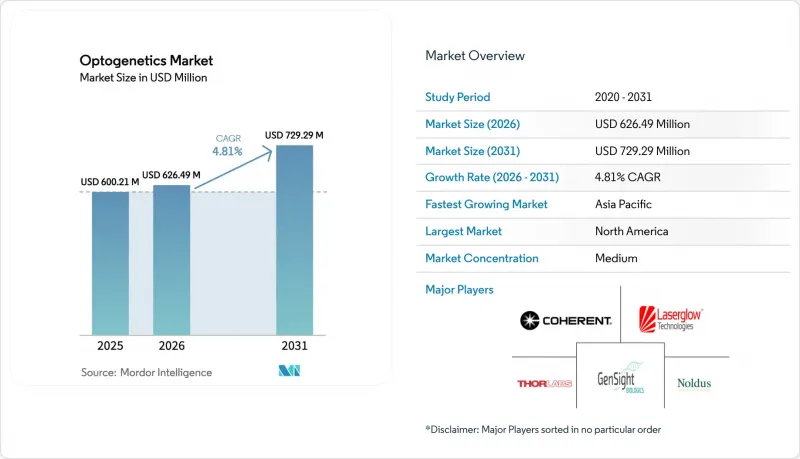
광유전학 시장 규모는 2025년 6억 21만 달러에서 2026년에는 6억 2,649만 달러로 확대되어 2031년까지 7억 2,929만 달러에 달할 것으로 예상되며, 2026년부터 2031년까지 CAGR 4.81%로 성장할 것으로 전망됩니다.
본 보고서는 제품 유형(조명 장치, 액추에이터, 센서), 기술(바이러스 벡터를 이용한 전달 등), 용도(신경과학, 망막 질환 치료 등), 최종사용자(학술·연구 기관 등), 지역(북미, 유럽, 아시아태평양, 중동 및 아프리카, 남미)별로 분류되어 있습니다. 시장 전망은 금액(달러) 기준으로 제시되어 있습니다.
세계 광유전학 시장의 동향 및 인사이트
신경과학 연구 자금의 증가와 ‘BRAIN 이니셔티브’
미국의 연방 예산은 2023년 6억 8,000만 달러에서 2025년 3억 2,100만 달러로 감소했으나, 현재 예산에서는 직접적인 임상 종결점을 가진 광유전학 도구가 우선시되고 있습니다. BICAN 아틀라스 프로그램만 해도 2024년에 1억 2,600만 달러를 뇌 세포 유형을 옵신으로 표지하는 프로젝트에 지원했으며, 분석법의 타당성을 확인하기 위해 도구 제조업체가 이미 라이선싱을 진행한 데이터세트를 구축했습니다. 유럽의 ‘휴먼 브레인 프로젝트’는 2025년, 광유전학 측정 결과를 전자건강기록과 통합하는 플랫폼에 8,900만 유로(9,700만 달러)를 지원했습니다. 한편, 일본의 ‘Brain/MINDS 2.0’은 마모셋을 이용한 질환 모델 연구에 150억 엔(1억 200만 달러)을 투자하여, 지역 CRO(의약품 개발 수탁 기관)가 연구를 수탁받을 수 있는 체제를 마련했습니다. 보조금이 중개 연구의 이정표를 향해 배정됨에 따라, 개별 구성요소가 아닌 하드웨어, 벡터, 소프트웨어를 통합 패키지로 제공할 수 있는 기업이 유리한 입장에 서게 됩니다. 이러한 보조금 동향은 초기 신약 개발 단계와 전임상 검증 단계 모두를 지원함으로써 광유전학 시장을 강화하고 있습니다.
신경 질환 및 망막 질환 유병률 증가
2025년에는 노화성 망막변성 및 유전성 망막이영양증 환자 수가 2억 8,500만 명에 달했으며, 그 발병률은 연평균 3.2% 씩 증가하고 있습니다. 고소득 국가에서 법정 실명 환자의 약 40%는 세포 이식이나 전자 임플란트 적용 대상에서 제외되므로, 광유전학 치료가 주요 대안으로 떠오르고 있습니다. 파킨슨병 환자 수는 2024년에 850만 명에 달했으나, 전임상 단계의 광유전학적 자극은 영구적인 전극을 사용하지 않고도 세포 유형 특이적인 조절을 수행할 가능성을 보여주고 있습니다. 간질은 전 세계적으로 5,000만 명에게 영향을 미치고 있으며, 2025년 설치류를 대상으로 한 실험에서 폐쇄 루프형 광유전학적 억제를 통해 경련이 62% 감소한 것으로 보고되었습니다. 따라서 만성적인 세포 특이적 개입이 가능한 확장성이 높은 벡터, 소형화된 광원 및 분석 플랫폼에 대한 수요가 증가하고 있습니다.
레이저 및 GMP 준수 바이러스 벡터 제조에 소요되는 고액의 자본 비용
200L 규모의 GMP 준수 바이러스 벡터 제조 플랜트 건설에는 4,500만-6,500만 달러의 비용이 소요될 수 있으며, 이러한 장벽으로 인해 대부분의 학술계 스핀아웃 기업들은 수직 통합을 이루기 어렵습니다. 다파장 레이저 시스템의 가격은 8만-15만 달러, 행동 시험용 완전한 설비 비용은 50만 달러를 초과하기도 하여, 예산이 제한된 환경에서의 도입을 방해하고 있습니다. 위탁 제조업체(CMO)는 AAV 배치당 25만-40만 달러를 청구하기 때문에 제I/II상 안과 임상시험에서는 투여 시작 전에 벡터 비용으로 120만 달러가 선지급되는 경우가 많습니다. 신흥 시장에서는 수입 관세와 규제상 지연도 감당해야 하며, 이러한 비용은 하드웨어 가격에 12-18% 가산되어 실험실 시운전 기간을 2년 연장시키는 요인이 됩니다. 이러한 요인들이 복합적으로 작용하여 개발도상 지역에서의 도입을 저해하고 있습니다.
부문 분석
2025년, 광학 장비는 43.72%의 점유율을 유지했습니다. 이는 중국의 신규 진입 기업들의 영향으로 평균 판매 가격이 6% 하락했음에도 불구하고, 광섬유 결합형 LED와 레이저 다이오드가 여전히 실험실의 주력 제품으로 자리매김했기 때문입니다. Addgene에 따르면, ChRmine 및 Chrimson을 포함한 액추에이터는 더 깊은 침투가 요구되는 요건의 혜택을 받아 2024년 출하량이 22% 증가했습니다.
센서 분야는 연평균 성장률(CAGR) 6.06%를 기록하며 다른 모든 카테고리를 능가하는 성장세를 보이고 있습니다. FDA는 2024년에 폐쇄 루프 신경 조절을 클래스 III로 분류했으나, 동시에 간소화된 복합 제품 승인 절차도 마련했으며, 이는 실시간 프로세서에 연결된 칼슘 센서 및 전압 센서에 대한 수요를 촉진했습니다. Inscopix사의 nVoke는 1.2g의 미니스코프와 내장 GPU를 결합하여, 기존의 오픈 루프 장치로는 불가능했던 적응형 실험을 실현하고 있습니다. 이러한 시스템의 보급에 따라 부품 공급업체들은 피드백을 자동화하는 임베디드 AI를 통합하고 있으며, 이 기능 덕분에 신약 개발 팀 내에서 광유전학 시장의 장기적인 입지가 강화되고 있습니다.
AAV(아데노 관련 바이러스) 기반 바이러스 벡터 전달 기술은 이 플랫폼의 유효성을 입증하는 3건의 FDA 승인 망막 유전자 치료에 힘입어 2025년 매출의 31.27%를 차지했습니다. 망막으로의 전이 효율이 10배 향상된 신흥 혈청형 덕분에 투여량을 줄일 수 있게 되어, 환자 1인당 제조 원가(COGS)가 1만 8,000달러 절감됩니다.
비바이러스성 및 나노입자 전달 기술은 연평균 성장률(CAGR) 7.63%로 확대되고 있으며, 초음파 및 지질 나노입자를 통해 AAV의 4.7 kb 제한과 면역 반응을 회피할 수 있기 때문에 형질전환 동물을 이용한 워크플로우를 능가하고 있습니다. 2024년 'Nature Biomedical Engineering' 저널의 논문에서는 집속 초음파를 이용한 9 kb 구축체를 통해 대뇌 피질 뉴런의 42%에 대한 형질 도입이 보고되었으며, 이는 표준 벡터로는 달성할 수 없는 성과입니다. 염증을 이유로 FDA가 2024년에 AAV를 이용한 망막 임상시험을 보류한 데 따라, 각 연구소는 신속한 mRNA 발현과 일시적인 안전성 프로파일과 잘 어울리는 나노입자 키트로 초점을 옮기고 있습니다.
지역별 분석
북미는 2025년 매출의 41.08%를 차지하고 있으며, NIH의 3억 2,100만 달러 규모의 BRAIN 예산과 12주 이내에 연구용 등급의 AAV를 공급할 수 있는 다수의 CDMO가 이를 뒷받침하고 있습니다. 진행 중인 28건의 광유전학 임상시험 중 18건은 FDA의 2024년판 ‘안과 유전자 치료에 관한 간소화된 지침’에 따라 수행되고 있으며, 이는 인간 대상 첫 임상시험에서 미국의 주도적인 위치를 부각시키고 있습니다. 캐나다 CIHR의 2,200만 캐나다 달러(1,600만 달러) 규모 프로그램은 폐쇄 루프형 간질 치료 기기 개발을 가속화하고 있으며, 캐나다 보건부와 FDA에 동시 신청함으로써 규제 처리 기간이 4개월 단축되었습니다.
유럽에서는 2024년에 조화로운 EU 지침의 혜택을 받고 있으며, 이를 통해 IND 신청에 필요한 비용이 18% 절감되었고, 여러 국가에서 진행되는 임상시험에 대해 하나의 신청 서류로 충분하게 되었습니다. 하드웨어 수출에서는 독일이 주도적인 역할을 하고 있으며, 2024년에는 4,200개의 LED 모듈을 출하하여 2023년 대비 16% 증가했습니다. 영국 치매 연구소는 전국 치료 센터의 보조금을 받은 GMP(우수 제조 기준) 대응 설비를 활용하여, 광유전학을 이용한 알츠하이머병 프로젝트에 1,800만 파운드를 투자했습니다. 프랑스의 GenSight사는 마일스톤 지급을 통해 2024년 매출 4,200만 유로를 달성했으며, 이 지역에서의 치료법 발전이 주목받고 있습니다.
아시아태평양은 연평균 성장률(CAGR) 10.27%로 가장 빠른 성장을 보이고 있습니다. 중국의 21억 위안(2억 9,000만 달러) 규모의 뇌 매핑 기금은 광유전학적 검증을 의무화하고 있어 확실한 국내 수요를 창출하고 있습니다. 일본의 ‘Brain/MINDS 2.0’ 및 ‘SAKIGAKE’ 신속 승인 제도를 통해 기존 승인 주기가 4년 단축됨에 따라, 유럽과 미국의 스폰서들이 현지 CRO로 몰리고 있습니다. 한국의 2,800만 달러 규모의 국립 광유전학 센터는 정신 질환에 초점을 맞추고 있는 반면, 인도와 호주는 규모는 작지만 전략적인 보조금을 저비용 하드웨어 및 통증·중독 연구에 할당하고 있습니다.
중동 및 아프리카 및 남미는 아직 발전 단계에 있습니다. 카타르의 320만 달러 예산 배정과 남아프리카공화국의 180만 달러 규모 연구 시설은 초기 단계의 역량 구축을 보여주고 있지만, FAPESP의 30%라는 비용 분담 상한선으로 인해 브라질 연구자들은 벡터 관련 작업을 해외에 위탁할 수밖에 없어 리드타임이 18개월 연장되고 있습니다.
기타 혜택:
- 엑셀 형식의 시장 예측(ME) 시트
- 3개월간의 애널리스트 지원
자주 묻는 질문
목차
제1장 소개
제2장 조사 방법
제3장 주요 요약
제4장 시장 구도
제5장 시장 규모와 성장 예측
제6장 경쟁 구도
제7장 시장 기회와 향후 전망
KSM 26.09.02According to Mordor Intelligence, the optogenetics market size is expected to increase from USD 600.21 million in 2025 to USD 626.49 million in 2026 and reach USD 729.29 million by 2031, growing at a CAGR of 4.81% over 2026-2031.
This report is Segmented by Product Type (Light Equipment, Actuators, Sensors), Technique (Viral Vector Delivery, and More), Application (Neuroscience, Retinal Disease Treatment, and More), End User (Academic & Research Institutes, and More), and Geography (North America, Europe, Asia-Pacific, Middle East & Africa, South America). The Market Forecasts are Provided in Terms of Value (USD).
Global Optogenetics Market Trends and Insights
Rising Neuroscience Research Funding & BRAIN Initiative
United States federal appropriations fell from USD 680 million in 2023 to USD 321 million in 2025, yet the budget now prioritizes optogenetic tools with direct clinical endpoints. The BICAN atlas program alone awarded USD 126 million in 2024 to projects that tag brain-cell types with opsins, creating data sets already licensed by tool makers for assay validation. Europe's Human Brain Project committed EUR 89 million (USD 97 million) in 2025 to platforms that integrate optogenetic readouts with electronic health records, while Japan's Brain/MINDS 2.0 put JPY 15 billion (USD 102 million) toward marmoset disease models, positioning regional CROs for outsourced studies. The redirection of grants toward translational milestones favors companies able to supply hardware, vectors, and software as unified packages rather than a-la-carte components. This grant landscape strengthens the optogenetics market by underwriting both early discovery and preclinical validation phases.
Growing Prevalence of Neurological & Retinal Disorders
Age-related retinal degeneration and inherited retinal dystrophies affected 285 million individuals in 2025, with incidence climbing 3.2% annually. Approximately 40% of legally blind patients in high-income nations are ineligible for cell transplants or electronic implants, leaving optogenetic therapy as a prime alternative. Parkinson's disease cases reached 8.5 million in 2024, and preclinical optogenetic stimulation shows promise for cell-type-specific modulation without permanent electrodes. Epilepsy affects 50 million people globally, and a 2025 rodent trial reported a 62% drop in convulsions after closed-loop optogenetic inhibition. Demand therefore rises for scalable vectors, miniaturized light sources, and analytics platforms capable of chronic, cell-specific intervention.
High Capital Cost of Lasers & GMP Viral-Vector Manufacture
Building a 200 L GMP viral-vector plant can cost USD 45-65 million, a barrier that bars most academic spin-outs from vertical integration. Multi-wavelength laser systems run USD 80,000-150,000, and full behavioral setups can exceed USD 500,000, limiting adoption in budget-constrained settings. Contract manufacturers charge USD 250,000-400,000 per AAV batch, so Phase 1/2 ophthalmology trials often front-load USD 1.2 million in vector costs before dosing begins. Emerging markets must also absorb import tariffs and regulatory delays that tack on 12-18% to hardware prices and extend lab commissioning by 2 years. These factors collectively dampen uptake in developing regions.
Other drivers and restraints analyzed in the detailed report include:
- Advances in Opsins, Viral Vectors & Mini-LED/Laser Hardware
- Surge in Vision-Restoration Clinical Trials
- Gene-Therapy Regulatory Stringency & Long Timelines
For complete list of drivers and restraints, kindly check the Table Of Contents.
Segment Analysis
Light Equipment maintained a 43.72% stake in 2025, as fiber-coupled LEDs and laser diodes remained lab staples, even as average selling prices slid 6% amid new Chinese entrants. Actuators, including ChRmine and Chrimson, benefited from deeper penetration requirements, expanding shipments by 22% in 2024, according to Addgene.
Sensors are outpacing all other categories at a 6.06% CAGR. The FDA classified closed-loop neuromodulation as Class III in 2024, but it also issued a streamlined combination-product path that catalyzed demand for calcium and voltage sensors tethered to real-time processors. Inscopix's nVoke couples a 1.2-g miniscope with on-board GPUs, enabling adaptive experiments that are impossible with legacy open-loop rigs. As these systems proliferate, component suppliers are integrating embedded AI to automate feedback, a feature that strengthens the optogenetics market's long-term stickiness among drug-discovery teams.
AAV-based Viral Vector Delivery held 31.27% of 2025 revenues, buoyed by three FDA-approved retinal gene therapies that validate the platform. Emerging serotypes with 10-fold retinal transduction enable dose cuts and reduce per-patient COGS by USD 18,000.
Non-viral and Nanoparticle Delivery is expanding at a 7.63% CAGR, eclipsing transgenic-animal workflows as ultrasound and lipid nanoparticles bypass AAV's 4.7 kb limit and immune responses. A 2024 Nature Biomedical Engineering paper reported 42% cortical-neuron transfection with a 9 kb construct using focused ultrasound, a feat unattainable with standard vectors. Given the FDA's 2024 clinical hold on an AAV-retinal trial due to inflammation, labs are pivoting to nanoparticle kits that pair well with rapid mRNA expression and transient safety profiles.
Complete Report Scope:
- By Product Type
- Light Equipment
- Actuators
- Sensors
- By Technique
- Viral Vector Delivery
- Transgenic Animals & Cre-dependent Systems
- Non-viral & Nanoparticle Delivery
- By Application
- Neuroscience
- Retinal Disease Treatment
- Behavioral Tracking
- Cardiovascular & Pacing
- By End User
- Academic & Research Institutes
- Biotech & Pharmaceutical Companies
- Contract Research Organizations
- Hospitals & Clinics
- By Geography
- North America
- United States
- Canada
- Mexico
- Europe
- Germany
- United Kingdom
- France
- Italy
- Spain
- Rest of Europe
- Asia-Pacific
- China
- Japan
- India
- Australia
- South Korea
- Rest of Asia-Pacific
- Middle East & Africa
- GCC
- South Africa
- Rest of Middle East & Africa
- South America
- Brazil
- Argentina
- Rest of South America
- North America
Geography Analysis
North America accounted for 41.08% of 2025 revenue, buoyed by NIH's USD 321 million BRAIN budget and an extensive roster of CDMOs capable of delivering research-grade AAV in 12 weeks. Eighteen of 28 active optogenetic trials are conducted under the FDA's 2024 streamlined ocular-gene guidance, underscoring U.S. primacy in first-in-human studies. Canada's CAD 22 million (USD 16 million) CIHR program accelerates the development of closed-loop epilepsy devices, while concurrent filings with Health Canada and the FDA trim four months off regulatory timelines.
Europe benefits from harmonized 2024 EU guidance that cuts IND-enabling costs by 18% and allows one dossier for multi-country trials. Germany leads hardware exports, shipping 4,200 LED modules in 2024, a 16% jump over 2023. The UK Dementia Research Institute invested GBP 18 million in optogenetic Alzheimer's disease projects, leveraging subsidized GMP capacity at national therapy centers. France's GenSight generated EUR 42 million in 2024 revenue on milestone payments, spotlighting therapeutic traction in the region.
Asia-Pacific is the velocity leader at 10.27% CAGR. China's CNY 2.1 billion (USD 290 million) brain-mapping fund mandates optogenetic validation, creating guaranteed domestic demand. Japan's Brain/MINDS 2.0 and SAKIGAKE fast tracks shave four years off conventional approval cycles, attracting Western sponsors to local CROs. South Korea's USD 28 million national optogenetics center focuses on psychiatric disorders, while India and Australia channel smaller but strategic grants into low-cost hardware and pain-addiction research.
Middle East & Africa and South America remain nascent. Qatar's USD 3.2 million allocation and South Africa's USD 1.8 million lab signal early-stage capacity building, but FAPESP's 30% cost-share cap forces Brazilian investigators to outsource vector work offshore, elongating lead times by 18 months.
- Addgene
- AGTC
- Bruker
- Circuit Therapeutics
- Coherent
- Danaher
- Doric Lenses
- Elliot Scientific Ltd.
- GenSight Biologics S.A.
- Inscopix Inc.
- Laserglow Technologies
- Merck
- Nanoscope Therapeutics
- Noldus Information Technology
- Opto Biolabs GmbH
- Prizmatix
- Thorlabs
Additional Benefits:
- The market estimate (ME) sheet in Excel format
- 3 months of analyst support
TABLE OF CONTENTS
1 Introduction
- 1.1 Study Assumptions & Market Definition
- 1.2 Scope of the Study
2 Research Methodology
3 Executive Summary
4 Market Landscape
- 4.1 Market Overview
- 4.2 Market Drivers
- 4.2.1 Rising Neuroscience Research Funding & BRAIN Initiative
- 4.2.2 Growing Prevalence of Neurological & Retinal Disorders
- 4.2.3 Advances in Opsins, Viral Vectors & Mini-LED/Laser Hardware
- 4.2.4 Surge in Vision-Restoration Clinical Trials
- 4.2.5 AI-Enabled Closed-Loop Neuromodulation Platforms
- 4.2.6 Reshoring of Optical-Component Supply Chains
- 4.3 Market Restraints
- 4.3.1 High Capital Cost of Lasers & GMP Viral-Vector Manufacture
- 4.3.2 Gene-Therapy Regulatory Stringency & Long Timelines
- 4.3.3 Photothermal Safety Limits for Red-Shifted Actuators
- 4.3.4 Talent Drain of Advanced Microscopists to Other Photonics Sectors
- 4.4 Regulatory Landscape
- 4.5 Technological Outlook
- 4.6 Porter's Five Forces Analysis
- 4.6.1 Threat of New Entrants
- 4.6.2 Bargaining Power of Buyers
- 4.6.3 Bargaining Power of Suppliers
- 4.6.4 Threat of Substitute Products
- 4.6.5 Intensity of Competitive Rivalry
5 Market Size & Growth Forecasts
- 5.1 By Product Type
- 5.1.1 Light Equipment
- 5.1.2 Actuators
- 5.1.3 Sensors
- 5.2 By Technique
- 5.2.1 Viral Vector Delivery
- 5.2.2 Transgenic Animals & Cre-dependent Systems
- 5.2.3 Non-viral & Nanoparticle Delivery
- 5.3 By Application
- 5.3.1 Neuroscience
- 5.3.2 Retinal Disease Treatment
- 5.3.3 Behavioral Tracking
- 5.3.4 Cardiovascular & Pacing
- 5.4 By End User
- 5.4.1 Academic & Research Institutes
- 5.4.2 Biotech & Pharmaceutical Companies
- 5.4.3 Contract Research Organizations
- 5.4.4 Hospitals & Clinics
- 5.5 By Geography
- 5.5.1 North America
- 5.5.1.1 United States
- 5.5.1.2 Canada
- 5.5.1.3 Mexico
- 5.5.2 Europe
- 5.5.2.1 Germany
- 5.5.2.2 United Kingdom
- 5.5.2.3 France
- 5.5.2.4 Italy
- 5.5.2.5 Spain
- 5.5.2.6 Rest of Europe
- 5.5.3 Asia-Pacific
- 5.5.3.1 China
- 5.5.3.2 Japan
- 5.5.3.3 India
- 5.5.3.4 Australia
- 5.5.3.5 South Korea
- 5.5.3.6 Rest of Asia-Pacific
- 5.5.4 Middle East & Africa
- 5.5.4.1 GCC
- 5.5.4.2 South Africa
- 5.5.4.3 Rest of Middle East & Africa
- 5.5.5 South America
- 5.5.5.1 Brazil
- 5.5.5.2 Argentina
- 5.5.5.3 Rest of South America
- 5.5.1 North America
6 Competitive Landscape
- 6.1 Market Concentration
- 6.2 Market Share Analysis
- 6.3 Company Profiles (includes Global Level Overview, Market Level Overview, Core Segments, Financials as Available, Strategic Information, Market Rank/Share for Key Companies, Products & Services, and Recent Developments)
- 6.3.1 Addgene Inc.
- 6.3.2 AGTC
- 6.3.3 Bruker Corporation
- 6.3.4 Circuit Therapeutics
- 6.3.5 Coherent Inc.
- 6.3.6 Danaher Corporation
- 6.3.7 Doric Lenses
- 6.3.8 Elliot Scientific Ltd.
- 6.3.9 GenSight Biologics S.A.
- 6.3.10 Inscopix Inc.
- 6.3.11 Laserglow Technologies
- 6.3.12 Merck KGaA
- 6.3.13 Nanoscope Therapeutics
- 6.3.14 Noldus Information Technology
- 6.3.15 Opto Biolabs GmbH
- 6.3.16 Prizmatix Ltd.
- 6.3.17 Thorlabs Inc.
7 Market Opportunities & Future Outlook
- 7.1 White-space & Unmet-Need Assessment


