


|
시장보고서
상품코드
1686297
아시아태평양의 종자 처리 : 시장 점유율 분석, 산업 동향 및 통계, 성장 예측(2025-2030년)Asia Pacific Seed Treatment - Market Share Analysis, Industry Trends & Statistics, Growth Forecasts (2025 - 2030) |
||||||
 Mordor Intelligence
■ 보고서에 따라 최신 정보로 업데이트하여 보내드립니다. 배송일정은 문의해 주시기 바랍니다.
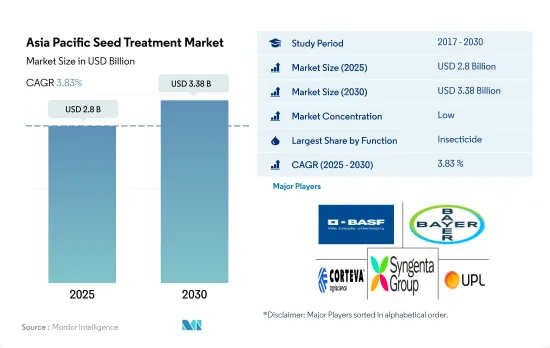
아시아태평양의 종자 처리 시장 규모는 2025년에 28억 달러에 달할 것으로 추정됩니다. 2030년에는 33억 8,000만 달러에 이를 것으로 예상되며, 예측 기간 중(2025-2030년) CAGR은 3.83%를 나타낼 것으로 전망됩니다.
종자는 토양 전염성 곤충의 영향을 받기 쉽기 때문에 살충제가 아시아태평양의 종자 처리 시장을 독점
- 아시아태평양에서는 종자를 보호하고 작물의 성적을 높이기 위해 종자 처리가 중요한 관행이되었습니다. 이러한 처리는 씨앗을 매개하는 질병, 해충, 선충을 제거하고, 건강한 모종을 확보하고, 작물 정착을 개선하는 데 도움이 됩니다.
- 종자 처리 시장 가치는 역사적인 기간에 29.2%의 성장을 경험했습니다. 이러한 상승 추세는 묘목의 보호와 성장, 생산성 향상을 위해 종자 처리가 제공하는 이점에 대한 인식이 높아지고 있기 때문입니다.
- 중국과 인도는 아시아태평양 시장에서 종자 처리의 큰 점유율을 차지하는 주요 농업 국가입니다. 2022년 중국은 이 지역 시장액의 약 16.8%를 차지했고 인도는 약 12.4% 시장 점유율을 차지했습니다.
- 살충제 종자 처리가 시장을 독점하고, 2022년에는 아시아태평양 종자 처리 시장의 77.6%를 차지했습니다. 곤충은 씨앗과 모종에 심각한 피해를 줄 수 있으므로 묘목이 나빠지거나 발아가 제한되거나 수율이 떨어집니다. 살충제 종자 처리는 이러한 해충으로 인한 피해를 예방하고 더 건강하고 활력있는 모종을 제공합니다.
- 살균제를 씨앗에 살포하면 보호 장벽이 형성되어 입증, 묘종, 근부병 등의 질병 예방과 방제에 도움이 됩니다. 살균제 종자 처리는 2022년 아시아태평양의 살균제 시장에서 21.2%라는 큰 점유율을 차지했습니다.
- 이 시장은 예측기간 중(2023-2029년) CAGR 4.0%를 나타낼 것으로 예상됩니다. 이 성장은 주로 인구 증가의 요구를 충족시키기 위한 식량 생산 수요 증가에 의해 초래될 것으로 예상됩니다. 작물의 수율을 최적화하고 질병과 해충으로 인한 손실을 최소화하기 위해 농부는 종자 처리를 채택합니다.
재배 초기의 병해충으로부터 종자나 모종을 보호할 필요가 있기 때문에 종자 처리의 채용률이 높아질 가능성이 있습니다.
- 아시아태평양의 종자 처리 시장은 작물의 초기 병해충으로부터 종자와 모종을 보호할 필요성에 대한 농가의 의식이 높아짐에 따라 현저한 성장을 이루고 있습니다. 쌀, 밀, 망고, 포도, 바나나, 면화 등이 지역의 주요 작물 농부는 종자 처리 애플리케이션을 채택합니다.
- 2022년에는 중국이 아시아태평양의 주요 시장으로 부상하여 시장의 16.7%라는 큰 점유율을 차지했습니다. 이러한 이점은 이 나라의 눈부신 성장을 뒷받침하는 다양한 요인들의 조합에 기인합니다. 이러한 요인은 식량 안보의 필요성 증가와 쌀과 밀과 같은 작물에서 종자 처리 제품의 채택 확대를 포함합니다.
- 아시아태평양의 종자 처리 시장을 독점하고 있는 것은 곡물 및 곡류 분야입니다. 2022년에는 이 부문은 시장총액의 50.3%를 차지했습니다. 이 우위성은 곡물 및 곡류가 이 지역의 주식작물이며, 농지의 상당 부분이 곡물 및 곡류의 재배에 충당되어 있기 때문이라고 생각됩니다. 그 경제적 중요성과 다양한 병해충에 대한 높은 감수성으로 인해 종자 처리는 성장 초기 단계에서 곡물 및 곡류를 보호하는 데 중요한 역할을 합니다.
- 아시아태평양에서는 식량 수요가 증가함에 따라 제작 면적이 증가하고 있습니다. 농부들은 같은 땅에서 작물을 반복하거나 연간 작곡 횟수를 늘리기도 합니다. 이러한 집약화에 의해 종자를 매개로 하는 다양한 질병이나 곤충의 발생 리스크가 높아져, 그 결과, 종자 처리의 사용량이 증가하고 있습니다. 아시아태평양의 종자 처리 시장은 예측 기간 중(2023-2029년)에 크게 성장하여 CAGR은 4.0%를 나타낼 것으로 예측되고 있습니다.
아시아태평양의 종자 처리 시장 동향
종자와 모종을 보호하는 의식이 높아져 종자 처리 농약의 소비를 촉진
- 아시아태평양의 종자 처리의 평균 소비량은 2022년 1헥타르당 261.08g이었습니다. 종자 처리는 작물의 생산성을 보호하고 향상시키는 효과와 효율성 때문에 최근 몇 년동안 점점 더 보급되고 있습니다.
- 아시아태평양 국가의 농업 관행이 치열해지고 생산성에 대한 요구가 증가함에 따라 아시아태평양 농부들은 작물을 질병, 해충 및 기타 스트레스로부터 보호하는 효과적인 수단으로 작물 보호의 중요성을 인식하여 수율 감소 위험을 줄이고 있습니다.
- 종자 처리는 씨앗 부패, 묘립 고통, 입 고병, 근부병, 우동병, 곰팡이 병, 초기 역병과 같은 엽면 병해를 비롯한 여러 곰팡이 병해를 예방하고 작물을 보호 할 수 있습니다. 활성 성분의 사용은 대상 병해와 종자 처리 요건을 기반으로 하기 때문에 유용합니다. 메탈락실, 카르벤다짐, 뚜껑탄은 아시아태평양 시장에서 종자 처리 제품에 가장 많이 사용되는 활성 성분입니다.
- 종자 처리는 해충과 선충에 대해서도 사용됩니다. 예를 들어, 뿌리 벌레 선충은 과일 및 채소 작물에 영향을 미치는 선충 중 가장 위험한 종이며, 당근에서 34%, 감자에서 26%, 토마토에서 23%, 빈로우리에서 22%, 브린잘에서 21%의 수량 손실을 일으키는 것으로 알려져 있지만, 종자 처리에 의해 효과적으로 완화할 수 있습니다.
- 아시아태평양 국가의 종자 처리 산업은 보다 정확하고 효율적인 종자 처리 적용을 가능하게 하는 기술의 진보를 볼 수 있습니다. 이러한 진보에는 개선된 종자 처리 제제 및 고급 종자 처리 장치가 포함되어 있으며, 이 지역의 농가에 의한 종자 처리의 사용량이 증가하게 됩니다.
아시아태평양의 다양한 정부 기관에 의한 촉진 활동 증가가 수요와 가격을 견인
- 종자 처리는 종자와 토양을 매개하는 병해와 작물의 출아와 성장에 영향을 미치는 해충으로부터 종자와 모종을 보호하는 데 중요한 역할을합니다. 시페르메트린, 아바멕틴, 아조시스트로빈, 말라티온, 메탈락실은 아시아태평양에서 가장 일반적으로 사용되는 종자 처리 약품입니다.
- 시펠메트린은 비전신 토양작용형의 피레스로이드계 살충제입니다. 가을 겨울 파종의 밀과 보리의 구근충이나 침금충의 피해를 경감하기 위해, 종자 처리에 사용됩니다. 2022년 가격은 톤당 2만1,000달러였습니다.
- 아바멕틴은 이버멕틴 시스템에 속하며 선충에 대해 높은 고유 활성을 가지고 있습니다. 옥수수, 콩, 면화의 생산에서 뿌리를 공격하는 선충으로부터 유식물을 보호하는 데 사용됩니다. 2022년 가격은 톤당 8,700달러였습니다.
- 아조시스트로빈은 농작물의 수율 저하를 일으키는 자실체균, 진균류, 새끼 곰팡이류, 담자균류의 방제에 추천되는 침투성 특성을 가지는 광역 예방 종자 처리 살균제입니다. 2022년 아조시스트로빈의 가격은 톤당 4,500달러였습니다.
- 정부 기관의 다양한 규정은 종자 시장성을 높이기 위해 종자 처리의 사용을 장려합니다. 인도 정부는 칼리프 시즌 동안 모든 중요한 작물에서 종자 처리를 100% 확실히 하기 위한 캠페인을 전국적으로 전개하기로 결정했습니다. 농약 산업 단체, ATMA, CIPMCs, KVK, 농민 클럽, SAU, NGO 등은 100% 종자 처리를 추진하는 캠페인에서 중요한 역할을 할 수 있습니다. 이러한 노력은 향후 몇 년동안이 지역의 종자 처리 가격에 더 영향을 줄 수 있습니다.
아시아태평양의 종자 처리 산업 개요
아시아태평양의 종자 처리 시장은 단편화되어 상위 5개사에서 33.38%를 차지하고 있습니다. 이 시장 주요 기업은 다음과 같습니다. BASF SE, Bayer AG, Corteva Agriscience, Syngenta Group and UPL Limited(알파벳순 정렬).
기타 혜택
- 엑셀 형식 시장 예측(ME) 시트
- 3개월의 애널리스트 서포트
목차
제1장 주요 요약과 주요 조사 결과
제2장 보고서 제안
제3장 소개
- 조사의 전제조건과 시장 정의
- 조사 범위
- 조사 방법
제4장 주요 산업 동향
- 1헥타르당 농약 소비량
- 유효성분의 가격 분석
- 규제 프레임워크
- 호주
- 중국
- 인도
- 인도네시아
- 일본
- 미얀마
- 파키스탄
- 필리핀
- 태국
- 베트남
- 밸류체인과 유통채널 분석
제5장 시장 세분화
- 기능
- 살균제
- 살충제
- 살선충제
- 작물 유형
- 상업 작물
- 과일 및 야채
- 곡물 및 곡류
- 맥류 및 유지종자
- 잔디 및 장식용
- 생산국
- 호주
- 중국
- 인도
- 인도네시아
- 일본
- 미얀마
- 파키스탄
- 필리핀
- 태국
- 베트남
- 기타 아시아태평양
제6장 경쟁 구도
- 주요 전략 동향
- 시장 점유율 분석
- 기업 상황
- 기업 프로파일
- ADAMA Agricultural Solutions Ltd
- BASF SE
- Bayer AG
- Corteva Agriscience
- Crystal Crop Protection Ltd
- FMC Corporation
- Nufarm Ltd
- PI Industries
- Syngenta Group
- UPL Limited
제7장 CEO에 대한 주요 전략적 질문
제8장 부록
- 세계 개요
- 개요
- Five Forces 분석 프레임워크
- 세계의 밸류체인 분석
- 시장 역학(DROs)
- 정보원과 참고문헌
- 도표 일람
- 주요 인사이트
- 데이터 팩
- 용어집
The Asia Pacific Seed Treatment Market size is estimated at 2.8 billion USD in 2025, and is expected to reach 3.38 billion USD by 2030, growing at a CAGR of 3.83% during the forecast period (2025-2030).
Insecticides dominated the Asia-Pacific seed treatment market as seeds are more susceptible to soil-borne insects
- Seed treatment is an important practice in Asia-Pacific to protect seeds and enhance crop performance. These treatments help control seed-borne diseases, pests, and nematodes, ensuring healthy seedlings and improved crop establishment.
- The market value of seed treatment experienced a growth of 29.2% during the historical period. This upward trend can be attributed to the increasing recognition of the advantages offered by seed treatment for protecting and enhancing the growth of seedlings and their productivity.
- China and India are the leading agricultural nations that hold a significant share of seed treatments in the Asia-Pacific market. China constituted approximately 16..8% of the regional market value, while India held around 12.4% market share in 2022.
- Insecticide seed treatment dominated the market, accounting for 77.6% of the Asia-Pacific seed treatment market in 2022. Insects can severely damage seeds and seedlings, which can result in poor stand establishment, limited germination, and yield losses. Insecticide seed treatments prevent the damage posed by these pests, resulting in seedlings that are healthier and more vigorous.
- Fungicides applied to seeds form a protective barrier that aids in the prevention and control of diseases such as damping off, seedling blight, and root rot. Fungicide seed treatment held a significant share of 21.2% in the Asia-Pacific fungicide market in 2022.
- The market is expected to grow during the forecast period (2023-2029), registering a CAGR of 4.0%. This growth is primarily anticipated to be driven by the rising demand for food production to meet the needs of a growing population. In order to optimize crop yields and minimize losses due to diseases and insects, farmers are increasingly adopting seed treatments.
The need to protect seeds and seedlings from early-growth pests and diseases may increase the seed treatment adoption rate
- The seed treatment market in Asia-Pacific is experiencing significant growth, driven by farmers' increasing awareness of the need to protect seeds and seedlings from early crop diseases and insect pests. Farmers of the region's major crops, including rice, wheat, mangoes, grapes, bananas, and cotton, are adopting seed treatment applications.
- In 2022, China emerged as the leading market within Asia-Pacific, accounting for a substantial share of 16.7% of the market. This dominance can be attributed to a combination of factors that fueled the country's impressive growth. These factors include the increasing imperative for ensuring food security and the escalating adoption of seed treatment products in crops such as rice and wheat.
- The grains & cereals segment dominates the Asia-Pacific seed treatment market. In 2022, the segment accounted for 50.3% of the market's total value. This dominance can be because they are staple crops in the region, and a significant portion of agricultural land is dedicated to their cultivation. Due to their economic importance and high susceptibility to various pests and diseases, seed treatment plays a vital role in protecting grains and cereals during the early stages of growth.
- Crop intensity has been rising in Asia-Pacific as a result of increased food demand. Farmers often practice repeated cropping or intensify the number of crop cycles per year on the same land. This intensification leads to a higher risk of various seed-borne diseases and insect outbreaks, resulting in an increase in seed treatment usage. The Asia-Pacific seed treatment market is projected to witness significant growth during the forecast period (2023-2029) and register a CAGR of 4.0%.
Asia Pacific Seed Treatment Market Trends
The growing awareness to protect seeds and seedlings is driving the consumption of seed treatment pesticides
- The average consumption of seed treatment chemicals in Asia-Pacific was 261.08 grams per hectare in 2022. Seed treatment has become increasingly popular in recent years due to its effectiveness and efficiency in protecting and enhancing crop productivity.
- As agricultural practices in these countries are intensifying and the need for higher productivity is growing, Asia-Pacific farmers are becoming more aware of the importance of crop protection as an effective means of protecting crops from diseases, pests, and other stresses, thereby reducing the risk of yield loss.
- Seed treatment can prevent and offer protection to crops against several fungal diseases, including seed rot, seedling blight, damping off, root rot, and foliar diseases like powdery mildew, downy mildew, and early blight. The use of active ingredients helps as they are based on target diseases and seed treatment requirements. Metalaxyl, carbendazim, and captan are the most used active ingredients in seed treatment products in the Asia-Pacific market.
- Seed treatments are also being used against insect pests and nematodes. For instance, the root-knot nematode is the most dangerous among the nematode species that affect fruit and vegetable crops and is known to cause a yield loss of 34% in carrots, 26% in potatoes, 23% in tomatoes, 22% in bottle gourds, and 21% in brinjal, which can effectively be mitigated by seed treatment practices.
- The seed treatment industry in Asia-Pacific countries is witnessing technological advancements that enable more precise and efficient seed treatment applications. These advancements include improved seed treatment formulations and advanced seed treatment equipment, leading to higher usage of seed treatment chemicals by farmers in the region.
Increasing promotional activities by various government agencies across Asia-Pacific drives the demand and price
- Seed treatment plays an important role in protecting seeds and seedlings from seed and soil-borne diseases and insect pests affecting crop emergence and growth. Cypermethrin, abamectin, azoxystrobin, malathion, and metalaxyl are the most commonly used seed treatment chemicals in Asia-Pacific.
- Cypermethrin is a non-systemic soil-acting pyrethroid insecticide. It is used in seed treatment for the reduction of wheat bulb fly and wireworm damage to autumn/winter sown wheat and barley. It was valued at a price of USD 21.0 thousand per metric ton in 2022.
- Abamectin belongs to the ivermectin chemical class and has high intrinsic activity against nematodes. It is used to protect young plants from root-attacking nematodes in corn, soybean, and cotton production. It was priced at USD 8.7 thousand per metric ton in 2022.
- Azoxystrobin is a broad-spectrum preventative seed treatment fungicide with systemic properties recommended for the control of Deuteromycetes, Oomycetes, Ascomycetes, and Basidiomycetes fungi that cause yield losses in crops. In 2022, azoxystrobin was priced at USD 4.5 thousand per metric ton.
- Various regulations by government agencies are encouraging the use of seed treatments to increase the marketability of seeds. The Government of India has decided to launch a countrywide campaign for ensuring 100% seed treatment in all important crops during the kharif season. Pesticide industry associations, ATMAs, CIPMCs, KVKs, farmers clubs, SAUs, NGOs, etc., can play an important role in the campaign promoting 100% seed treatment. Such initiatives may further affect the price of seed treatment chemicals in the region over the coming years.
Asia Pacific Seed Treatment Industry Overview
The Asia Pacific Seed Treatment Market is fragmented, with the top five companies occupying 33.38%. The major players in this market are BASF SE, Bayer AG, Corteva Agriscience, Syngenta Group and UPL Limited (sorted alphabetically).
Additional Benefits:
- The market estimate (ME) sheet in Excel format
- 3 months of analyst support
TABLE OF CONTENTS
1 EXECUTIVE SUMMARY & KEY FINDINGS
2 REPORT OFFERS
3 INTRODUCTION
- 3.1 Study Assumptions & Market Definition
- 3.2 Scope of the Study
- 3.3 Research Methodology
4 KEY INDUSTRY TRENDS
- 4.1 Consumption Of Pesticide Per Hectare
- 4.2 Pricing Analysis For Active Ingredients
- 4.3 Regulatory Framework
- 4.3.1 Australia
- 4.3.2 China
- 4.3.3 India
- 4.3.4 Indonesia
- 4.3.5 Japan
- 4.3.6 Myanmar
- 4.3.7 Pakistan
- 4.3.8 Philippines
- 4.3.9 Thailand
- 4.3.10 Vietnam
- 4.4 Value Chain & Distribution Channel Analysis
5 MARKET SEGMENTATION (includes market size in Value in USD and Volume, Forecasts up to 2030 and analysis of growth prospects)
- 5.1 Function
- 5.1.1 Fungicide
- 5.1.2 Insecticide
- 5.1.3 Nematicide
- 5.2 Crop Type
- 5.2.1 Commercial Crops
- 5.2.2 Fruits & Vegetables
- 5.2.3 Grains & Cereals
- 5.2.4 Pulses & Oilseeds
- 5.2.5 Turf & Ornamental
- 5.3 Country
- 5.3.1 Australia
- 5.3.2 China
- 5.3.3 India
- 5.3.4 Indonesia
- 5.3.5 Japan
- 5.3.6 Myanmar
- 5.3.7 Pakistan
- 5.3.8 Philippines
- 5.3.9 Thailand
- 5.3.10 Vietnam
- 5.3.11 Rest of Asia-Pacific
6 COMPETITIVE LANDSCAPE
- 6.1 Key Strategic Moves
- 6.2 Market Share Analysis
- 6.3 Company Landscape
- 6.4 Company Profiles (includes Global level Overview, Market level overview, Core Business Segments, Financials, Headcount, Key Information, Market Rank, Market Share, Products and Services, and analysis of Recent Developments)
- 6.4.1 ADAMA Agricultural Solutions Ltd
- 6.4.2 BASF SE
- 6.4.3 Bayer AG
- 6.4.4 Corteva Agriscience
- 6.4.5 Crystal Crop Protection Ltd
- 6.4.6 FMC Corporation
- 6.4.7 Nufarm Ltd
- 6.4.8 PI Industries
- 6.4.9 Syngenta Group
- 6.4.10 UPL Limited
7 KEY STRATEGIC QUESTIONS FOR CROP PROTECTION CHEMICALS CEOS
8 APPENDIX
- 8.1 Global Overview
- 8.1.1 Overview
- 8.1.2 Porter's Five Forces Framework
- 8.1.3 Global Value Chain Analysis
- 8.1.4 Market Dynamics (DROs)
- 8.2 Sources & References
- 8.3 List of Tables & Figures
- 8.4 Primary Insights
- 8.5 Data Pack
- 8.6 Glossary of Terms








샘플 요청 목록