|
시장보고서
상품코드
1687359
항공 정비 수리 및 점검(MRO)소프트웨어 : 시장 점유율 분석, 산업 동향, 통계, 성장 예측(2025-2030년)Aviation Maintenance Repair And Overhaul (MRO) Software - Market Share Analysis, Industry Trends & Statistics, Growth Forecasts (2025 - 2030) |
||||||
 Mordor Intelligence
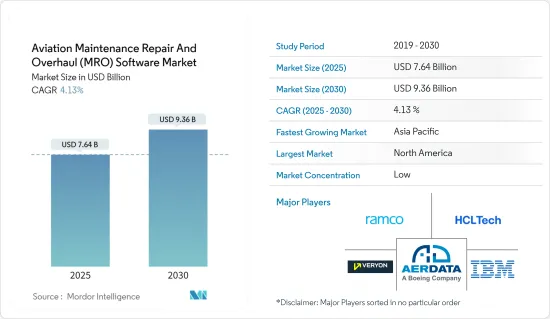
항공 정비 수리 및 점검(MRO)소프트웨어 시장 규모는 2025년에 76억 4,000만 달러, 2030년에는 93억 6,000만 달러에 달할 것으로 예측됩니다. 예측 기간 중(2025-2030년) CAGR은 4.13%를 나타낼 전망입니다.
항공 여객 수송량 증가에 수반하는 세계의 항공기 납품 수 증가에 의해 항공 정비 수리 및 점검(MRO) 서비스 수요가 높아지고 있습니다. 이 수요의 급증은 주로 항공기의 운영 수명주기를 연장하기 때문입니다. Forflight, TRAX Maintenance, Quantum MX, Flightdocs, Airlabs, WinAir 등 다양한 MRO 소프트웨어 솔루션이 제공됩니다. 항공사는 인공지능(AI)과 그 인지 기술을 이용하여 분석의 합리화, 기계 정비의 자동화, 고객 서비스의 강화, 사내 프로세스의 최적화를 할 수 있어 항공사의 운영에 있어서 AI가 매우 중요한 역할을 담당하고 있는 것으로 밝혀졌습니다.
AI의 등장은 정밀 수리와 예지 보전에 혁명을 가져오고, 항공기의 정비 엔지니어는 MRO 소프트웨어에 대한 의존을 높이고 있습니다. 이러한 MRO 소프트웨어에 대한 관심이 높아짐에 따라 세계 항공사들이 첨단 솔루션에 투자하게 되어 예측 기간 동안 시장 성장에 밝은 징조가 나타났습니다.
그러나 과제도 남아 있습니다. 도입 비용과 높은 유지 보수 비용, 전문적인 인재 육성의 필요성, 새로운 소프트웨어와 기존 시스템과의 통합 복잡성 등의 장애물에 직면하고 있습니다. 게다가, 지역에 따라 규제 요건이 다르다는 것도 보급의 장애가 되고 있습니다. 그럼에도 불구하고 업무 효율성 향상과 정비 실수 감소를 기대할 수 있는 MRO 소프트웨어 시장은 여전히 장기적인 촉진 요인이 되고 있습니다.
항공 정비 수리 및 점검(MRO)소프트웨어 시장은 블록체인이나 증강현실(AR)과 같은 신기술이 중심이 되어 더욱 확대되는 태세를 갖추고 있습니다. 예를 들어, 블록체인은 유지보수 로그의 보안과 투명성을 강화하고 유지보수 작업의 신뢰성과 컴플라이언스를 침투시킵니다. 이러한 기술적 진보는 기존의 정비 업무를 재구성하고, 높은 효율성과 에러율의 저감을 약속하며, 시장의 성장을 가속합니다.
항공 정비 수리 및 점검(MRO)소프트웨어 시장 동향
예측 기간 동안 MRO 부문이 시장을 독점
앞으로 몇 년동안 MRO 부문이 항공 정비 수리 및 점검(MRO)소프트웨어 시장을 독점할 것으로 예상됩니다. MRO 소프트웨어는 유지 보수 일정 관리, 수리 추적 및 규정 준수에 중요하며 주목을 받고 있습니다. 항공기 노후화와 세계 항공 교통량 증가가 주로 이러한 변화를 뒷받침하고 있습니다. 현대 항공기 시스템은 복잡성을 증가시키고 있으며, 고급 유지보수 기능과 매우 견고한 데이터 분석이 운영 효율성과 안전성을 보장하기 위해 가장 중요합니다.
예측 분석과 인공지능과 같은 매우 중요한 기술이 MRO 부문의 선진을 끊고 있습니다. 시스템 고장을 예측하는 소프트웨어의 능력을 강화함으로써, 이러한 기술은 사전 활동적인 전략을 통해 가동 중지 시간과 유지 보수 비용을 크게 줄이는 길을 열어줍니다. 또한 항공 산업이 환경 친화적 인 관행을 강조하는 동안 MRO 운영은 연료 효율을 높이고 배출량을 관리하는 소프트웨어 솔루션을 점차 채택하고 있습니다.
항공 교통량이 증가함에 따라 세계 항공기 보유 대수가 확대되는 가운데, 이 보유 대수 증가에 대응하기 위해 새로운 MRO 시설이 대두해 시장 성장을 가속하고 있습니다. 예를 들어, 2022년 11월, 세계 기술 기업인 HCltech는 민간 항공의 주요 MRO 서비스 제공업체인 SR Technics와 다 년간 계약을 체결했습니다. 이 파트너십은 SR 기술의 업무를 디지털화하기 위한 것입니다. SR 기술은 유럽, 미국, 아시아, 중동에 걸친 파트너 및 비즈니스 개발 사무소를 보유하고 있으며 광범위한 네트워크를 자랑합니다.
예측기간 동안 아시아태평양이 가장 높은 성장을 보일 것으로 예상
아시아태평양은 견고한 항공 부문으로 견인되어 항공 정비 수리 및 점검(MRO)소프트웨어의 성장에 있어 세계 리더로 자리매김하고 있습니다. 항공 교통량 증가, 중간층 인구동태 확대, 국내 및 국제 항공기 확대 등의 요인이 이 성장을 뒷받침하고 있습니다. 주목할만한 것은 세계에서 가장 급성장하는 중국과 인도와 같은 경제가 항공 인프라에 많은 투자를하고 있다는 것입니다.
아시아태평양 MRO 소프트웨어 시장의 주요 촉진요인은 저렴한 항공사(LCC)의 상승과 국제 노선 증가입니다. 이러한 항공사는 증가하는 여행 수요에 대응하기 위해 신속하게 장비를 확장하고 효율적인 장비 관리 및 유지 보수 스케줄링을 위한 고급 MRO 소프트웨어가 필요합니다.
이 지역의 경제 및 여행 수요가 증가함에 따라 항공기의 최적 가용성과 신뢰성을 보장하기 위해 최첨단 MRO 기능의 필요성이 가장 중요해지고 있습니다. 예를 들어, 2023년 6월 세계 엔터프라이즈 항공 소프트웨어 공급업체인 람코 시스템즈는 스카이텍에 에비에이션 스위트 V5.9를 도입할 것을 발표했습니다. 이 움직임은 Skytek의 업무를 통합하고 자동화하고 최신 솔루션으로 비즈니스 성장을 강화하는 것을 목표로합니다. 람코의 에비에이션 스위트는 엔지니어링 및 CAMO, 유지 보수, 공급망, MRO 및 부품 판매, 직원 관리, 재무 및 회계, 컴플라이언스 리포팅, 저니 로그 엔트리 모듈을 다룹니다. 게다가 램코 스위트 내의 HUB 및 워크플로우와 같은 디지털 인에이블러는 스카이텍의 생산성을 향상시키고 프로세스를 간소화하여 경쟁이 치열한 항공 엔지니어링 부문에서 더 높은 업무 효율성과 성장을 실현합니다.
아시아태평양 항공기 MRO 소프트웨어 시장은 급성장하는 항공 부문, 기술 혁신, 전략적 정부 지침으로 성장 궤도를 타고 있습니다. 규제가 진화함에 따라 운영 효율성과 컴플라이언스를 보장하는 정교한 MRO 소프트웨어 솔루션에 대한 이 지역 수요가 점점 커지고 있습니다.
항공 정비 수리 및 점검(MRO) 소프트웨어 산업 개요
시장은 세분화되어 있으며 여러 기업이 큰 점유율을 차지하고 있습니다. Veryon, Ramco Systems Ltd., IBM Corporation, HCL Technologies Ltd., AerData BV가 시장을 선도하는 기업입니다.
시장 성장의 원동력이 되고 있는 것은 업계 선두에 의한 R&D 투자의 활성화와 최첨단 항공기 MRO 소프트웨어의 전개입니다. MRO 기업의 대부분은 사업 확대에 따라 현지 서비스 제공업체와 제휴를 맺는 등 파트너십을 강화하고 있습니다. 그 대표적인 예는 대기업 소프트웨어 공급자인 람코 시스템즈와 엔지니어링 서비스의 주요 기업인 노바 시스템즈와의 제휴입니다. 2022년 2월, 양사는 계약을 체결했고, 람코의 Aviation M&E MRO Suite V5.9가 Nova Systems의 영국 사업에 통합되었습니다. Nova Systems는 Part 21J, Part 21G 및 Part 145의 업무를 간소화하기 위해 이 제품군의 고급 워크 플로우 및 보고 도구에 주목합니다. 주요 목표는? 자재 관리의 효율성을 높이고 중요한 운영 인사이트를 확보하는 것입니다.
기타 혜택 :
- 엑셀 형식 시장 예측(ME) 시트
- 3개월간의 애널리스트 서포트
목차
제1장 서론
- 조사의 전제조건
- 조사 범위
제2장 조사 방법
제3장 주요 요약
제4장 시장 역학
- 시장 개요
- 시장 성장 촉진요인
- 시장 성장 억제요인
- 업계의 매력도 - Porter's Five Forces 분석
- 신규 참가업체의 위협
- 구매자 및 소비자의 협상력
- 공급기업의 협상력
- 대체품의 위협
- 경쟁 기업간 경쟁 관계의 강도
제5장 시장 세분화
- 배포
- 클라우드 기반
- 온프레미스
- 최종 사용자
- 항공사
- MRO
- OEM
- 지역
- 북미
- 유럽
- 아시아태평양
- 라틴아메리카
- 중동 및 아프리카
제6장 경쟁 구도
- 벤더의 시장 점유율
- 기업 프로파일
- AerData BV
- IBM Corporation
- Ramco Systems Ltd.
- Rusada
- IBS Software Private Limited
- HCL Technologies Limited
- IFS Aktiebolag
- Oracle Corporation
- SAP SE
- Swiss AviationSoftware Ltd.(Swiss-AS)
- Communications Software(Airline Systems) Limited
- Flatirons Solutions, Inc.
제7장 시장 기회와 앞으로의 동향
SHW 25.04.03The Aviation Maintenance Repair And Overhaul Software Market size is estimated at USD 7.64 billion in 2025, and is expected to reach USD 9.36 billion by 2030, at a CAGR of 4.13% during the forecast period (2025-2030).
The rise in global aircraft deliveries, driven by increased air passenger traffic, has heightened the demand for maintenance, repair, and overhaul (MRO) services. This surge in demand is primarily to extend the operational life cycle of aircraft. Various MRO software solutions are available, including Foreflight, TRAX Maintenance, Quantum MX, Flightdocs, Airlabs, and WinAir. Airlines can use artificial intelligence (AI) and its cognitive technologies to streamline analytics, automate machinery maintenance, enhance customer service, and optimize internal processes, underscoring AI's pivotal role in airline operations.
The emergence of AI has revolutionized precision repair and predictive maintenance, prompting aircraft maintenance engineers to rely on MRO software increasingly. This growing interest in MRO software has seen airlines worldwide investing in advanced solutions, setting a positive trajectory for market growth in the forecast period.
However, challenges persist. The market faces hurdles such as high implementation and maintenance costs, the need for specialized personnel training, and the complexity of integrating new software with existing systems. Additionally, varying regulatory requirements across regions pose further obstacles to widespread adoption. Yet, the promise of enhanced operational efficiency and reduced maintenance errors remains a compelling long-term driver for the MRO software market.
The aviation MRO software market is poised for further expansion, with emerging technologies like blockchain and augmented reality (AR) taking center stage. Blockchain, for instance, bolsters maintenance log security and transparency, instilling confidence and compliance in maintenance operations. These technological advancements reshape traditional maintenance practices, promising greater efficiency and reduced error rates, propelling market growth.
Aviation MRO Software Market Trends
The MRO Segment Dominated the Market During the Forecast Period
Forecasted for the coming years, the MRO segment is set to dominate the Aviation MRO Software market. MRO software, crucial for managing maintenance schedules, repair tracking, and regulatory compliance, is gaining prominence. The aging aircraft fleet and the escalating global air traffic primarily drive this shift. With modern aircraft systems growing in complexity, advanced maintenance capabilities, and exceptionally robust data analysis are paramount to ensure operational efficiency and safety.
Pivotal technologies like predictive analytics and artificial intelligence are spearheading the MRO segment. By enhancing the software's ability to predict system failures, these technologies pave the way for substantial reductions in downtime and maintenance costs through proactive strategies. Additionally, as the aviation industry emphasizes eco-friendly practices, MRO operations increasingly adopt software solutions to boost fuel efficiency and manage emissions.
With the global aircraft fleet expanding alongside the rise in air traffic, new MRO facilities are rising to cater to this growing fleet, propelling the market's growth. For instance, in November 2022, HCLTech, a global technology company, inked a multi-year deal with SR Technics, a leading MRO service provider in civil aviation. This partnership aims to transform SR Technics' operations digitally. Notably, SR Technics boasts a wide-reaching network, with partners and business development offices spanning Europe, the Americas, Asia, and the Middle East.
Asia-Pacific is Expected to Show the Highest Growth During the Forecast Period
Asia Pacific is positioned as the global leader in the growth of aviation MRO software, driven by its robust aviation sector. Factors such as rising air traffic, expanding middle-class demographics, and domestic and international fleet expansions fuel this growth. Notably, economies like China and India, among the world's fastest-growing, are investing significantly in their aviation infrastructures.
Key drivers in Asia Pacific's MRO software market include the rise of Low-Cost Carriers (LCCs) and an increase in international routes. These carriers rapidly expand their fleets to meet growing travel demands, necessitating advanced MRO software for efficient fleet management and maintenance scheduling.
With the region's economies and travel demands rising, the need for cutting-edge MRO capabilities to ensure optimal aircraft availability and reliability becomes paramount. For example, in June 2023, Ramco Systems, a global enterprise aviation software provider, announced the implementation of its Aviation Suite V5.9 for Skytek Pty Ltd. This move aims to integrate and automate Skytek's operations, bolstering their business growth with a modern solution. Ramco's Aviation Suite encompasses modules for Engineering & CAMO, Maintenance, Supply Chain, MRO & Part Sales, Employee Management, Finance & Accounting, Compliance Reporting, and Journey Log Entries. Additionally, digital enablers like HUBs and workflows within Ramco's suite are set to enhance productivity and streamline processes for Skytek, positioning them for greater operational effectiveness and growth in the competitive aviation engineering sector.
Asia Pacific's aircraft MRO software market is on a growth trajectory, driven by a rapidly expanding aviation sector, technological innovations, and strategic governmental directives. As regulations evolve, the region's demand for sophisticated MRO software solutions, ensuring operational efficiency and compliance is only set to intensify.
Aviation MRO Software Industry Overview
The market is fragmented, with several players holding significant shares. Veryon, Ramco Systems Ltd., IBM Corporation, HCL Technologies Ltd., and AerData B.V. are the leading market players.
Anticipated market growth is being fueled by heightened R&D investments and the rollout of cutting-edge aircraft MRO software by industry leaders. MRO firms are broadening their reach, with many forging partnerships with local service providers as they expand. A prime example is the collaboration between Ramco Systems, a major aviation software provider, and Nova Systems, a leading engineering services company. In February 2022, the two entities inked a deal, with Ramco's Aviation M&E MRO Suite V5.9 set to be integrated into Nova Systems' UK operations. Nova Systems is eyeing the suite's advanced workflows and reporting tools to streamline its Part 21J, Part 21G, and Part 145 operations. The primary goal? Boosting material management efficiency and unlocking crucial operational insights.
Additional Benefits:
- The market estimate (ME) sheet in Excel format
- 3 months of analyst support
TABLE OF CONTENTS
1 INTRODUCTION
- 1.1 Study Assumptions
- 1.2 Scope of Study
2 RESEARCH METHODOLOGY
3 EXECUTIVE SUMMARY
4 MARKET DYNAMICS
- 4.1 Market Overview
- 4.2 Market Drivers
- 4.3 Market Restraints
- 4.4 Industry Attractiveness - Porter's Five Forces Analysis
- 4.4.1 Threat of New Entrants
- 4.4.2 Bargaining Power of Buyers/Consumers
- 4.4.3 Bargaining Power of Suppliers
- 4.4.4 Threat of Substitute Products
- 4.4.5 Intensity of Competitive Rivalry
5 MARKET SEGMENTATION
- 5.1 Deployment
- 5.1.1 Cloud-based
- 5.1.2 On-premises
- 5.2 End User
- 5.2.1 Airlines
- 5.2.2 MROs
- 5.2.3 OEMs
- 5.3 Geography
- 5.3.1 North America
- 5.3.2 Europe
- 5.3.3 Asia-Pacific
- 5.3.4 Latin America
- 5.3.5 Middle East and Africa
6 COMPETITIVE LANDSCAPE
- 6.1 Vendor Market Share
- 6.2 Company Profiles
- 6.2.1 AerData B.V.
- 6.2.2 IBM Corporation
- 6.2.3 Ramco Systems Ltd.
- 6.2.4 Rusada
- 6.2.5 IBS Software Private Limited
- 6.2.6 HCL Technologies Limited
- 6.2.7 IFS Aktiebolag
- 6.2.8 Oracle Corporation
- 6.2.9 SAP SE
- 6.2.10 Swiss AviationSoftware Ltd. (Swiss-AS)
- 6.2.11 Communications Software (Airline Systems) Limited
- 6.2.12 Flatirons Solutions, Inc.