|
시장보고서
상품코드
1692444
하지불안 증후군 : 시장 점유율 분석, 산업 동향 및 통계, 성장 예측(2025-2030년)Restless Legs Syndrome - Market Share Analysis, Industry Trends & Statistics, Growth Forecasts (2025 - 2030) |
||||||
 Mordor Intelligence
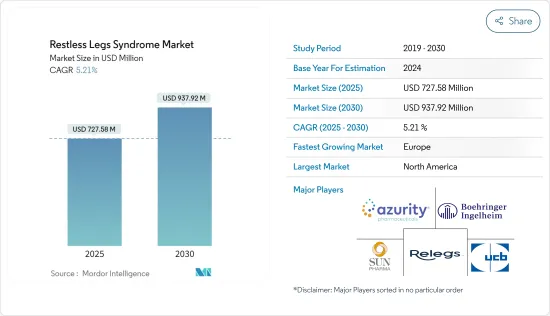
하지불안 증후군 시장 규모는 2025년에 7억 2,758만 달러로 추정되고, 2030년에는 9억 3,792만 달러에 달할 것으로 예측되며, 예측 기간(2025-2030년)의 CAGR은 5.21%를 나타낼 전망입니다.

유행 기간 동안, 시장은 COVID-19 감염된 환자에서 하지불안증후군(RLS)의 부담이 증가하면서 상당한 영향을 받았습니다. 예를 들어, 2022년 5월 임상 수면 의학 저널에 게재된 기사에 따르면 미국에서 장기 COVID-199(LC) 환자에서 수면 장애가 흔하며 바이러스 감염 후 RLS가 종종 보고된다는 연구가 수행되었습니다. 이로 인해 RLS 치료제에 대한 수요가 증가하여 팬데믹 기간 동안 시장 성장에 더욱 영향을 미쳤습니다. 그러나 COVID-19 확진자 수가 팬데믹 이전 수준으로 돌아갈 정도로 감소하면서 시장은 점차 안정화되고 있습니다.
하지불안 증후군의 유병률 증가, 높은 미충족 치료 수요, 노인 인구 증가는 시장 성장의 주요 요인입니다. 예를 들어, 프론티어스 미디어(Frontiers Media S.A.)가 2022년 3월 발표한 연구에 따르면 하지불안증후군의 유병률은 전 세계적으로 3.9%에서 14.3%까지 다양합니다.
도파민 작용제는 RLS 치료에 가장 자주 사용되는 최초의 의약품입니다. 프라미펙솔(미라펙스), 로티고틴(뉴프로), 로피니롤(리큅)을 포함한 이러한 약물은 뇌의 신경전달물질인 도파민처럼 작용합니다. 하지불안증후군의 유병률 증가, 신경계에 대한 압박으로 인한 업무 관련 스트레스 증가와 같은 요인은 RLS 치료를 위한 도파민 작용제의 사용을 증가시킬 것으로 예상됩니다.
또한 하지불안증후군 치료를 위한 도파민 작용제의 사용이 증가하고 있는 것도 이 부문의 주요 동인입니다. 예를 들어, 2023 년 10 월 Nat Sci Sleep에 발표 된 연구에 따르면 도파민 작용제 치료는 영향을받는 개인의 최대 60.0 %에서 90.0 %까지 효과적입니다.
따라서 하지불안 증후군의 높은 유병률과 시장 참여자들의 노력 증가와 같은 위의 요인으로 인해 연구 된 시장은 분석 기간 동안 성장할 것으로 예상됩니다.
하지불안 증후군 시장 동향
도파민 작용제 부문이 예측 기간 동안 큰 시장 점유율을 차지할 전망
도파민 작용제는 RLS의 치료에 처음 사용되는 약물입니다. 뇌의 신경전달물질인 도파민처럼 작용합니다. 예를 들어, 미국 국민 보건 서비스(NHS)가 2023년10 월에 갱신 한 논문에 따르면, 영국에서는 매년 10 명 중 1 명이 하지불안 증후군의 영향을받습니다. 나라에서는 남성보다 여성 쪽이 발병하기 쉽다고 합니다.또, 임산부의 5명에 1명이 임신 후기에 발병한다고 합니다.이 때문에 치료에 대한 수요가 증가해, 부문 성장의 원동력이 되고 있습니다.
또한, 하지불안 증후군의 치료에 도파민 작용제의 사용이 증가하고 있다는 것이이 부문의 주요 촉진요인이되었습니다. Sleep이 2023년 10월에 발표한 연구에 따르면, 도파민 작용제에 의한 치료는 이환 환자의 최대 60.0%-90.0%에 효과적입니다.
게다가 업계 각사에 의한 제품 출시 증가가 이 부문의 성장을 가속할 것으로 예상되고 있습니다. 무의 세계의 개발권과 상업권을 제공하는 것을 보고했습니다.
따라서 RLS의 높은 유병률, RLS 치료를위한 도파민 작용제의 사용 증가, 업계 기업의 제품 출시 증가와 같은 위에서 언급 한 요인으로 인해이 부문은 분석 기간 동안 성장할 것으로 예상됩니다.
예측기간 중 북미가 시장에서 큰 점유율을 차지할 전망
북미 지역은 하지불안증후군의 유병률이 증가함에 따라 하지불안증후군 시장에서 상당한 시장 점유율을 차지할 것으로 예상됩니다. 예를 들어, 2023년 2월 미국 국립보건원에서 발표한 기사에 따르면 미국 인구의 최대 7-10%가 모든 연령대에서 발병할 수 있는 하지불안증후군을 앓고 있는 것으로 추정되었습니다. 남성과 여성 모두에게 발생하지만 여성에게 더 많이 발생합니다.
마찬가지로 미국 신경근육 및 전기진단의학협회 보고서에 따르면 2022년 2월 미국에서는 약 1,200만 명의 사람들이 하지불안증후군을 앓고 있는 것으로 나타났습니다.
연구 프로그램의 수가 증가함에 따라 연구 된 시장도 활성화 될 것으로 예상됩니다. 캐나다 하지불안증후군 재단이 이 연구에 자금을 지원했습니다. 하지불안증후군 재단은 캐나다와 미국에서 활동 범위를 크게 확장하고 있으며, 캐나다와 미국 전역에 70개 이상의 그룹과 원격 지원 네트워크를 보유하고 있습니다.
따라서 RLS의 높은 유병률과 RLS에 대한 연구 프로그램 증가와 같은 앞서 언급 한 요인은 북미 지역의 예측 기간 동안 시장 성장에 기여할 것입니다.
하지불안 증후군 산업 개요
하지불안 증후군 시장은 세계적으로 그리고 지역적으로 사업을 전개하는 다수의 기업이 존재하기 때문에 그 성격상, 적당히 단편화되고 있습니다. GmbH, Relegs, Restiffic, Viatris Inc., Psychocare Health Private Limited, Noctrix Health, Inc. 등이 있습니다.
기타 혜택
- 엑셀 형식 시장 예측(ME) 시트
- 3개월간의 애널리스트 지원
목차
제1장 서론
- 조사의 전제조건과 시장 정의
- 조사 범위
제2장 조사 방법
제3장 주요 요약
제4장 시장 역학
- 시장 개요
- 시장 성장 촉진요인
- 하지불안 증후군의 유병률 상승
- 높은 미충족 치료 수요와 노인 인구 증가
- 시장 성장 억제요인
- 하지불안 증후군 치료와 관련된 부작용
- Porter's Five Forces 분석
- 공급기업의 협상력
- 구매자 및 소비자의 협상력
- 신규 참가업체의 위협
- 대체품의 위협
- 경쟁 기업간 경쟁 관계의 강도
제5장 시장 세분화
- 부문별
- 1차성 하지불안 증후군
- 2차성 하지불안 증후군
- 치료 부문별
- 약물요법과 장치
- 도파민 작용제
- 항경련제
- 벤조디아제핀계 약제
- 오피오이드
- 기타 치료
- 수술
- 약물요법과 장치
- 지역
- 북미
- 미국
- 캐나다
- 멕시코
- 유럽
- 독일
- 영국
- 프랑스
- 이탈리아
- 스페인
- 기타 유럽
- 아시이평양
- 중국
- 일본
- 인도
- 호주
- 한국
- 기타 아시이평양
- 중동 및 아프리카
- GCC
- 남아프리카
- 기타 중동 및 아프리카
- 남미
- 브라질
- 아르헨티나
- 기타 남미
- 북미
제6장 경쟁 구도
- 기업 프로파일
- Azurity Pharmaceuticals, LLC
- UCB SA
- Sun Pharmaceutical Industries Ltd
- Boehringer Ingelheim International GmbH
- Relegs
- Restiffic
- Viatris Inc
- Psychocare Health Private Limited
- Glenmark Pharmaceutical
- Noctrix Health, Inc.
제7장 시장 기회와 앞으로의 동향
HBR 25.05.15The Restless Legs Syndrome Market size is estimated at USD 727.58 million in 2025, and is expected to reach USD 937.92 million by 2030, at a CAGR of 5.21% during the forecast period (2025-2030).
During the pandemic period, the market witnessed a significant impact attributed to the increased burden of restless legs syndrome (RLS) in COVID-19-infected patients. For instance, as per the article published by the Journal of Clinical Sleep Medicine in May 2022, a study was conducted in the United States that showed that sleep disturbance was common in long-COVID-19 (LC) patients and RLS was often reported after the viral infection. This led to the increased demand for RLS treatment medications, which has further impacted the market growth during the pandemic period. However, the market is gradually stabilizing as COVID-19 cases declined to result in a return to the pre-pandemic level. Therefore, the COVID-19 pandemic accelerated the treatment of RLS and created lucrative opportunities for market growth in the studied period.
The rise in the prevalence of restless leg syndrome, the high unmet need for treatment, and the increasing geriatric population are key factors responsible for the market's growth. For instance, according to a study published by Frontiers Media S.A. in March 2022, the reported prevalence of restless legs syndrome varied between 3.9% and 14.3% globally. According to the same study, the prevalence of restless legs syndrome was higher among females than males. Thus, the high prevalence of RLS is expected to enhance market growth.
Furthermore, according to a study published in eClinicalMedicine in April 2022, about 25% of people with diabetes showed signs of restless legs syndrome, and people with diabetes had an increased risk of developing restless legs syndrome compared to people without diabetes. Also, according to the data published by the CDC, in June 2022, 37.3 million people in the United States had diabetes, which is approximately 11.3% of the United States population. Thus, the high prevalence of diabetes associated with restless leg syndrome is expected to drive market growth over the forecast period.
Additionally, various initiatives taken by the key market players, such as product launches, mergers, acquisitions, and partnerships, are expected to boost the market's growth during the forecast period. For instance, in April 2022, an East Carolina University researcher landed a licensing agreement with Clemens, a professor in the Brody School of Medicine's Department of Physiology, for a patent to treat restless legs syndrome and helped them secure the patent and an eventual licensing agreement with Emalex Biosciences. The partnership gave Emalex potential use for its D1 receptor antagonist, ecopipam. Such an initiative is expected to drive the growth of the market.
Thus, owing to the factors above, such as the high prevalence of restless legs syndrome and the rising initiatives by market players, the market studied is anticipated to grow over the analysis period. However, the side effects associated with restless syndrome treatments are expected to restrain the market's growth.
Restless Legs Syndrome Market Trends
Dopamine Agonists Segment is Expected to Hold a Significant Market Share Over the Forecast Period
Dopamine agonists are most often the first medicines used to treat RLS. These drugs, including pramipexole (Mirapex), rotigotine (Neupro), and ropinirole (Requip), act like the neurotransmitter dopamine in the brain. Factors such as the increase in the prevalence of restless legs syndrome and rising work-related stress caused due to pressure on the nervous system are expected to enhance the usage of dopamine agonists for the treatment of RLS. For instance, an article updated in October 2023 by the National Health Service (NHS) stated that 1 in 10 people are impacted by the restless legs syndrome in the United Kingdom every year, and women are more likely to develop the syndrome than men in the country. Additionally, 1 in 5 pregnant women develops the symptoms in the last trimester of their pregnancy. This leads to an increasing demand for its treatment, driving segmental growth.
Moreover, the increasing use of dopamine agonists for the treatment of restless leg syndrome is the key driver for the segment. For instance, according to the study published by the Nat Sci Sleep in October 2023, treatment with dopamine agonists is effective for up to 60.0% to 90.0% of affected individuals. Thus, such increasing use of dopamine agonists for the treatment of restless leg syndrome is expected to propel the segment growth.
Furthermore, the increase in product launches by the industry players is anticipated to drive the segment's growth. For instance, in July 2021, Ipsen and IRLAB reported signing a licensing agreement, providing Ipsen worldwide development and commercial rights to mesdopetam, a novel dopamine D3-receptor antagonist. Mesdopetam, an oral dopamine D3-receptor antagonist, has completed Phase Ib and IIa clinical programs. Such development is expected to increase the demand for segmental growth.
Thus, owing to the abovementioned factors, such as the high prevalence of RLS, the growing use of dopamine agonists for the treatment of RLS, and the increase in product launches by the industry players, the segment is expected to grow over the analysis period.
North America is Expected to Hold a Significant Share in the Market Over the Forecast Period
North America is expected to hold a significant market share in the restless legs syndrome market due to the region's rising prevalence of restless legs syndrome. For instance, according to an article published by the National Institutes of Health in February 2023, it was estimated that up to seven to 10% of the United States population have RLS, which can begin at any age. It occurs in males and females, although females are likelier to have it. Many severely affected individuals are middle-aged or older, and the symptoms typically become more frequent and last longer with age.
Similarly, as per the American Association of Neuromuscular & Electrodiagnostic Medicine report, in February 2022, about 12 million people in the United States had restless legs syndrome. Thus, with an increase in the prevalence of RLS, the demand for its treatment increases, thereby driving regional growth over the forecast period.
The increasing number of research programs is also expected to boost the studied market. For instance, Restless Legs Syndrome Foundation, Inc. awarded its 2023 RLS Research Grant to a researcher from the University of Toronto for its extensive research on using Canadian-approved cannabidiol/tetrahydrocannabinol topical oil to treat restless legs syndrome. The Canadian RLS Foundation funded the study. The Restless Legs Syndrome Foundation is highly expanding its reach in Canada and the United States, it has more than 70 groups and a network of remote support across Canada and the United States. The organization has also launched a Quality Care Center program to offer services and care to patients.
Therefore, the factors mentioned earlier, such as the high prevalence of RLS and growing research programs for RLS, will likely contribute to market growth over the forecast period in the North American region.
Restless Legs Syndrome Industry Overview
The restless legs syndrome market is moderately fragmented in nature due to the presence of several companies operating globally and regionally. The competitive landscape includes analyzing companies Azurity Pharmaceuticals, LLC, Glenmark Pharmaceutical, UCB S.A., Sun Pharmaceutical Industries Ltd, Boehringer Ingelheim International GmbH, Relegs, Restiffic, Viatris Inc., Psychocare Health Private Limited, and Noctrix Health, Inc. among others.
Additional Benefits:
- The market estimate (ME) sheet in Excel format
- 3 months of analyst support
TABLE OF CONTENTS
1 INTRODUCTION
- 1.1 Study Assumptions and Market Definition
- 1.2 Scope of the Study
2 RESEARCH METHODOLOGY
3 EXECUTIVE SUMMARY
4 MARKET DYNAMICS
- 4.1 Market Overview
- 4.2 Market Drivers
- 4.2.1 Rise in Prevalence of Restless Leg Syndrome
- 4.2.2 High Unmet Need of Treatment and Increasing Geriatric Population
- 4.3 Market Restraints
- 4.3.1 Side Effects Associated with Restless Syndrome Treatments
- 4.4 Porter's Five Forces Analysis
- 4.4.1 Bargaining Power of Suppliers
- 4.4.2 Bargaining Power of Buyers/Consumers
- 4.4.3 Threat of New Entrants
- 4.4.4 Threat of Substitute Products
- 4.4.5 Intensity of Competitive Rivalry
5 MARKET SEGMENTATION (Market Size by Value - USD)
- 5.1 By Type
- 5.1.1 Primary Restless Legs Syndrome
- 5.1.2 Secondary Restless Legs Syndrome
- 5.2 By Treatment Type
- 5.2.1 Medication and Devices
- 5.2.1.1 Dopamine Agonists
- 5.2.1.2 Anti-seizure Agent
- 5.2.1.3 Benzodiazepines
- 5.2.1.4 Opioids
- 5.2.1.5 Other Treatment Types
- 5.2.2 Surgery
- 5.2.1 Medication and Devices
- 5.3 Geography
- 5.3.1 North America
- 5.3.1.1 United States
- 5.3.1.2 Canada
- 5.3.1.3 Mexico
- 5.3.2 Europe
- 5.3.2.1 Germany
- 5.3.2.2 United Kingdom
- 5.3.2.3 France
- 5.3.2.4 Italy
- 5.3.2.5 Spain
- 5.3.2.6 Rest of Europe
- 5.3.3 Asia-Pacific
- 5.3.3.1 China
- 5.3.3.2 Japan
- 5.3.3.3 India
- 5.3.3.4 Australia
- 5.3.3.5 South Korea
- 5.3.3.6 Rest of Asia-Pacific
- 5.3.4 Middle East and Africa
- 5.3.4.1 GCC
- 5.3.4.2 South Africa
- 5.3.4.3 Rest of Middle East and Africa
- 5.3.5 South America
- 5.3.5.1 Brazil
- 5.3.5.2 Argentina
- 5.3.5.3 Rest of South America
- 5.3.1 North America
6 COMPETITIVE LANDSCAPE
- 6.1 Company Profiles
- 6.1.1 Azurity Pharmaceuticals, LLC
- 6.1.2 UCB S.A
- 6.1.3 Sun Pharmaceutical Industries Ltd
- 6.1.4 Boehringer Ingelheim International GmbH
- 6.1.5 Relegs
- 6.1.6 Restiffic
- 6.1.7 Viatris Inc
- 6.1.8 Psychocare Health Private Limited
- 6.1.9 Glenmark Pharmaceutical
- 6.1.10 Noctrix Health, Inc.