|
시장보고서
상품코드
1694045
미국의 센서 시장 : 점유율 분석, 산업 동향, 통계, 성장 예측(2025-2030년)United States Sensor - Market Share Analysis, Industry Trends & Statistics, Growth Forecasts (2025 - 2030) |
||||||
 Mordor Intelligence
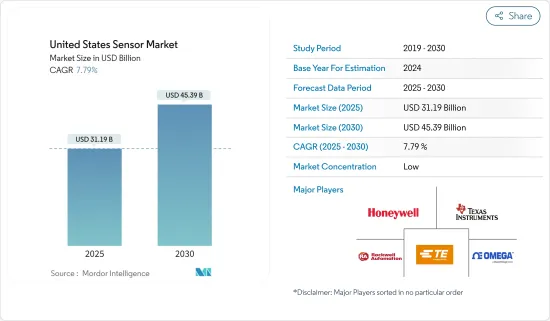
미국의 센서 시장 규모는 2025년에 311억 9,000만 달러, 시장 예측 기간(2025-2030년)의 CAGR은 7.79%를, 2030년에는 453억 9,000만 달러에 달할 것으로 예측되고 있습니다.
센서는 압력, 열, 빛, 움직임, 습기와 같은 물리적 환경에서 다양한 입력을 감지하고 반응하도록 설계되어 있습니다.
스마트폰 내비게이션 시스템에서 운전 지원 시스템에 이르기까지 지능형 센서 기술에 대한 수요 증가는 다양한 산업 분야에서 두드러집니다. 웨어러블 헬스 모니터링 시스템, 자동차의 자동화 등 큰 동향이 이 수요를 뒷받침하고 있습니다.
센싱 기술의 진화는 프로세스 오토메이션의 진보와 함께 분명하며, 보다 고성능으로 상호 접속된 센싱 디바이스의 개발로 이어지고 있습니다.
지속적인 기술 진보로 미국의 자동차 산업에서는 특히 위치 검출 용도용 전자 센서의 요구가 높아지고 있습니다.
게다가 미국에서는 스마트 차량 시장이 확대되어 자동차 상대방 상표 제품 제조업체(OEM)에 의한 센서의 이용이 확대되고 있는 것도 자동차 부문에서의 센서 수요를 뒷받침하고 있습니다.
센서의 통합은 산업 자동화를 강화하는 한편, 비용 증가를 수반하므로 비용 중시의 용도에서는 제한 요인이 될 가능성이 있습니다.
미국 센서 시장 동향
리트랙터블 세이프티 주사기 부문이 예측 기간 동안 큰 성장을 이룰 전망
- 화학 센서는 특정 분석 대상물에 선택적이고 가역적으로 반응하여 종합적인 조성 분석을 가능하게 하는 전기 출력 신호를 제공하는 분석 장치입니다. 다양한 샘플 조성물을 분석하는 데 있어 화학 센서의 응용이 증가함에 따라 그 채택이 촉진되고 있습니다.
- 산업개발은 발암성, 변이원성, 일반적으로 유해한 화학제품을 포함한 다양한 유독물질의 생산에 박차를 가하고 있습니다.
- 또한 의료산업에서는 연속적인 실시간 생리학적·화학적 데이터를 제공하고 눈물, 타액, 땀, 간질액, 인간 휘발성 물질 등의 인간 생체유체 중 생화학 마커를 비침습적으로 모니터링할 수 있는 화학 센서에 대한 관심이 높아지고 있다
- 최근의 진보는 특히 대사물질, 단백질, 화학제품, 세균을 모니터링하기 위한 전기화학 바이오센서에 집중하고 있습니다.
- 또한, 당뇨병 이환율의 급증에 따라, 각국 정부는 선진적인 진단 방법에 대한 투자를 강화하고 있어 의료에 있어서의 화학 센서의 보급에 박차를 가하고 있습니다.
- 2024년의 전미 당뇨병 통계 보고서에 따르면, 미국의 성인 3,840만명이 당뇨병인 것이 밝혀졌습니다.그 중 2,930만명이 진단을 받고 있어 970만명이 미진단이었습니다. 650만명이 65세 이상의 고령자였던 것입니다. 또한 매년 추정 120만명의 미국인이 당뇨병이라고 진단되고 있습니다.
예측기간 중 북미가 큰 시장 점유율을 차지할 전망
- 소비자용 전자기기 부문에는 스마트폰, 노트북, 태블릿, TV, 게임기, 스마트 홈 디바이스, 디지털 카메라 등이 포함됩니다.
- 휴대전화, 노트북, 게임기, 전자레인지, 냉장고 등의 소비자용 전자기기 제품의 대부분은 온도, 근접, 모션 센서 등으로 동작합니다.
- 소비자용 전자기기 제품의 센서는 스마트폰, 태블릿, 웨어러블, 게임기, 소비자용 전자기기 제품 등 폭넓은 소비자용 전자기기 제품의 기능성, 사용 용이성, 전반적인 성능을 향상시키는 데 중요한 역할을 합니다. 이 센서는 이러한 장치가 주변 환경과 상호 작용할 수 있게 해주며 터치 감지 인터페이스, 모션 감지, 이미지 캡처, 환경 모니터링 등의 기능을 설명합니다.
- 센싱 디바이스는 스마트 구조의 보급에 따라 보다 많은 스마트 홈 용도로 사용되게 되고 있습니다.
- 예를 들어 소비자기술협회(CTA)에 따르면 미국에서는 스마트홈 디바이스 판매에 의한 총수입은 2018년 197억 달러에 대해 2023년에는 235억 달러에 이를 것으로 추정되고 있습니다.
- 스마트 소비자용 전자기기의 채용은 센서기술, AI, 빅데이터 분석, IoT 대응 기기에 의해 촉진됩니다.
미국 센서 산업 개요
미국의 센서 시장은 세분화되어 센서 산업에서 유명한 제조업체의 존재감이 증가하고 있기 때문에 예측 기간 동안 경쟁 기업간 경쟁 관계가 격화될 것으로 예측됩니다.
2024년 2월 - STMicroelectronics는 시장을 선도하는 2.3k 해상도를 자랑하는 올인원 직접 비행 시간(dToF) 3D LiDAR 모듈을 발표했습니다. 또한 이 회사는 세계 최소 50만 화소 간접 비행 시간(iToF) 센서의 조기 설계 성공을 발표했습니다. VL53L9는 새로운 직접 ToF 3차원 LiDAR 디바이스로 최대 2.3k 영역의 해상도를 제공합니다. 시장에서 타의 추종을 불허하는 듀얼 스캔 플러드 조명을 특징으로 하는 이 LiDAR는 2D 적외선(IR) 이미지와 3D 심도 맵 정보를 동시에 획득하면서 작은 물체와 가장자리를 감지할 수 있습니다.
2024년 1월 - ams 오스람은 샌프란시스코에서 개최된 Photonics West에서 Mira 제품군의 최신 제품인 Mira016 CMOS 이미지 센서의 전시를 발표했습니다. Mira016은 컴팩트한 1.8mm x 1.8mm 포장 뒷면 조사형(BSI) 더블 스택 센서로 400x400픽셀 해상도를 자랑합니다. 풀 해상도, 90fps로 20mW의 소비 전력으로 동작해, 근적외에서도 높은 양자 효율을 실현해, 저소비 전력으로 고성능을 발휘합니다.
기타 혜택
- 엑셀 형식 시장 예측(ME) 시트
- 3개월간의 애널리스트 서포트
목차
제1장 서론
- 조사의 전제조건과 시장 정의
- 조사 범위
제2장 조사 방법
제3장 주요 요약
제4장 시장 인사이트
- 시장 개요
- 산업의 매력 - Porter's Five Forces 분석
- 공급기업의 협상력
- 구매자의 협상력
- 신규 참가업체의 위협
- 대체품의 위협
- 경쟁도
- 산업 밸류체인/공급 체인 분석
제5장 시장 역학
- 시장 성장 촉진요인
- IoT와 커넥티드 디바이스에 대한 수요 증가
- 자동차 산업에 있어서의 선진적 센서 기술의 채용 증가
- 시장 성장 억제요인
- 초기 비용의 높이
제6장 시장 세분화
- 제품 유형별
- 압력
- 레벨
- 흐름
- 근접
- 환경
- 케미컬
- 관성
- 자기
- 홀 효과 센서
- 기타 자기 센서
- 위치 센서
- 전류 센서
- 기타
- 동작 모드별
- 광학식
- 전기 저항
- 바이오센서
- 압전 저항
- 이미지
- 용량성
- 압전
- 라이더
- 레이더
- 기타 동작 모드
- 최종 사용자 산업별
- 자동차
- 소비자용 전자 기기
- 에너지
- 산업 및 기타
- 의료 복지
- 건설·농업·광업
- 항공우주
- 로봇 공학
제7장 경쟁 구도
- 기업 프로파일
- Texas Instruments Incorporated
- TE Connectivity Ltd
- Omega Engineering Inc.
- Honeywell International Inc.
- Rockwell Automation Inc.
- Siemens AG
- STMicroelectronics Inc.
- AMS Osram AG
- NXP Semiconductors NV
- Infineon Technologies AG
- Bosch Sensortec GmbH
- Sick AG
- ABB Limited
- Omron Corporation
- Allegro MicroSystems Inc
제8장 시장 전망
SHW 25.05.15The United States Sensor Market size is estimated at USD 31.19 billion in 2025, and is expected to reach USD 45.39 billion by 2030, at a CAGR of 7.79% during the forecast period (2025-2030).
A sensor is designed to detect and react to various inputs from the physical environment, such as pressure, heat, light, motion, and moisture. The resulting output typically consists of a signal that can be displayed in a human-readable format at the sensor's location or transmitted electronically over a network for easy reading or additional processing.
The increasing demand for intelligent sensor technology is evident in various industries, from smartphone navigation systems to driver-assistance systems. Sensors are playing a vital role in staying competitive in the technology sector. Major trends like the Internet of Things (IoT), wearable health monitoring systems, and vehicle automation drive this demand. Consequently, intelligent sensors are now more accessible, enabling businesses in various industries to enhance automation, productivity, efficiency, and safety measures.
The evolution of sensing technology is apparent with advancements in process automation, leading to the development of more capable and interconnected sensing devices. As the shift toward digitalization speeds up, there is a growing demand for increased process automation, improved anomaly detection, and predictive maintenance capabilities, prompting a significant uptake of sensing technology.
Due to ongoing technological advancements, the automotive industry in the United States is experiencing a growing need for electronic sensors, especially for position-sensing applications. The industry's focus on technical progress, such as electrification and autonomous driving, has increased the demand for sensors. Additionally, the trend of incorporating position sensors into vehicles demonstrates a promising future for the market's growth.
Additionally, the increasing market for smart vehicles and the growing use of sensors by automotive original equipment manufacturers (OEMs) in the United States also drive the demand for sensors in the automotive sector. The rise in demand for sensors in the automotive industry is further bolstered by the enforcement of regulations requiring the use of specific sensors in vehicles.
While integrating sensors enhances industrial automation, it comes with an added cost that may be a limiting factor in cost-sensitive applications. Furthermore, the high costs associated with research and development for creating new products pose a significant challenge, especially for smaller sensor manufacturers that may lack funds.
United States Sensor Market Trends
Retractable Safety Syringes Segment Expected to Witness Significant Growth During the Forecast Period
- Chemical sensors are analyzers that respond selectively and reversibly to specific analytes, providing an electrical output signal that enables a comprehensive composition analysis. The country's escalating pollution levels have bolstered the demand for these sensors. Rising applications for chemical sensors in analyzing diverse sample compositions drive their adoption. Notably, the market is witnessing a surge in demand for low-cost, portable chemical sensors, including advanced orthogonal variants, underscoring a significant trend poised to propel the market's growth.
- Industrial development has spurred the production of various toxic materials, encompassing carcinogenic, mutagenic, and generally hazardous chemicals. Despite stringent management, these substances continue to endanger human health.
- Furthermore, the healthcare industry is increasingly interested in chemical sensors due to their capability to deliver continuous, real-time physiological and chemical data and non-invasive monitoring of biochemical markers in human biofluids such as tears, saliva, sweat, interstitial fluid, and human volatiles.
- Recent advancements have concentrated on electrochemical biosensors, particularly for monitoring metabolites, proteins, chemicals, and bacteria. Measuring biophysical quantities in the human body has been a significant focus in healthcare and medicine. Numerous flexible, wearable, and detachable sensors have been developed and commercialized to monitor critical parameters in sports, healthcare, and medical applications.
- Furthermore, as diabetes rates surge, the country's governments are ramping up investments in advanced diagnostic methods, fueling the uptake of chemical sensors in healthcare.
- The National Diabetes Statistics Report of 2024 revealed that 38.4 million adults in the United States had diabetes. Among them, 29.3 million had been diagnosed, while a concerning 9.7 million were undiagnosed. Notably, 29.2% of the American population, equating to 16.5 million seniors, were aged 65 and above. Furthermore, an estimated 1.2 million Americans are diagnosed with diabetes each year. The increasing number of diabetes patients in the country every year is expected to fuel the market's growth in the coming years.
North America Expected to Hold Significant Market Share During the Forecast Period
- The consumer electronics segment includes smartphones, laptops, tablets, televisions, gaming consoles, smart home devices, digital cameras, and others. Smart wearables are not considered in this segment.
- Most consumer electronics, such as mobile phones, laptops, game consoles, microwaves, and refrigerators, operate with temperature, proximity, motion sensors, etc. The high demand for these devices is a crucial factor contributing to the market's growth.
- Sensors in consumer electronics play a crucial role in improving the functionality, user-friendliness, and overall performance of a wide range of consumer electronic products, including smartphones, tablets, wearables, gaming consoles, home appliances, and others. These sensors enable these devices to interact with their surroundings and offer touch-sensitive interfaces, motion detection, image capture, environmental monitoring, and more capabilities.
- Sensing devices are used in more smart home applications as smart structures gain popularity. The demand for sensors is expected to increase due to the growing popularity of smart consumer electronics, IoT devices for smart homes, and technological advancements and innovations. Additionally, the growing use of wireless technologies, propelling the market for smart consumer electronics, is anticipated to open up new market opportunities for sensors.
- For instance, according to the Consumer Technology Association (CTA), in the United States, total revenue from the sales of smart home devices was estimated to reach USD 23.5 billion in 2023, compared to USD 19.7 billion in 2018. It is anticipated that the market for smart technology will witness rising demand for energy-saving appliances and increasing demand for sensors with applications.
- The adoption of smart home appliances will be fueled by sensor technology, AI, big data analytics, and IoT-enabled devices. Projections indicate that 2024 retail sales in the United States for consumer electronics will hit a significant USD 512 billion. In 2023, OLED TVs were on track to rake in USD 2.3 billion, while portable gaming consoles were eyeing a revenue of USD 1.5 billion.
United States Sensor Industry Overview
The United States Sensor market is fragmented, and the increasing presence of prominent manufacturers in the sensor industry is expected to intensify competitive rivalry during the forecast period. Market incumbents, such as Texas Instruments Incorporated, TE Connectivity Ltd, Omega Engineering Inc., Honeywell International Inc., Rockwell Automation Inc., etc., considerably influence the overall market.
February 2024 - STMicroelectronics introduced an all-in-one, direct Time-of-Flight (dToF) 3D LiDAR module boasting a market-leading 2.3k resolution. Additionally, the company has disclosed an early design win for the world's smallest 500k-pixel indirect Time-of-Flight (iToF) sensor. The VL53L9, a novel direct ToF 3D LiDAR device, offers a resolution of up to 2.3k zones. Featuring a dual scan flood illumination, which is unparalleled in the market, this LiDAR can detect small objects and edges while simultaneously capturing 2D infrared (IR) images and 3D depth map information.
January 2024 - ams OSRAM announced the showcase of the latest member of the Mira product family, the Mira016 CMOS image sensor, at Photonics West in San Francisco. The Mira016 boasts a resolution of 400 x 400 pixels for a backside illuminated (BSI) double-stack sensor that comes in a compact 1.8 mm x 1.8 mm package. It operates at a power of 20 mW at full resolution and 90 fps and also offers high quantum efficiency in the near-infrared, providing high performance with low power consumption.
Additional Benefits:
- The market estimate (ME) sheet in Excel format
- 3 months of analyst support
TABLE OF CONTENTS
1 INTRODUCTION
- 1.1 Study Assumptions and Market Definition
- 1.2 Scope of the Study
2 RESEARCH METHODOLOGY
3 EXECUTIVE SUMMARY
4 MARKET INSIGHTS
- 4.1 Market Overview
- 4.2 Industry Attractiveness - Porter's Five Forces Analysis
- 4.2.1 Bargaining Power of Suppliers
- 4.2.2 Bargaining Power of Buyers
- 4.2.3 Threat of New Entrants
- 4.2.4 Threat of Substitutes
- 4.2.5 Degree of Competition
- 4.3 Industry Value Chain/Supply Chain Analysis
5 MARKET DYNAMICS
- 5.1 Market Drivers
- 5.1.1 Rising Demand for IoT and Connected Devices
- 5.1.2 Increasing Adoption of Advanced Sensor Technologies in Automotive Industry
- 5.2 Market Restraints
- 5.2.1 High Initial Cost Involved
6 MARKET SEGMENTATION
- 6.1 By Product Type
- 6.1.1 Pressure
- 6.1.2 Level
- 6.1.3 Flow
- 6.1.4 Proximity
- 6.1.5 Environmental
- 6.1.6 Chemical
- 6.1.7 Inertial
- 6.1.8 Magnetic
- 6.1.8.1 Hall Effect Sensors
- 6.1.8.2 Other Magnetic Sensors
- 6.1.9 Position Sensors
- 6.1.10 Current Sensors
- 6.1.11 Other Types
- 6.2 By Mode of Operation
- 6.2.1 Optical
- 6.2.2 Electrical Resistance
- 6.2.3 Biosensor
- 6.2.4 Piezoresistive
- 6.2.5 Image
- 6.2.6 Capacitive
- 6.2.7 Piezoelectric
- 6.2.8 Lidar
- 6.2.9 Radar
- 6.2.10 Other Modes of Operation
- 6.3 By End-user Industry
- 6.3.1 Automotive
- 6.3.2 Consumer Electronics
- 6.3.3 Energy
- 6.3.4 Industrial and Other
- 6.3.5 Medical and Wellness
- 6.3.6 Construction, Agriculture and Mining
- 6.3.7 Aerospace
- 6.3.8 Robotics
7 COMPETITIVE LANDSCAPE
- 7.1 Company Profiles
- 7.1.1 Texas Instruments Incorporated
- 7.1.2 TE Connectivity Ltd
- 7.1.3 Omega Engineering Inc.
- 7.1.4 Honeywell International Inc.
- 7.1.5 Rockwell Automation Inc.
- 7.1.6 Siemens AG
- 7.1.7 STMicroelectronics Inc.
- 7.1.8 AMS Osram AG
- 7.1.9 NXP Semiconductors NV
- 7.1.10 Infineon Technologies AG
- 7.1.11 Bosch Sensortec GmbH
- 7.1.12 Sick AG
- 7.1.13 ABB Limited
- 7.1.14 Omron Corporation
- 7.1.15 Allegro MicroSystems Inc