
|
시장보고서
상품코드
1836703
군용 광섬유 케이블 시장 : 시장 점유율 분석, 산업 동향, 통계, 성장 예측(2025-2030년)Military Fiber Optic Cables - Market Share Analysis, Industry Trends & Statistics, Growth Forecasts (2025 - 2030) |
||||||
 Mordor Intelligence
군용 광섬유 케이블 시장은 2025년에 38억 2,000만 달러로 추정되었고, 2030년에는 55억 달러에 이를 전망이며, CAGR 7.56%로 성장할 것으로 예측됩니다.
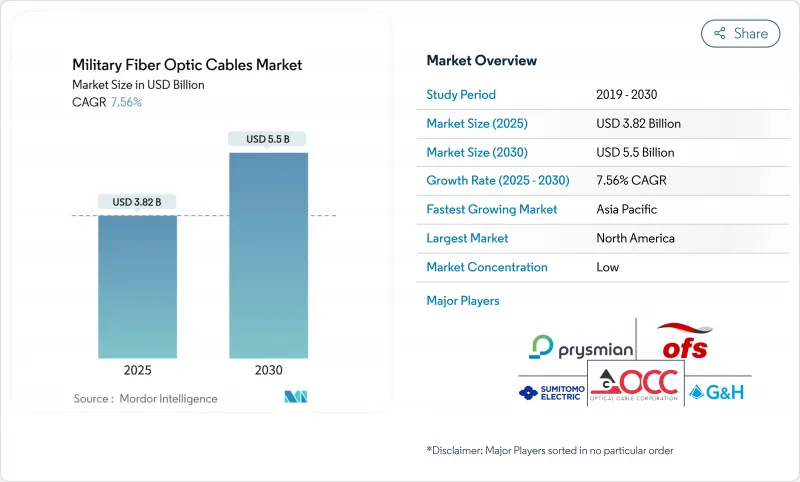
이 성장은 구리선 링크가 전자기 간섭을 견디고 훨씬 높은 데이터 부하를 전송하는 파이버 솔루션으로 빠르게 대체되고 있음을 반영하고 있습니다. 광섬유 무인 항공기, 지향성 에너지 무기 및 5G 대응 전술 네트워크에 대한 투자는 전장의 연결성을 재구성하고 있으며, 군는 광대역 광 백본으로 레거시 플랫폼을 개조하도록 촉구하고 있습니다. 국방부는 또한 광 기반 신호가 감청에 저항하고 전자기 시그니처를 방출하지 않기 때문에 광섬유를 방해나 사이버 위험에 대한 헤지로 간주합니다. 조달 지출은 선박, 차량 및 항공기에서 100Gbps 이상의 데이터 속도를 추진하는 다중 도메인 센서 퓨전 프로그램에 의해 더욱 지원됩니다.
세계의 군용 광섬유 케이블 시장 동향 및 인사이트
손실없는 EMI 면제 데이터 링크에 대한 전장에서의 수요
전자전은 현대의 전장을 포화시켰기 때문에 광섬유 회선이 구리선에 대신해, 방해 전파하에서도 온전한 신호를 유지할 수 있게 되었습니다. 우크라이나 군은 광섬유로 연결된 FPV 드론을 운용하며, 방해의 영향을 받지 않고 고해상도의 비디오를 흘리면서 41km 관통하고 있습니다. NATO의 플래너는 이러한 성과를 관찰하고 미국 육군은 능력의 격차를 메우기 위해 유사한 시스템을 1,100대 계획하고 있습니다. 이러한 전투 입증된 가속기는 분대 및 사령부를 위한 견고한 마이크로 섬유릴과 빠른 배치 커넥터의 조달을 가속화합니다. 군용 광섬유 케이블 시장은 각 드론이 MIL 표준의 인장 한계와 굽힘 한계에 맞추어야 하는 수 킬로미터의 스풀 및 교체 키트를 사용하기 때문에 직접 혜택을 받습니다. 수요는 전방 기지를 전자 공격으로부터 보호하는 국가적 의무에 의해 강화되고 있습니다.
5G 전술 네트워크의 군사화
미국, 스페인, 독일 및 노르웨이 기지에서 민간 5G 전개는 까다로운 대기 시간과 보안 목표를 충족하면서 몇 기가비트 트래픽을 처리하는 고밀도 섬유 백홀에 의존합니다. 방위 5G 인프라에 대한 지출은 2024-2027년 사이에 총액 15억 달러가 될 전망이며, 그 약 3분의 1이 광케이블과 종단 처리에 충당됩니다. 이 프로그램은 개방형 RAN 인터페이스를 채택하므로 공급업체는 다양한 무선 장치 및 에지 클라우드용 광섬유를 인증해야 합니다. 따라서 군용 광케이블 시장은 싱글 모드 간선, 현장 배치 가능한 실내 및 옥외 패치 코드, 연료 유출 및 차량 적재를 견디는 경화형 MPO 커넥터의 지속적인 주문을 획득하고 있습니다.
현장 수준의 수리 복잡성
원격지의 전투 지대에서의 섬유 스플라이싱은 노동 집약적이며 공구를 많이 사용하기 때문에 절단된 라인은 중요한 센서를 정지시킬 수 있습니다. 따라서 절단된 회선은 중요한 센서를 정지시킬 수 있습니다. 군사 시험에서는 3분 이내에 설치되는 '압착 및 벽개' 커넥터를 사용하여 0.5dB의 여분 손실로 교환하여 신속한 복구를 수행합니다. 교육 지연이 계속되고 있으며 공인 엔지니어 부족으로 인해 대규모 전개가 지연됩니다. 벤더는 미리 종단된 릴이나 휴먼 에러를 줄이는 색으로 구분된 부츠로 대답합니다. 이러한 진보가 문제를 완화하는 반면, 군용 광섬유 케이블 시장은 군이 충분한 유지 보수 팀을 조직할 때까지 여전히 계약 지연에 직면하고 있습니다.
보고서에서 분석된 기타 촉진요인 및 억제요인
- ISR 센서 밀도의 급증
- 지향성 에너지 무기의 통합
- 공급망 보안 취약점
부문 분석
싱글 모드 라인은 2024년에 약 54.50%로 최대의 군용 광섬유 케이블 시장 점유율을 차지했으며, 2030년까지 한 자리 대 중반의 CAGR을 유지할 것으로 예측되고 있습니다. 그 좁은 코어는 구축함, 공중 조기 경계기, 전방 작전 기지를 상호 연결하는 지하 섬유 트렁크에서 초장거리 링크를 가능하게 합니다. 유익한 결과는 각 단일 모드 실행이 종종 예비 다크 섬유를 탑재하고 미래에 투자를 보호하는 잠재적 용량을 생성한다는 것입니다.
둘째, 멀티 모드는 현재보다 작은 슬라이스를 차지하고 있지만 CAGR 8.75%에서 시장 전체의 성장을 웃도는 것으로 예측되고 있습니다. 비용 효율적인 송수신기, 광범위한 발사 조건에 대한 내성, 방사선에 강한 다중 모드 광섬유의 최근 돌파구는 장갑차 및 항공기 캐빈 내에서 광범위한 전개를 제안합니다. 이러한 증가는 두 코어 유형을 결합한 하이브리드 케이블 번들을 제공하는 공급업체가 통합자의 물류를 단순화하여 상업적 우위를 확보한다는 것을 의미합니다.
유리는 탁월한 대역폭과 견고성으로 인해 군용 광섬유 케이블 시장의 약 90.45%를 차지했습니다. 해군 설계사는 열창이 해상 충격 기준에 적합하기 때문에 탑 사이드 및 갑판 아래 배선에 유리를 선호합니다. 공급업체의 장점은 생산량의 안정성입니다. 선대의 리노베이션 사이클은 새로운 건설 일정과 무관하게 지속적인 수요를 보장합니다.
플라스틱 광섬유(POF) 시장 규모는 전체의 10분의 1에 미치지 못하지만, 유연성과 현장에서의 신속한 종단 처리로 CAGR은 약 10.47%로 추이하고 있습니다. 베어링과 해치 씰에 내장된 마모 센서는 틈새이지만 정기적인 주문을 보여줍니다. POF의 진전은 다양한 재료 포트폴리오가 유리 특유의 지정학적 공급 위험에 대한 위험 회피를 계약자에게 제공한다는 것을 시사합니다.
지역 분석
북미는 지속적인 방위 예산과 기술 리더십으로 2024년 34.47%의 매출을 유지했습니다. 1,100유닛의 파이버 드론 전개와 같은 프로그램은 성능이 입증되면 조달이 신속하게 확장된다는 것을 강조합니다. 국립연구소에서의 조사는 코히런트 결합 레이저와 굽힘에 둔감하고 견고한 섬유를 진보시켜, 이 지역의 기술적 우위성을 확보하고 있습니다. 북미의 군용 광섬유 케이블 시장 규모는 새로운 플랫폼이 광 백본을 표준화함에 따라 더욱 확대되고 있습니다.
아시아태평양은 인도, 일본, 한국, 호주가 현대화를 진행함에 따라 2030년까지 연평균 복합 성장률(CAGR)이 가장 빠른 9.31%를 기록할 전망입니다. 인도의 Network For Spectrum 계약은 2억 700만 달러 상당으로 57,015km의 섬유 부설을 커버. 지역 통신 사업자는 1대당 18Tbps를 제공하는 ALPHA 케이블로 제휴하여 해군에 탄력적인 경로를 제공합니다. 국방부는 고밀도 광 프론트 홀에 의존하는 5G 대응 훈련장에 투자하고 있습니다. 이러한 노력은 이 지역의 군용 광섬유 케이블 시장의 지명도를 높이고 있습니다.
유럽은 해저 인프라와 국경을 넘어 육상 루트를 확보하는 NATO 프로젝트가 견인하여 견조한 수요를 유지하고 있습니다. Baltic Sentry 미션에서는 해군 무인 항공기를 사용하여 파이프라인과 케이블을 순찰하여 내충격 섬유 번들의 주문을 유도했습니다. 스웨덴과 핀란드는 3Pbps 전송이 가능한 7,500만 크로네(780만 달러)의 3케이블 육상 회랑을 개설하여 지역 회복력을 강화했습니다. EU의 군가 공통의 아키텍처에 수렴해 가는 가운데, 범유럽적인 인가를 가지는 공급자가 군용 광섬유 케이블 시장에서 점유율을 확대하고 있습니다.
기타 혜택 :
- 엑셀 형식 시장 예측(ME) 시트
- 3개월간의 애널리스트 서포트
목차
제1장 서론
- 조사의 전제조건 및 시장 정의
- 조사 범위
제2장 조사 방법
제3장 주요 요약
제4장 시장 상황
- 시장 개요
- 시장 성장 촉진요인
- 무손실로 EMI 면역의 데이터 링크에 대한 전장에서의 수요
- 5G 전술 네트워크의 군사화
- ISR 센서 밀도의 급증
- 지향성 에너지 무기의 통합
- 소형화된 견고한 섬유 종단
- 섬유 중심 아비오닉스 아키텍쳐에 대한 NATO STANAG 시프트
- 시장 성장 억제요인
- 현장 레벨에서 수리의 복잡성
- 공급망 보안 취약성
- 높은 수명주기 비용 대 구리
- 장갑차의 동적 진동에 의한 굽힘 손실에 대한 취약성
- 밸류체인 및 공급망 분석
- 규제 및 기술의 전망
- Porter's Five Forces 분석
- 신규 참가업체의 위협
- 구매자의 협상력
- 공급기업의 협상력
- 대체품의 위협
- 경쟁 기업간 경쟁 관계의 강도
제5장 시장 규모 및 성장 예측 : 금액
- 케이블 유형별
- 싱글 모드
- 멀티 모드
- 재료 유형별
- 유리 광섬유
- 플라스틱 광섬유
- 전개 플랫폼
- 육상 시스템
- 항공 시스템
- 해군 및 해저 시스템
- 설치 환경별
- 전술적 현장 전개형
- 가혹한 환경 장갑
- 수중 및 잠수함
- 용도별
- C3ISR 및 전술 통신
- 레이더 및 전자전
- 유도 무기 및 지향성 에너지 무기
- 온보드 데이터 네트워크 및 항공전자공학
- 기타(파워 오버 파이버, 센서)
- 지역별
- 북미
- 미국
- 캐나다
- 멕시코
- 남미
- 브라질
- 기타 남미
- 유럽
- 영국
- 독일
- 프랑스
- 이탈리아
- 러시아
- 기타 유럽
- 아시아태평양
- 중국
- 인도
- 일본
- 싱가포르
- 기타 아시아태평양
- 중동 및 아프리카
- 중동
- 이스라엘
- 아랍에미리트(UAE)
- 기타 중동
- 아프리카
- 남아프리카
- 기타 아프리카
- 북미
제6장 경쟁 구도
- 시장 집중도
- 전략적 동향
- 시장 점유율 분석
- 기업 프로파일
- Prysmian SpA
- OFS Fitel, LLC
- Lynxeo SAS
- Sumitomo Electric Industries, Ltd.
- Optical Cable Corporation
- Corning Incorporated
- Gooch & Housego PLC
- Timbercon, Inc.
- WL Gore & Associates, Inc.
- Infinite Electronics, Inc.
- Sterlite Technologies Limited
- TE Connectivity plc
- L3Harris Technologies, Inc.
- Amphenol Corporation
- Radiall LLC
- Rosenberger Hochfrequenztechnik GmbH & Co KG
- Cinch Connectivity Solutions, Inc.
- Fujikura Ltd.
- Leoni AG
- Yangtze Optical Fibre and Cable Joint Stock Limited Company
제7장 시장 기회 및 전망
AJY 25.10.27The military fiber optic cables market stands at USD 3.82 billion in 2025 and is projected to reach USD 5.5 billion by 2030, registering a 7.56% CAGR.
Growth reflects the swift replacement of copper links with fiber solutions that withstand electromagnetic interference while carrying far higher data loads. Investments in fiber-optic drones, directed-energy weapons, and 5G-enabled tactical networks are reshaping battlefield connectivity, prompting armies to refit legacy platforms with high-bandwidth optical backbones. Defense ministries also view fiber as a hedge against jamming and cyber risks, since light-based signals resist interception and radiate no electromagnetic signature. Procurement spending is further supported by multi-domain sensor fusion programs that push data rates above 100 Gbps on ships, vehicles, and aircraft.
Global Military Fiber Optic Cables Market Trends and Insights
Battlefield demand for loss-less, EMI-immune data links
Electronic warfare has saturated modern battlefields, so fiber-optic lines now replace copper to keep signals intact under jamming. Ukrainian forces operate fiber-tethered FPV drones that penetrate 41 km while streaming high-resolution video unaffected by interference. NATO planners observed these results, and the US Army plans 1,100 similar systems to close capability gaps. These combat-proven accelerators accelerate the procurement of rugged micro-fiber reels and quick-deploy connectors for squads and command posts. The military fiber optic cables market benefits directly as each drone uses multi-kilometre spools and replacement kits that must meet MIL-spec pull and bend limits. Demand is reinforced by national mandates to harden forward bases against electronic attack.
Militarisation of 5G tactical networks
Private 5G roll-outs at bases in the United States, Spain, Germany, and Norway depend on dense fiber backhaul that handles multi-gigabit traffic while meeting strict latency and security targets. Spending on defence 5G infrastructure will total USD 1.5 billion during 2024-2027, with roughly one-third flowing to optical cabling and terminations. Programs adopt Open RAN interfaces, so suppliers must certify fibers for diverse radio units and edge clouds. The military fiber optic cables market thus gains sustained orders for single-mode trunk lines, field-deployable indoor/outdoor patch cords, and hardened MPO connectors able to survive fuel spills and vehicle loads.
Field-level repair complexity
Splicing fibers in remote combat zones is labour-intensive and tool-heavy, so cut lines can idle critical sensors. Military trials "crimp & cleave" connectors that install in under three minutes, trading 0.5 dB extra loss for rapid restoration. Training backlogs persist, and shortages of certified technicians slow large-scale roll-outs. Vendors answer with pre-terminated reels and colour-coded boots that reduce human error. While these advances ease the issue, the military fiber optic cables market still faces delayed contracts until armies field enough maintenance teams.
Other drivers and restraints analyzed in the detailed report include:
- Surge in ISR sensor density
- Directed-energy weapons integration
- Supply chain security vulnerabilities
For complete list of drivers and restraints, kindly check the Table Of Contents.
Segment Analysis
Single-mode lines command the largest military fiber optic cables market share at roughly 54.50% in 2024 and are forecast to maintain a mid-single-digit CAGR through 2030. Their narrow core enables ultra-long links on destroyers, airborne early warning aircraft, and underground fiber trunks interconnecting forward operating bases. A useful consequence is that each single-mode run often carries spare dark fibers, creating latent capacity that future-proofs the investment.
Second, multi-mode occupies a smaller slice today, yet is predicted to outpace overall market growth with an 8.75% CAGR. Cost-effective transceivers, tolerance of wider launch conditions, and recent breakthroughs in radiation-hard multimode fiber suggest wider deployment inside armored vehicles and aircraft cabins. This uptick implies that vendors offering hybrid cable bundles-combining both core types-gain a commercial edge by simplifying logistics for integrators.
Glass commands about 90.45% of the military fiber optic cables market, thanks to its unmatched bandwidth and robustness. Naval architects favour glass for topside and below-decks runs because its thermal window aligns with maritime shock standards. The inferred benefit for suppliers is volume stability: fleet refit cycles assure ongoing demand independent of new-build schedules.
Plastic optical fiber (POF) may hold less than a tenth of the market value, but it is advancing at roughly 10.47% CAGR owing to flexibility and quick field termination. Embedded wear sensors in bearings and hatch seals illustrate niche yet recurring orders. POF's progress suggests that a diversified materials portfolio gives contractors a hedge against glass-specific geopolitical supply risks.
The Military Fiber Optic Cables Market Report is Segmented by Cable Type (Single-Mode and Multi-Mode), Material Type (Glass Optical Fiber, and More), Deployment Platform (Land Systems, and More), Installation Environment (Tactical Field-Deployable, and More), Application (Radar and Electronic Warfare, and More) and Geography (North America, Europe, and More). The Market Forecasts are Provided in Terms of Value (USD).
Geography Analysis
North America retained 34.47% revenue in 2024 due to sustained defense budgets and technology leadership. Programs such as the 1,100-unit fiber drone rollout highlight how procurement scales quickly once performance is proven. Research at national laboratories advances coherently combined lasers and bend-insensitive, rugged fibers, securing the region's technical edge. The military fiber optic cables market size in North America further widens as each new platform standardises on optical backbones.
Asia-Pacific records the fastest 9.31% CAGR to 2030 as India, Japan, South Korea, and Australia step up modernisation. India's Network For Spectrum contracts worth USD 207 million cover 57,015 km of fiber builds. Regional carriers partner on the ALPHA cable that offers 18 Tbps per pair, giving navies resilient routes. Defense ministries invest in 5G-backed training ranges that depend on dense optical fronthaul. These initiatives raise the military fiber optic cables market profile across the region.
Europe maintains solid demand, led by NATO projects that secure undersea infrastructure and cross-border land routes. The Baltic Sentry mission uses naval drones to patrol pipelines and cables, triggering orders for impact-proof fiber bundles. Sweden and Finland opened a SEK 75 million (USD 7.8 million) three-cable land corridor able to carry 3 Pbps, reinforcing regional resilience. As EU forces converge on common architectures, suppliers with pan-European approvals gain share in the military fiber optic cables market.
- Prysmian S.p.A.
- OFS Fitel, LLC
- Lynxeo SAS
- Sumitomo Electric Industries, Ltd.
- Optical Cable Corporation
- Corning Incorporated
- Gooch & Housego PLC
- Timbercon, Inc.
- W. L. Gore & Associates, Inc.
- Infinite Electronics, Inc.
- Sterlite Technologies Limited
- TE Connectivity plc
- L3Harris Technologies, Inc.
- Amphenol Corporation
- Radiall LLC
- Rosenberger Hochfrequenztechnik GmbH & Co KG
- Cinch Connectivity Solutions, Inc.
- Fujikura Ltd.
- Leoni AG
- Yangtze Optical Fibre and Cable Joint Stock Limited Company
Additional Benefits:
- The market estimate (ME) sheet in Excel format
- 3 months of analyst support
TABLE OF CONTENTS
1 INTRODUCTION
- 1.1 Study Assumptions and Market Definition
- 1.2 Scope of the Study
2 RESEARCH METHODOLOGY
3 EXECUTIVE SUMMARY
4 MARKET LANDSCAPE
- 4.1 Market Overview
- 4.2 Market Drivers
- 4.2.1 Battlefield demand for loss-less, EMI-immune data links
- 4.2.2 Militarisation of 5G tactical networks
- 4.2.3 Surge in ISR sensor density
- 4.2.4 Directed-energy weapons integration
- 4.2.5 Miniaturised rugged fiber terminations
- 4.2.6 NATO STANAG shift towards fiber-centric avionics architectures
- 4.3 Market Restraints
- 4.3.1 Field-level repair complexity
- 4.3.2 Supply chain security vulnerabilities
- 4.3.3 High lifecycle cost vs copper
- 4.3.4 Vulnerability to bend-loss under dynamic vibration in armored vehicles
- 4.4 Value/Supply-Chain Analysis
- 4.5 Regulatory and Technological Outlook
- 4.6 Porter's Five Forces Analysis
- 4.6.1 Threat of New Entrants
- 4.6.2 Bargaining Power of Buyers
- 4.6.3 Bargaining Power of Suppliers
- 4.6.4 Threat of Substitutes
- 4.6.5 Intensity of Competitive Rivalry
5 MARKET SIZE AND GROWTH FORECASTS (VALUE)
- 5.1 By Cable Type
- 5.1.1 Single-mode
- 5.1.2 Multi-mode
- 5.2 By Material Type
- 5.2.1 Glass Optical Fiber
- 5.2.2 Plastic Optical Fiber
- 5.3 Deployment Platform
- 5.3.1 Land Systems
- 5.3.2 Airborne Systems
- 5.3.3 Naval and Sub-sea Systems
- 5.4 By Installation Environment
- 5.4.1 Tactical Field-Deployable
- 5.4.2 Harsh-Environment Armored
- 5.4.3 Under-water / Submarine
- 5.5 By Application
- 5.5.1 C3ISR and Tactical Communications
- 5.5.2 Radar and Electronic Warfare
- 5.5.3 Guided and Directed-Energy Weapons
- 5.5.4 On-board Data Networks / Avionics
- 5.5.5 Others (Power-over-Fiber, Sensors)
- 5.6 By Geography
- 5.6.1 North America
- 5.6.1.1 United States
- 5.6.1.2 Canada
- 5.6.1.3 Mexico
- 5.6.2 South America
- 5.6.2.1 Brazil
- 5.6.2.2 Rest of South America
- 5.6.3 Europe
- 5.6.3.1 United Kingdom
- 5.6.3.2 Germany
- 5.6.3.3 France
- 5.6.3.4 Italy
- 5.6.3.5 Russia
- 5.6.3.6 Rest of Europe
- 5.6.4 Asia-Pacific
- 5.6.4.1 China
- 5.6.4.2 India
- 5.6.4.3 Japan
- 5.6.4.4 Singapore
- 5.6.4.5 Rest of Asia-Pacific
- 5.6.5 Middle East and Africa
- 5.6.5.1 Middle East
- 5.6.5.1.1 Israel
- 5.6.5.1.2 United Arab Emirates
- 5.6.5.1.3 Rest of Middle East
- 5.6.5.2 Africa
- 5.6.5.2.1 South Africa
- 5.6.5.2.2 Rest of Africa
- 5.6.1 North America
6 COMPETITIVE LANDSCAPE
- 6.1 Market Concentration
- 6.2 Strategic Moves
- 6.3 Market Share Analysis
- 6.4 Company Profiles (includes Global level Overview, Market level overview, Core Segments, Financials as available, Strategic Information, Market Rank/Share for key companies, Products and Services, and Recent Developments)
- 6.4.1 Prysmian S.p.A.
- 6.4.2 OFS Fitel, LLC
- 6.4.3 Lynxeo SAS
- 6.4.4 Sumitomo Electric Industries, Ltd.
- 6.4.5 Optical Cable Corporation
- 6.4.6 Corning Incorporated
- 6.4.7 Gooch & Housego PLC
- 6.4.8 Timbercon, Inc.
- 6.4.9 W. L. Gore & Associates, Inc.
- 6.4.10 Infinite Electronics, Inc.
- 6.4.11 Sterlite Technologies Limited
- 6.4.12 TE Connectivity plc
- 6.4.13 L3Harris Technologies, Inc.
- 6.4.14 Amphenol Corporation
- 6.4.15 Radiall LLC
- 6.4.16 Rosenberger Hochfrequenztechnik GmbH & Co KG
- 6.4.17 Cinch Connectivity Solutions, Inc.
- 6.4.18 Fujikura Ltd.
- 6.4.19 Leoni AG
- 6.4.20 Yangtze Optical Fibre and Cable Joint Stock Limited Company
7 MARKET OPPORTUNITIES AND FUTURE OUTLOOK
- 7.1 White-space and Unmet-Need Assessment