|
시장보고서
상품코드
1842525
표면 소독제 시장 : 시장 점유율 분석, 산업 동향, 통계, 성장 예측(2025-2030년)Surface Disinfectant - Market Share Analysis, Industry Trends & Statistics, Growth Forecasts (2025 - 2030) |
||||||
 Mordor Intelligence
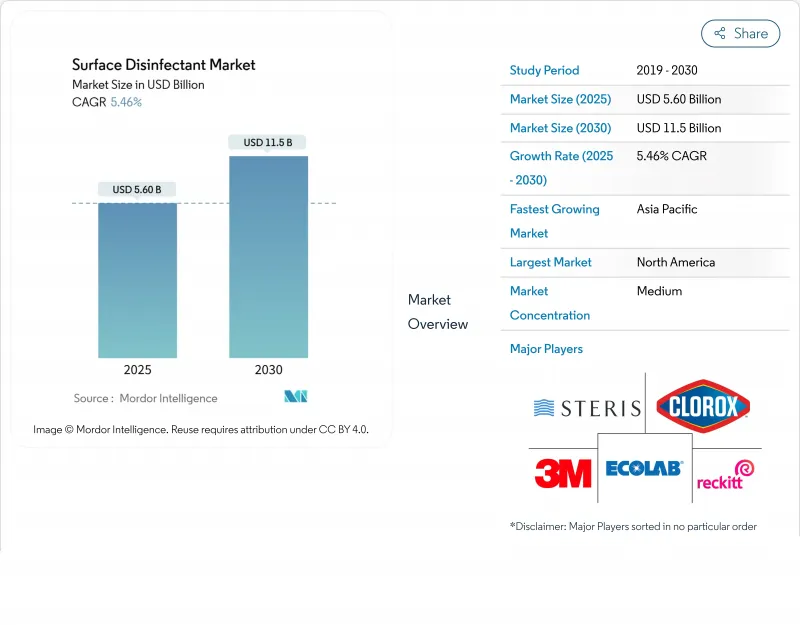
표면 소독제 시장 규모는 2025년에 56억 달러로 추정되고, 2030년에는 115억 달러로 확대될 것으로 예측됩니다.
이는 의료환경, 직장, 가정에 대한 수요가 늘어남에 따라 CAGR이 5.90%로 견조하게 성장하는 것을 반영하고 있습니다.
감염 예방 기준이 건축 기준, 보험 상환 방침, 기업의 지속가능성 목표에 담겨지면서 표면 소독제 업계는 대응 가능한 저변을 넓히고 있습니다. 아웃브레이크 시 갑작스런 구매에서 계획적이고 예산화된 조달주기로의 점진적인 변화는 수익의 계절성을 평활화하고 생산자의 생산 능력 계획을 최적화하는 데 도움이 됩니다. 질병 관리 예방 센터와 같은 규제 기관은 기존 화학물질에 대한 허용 노출 한계를 엄격히 하고 있으며, 이는 최종 사용자의 전환 비용을 늘리는 동시에 공급업체의 혁신 파이프라인을 자극하고 있습니다. 예측 가능한 수요와 끊임없는 개선 요구의 조합은 특정 재료 적합성과 지속가능성의 격차를 목표로 하는 틈새 혁신자의 진입 장벽을 미묘하게 낮춥니다.
세계의 표면 소독제 시장 동향 및 인사이트
세계의 HAI 벌칙 강화로 병원은 정기적 표면 소독 감사에 착수했습니다.
현재, 병원은 의료 관련 감염이 예방 가능한 실수에 기인하는 것이 판명되었을 경우, 진료 보수의 감액에 직면하고 있어, 이러한 금전적 페널티에 의해 엄격한 표면 검사 프로그램의 가치가 높아지고 있습니다. 독일의 데이터에서 감염된 환자의 재원 일수는 19일에 뛰어오르고, 그 이외의 환자의 재원 일수는 7일이었습니다. 감사 결과는 진료 보상과 연결되기 때문에 감염 관리 팀은 디지털 기록 도구와 통합된 제품을 선택하는 것이 늘어나고, 그 결과 벤더의 영향력은 화학제품 자체를 넘어 확대되고 있습니다. 직접적인 결과로, 대시보드에 해당하는 사용 지표를 제공하는 공급업체는 제품 라벨의 살균 시간이 비슷하더라도 경쟁 우위를 확보했습니다.
헬스케어 인프라 확대가 기관 구매를 촉진
인도, 인도네시아, 걸프 협력 회의 국가에서 신규 개원 예정인 수십 개의 3차 병원은 이미 감염 통제를 위한 알코브, 자동 희석 센터, 분별 보관 베이를 건축 설계에 통합하고 있습니다. 이러한 설계 선택은 폐쇄 루프 조제와 결합된 벌크 농축액의 조달을 기울여 포장 낭비를 생략하면서 계약 규모를 확대하고 있습니다. 건축가가 설계도 단계에서 장비의 적합성을 지정하기 때문에 소독제 공급업체는 시설 시운전 몇 개월 전에 상담을 받게됩니다. 이 패턴은 미래에 신설될 병원이 환자의 수락을 시작하기 전에 다년간의 약품 공급 계약을 체결할 가능성을 시사하며, 표면 소독제 산업에 대한 수익 전망이 원활해집니다.
민감한 의료기기의 표면 손상 우려가 염소와 알데히드의 사용을 제한합니다.
차세대 영상 처리 장치는 고분자로 만들어진 인클로저와 터치스크린 인터페이스를 채택하지만, 이들은 염소계 약물에 침범될 때 급속히 열화되기 때문에 생물의학 엔지니어는 염소가 없는 구역을 지정해야 합니다. 10만 달러나 되는 장치를 조기에 교환할 때마다 자본 예산이 압박되기 때문에 부식 고장을 피하기 위해, 시설에서는 1회당의 소독제 비용이 다소 높아도 받아들이는 케이스가 늘고 있습니다. 공급업체는 부식 방지제를 강화한 4급 암모늄 혼합액으로 대응하고 있으며, 동일한 4급 암모늄을 둘러싼 규제 논쟁이 있어도 수익을 유지하는 틈새 분야가 되고 있습니다. 이 줄다리기는 시설의 보전에 대한 우려가 성분의 안전성에 대한 논쟁을 일시적으로 능가할 수 있음을 보여줍니다.
부문 분석
알코올 기반 솔루션은 2024년에 39.1%의 표면 소독제 시장 점유율을 차지했으며, 이 부문 시장 규모를 지원하고 단일 최대 판매 기여자로 자리잡고 있습니다. 딱딱한 표면에 대한 보편적인 적합성과 거의 순간적으로 살균이 완료되는 시간이 의료기관의 신뢰를 강화하고 새로운 화학물질이 등장해도 안정된 기본 수요를 확보하고 있습니다. 헬스케어 구매자는 알코올의 빠른 증발을 평가합니다. 이는 방 교체의 지연을 최소화하고 간접적으로 병상 이용률과 인식되는 서비스의 질을 높이기 때문입니다. 이 부문의 충성도를 통해 공급업체는 향기나지 않은 습기 및 보습 효과에 투자할 수 있어 주력 SKU를 탄력화하지 않고 마이크로 틈새를 생성할 수 있습니다.
과산화물 제형은 2025-2030년 CAGR 7.8%로 성장할 것으로 예측되고, 이는 표면 소독제 시장 전체의 성장률의 3분의 1 이상이며, 업계가 지속가능성에 축발을 두고 있음을 뒷받침하고 있습니다. 기화된 과산화수소가 FDA(미국 식품의약품국)에 승인됨으로써, 곧바로 사용할 수 있는 와이프나 에어로졸화 미스트 등의 경쟁 제품의 발매가 촉진되어, 일찌기 설비 투자의 전제조건에 의해 방해될 것으로 생각되고 있던 제품 채용 사이클이 단축되었습니다. 탄력있는 포자에 대한 과산화물의 광범위한 효능은 병원에 한 단계의 프로토콜을 제공합니다. 이 장점은 표백제와 알코올과 같은 두 가지 제품을 사용하는 워크 플로우를 과산화물에 의한 닦아내기 한 번으로 끝내는 시설이 있다는 것을 설명합니다.
2024년, 농축액제의 표면 소독제 시장 점유율은 43.2%에 달했고, 비용 대 커버율로 최대 시장 규모가 되었습니다. 시설은 바닥 모핑 시스템과 중앙 희석 스테이션에 액체를 선호합니다. 부차적인 이점으로 대용량 팩은 포장 폐기량을 줄이고 헬스케어의 지속가능성 서약에 따라 간접적으로 매립지 과징금을 억제합니다. 벤더는 액제를 기준선으로 함으로써 예측 가능한 원료 구매를 확보하고 마진의 변동을 완화하는 요인이 되고 있습니다.
스프레이와 에어로졸은 2030년까지 연평균 복합 성장률(CAGR) 8.5%로 성장할 것으로 예측되며, 표면 소독제 업계에서 가장 빠르게 성장하는 제제입니다. 정전형은 시설에 영업예산이 아닌 자본예산을 할당하도록 설득하는 성능을 부가하고, 승인 워크플로우를 공급자에게 유리하게 미묘하게 변화시킵니다. 액적의 부착이 개선되면 면당 통과 횟수가 줄어들어 하우스키핑 직원을 다른 작업으로 돌릴 수 있어 암묵적으로 노동력 부족이 완화됩니다. 이러한 노동 생산성의 관점에서는 하이브리드 워크 모델을 채용하는 기업의 사무실이 현장 직원 수가 감소하고 있음에도 불구하고 스프레이 시스템에 투자를 계속하고 있는 이유를 설명하고 있습니다.
지역 분석
북미는 2024년에 34.7%의 표면 소독제 시장 점유율을 유지하였고, 진료 보수 규칙이 감염 예방 지표를 자금 수준에 묶어 수요를 효과적으로 제도화하고 있습니다. 병원의 구매 그룹은 농축액, 즉시 사용할 수 있는 닦아내기, 정전 스프레이액 등을 하나의 계약으로 정리하는 입찰을 실시하는 것이 늘어나고, 이것은 완전한 포트폴리오를 제공하는 공급자에게 유리한 약정이 되고 있습니다. 이 지역은 또한 격리실에 과산화수소 증기에 의한 오염 제거를 신속하게 채택하여 소독 1제곱미터당 평균 매출을 인상하고 있습니다. 공급업체는 국가 조달 팀이 유효성 데이터와 함께 탄소 실적 공개를 요구하게 되었으며 환경 지표가 가까운 미래에 가격과 마찬가지로 입찰 채점에 강한 영향을 미칠 가능성을 시사합니다.
아시아태평양은 2025-2030년 연평균 복합 성장률(CAGR) 8.9%를 달성할 것으로 예상되며, 표면 소독제 시장에서 가장 빠른 속도로 추이하고 있습니다. 중국, 인도, 인도네시아에서는 병원 신설을 지원하는 정부 인센티브가 소독제 공급업체와의 초기 단계에서의 틀 계약에 반영되고 있으며, 장기적인 수익 전망이 벌어지고 있습니다. 현지 제조업체는 세분화된 유통망에 정통하여 2차 도시에서 입찰을 획득하고 있지만 고급 국제 브랜드가 여전히 3차 수준의 시설을 지배하고 있습니다. 건축 기준법은 현재 소독액의 저장과 분주 시스템이 통합되어 있다고 규정되어 있기 때문에 화학약품의 사양은 건축의 입찰 중에 결정되어 입찰 후에 결정되는 경우는 없습니다. 제약회사의 클린룸과 의료기기 공장 수요가 증가함에 따라 산업계의 수익도 병행하여 증가하기 때문에 공급업체는 두 최종 시장에 걸쳐 제제의 연구개발을 상각할 수 있습니다.
유럽은 여전히 규제의 선두 역할을 하고 있으며, 성분 규제 및 유효성 시험 프로토콜을 지도하고 종종 세계 표준을 선점하고 있습니다. 이 지역은 순환 포장을 중시하고 농축 리필과 골판지 용기에 박차를 가하고 있습니다. 자본 예산의 박멸에 직면하고 있는 남유럽과 동유럽 병원은 비중요 지역을 위한 기존의 염소계 소독액과 집중 치료실용 과산화물 와이프를 조합한 혼합 접근법을 선택하고 있으며, 비용 계층 전략이 어떻게 벤더 포트폴리오를 형성하고 있는지를 보여줍니다. 2024년 3월, 유럽 화학청은 제4급 암모늄 화합물의 재분류에 관한 제안을 진행했습니다. 이 움직임은 제품의 재조합 사이클을 가속화하고 대체 활성제 수요에 박차를 가할 수 있습니다. 유럽 대륙의 보험 상환 제도는 단일 지불 제도에서 혼합 제도까지 다양하기 때문에 패치워크와 같은 시장이 형성되어 국가별로 가치 제안을 조정하는 데 뛰어난 공급업체가 보상하게 됩니다.
기타 혜택 :
- 엑셀 형식 시장 예측(ME) 시트
- 3개월간의 애널리스트 서포트
목차
제1장 도입
- 조사의 전제조건 및 시장 정의
- 조사 범위
제2장 조사 방법
제3장 주요 요약
제4장 시장 상황
- 시장 개요
- 시장 성장 촉진요인
- 세계의 HAI 벌칙 강화에 의해 병원은 정기적인 표면 소독 감사에 착수
- 헬스케어 인프라의 확대가 기관 구입 뒷받침
- COVID 후, 소비자의 위생 의식 향상이 가정과 직장 수요 유지
- 저잔사 및 속효성 제제에 대한 연구 개발 시프트에 의한 제품 교환 사이클 강화
- HACCP 및 FSMA 준수 의무화로 NA 및 EU 식품 공장에서 소독 예산 증가
- 신흥 시장에서의 도시화 가속이 위탁 세정의 성장 가속
- 시장 성장 억제요인
- 섬세한 의료기기의 표면 손상 우려에 의한 염소와 알데히드의 사용 제한
- UV-C 및 정전 기술 등장에 의한 화학약품 프리의 대체 기술
- EU 및 캘리포니아 주에서 그린 케미컬 규제 강화에 의한 고 VOC 제제 억제
- 알코올과 염소 알칼리 원료 가격의 변동이 제조업체의 마진 압박
- 밸류체인 분석
- 규제 전망
- Porter's Five Forces 분석
- 신규 진입업자의 위협
- 구매자의 협상력
- 공급기업의 협상력
- 대체품의 위협
- 경쟁 기업간 경쟁 관계의 강도
제5장 시장 규모 및 성장 예측
- 조성별
- 제4급 암모늄 화합물
- 차아염소산염
- 알코올류
- 알데히드
- 과산화물(수소 및 과아세트산)
- 페놀류
- 요오드
- 기타
- 제형별
- 액체
- 와이프
- 스프레이 및 에어로졸
- 분말 및 과립
- 판매 채널별
- 직접 판매
- 유통업체 및 도매업체 판매
- 온라인 전자상거래
- 최종 사용자별
- 병원 및 클리닉
- 외래 외과 센터
- 장기 간병 시설
- 진단 및 연구소
- 기타 최종 사용자
- 지역
- 북미
- 미국
- 캐나다
- 멕시코
- 유럽
- 독일
- 영국
- 프랑스
- 이탈리아
- 스페인
- 기타 유럽
- 아시아태평양
- 중국
- 일본
- 인도
- 한국
- 호주
- 기타 아시아
- 중동 및 아프리카
- GCC
- 남아프리카
- 기타 중동 및 아프리카
- 남미
- 브라질
- 아르헨티나
- 기타 남미
- 북미
제6장 경쟁 구도
- 시장 집중도
- 시장 점유율 분석
- 기업 프로파일
- Ecolab Inc.
- 3M Company
- STERIS plc
- The Clorox Company(CloroxPro)
- Reckitt Benckiser Group plc
- GOJO Industries Inc.
- PDI Healthcare(Nice-Pak)
- Diversey Holdings Ltd.
- Metrex Research LLC
- Medline Industries LP
- Kimberly-Clark Corporation
- Whiteley Corporation
- Christeyns NV
- Lonza(Arxada)
- Sanosil AG
- Spartan Chemical Co.
- Betco Corporation
- Zep Inc.
- Evonik Industries AG
- Acuro Organics Ltd.
제7장 시장 기회 및 전망
AJY 25.10.29The Surface Disinfectants market size reached USD 5.6 billion in 2025 and is forecast to expand to USD 11.5 billion in 2030, reflecting a resilient 5.90 % CAGR as demand spreads across healthcare settings, workplaces, and households.
The surface disinfectants industry continues to widen its addressable base because infection-prevention standards are now written into building codes, insurance reimbursement policies, and corporate sustainability goals. A gradual shift from episodic purchasing during outbreaks to planned, budgeted procurement cycles is smoothing revenue seasonality, an outcome that helps producers optimise capacity planning. Regulatory agencies like the Centers for Disease Control and Prevention are tightening permissible exposure limits for legacy chemistries, which raises switching costs for end-users, yet concurrently stimulates innovation pipelines at suppliers. The combination of predictable demand and constant reformulation needs is subtly lowering entry barriers for niche innovators that target specific material compatibility or sustainability gaps.
Global Surface Disinfectant Market Trends and Insights
Escalating Global HAI Penalties Pushing Hospitals Toward Routine Surface Disinfection Audits
Hospitals now face reduced reimbursements when healthcare-associated infections are traced back to preventable lapses, and that financial penalty magnifies the value of rigorous surface-testing programs. German data showing hospital stays jump to 19 days for infected patients compared with 7 days for others offer administrators a straightforward savings narrative, reinforcing the business case for higher-spec disinfectants. Because audit findings are tied to reimbursement, infection control teams increasingly select products that integrate with digital logging tools, which in turn extends vendor influence beyond the chemistry itself. A direct consequence is that suppliers offering dashboard-ready usage metrics gain a competitive edge despite similar kill times on product labels.
Expansion of Healthcare Infrastructure Fuelling Institutional Purchases
Dozens of new tertiary hospitals scheduled to open across India, Indonesia, and the Gulf Cooperation Council nations have already embedded infection-control alcoves, automated dilution centres, and segregated storage bays into their architectural designs. These design choices tilt procurement toward bulk concentrates paired with closed-loop dispensing, thereby increasing contract sizes while cutting packaging waste. As architects specify fixture compatibility during the blueprint phase, disinfectant vendors are consulted months before a facility's commissioning, a timing shift that gives brand incumbents an early lock-in advantage. The pattern suggests that future greenfield hospitals may sign multi-year chemical supply agreements before patient admission begins, smoothing revenue visibility for the Surface Disinfectants industry.
Surface Damage Concerns on Sensitive Medical Equipment Limiting Chlorine & Aldehyde Use
Next-generation imaging suites feature polymer housings and touch-screen interfaces that degrade quickly under aggressive chlorinated agents, prompting biomedical engineers to designate chlorine-free zones. Every premature replacement of a USD 100,000 device strains capital budgets, so facilities increasingly accept slightly higher per-use disinfectant costs to avoid corrosion incidents. Suppliers have responded with quaternary ammonium blends fortified with corrosion inhibitors, a niche that maintains revenue even as regulatory debates surround those same quats. This tug-of-war shows how equipment preservation worries can temporarily outweigh ingredient safety controversies.
Other drivers and restraints analyzed in the detailed report include:
- Post-COVID Consumer Hygiene Sensitization Sustaining Household & Workplace Demand
- R&D Shift Toward Low-Residue, Rapid-Kill Formulations Enhancing Product Replacement Cycles
- Emergence of UV-C & Electrostatic Technologies Offering Chemical-Free Alternatives
For complete list of drivers and restraints, kindly check the Table Of Contents.
Segment Analysis
Alcohol-based solutions held a 39.1% Surface Disinfectants market share in 2024, underpinning a segment market size that remains the single largest revenue contributor. Their universal compatibility with hard surfaces and near-instant kill times reinforces institutional trust, ensuring stable baseline demand even as newer chemistries emerge. Healthcare buyers value alcohol's rapid evaporation because it minimises room-turnover delays, indirectly lifting bed utilisation rates and perceived service quality. The segment's loyalty allows suppliers to invest in scent-neutral or moisturising variants, creating micro-niches without cannibalising flagship SKUs.
Peroxide formulations are forecast to post a 7.8% CAGR from 2025-2030, more than one-third faster than overall Surface Disinfectants market size growth, confirming an industry pivot toward sustainability. FDA recognition of vaporised hydrogen peroxide has prompted competitive launches in ready-to-use wipes and aerosolised mists, shortening product-adoption cycles once seen as hindered by capital-equipment prerequisites. The broad-spectrum efficacy of peroxides against resilient spores offers hospitals a single-step protocol, an operational benefit that quietly lowers labour costs. This advantage explains why some facilities are replacing dual-product workflows-such as bleach plus alcohol-with a single peroxide wipe.
In 2024, liquid concentrates commanded a 43.2% Surface Disinfectants market share, translating into the largest formulation market size thanks to their cost-to-coverage efficiency. Facilities prefer liquids for floor-mopping systems and central dilution stations because dosing precision supports audit compliance. A side benefit is that large packs reduce packaging disposal volumes, aligning with healthcare sustainability pledges and indirectly limiting landfill surcharges. By retaining liquids as the baseline, vendors secure predictable raw-material purchasing, a factor that cushions margin volatility.
Sprays and aerosols are projected to record an 8.5% CAGR through 2030, making them the fastest-growing formulation slice within the Surface Disinfectants industry. Electrostatic variants add a performance halo that persuades facilities to allocate capital budgets rather than operating budgets, subtly altering approval workflows in suppliers' favour. Improved droplet adherence means fewer passes per surface, freeing housekeeping staff for other tasks and implicitly easing labour shortages. This labour-productivity angle explains why corporate offices adopting hybrid work models continue to invest in spray systems despite lower on-site headcounts.
The Surface Disinfectant Market is Segmented by Composition (Quaternary Ammonium Compounds, Hypochlorite, and More), Formulation (Liquids, Wipes, and More), Distribution Channel (Direct Institutional Sales, Distributor/Wholesaler Sales, and More), End-User (Hospitals & Clinics, and More), and Geography (North America, Europe, Asia-Pacific, and More). The Market Sizes and Forecasts are Provided in Terms of Value (USD).
Geography Analysis
North America retained a 34.7% Surface Disinfectants market share in 2024, with reimbursement rules tying infection-prevention metrics to funding levels, effectively institutionalising demand. Hospital purchasing groups increasingly issue tenders that bundle liquid concentrates, ready-to-use wipes, and electrostatic sprayer fluids under a single contract, an arrangement that favours suppliers offering complete portfolios. The region is also a first mover in adopting hydrogen peroxide vapour decontamination for isolation rooms, lifting the average revenue per square metre disinfected. Suppliers notice that state procurement teams now request carbon-footprint disclosures alongside efficacy data, signalling that environmental metrics may soon influence bid scoring as strongly as price.
Asia-Pacific is projected to deliver an 8.9% CAGR between 2025 and 2030, the fastest regional pace in the Surface Disinfectants market. Government incentives supporting new hospital construction in China, India, and Indonesia are translating into early-stage framework agreements with disinfectant vendors, embedding long-run revenue visibility. Local producers leverage familiarity with fragmented distribution networks to win tenders in secondary cities, yet premium international brands still dominate tertiary-level facilities. Because construction codes now specify built-in disinfection storage and dispensing systems, upfront chemical specifications are being locked during architectural tendering, not post-commissioning-a nuance that reorders sales cycles. Incremental demand from pharmaceutical cleanrooms and medical-device factories adds a parallel industrial revenue stream, allowing suppliers to amortise formulation R&D across dual end-markets.
Europe remains a regulatory bellwether, guiding ingredient restrictions and efficacy testing protocols that often prefigure global norms. Regional emphasis on circular packaging has spurred concentrated refills and cardboard canisters, practices that later migrate to North America once proven viable. Southern and Eastern European hospitals, facing tighter capital budgets, opt for mixed approaches that combine legacy chlorine solutions for non-critical areas with peroxide wipes in intensive-care units, showing how cost-tiering strategies shape vendor portfolios. In March 2024, the European Chemicals Agency advanced proposals on quaternary ammonium compound re-classification, a move that could accelerate product reformulation cycles and spur demand for alternative actives. The continent's variable reimbursement structures, from single-payer to mixed systems, create a patchwork market that rewards suppliers adept at tailoring value propositions by country.
- Ecolab
- 3M
- STERIS
- The Clorox Company (CloroxPro)
- Reckitt Benckiser Group
- GOJO Industries Inc.
- PDI Healthcare (Nice-Pak)
- Diversey Holdings Ltd.
- Metrex Research
- Medline Industries
- Kimberly-Clark Worldwide
- Whiteley Corporation
- Christeyns NV
- Lonza (Arxada)
- Sanosil AG
- Spartan Chemical Co.
- Betco Corporation
- Zep Inc.
- Evonik Industries
- Acuro Organics Ltd.
Additional Benefits:
- The market estimate (ME) sheet in Excel format
- 3 months of analyst support
TABLE OF CONTENTS
1 Introduction
- 1.1 Study Assumptions & Market Definition
- 1.2 Scope of the Study
2 Research Methodology
3 Executive Summary
4 Market Landscape
- 4.1 Market Overview
- 4.2 Market Drivers
- 4.2.1 Escalating Global HAI Penalties Pushing Hospitals Toward Routine Surface Disinfection Audits
- 4.2.2 Expansion of Healthcare Infrastructure Fuelling Institutional Purchases
- 4.2.3 Post-COVID Consumer Hygiene Sensitization Sustaining Household & Workplace Demand
- 4.2.4 R&D Shift Toward Low-Residue, Rapid-Kill Formulations Enhancing Product Replacement Cycles
- 4.2.5 Mandatory HACCP & FSMA Compliance Elevating Disinfection Budgets in NA & EU Food Plants
- 4.2.6 Accelerated Urbanization in Emerging Markets Driving Contract Cleaning Growth
- 4.3 Market Restraints
- 4.3.1 Surface Damage Concerns on Sensitive Medical Equipment Limiting Chlorine & Aldehyde Use
- 4.3.2 Emergence of UV-C & Electrostatic Technologies Offering Chemical-Free Alternatives
- 4.3.3 Intensifying Green-Chemical Regulations in EU & California Curtailing High-VOC Formulations
- 4.3.4 Volatility in Alcohol & Chlor-Alkali Raw Material Prices Compressing Manufacturer Margins
- 4.4 Value Chain Analysis
- 4.5 Regulatory Outlook
- 4.6 Porter's Five Forces Analysis
- 4.6.1 Threat of New Entrants
- 4.6.2 Bargaining Power of Buyers
- 4.6.3 Bargaining Power of Suppliers
- 4.6.4 Threat of Substitute Products
- 4.6.5 Intensity of Competitive Rivalry
5 Market Size & Growth Forecasts (Value)
- 5.1 By Composition
- 5.1.1 Quaternary Ammonium Compounds
- 5.1.2 Hypochlorite
- 5.1.3 Alcohols
- 5.1.4 Aldehydes
- 5.1.5 Peroxides (Hydrogen & Peracetic Acid)
- 5.1.6 Phenolics
- 5.1.7 Iodophors
- 5.1.8 Others
- 5.2 By Formulation
- 5.2.1 Liquids
- 5.2.2 Wipes
- 5.2.3 Sprays & Aerosols
- 5.2.4 Powders & Granules
- 5.3 By Distribution Channel
- 5.3.1 Direct Institutional Sales
- 5.3.2 Distributor / Wholesaler Sales
- 5.3.3 Online & E-commerce
- 5.4 By End-User
- 5.4.1 Hospitals & Clinics
- 5.4.2 Outpatient Surgical Centers
- 5.4.3 Long-Term Care Facilities
- 5.4.4 Diagnostic & Research Laboratories
- 5.4.5 Other End-Users
- 5.5 Geography
- 5.5.1 North America
- 5.5.1.1 United States
- 5.5.1.2 Canada
- 5.5.1.3 Mexico
- 5.5.2 Europe
- 5.5.2.1 Germany
- 5.5.2.2 United Kingdom
- 5.5.2.3 France
- 5.5.2.4 Italy
- 5.5.2.5 Spain
- 5.5.2.6 Rest of Europe
- 5.5.3 Asia Pacific
- 5.5.3.1 China
- 5.5.3.2 Japan
- 5.5.3.3 India
- 5.5.3.4 South Korea
- 5.5.3.5 Australia
- 5.5.3.6 Rest of Asia
- 5.5.4 Middle East and Africa
- 5.5.4.1 GCC
- 5.5.4.2 South Africa
- 5.5.4.3 Rest of Middle East and Africa
- 5.5.5 South America
- 5.5.5.1 Brazil
- 5.5.5.2 Argentina
- 5.5.5.3 Rest of South America
- 5.5.1 North America
6 Competitive Landscape
- 6.1 Market Concentration
- 6.2 Market Share Analysis
- 6.3 Company profiles (includes Global level Overview, Market level overview, Core Segments, Financials as available, Strategic Information, Market Rank/Share for key companies, Products & Services, and Recent Developments)
- 6.3.1 Ecolab Inc.
- 6.3.2 3M Company
- 6.3.3 STERIS plc
- 6.3.4 The Clorox Company (CloroxPro)
- 6.3.5 Reckitt Benckiser Group plc
- 6.3.6 GOJO Industries Inc.
- 6.3.7 PDI Healthcare (Nice-Pak)
- 6.3.8 Diversey Holdings Ltd.
- 6.3.9 Metrex Research LLC
- 6.3.10 Medline Industries LP
- 6.3.11 Kimberly-Clark Corporation
- 6.3.12 Whiteley Corporation
- 6.3.13 Christeyns NV
- 6.3.14 Lonza (Arxada)
- 6.3.15 Sanosil AG
- 6.3.16 Spartan Chemical Co.
- 6.3.17 Betco Corporation
- 6.3.18 Zep Inc.
- 6.3.19 Evonik Industries AG
- 6.3.20 Acuro Organics Ltd.
7 Market Opportunities & Future Outlook
- 7.1 White-space & Unmet-Need Assessment