
|
시장보고서
상품코드
1842691
회장루 시장 : 점유율 분석, 산업 동향, 통계, 성장 예측(2025-2030년)Ileostomy - Market Share Analysis, Industry Trends & Statistics, Growth Forecasts (2025 - 2030) |
||||||
 Mordor Intelligence
회장루 시장은 2025년에 13억 1,000만 달러, 2030년에는 18억 6,000만 달러에 이르고, CAGR 7.30%로 성장할 것으로 예측됩니다.
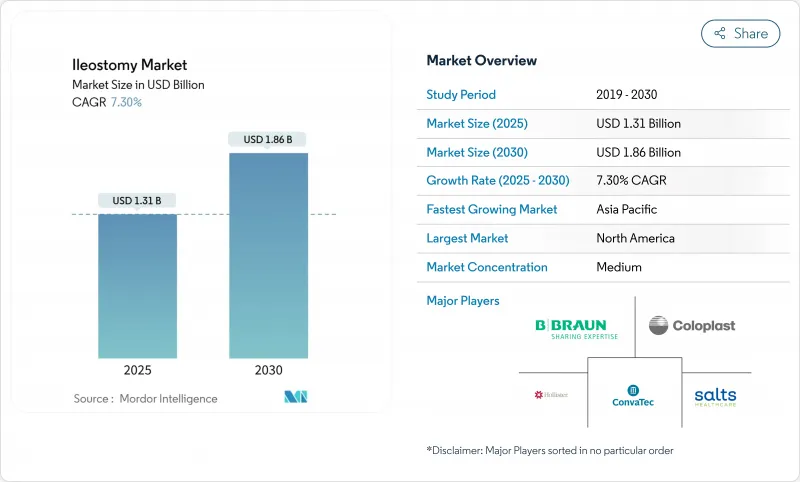
염증성 장질환(IBD) 이환율의 상승을 수반하는 고령화, 안정된 대장암 수술 건수, 2피스 드레너블 시스템에 있어서의 급속한 제품 혁신입니다. 북미가 지역별로 가장 큰 공헌국인 것에는 변함이 없지만, 아시아태평양은 병원의 능력 향상과 평균 수명의 성장으로 가장 빠른 보급을 기록하고 있습니다. 술식 패턴도 진화하고 있으며, 장관 온존을 위해 일시적인 루프상 이레우스 누조설술이 외과의사에게 선호되게 되었지만, 여전히 영속적인 종말 수술이 수량의 대부분을 차지하고 있습니다. 경쟁의 심각성은 중간 정도이며 대기업은 디지털 누출 경고, 성형 가능한 피부 장벽 및 서비스를 통한 의료 생태계에서 차별화를 도모하고 있습니다.
세계 회장루 시장 동향과 통찰
IBD의 유병률 상승
연령표준화 IBD 이환율은 1990년에서 2022년 사이에 10만명당 4.22명에서 4.45명으로 증가했습니다. 고령자 코호트에서 가장 급증하고 60-89세 여성이 가장 증가하고 있습니다. 아시아, 아프리카, 라틴아메리카의 신흥 공업국은 가속 단계에 들어가고 있으며, 고급 스토머 솔루션에 대한 세계 수요가 지속되고 있음을 보여줍니다. 복잡한 경우에는 내과적 치료가 잘 되지 않기 때문에 영구적 또는 일시적인 회장루가 필수적이며, 여러 합병증에 대응하면서 항문 주위의 피부 무결성을 유지하는 프리미엄 제품의 보급을 뒷받침하고 있습니다.
대장암 수술 증가
대장암은 세계 소화기 종양의 평생 위험의 38.5%를 차지합니다. 조기 발병의 경우는 가장 빠르게 진행되고 있으며 외과의사는 눈에 띄지 않는 기구를 우선하는 젊고 활동적인 환자에게 보호적인 회장 우회술을 시행할 수밖에 없습니다. 아시아계 미국인의 결장암 이환율은 2017년부터 2022년 사이에 10만명당 155명에서 755명으로 증가하고 있으며, 고품질의 라이프스타일에 적합한 시스템으로의 시프트가 현저해지고 있습니다. 수요의 중심은 단기간의 사용을 단순화하고 계획적인 반전을 위해 피부를 보호하는 장치입니다.
낮은 침습을 장내 생존 수술로 이동
로봇에 의한 대장 수술에서는 개복 수술에 비해 합병증이 적고 입원 기간도 짧다고 보고되었습니다. 미국 데이터는 스토머 반전술에서 로봇 사용이 증가하고 있지만, 이는 기술적으로 위험이 줄어들면 외과의가 직접 문합술을 선호한다는 것을 보여줍니다. 전문가의 지침에 따르면 복강경과 로봇 수술은 종양학적 안전성을 유지하면서 통증과 입원 기간을 단축하는 것으로 확인되었습니다. 숙련도가 넓어짐에 따라 보호 이레우스 문합을 필요로 하는 환자는 감소하고 첨단 의료 시스템 수요가 완화되고 있습니다.
부문 분석
말단 회장루는 2024년 매출의 62.54%를 차지했으며, 장기간 사용자가 많은 회장루 시장의 기반을 형성한다. 이들의 장루 장치 사용 수명은 10년 이상에 이를 수 있다. 수술 후 복잡성과 스토머의 고출력화로 인해 병원은 보강 하이드로콜로이드 베이스를 갖춘 내구성이 높은 투피스 배리어를 선택하는 경향이 있습니다. 외과의사가 저위 전방 절제술을 위해 일시적인 우회를 건설하는 것이 늘어나고 있기 때문에 경쟁하는 루프 분야는 소규모이면서 CAGR 7.81%로 성장을 지속하고 있습니다. 품질개선 프로젝트는 적시 역전으로 30일 재입원이 20.10%에서 8.75%로 감소하는 것으로 입증되었습니다. 따라서 각 제조업체는 단기간의 활동 기간 동안 교체를 단순화할 수 있는 가볍고 피부 친화적인 시스템을 설계합니다.
루프 서지는 재 문합 전의 제거의 용이성을 중시하는 젊은 환자를 모집하여 회장루 시장을 확대합니다. 교육용 앱은 공석 일정, 배설량 추적 및 조기 경고 기호를 안내합니다. 간호사가 주도하는 원격 후속 조치와 결합하여 이러한 도구는 응급 상황을 줄이고 브랜드 충성도를 강화합니다. 그 결과, 미리 절단된 크기와 색으로 구분된 패널을 갖춘 치료 전용 키트가 대장 항문 센터 사이에서 인기를 끌고 있습니다.
스토마 백은 2024년 매출의 76.31%를 차지하고 회장루 시장에서 중심적인 역할을 뒷받침하고 있습니다. 풍선이나 냄새를 경감하는 필터막을 내장한 드레나블 파우치 수요가 높습니다. 그러나, 부속품 기타 부문은 CAGR 8.12%로 선행해, 배리어 와이프, 조절 가능 벨트, 소취 젤이 견인하고 있습니다. 임상의는 현재 악취 강도 점수를 낮추고 사회적 신용을 높이는 악취 감소 첨가제를 도입하고 있습니다.
고도의 배리어링과 볼록한 쿠션을 구조화된 지도와 결합함으로써 위험 계층화된 프로토콜은 90일 후에 누공 주위의 피부 합병증을 6.2%로 억제합니다. 이 증거는 공급자가 파우치와 액세서리의 스타터 팩을 번들로 촉구하고 장기 사용 습관을 정착시키고 평균 판매 가격을 상승시킵니다. 회장루 시장에서는 액세서리 믹스의 확대로 수익 흐름이 더욱 다양해지고 있습니다.
시장은 절차 유형별(엔드회장루, 루프 회장루), 장비 유형별, 질병 유형별, 지역별로 구분됩니다.
지역별 분석
북미는 2024년 매출의 43.28%를 차지했으며 전문 간호사 밀도, 보험 적용 범위, 디지털 누수 모니터의 급속한 보급으로 주도권을 강화했습니다. FDA는 2025년 ISO 13485와 일관되게 하여 보다 부드러운 시판 전 신청을 보장하고 신속한 기술 업그레이드를 촉진합니다. 복강경 수술의 보급이 새로운 스토마조설을 억제하고 있는 것, 고급품의 업셀이 판매량의 연화를 상쇄해, 회장루 시장 규모는 탄력적으로 유지하고 있습니다.
아시아태평양은 2030년까지 연평균 복합 성장률(CAGR) 8.84%로 가장 빠르게 성장하고 있습니다. 중국과 인도의 도시 지역 병원은 가처분 소득 증가를 반영하여 볼록한 맞는 장벽과 조정 가능한 벨트를 재고합니다. 중국의 의료비는 2060년까지 33조 4,000억 달러에 달할 전망으로 만성기 의료기기에 대한 구조적인 수요가 강화됩니다. 태국과 인도네시아에서는 상환제도의 시험운용이 개시되어 접근이 더욱 향상되고 있지만, 농촌에서의 유통격차는 여전히 남아 있습니다.
유럽은 성숙하면서도 혁신에 열성적인 지역입니다. EU의 포장 및 포장 폐기물 규제는 2030년까지 모든 의료용 포장을 재활용할 수 있도록 해야 합니다. 생산자는 플라스틱의 무게를 줄이면서 장벽 특성을 유지하는 더 얇은 단일 소재 파우치로 대응했습니다. 동시에 단일 사용 장치의 재처리 규칙이 지원 벨트와 클로저 클립의 안전한 재활용을 이끌고 있습니다. 이러한 규제의 뒷받침은 회장루 시장에서 지속 가능한 제품 재설계의 원동력이 되고 있습니다.
기타 혜택 :
- 엑셀 형식 시장 예측(ME) 시트
- 3개월간의 애널리스트 서포트
목차
제1장 서론
- 조사의 전제조건과 시장 정의
- 조사 범위
제2장 조사 방법
제3장 주요 요약
제4장 시장 상황
- 시장 개요
- 시장 성장 촉진요인
- 염증성 장질환(IBD)의 유병률 상승
- 대장암 수술 이환율 증가
- 인구의 고령화와 만성 질환의 부담
- 투피스 드레너블 가방의 진보
- 디지털 스토머 모니터 웨어러블의 출현
- 3D 프린팅에 의한 커스텀 피트 피부 배리어의 채택
- 시장 성장 억제요인
- 저침습성 장온존수기로의 시프트
- 신흥 경제 국가의 비용과 상환의 격차
- 하이드로콜로이드 접착제공급 체인 취약성
- 일회용 장루 제품의 폐기물 처리 규제
- 가치/공급망 분석
- 규제 상황
- 기술적 전망
- Porter's Five Forces 분석
- 신규 참가업체의 위협
- 구매자의 협상력
- 공급기업의 협상력
- 대체품의 위협
- 경쟁 기업간 경쟁 관계
제5장 시장 규모 및 성장 예측
- 수기 유형별
- 말단 회장루
- 루프 회장루
- 기기 유형별
- 스토마 백
- 벨트&거들
- 액세서리 & 기타
- 질환 유형별
- 암
- 크론병
- 궤양성 대장염
- 기타 적응증
- 시스템 유형별
- 원피스 시스템
- 투피스 시스템
- 사용성별
- 배출형 주머니
- 폐쇄형 주머니
- 최종 사용자별
- 병원
- 재택치료
- 외래수술센터(ASC)
- 지역별
- 북미
- 미국
- 캐나다
- 멕시코
- 유럽
- 독일
- 영국
- 프랑스
- 이탈리아
- 스페인
- 기타 유럽
- 아시아태평양
- 중국
- 일본
- 인도
- 호주
- 한국
- 기타 아시아태평양
- 중동 및 아프리카
- GCC
- 남아프리카
- 기타 중동 및 아프리카
- 남미
- 브라질
- 아르헨티나
- 기타 남미
- 북미
제6장 경쟁 구도
- 시장 집중도
- 시장 점유율 분석
- 기업 프로파일
- Coloplast A/S
- ConvaTec Group Plc
- Hollister Incorporated
- B. Braun Melsungen AG
- 3M Healthcare
- Salts Healthcare Ltd
- Flexicare Medical Ltd
- Marlen Manufacturing & Development
- Smith & Nephew Plc
- Welland Medical Ltd
- Nu-Hope Laboratories Inc.
- Cymed Micro Skin
- ALCARE Co., Ltd.
- Medline Industries LP
- Torbot Group Inc.
- Trio Healthcare
- Safe N Simple LLC
- Fittleworth Medical Ltd
- SecuriCare(Medical) Ltd
- Stomocare International
제7장 시장 기회와 전망
SHW 25.11.03The ileostomy market stood at USD 1.31 billion in 2025 and is predicted to reach USD 1.86 billion by 2030, advancing at a 7.30% CAGR.
The expansion stems from three converging forces: an ageing population with higher inflammatory bowel disease (IBD) incidence, steady colorectal-cancer surgery volumes, and rapid product innovation in two-piece drainable systems. North America remains the largest regional contributor, while Asia-Pacific registers the quickest uptake thanks to hospital-capacity upgrades and growing life expectancy. Procedure patterns are also evolving; surgeons now favour temporary loop ileostomies for bowel preservation, yet permanent end procedures still dominate volumes. Competitive intensity is moderate as leading firms differentiate through digital leakage alerts, mouldable skin barriers, and service-backed care ecosystems.
Global Ileostomy Market Trends and Insights
Rising Prevalence of IBD
Age-standardized IBD incidence climbed from 4.22 to 4.45 per 100,000 between 1990 and 2022. Elderly cohorts show the sharpest rise, with women aged 60-89 exhibiting the greatest case growth. Newly industrialised nations in Asia, Africa, and Latin America are entering an acceleration phase, signalling sustained global demand for advanced stoma solutions. As medical therapy fails for complex cases, permanent or temporary ileostomies become essential, boosting premium product uptake that preserves peristomal skin integrity while accommodating multiple comorbidities.
Growing Colorectal-Cancer Surgical Incidence
Colorectal cancer constitutes 38.5% of the lifetime risk for gastrointestinal tumours worldwide . Early-onset cases are advancing fastest, compelling surgeons to perform protective diverting ileostomies in younger, active patients who prioritise discreet appliances. Colon cancer rates among Asian Americans rose from 155 to 755 per 100,000 between 2017 and 2022, underscoring the shift toward high-quality, lifestyle-compatible systems. Demand centres on devices that simplify short-term use and safeguard skin for planned reversals.
Shift Toward Minimally-Invasive Bowel-Sparing Procedures
Robotic colorectal surgeries now report fewer complications and shorter stays versus open approaches. US data show robotic use rising in stoma reversals, indicating surgeon preference for direct anastomosis when technology reduces risk. Professional guidelines confirm laparoscopic and robotic methods lessen pain and length of stay while maintaining oncologic safety. As proficiency spreads, fewer patients require protective ileostomies, tempering demand in advanced health systems.
Other drivers and restraints analyzed in the detailed report include:
- Ageing Population & Chronic Disease Burden
- Advances in Two-Piece Drainable Bags
- Cost & Reimbursement Gaps in Developing Economies
For complete list of drivers and restraints, kindly check the Table Of Contents.
Segment Analysis
End ileostomy accounted for 62.54% of 2024 revenue, anchoring the ileostomy market with long-term users whose appliance lifespan can exceed a decade. Post-operative complexity and higher stoma output push hospitals to select durable two-piece barriers with reinforced hydrocolloid bases. The competing loop segment, though smaller, posts a 7.81% CAGR as surgeons increasingly construct temporary diversions for low-anterior resections. Quality-improvement projects prove that timely reversal trims 30-day readmissions from 20.10% to 8.75%. Manufacturers therefore design lightweight, skin-gentle systems that simplify changes during the short active period.
The loop surge expands the ileostomy market by recruiting younger patients who value ease of removal before re-anastomosis. Educational apps guide them through emptying schedules, output tracking, and early warning signs. Combined with nurse-led tele-follow-ups, these tools cut emergency visits and reinforce brand loyalty. Consequently, procedure-specific kits with pre-cut sizing and colour-coded panels are gaining traction among colorectal centres.
Stoma bags represented 76.31% of 2024 revenue, confirming their central role in the ileostomy market. High demand persists for drainable pouches with integrated filter membranes that mitigate ballooning and odour. Yet accessories and others segment races ahead at 8.12% CAGR, propelled by barrier wipes, adjustable belts, and deodorising gels. Clinicians now deploy malodour-reducing additives that lower odour intensity scores and enhance social confidence.
Risk-stratified protocols limit peristomal skin complications to 6.2% by 90 days when advanced barrier rings and convex cushions are combined with structured teaching. This evidence encourages suppliers to bundle pouches with accessory starter packs, embedding long-term usage habits and elevating average selling price. The growing accessory mix further diversifies revenue streams within the ileostomy market.
The Market is Segmented by Procedure Type (End Ileostomy, Loop Ileostomy), by Equipment Type, by Disease Type, and by Geography.
Geography Analysis
North America generated 43.28% of 2024 revenue, cementing its leadership through specialist nursing density, widespread insurance coverage, and rapid adoption of digital leakage monitors. FDA alignment with ISO 13485 in 2025 ensures smoother premarket submissions, fostering swift technological upgrades. Despite laparoscopic uptake tempering new stoma creation, premium upselling offsets volume softness, keeping the ileostomy market size resilient.
Asia-Pacific remains the quickest climber with an 8.84% CAGR to 2030. Urban hospitals in China and India now stock convex-fit barriers and adjustable belts, reflecting higher disposable incomes. China's health-spend trajectory towards USD 33.4 trillion by 2060 reinforces structural demand for chronic-care devices. Emerging reimbursement pilots in Thailand and Indonesia further unlock access, although rural distribution gaps persist.
Europe presents a mature yet innovation-minded landscape. The EU Packaging and Packaging Waste Regulation forces all medical packaging to be recyclable by 2030. Producers have responded with thinner, mono-material pouches that sustain barrier properties while cutting plastic weight. Simultaneously, single-use-device reprocessing rules guide safe recycling of support belts and closure clips. These regulatory nudges drive sustainable product redesign within the ileostomy market.
- Coloplast
- Convatec
- Hollister
- B. Braun
- 3M
- Salts Healthcare
- Flexicare Medical
- Marlen Manufacturing
- Smiths Group
- Welland Medical
- Nu-Hope Laboratories Inc.
- Cymed Micro Skin
- Alcare
- Medline Industries
- Torbot Group
- Trio Healthcare
- Safe N Simple LLC
- Fittleworth Medical Ltd
- SecuriCare (Medical) Ltd
- Stomocare International
Additional Benefits:
- The market estimate (ME) sheet in Excel format
- 3 months of analyst support
TABLE OF CONTENTS
1 Introduction
- 1.1 Study Assumptions & Market Definition
- 1.2 Scope of the Study
2 Research Methodology
3 Executive Summary
4 Market Landscape
- 4.1 Market Overview
- 4.2 Market Drivers
- 4.2.1 Rising prevalence of inflammatory bowel disease (IBD)
- 4.2.2 Growing colorectal-cancer surgical incidence
- 4.2.3 Ageing population & chronic disease burden
- 4.2.4 Advances in two-piece drainable bags
- 4.2.5 Emergence of digital stoma-monitoring wearables
- 4.2.6 Adoption of 3-D printed custom-fit skin barriers
- 4.3 Market Restraints
- 4.3.1 Shift toward minimally-invasive bowel-sparing procedures
- 4.3.2 Cost & reimbursement gaps in developing economies
- 4.3.3 Supply-chain vulnerability of hydrocolloid adhesives
- 4.3.4 Waste-disposal regulations for single-use ostomy products
- 4.4 Value / Supply-Chain Analysis
- 4.5 Regulatory Landscape
- 4.6 Technological Outlook
- 4.7 Porter's Five Forces Analysis
- 4.7.1 Threat of New Entrants
- 4.7.2 Bargaining Power of Buyers
- 4.7.3 Bargaining Power of Suppliers
- 4.7.4 Threat of Substitutes
- 4.7.5 Competitive Rivalry
5 Market Size & Growth Forecasts
- 5.1 By Procedure Type
- 5.1.1 End Ileostomy
- 5.1.2 Loop Ileostomy
- 5.2 By Equipment Type
- 5.2.1 Stoma Bags
- 5.2.2 Belts & Girdles
- 5.2.3 Accessories & Others
- 5.3 By Disease Type
- 5.3.1 Cancer
- 5.3.2 Crohn's Disease
- 5.3.3 Ulcerative Colitis
- 5.3.4 Other Indications
- 5.4 By System Type
- 5.4.1 One-Piece Systems
- 5.4.2 Two-Piece Systems
- 5.5 By Usability
- 5.5.1 Drainable Bags
- 5.5.2 Closed-End Bags
- 5.6 By End User
- 5.6.1 Hospitals
- 5.6.2 Home-care Settings
- 5.6.3 Ambulatory Surgical Centers
- 5.7 By Geography
- 5.7.1 North America
- 5.7.1.1 United States
- 5.7.1.2 Canada
- 5.7.1.3 Mexico
- 5.7.2 Europe
- 5.7.2.1 Germany
- 5.7.2.2 United Kingdom
- 5.7.2.3 France
- 5.7.2.4 Italy
- 5.7.2.5 Spain
- 5.7.2.6 Rest of Europe
- 5.7.3 Asia-Pacific
- 5.7.3.1 China
- 5.7.3.2 Japan
- 5.7.3.3 India
- 5.7.3.4 Australia
- 5.7.3.5 South Korea
- 5.7.3.6 Rest of Asia-Pacific
- 5.7.4 Middle East & Africa
- 5.7.4.1 GCC
- 5.7.4.2 South Africa
- 5.7.4.3 Rest of Middle East & Africa
- 5.7.5 South America
- 5.7.5.1 Brazil
- 5.7.5.2 Argentina
- 5.7.5.3 Rest of South America
- 5.7.1 North America
6 Competitive Landscape
- 6.1 Market Concentration
- 6.2 Market Share Analysis
- 6.3 Company Profiles (includes Global level Overview, Market level overview, Core Segments, Financials as available, Strategic Information, Market Rank/Share for key companies, Products & Services, and Recent Developments)
- 6.3.1 Coloplast A/S
- 6.3.2 ConvaTec Group Plc
- 6.3.3 Hollister Incorporated
- 6.3.4 B. Braun Melsungen AG
- 6.3.5 3M Healthcare
- 6.3.6 Salts Healthcare Ltd
- 6.3.7 Flexicare Medical Ltd
- 6.3.8 Marlen Manufacturing & Development
- 6.3.9 Smith & Nephew Plc
- 6.3.10 Welland Medical Ltd
- 6.3.11 Nu-Hope Laboratories Inc.
- 6.3.12 Cymed Micro Skin
- 6.3.13 ALCARE Co., Ltd.
- 6.3.14 Medline Industries LP
- 6.3.15 Torbot Group Inc.
- 6.3.16 Trio Healthcare
- 6.3.17 Safe N Simple LLC
- 6.3.18 Fittleworth Medical Ltd
- 6.3.19 SecuriCare (Medical) Ltd
- 6.3.20 Stomocare International
7 Market Opportunities & Future Outlook
- 7.1 White-space & Unmet-Need Assessment