|
시장보고서
상품코드
1842704
공중 표적 포착 시스템 시장 : 점유율 분석, 산업 동향, 통계, 성장 예측(2025-2030년)Target Acquisition Systems - Market Share Analysis, Industry Trends & Statistics, Growth Forecasts (2025 - 2030) |
||||||
 Mordor Intelligence
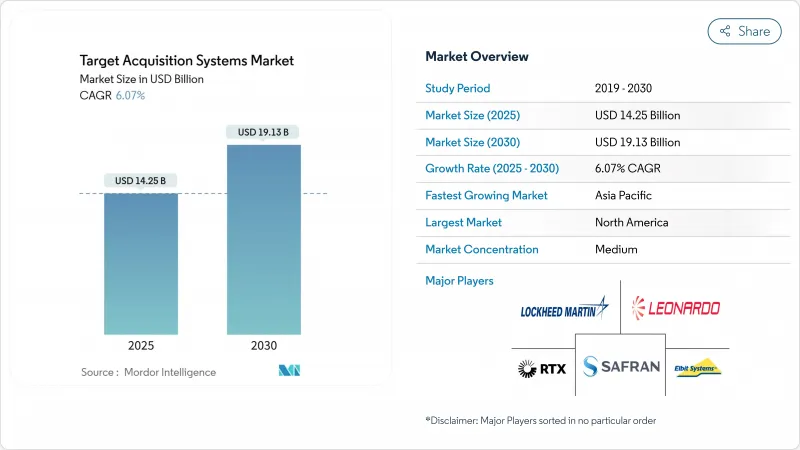
공중 표적 포착 시스템 시장 규모는 2025년에 142억 5,000만 달러, CAGR 6.07%로 2030년까지 191억 3,000만 달러로 확대될 것으로 예측되고 있습니다.
지정학적 긴장 증가와 무인 항공기의 위협의 확산으로 각국 정부는 전력 근대화 프로그램, 특히 네트워크 중심 작전을 목적으로 한 프로그램을 가속화하고 있습니다. NATO 회원국은 연간 국방 지출을 GDP의 2% 이상으로 유지할 것을 약속하며 새로운 감지, 추적, 화기관제 기술을 위한 확실한 자금원을 확보하고 있습니다. 육상 플랫폼은 가장 광범위한 설치 기반을 보유하고 있지만 군가 지속적이고 다중 영역 모니터링을 요구하기 때문에 공중 시스템이 가장 빠르게 성장하고 있습니다. 전기 광학/적외선(EO/IR) 센서가 최대의 점유율을 유지하고 있지만, AI 대응의 멀티 센서 퓨전 스위트의 급속한 채택이 경쟁 역학을 재구성하고 있습니다. 미국의 주요 프로그램을 통해 북미는 여전히 가장 규모가 큰 지역 지출국이지만 아시아태평양은 중국, 일본 및 인도의 기록적 예산으로 성장을 이끌고 있습니다.
세계 공중 표적 포착 시스템 시장 동향과 통찰
네트워크 중심 전쟁 능력을 지원하는 육상 부대의 현대화
네트워크 중심주의의 독트린은 현재 모든 업그레이드 계획의 지침이 되고 있으며, 육군은 이전에는 독립형이었던 센서를 디지털 커맨드 네트워크와 링크시켜야 합니다. 미국 육군의 자율적인 다중 도메인 런처의 시연은 이 변화를 강조하고 목표 캡처 노드가 분산된 화기 관제 체인에 몇 초 안에 공급되어야 함을 나타냅니다. 유럽 프로그램도 이러한 추세를 반영합니다. 독일에서는 푸마 보병 차량에 HENSOLDT 비전 스위트를 디지털화하여 승무원이 전투 그룹간에 센서 피드를 공유할 수 있도록 하고 있습니다. 레거시 하드웨어는 보안이 낮고 지연이 적은 게이트웨이가 필요한 아날로그 백본에서 작동하기 때문에 복고풍 패키지는 복잡합니다. 최근의 분쟁에서 얻은 운영상의 교훈은 실시간 데이터 퓨전이 결정적인 전술적 우위를 가져오고, 전통적으로 느린 조달 문화 내에서도 채택 주기를 가속화한다는 것을 확인시켜줍니다.
신속한 대 UAS 감지 및 추적 솔루션에 대한 방어 긴급 요구 사항
상업용 드론은 전통적인 방공 레이어의 격차를 드러내며 군가 합리화된 계약 규칙에 따라 UAS 키트를 구매하도록 촉구합니다. Teledyne FLIR의 Cerberus XL과 같은 시스템은 레이더, EO/IR, RF 검출을 혼합하고 지저분한 공역에서 스탠드 오프 레인지에서 쿼드콥터와 고정 날개 UAS를 추적합니다. 미국 육군은 이러한 솔루션에 대해 2024년에만 4억 달러 이상의 계약을 맺고 있습니다. 알고리즘은 전자전의 소음을 견디면서 취미의 무인 항공기를 적대 플랫폼에서 분리해야합니다. 음향 어레이와 패시브 RF 분석기는 도시 지형에서 오경보율을 줄이기 위해 레이더를 보완해 왔습니다.
국방조달의 장기화와 예산 우선순위 변화가 시스템 도입을 지연시킨다.
미국 정부 책임국은 극초음속 무기와 같은 중요한 프로그램조차도 공식 취득 기준선이 없기 때문에 업계 투자 사례가 복잡해지고 있다고 지적합니다. 정치적 전환으로 인해 자금이 주기 도중에 돌이킬 수 있어 원청 기업은 이정표를 늘리거나 스코프 컷을 받아들일 수밖에 없습니다. 다국적 프로젝트에서는 생산을 시작하기 전에 모든 파트너가 수출 라이선스 조건을 충족해야 하므로 심사가 더욱 엄격해집니다. 스케줄이 상업 기술의 업데이트 속도를 초과하면 시스템은 진부한 전자 장치로 사용되어 라이프 사이클 가치를 손상시킬 위험이 있습니다.
부문 분석
육상 플랫폼이 2024년 매출의 40.90%를 차지했지만, 분쟁지대에서 지속적인 감시를 요구하는 군 증가로 2030년까지의 CAGR은 공중자산이 8.23%로 가장 높습니다. 따라서 공중 표적 포착 시스템 시장은 단일 영역 중심에서 지상 레이더와 고도의 이미징을 결합한 통합 자산 포트폴리오로 전환하고 있습니다. 장갑 전투 차량은 여전히 가장 큰 육상 하위 부문이며, 대 드론 센서와 대전차 조준기를 융합시킨 독일의 Leopard 2 ARC 3.0 리노베이션에 밀려 있습니다.
미국에서는 1,300만 달러의 SMASH 2000L 화기관제조준기 주문이 있어 보병이 초소형 드론을 무력화할 수 있는 병사 휴대용 키트의 급속한 보급을 보여주고 있습니다. 항공기 분야에서는 록히드 마틴의 IRST21이 2025년 초에 F/A-18의 초기 운용 능력을 달성하여 해군용 항공대의 패시브 장거리 감지기에 대한 의욕을 부각시켰습니다. 제너럴 아토믹스는 EagleEye 레이더를 Gray Eagle 25M에 통합하여 여단 수준에서 내구 모니터링을 진행하고 있습니다.
EO/IR 기기는 주야간에 관계없이 작동하고 방해 전파에 강하기 때문에 2024년의 점유율은 42.17%였습니다. 그러나 퓨전 스위트는 레이더, 광학, 레이저 및 음향 채널을 하나의 프로세서로 연결하여 CAGR 7.26% 성장률을 기록하고 있습니다. 이 진화는 공중 표적 포착 시스템 시장을 하드웨어 스왑이 아닌 코드로 업데이트하는 소프트웨어 중심 아키텍처로 이동하게 됩니다. GhostEye AESA 레이더는 레이더의 진보의 일례이며 갈륨 나이트 라이드 파워 앰프를 활용하여보다 선명한 해상도를 실현하고 있습니다.
2024년 사프란은 미국 육군으로부터 2억 7,500만 달러의 유지 계약을 획득하여 현장 부대가 소대 수준의 정밀탄을 지정할 수 있게 되었습니다. HENSOLDT의 CERETRON 소프트웨어 플랫폼은 이기종 센서의 스트림을 처리하고 실시간 퓨전이 크러터가 많은 상황에서도 올바른 식별 확률을 높일 수 있음을 입증합니다.
지역 분석
북미는 미국의 비교할 수 없는 R&D 생태계와 조달력으로 2024년 매출의 34.52%를 차지합니다. 69억 달러의 극초음속 포트폴리오와 같은 국방부 프로그램은 유도 컴퓨터, 관성 항법 유닛, 멀티피직스 센서 헤드에 대한 지속적인 요구를 촉진합니다. 북극권의 주권을 중시하는 캐나다에서는 눈과 얼음, 자기 이상에도 견딜 수 있는 센서 패키지가 요구되고 있으며, 이는 라인메탈사의 미션 마스터 CXT 시험에서 증명되고 있습니다. 멕시코의 국경 감시는 EO/IR 타워와 휴대용 음향 감지기를 중심으로 소규모이면서 안정적인 수주를 늘려야 합니다.
아시아태평양은 CAGR 7.81%에서 가장 높은 궤도를 기록하고 있습니다. 중국의 3,140억 달러 예산은 동업자를 압도하고 있지만, 시장은 여전히 내향적입니다. 일본은 21% 증가한 553억 달러로 섬 섬 방어를 위한 요격 레이더와 분산형 EO 노드에 자금을 제공합니다. 인도는 36억 달러의 즉각적인 미사일 계약에 조인하고, 8억 5,000만 달러의 관포 조준기를 추가 발주하는 등 국산 설계를 진행하고 있습니다. 호주와 한국이 해상 순찰용 센서 키트 개발에 협력해 동남아시아로 수출 길을 열었습니다.
유럽은 공동 사업에 뿌리를 둔 큰 점유율을 유지하고 있습니다. 유럽의 스카이 쉴드 프로그램은 국가 간 주문을 풀어 공유 아키텍처를 중심으로 한 다층 방공을 실현합니다. 독일의 2억 유로(2억 3,443만 달러) 프리깃 레이더 계약은 HENSOLDT와 이스라엘 에어로스페이스 인더스트리즈의 국경을 넘어서는 팀워크를 강조합니다. NATO DIANA의 11억 유로(12억 9,000만 달러) 기금은 상용 드론에서 장갑차로 이행할 수 있는 듀얼 유스 ISR 페이로드를 가속시킵니다. 동유럽 국가들은 인근 분쟁에 대응하여 UAS 레이더 광학 하이브리드의 구매를 강화하고 공급업체의 납기를 엄격히 하고 있습니다.
기타 혜택 :
- 엑셀 형식 시장 예측(ME) 시트
- 3개월간의 애널리스트 서포트
목차
제1장 서론
- 조사의 전제조건과 시장 정의
- 조사 범위
제2장 조사 방법
제3장 주요 요약
제4장 시장 상황
- 시장 개요
- 시장 성장 촉진요인
- 네트워크 중심 전쟁 능력을 지원하기 위한 육상 부대의 근대화
- 신속한 대 UAS 감지·추적 솔루션에 대한 방위상의 긴급 요건
- 자율적인 위협 인식과 신호 전달을 위한 AI 구동형 센서 퓨전의 채택
- EO/IR센서의 소형화가 진행되어, 보병 장비 통합이 가능
- NATO DIANA 이니셔티브에 의한 ISR 페이로드의 듀얼 유스 기술 자금 증가
- 비대칭지대에 있어서의 국경 감시와 전술적 상황 인식에 대한 수요 증가
- 시장 성장 억제요인
- 방위 조달 스케줄의 장기화와 예산 우선 순위의 변화에 의한 시스템 도입의 지연
- 주파수 할당에 관한 규제상의 과제가 액티브 레이더의 통합을 제약
- III-V 반도체 포컬 플레인 어레이의 조달이 넥이 되어, 생산의 확장성에 영향
- 사이버나 전자전의 위협에 대한 디지털 조준 시스템의 취약성의 증대 사이버나 전자전의 위협에 대한 디지털 조준 시스템의 취약성의 증대
- 밸류체인 분석
- 규제 상황
- 기술적 전망
- Porter's Five Forces 분석
- 신규 참가업체의 위협
- 구매자·소비자의 협상력
- 공급기업의 협상력
- 대체품의 위협
- 경쟁 기업간 경쟁 관계의 강도
제5장 시장 규모와 성장 예측
- 플랫폼별
- 육상
- 장갑 전투 차량(AFV)
- 병사 휴대/보병 시스템
- 포병 및 미사일 발사기 통합
- 항공기
- 고정익 항공기
- 회전익 항공기
- 무인 항공기(UAV)
- 해군
- 수상 전투기
- 잠수함
- 무인 지상·수중 항행체
- 육상
- 센서 유형별
- 전기 광학/적외선(EO/IR)
- 레이더
- 레이저 거리계·지시기
- 음향·지진
- 멀티 센서 퓨전 스위트
- 항속 거리별
- 단거리
- 중거리
- 장거리
- 최종 사용자별
- 군사
- 육군
- 공군
- 해군
- 특수작전부대
- 국토 안보
- 군사
- 지역별
- 북미
- 미국
- 캐나다
- 멕시코
- 유럽
- 독일
- 영국
- 프랑스
- 러시아
- 기타 유럽
- 아시아태평양
- 중국
- 인도
- 일본
- 한국
- 기타 아시아태평양
- 남미
- 브라질
- 기타 남미
- 중동 및 아프리카
- 중동
- 사우디아라비아
- 아랍에미리트(UAE)
- 기타 중동
- 아프리카
- 남아프리카
- 기타 아프리카
- 북미
제6장 경쟁 구도
- 시장의 집중
- 전략적인 동향
- 시장 점유율 분석
- 기업 프로파일
- ASELSAN AS
- BAE Systems plc
- Elbit Systems Ltd.
- HENSOLDT AG
- Israel Aerospace Industries Ltd.
- Leonardo SpA
- Lockheed Martin Corporation
- RTX Corporation
- Rheinmetall AG
- Safran SA
- Thales Group
- Northrop Grumman
- L3Harris Technologies, Inc.
- Teledyne Technologies Incorporated
- 한화시스템(한화그룹)
- Bharat Electronics Ltd.
제7장 시장 기회와 전망
SHW 25.11.03The target acquisition systems market size is estimated at USD 14.25 billion in 2025 and is forecasted to expand to USD 19.13 billion by 2030 at a 6.07% CAGR.
Heightened geopolitical tensions and the spread of unmanned aerial threats have pushed governments to accelerate force-modernization programs, especially those aimed at network-centric operations. NATO members have pledged to keep annual defense outlays above the 2% of GDP threshold, ensuring a dependable funding stream for new detection, tracking, and fire-control technologies. Land platforms hold the widest installed base, yet airborne systems are growing fastest as armies demand persistent, multi-domain surveillance. Electro-optical/infrared (EO/IR) sensors retain the largest share, although rapid adoption of AI-enabled multi-sensor fusion suites is reshaping competitive dynamics. Thanks to major US programs, North America remains the biggest regional spender, while Asia-Pacific leads growth because of record budgets in China, Japan, and India.
Global Target Acquisition Systems Market Trends and Insights
Modernization of land forces to support network-centric warfare capabilities
Network-centric doctrine now guides every upgrade plan, compelling armed forces to link previously standalone sensors with digital command networks. The US Army's Autonomous Multi-Domain Launcher demonstrations underline this shift, showing how target acquisition nodes must feed distributed fire-control chains in seconds. European programs mirror the trend: Germany digitizes Puma infantry vehicles with HENSOLDT vision suites so crews can share sensor feeds across battle groups. Retrofit packages are complex because legacy hardware often runs on analog backbones that need secure, low-latency gateways. Operational lessons from recent conflicts confirm that real-time data fusion delivers decisive tactical advantages, accelerating adoption cycles even inside traditionally slow procurement cultures.
Urgent defense requirements for rapid counter-UAS detection and tracking solutions
Commercial drones have exposed gaps in classical air-defense layers, prompting militaries to purchase counter-UAS kits under streamlined contracting rules. Systems such as Teledyne FLIR's Cerberus XL blend radar, EO/IR, and RF detection to follow quadcopters and fixed-wing UAS at standoff ranges in cluttered airspace. The US Army awarded contracts worth over USD 400 million for such solutions in 2024 alone. Algorithms must separate hobby drones from hostile platforms while surviving electronic-warfare noise, which drives heavy investment in AI-based signal classification and sensor fusion. Acoustic arrays and passive RF analyzers increasingly complement radar to cut false-alarm rates in urban terrain.
Prolonged defense procurement timelines and shifting budgetary priorities delay system adoption
The US Government Accountability Office notes that even marquee programs like hypersonic weapons lack formal acquisition baselines, complicating industry investment cases. Political turnovers redirect funds mid-cycle, forcing prime contractors to stretch milestones or accept scope cuts. Multinational projects face extra layers of review, since every partner must align export-licensing terms before production can start. When timelines exceed commercial technology refresh rates, systems risk entering service with obsolescent electronics, eroding lifecycle value.
Other drivers and restraints analyzed in the detailed report include:
- Adoption of AI-driven sensor fusion for autonomous threat recognition and cueing
- Advancements in EO/IR sensor miniaturization enabling dismounted soldier integration
- Regulatory challenges in spectrum allocation constrain active radar integration
For complete list of drivers and restraints, kindly check the Table Of Contents.
Segment Analysis
Land platforms dominated 40.90% of 2024 revenue, yet airborne assets post the strongest 8.23% CAGR to 2030 as forces seek continuous overwatch across contested zones. Therefore, the target acquisition systems market is transitioning from single-domain emphasis to integrated asset portfolios that pair ground radar with high-altitude imaging. Armored fighting vehicles remain the biggest land sub-segment, propelled by Germany's Leopard 2 ARC 3.0 retrofit that fuses counter-drone sensors and anti-tank sights.
The USD 13 million United States orders for SMASH 2000L fire-control sights show the rapid uptake of soldier-portable kits that let infantry neutralize micro-drones. On the airborne side, Lockheed Martin's IRST21 reached Initial Operational Capability on F/A-18s in early 2025, underscoring naval aviation's appetite for passive long-range detection. Unmanned aircraft also accelerate demand; General Atomics is integrating EagleEye radar into the Gray Eagle 25M, advancing endurance surveillance at the brigade level.
EO/IR devices held a 42.17% share in 2024 because they work day or night and resist jamming. Still, fusion suites grow at a 7.26% CAGR as militaries connect radar, optical, laser, and acoustic channels in one processor. That evolution pushes the target acquisition systems market toward software-centric architectures that update via code rather than hardware swaps. GhostEye AESA radar exemplifies radar progress, leveraging gallium-nitride power amps for sharper resolution.
Laser rangefinders remain indispensable; in 2024, Safran won a USD 275 million US Army sustainment contract, ensuring field units can still designate platoon-level precision munitions. HENSOLDT's CERETRON software platform processes streams from disparate sensors, proving that real-time fusion lifts the probability of correct identification under heavy clutter.
The Target Acquisition Systems Market Report is Segmented by Platform (Land, Airborne, and Naval), Sensor Type (Electro-Optical/Infrared, Radar, Laser Rangefinders and Designators, Acoustic and Seismic, and More), Range Capability (Short Range, Medium Range, and More), End User (Military and Homeland Security), and Geography (North America, Europe, Asia-Pacific, and More). The Market Forecasts are Provided in Terms of Value (USD).
Geography Analysis
North America commands 34.52% of 2024 turnover due to the United States' unmatched R&D ecosystem and procurement heft. Pentagon programs such as the USD 6.9 billion hypersonic portfolio drive continuous requirements for guidance computers, inertial navigation units, and multi-physics sensor heads. Canada's focus on Arctic sovereignty leads to sensor packages built to survive snow, ice, and magnetic anomalies, evidenced by Rheinmetall Mission Master CXT testing. Mexican border surveillance must add small but steady orders, mainly for EO/IR towers and portable acoustic detectors.
Asia-Pacific records the highest trajectory at 7.81% CAGR. China's USD 314 billion budget overshadows peers, yet the market remains inward-looking. Japan's 21% uplift to USD 55.3 billion funds interceptor radars and distributed EO nodes for island defense. India advances indigenous design, signing a USD 3.6 billion quick-reaction missile contract and placing follow-on orders for tube-artillery sights valued at USD 850 million. Australia and South Korea collaborate on maritime-patrol sensor kits, opening export lanes to Southeast Asia.
Europe retains a sizeable share rooted in cooperative ventures. The European Sky Shield program pools orders across states to field layered air defenses around shared architectures. Germany's EUR 200 million (USD 234.43 million) frigate-radar contract underscores cross-border teaming between HENSOLDT and Israel Aerospace Industries. NATO DIANA's EUR 1.1 billion (USD 1.29 billion) fund accelerates dual-use ISR payloads that can migrate from commercial drones to armored vehicles. Eastern European nations step up buys of counter-UAS radar-optical hybrids in response to nearby conflicts, tightening delivery schedules for suppliers.
- ASELSAN A.S.
- BAE Systems plc
- Elbit Systems Ltd.
- HENSOLDT AG
- Israel Aerospace Industries Ltd.
- Leonardo S.p.A
- Lockheed Martin Corporation
- RTX Corporation
- Rheinmetall AG
- Safran SA
- Thales Group
- Northrop Grumman
- L3Harris Technologies, Inc.
- Teledyne Technologies Incorporated
- Hanwha System (Hanwha Group)
- Bharat Electronics Ltd.
Additional Benefits:
- The market estimate (ME) sheet in Excel format
- 3 months of analyst support
TABLE OF CONTENTS
1 INTRODUCTION
- 1.1 Study Assumptions and Market Definition
- 1.2 Scope of the Study
2 RESEARCH METHODOLOGY
3 EXECUTIVE SUMMARY
4 MARKET LANDSCAPE
- 4.1 Market Overview
- 4.2 Market Drivers
- 4.2.1 Modernization of land forces to support network-centric warfare capabilities
- 4.2.2 Urgent defense requirements for rapid counter-UAS detection and tracking solutions
- 4.2.3 Adoption of AI-driven sensor fusion for autonomous threat recognition and cueing
- 4.2.4 Advancements in EO/IR sensor miniaturization enabling dismounted soldier integration
- 4.2.5 Increased dual-use technology funding for ISR payloads through NATO DIANA initiatives
- 4.2.6 Rising demand for border surveillance and tactical situational awareness in asymmetric zones
- 4.3 Market Restraints
- 4.3.1 Prolonged defense procurement timelines and shifting budgetary priorities delay system adoption
- 4.3.2 Regulatory challenges in spectrum allocation constrain active radar integration
- 4.3.3 Bottlenecks in sourcing III-V semiconductor focal-plane arrays impact production scalability
- 4.3.4 Increased vulnerability of Increased vulnerability of digital targeting systems to cyber and electronic-warfare threats digital targeting systems to cyber and electronic warfare threats
- 4.4 Value Chain Analysis
- 4.5 Regulatory Landscape
- 4.6 Technological Outlook
- 4.7 Porter's Five Forces Analysis
- 4.7.1 Threat of New Entrants
- 4.7.2 Bargaining Power of Buyers/Consumers
- 4.7.3 Bargaining Power of Suppliers
- 4.7.4 Threat of Substitute Products
- 4.7.5 Intensity of Competitive Rivalry
5 MARKET SIZE AND GROWTH FORECASTS (VALUE)
- 5.1 By Platform
- 5.1.1 Land
- 5.1.1.1 Armored Fighting Vehicles (AFVs)
- 5.1.1.2 Soldier Portable/Infantry Systems
- 5.1.1.3 Artillery and Missile Launcher Integrated
- 5.1.2 Airborne
- 5.1.2.1 Fixed-Wing Aircraft
- 5.1.2.2 Rotary-Wing Aircraft
- 5.1.2.3 Unmanned Aerial Vehicles (UAVs)
- 5.1.3 Naval
- 5.1.3.1 Surface Combatants
- 5.1.3.2 Submarines
- 5.1.3.3 Unmanned Surface/Underwater Vehicles
- 5.1.1 Land
- 5.2 By Sensor Type
- 5.2.1 Electro-Optical/Infrared (EO/IR)
- 5.2.2 Radar
- 5.2.3 Laser Rangefinders and Designators
- 5.2.4 Acoustic and Seismic
- 5.2.5 Multi-Sensor Fusion Suites
- 5.3 By Range Capability
- 5.3.1 Short
- 5.3.2 Medium
- 5.3.3 Long
- 5.4 By End User
- 5.4.1 Military
- 5.4.1.1 Army
- 5.4.1.2 Air Force
- 5.4.1.3 Navy
- 5.4.1.4 Special Operations Forces
- 5.4.2 Homeland Security
- 5.4.1 Military
- 5.5 By Geography
- 5.5.1 North America
- 5.5.1.1 United States
- 5.5.1.2 Canada
- 5.5.1.3 Mexico
- 5.5.2 Europe
- 5.5.2.1 Germany
- 5.5.2.2 United Kingdom
- 5.5.2.3 France
- 5.5.2.4 Russia
- 5.5.2.5 Rest of Europe
- 5.5.3 Asia-Pacific
- 5.5.3.1 China
- 5.5.3.2 India
- 5.5.3.3 Japan
- 5.5.3.4 South Korea
- 5.5.3.5 Rest of Asia-Pacific
- 5.5.4 South America
- 5.5.4.1 Brazil
- 5.5.4.2 Rest of South America
- 5.5.5 Middle East and Africa
- 5.5.5.1 Middle East
- 5.5.5.1.1 Saudi Arabia
- 5.5.5.1.2 United Arab Emirates
- 5.5.5.1.3 Rest of Middle East
- 5.5.5.2 Africa
- 5.5.5.2.1 South Africa
- 5.5.5.2.2 Rest of Africa
- 5.5.1 North America
6 COMPETITIVE LANDSCAPE
- 6.1 Market Concentration
- 6.2 Strategic Moves
- 6.3 Market Share Analysis
- 6.4 Company Profiles (includes Global level Overview, Market level overview, Core Segments, Financials as available, Strategic Information, Market Rank/Share for key companies, Products and Services, and Recent Developments)
- 6.4.1 ASELSAN A.S.
- 6.4.2 BAE Systems plc
- 6.4.3 Elbit Systems Ltd.
- 6.4.4 HENSOLDT AG
- 6.4.5 Israel Aerospace Industries Ltd.
- 6.4.6 Leonardo S.p.A
- 6.4.7 Lockheed Martin Corporation
- 6.4.8 RTX Corporation
- 6.4.9 Rheinmetall AG
- 6.4.10 Safran SA
- 6.4.11 Thales Group
- 6.4.12 Northrop Grumman
- 6.4.13 L3Harris Technologies, Inc.
- 6.4.14 Teledyne Technologies Incorporated
- 6.4.15 Hanwha System (Hanwha Group)
- 6.4.16 Bharat Electronics Ltd.
7 MARKET OPPORTUNITIES AND FUTURE OUTLOOK
- 7.1 White-space and Unmet-Need Assessment