|
시장보고서
상품코드
1844577
접착제 및 실란트 : 시장 점유율 분석, 산업 동향, 통계, 성장 예측(2025-2030년)Adhesives And Sealants - Market Share Analysis, Industry Trends & Statistics, Growth Forecasts (2025 - 2030) |
||||||
 Mordor Intelligence
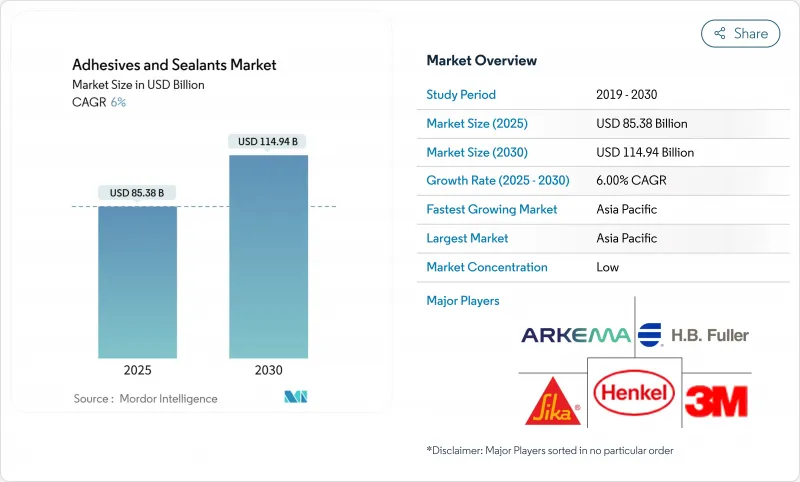
접착제 및 실란트 시장 규모는 2025년에 853억 8,000만 달러로 평가되었고, 예측기간 중(2025-2030년)의 CAGR은 6%를 나타낼 것으로 예측되며 2030년에 1,149억 4,000만 달러로 성장할 전망입니다.
차량 경량화, 자동화 전자상거래 포장, 모듈식 건축을 지원하는 고성능 접착 솔루션에 대한 수요 증가로 강력한 성장세를 보이고 있습니다. 특히 EU 그린딜 하에서 저배출 화학물질에 대한 규제 압박이 생물 기반 및 저휘발성 유기화합물(VOC) 제형으로의 전환을 가속화하고 있습니다. 아시아태평양 지역은 산업 확장 및 인프라 지출에 힘입어 성장 동력으로 자리매김하고 있으며, 북미와 유럽은 엄격한 지속가능성 규정을 충족하는 기술 업등급에 주력하고 있습니다. 이소시아네이트 및 아크릴 단량체의 공급망 취약성은 가격 형성에 지속적인 영향을 미치며, 생산업체들은 원료 다각화와 바이오 기반 공정 투자로 대응하고 있습니다. 실리콘 및 반응성 기술이 경쟁 구도를 주도하는 가운데, 이들 기술은 우수한 내구성, 높은 내열성, 향상된 가공 속도를 약속합니다.
세계의 접착제 및 실란트 시장 동향 및 인사이트
경량 다중 소재 차량 조립 증가로 구조용 접착제 수요 확대
전기차 제조사들은 무게 절감, 충돌 성능 개선, 알루미늄·복합재·고강도 강철 접합을 위해 용접 및 리벳을 구조용 접착제로 대체하고 있습니다. 접착제는 배터리 하우징 고정에도 사용되며, 열 관리 및 전기 절연 기능을 수행합니다. 배터리 팩 내부의 열전도 재료는 과열을 방지하고 수명을 연장하여 접착제 및 실란트 시장 내 특수한 틈새 시장을 창출합니다. 자동차 제조업체들은 접합 기술이 넓은 온도 변화 범위에서 치수 안정성을 유지하고 차량 수명 전체에 걸쳐 유체 노출에 견딜 것을 기대합니다. 이러한 엄격한 요구사항은 강도와 유연성을 결합한 반응성 폴리우레탄 핫멜트 및 개질 에폭시 개발로 포뮬레이터를 이끌고 있습니다. 따라서 전기차 보급 확대는 접착제 및 실란트 시장에 대한 구조적 수요 촉매 역할을 합니다.
고성능 포장 접착제 솔루션이 필요한 글로벌 전자상거래의 폭발적 성장
소비자 직배송 과정에서 골판지 상자는 진동, 습도, 극한 온도에 노출되므로, 브랜드 소유자들은 복잡한 물류망 전반에 걸쳐 포장을 밀봉 상태로 유지하는 고접착성 핫멜트 및 수성 시스템을 채택하고 있습니다. 포장 분야는 접착제 및 실란트 시장의 43%를 차지하며, 전자상거래 물량 증가에 따라 지속적으로 확장되고 있습니다. 지속가능성 기준은 이제 재활용 공정과 호환되는 접착제를 요구합니다. 헨켈과 팩사이즈는 연간 3억 4천만 개의 박스 생산 시 온실가스 배출량을 32% 절감할 수 있는 바이오 기반 핫멜트 '에코팍스(Eco-Pax)'를 출시했습니다. 자동 케이스 조립 라인 역시 에너지 절감을 위해 저온에서 유동성이 우수한 저점도 등급을 요구합니다. 이러한 촉진요인에 대한 혁신이 접착제 및 실런트 시장의 꾸준한 물량 성장을 뒷받침하고 있습니다.
휘발성 이소시아네이트 및 아크릴 단량체 공급망, 비용 압박 가중
새로운 EU 규정은 0.1% 이상의 유리 이소시아네이트를 함유한 폴리우레탄 시스템을 취급하는 모든 작업자에게 특별 교육을 의무화하여 행정 비용을 증가시키고 중소 변환업체의 접근을 제한합니다. 아크릴산 공급의 병행적 부족은 가격 변동성을 높여 최종 사용자가 분기별로 계약을 재협상하도록 촉발합니다. 생산자들은 원료 조달의 현지화와 식물성 오일 기반 바이오 경로 채택으로 헤지하지만, 이러한 조치들은 마진을 압박하는 자본 지출을 수반합니다. 원자재 지수의 갑작스러운 급등은 하류 가격에 파급되어 건설 및 자동차 분야의 프로젝트 승인을 지연시킵니다. 따라서 접착제 및 실런트 시장은 성능을 유지하면서 비용 인플레이션을 헤쳐나가야 하는, 성장 전망을 누그러뜨리는 균형 잡기 작업을 수행해야 합니다.
부문 분석
아크릴 수지는 2024년 접착제 및 실란트 시장 매출의 24%를 차지했으며, 광범위한 기판 호환성과 적정 비용으로 선호됩니다. 그럼에도 불구하고 실리콘의 2025-2030년 연평균 복합 성장률(CAGR) 8.50%는 특히 자동차 전자기기 및 건물 외장재 분야에서 고온·내후성 응용 분야로의 전환을 시사합니다. 성능 차별화가 이러한 변화를 주도합니다. 실리콘 접착제는 -50°C에서 200°C까지 탄성을 유지하며 전기 절연성을 보존하고 자외선 열화를 견뎌 LED 어셈블리 및 5G 안테나 모듈에 적합합니다. 아크릴계는 기능성 단량체 개질을 통해 경화 속도를 높이고 저표면에너지 플라스틱을 접합하는 차세대 제형으로 대응합니다. 폴리우레탄은 동적 하중에 노출된 구조적 접합부에 여전히 선호되며, 시아노아크릴레이트는 정밀 의료 및 소비자 전자제품 용도로 활용됩니다. 글리세롤과 리그닌으로 생산된 바이오 기반 에폭시는 초기 단계 잠재력을 보여주며 접착제 및 실란트 산업의 점진적 탈탄소화를 예고합니다.
수성 시스템은 지역별 VOC 배출 제한 준수 및 다공성 기판에서의 강력한 접착력 덕분에 2024년 매출의 42%를 차지했습니다. 이들은 접착제 및 실란트 시장의 핵심 하위 부문인 골판지 상자 밀봉, 라벨 라미네이션, 가구 조립 분야에서 우위를 점하고 있습니다. 폴리머 분산 기술의 발전으로 건조 시간이 단축되어 자동화 라인의 기존 속도 제약이 해소되었습니다.
반응성 기술은 열경화성 네트워크로 가교되어 에폭시만의 전유물로 여겨졌던 구조적 강도를 달성하므로 가장 빠른 8.20% CAGR을 기록합니다. 반응성 폴리우레탄 핫멜트는 습기 노출 후 즉각적인 초기 접착력과 최종 화학적 결합을 제공하여 가전 및 운송 장비 제조업체의 조립 시간을 단축합니다. UV 경화형 아크릴레이트는 용매 제거와 신속한 처리량이 필수적인 전자제품 및 의료 기기 분야에 적합합니다. 용매형 및 고무 기반 시스템은 자동차 내장재 및 신발과 같은 특수 분야에서 지속 사용되며, 이들의 독특한 점착성과 박리 강도 균형이 규제 장벽을 상쇄합니다.
지역 분석
아시아태평양 지역은 2024년 전 세계 매출의 37%를 차지했으며, 인프라 메가 프로젝트와 전자 공급망의 아세안 국가로의 이전에 힘입어 연평균 6.60%의 성장률을 보이고 있습니다. 중국은 대규모 고속철도 및 재생 에너지 투자를 지속하며 구조용 실란트와 풍력 블레이드 접착 시스템에 대한 수요를 촉진하고 있습니다. 인도의 1조 4천억 달러 규모 국가 인프라 파이프라인은 도로, 공항, 저소득층 주택 건설에 접착제 소비를 유도합니다. 베트남과 한국의 전자제품 제조는 반도체 및 디스플레이 패널에 사용되는 저공극·고열전도성 접착제에 대한 지역 수요를 심화시킵니다. 해당 산업의 지속적인 온도 안정성 추구로 실리콘 제품이 가장 큰 수혜를 입으며, 아시아태평양 지역이 접착제 및 실란트 시장에서 주도권을 유지할 것으로 전망됩니다.
북미는 기술 차별화와 신속한 규제 조화를 중시하는 성숙한 시장입니다. 2024년 미국 전기차 생산량이 100만 대를 돌파하며 배터리 팩 및 차체 조립체용 구조용 내충격 접착제 수요가 증가했습니다. 교량 및 광대역 통신망에 대한 연방 자금 지원은 극한 기후에서도 유연성을 유지하는 토목 공학용 실란트 수요를 더욱 높인다. 캐나다 목조 구조물 건설은 기밀 조립체를 통해 에너지 효율을 개선하는 폴리우레탄 접착제 채택을 가속화합니다. 접착제 및 실란트 시장은 CARB 및 EPA VOC 제한을 준수하는 수성 대체품을 제조사들이 제공함에 따라 꾸준한 중간 단일자리 수 성장세를 보입니다.
유럽은 2050년까지 탄소 중립 제품을 요구하는 EU 그린딜의 영향으로 형성됩니다. 제조사들은 시장 접근성을 유지하기 위해 리그닌 기반 페놀계 대체재 및 바이오 재생 에폭시로의 전환을 가속화하고 있습니다. 독일 및 북유럽의 프리팹 공장은 교차 적층 목재 모듈에 인증된 저VOC 접착제를 사용하며, 이는 창문 및 외벽 실링용 실리콘 수요를 강화합니다. 유럽의 접착제 및 실란트 시장은 엄격한 품질 기대치로 혜택을 보지만, 규정 준수 비용이 EBIT 마진을 낮추고 있습니다. 동유럽 자동차 공장들은 생산 기반을 확대하며 지역 접착제 수요를 증폭시키고 있습니다.
남미는 규모는 작지만 활기찬 시장으로 남아 있습니다. 브라질의 주택 부족은 정부 지원 사회 프로그램을 촉진하여 실리콘 및 아크릴 실란트를 저비용 주택에 공급하고 있습니다. 아르헨티나의 농업 포장 부문은 장기 저장 및 수출 경로 문제를 해결하기 위한 핫멜트 업등급의 혜택을 받고 있습니다. 칠레 광산 업체들은 산 노출을 견디는 하이브리드 실란트를 적용하여 접착제 및 실란트 시장 내 틈새 성장 영역을 추가하고 있습니다.
중동 및 아프리카는 사우디아라비아의 네옴(NEOM) 도시, 나이지리아의 라고스-이바단 철도 등 인프라 개발에 의존하고 있습니다. 가혹한 기후 조건은 자외선 및 모래 마모 저항성이 뛰어난 실리콘 및 폴리설파이드 실란트의 수요를 촉진합니다. 걸프 지역의 수입 대체 정책은 현지 접착제 공장 설립을 장려하여 운송 비용과 납품 기간을 단축시킵니다. 전반적으로 다양한 기후 및 규제 환경은 접착제 및 실란트 시장의 지역 업체들에게 차별화된 제품 라인업을 형성하게 합니다.
기타 혜택 :
- 엑셀 형식 시장 예측(ME) 시트
- 3개월의 애널리스트 지원
목차
제1장 서론
- 조사의 전제조건과 시장 정의
- 조사 범위
제2장 조사 방법
제3장 주요 요약
제4장 시장 상황
- 시장 개요
- 시장 성장 촉진요인
- 경량 다중 소재 차량 조립 증가로 인한 구조용 접착제 수요 확대
- 고성능 포장 접착제 솔루션 수요를 촉진하는 글로벌 전자상거래의 폭발적 성장
- 아시아태평양 지역 모듈식 및 프리패브 건축 방식의 급속한 확산
- EU 그린 딜 및 글로벌 규제 강화로 가속화되는 바이오 기반, 저 VOC 접착제
- 의료용 웨어러블 채택 증가로 의료용 반응성 핫멜트 접착제 수요 촉진
- 시장 성장 억제요인
- 휘발성 이소시아네이트 및 아크릴 단량체 공급망 불안정성으로 인한 비용 압박
- VOC 배출에 관한 엄격한 환경 규제
- 신흥 시장에 있어서의 메카니컬 패스너의 대체 비용의 낮음이 보급을 제한
- 밸류체인 분석
- Five Forces 분석
- 공급기업의 협상력
- 구매자의 협상력
- 신규 참가업체의 위협
- 대체품의 위협
- 경쟁도
제5장 시장 규모와 성장 예측
- 접착 수지별
- 폴리우레탄
- 에폭시
- 아크릴
- 실리콘
- 시아노아크릴레이트
- VAE/EVA
- 기타 수지(폴리에스테르, 고무 등)
- 점착 기술별
- 용매계
- 반응성
- 핫멜트
- UV 경화형
- 수성
- 실란트 수지
- 실리콘
- 폴리우레탄
- 아크릴
- 에폭시
- 기타 수지(역청, 폴리설파이드 UV 경화형 등)
- 최종 사용자 산업별
- 항공우주
- 자동차
- 건축 및 건설
- 신발 및 가죽
- 헬스케어
- 포장(종이 및 연포장)
- 목공 및 가구
- 기타 최종 사용자 산업(전자, 소비자/DIY 등)
- 지역별
- 아시아태평양
- 중국
- 인도
- 일본
- 한국
- 인도네시아
- 말레이시아
- 태국
- 베트남
- 기타 아시아태평양
- 북미
- 미국
- 캐나다
- 멕시코
- 유럽
- 독일
- 영국
- 프랑스
- 이탈리아
- 스페인
- 러시아
- 튀르키예
- 북유럽 국가
- 기타 유럽
- 남미
- 브라질
- 아르헨티나
- 콜롬비아
- 기타 남미
- 중동 및 아프리카
- 사우디아라비아
- 아랍에미리트(UAE)
- 카타르
- 이집트
- 남아프리카
- 알제리
- 기타 지역
- 아시아태평양
제6장 경쟁 구도
- 시장의 집중도
- 전략적인 동향
- 시장 점유율 분석
- 기업 프로파일(세계 수준 개요, 시장 수준 개요, 핵심 부문, 가능한 한 재무, 전략 정보, 시장 순위/공유, 제품 및 서비스, 최근 동향 포함)
- 3M
- Aica Kogyo Co. Ltd.
- Akzo Nobel NV
- Arkema SA(Bostik)
- Avery Dennison Corporation
- DELO Industrial Adhesives
- DIC Corporation
- Dow
- DuPont
- Dymax
- HB Fuller Company
- Henkel AG & Co. KGaA
- Illinois Tool Works Inc.
- MAPEI SpA
- Nanpao Resins Chemical Group
- Parker Hannifin
- Permabond LLC
- Pidilite Industries Ltd.
- RPM International Inc.
- Sika AG
- Soudal Group
- Wacker Chemie AG
제7장 시장 기회와 전망
HBR 25.11.03The Adhesives And Sealants Market size is estimated at USD 85.38 billion in 2025, and is expected to reach USD 114.94 billion by 2030, at a CAGR of 6% during the forecast period (2025-2030).
Strong gains stem from rising demand for high-performance bonding solutions that support light-weighting in vehicles, automated e-commerce packaging, and modular construction. Regulatory pressure for lower-emission chemistries, especially under the EU Green Deal, is accelerating the shift toward bio-based and low-VOC formulations. Asia-Pacific remains the growth engine, supported by industrial expansion and infrastructure spending, while North America and Europe focus on technology upgrades that meet strict sustainability rules. Supply chain fragility for isocyanates and acrylic monomers continues to influence pricing, prompting producers to diversify feedstocks and invest in bio-based routes. Competitive dynamics are increasingly shaped by silicone and reactive technologies, which promise superior durability, higher temperature resistance, and improved processing speeds.
Global Adhesives And Sealants Market Trends and Insights
Surge in Lightweight Multi-material Vehicle Assemblies Boosting Structural Adhesive Uptake
Electric-vehicle makers are replacing welds and rivets with structural adhesives to save weight, improve crash performance, and enable joining of aluminum, composites, and high-strength steel. Adhesives also secure battery housings, where they manage heat and provide electrical insulation. Thermal interface materials inside packs prevent runaway and extend battery life, creating a specialized niche within the adhesives and sealants market. Automakers expect bonding technologies to remain dimensionally stable across wide temperature swings and resist fluid exposure for the entire vehicle lifespan. Such stringent requirements are pushing formulators toward reactive polyurethane hot-melts and modified epoxies that combine strength with flexibility. Growing EV penetration therefore acts as a structural demand catalyst for the adhesives and sealants market.
Explosive Growth of E-commerce Requiring High-Performance Packaging Adhesive Solutions Globally
Direct-to-consumer shipping exposes cartons to vibration, humidity, and temperature extremes, prompting brand owners to adopt high-tack hot-melt and water-based systems that keep packages sealed throughout complex logistics chains. Packaging represents 43% of the adhesives and sealants market and continues to expand as e-commerce volumes rise. Sustainability standards now require adhesives compatible with recycling streams; Henkel and Packsize introduced Eco-Pax, a bio-based hot-melt that can cut greenhouse gas emissions by 32% per 340 million boxes produced annually. Automated case-erection lines also demand low-viscosity grades that flow at reduced temperatures to save energy. Innovation in this driver underpins steady volume growth in the adhesives and sealants market.
Volatile Isocyanate & Acrylic Monomer Supply Chains Creating Cost Pressures
New EU rules require special training for anyone handling polyurethane systems with greater than 0.1% free isocyanate, adding administrative cost and limiting smaller converters' access. Parallel tightness in acrylic acid supply elevates price volatility, prompting end users to renegotiate contracts quarterly. Producers hedge by localizing feedstock procurement and adopting bio-routes from vegetable oils, yet these measures involve capital outlays that weigh on margins. Sudden spikes in raw-material indices ripple through downstream prices, delaying project approvals in construction and automotive. The adhesives and sealants market must therefore navigate cost inflation while maintaining performance, a balancing act that tempers the growth outlook.
Other drivers and restraints analyzed in the detailed report include:
- Rapid Expansion of Modular & Prefabricated Construction Methods in Asia-Pacific
- EU Green Deal & Global Regulatory Push Accelerating Bio-based, Low-VOC Adhesives
- Stringent Environmental Regulations Regarding VOC Emissions
For complete list of drivers and restraints, kindly check the Table Of Contents.
Segment Analysis
Acrylic resins generated 24% of the adhesives and sealants market revenue in 2024, favored for broad substrate compatibility and moderate cost. Nevertheless, silicone's 8.50% CAGR over 2025-2030 signals a pivot toward high-temperature, weather-resistant applications, notably in automotive electronics and building facades. Performance differentiation drives this shift. Silicone adhesives retain elasticity from -50 °C to 200 °C, remain electrically insulating, and resist UV degradation, making them fit for LED assemblies and 5G antenna modules. Acrylics respond with next-generation formulations that cure faster and bond low-surface-energy plastics through functional monomer modifications. Polyurethane remains the choice for structural joints exposed to dynamic loads, while cyanoacrylates serve precision medical and consumer electronics uses. Bio-based epoxies produced from glycerol and lignin showcase early-stage potential, signaling a gradual decarbonization of the adhesives and sealants industry.
Water-based systems held 42% revenue in 2024, aided by compliance with regional VOC caps and robust adhesion on porous substrates. They dominate corrugated box sealing, label lamination, and furniture assembly, all critical subsegments of the adhesives and sealants market. Product advances in polymer dispersion lower drying times, addressing historical speed constraints on automated lines.
Reactive technologies deliver the fastest 8.20% CAGR because they crosslink into thermoset networks, achieving structural strength once considered exclusive to epoxies. Reactive polyurethane hot-melts supply instant green strength plus final chemical bonding after moisture exposure, reducing assembly time for appliance and transportation manufacturers. UV-cured acrylates address electronics and medical devices where solvent elimination and rapid throughput are essential. Solvent-borne and rubber-based systems persist in niche uses, such as automotive interior trim and footwear, where their unique balance of tack and peel strength offsets regulatory hurdles.
The Adhesives and Sealants Market Report is Segmented by Adhesive Resin (Polyurethane, Epoxy, and More), Adhesives Technology (Solvent-Borne, Reactive, and More), Sealant Resin (Silicone, Polyurethane, and More), End-User Industry (Aerospace, Automotive, and More), and Geography (Asia-Pacific, North America, Europe, South America, and Middle East and Africa). The Market Forecasts are Provided in Terms of Value (USD).
Geography Analysis
Asia-Pacific generated 37% of global revenue in 2024 and is growing at 6.60% CAGR, driven by infrastructure megaprojects and the relocation of electronics supply chains into ASEAN nations. China continues large-scale high-speed rail and renewable-energy investments, stimulating demand for structural sealants and wind blade bonding systems. India's USD 1.4 trillion National Infrastructure Pipeline channels adhesive consumption into roads, airports, and affordable housing. Electronics manufacturing in Vietnam and South Korea deepens regional requirements for low-void, high-thermal-conductivity adhesives used in semiconductors and display panels. Silicone products benefit most, given relentless pursuit of temperature stability in these sectors, ensuring Asia-Pacific retains primacy within the adhesives and sealants market.
North America represents a mature arena emphasizing technology differentiation and rapid regulatory alignment. U.S. electric-vehicle output surpassed 1 million units in 2024, raising consumption of structural, crash-durable adhesives for battery packs and body-in-white assemblies. Federal funding for bridges and broadband further elevates demand for civil-engineering sealants that remain flexible under extreme climates. Canadian wood-frame construction accelerates adoption of polyurethane adhesives that improve energy efficiency through airtight assemblies. The adhesives and sealants market shows steady mid-single-digit growth as producers offer drop-in water-borne alternatives conforming to CARB and EPA VOC limits.
Europe is shaped by the EU Green Deal's call for carbon-neutral products by 2050. Manufacturers accelerate the transition to lignin-based phenolic alternatives and bio-renewable epoxies to retain market access. German and Nordic prefabrication plants rely on certified low-VOC adhesives in cross-laminated timber modules, reinforcing silicone demand for window and facade sealing. The adhesives and sealants market in Europe benefits from stringent quality expectations, though compliance costs lower EBIT margins. Eastern European vehicle plants broaden production footprints, amplifying regional adhesive requirements.
South America remains a small but vibrant arena. Brazil's housing deficit spurs government-funded social programs that channel silicone and acrylic sealants into low-cost housing. Argentina's agricultural packaging sector benefits from hot-melt upgrades to address prolonged storage and export routes. Chilean miners apply hybrid sealants that withstand acid exposure, adding niche growth pockets inside the adhesives and sealants market.
The Middle East & Africa lean on infrastructure ambitions such as Saudi Arabia's NEOM city and Nigeria's Lagos-Ibadan railway. Harsh climates reward silicone and polysulfide sealants with elevated UV and sand-abrasion resistance. Import substitution policies in the Gulf encourage local adhesive plants, reducing freight costs and delivery times. Overall, diverse climatic and regulatory landscapes shape differentiated product lineups for regional players in the adhesives and sealants market.
- 3M
- Aica Kogyo Co. Ltd.
- Akzo Nobel N.V.
- Arkema S.A. (Bostik)
- Avery Dennison Corporation
- DELO Industrial Adhesives
- DIC Corporation
- Dow
- DuPont
- Dymax
- H.B. Fuller Company
- Henkel AG & Co. KGaA
- Illinois Tool Works Inc.
- MAPEI S.p.A.
- Nanpao Resins Chemical Group
- Parker Hannifin
- Permabond LLC
- Pidilite Industries Ltd.
- RPM International Inc.
- Sika AG
- Soudal Group
- Wacker Chemie AG
Additional Benefits:
- The market estimate (ME) sheet in Excel format
- 3 months of analyst support
TABLE OF CONTENTS
1 Introduction
- 1.1 Study Assumptions and Market Definition
- 1.2 Scope of the Study
2 Research Methodology
3 Executive Summary
4 Market Landscape
- 4.1 Market Overview
- 4.2 Market Drivers
- 4.2.1 Surge in Lightweight Multi-material Vehicle Assemblies Boosting Structural Adhesive Uptake
- 4.2.2 Explosive Growth of E-commerce Requiring High-Performance Packaging Adhesive Solutions Globally
- 4.2.3 Rapid Expansion of Modular and Prefabricated Construction Methods in Asia-Pacific
- 4.2.4 EU Green Deal and Global Regulatory Push Accelerating Bio-based, Low-VOC Adhesives
- 4.2.5 Healthcare Wearables Adoption Driving Medical-grade Reactive Hot-Melt Adhesives
- 4.3 Market Restraints
- 4.3.1 Volatile Isocyanate and Acrylic Monomer Supply Chains Creating Cost Pressures
- 4.3.2 Stringent Environmental Regulations Regarding VOC Emissions
- 4.3.3 Low Substitution Cost of Mechanical Fasteners in Emerging Markets Limiting Penetration
- 4.4 Value Chain Analysis
- 4.5 Porter's Five Forces
- 4.5.1 Bargaining Power of Suppliers
- 4.5.2 Bargaining Power of Buyers
- 4.5.3 Threat of New Entrants
- 4.5.4 Threat of Substitutes
- 4.5.5 Degree of Competition
5 Market Size and Growth Forecasts (Value)
- 5.1 By Adhesive Resin
- 5.1.1 Polyurethane
- 5.1.2 Epoxy
- 5.1.3 Acrylic
- 5.1.4 Silicone
- 5.1.5 Cyanoacrylate
- 5.1.6 VAE / EVA
- 5.1.7 Other Resins (Polyester, Rubber, etc.)
- 5.2 By Adhesive Technology
- 5.2.1 Solvent-borne
- 5.2.2 Reactive
- 5.2.3 Hot Melt
- 5.2.4 UV-cured
- 5.2.5 Water-borne
- 5.3 By Sealant Resin
- 5.3.1 Silicone
- 5.3.2 Polyurethane
- 5.3.3 Acrylic
- 5.3.4 Epoxy
- 5.3.5 Other Resins (Bituminous, Polysulfide UV-curable, etc.)
- 5.4 By End-user Industry
- 5.4.1 Aerospace
- 5.4.2 Automotive
- 5.4.3 Building and Construction
- 5.4.4 Footwear and Leather
- 5.4.5 Healthcare
- 5.4.6 Packaging (Paper and Flexible)
- 5.4.7 Woodwork and Joinery
- 5.4.8 Other End-user Industries (Electronics, Consumer/DIY, etc.)
- 5.5 By Geography
- 5.5.1 Asia-Pacific
- 5.5.1.1 China
- 5.5.1.2 India
- 5.5.1.3 Japan
- 5.5.1.4 South Korea
- 5.5.1.5 Indonesia
- 5.5.1.6 Malaysia
- 5.5.1.7 Thailand
- 5.5.1.8 Vietnam
- 5.5.1.9 Rest of Asia-Pacific
- 5.5.2 North America
- 5.5.2.1 United States
- 5.5.2.2 Canada
- 5.5.2.3 Mexico
- 5.5.3 Europe
- 5.5.3.1 Germany
- 5.5.3.2 United Kingdom
- 5.5.3.3 France
- 5.5.3.4 Italy
- 5.5.3.5 Spain
- 5.5.3.6 Russia
- 5.5.3.7 Turkey
- 5.5.3.8 Nordic Countries
- 5.5.3.9 Rest of Europe
- 5.5.4 South America
- 5.5.4.1 Brazil
- 5.5.4.2 Argentina
- 5.5.4.3 Colombia
- 5.5.4.4 Rest of South America
- 5.5.5 Middle East and Africa
- 5.5.5.1 Saudi Arabia
- 5.5.5.2 United Arab Emirates
- 5.5.5.3 Qatar
- 5.5.5.4 Egypt
- 5.5.5.5 South Africa
- 5.5.5.6 Algeria
- 5.5.5.7 Rest of Middle and Africa
- 5.5.1 Asia-Pacific
6 Competitive Landscape
- 6.1 Market Concentration
- 6.2 Strategic Moves
- 6.3 Market Share Analysis
- 6.4 Company Profiles {includes Global level Overview, Market level overview, Core Segments, Financials as available, Strategic Information, Market Rank/Share, Products and Services, Recent Developments}
- 6.4.1 3M
- 6.4.2 Aica Kogyo Co. Ltd.
- 6.4.3 Akzo Nobel N.V.
- 6.4.4 Arkema S.A. (Bostik)
- 6.4.5 Avery Dennison Corporation
- 6.4.6 DELO Industrial Adhesives
- 6.4.7 DIC Corporation
- 6.4.8 Dow
- 6.4.9 DuPont
- 6.4.10 Dymax
- 6.4.11 H.B. Fuller Company
- 6.4.12 Henkel AG & Co. KGaA
- 6.4.13 Illinois Tool Works Inc.
- 6.4.14 MAPEI S.p.A.
- 6.4.15 Nanpao Resins Chemical Group
- 6.4.16 Parker Hannifin
- 6.4.17 Permabond LLC
- 6.4.18 Pidilite Industries Ltd.
- 6.4.19 RPM International Inc.
- 6.4.20 Sika AG
- 6.4.21 Soudal Group
- 6.4.22 Wacker Chemie AG
7 Market Opportunities and Future Outlook
- 7.1 Increasing Awareness of Renewable and Eco-friendly Products
- 7.2 White-space and Unmet-need Assessment