|
시장보고서
상품코드
1844684
뼈 성장 자극기 : 시장 점유율 분석, 산업 동향, 통계, 성장 예측(2025-2030년)Bone Growth Stimulator - Market Share Analysis, Industry Trends & Statistics, Growth Forecasts (2025 - 2030) |
||||||
 Mordor Intelligence
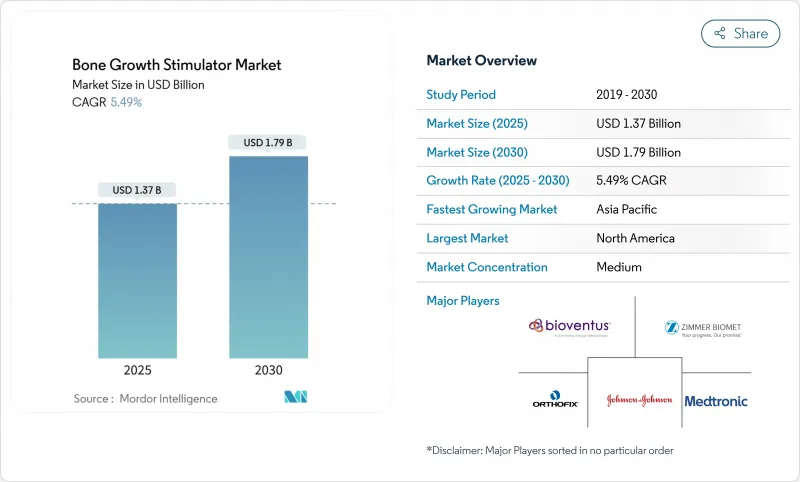
뼈 성장 자극기 시장 규모는 2025년 13억 7,000만 달러로 평가되었고, 2030년 17억 9,000만 달러에 이를 것으로 예측되며, CAGR 5.49%를 나타낼 전망입니다.
수요 증가는 근골격계 질환의 꾸준한 증가, 기대 수명 연장, 비만 유병률 상승에 기인하며, 이 모든 요인이 골절 치유 촉진 치료에 대한 임상적 필요성을 높이고 있습니다. 기술은 독립형 외부 자극기를 넘어 실시간으로 치유 데이터를 전송하는 센서가 풍부한 스마트 임플란트와 기계적 자극을 보완하는 생물학적 활성 물질로 진화하고 있습니다. 미국 내 지불 정책은 광범위한 보장 범위에서 사전 승인 심사 체계로 전환되며, 이는 시장 성숙도와 함께 더 강력한 증거 자료 요구를 시사합니다. 유럽에서도 유사한 심사가 시작되는 한편, 주요 신흥 경제국들은 혁신적 기기에 대한 신속 승인 제도를 도입해 국내 접근성을 확대하고 있습니다. 이러한 변화들은 종합적으로 강력한 임상 데이터와 치료 비용 논리를 제시할 수 있는 기기 제조사들에게 유리한 환경을 조성합니다.
세계의 뼈 성장 자극기 시장 동향 및 인사이트
근골격계 질환의 유병률 상승
비유합 골절은 여전히 모든 장골 골절의 10%에서 발생하여 비수술적 치유 보조 장치에 대한 임상 수요를 높게 유지하고 있습니다. 임상 문헌에 따르면 중간엽 줄기세포 치료와 전자기 자극을 병행할 경우 9개월 시점에서 90% 이상의 치유율을 보이며 기존 고정법보다 우수한 결과를 나타냅니다. 펄스 전자기장 장치는 난치성 골절에서 73-91%의 골유합률을 제공하여 재수술 감소와 재활 기간 단축으로 이어집니다. 이러한 성과는 병원 프로토콜과 보험사 보장 근거를 강화하여 뼈 성장 자극기 시장을 더욱 확대합니다.
비침습적/최소 침습적 정형외과적 개입에 대한 선호도 증가
용량 결합 및 복합 자기장 자극기는 수술적 이식을 피함으로써 수술 전후 위험을 감소시킵니다. 2024년 FDA가 승인한 저에너지 척추 융합 자극기는 이러한 변화를 대표하며, 무작위 연구에서 위약군 61% 대비 79%의 융합 성공률을 입증했습니다. Cigna와 같은 보험사들은 이제 고위험 골절에 대한 특정 프로토콜을 보상하여 외래 센터의 기술 도입을 장려하고 환자 수용도를 높입니다. 이 추세는 치료 준수 모니터링을 위해 의료진 대시보드와 연동되는 웨어러블 시스템 개발을 뒷받침하며, 이는 뼈 성장 자극기 시장을 더욱 확대하는 기능입니다.
미국 외 지역에서의 높은 기기 비용 및 제한된 보험 적용
고급 자극기는 단위당 5,000달러를 초과할 수 있어, 강력한 보험 체계가 없는 많은 의료 시스템에서는 접근이 불가능하다. 장치 규제의 글로벌 조화 역시 승인 기간을 연장하고 규정 준수 비용을 증가시켜, 가격에 민감한 시장에서 소규모 혁신 기업들을 밀어내고 있습니다. 중국의 신속 승인 절차는 이러한 장벽을 다소 완화하지만, 여전히 보험 적용 범위가 제한적이어서 광범위한 보급이 지연되고 있습니다. 시간이 지남에 따라 생산 규모가 확대되고 더 많은 임상 결과 증거가 보험사들을 설득하여 이 기술을 보장하게 되면 비용 곡선은 하향 조정될 것입니다.
부문 분석
자극 장치 매출은 2024년 뼈 성장 자극기 시장 점유율의 67.81%를 차지했습니다. 자기장, 펄스 전자기장, 정전용량 결합 기술을 결합한 방식이 외래 환자 워크플로우에 부합하고 다양한 골절 유형에서 높은 융합률을 제공하여 시장을 주도하고 있습니다. 내장형 센서 패키지는 이제 준수 지표를 보고하여 보험 적용 문서화를 지원하고 의료진의 신뢰도를 강화합니다. 내부 자극기는 심부 골반 골절 등 외부 자기장이 침투할 수 없는 특수 적응증에서 사용되며, 서비스 수명을 연장하는 소형 배터리 시스템의 혜택을 받고 있습니다.
생물학적 자극제는 6.21%의 연평균 복합 성장률(CAGR)로 가장 빠르게 성장하는 분야입니다. 재조합 성장 인자와 중간엽 줄기세포, 지지체 매트릭스를 혼합한 제형은 시너지적 골유도 효과를 약속합니다. 최근 임상 시험에서 난치성 불유합 사례에서 12개월 시점 방사선학적 유합률 91%를 기록하며 기존 기준을 뛰어넘었습니다. 인공지능은 이제 기증 세포 선택과 투여 일정 수립을 안내하여 일관성을 개선하고 규제 심사를 가속화합니다. 이러한 복합적 동향은 향후 10년간 생물학적 부문이 뼈 성장 자극기 시장 규모에서 더 큰 비중을 차지할 수 있는 기반을 마련합니다.
2024년 척추 유합술은 뼈 성장 자극기 시장 수요의 57.45%를 차지했는데, 이는 견고한 관절 유합술이 통증 완화와 신경 감압 성공에 여전히 핵심적이기 때문입니다. 외과의들은 무작위 대조군 연구에서 대조군 대비 방사선학적 융합 점수 30점 상승을 입증한 근거에 힘입어, 다수 경추 및 고위험 요추 사례에 보조 자극기 처방을 확대하고 있습니다. 병원들은 회복 가속화 경로에 자극 프로토콜을 통합하여 입원 기간 단축 및 재입원률 감소를 도모함으로써 치료의 인지 가치를 높이고 있습니다.
구강악안면 분야는 6.34%의 최고 연평균 복합 성장률(CAGR)을 기록할 전망입니다. 치과 임플란트 분야는 저강도 초음파 및 정전용량 결합 기술을 활용해 치조골 높이를 유지함으로써 흡연자 및 당뇨병 환자의 임플란트 실패율을 감소시키고 있습니다. 혈소판 풍부 섬유소 매트릭스는 치조골 유지 기술을 발전시켜 기존 이식술 대비 생체 골량 12% 증가를 달성하고 있습니다. 이러한 성과는 치주과 전문의 및 구강외과 의사들의 채택을 촉진하며, 진료실 기반 치과에서의 뼈 성장 자극기 시장을 확대하고 있습니다.
지역 분석
북미는 2024년 세계 매출의 44.43%를 차지했습니다. 메디케어 적용 범위, 광범위한 상업 보험 도입, 그리고 1급 외상 센터의 높은 밀집도가 높은 시술량과 빠른 기술 갱신 주기를 뒷받침합니다. 국방보건청(DHA)은 재생의학 플랫폼에 4천만 달러를 배정하여 국내 공급업체에 혜택을 주는 혁신의 선순환 구조를 조성했습니다. 2024년 전국적 골형성자극기 사전승인 의무화 등 규제 강화는 문서화 부담을 초래하지만 장기적 보상 확실성을 법제화하여 뼈 성장 자극기 시장을 유지합니다.
유럽은 성숙했으나 기회가 풍부한 지역으로 남아 있습니다. 의료기기 규정(MDR) 이행 기간은 2027년 12월까지로, 기존 업체들은 기존 제품을 판매하면서 향후 인증을 위한 임상 자료 업데이트가 가능하다. 독일, 프랑스, 이탈리아는 확립된 정형외과 인프라 덕분에 지역 수요를 주도하는 반면, 스칸디나비아 지불기관들은 방사선학적 융합 확인 시에만 자극기에 대한 보상을 지급하는 성과 기반 계약을 시범 운영 중입니다. 이 접근법은 공급업체들이 융합 진행 상황을 자동으로 보험사 대시보드에 전송하는 연결 모듈을 제공하도록 유도하여 투명성과 환자 참여도를 높인다.
아시아태평양 지역은 2030년까지 연평균 6.49%의 가장 가파른 성장세를 보일 전망입니다. 중국 국가의약품감독관리국은 기기 승인을 가속화하고 있으며, 전자기장 노출 한도에 대한 별도 지침을 마련 중이어서 수입업체에 명확성을 제공하고 있습니다. 일본 PMDA의 재생치료 분류 체계는 외부 자극기와 연동되는 세포 강화 생체재료의 신속한 허가 신청을 허용하여 출시 활동을 촉진하고 있습니다. 인도의 증가하는 외상 환자 수와 급성장하는 민간 보험 부문은 중급 자극기의 병원 구매를 견인하는 반면, 호주와 한국은 공공병원 입찰 주기를 통해 최상위 기기 도입을 지속하고 있습니다. 이러한 역학은 다양한 의료 지출 계층 전반에 걸쳐 뼈 성장 자극기 시장 규모를 확대합니다.
기타 혜택 :
- 엑셀 형식 시장 예측(ME) 시트
- 3개월의 애널리스트 지원
목차
제1장 도입
- 조사의 전제조건과 시장 정의
- 조사 범위
제2장 조사 방법
제3장 주요 요약
제4장 시장 상황
- 시장 개요
- 시장 성장 촉진요인
- 근골격계 장애의 유병률의 상승
- 비침습적/최소 침습적 정형외과적 치료에 대한 선호도 증가
- 골유합 지연이 있는 노인 및 비만 인구 증가
- 척추유합술 적응증 확대
- 원격 순응도 모니터링을 가능하게 하는 웨어러블, 앱 연동 자극기
- 가속 회복 기술에 대한 군 및 엘리트 스포츠 자금 지원
- 시장 성장 억제요인
- 높은 기기 비용 및 미국 외 지역에서의 제한된 보험 적용
- BMP/PRP 생물학적 제제에 대한 안전성 및 효능 우려
- 장기간 자극 프로토콜에 대한 환자 순응도 저하
- 기기 자기장 강도를 제한하는 신흥 전자기장(EMF) 노출 한계
- 규제 상황
- Porter's Five Forces 분석
- 신규 참가업체의 위협
- 구매자의 협상력
- 공급기업의 협상력
- 대체품의 위협
- 경쟁 기업간 경쟁 관계의 강도
제5장 시장 규모 및 성장 예측
- 제품별
- 뼈 성장 자극기
- 외부 뼈 성장 자극기
- 복합 자기장(CMF) 장치
- 용량 결합(CC) 장치
- 펄스 전자기장(PEMF) 장치
- 이식형 뼈 성장 자극기
- 초음파 뼈 성장 자극기
- 생물학적 자극제
- 골형성 단백질(BMP)
- 다혈소판 혈장(PRP)
- 세포 기반 뼈 형성 매트릭스
- 뼈 성장 자극기
- 용도별
- 척추 유합술
- 융합 지연 골절 및 비유합 골절
- 구강 및 턱 안면 처리
- 외상 수술
- 기타 용도
- 최종 사용자별
- 병원 및 정형외과 센터
- 외래수술센터(ASC)
- 재택치료
- 기타
- 지역별
- 북미
- 미국
- 캐나다
- 멕시코
- 유럽
- 독일
- 영국
- 프랑스
- 이탈리아
- 스페인
- 기타 유럽
- 아시아태평양
- 중국
- 일본
- 인도
- 호주
- 한국
- 기타 아시아태평양
- 중동 및 아프리카
- GCC
- 남아프리카
- 기타 중동 및 아프리카
- 남미
- 브라질
- 아르헨티나
- 기타 남미
- 북미
제6장 경쟁 구도
- 시장 집중도
- 시장 점유율 분석
- 기업 프로파일
- Medtronic plc
- Bioventus LLC
- Orthofix Medical Inc.
- Stryker Corporation
- Zimmer Biomet Holdings Inc.
- Smith & Nephew plc
- Johnson & Johnson(DePuy Synthes)
- DJO Global(Colfax)
- Arthrex Inc.
- IGEA SpA
- Ito Co., Ltd.
- Terumo BCT Inc.
- Altis Biologics Pty Ltd
- Bone Therapeutics SA
- Stimwave Technologies Inc.
- Theragen Inc.
- Welte Medical BV(Ossatec)
- Isto Biologics
- Wright Medical Group NV
- Elizur Corporation
제7장 시장 기회와 전망
HBR 25.11.03The bone growth stimulator market size is USD 1.37 billion in 2025 and is forecast to reach USD 1.79 billion by 2030, advancing at a 5.49% CAGR.
Demand expansion is rooted in the steady rise of musculoskeletal disorders, longer life expectancy, and higher obesity prevalence, all of which increase the clinical need for accelerated fracture healing therapies. Technology is moving beyond stand-alone external stimulators into smart, sensor-rich implants that transmit healing data in real time and into biologically active agents that complement mechanical stimulation. Payer policy in the United States is moving from broad coverage to prior-authorization triage, signaling both market maturity and a call for stronger evidence packages. Similar scrutiny is starting in Europe, while large emerging economies are rolling out fast-track approvals for innovative devices to expand domestic access. These shifts collectively build a supportive environment for device makers that can supply robust clinical data and cost-of-care arguments.
Global Bone Growth Stimulator Market Trends and Insights
Rising Prevalence of Musculoskeletal Disorders
Non-union fractures still occur in as many as 10% of all long-bone breaks, keeping clinical demand for non-surgical healing adjuncts high . Clinical literature shows that mesenchymal stem cell therapy combined with electromagnetic stimulation yields healing rates above 90% at nine months, outpacing conventional fixation approaches. Pulsed electromagnetic field devices deliver 73-91% consolidation in difficult fractures, which translates into fewer revision surgeries and shorter rehabilitation courses. These outcomes reinforce hospital protocols and payer coverage rationales, further enlarging the bone growth stimulator market.
Growing Preference for Non/Minimally-Invasive Orthopedic Interventions
Capacitively coupled and combined magnetic field stimulators avoid surgical implantation and thereby reduce perioperative risks. FDA approval of a low-energy spine fusion stimulator in 2024 exemplifies this shift and demonstrated 79% fusion success versus 61% for placebo in a randomized study . Insurers such as Cigna now reimburse specific protocols for high-risk fractures, which encourages outpatient centers to adopt the technology and lifts patient acceptance. The trend supports the development of wearable systems that sync with clinician dashboards for adherence monitoring-a capability that further widens the bone growth stimulator market.
High Device Cost & Limited Reimbursement Outside the US
Advanced stimulators can exceed USD 5,000 per unit, putting them beyond reach for many health systems without robust insurance. Global harmonization of device regulations is also lengthening approval times and raising compliance costs, pushing small innovators out of price-sensitive markets. China's fast-track pathway mitigates this barrier somewhat, yet reimbursement remains sparse, delaying broad uptake. Over time, cost curves should bend downward as production scales and more clinical-outcome evidence convinces payers to cover the technology.
Other drivers and restraints analyzed in the detailed report include:
- Increasing Geriatric & Obese Population with Delayed Bone Healing
- Expansion of Reimbursed Spinal-Fusion Indications
- Safety & Efficacy Concerns Around BMP/PRP Biologics
For complete list of drivers and restraints, kindly check the Table Of Contents.
Segment Analysis
Revenue from stimulation devices captured 67.81% of bone growth stimulator market share in 2024. Combined magnetic field, pulsed electromagnetic field, and capacitive coupling technologies dominate because they align with outpatient workflows and deliver robust fusion rates across fracture classes. Embedded sensor packages now report compliance metrics, thereby supporting reimbursement documentation and strengthening provider confidence. Internal stimulators occupy niche indications where external fields cannot penetrate, such as deep-pelvic fractures, and are benefiting from miniaturized battery systems that extend service life.
Biologic stimulation agents represent the fastest growing cohort, expanding at a 6.21% CAGR. Formulations that blend recombinant growth factors with mesenchymal stem cells and scaffold matrices promise synergistic osteoinduction. Recent clinical trials recorded 91% radiographic union at 12 months in recalcitrant non-union cases, surpassing historical benchmarks. Artificial intelligence now guides donor-cell selection and dose scheduling, improving consistency and accelerating regulatory review. The combined momentum positions the biologic segment to command a larger slice of the bone growth stimulator market size over the next decade.
Spinal fusion accounted for 57.45% of bone growth stimulator market demand in 2024 because solid arthrodesis remains critical to pain relief and neural decompression success. Surgeons increasingly prescribe adjunct stimulators for multi-level cervical and high-risk lumbar cases, confident in randomized evidence showing 30-point gains in radiographic fusion scores relative to controls. Hospitals are embedding stimulation protocols into enhanced recovery pathways, trimming length of stay and lowering readmissions, which raises the perceived value of the therapy.
Oral and maxillofacial indications register the highest forward CAGR at 6.34%. Dental implantology leans on low-intensity ultrasound and capacitive coupling to maintain crestal bone height, reducing implant failure in smokers and diabetic patients. Platelet-rich fibrin matrices are advancing alveolar ridge preservation, producing a 12 percentage-point increase in vital bone volume versus conventional grafting. These gains spur adoption among periodontists and oral surgeons and enlarge the bone growth stimulator market in office-based dentistry.
The Bone Growth Stimulator Market is Segmented by Product (Bone Growth Stimulation Devices [External Bone Growth Stimulators and More] and Biologic Stimulation Agents), Application (Spinal Fusion Surgeries, Delayed & Non-Union Bone Fractures, and More), End User (Hospitals and Orthopedic Centers, and More), and Geography (North America, Europe, Asia-Pacific, and More). The Market and Forecasts are Provided in Terms of Value (USD).
Geography Analysis
North America controlled 44.43% of global revenue in 2024. Medicare coverage, broad commercial insurance adoption, and a dense roster of level-I trauma centers support high procedural volumes and rapid technology refresh cycles. The Defense Health Agency has earmarked USD 40 million for regenerative medicine platforms, creating an innovation flywheel that benefits domestic suppliers. Regulatory tightening, such as the 2024 nationwide prior-authorization mandate for osteogenesis stimulators, introduces documentation burdens but also codifies long-term reimbursement certainty, sustaining the bone growth stimulator market.
Europe remains a mature but opportunity-rich region. Medical Device Regulation transition periods run until December 2027, allowing incumbents to market legacy products while updating clinical dossiers for future certificates. Germany, France, and Italy anchor regional demand thanks to well-established orthopedic infrastructures, while Scandinavian payers pilot outcome-based contracts that reimburse stimulators only when union is confirmed radiographically. The approach encourages vendors to supply connectivity modules that feed fusion progress automatically into insurer dashboards, enhancing transparency and patient engagement.
Asia-Pacific is on the steepest expansion path at a 6.49% CAGR through 2030. China's National Medical Products Administration has accelerated device approvals and is drafting separate guidelines for electromagnetic field exposure limits, creating clarity for importers. Japan's PMDA classification for regenerative therapies allows expedited filing for cell-enhanced biomaterials that pair with external stimulators, lifting launch activity. India's growing trauma caseload and burgeoning private insurance sector propel hospital procurement of mid-range stimulators, while Australia and South Korea continue to adopt top-tier devices through public-hospital tender cycles. These dynamics collectively expand the bone growth stimulator market size across diverse healthcare spending brackets.
- Medtronic
- Bioventus
- Orthofix
- Stryker
- Zimmer Biomet
- Smiths Group
- Johnson & Johnson
- DJO Global (Colfax)
- Arthrex
- IGEA S.p.A.
- Ito Co., Ltd.
- Terumo
- Altis Biologics
- Bone Therapeutics
- Stimwave Technologies Inc.
- Theragen Inc.
- Welte Medical B.V. (Ossatec)
- Isto Biologics
- Wright Medical Group
- Elizur
Additional Benefits:
- The market estimate (ME) sheet in Excel format
- 3 months of analyst support
TABLE OF CONTENTS
1 Introduction
- 1.1 Study Assumptions & Market Definition
- 1.2 Scope of the Study
2 Research Methodology
3 Executive Summary
4 Market Landscape
- 4.1 Market Overview
- 4.2 Market Drivers
- 4.2.1 Rising Prevalence of Musculoskeletal Disorders
- 4.2.2 Growing Preference for Non/Minimally-Invasive Orthopedic Interventions
- 4.2.3 Increasing Geriatric & Obese Population with Delayed Bone Healing
- 4.2.4 Expansion of Reimbursed Spinal?Fusion Indications
- 4.2.5 Wearable, App-Linked Stimulators Enabling Remote Compliance Monitoring
- 4.2.6 Military & Elite-Sports Funding for Accelerated Recovery Technologies
- 4.3 Market Restraints
- 4.3.1 High Device Cost & Limited Reimbursement Outside The US
- 4.3.2 Safety & Efficacy Concerns Around BMP/PRP Biologics
- 4.3.3 Low Patient Adherence to Long-Duration Stimulation Protocols
- 4.3.4 Emerging EMF-Exposure Limits Constraining Device Field Strength
- 4.4 Regulatory Landscape
- 4.5 Porters Five Forces Analysis
- 4.5.1 Threat of New Entrants
- 4.5.2 Bargaining Power of Buyers
- 4.5.3 Bargaining Power of Suppliers
- 4.5.4 Threat of Substitute Products
- 4.5.5 Intensity of Competitive Rivalry
5 Market Size & Growth Forecasts (Value, USD)
- 5.1 By Product
- 5.1.1 Bone Growth Stimulation Devices
- 5.1.1.1 External Bone Growth Stimulators
- 5.1.1.1.1 Combined Magnetic Field (CMF) Devices
- 5.1.1.1.2 Capacitive Coupling (CC) Devices
- 5.1.1.1.3 Pulsed Electromagnetic Field (PEMF) Devices
- 5.1.1.2 Implanted Bone Growth Stimulators
- 5.1.1.3 Ultrasonic Bone Growth Stimulators
- 5.1.2 Biologic Stimulation Agents
- 5.1.2.1 Bone Morphogenetic Proteins (BMP)
- 5.1.2.2 Platelet-Rich Plasma (PRP)
- 5.1.2.3 Cell-based Osteogenic Matrices
- 5.1.1 Bone Growth Stimulation Devices
- 5.2 By Application
- 5.2.1 Spinal Fusion Surgeries
- 5.2.2 Delayed & Non-union Fractures
- 5.2.3 Oral & Maxillofacial Procedures
- 5.2.4 Trauma Surgeries
- 5.2.5 Other Applications
- 5.3 By End User
- 5.3.1 Hospitals and Orthopedic Centers
- 5.3.2 Ambulatory Surgical Centers
- 5.3.3 Home Care Settings
- 5.3.4 Others
- 5.4 By Geography
- 5.4.1 North America
- 5.4.1.1 United States
- 5.4.1.2 Canada
- 5.4.1.3 Mexico
- 5.4.2 Europe
- 5.4.2.1 Germany
- 5.4.2.2 United Kingdom
- 5.4.2.3 France
- 5.4.2.4 Italy
- 5.4.2.5 Spain
- 5.4.2.6 Rest of Europe
- 5.4.3 Asia-Pacific
- 5.4.3.1 China
- 5.4.3.2 Japan
- 5.4.3.3 India
- 5.4.3.4 Australia
- 5.4.3.5 South Korea
- 5.4.3.6 Rest of Asia-Pacific
- 5.4.4 Middle East and Africa
- 5.4.4.1 GCC
- 5.4.4.2 South Africa
- 5.4.4.3 Rest of Middle East and Africa
- 5.4.5 South America
- 5.4.5.1 Brazil
- 5.4.5.2 Argentina
- 5.4.5.3 Rest of South America
- 5.4.1 North America
6 Competitive Landscape
- 6.1 Market Concentration
- 6.2 Market Share Analysis
- 6.3 Company Profiles (includes Global level Overview, Market level overview, Core Segments, Financials as available, Strategic Information, Market Rank/Share for key companies, Products & Services, and Recent Developments)
- 6.3.1 Medtronic plc
- 6.3.2 Bioventus LLC
- 6.3.3 Orthofix Medical Inc.
- 6.3.4 Stryker Corporation
- 6.3.5 Zimmer Biomet Holdings Inc.
- 6.3.6 Smith & Nephew plc
- 6.3.7 Johnson & Johnson (DePuy Synthes)
- 6.3.8 DJO Global (Colfax)
- 6.3.9 Arthrex Inc.
- 6.3.10 IGEA S.p.A.
- 6.3.11 Ito Co., Ltd.
- 6.3.12 Terumo BCT Inc.
- 6.3.13 Altis Biologics Pty Ltd
- 6.3.14 Bone Therapeutics SA
- 6.3.15 Stimwave Technologies Inc.
- 6.3.16 Theragen Inc.
- 6.3.17 Welte Medical B.V. (Ossatec)
- 6.3.18 Isto Biologics
- 6.3.19 Wright Medical Group N.V.
- 6.3.20 Elizur Corporation
7 Market Opportunities & Future Outlook
- 7.1 White-space & unmet-need assessment