|
시장보고서
상품코드
1846171
국소분절사구체경화증(FSGS) 치료 : 시장 점유율 분석, 산업 동향, 통계, 성장 예측(2025-2030년)Focal Segmental Glomerulosclerosis (FSGS) Treatment - Market Share Analysis, Industry Trends & Statistics, Growth Forecasts (2025 - 2030) |
||||||
 Mordor Intelligence
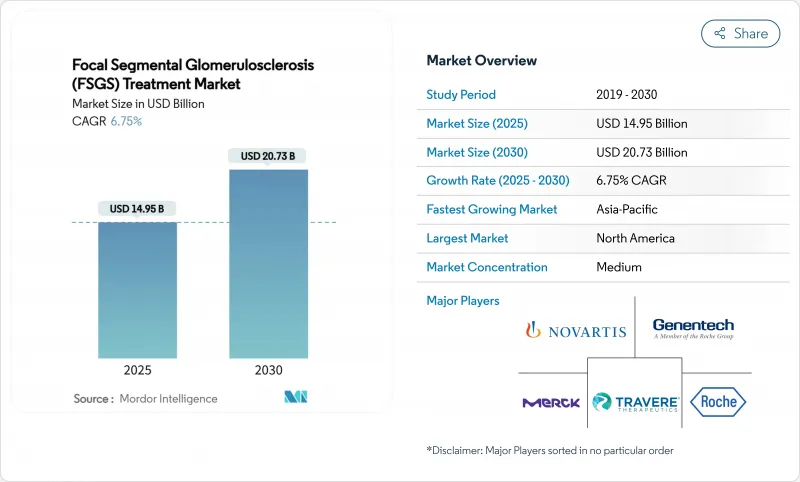
국소분절사구체경화증(FSGS) 치료 시장 규모는 2025년에 149억 5,000만 달러로 추정되며, 예측 기간(2025-2030년)의 CAGR은 6.75%로, 2030년에는 207억 3,000만 달러에 달할 것으로 예상됩니다.
이 꾸준한 성장은 세계적인 질병 인지도의 급상승, 면역조절제의 급속한 보급, 포드사이트 장애를 직접 표적으로 하는 일급 치료제의 출시를 반영합니다. 국소분절사구체경화증(FSGS) 치료 시장은 또한 강력한 오판 드래그 파이프라인, 간소화된 승인 경로, 효능까지의 시간을 단축하는 바이오마커 유도 요법의 사용 확대로부터 혜택을 누리고 있습니다. Precision Medicine(정밀의료)은 처방 행동을 검토하고 가치 기반 관리 계약을 통해 지불자는 신규 생물 제제의 고액 초기 비용을 관리하기 쉽습니다. 경쟁은 여전히 치열하고, 주요 제약 회사는 국소분절사구체경화증(FSGS) 치료 시장에서 조기 발판을 얻기 위해 유망한 생명 공학 자산을 인수하고 있습니다.
세계의 국소분절사구체경화증(FSGS) 치료 시장 동향과 인사이트
대사 이상과 관련된 FSGS의 유병률 증가
당뇨병과 비만의 지속적인 증가는 대사 스트레스가 포도사이트 감소와 사구체 경화를 가속화하기 때문에 FSGS의 발병을 직접 촉진합니다. 따라서 의약품 개발자는 대사 신호와 신장 신호를 모두 조절하는 이중 경로 약물을 시험하고 있습니다. 고혈압 및 당뇨병 환자의 조기 스크리닝은 진단 건수를 증가시키고 국소분절사구체경화증(FSGS) 치료 시장의 대응 가능한 기반을 확대하고 있습니다. 임상의는 대사관리 대책을 케어패스에 통합해 혈당과 지질관리와 포도사이트 보호약을 통합한 콤보레지멘에 대한 장기적인 수요를 창출하고 있습니다.
견고한 치료 파이프라인과 R&D 자금
Vertex의 Inaksapurin, Travere의 Supercentan 및 여러 안티센스 구조물이 FDA의 획기적인 치료제 또는 희귀 질병 의약품 지정을 받았으며 약사 승인까지의 기간이 단축되었습니다. 신장의 신흥 기업에 대한 벤처 자금은 2024년에 45% 급증했고, 중소의 생명 공학 기업이 보체 억제제, 포도사이트 재생 생물 제제, 유전자 침묵 분자를 추구하는 것을 뒷받침했습니다. 파이프라인의 폭이 넓어짐에 따라 국소분절사구체경화증(FSGS) 치료 시장은 전략적 투자자들에게 점점 더 매력적이 되고, 거래 흐름이 가속화되고 첫 치료의 상업화를 위해 전진하고 있습니다.
높은 비용과 투석 및 이식에 대한 제한된 접근
미국의 연간 투석 비용은 환자 1인당 평균 8만 9,000달러, 신장 이식 비용은 약 44만 2,500달러입니다. 제한된 이식 공급과 긴 대기 목록이 부담을 늘리고 있습니다. 따라서 지불자는 신규 진입마다 비용 효과를 조사하고 장기적인 결과 데이터가 없는 고가의 세포 치료 및 유전자 치료를 승인하기 위해 노력하고 있습니다. 저·중소득국에서는 투석 능력의 제약으로 치료 격차가 심각해지고, 고가의 약제의 사용이 억제되기 때문에 국소분절사구체경화증(FSGS) 치료 시장의 성장 가능성의 일부가 약해지고 있습니다.
부문 분석
원발성 FSGS는 2024년에 국소분절사구체경화증(FSGS) 치료 시장의 61.08%를 차지했고, 2030년까지의 CAGR은 9.01%를 나타낼 전망입니다. 이 높은 점유율은 면역 조절제와 면역 매개 포도 사이트 감소를 억제하는 새로운 표적 약물에 대한 감수성을 반영합니다. APOL1의 유전자형 판정은 일상적으로 행해지게 되어, 고위험 대립유전자를 가진 환자가 이나크사푸린과 같은 유전자형 특이적 억제제의 임상시험에 등록되게 되어 있습니다. 따라서 원발성 국소분절사구체경화증(FSGS) 치료 시장 규모는 이차성 FSGS를 초과할 것으로 예측됩니다. 이차성 국소분절사구체경화증(FSGS) 치료는 여전히 당뇨병, 고혈압, 약물 독성에 대한 치료에 의존합니다.
유전학적 검사는 APOL1의 상태에 의해 정의된 마이크로부문을 생성하고, 하위 집단을 개별 상기로 붕괴시킵니다. 인공지능으로 강화 된 디지털 병리학은 분류를 더욱 정교하게 만들고 의약품 제조업체가 가장 반응성이 높은 코호트에 화합물을 맞출 수있게합니다. 이러한 정확한 전술은 임상시험의 성공 확률을 높이고 투자자의 신뢰를 높이고 국소분절사구체경화증(FSGS) 치료 시장의 전반적인 궤도 방향타에서 원발성 FSGS의 핵심 역할을 강화합니다.
지역 분석
북미는 생물학적 제제의 조기 도입, 집중적인 신장 내과 전문 지식, 폭넓은 보험 적용을 배경으로 2024년 매출의 38.74%를 차지해 선두가 되었습니다. 미국만으로도 4만 명 이상의 진단 환자가 있어 향후 등장하는 정밀 치료제에 가장 큰 단일 국가 수영장을 형성하고 있습니다. 캐나다는 보편적인 보험 상환으로 접근이 원활하며 멕시코는 민간 의료 분야의 확대로 고급 신장 내과 서비스에 대한 수요가 높아지고 있습니다.
유럽은 EMA의 PRIME 패스웨이와 협조적인 의료기술 평가를 통해 높은 요구를 가진 의약품을 신속하게 개발할 수 있기 때문에 2위를 차지하고 있습니다. 독일, 프랑스, 영국은 단백뇨 저하제의 사용을 주도하고 있으며, 남유럽은 EU 구조 기금을 활용하여 신장 관리 인프라를 업그레이드하고 있습니다. 3상 임상시험 후 조건부 판매 승인은 환자에 대한 조기 접근을 가능하게 하고 대륙 전체에서 국소분절사구체경화증(FSGS) 치료 시장의 기세를 강화하고 있습니다.
아시아태평양은 가장 급성장하고 있는 지역으로, 2030년까지의 CAGR은 18.60%를 나타낼 예정입니다. 중국에서는 희소질환 치료제를 지방의 처방에 포함시키는 움직임이 있어 상환의 밑단이 퍼지고 있어 일본에서는 확립된 신장 내과 문화가 신약의 흡수를 가속시키고 있습니다. 한국의 Kidney Health Plan 2033은 전국적인 조기 발견, 원격 신장 내과 및 생검의 표준화를 위해 노력하고 있습니다. 인도는 농촌 지역과 도시 지역 간의 접근 격차에 직면하면서도 가장 큰 판매량의 업사이드를 제공하며, 호주는 강력한 연구 네트워크를 활용하여 지역 시험을 주도하고 있습니다. 이러한 힘을 통해 국소분절사구체경화증(FSGS) 치료 시장은 계속 세계화되고 다국적 기업은 다양한 상환 및 인프라 현실에 맞게 출시 계획을 조정할 것입니다.
기타 혜택 :
- 엑셀 형식 시장 예측(ME) 시트
- 3개월간의 애널리스트 서포트
목차
제1장 서론
- 조사 전제조건과 시장 정의
- 조사 범위
제2장 조사 방법
제3장 주요 요약
제4장 시장 상황
- 시장 개요
- 시장 성장 촉진요인
- 대사질환과 관련된 FSGS의 유병률 증가
- 강력한 치료 파이프라인과 R&D 자금
- 희소신질환 치료제에 대한 규제상의 우대조치
- 신 단일 세포 전사체학의 진보에 의한 고정밀 타겟의 실현
- 헬스 퀴티 이니셔티브 증가로 인한 고위험 민족 집단의 조기 생검 확대
- 조기 진단을 위한 신기능 바이오마커의 채용 증가
- 시장 성장 억제요인
- 높은 비용과 투석 및 이식에 대한 제한된 접근
- 희귀질환에 있어서 임상시험 모집의 과제
- 현행 면역억제제에 의한 부작용과 재발률
- APOL1 표적 치료제의 장기 데이터가 한정
- 규제 상황
- Porter's Porter's Five Forces
- 신규 참가업체의 위협
- 구매자의 협상력
- 공급기업의 협상력
- 대체품의 위협
- 경쟁 기업 간 경쟁 관계의 강도
제5장 시장 규모·성장 예측(금액 기준)
- 질환 유형별
- 원발성 FSGS
- 이차성 FSGS
- 질병 관리별
- 진단
- 신장 생검
- 크레아티닌 검사
- 기타 진단
- 치료
- 약물 치료
- 코르티코스테로이드
- 칼시뉴린 억제제
- 면역억제제
- 생물학적 제제
- APOL1 억제제 및 신흥 치료법
- 투석
- 혈액투석
- 복막투석
- 신장 이식
- 진단
- 최종 사용자별
- 병원 및 이식 센터
- 전문 클리닉 및 신장 내과 진료소
- 투석 센터
- 학술 및 연구 기관
- 지역별
- 북미
- 미국
- 캐나다
- 멕시코
- 유럽
- 독일
- 영국
- 프랑스
- 이탈리아
- 스페인
- 기타 유럽
- 아시아태평양
- 중국
- 일본
- 인도
- 호주
- 한국
- 기타 아시아태평양
- 중동 및 아프리카
- GCC
- 남아프리카
- 기타 중동 및 아프리카
- 남미
- 브라질
- 아르헨티나
- 기타 남미
- 북미
제6장 경쟁 구도
- 시장 집중도
- 시장 점유율 분석
- 기업 프로파일
- F. Hoffmann-La Roche Ltd.
- Genentech Inc.
- Novartis AG
- Merck KGaA
- Teva Pharmaceutical Industries Ltd.
- Travere Therapeutics Inc.
- Vertex Pharmaceuticals Incorporated
- AstraZeneca plc
- Pfizer Inc.
- Bristol Myers Squibb Company
- Otsuka Pharmaceutical Co. Ltd.
- Equillium Inc.
- Goldfinch Bio
- Reata Pharmaceuticals Inc.
- Ionis Pharmaceuticals Inc.
- Chinook Therapeutics Inc.
- Omeros Corporation
- Labcorp
- Arkana Laboratories
- Allina Health Laboratory
제7장 시장 기회와 전망
KTH 25.11.07The Focal Segmental Glomerulosclerosis Treatment Market size is estimated at USD 14.95 billion in 2025, and is expected to reach USD 20.73 billion by 2030, at a CAGR of 6.75% during the forecast period (2025-2030).
The steady rise reflects the worldwide surge in disease recognition, rapid adoption of immunomodulating drugs and the launch of first-in-class therapies that directly target podocyte injury. The FSGS treatment market is also benefiting from a robust orphan-drug pipeline, streamlined approval pathways and the growing use of biomarker-guided regimens that shorten time to response. Precision medicine is reshaping prescribing behaviour, while value-based care agreements are helping payers manage the high upfront cost of novel biologics. Competitive activity remains intense, with large pharma firms buying promising biotech assets to gain an early foothold in the FSGS treatment market.
Global Focal Segmental Glomerulosclerosis (FSGS) Treatment Market Trends and Insights
Increasing Prevalence of FSGS Linked to Metabolic Disorders
The continuing rise of diabetes and obesity is directly fuelling FSGS incidence, as metabolic stress accelerates podocyte loss and glomerular sclerosis. Pharmaceutical developers are therefore testing dual-pathway agents that modulate both metabolic and renal signals. Earlier screening of hypertensive and diabetic patients is boosting diagnostic volumes, which in turn enlarges the addressable base of the FSGS treatment market. Clinicians are embedding metabolic control measures into care pathways, creating long-term demand for combo regimens that integrate glycaemic and lipid management with podocyte-protective drugs.
Robust Therapeutic Pipeline & R&D Funding
Vertex's inaxaplin, Travere's sparsentan and several antisense constructs have secured FDA Breakthrough Therapy or Orphan Drug designations, shortening regulatory timelines. Venture funding for kidney startups jumped 45% in 2024, which is encouraging smaller biotechs to pursue complement inhibitors, podocyte-regeneration biologics and gene-silencing molecules. Pipeline breadth is making the FSGS treatment market increasingly attractive to strategic investors, accelerating deal flow and advancing first-time modalities toward commercial launch.
High Cost & Limited Access to Dialysis and Transplant
Annual U.S. dialysis expenditure averages USD 89,000 per patient and a kidney transplant costs about USD 442,500. Limited transplant supply and long waiting lists amplify the burden. Payers therefore scrutinize the cost-effectiveness of every new entrant and are slow to endorse high-price cell or gene therapies without long-term outcome data. In low- and middle-income countries, dialysis capacity constraints create a stark treatment gap and temper uptake of premium drugs, muting part of the FSGS treatment market's growth potential.
Other drivers and restraints analyzed in the detailed report include:
- Regulatory Incentives for Rare Kidney Disease Drugs
- Advances in Single-Cell Renal Transcriptomics Enabling Precision Targets
- Clinical Trial Recruitment Challenges in Rare Disease
For complete list of drivers and restraints, kindly check the Table Of Contents.
Segment Analysis
Primary FSGS captured 61.08% of the FSGS treatment market in 2024 and is set to post a 9.01% CAGR through 2030. The strong share reflects sensitivity to immunomodulators and emerging targeted agents that block immune-mediated podocyte loss. APOL1 genotyping has become routine, and patients with high-risk alleles are enrolling in trials of genotype-specific inhibitors such as inaxaplin. The FSGS treatment market size for primary disease is therefore projected to outpace secondary FSGS, whose therapy still hinges on addressing diabetes, hypertension or drug toxicity.
Genetic testing is spawning micro-segments defined by APOL1 status, collapsing sub-populations into discrete commercial opportunities. AI-enhanced digital pathology further refines classification, allowing drug makers to align compounds with the most responsive cohorts. These precision tactics increase trial success probability and heighten investor confidence, reinforcing the central role of primary FSGS in steering the overall trajectory of the FSGS treatment market.
The Focal Segmental Glomerulosclerosis (FSGS) Treatment Market Report is Segmented by Disease Type (Primary FSGS, Secondary FSGS), Disease Management (Diagnosis, Treatment), End User (Hospitals & Transplant Centers, Specialty Clinics & Nephrology Practices, and More), and Geography (North America, Europe, Asia-Pacific, Middle East & Africa, South America). The Market Forecasts are Provided in Terms of Value (USD).
Geography Analysis
North America led with 38.74% of 2024 revenue on the back of early biologic uptake, concentrated nephrology expertise and broad insurance coverage. The United States alone hosts more than 40,000 diagnosed patients, forming the largest single-country pool for upcoming precision therapies. Canada benefits from universal reimbursement that smooths access, while Mexico's expanding private-care segment is stimulating demand for advanced nephrology services.
Europe ranks second, supported by the EMA's PRIME pathway and coordinated health-technology assessment that fast-track high-need drugs. Germany, France and the United Kingdom spearhead usage of proteinuria-lowering agents, whereas Southern Europe leverages EU structural funds to upgrade renal-care infrastructure. Conditional marketing approvals granted after interim phase-3 readouts are allowing earlier patient access and reinforcing the FSGS treatment market's momentum across the continent.
Asia Pacific is the fastest-growing arena, scheduled to post an 18.60% CAGR to 2030. China's drive to include rare-disease drugs on provincial formularies is widening the reimbursement base, and Japan's established nephrology culture accelerates new-drug uptake. Korea's Kidney Health Plan 2033 commits to nationwide early detection, tele-nephrology and biopsy standardisation. India and Australia present divergent dynamics: India faces rural-urban access gaps yet offers the largest volume upside, while Australia leverages strong research networks to lead regional trials. Together, these forces ensure that the FSGS treatment market continues to globalise, with multinational firms tailoring launch plans to varied reimbursement and infrastructure realities.
- Roche
- Genentech
- Novartis
- Merck
- Teva Pharmaceutical Industries
- Travere Therapeutics Inc.
- Vertex Pharmaceuticals
- AstraZeneca
- Pfizer
- Bristol-Myers Squibb
- Otsuka Pharmaceutical Co. Ltd.
- Equillium Inc.
- Goldfinch Bio
- Reata Pharmaceuticals Inc.
- Ionis Pharmaceuticals
- Chinook Therapeutics Inc.
- Omeros Corporation
- LabCorp
- Arkana Laboratories
- Allina Health Laboratory
Additional Benefits:
- The market estimate (ME) sheet in Excel format
- 3 months of analyst support
TABLE OF CONTENTS
1 Introduction
- 1.1 Study Assumptions & Market Definition
- 1.2 Scope of the Study
2 Research Methodology
3 Executive Summary
4 Market Landscape
- 4.1 Market Overview
- 4.2 Market Drivers
- 4.2.1 Increasing Prevalence of FSGS Linked to Metabolic Disorders
- 4.2.2 Robust Therapeutic Pipeline & R&D Funding
- 4.2.3 Regulatory Incentives for Rare Kidney Disease Drugs
- 4.2.4 Advances in Single-Cell Renal Transcriptomics Enabling Precision Targets
- 4.2.5 Rising Health-Equity Initiatives Expanding Early Biopsy in High-Risk Ethnic Populations
- 4.2.6 Increasing Adoption of Kidney Function Biomarkers for Early Diagnosis
- 4.3 Market Restraints
- 4.3.1 High Cost & Limited Access to Dialysis and Transplant
- 4.3.2 Clinical Trial Recruitment Challenges in Rare Disease
- 4.3.3 Adverse Effects & Relapse Rates with Current Immunosuppressants
- 4.3.4 Limited Long-Term Data for APOL1-Targeted Therapies
- 4.4 Regulatory Landscape
- 4.5 Porter's Five Forces Analysis
- 4.5.1 Threat of New Entrants
- 4.5.2 Bargaining Power of Buyers
- 4.5.3 Bargaining Power of Suppliers
- 4.5.4 Threat of Substitute Products
- 4.5.5 Intensity of Competitive Rivalry
5 Market Size & Growth Forecasts (Value in USD)
- 5.1 By Disease Type
- 5.1.1 Primary FSGS
- 5.1.2 Secondary FSGS
- 5.2 By Disease Management
- 5.2.1 Diagnosis
- 5.2.1.1 Kidney Biopsy
- 5.2.1.2 Creatinine Test
- 5.2.1.3 Other Diagnostics
- 5.2.2 Treatment
- 5.2.2.1 Drug Therapy
- 5.2.2.1.1 Corticosteroids
- 5.2.2.1.2 Calcineurin Inhibitors
- 5.2.2.1.3 Immunosuppressants
- 5.2.2.1.4 Biologics
- 5.2.2.1.5 APOL1 Inhibitors & Emerging Therapies
- 5.2.2.2 Dialysis
- 5.2.2.2.1 Hemodialysis
- 5.2.2.2.2 Peritoneal Dialysis
- 5.2.2.3 Kidney Transplant
- 5.2.1 Diagnosis
- 5.3 By End User
- 5.3.1 Hospitals & Transplant Centers
- 5.3.2 Specialty Clinics & Nephrology Practices
- 5.3.3 Dialysis Centers
- 5.3.4 Academic & Research Institutes
- 5.4 By Geography
- 5.4.1 North America
- 5.4.1.1 United States
- 5.4.1.2 Canada
- 5.4.1.3 Mexico
- 5.4.2 Europe
- 5.4.2.1 Germany
- 5.4.2.2 United Kingdom
- 5.4.2.3 France
- 5.4.2.4 Italy
- 5.4.2.5 Spain
- 5.4.2.6 Rest of Europe
- 5.4.3 Asia-Pacific
- 5.4.3.1 China
- 5.4.3.2 Japan
- 5.4.3.3 India
- 5.4.3.4 Australia
- 5.4.3.5 South Korea
- 5.4.3.6 Rest of Asia-Pacific
- 5.4.4 Middle East & Africa
- 5.4.4.1 GCC
- 5.4.4.2 South Africa
- 5.4.4.3 Rest of Middle East & Africa
- 5.4.5 South America
- 5.4.5.1 Brazil
- 5.4.5.2 Argentina
- 5.4.5.3 Rest of South America
- 5.4.1 North America
6 Competitive Landscape
- 6.1 Market Concentration
- 6.2 Market Share Analysis
- 6.3 Company Profiles (includes Global level Overview, Market level overview, Core Segments, Financials as available, Strategic Information, Market Rank/Share for key companies, Products & Services, and Recent Developments)
- 6.3.1 F. Hoffmann-La Roche Ltd.
- 6.3.2 Genentech Inc.
- 6.3.3 Novartis AG
- 6.3.4 Merck KGaA
- 6.3.5 Teva Pharmaceutical Industries Ltd.
- 6.3.6 Travere Therapeutics Inc.
- 6.3.7 Vertex Pharmaceuticals Incorporated
- 6.3.8 AstraZeneca plc
- 6.3.9 Pfizer Inc.
- 6.3.10 Bristol Myers Squibb Company
- 6.3.11 Otsuka Pharmaceutical Co. Ltd.
- 6.3.12 Equillium Inc.
- 6.3.13 Goldfinch Bio
- 6.3.14 Reata Pharmaceuticals Inc.
- 6.3.15 Ionis Pharmaceuticals Inc.
- 6.3.16 Chinook Therapeutics Inc.
- 6.3.17 Omeros Corporation
- 6.3.18 Labcorp
- 6.3.19 Arkana Laboratories
- 6.3.20 Allina Health Laboratory
7 Market Opportunities & Future Outlook
- 7.1 White-Space & Unmet-Need Assessment