|
시장보고서
상품코드
1846211
자동차용 단말기 : 시장 점유율 분석, 산업 동향, 통계, 성장 예측(2025-2030년)Automotive Terminals - Market Share Analysis, Industry Trends & Statistics, Growth Forecasts (2025 - 2030) |
||||||
 Mordor Intelligence
자동차용 단말기 시장 규모는 2025년에 249억 7,000만 달러로 추정되며 예측 기간 중(2025-2030년) CAGR은 14.72%로, 2030년에는 496억 1,000만 달러에 이를 것으로 예상됩니다.

테슬라의 저전압 커넥터 표준으로 대표되는 바와 같이, 48V 저전압 아키텍처로의 급속한 변화는 커넥터 SKU를 6개로 줄이면서도 신호 및 전력 요구의 90% 이상을 커버하고, 중량을 압축하고, 재료 사용량을 줄이고, 하네스 자동화를 가속화하고 있습니다. 터미널 공급업체도 ADAS의 보급으로 이익을 얻고 있으며, 북미와 유럽에서는 후부 프로그램을 통해 멀티기가비트 전송이 가능한 데이터 등급 차폐형 마이크로 커넥터에 대한 애프터마켓에 대한 수요가 높아지고 있습니다. 한편, 구리를 많이 사용하는 배터리 시스템은 내연 기관 플랫폼의 3배의 도체량을 필요로 하기 때문에 OEM은 다년간공급 계약을 맺게 됩니다.
세계의 자동차용 단말기 시장 동향과 인사이트
전동화에 따른 저전압 접속점의 폭발적 증가
자동차의 전동화에 의해 저전압 노드의 수가 증가하고, 기존 12V차에서는 100 미만이었던 접속 포인트가, 현대의 배터리 전동 플랫폼에서는 200 이상 통합되고 있습니다. 배터리 관리 시스템은 강력한 CAGR로 성장하고 있으며, 밀리초 간격으로 셀 전압과 온도를 모니터링하는 초소형 단자가 필요합니다. 48V 배전의 높은 전류 밀도는 접촉 표면의 열 부하를 증가시키고 플레팅 부식 없이 100A의 연속 부하를 견디는 새로운 주석은 도금 레시피를 채택하도록 촉구합니다. 상업용 차량은 이 수요 신호를 확대하고 48V 전기 터보차저와 회생 액세서리를 개장하여 차량 1대당 4-6개의 새로운 하네스 분기를 추가하고 있습니다.
프리미엄 자동차에서 48V 전기 아키텍처로 전환
BMW, 메르세데스 벤츠, 볼보는 현재 2024년 중반 이후 출시된 모든 프리미엄 모델에 48V 서브시스템을 탑재하여 전선 게이지를 대형화하지 않고 액티브 섀시, e터보차저, 존 컨트롤러에 전력을 공급했습니다. 하네스 무게는 차량 1대당 최대 19kg 감소하고 보조 전기와 조합하면 0.3L/100km의 연료 절약 또는 EV 항속 거리의 연장으로 이어집니다. 테슬라의 LVCS는 48V 백본이 DCDC 노드를 통해 기존의 12V 부하와 공존할 수 있음을 입증하여 애프터마켓 호환성을 보호하는 단계적 전환을 가능하게 합니다. 터미널은 현재 기존 압착 공구와 역 호환성을 유지하면서 60V DC의 절연 내압을 보장해야 합니다.
구리 가격 변동이 단자 BOM 마진을 압박
2024년 초에 구리의 평균 가격은 1톤당 1만 800달러였습니다. 2025년 초에는 미국의 관세와 달러가격으로 동가격이 상승했지만 세계적인 경기감속 우려와 중국의 보복관세가 가격과 수요 전망에 무겁게 걸렸습니다. 중국의 제련회사는 광석의 품위가 저하된 칠레의 노천 채굴장이 폐쇄됨으로써 정광 공급이 압박하고 있는 것에 직면하고 있으며, 가공업자는 분기별 가격 인상 협상을 강요하고 있습니다. 재활용은 변동성을 상쇄하는 데 도움이 됩니다.미국 황동봉 공장은 평균 재활용률을 2025년 5분의 4 이상으로 인증하여 1차 구리 노출을 38톤 줄였습니다.
부문 분석
배터리 시스템은 2024년에 자동차용 단말기 시장 점유율의 33.25%를 차지해 자동차용 단말기 시장 전체에서 가장 단자 집약적인 서브 시스템으로서의 지위를 명확히 했습니다. 유닛의 성장은 셀 레벨 감지와 차세대 스케이트보드 섀시에서 접점 밀도를 1,400핀 이상으로 밀어 올리는 팩 전압 상승으로 인한 것입니다. 세이프티 & ADAS는 2030년까지 연평균 복합 성장률(CAGR) 14.81%로 성장하지만, 이는 카메라와 레이더 모듈마다 4-6개의 실드 연결이 추가되기 때문입니다.
신흥의 솔리드 스테이트 팩이 마이크로 단자의 채용을 촉진하고, 그 피치는 0.35mm 미만으로 프리미엄 가격을 낳습니다. HVAC와 편안함의 분야는 점유율이 작고, 48V 송풍기, 시트 히터, 히트 펌프가 브러쉬리스 모터로 전환되어 전류가 흐르고 구리 버스 바의 통합이 진행됨에 따라 관련성이 증가하고 있습니다.
승용차는 2024년 자동차용 단말기 시장 점유율의 64.85%를 차지했고 CAGR 15.73%를 나타낼 전망입니다. 소형상용차(LCV)도 도시의 저배출가스지대에 대응하기 때문에 택배사업자가 라스트원마일의 차량을 전동화함에 따라 견조한 성장을 보이고 있습니다. 이륜차와 스쿠터는 IP67의 밀폐형 DC 단자 표준화에 박차를 가하고 교체 가능한 배터리 플랫폼을 활용하고 있습니다.
함대 운영자는 수명주기의 경제성을 엄격하게 측정합니다. 가동률이 높은 LCV에서 예정되지 않은 노상 수리가 발생할 때마다 배송 페널티로서 공정한 비용이 발생하기 때문에 프리미엄 하이사이클 단자에 인센티브를 주고 있습니다. Aptiv의 CTCS 헤비 듀티 커넥터는 30.6G 진동과 -40°C-140°C의 온도를 견디며 총 소유 비용 모델에서 14-18%의 가격 프리미엄을 정당화하는 가동 시간의 이점을 제공합니다.
지역 분석
2024년 자동차용 단말기 시장 점유율은 아시아태평양이 37.76%를 차지했고 2030년까지 연평균 복합 성장률(CAGR)은 15.21%로 가장 빠릅니다. 일본의 티아완 공급업체는 수십년에 걸친 린 생산 방식을 활용하여 한 자리수의 PPM 불량률로 정밀 스탬프된 접점을 세계 OEM에 출하하고 있습니다. 인도네시아, 태국 등 동남아시아 국가들은 2024년 3자리 EV 등록 대수 증가를 기록해 OEM에 커넥터와 와이어 하네스의 현지 생산을 촉진했습니다.
유럽은 인플레이션과 에너지 비용의 역풍 속에서 지역 자동차 수익이 떨어진 후에도 EV 생산이 증가합니다. 엄격한 함대 CO2 규제로 인해 EV 판매는 2025년 예상되는 숫자로 상승하여 고출력 충전 단자 및 데이터 등급 기판 대 기판 커넥터와 같은 수요에 공급됩니다. 독일은 87만 3,000대의 EV 신규 등록을 목표로 내걸고 있으며, 단자 공급자에 대한 로컬 컨텐츠 요건이 강화됩니다. 이 지역의 ISO 19642와 DIN 72036에 의한 규제 리더십은 경제 정체가 목표 금리를 줄이더라도 규제 벤더에게 선행자 이익을 가져다줍니다.
고령화가 진행되는 자동차 시장은 애프터마켓의 활기를 유지하고 고급 실드 커넥터에 의존하는 ADAS 개장 키트의 판매를 가속화하고 있습니다. 제너럴 모터스의 40억 달러의 공장 개수, 현대의 210억 달러의 다년도 확장, 클라리오스의 투자 전략은 첨단 48V 및 800V 단자의 안정적인 견인력을 보장합니다. 중동 및 아프리카와 남미는 2024년에는 전체적으로 적당한 점유율을 차지하고 남미는 브라질의 CO2규제와 아르헨티나의 리튬 채굴 장려책을 배경으로 꾸준한 성장을 보였습니다. 사우디아라비아와 아랍에미리트(UAE)은 지역 케이블 및 터미널 제조 클러스터를 활성화하기 위해 신흥 EV 조립 프로그램에서 로컬 컨텐츠 정책을 활용합니다.
기타 혜택 :
- 엑셀 형식 시장 예측(ME) 시트
- 3개월간의 애널리스트 지원
목차
제1장 서론
- 조사 전제조건과 시장 정의
- 조사 범위
제2장 조사 방법
제3장 주요 요약
제4장 시장 상황
- 시장 개요
- 시장 성장 촉진요인
- 전동화에 수반하는 저전압 접속점의 폭발적 증가
- 프리미엄 자동차의 48V 전기 아키텍처로의 이동
- ADAS 후부 키트에 의한 애프터마켓 수요의 급증
- 엄격한 ISO 19642 하네스 규격이 단자의 재설계 사이클을 가속
- 고정밀 마이크로 단자를 필요로 하는 솔리드 스테이트 배터리 BMS
- 자동차 제조업체에 의한 압착리스 레이저 용접 단자의 추진에 의한 조립 공수 삭감
- 시장 성장 억제요인
- 구리 가격의 변동에 의한 단자 BOM 마진의 압박
- OEM의 통합 커넥터대로의 이행에 의한 단자수의 감소
- EV 대전류 경로용 알루미늄 합금 링 단자의 신뢰성 문제
- 아시아의 새로운 라인에 있어서 자동 압착력 모니터링의 스킬 격차
- 밸류체인 분석
- 규제 상황
- 기술적 전망
- Porter's Porter's Five Forces
- 신규 참가업체의 위협
- 구매자의 협상력
- 공급기업의 협상력
- 대체품의 위협
- 경쟁 기업 간 경쟁 관계의 강도
제5장 시장 규모·성장 예측
- 용도별
- 배터리 시스템
- 조명 시스템
- 인포테인먼트 시스템
- 파워트레인 및 엔진 관리
- 안전 및 ADAS
- HVAC 및 편의 기능
- 차종별
- 승용차
- 소형 상용차
- 중대형 상용차
- 이륜차
- 단자 유형별
- 링 단자
- 스페이드 단자
- 퀵 커넥트 단자
- 버트 커넥터
- 멀티핀 커넥터
- 재료별
- 구리
- 황동
- 강철
- 기타 합금
- 정격 전류별
- 25암페어 미만
- 25-50암페어
- 50암페어 이상
- 판매 채널별
- OEM
- 애프터마켓
- 지역별
- 북미
- 미국
- 캐나다
- 기타 북미
- 남미
- 브라질
- 아르헨티나
- 기타 남미
- 유럽
- 독일
- 영국
- 프랑스
- 이탈리아
- 러시아
- 기타 유럽
- 아시아태평양
- 중국
- 인도
- 일본
- 한국
- 기타 아시아태평양
- 중동 및 아프리카
- 사우디아라비아
- 아랍에미리트(UAE)
- 튀르키예
- 남아프리카
- 나이지리아
- 기타 중동 및 아프리카
- 북미
제6장 경쟁 구도
- 시장의 집중도
- 전략적인 동향
- 시장 점유율 분석
- 기업 프로파일
- TE Connectivity
- Lear Corporation
- Aptiv PLC
- Viney Corporation
- Furukawa Electric Co., Ltd.
- Grote Industries
- Keats Manufacturing Co.
- Sumitomo Electric Industries, Ltd.
- Yazaki Corporation
- Amphenol Corporation
- KS Terminals Inc.
- Hirose Electric Co., Ltd.
- Littelfuse, Inc.
- Samtec Inc.
- Wurth Elektronik
제7장 시장 기회와 전망
KTH 25.11.07The Automotive Terminals Market size is estimated at USD 24.97 billion in 2025, and is expected to reach USD 49.61 billion by 2030, at a CAGR of 14.72% during the forecast period (2025-2030).
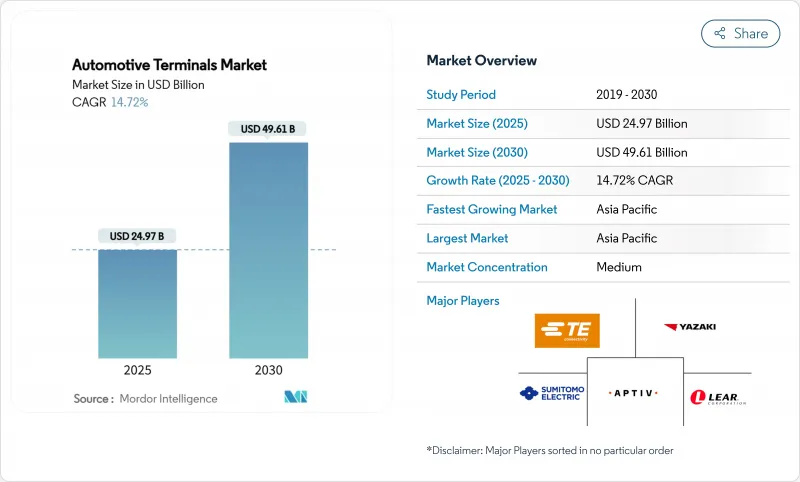
A rapid shift toward 48 V low-voltage architectures, exemplified by Tesla's Low-Voltage Connector Standard that reduces connector SKUs to six while still covering more than 90% of signal and power needs, is compressing weight, cutting material usage, and accelerating harness automation. Terminal suppliers also benefit from ADAS proliferation, with retrofit programs in North America and Europe raising aftermarket demand for data-grade, shielded micro-connectors capable of multigigabit transmission. Meanwhile, copper-intensive battery systems require three times the conductor mass of internal-combustion platforms, pushing OEMs to lock multi-year supply contracts even as volatile spot prices pressure gross margins
Global Automotive Terminals Market Trends and Insights
Electrification-Led Explosion in Low-Voltage Connection Points
Vehicle electrification multiplies the number of low-voltage nodes: a contemporary battery electric platform integrates more than 200 distinct connection points against fewer than 100 in conventional 12 V cars. Battery management systems is growing at a robust CAGR, demanding ultra-compact terminals that monitor cell voltage and temperature at millisecond intervals. The higher current density of 48 V distribution increases the thermal load on contact surfaces, prompting the adoption of new tin-silver plating recipes that sustain 100 A continuous loads without fretting corrosion. Commercial fleets extend this demand signal, retrofitting 48 V electric turbochargers and regenerative accessories that add four to six new harness branches per vehicle.
Shift to 48 V Electrical Architectures in Premium Vehicles
BMW, Mercedes-Benz, and Volvo now fit 48 V subsystems across all premium models launched since mid-2024, delivering power for active chassis, e-turbochargers, and zone controllers without oversizing wire gauges. Harness weight falls by up to 19 kg per vehicle, translating to 0.3 L/100 km fuel savings or extended EV range when paired with auxiliary electrics. Tesla's LVCS proves that a 48 V backbone can coexist with legacy 12 V loads through DCDC nodes, allowing phased migration that protects aftermarket compatibility. Terminals must now guarantee 60 V DC dielectric strength while remaining backward-compatible with existing crimp tooling.
Copper Price Volatility is Squeezing Terminal BOM Margins
Copper averaged USD 10,800 per tonne in early 2024. Early 2025 saw rising copper prices due to U.S. tariffs and a weaker dollar, but fears of a global slowdown and China's retaliatory tariffs have weighed heavily on prices and demand outlooks. Chinese smelters face tightening concentrate availability after the closure of Chilean open-pit pits with declining ore grades, forcing fabricators to negotiate quarterly price escalators. Recycling helps offset volatility: US brass-rod mills certified average recycled content more than four fifth of the amount in 2025, reducing primary copper exposure by 38 kt.
Other drivers and restraints analyzed in the detailed report include:
- ADAS Retrofit Kits Creating Aftermarket Demand Spikes
- Stringent ISO 19642 Harness Standards Accelerate Terminal Redesign Cycles
- OEM Migration to Consolidated Connector Blocks Reduces Terminal Counts
For complete list of drivers and restraints, kindly check the Table Of Contents.
Segment Analysis
Battery systems contributed 33.25% of the automotive terminals market share in 2024, underscoring their status as the most terminal-intensive sub-system across the automotive terminal market. Unit growth stems from cell-level sensing and rising pack voltages that push contact density beyond 1,400 pins in next-generation skateboard chassis. Safety & ADAS is growing at 14.81% CAGR through 2030 because each camera and radar module adds four to six shielded connections.
Emerging solid-state packs drive micro-terminal adoption, whose pitch falls below 0.35 mm, generating premium pricing. HVAC and comfort segments, despite their modest share, gain relevance as 48 V blowers, seat heaters, and heat pumps switch to brushless motors, lifting current draw and prompting copper busbar integration.
Passenger cars contributed to 64.85% of the automotive terminals market share in 2024, growing at 15.73% CAGR as stricter CO2 targets favor zero-tailpipe solutions. Light commercial vehicles (LCV) also grow steadily as parcel operators electrify last-mile fleets to comply with urban low-emission zones. Motorcycles and scooters leverage swappable battery platforms that spur standardization of IP67 sealed DC terminals.
Fleet operators measure lifecycle economics rigorously: every unscheduled roadside repair on high-utilization LCVs costs fairly in delivery penalties, incentivizing premium high-cycle terminals. Aptiv's CTCS heavy-duty connectors survive 30.6 G vibration and temperatures from -40 °C to +140 °C, offering uptime advantages that justify 14-18% price premiums in total-cost-of-ownership models.
The Automotive Terminals Market Report is Segmented by Application (Battery System, Lighting System, and More), Vehicle Type (Passenger Cars, Light Commercial Vehicles, and More), Terminal Type (Ring Terminals, Spade Terminals, and More), Material (Copper, Brass, and More), Current Rating (Less Than 25 Amp and More), Sales Channel (OEM and Aftermarket), and Geography. The Market Forecasts are Provided in Terms of Value (USD).
Geography Analysis
Asia-Pacific dominated with a 37.76% automotive terminals market share in 2024 and is showcasing the fastest 15.21% CAGR through 2030, underpinned by China's control of global new-energy vehicle production. Japan's tier-one suppliers leverage decades of lean manufacturing to ship precision-stamped contacts with single-digit PPM defect rates to global OEMs. Southeast Asian nations such as Indonesia and Thailand recorded triple-digit EV registration growth in 2024, prompting OEMs to localize connector and wire-harness production.
Europe, even after regional automotive revenue fell short amid inflation and energy-cost headwinds. Strict fleet CO2 rules lift EV sales to an expected figure in 2025, feeding demand for high-power charging terminals and data-grade board-to-board connectors, etc. Germany targets 873,000 new EV registrations, cementing local-content requirements for terminal suppliers. The region's regulatory leadership through ISO 19642 and DIN 72036 gives compliant vendors a first-mover edge even as economic stagnation tempers near-term margins.
An aging vehicle parc keeps the aftermarket vibrant and accelerates ADAS retrofit kit sales that rely on premium shielded connectors. General Motors' USD 4 billion plant overhaul, Hyundai's USD 21 billion multiyear expansion, and Clarios' investment strategy guarantee a steady pull for advanced 48V and 800V terminals. Middle East & Africa and South America collectively contributed a affairly decent share in 2024, with South America portraying steady growth on the back of Brazil's CO2 mandates and Argentina's lithium-mining incentives. Saudi Arabia and the United Arab Emirates use local-content policies within nascent EV assembly programs to stimulate regional cable and terminal manufacturing clusters.
- TE Connectivity
- Lear Corporation
- Aptiv PLC
- Viney Corporation
- Furukawa Electric Co., Ltd.
- Grote Industries
- Keats Manufacturing Co.
- Sumitomo Electric Industries, Ltd.
- Yazaki Corporation
- Amphenol Corporation
- K.S. Terminals Inc.
- Hirose Electric Co., Ltd.
- Littelfuse, Inc.
- Samtec Inc.
- Wurth Elektronik
Additional Benefits:
- The market estimate (ME) sheet in Excel format
- 3 months of analyst support
TABLE OF CONTENTS
1 Introduction
- 1.1 Study Assumptions & Market Definition
- 1.2 Scope of the Study
2 Research Methodology
3 Executive Summary
4 Market Landscape
- 4.1 Market Overview
- 4.2 Market Drivers
- 4.2.1 Electrification-led explosion in low-voltage connection points
- 4.2.2 Shift to 48-V electrical architectures in premium vehicles
- 4.2.3 ADAS retrofit kits creating aftermarket demand spikes
- 4.2.4 Stringent ISO 19642 harness standards accelerating terminal redesign cycles
- 4.2.5 Solid-state battery BMS requiring high-precision micro-terminals
- 4.2.6 Automaker push for crimp-less laser-weld terminals to cut assembly takt-time
- 4.3 Market Restraints
- 4.3.1 Copper price volatility squeezing terminal BOM margins
- 4.3.2 OEM migration to consolidated connector blocks reducing terminal counts
- 4.3.3 Reliability issues in aluminum-alloy ring terminals for EV high-current paths
- 4.3.4 Skills gap in automated crimp-force monitoring on new Asian lines
- 4.4 Value-Chain Analysis
- 4.5 Regulatory Landscape
- 4.6 Technological Outlook
- 4.7 Porter's Five Forces Analysis
- 4.7.1 Threat of New Entrants
- 4.7.2 Bargaining Power of Buyers
- 4.7.3 Bargaining Power of Suppliers
- 4.7.4 Threat of Substitutes
- 4.7.5 Intensity of Competitive Rivalry
5 Market Size & Growth Forecasts (Value (USD))
- 5.1 By Application
- 5.1.1 Battery System
- 5.1.2 Lighting System
- 5.1.3 Infotainment System
- 5.1.4 Powertrain & Engine Management
- 5.1.5 Safety and ADAS
- 5.1.6 HVAC and Comfort
- 5.2 By Vehicle Type
- 5.2.1 Passenger Cars
- 5.2.2 Light Commercial Vehicles
- 5.2.3 Medium and Heavy Commercial Vehicles
- 5.2.4 Two-Wheelers
- 5.3 By Terminal Type
- 5.3.1 Ring Terminals
- 5.3.2 Spade Terminals
- 5.3.3 Quick-Connect Terminals
- 5.3.4 Butt Connectors
- 5.3.5 Multi-Pin Connectors
- 5.4 By Material
- 5.4.1 Copper
- 5.4.2 Brass
- 5.4.3 Steel
- 5.4.4 Other Alloys
- 5.5 By Current Rating
- 5.5.1 Less than 25 Amp
- 5.5.2 25 - 50 Amp
- 5.5.3 More than 50 Amp
- 5.6 By Sales Channel
- 5.6.1 OEM
- 5.6.2 Aftermarket
- 5.7 By Geography
- 5.7.1 North America
- 5.7.1.1 United States
- 5.7.1.2 Canada
- 5.7.1.3 Rest of North America
- 5.7.2 South America
- 5.7.2.1 Brazil
- 5.7.2.2 Argentina
- 5.7.2.3 Rest of South America
- 5.7.3 Europe
- 5.7.3.1 Germany
- 5.7.3.2 United Kingdom
- 5.7.3.3 France
- 5.7.3.4 Italy
- 5.7.3.5 Russia
- 5.7.3.6 Rest of Europe
- 5.7.4 Asia-Pacific
- 5.7.4.1 China
- 5.7.4.2 India
- 5.7.4.3 Japan
- 5.7.4.4 South Korea
- 5.7.4.5 Rest of Asia-Pacific
- 5.7.5 Middle East and Africa
- 5.7.5.1 Saudi Arabia
- 5.7.5.2 United Arab Emirates
- 5.7.5.3 Turkey
- 5.7.5.4 South Africa
- 5.7.5.5 Nigeria
- 5.7.5.6 Rest of Middle East and Africa
- 5.7.1 North America
6 Competitive Landscape
- 6.1 Market Concentration
- 6.2 Strategic Moves
- 6.3 Market Share Analysis
- 6.4 Company Profiles (includes Global Level Overview, Market Level Overview, Core Segments, Financials as Available, Strategic Information, Market Rank/Share for Key Companies, Products and Services, SWOT Analysis, and Recent Developments)
- 6.4.1 TE Connectivity
- 6.4.2 Lear Corporation
- 6.4.3 Aptiv PLC
- 6.4.4 Viney Corporation
- 6.4.5 Furukawa Electric Co., Ltd.
- 6.4.6 Grote Industries
- 6.4.7 Keats Manufacturing Co.
- 6.4.8 Sumitomo Electric Industries, Ltd.
- 6.4.9 Yazaki Corporation
- 6.4.10 Amphenol Corporation
- 6.4.11 K.S. Terminals Inc.
- 6.4.12 Hirose Electric Co., Ltd.
- 6.4.13 Littelfuse, Inc.
- 6.4.14 Samtec Inc.
- 6.4.15 Wurth Elektronik
7 Market Opportunities & Future Outlook
- 7.1 White-space & Unmet-Need Assessment