|
시장보고서
상품코드
1846250
폐색 기기 : 시장 점유율 분석, 산업 동향, 통계, 성장 예측(2025-2030년)Occlusion Devices - Market Share Analysis, Industry Trends & Statistics, Growth Forecasts (2025 - 2030) |
||||||
 Mordor Intelligence
폐색 기기 시장 규모는 2025년에 34억 6,000만 달러로 추정되며, 예측 기간(2025-2030년)의 CAGR은 6.27%로, 2030년에는 46억 9,000만 달러에 달할 것으로 예상됩니다.

예측 기간 동안 저침습 신경혈관 및 말초 인터벤션에 대한 수요가 증가하고, 복잡한 절차의 외래로의 꾸준한 전환, AI 대응 장비에 대한 규제의 명확화가 전체적으로 확대를 지원합니다. 뇌졸중과 동맥류의 치료에 대한 보험 적용 범위가 확대됨에 따라 의료 제공업체에 대한 재원 일수 단축의 압력은 뿌리 깊고 차세대 폐색 시스템의 구입을 뒷받침하고 있습니다. 생체 흡수성 고분자를 중심으로 한 재료 혁신이 새로운 상업적 여지를 여는 한편, 고품위 합금을 둘러싼 공급망상의 스트레스와 전문가 양성의 필요성이 일부 저자원 지역에서의 성장을 억제하고 있습니다. 포트폴리오의 넓이, 임상 증거의 리더십, AI와 로봇 지원의 신속한 통합이 폐색 기기 시장의 핵심 경쟁력임에 변함이 없습니다.
세계의 폐색 기기 시장 동향과 인사이트
낮은 침습 폐쇄 절차에 대한 선호도 증가
규제 당국은 2024년에 전달성을 개선하고 합병증 발생률을 감소시키는 다수의 차세대 시스템을 승인했으며, 낮은 침습 접근법에 대한 신뢰를 보여주었습니다. 비교 연구에 따르면 폐색 기기가 개복 수술을 대체하면 입원일수가 1.5-2일 단축되어 에피소드의 총비용이 15-20% 절약됩니다. 이러한 임상적, 경제적 이점은 특히 진료 보상에 민감한 의료 기관에서 도입을 장려하고 있습니다. 외래센터에서는 저침습 프로토콜이 일상적으로 진행됨에 따라 2자리수의 치료 건수 증가가 보고되고 있어 같은 날 퇴원을 지원하는 기기에 대한 수요가 높아지고 있습니다. 뇌졸중과 말초동맥질환의 이환율이 고령화 사회에서 상승하는 가운데, 저침습 폐색 솔루션은 미래의 치료 알고리즘의 중심입니다.
외래 혈관 내 치료 모델로 이동
2025년에 갱신된 CMS의 지불 규칙은 외래에서의 혈관내 치료가 보다 폭넓게 보험적으로 적용되게 되었습니다. 이러한 변화로 ASC는 병원에 대한 비용 우위를 유지하면서 프리미엄 폐색 플랫폼에 투자할 수 있습니다. 다기관 등록에서 얻은 데이터에 따르면 ASC에 의한 치료의 안전성 프로파일은 동등하며 총 비용은 25-30% 낮습니다. 지불자는 시설 사용료의 감소로 이익을 얻고 보험 회사는 병원 외부에서 더 많은 사례를 승인합니다. 제조업체는 소규모 처치실용으로 설계된 컴팩트한 콘솔 및 일회용 키트를 지원합니다. 혈관 내 치료에서 외래 환자의 비율이 증가함에 따라 휴대성, 사용 편의성 및 견고한 임상 성능의 균형을 맞춘 장비에 수요가 집중됩니다.
제한된 자원 환경에서 높은 자본 비용
신흥국의 의료 제공자는 지출 우선순위가 경쟁하는 동안 비싼 폐색 시스템에 자금을 공급하는 데 어려움을 겪고 있습니다. 통화 변동 및 EU MDR 관련 컴플라이언스 비용이 공급업체에서 구매자로 전가됨에 따라 구매 가격은 15-25% 상승합니다. 임대와 공유 서비스 모델과 같은 자금 조달의 혁신은 부분적으로 장벽을 완화하고 있지만, 뇌졸중의 부담이 큰 지방 병원에서는 도입이 늦어지고 있습니다. 일관된 의료기기에 대한 액세스가 없으면 이 지역에서는 결과가 악화되고 의료 격차가 확대될 위험이 있습니다.
부문 분석
혈관의 신속한 재개통이 결과를 좌우하는 뇌졸중 응급 의료에서 제거 장치는 필수적인 역할을 하기 때문에 2024년에는 폐색 기기 시장의 42.68%를 확보했습니다. 견고한 임상 지침과 호의적인 상환이 안정적인 수요를 유지하는 반면, 응혈 덩어리 맞물림 스텐트 리트리버의 강화 등 반복적인 설계의 진보가 임상 성능을 갈망합니다. 새로운 소형 코일 리트리버는 치료할 수 있는 해부학적 구조를 넓혀 부문의 탄력성을 강화합니다. 동시에 색전용 기기는 2030년까지 연평균 복합 성장률(CAGR)이 8.01%가 되어 암 치료와 동맥류 예방 워크플로우의 성장에 뒷받침됩니다. 의료 제공업체는 색전제와 전달 카테터를 패키징한 병용 요법 키트를 선호하기 때문에 절차의 효율성이 향상되었습니다. 복잡한 혈관계에 정확한 유치를 허용하는 마이크로카테터, 가이드와이어 및 보조기구를 제공하는 지원 장비도 동시에 성장하고 있습니다.
임상의는 슈퍼트래킹 가능한 스텐트 회수장치 덕분에 한때 도달 불가능한 것으로 간주되었던 원위 뇌졸중 영역에서 제거 장치의 사용이 확대되고 있다고 보고했습니다. 제조업체 각사는 방사선 불투과성 마커와 내변색성 샤프트 설계를 통합하여 전달성을 향상시키면서 촉각 피드백을 유지하고 있습니다. 색전술의 혁신자는 보다 낮은 재소통률로 확실한 폐색을 달성하는 생물활성 코일과 액체 색전제에 초점을 맞추었습니다. 종양 및 외상 적응이 확대됨에 따라 수익 균형은 색전 요법에 점진적으로 기울어지고 있지만, 긴급 신경혈관 응용은 폐색 기기 시장에서 제거 시스템의 이점을 지키고 있습니다.
니티놀의 2024년 점유율은 43.93%로 형상 기억성과 초탄성 특성이 구부러진 뇌 혈관의 해부학적 구조에 적합하기 때문에 고성능 폐색 기구의 기간 제품이 되었습니다. 치료 제조업체는 니켈 이온의 방출을 완화하고 내피화를 촉진하기 위해 합금의 순도와 표면 처리를 개선했습니다. 백금은 미세한 해부학적 시각화를 위해 높은 방사선 투과성을 필요로 하는 경우에 계속 사용되고 있습니다. 한편, 생체흡수성 폴리머의 CAGR은 11.39%로 성장을 지속하고 있으며, 장기적인 이미지 아티팩트를 피하고 미래의 인터벤션을 가능하게 하는 임시 비계에 대한 임상의의 요구를 반영하고 있습니다. 초기 임상 프로그램은 예측 가능한 분해 프로파일과 양호한 염증 반응을 입증했지만, 생산 수율과 멸균 프로토콜은 여전히 비용 상승 요인으로 남아 있습니다.
디바이스 제조업체는 시인성과 흡수성을 양립하기 위해 폴리머 매트릭스에 방사선 불투과성 섬유를 내장한 하이브리드 구조를 모색하고 있습니다. 규제기관은 엄격한 생체내 열화 데이터를 요구하고 있으며, 일부 컨셉 시장 진입을 늦추고 있습니다. 그러나, 규모의 효율화가 실현되면, 생체 흡수성 임플란트는 영구 임플란트가 평생의 리스크 관리에 과제를 가져오는 적응증을 확대할 것으로 기대됩니다. 금속의 내구성과 폴리머의 편의성의 경쟁은 예측 기간 동안 재료의 연구 개발 예산을 형성할 것으로 보입니다.
지역 분석
북미는 2024년 매출의 43.04%를 차지하며, 메디케어에 의한 상환의 확실성, 뇌졸중 센터의 치밀한 네트워크, 학술 병원과 업계 파트너에 걸친 성숙한 혁신 생태계에 지지되었습니다. 인공지능과 생체흡수물에 대한 FDA의 정책이 계속 명확하기 때문에 신규 폐색 솔루션의 상시 환경이 양호합니다. 캐나다의 1인친구제는 뇌졸중 예방에 단계적으로 자금을 투입하고, 멕시코의 관민병원 확장은 점차 치료능력을 향상시키고 있습니다. 비용억제의 압력이 커지고 있음에도 불구하고 인재의 집중과 지불자와 의료제공업체의 견고한 협력이 북미의 리더십을 유지하고 있습니다.
아시아태평양의 2030년까지 연평균 복합 성장률(CAGR)은 12.58%로 가장 빠르고 급속한 병원 건설, 보험 제도 확대, 고령화 사회에서 뇌혈관 질환의 만연에 지지되고 있습니다. 중국의 수량 기준 조달의 틀은 가격대를 압축하고 있지만, 수술 건수의 많음과 지방의 뇌졸중 센터 전개가 마진 압력을 상쇄합니다. 일본은 고정밀 마이크로카테터와 첨단 합금 조성 연구를 주도하고 있지만 인구 역학의 역풍이 장기적인 절차의 성장을 억제하고 있습니다. 신경 인터벤션의 훈련 파이프라인이 개선되고 중간층의 보험 가입률이 상승하고 있는 인도는 인프라 격차에도 불구하고 2자리대의 고성장을 실현합니다. 한국과 호주는 고난이도의 3차 의료시설과 활발한 임상시험 참여에 힘입어 안정적인 수요를 제공합니다.
유럽은 견고한 국민 모두 보험제도, 대륙 전체의 뇌졸중 치료 프로토콜, 복수 시장에서의 상시를 촉진하는 EU 전역의 규제 조화가 원동력이 되어, 한 자리대 중반의 꾸준한 성장을 유지하고 있습니다. 독일의 엔지니어링 능력은 현지 제조 클러스터를 지원하고 영국은 브렉짓 후 조정을 거쳐 가이드 라인 개발과 결과 연구에 영향력을 유지하고 있습니다. 남유럽 시장은 병원의 근대화에 자금을 투입하는 EU의 결속 기금으로부터 혜택을 받으며, 동유럽은 상환의 틀이 성숙함에 따라 장기적인 상승 여지가 있습니다. 유럽의약청(EEA)과 미국식품의약국(FDA)의 협력체제는 증거의 공유를 가속화하고 대서양을 가로지르는 제품 출시까지의 시간을 단축합니다.
기타 혜택 :
- 엑셀 형식 시장 예측(ME) 시트
- 3개월간의 애널리스트 서포트
목차
제1장 서론
- 조사 전제조건과 시장 정의
- 조사 범위
제2장 조사 방법
제3장 주요 요약
제4장 시장 상황
- 시장 개요
- 시장 성장 촉진요인
- 저침습성 폐색성 수술에의 기호 고조
- 외래 혈관내 치료 모델로의 변화
- AI를 활용한 영상 진단과 로봇 지원의 통합
- 뇌졸중 치료에 대한 보험 적용 확대
- SRS 및 경방사선적 수술과 관련된 신경종양학 수요 증가
- 군용 출혈 제어 디바이스의 민간 채용
- 시장 성장 억제요인
- 자원이 한정된 환경에서의 높은 자본 비용
- 신경 폐쇄 절차의 훈련 수요
- 유로 전환에 있어서 재료 안전성의 우려
- 고등급 합금 취약한 공급망
- 기술적 전망
- Porter's Porter's Five Forces
- 신규 참가업체의 위협
- 구매자의 협상력
- 공급기업의 협상력
- 대체품의 위협
- 경쟁 기업 간 경쟁 관계의 강도
제5장 시장 규모·성장 예측(단위 : 달러)
- 제품별
- 폐색 제거 장치
- 코일 회수 장치
- 스텐트 회수 장치
- 기타 제거 장치
- 색전 장치
- 지지 장치
- 폐색 제거 장치
- 재질별
- 니티놀
- 백금
- 생체흡수성 폴리머
- 용도별
- 말초 혈관 질환
- 신경학
- 종양학
- 비뇨기과
- 기타
- 질환 병리학별
- 허혈성 뇌졸중
- 뇌동맥류
- 말초 동맥 폐색
- 종양 색전술
- 최종 사용자별
- 병원
- 외래 수술 센터(ASC)
- 전문 클리닉
- 지역별
- 북미
- 미국
- 캐나다
- 멕시코
- 유럽
- 독일
- 영국
- 프랑스
- 이탈리아
- 스페인
- 기타 유럽
- 아시아태평양
- 중국
- 일본
- 인도
- 호주
- 한국
- 기타 아시아태평양
- 중동 및 아프리카
- GCC
- 남아프리카
- 기타 중동 및 아프리카
- 남미
- 브라질
- 아르헨티나
- 기타 남미
- 북미
제6장 경쟁 구도
- 시장 집중도
- 시장 점유율 분석
- 기업 프로파일 기업 프로파일
- Medtronic
- Boston Scientific Corporation
- Abbott Laboratories
- Stryker Corporation
- Terumo Corporation
- Penumbra Inc.
- Merit Medical Systems
- Edwards Lifesciences
- Johnson & Johnson
- BTG International Ltd
- Cook Medical
- WL Gore & Associates
- MicroVention(Terumo)
- Kaneka Corp.
- Acandis GmbH
- Phenox GmbH
- Cardinal Health
- Balt Extrusion
- Asahi Intecc
- B. Braun Melsungen
제7장 시장 기회와 전망
KTH 25.11.07The Occlusion Devices Market size is estimated at USD 3.46 billion in 2025, and is expected to reach USD 4.69 billion by 2030, at a CAGR of 6.27% during the forecast period (2025-2030).
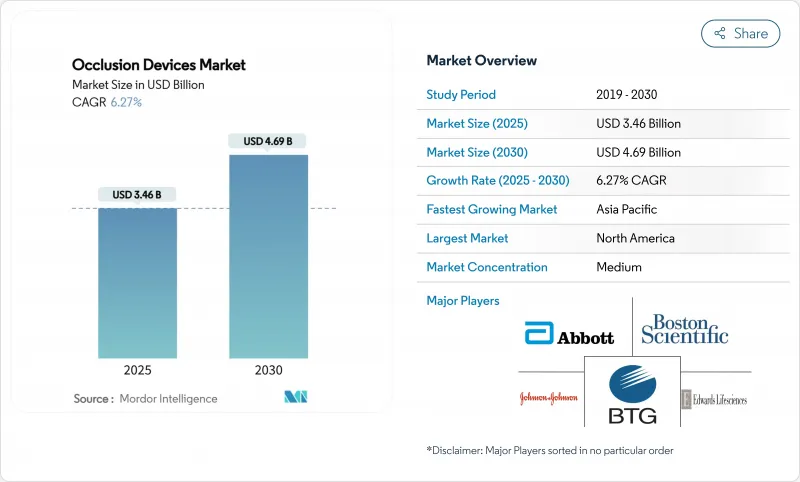
Across the forecast horizon, rising demand for minimally invasive neurovascular and peripheral interventions, steady migration of complex procedures into outpatient settings, and regulatory clarity for AI-enabled devices collectively underpin expansion. Persistent pressure on providers to shorten length-of-stay, together with broader insurance coverage for stroke and aneurysm care, reinforces purchasing of next-generation occlusion systems. Material innovation centred on bio-resorbable polymers opens new commercial white spaces, while supply-chain stress around high-grade alloys and the need for specialist training temper growth in some low-resource regions. Portfolio breadth, clinical-evidence leadership, and rapid integration of AI and robotic assistance remain the core competitive levers in the occlusion devices market.
Global Occlusion Devices Market Trends and Insights
Growing Preference for Minimally Invasive Occlusive Procedures
Regulators cleared several next-generation systems in 2024 that improve deliverability and reduce complication rates, illustrating confidence in less-invasive approaches. Comparative studies show hospital stay reductions of 1.5-2 days and 15-20% total episode cost savings when occlusion devices replace open surgery. These clinical and economic benefits encourage provider adoption, especially in reimbursement-sensitive environments. Ambulatory centers report double-digit volume increases as minimally invasive protocols become routine, reinforcing demand for devices that support same-day discharge. With stroke and peripheral arterial disease incidence rising among ageing populations, minimally invasive occlusion solutions remain central to future treatment algorithms.
Shift Toward Ambulatory Endovascular Care Models
Updated 2025 CMS payment rules now reimburse a broader list of endovascular procedures in outpatient settings. This shift lets ASCs invest in premium occlusion platforms while maintaining cost advantages over hospitals. Data from multisite registries indicate equivalent safety profiles and 25-30% lower total costs for ASC procedures. Payers gain from reduced facility fees, prompting insurers to authorise more cases outside hospitals. Manufacturers respond with compact consoles and single-use kits engineered for smaller procedure rooms. As the outpatient share of endovascular volumes climbs, demand concentrates on devices that balance portability, ease of use, and robust clinical performance.
High Capital Costs in Resource-Limited Settings
Healthcare providers in emerging economies struggle to fund premium occlusion systems amid competing spending priorities. Currency volatility and EU MDR-related compliance costs that suppliers pass through to buyers raise acquisition prices by 15-25%. Financing innovations such as leasing and shared-service models partly ease barriers, yet uptake lags in rural hospitals where stroke burden is high. Without consistent device access, these regions risk poorer outcomes and widening care disparities.
Other drivers and restraints analyzed in the detailed report include:
- Integration of AI-Guided Imaging & Robotic Assistance
- Broader Insurance Coverage for Stroke Interventions
- Training Demands for Neuro-Occlusion Techniques
For complete list of drivers and restraints, kindly check the Table Of Contents.
Segment Analysis
Removal devices secured 42.68% of the occlusion devices market in 2024 owing to their indispensable role in emergency stroke care where rapid vessel recanalisation dictates outcomes. Robust clinical guidelines and favourable reimbursement sustain steady demand, while iterative design advances such as enhanced clot-engagement stent retrievers sharpen clinical performance. Emerging miniaturised coil retrievers broaden treatable anatomy, reinforcing segment resilience. Concurrently, Embolization devices post an 8.01% CAGR to 2030, propelled by growth in oncology and preventive aneurysm workflows. Providers increasingly prefer combination therapy kits that package embolic agents with delivery catheters, improving procedural efficiency. Support devices grow in tandem, supplying micro-catheters, guidewires, and ancillary tools that enable precise deployment across complex vasculature.
Clinicians report expanding utilisation of removal devices in distal stroke territories once considered unreachable, thanks to ultra-trackable stent retrievers. Manufacturers integrate radiopaque markers and kink-resistant shaft designs that maintain tactile feedback while improving deliverability. Embolization innovators focus on bio-active coils and liquid embolics that achieve definitive occlusion with lower re-canalisation rates. As oncologic and trauma indications broaden, the balance of revenue slowly tilts toward embolization, yet emergency neurovascular applications safeguard the primacy of removal systems within the occlusion devices market.
Nitinol, with 43.93% 2024 share, remains the backbone of high-performance occlusion devices because shape-memory and super-elastic characteristics match tortuous cerebrovascular anatomy. Suppliers refine alloy purity and surface treatments to mitigate nickel ion release and enhance endothelialisation. Platinum continues serving cases requiring high radiopacity for fine anatomical visualisation. In contrast, bio-resorbable polymers record an 11.39% CAGR, mirroring clinician appetite for temporary scaffolds that avoid long-term imaging artefacts and permit future interventions. Early clinical programs demonstrate predictable degradation profiles and favourable inflammatory responses, although manufacturing yields and sterilisation protocols still add cost premiums.
Device makers explore hybrid constructions, embedding radiopaque fibres into polymer matrices to marry visibility with resorption. Regulatory bodies require stringent in-vivo degradation data, delaying market entry for some concepts. Yet once scale efficiencies materialise, bio-resorbables promise to expand indications where permanent implants pose lifetime risk management challenges. The competition between metallic durability and polymer convenience is likely to shape materials R&D budgets throughout the forecast period.
The Occlusion Devices Market Report is Segmented by Product (Occlusion Removal Devices, Embolization Devices, Support Devices), Material (Nitinol, Platinum, and More), Application (Peripheral Vascular Disease, and More), Disease Pathology (Ischemic Stroke, and More), End User (Hospitals, and More), and Geography (North America, Europe, Asia-Pacific, and More). The Market Forecasts are Provided in Terms of Value (USD).
Geography Analysis
North America generated 43.04% of 2024 revenue, buoyed by Medicare reimbursement certainty, dense stroke-centre networks, and a mature innovation ecosystem spanning academic hospitals and industry partners. Continued FDA policy clarity around AI and bio-resorbables sustains a favourable launch environment for novel occlusion solutions. Canada's single-payer system channels incremental funding to stroke prevention, while Mexico's public-private hospital expansion gradually adds procedure capacity. Talent concentration and strong payer-provider alignment preserve North America's leadership despite intensifying cost-containment pressures.
Asia-Pacific posts the fastest regional CAGR at 12.58% through 2030, underpinned by rapid hospital construction, insurance expansion, and mounting cerebrovascular disease prevalence among ageing citizens. China's Volume-Based Procurement framework compresses price points, yet sheer procedural volume and provincial stroke-centre rollouts offset margin pressure. Japan leads research into high-precision micro-catheters and advanced alloy compositions, although demographic headwinds moderate long-term procedure growth. India, with improving neuro-interventional training pipeline and rising middle-class insurance coverage, delivers high-double-digit unit growth despite infrastructure gaps. South Korea and Australia provide stable demand anchored in high-acuity tertiary facilities and active clinical-trial participation.
Europe maintains steady, mid-single-digit growth driven by robust universal healthcare systems, continent-wide stroke care protocols, and pan-EU regulatory harmonisation that expedites multi-market launches. Germany's engineering strengths support local manufacturing clusters, while the United Kingdom, navigating post-Brexit adjustments, remains influential in guideline development and outcomes research. Southern European markets benefit from EU Cohesion Funds funnelling capital into hospital modernisation, whereas Eastern Europe offers long-term upside as reimbursement frameworks mature. Collaborative initiatives between the European Medicines Agency and FDA accelerate evidence sharing, shortening time-to-market for cross-Atlantic product launches.
- Medtronic
- Boston Scientific
- Abbott Laboratories
- Stryker
- Terumo
- Penumbra
- Merit Medical Systems
- Edward Lifesciences
- Johnson & Johnson
- BTG International
- Cook Group
- W. L. Gore & Associates
- MicroVention (Terumo)
- Kaneka Corp.
- Acandis
- Phenox
- Cardinal Health
- Balt Extrusion
- Asahi Intecc
- B. Braun
Additional Benefits:
- The market estimate (ME) sheet in Excel format
- 3 months of analyst support
TABLE OF CONTENTS
1 Introduction
- 1.1 Study Assumptions & Market Definition
- 1.2 Scope of the Study
2 Research Methodology
3 Executive Summary
4 Market Landscape
- 4.1 Market Overview
- 4.2 Market Drivers
- 4.2.1 Growing Preference for Minimally Invasive Occlusive Procedures
- 4.2.2 Shift Toward Ambulatory Endovascular Care Models
- 4.2.3 Integration of AI-Guided Imaging & Robotic Assistance
- 4.2.4 Broader Insurance Coverage for Stroke Interventions
- 4.2.5 Rising Neuro-Oncology Demand Linked to SRS & Trans-Radial Techniques
- 4.2.6 Civilian Adoption of Military Hemorrhage Control Devices
- 4.3 Market Restraints
- 4.3.1 High Capital Costs in Resource-Limited Settings
- 4.3.2 Training Demands for Neuro-Occlusion Techniques
- 4.3.3 Material Safety Concerns in Flow-Diversion
- 4.3.4 Vulnerable Supply Chains for High-Grade Alloys
- 4.4 Technological Outlook
- 4.5 Porter's Five Forces Analysis
- 4.5.1 Threat of New Entrants
- 4.5.2 Bargaining Power of Buyers
- 4.5.3 Bargaining Power of Suppliers
- 4.5.4 Threat of Substitutes
- 4.5.5 Intensity of Competitive Rivalry
5 Market Size & Growth Forecasts (Value in USD)
- 5.1 By Product
- 5.1.1 Occlusion Removal Devices
- 5.1.1.1 Coil Retrievers
- 5.1.1.2 Stent Retrievers
- 5.1.1.3 Other Removal Devices
- 5.1.2 Embolization Devices
- 5.1.3 Support Devices
- 5.1.1 Occlusion Removal Devices
- 5.2 By Material
- 5.2.1 Nitinol
- 5.2.2 Platinum
- 5.2.3 Bio-resorbable Polymers
- 5.3 By Application
- 5.3.1 Peripheral Vascular Disease
- 5.3.2 Neurology
- 5.3.3 Oncology
- 5.3.4 Urology
- 5.3.5 Other Applications
- 5.4 By Disease Pathology
- 5.4.1 Ischemic Stroke
- 5.4.2 Cerebral Aneurysm
- 5.4.3 Peripheral Arterial Occlusion
- 5.4.4 Tumor Embolization
- 5.5 By End User
- 5.5.1 Hospitals
- 5.5.2 Ambulatory Surgical Centers
- 5.5.3 Specialty Clinics
- 5.6 By Geography
- 5.6.1 North America
- 5.6.1.1 United States
- 5.6.1.2 Canada
- 5.6.1.3 Mexico
- 5.6.2 Europe
- 5.6.2.1 Germany
- 5.6.2.2 United Kingdom
- 5.6.2.3 France
- 5.6.2.4 Italy
- 5.6.2.5 Spain
- 5.6.2.6 Rest of Europe
- 5.6.3 Asia-Pacific
- 5.6.3.1 China
- 5.6.3.2 Japan
- 5.6.3.3 India
- 5.6.3.4 Australia
- 5.6.3.5 South Korea
- 5.6.3.6 Rest of Asia-Pacific
- 5.6.4 Middle East & Africa
- 5.6.4.1 GCC
- 5.6.4.2 South Africa
- 5.6.4.3 Rest of Middle East & Africa
- 5.6.5 South America
- 5.6.5.1 Brazil
- 5.6.5.2 Argentina
- 5.6.5.3 Rest of South America
- 5.6.1 North America
6 Competitive Landscape
- 6.1 Market Concentration
- 6.2 Market Share Analysis
- 6.3 Company Profiles Company Profiles (includes Global level Overview, Market level overview, Core Segments, Financials as available, Strategic Information, Market Rank/Share, Products & Services, Recent Developments)
- 6.3.1 Medtronic
- 6.3.2 Boston Scientific Corporation
- 6.3.3 Abbott Laboratories
- 6.3.4 Stryker Corporation
- 6.3.5 Terumo Corporation
- 6.3.6 Penumbra Inc.
- 6.3.7 Merit Medical Systems
- 6.3.8 Edwards Lifesciences
- 6.3.9 Johnson & Johnson
- 6.3.10 BTG International Ltd
- 6.3.11 Cook Medical
- 6.3.12 W. L. Gore & Associates
- 6.3.13 MicroVention (Terumo)
- 6.3.14 Kaneka Corp.
- 6.3.15 Acandis GmbH
- 6.3.16 Phenox GmbH
- 6.3.17 Cardinal Health
- 6.3.18 Balt Extrusion
- 6.3.19 Asahi Intecc
- 6.3.20 B. Braun Melsungen
7 Market Opportunities & Future Outlook
- 7.1 White-space & Unmet-need Assessment