|
시장보고서
상품코드
1846316
지혈대 시스템 시장 : 시장 점유율 분석, 산업 동향, 통계, 성장 예측(2025-2030년)Tourniquet Systems - Market Share Analysis, Industry Trends & Statistics, Growth Forecasts (2025 - 2030) |
||||||
 Mordor Intelligence
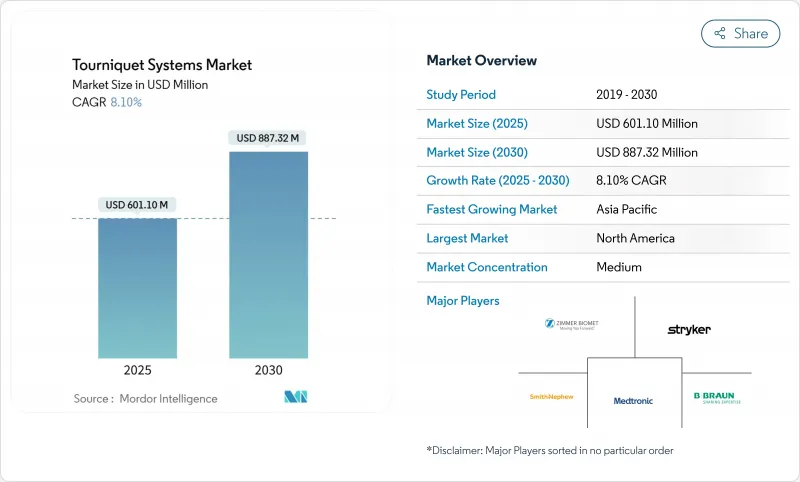
지혈대 시스템 시장 규모는 2025년에 6억 110만 달러로 추정되고, CAGR 8.10%로 성장할 전망이며, 2030년에는 8억 8,732만 달러에 이를 것으로 예측됩니다.
정형외과 수술의 견고한 성장, 지속적인 군사 수요, 스마트 사지 폐쇄 압력(LOP) 장치로의 전환이 이러한 확대를 지원합니다. 설치 대수의 대부분은 병원이 차지하고 있지만, 외래수술센터(ASC)에서는 당일 인공 관절 치환술 및 손 수술이 외래로 이행하고 있기 때문에 구입이 가속하고 있습니다. 기술적 측면에서 자동 압력 교정과 클라우드에 연결된 데이터 획득은 조달 기준을 재구성하고 있으며, 라텍스가 없는 실리콘과 고급 열가소성 엘라스토머로의 재료 업그레이드가 감염 제어 및 환자의 편안함 목표를 지원합니다. 경쟁의 격렬함은 중간 정도에 그치고 있으며, 주요 공급업체는 AI를 활용한 압박 알고리즘, 국내 제조에 대한 투자, 선택적 인수를 활용하여 점유율을 지키고 있습니다.
세계의 지혈대 시스템 시장 동향 및 인사이트
세계에서 급증하는 정형외과 및 외상 수술
고령화 사회와 스포츠 의학 수요에 힘입어 선택적 정형외과 수술과 외상을 기반으로 한 정형외과 수술의 건수는 증가의 길을 따라가고 있습니다. 고관절과 무릎관절의 당일 수술은 2017년의 1%에서 2021년에는 30.5%로 증가하였고, 평균 재원 일수는 0.94일로 단축되어 신뢰성 높은 사지 탈혈용구에 대한 신뢰가 높아집니다. 세계의 고관절 및 무릎 관절 임플란트 부문은 로봇 지침에 의해 수술 분야를 명확히 할 필요성이 높아져 2023년에는 전년 대비 7.2% 증가한 185억 달러로 성장했습니다. 하지의 긴급 절단율은 미국 우편번호에 따라 3.7%에서 90%의 폭을 가지며, 효율적인 지혈대의 전개가 필요한 서비스가 부족하다는 것을 시사합니다. 이러한 절차 동향은 커프의 연간 교환 사이클을 강화하고, 마이크로프로세서 펌프의 업그레이드를 촉진하며, 지혈대 시스템 시장을 지원합니다.
사지 압박형 스마트 지혈대 시스템의 급속한 보급
스마트 장치는 경험치에서 환자 특정 압력으로 진료를 이동시킵니다. Stryker의 SmartPump 2.0은 수술기 데이터 스트림을 자동으로 기록하면서 더 낮은 폐색 임계값을 보여줍니다. 짐머 바이오메트의 ATS 5000은 사지 형태에 맞게 팽창을 조절하는 개인화된 압력 기술을 제공하여 수술 후 통증 점수를 감소시킵니다. 비교 테스트에서는 Delfi의 수술 등급 알고리즘이 100%의 자동 조절 정확도를 실현했지만, 소비자용 기기의 성능은 좋았습니다. 이러한 기능은 병원의 품질 평가 기준과 보다 안전한 압력 창을 요구하는 규제 당국의 요청과 공명하며 스마트펌프를 지혈대 시스템 시장 내에서 가장 빠르게 성장하는 유닛 부문으로 자리매김하고 있습니다.
수술 후 합병증 위험 상승(신경 및 허혈)
신경 마비는 여전히 과도한 지혈압 및 지혈 시간과 관련된 주요 부작용입니다. 세계 범위 검토는 허혈성 통증, 혈전 색전 사건 및 지혈 후 증후군을 추가적인 우려 사항으로 제시했지만 증거 기반 프로토콜에 따라 발생률이 급격히 감소합니다. 유럽 외상 지침은 마비의 위험을 억제하기 위해 시간 제한과 실시간 모니터링을 강조합니다. AORN의 2025년 진료 권고에서는 팔다리 몸통 측정, 커프의 핏 점검, 연속 압력 판독을 의무화하고 있으며, 시설은 재사용 가능한 커프 정책을 검토하도록 촉구하고 있습니다. 소송과 보험료 상승을 두려워하고 예산에 민감한 병원에서는 장비 구매가 지연될 수 있으며, 지혈대 시스템 시장 성장 속도가 완만해집니다.
부문 분석
지혈 커프는 2024년 매출의 88.75%를 차지했으며, 지혈대 시스템 시장을 수술 횟수에 가장 직접 연결하는 소모품 요소로 지원하고 있습니다. 커프는 정기적인 교환, 일회용 감염 통제 정책 및 사지 별 다양한 구성으로 구매 예산에 통합되어 있습니다. 스마트펌프의 채용은 현재 틈새이지만, CAGR 9.25%로 진행되고 있으며, 번들 계약에서는 적응 펌프와 독자적인 커프라인의 조합이 늘어나, 판매 후의 소모품 수입을 고정화하고 있습니다.
병원의 가치 분석은 재사용 가능한 직물과 관련된 멸균 수고와 품질 변동의 위험을 반복적으로 강조하고 라텍스가 없는 일회용 나일론 또는 실리콘 커프로 조달을 유도합니다. 2024년 공급 제약에서 FDA는 커프의 재사용을 제한하는 것을 승인했으며, 일시적으로 오래된 재고를 지원했지만 싱글 소스 체인의 부서짐을 부각시켰습니다. 스마트 시스템은 디지털 자동 압력 센서를 통합하고 각 사이클을 EMR에 기록하며 감사 추적 및 예방 유지보수를 지원합니다. 이러한 데이터 인증이 지급자 감사에 영향을 미치기 때문에 구성 요소의 구성이 바뀔 것으로 예상되지만 커프가 수익의 중요성으로 변함이 없으며 지혈대 시스템 시장의 장기적인 전망은 유지됩니다.
하지의 수술은 2024년 수술 건수의 68.35%, 지혈대 시스템 시장 규모의 4억 1,140만 달러에 기여하고 있으며, 팔의 용도에 비해 높은 압력 임계치와 긴 팽창 시간을 활용하고 있습니다. 인공관절 치환술의 성장, 전장에서의 외상, 당뇨병성 절단이 수요의 고수준을 유지하고 있으며, 각각의 견인역이 여러 해에 걸친 지속적인 동향을 나타내고 있습니다.
상지의 수술은 절대 수가 적은 반면, 2030년까지 연평균 복합 성장률(CAGR) 9.42%로 확대될 것으로 예측되며, 저침습 손목과 팔꿈치 수술이 증가함에 따라 시장 평균을 상회합니다. 비용 분석에 따르면 신축성 스트랩은 공압식 대체품에 비해 외과 수술 1건당 28.27달러를 절약할 수 있으며, 현장의 선명도는 손상되지 않았습니다. 이러한 발견은 특히 ASC에서 저렴한 기계식 루프의 틈새 채택을 뒷받침합니다. 다른 분야에서는 EMS 외상 키트와 하이브리드 혈관 케이스가 '기타' 버킷으로 분류되어 응급 의사가 휴대용 퀵 릴리스 밴드를 통합하여 안정적인 점유율을 유지하고 있습니다. 이러한 부문을 합치면, 지혈대 시스템 시장은 대량의 하지용 틈새와 고성장 상지용 틈새 사이에 균형을 유지합니다.
지역 분석
북미는 2024년 매출의 45.45%를 차지했는데, 이는 정형외과 수술 건수가 많고 보험 적용 범위가 넓으며 LOP 펌프의 조기 채용을 반영하고 있습니다. 미국 병원 통합과 집중 구매 계약은 공급업체의 발판을 더욱 강화하고 국내 제조 보조금은 생산 능력의 탄력성을 강화합니다. 캐나다는 이러한 요인들 중 많은 부분을 반영하고 있지만, 주 감염 제어 지침에 따라 일회용 커프의 보급이 빠릅니다.
유럽은 엄격한 CE 브랜드와 증거 기반 장비 선택을 촉진하는 전 지역 정형외과 등록을 배경으로 꾸준한 성장을 유지했습니다. 독일과 북유럽 국가에서는 스마트펌프의 보급률이 높지만, 남유럽에서는 비용 중시의 공압식 번들이 선호됩니다. 이 지역에서는 NATO 회원국이 전술 키트를 보충하고 있기 때문에 방위 비축품에서의 수요도 증가하고 있습니다.
아시아태평양은 가장 급성장하고 있는 클러스터로, 수술의 정체가 해소되고 민간 보험의 보급이 진행됨에 따라 CAGR 예측은 10.35%를 기록합니다. 중국에서는 카운티 수준의 외상 네트워크가 확대되고 인도에서는 교통사고로 인한 부상이 급증하고 있기 때문에 수갑의 소비가 가속화되고 있습니다. 일본의 정형외과학회는 AI와 연동한 압박 알고리즘을 시험적으로 도입하고 있으며, 호주에서는 국방 주도의 연구 개발이 민간 입찰에 파급하고 있습니다. 중동 및 아프리카와 남미는 절대적인 규모로 후진을 숭배하고 있지만 두 자리의 성장 포켓을 제공합니다. 브라질의 유니버설 디지털 헬스 레코드로의 전환과 사우디아라비아의 비전 2030 병원 건설은 모두 스마트 지혈대 조달 조항을 통합하고 있습니다. 전력이 불안정한 지역을 위한 배터리가 없는 공압식 유닛과 같은 지역별 제품 적응을 통해 공급업체는 지혈대 시스템 시장 규모를 확대할 수 있습니다.
기타 혜택 :
- 엑셀 형식 시장 예측(ME) 시트
- 3개월의 애널리스트 서포트
목차
제1장 도입
- 조사의 전제조건 및 시장 정의
- 조사 범위
제2장 조사 방법
제3장 주요 요약
제4장 시장 상황
- 시장 개요
- 시장 성장 촉진요인
- 세계의 정형외과 수술 및 외상 수술 급증
- 사지 관류압(LOP) 스마트 지혈대 시스템의 급속한 보급
- 분쟁이 장기화하는 중 군사 조달 증가
- 당뇨병 관련 절단 증가
- 외래 및 정형외과 수술 증가
- 신흥 시장용 저비용 공압식 유닛 출현
- 시장 성장 억제요인
- 수술 후 합병증 위험 증가(신경 및 허혈)
- 압력 교정을 위한 숙련자 및 직원의 부족
- 재사용 가능한 커프의 멸균에 대한 우려
- 위험한 압력 임계치를 둘러싼 규제의 엄격함
- 밸류체인 및 공급망 분석
- 기술적 전망
- 규제 상황
- Porter's Five Forces 분석
- 신규 참가업체의 위협
- 구매자의 협상력
- 공급기업의 협상력
- 대체품의 위협
- 경쟁 기업 간 경쟁 관계의 강도
제5장 시장 규모 및 성장 예측
- 컴포넌트 유형별
- 지혈 기구
- 지혈 커프
- 공압식
- 비공기식
- 용도별
- 하지 외과
- 상지 수술
- 기타
- 최종 사용자별
- 병원
- 외래수술센터(ASC)
- 기타
- 재료별
- 나일론
- 실리콘 및 고무
- 벨크로 및 텍스타일
- 지역별
- 북미
- 미국
- 캐나다
- 멕시코
- 유럽
- 독일
- 영국
- 프랑스
- 이탈리아
- 스페인
- 기타 유럽
- 아시아태평양
- 중국
- 일본
- 인도
- 호주
- 한국
- 기타 아시아태평양
- 중동 및 아프리카
- GCC
- 남아프리카
- 기타 중동 및 아프리카
- 남미
- 브라질
- 아르헨티나
- 기타 남미
- 북미
제6장 경쟁 구도
- 시장 집중도
- 시장 점유율 분석
- 기업 프로파일
- Delfi Medical Innovations Inc.
- Zimmer Biomet Holdings Inc.
- Hammarplast Medical AB
- Stryker Corporation
- Anetic Aid Ltd.
- Ulrich Medical
- OHK Medical Devices
- Rudolf Riester GmbH
- Dessillons & Dutrillaux
- VBM Medizintechnik GmbH
- B. Braun Melsungen AG
- Smith & Nephew plc
- Medtronic plc
- North American Rescue LLC
- SAM Medical
- RevMedx Inc.
- TyTek Medical
- CAT Resources
- Tactical Medical Solutions Inc.
- Dunlap Medical Inc.
제7장 시장 기회 및 전망
AJY 25.11.10The tourniquet systems market reached a value of USD 601.10 million in 2025 and is projected to climb to USD 887.32 million by 2030, registering an 8.10% CAGR.
Robust orthopedic procedure growth, sustained military demand and the transition to smart limb-occlusion-pressure (LOP) devices underpin this expansion. Hospitals continue to account for most unit placements, yet ambulatory surgical centers (ASCs) are accelerating purchases as same-day joint replacements and hand surgeries migrate into outpatient settings. On the technology front, automatic pressure calibration and cloud-connected data capture are reshaping procurement criteria, while material upgrades toward latex-free silicone and advanced thermoplastic elastomers support infection-control and patient-comfort targets. Competitive intensity remains moderate; leading suppliers leverage AI-driven compression algorithms, domestic manufacturing investments and selective acquisitions to defend share as regional specialist entrants target lower-price pneumatic niches.
Global Tourniquet Systems Market Trends and Insights
Surging Orthopedic & Trauma Surgeries Worldwide
Elective and trauma-based orthopedic volumes continue to climb, buoyed by aging populations and sports-medicine demand. Same-day hip and knee arthroplasties moved from 1% in 2017 to 30.5% in 2021, compressing average stays to 0.94 days and lifting reliance on reliable limb exsanguination tools. The global hip-knee implant sector grew 7.2% year-on-year to USD 18.5 billion in 2023, with robotic guidance amplifying the need for clear operative fields. Geographic variability remains stark; emergency lower-extremity amputation rates ranged from 3.7% to 90% across U.S. zip codes, signaling under-served segments that require efficient tourniquet deployment. Collectively, these procedure trends bolster annual replacement cycles for cuffs and drive upgrades to micro-processor pumps, sustaining the tourniquet systems market.
Rapid Adoption of Limb-Occlusion-Pressure Smart Tourniquet Systems
Smart devices shift practice from empirical values toward patient-specific pressures. Stryker's SmartPump 2.0 demonstrates lower occlusion thresholds while auto-documenting perioperative data streams . Zimmer Biomet's A.T.S. 5000 offers Personalized Pressure Technology that tailors inflation to limb morphology, reducing post-operative pain scores . Comparative testing showed Delfi's surgical-grade algorithms delivering 100% autoregulation accuracy versus variable performance among consumer devices. These capabilities resonate with hospital quality metrics and regulatory calls for safer pressure windows, positioning smart pumps as the fastest rising unit segment within the tourniquet systems market.
Higher Post-Operative Complication Risk (Nerve/Ischemia)
Nerve palsy remains the primary adverse event linked to excessive tourniquet pressure or duration. A global scoping review identified ischemic pain, thromboembolic events and post-tourniquet syndrome as additional concerns, though incidence drops sharply when evidence-based protocols are followed. European trauma guidelines now highlight time limits and real-time monitoring to curb paralysis risk. AORN's 2025 practice advisory mandates limb girth measurement, cuff fit checks and continuous pressure readouts, prompting facilities to reassess reusable cuff policies. Fear of litigation and higher insurance premiums can delay capital purchases among budget-sensitive hospitals, moderating the tourniquet systems market growth pace.
Other drivers and restraints analyzed in the detailed report include:
- Increasing Military Procurement Amid Prolonged Conflicts
- Rising Prevalence of Diabetes-Related Amputations
- Shortage of Skilled Staff for Pressure Calibration
For complete list of drivers and restraints, kindly check the Table Of Contents.
Segment Analysis
Tourniquet cuffs generated 88.75% of 2024 revenue, anchoring the tourniquet systems market as the consumable element most directly tied to procedure counts. Recurring replacement, single-use infection-control policies and varied limb-specific configurations lock cuffs into purchasing budgets. Smart pump adoption, while currently niche, is advancing at a 9.25% CAGR, and bundled contracts increasingly pair adaptive pumps with proprietary cuff lines to lock in post-sale consumable income.
Hospital value analyses repeatedly highlight the sterilization labor and quality-variation risks linked to reusable fabrics, steering procurement toward latex-free disposable nylon or silicone cuffs. During 2024 supply constraints, the FDA endorsed limited cuff reuse, which temporarily propped up older stock yet underscored the fragility of single-source chains. Smart systems integrate digital auto-pressure sensors that log each cycle to the EMR, supporting audit trails and preventive maintenance. As these data credentials influence payer audits, the component mix is expected to shift, but cuffs will remain the revenue cornerstone, sustaining the long-term outlook for the tourniquet systems market.
Lower-extremity surgeries contributed 68.35% of 2024 procedures and USD 411.4 million of tourniquet systems market size, leveraging higher pressure thresholds and longer inflation times compared with arm applications. Arthroplasty growth, battlefield trauma and diabetic amputations converge to keep demand high, with each driver exhibiting durable multi-year trends.
Upper-limb procedures, although smaller in absolute numbers, are forecast to expand at 9.42% CAGR through 2030, outpacing market average as minimally invasive wrist and elbow work rises. Cost analyses show elastic straps saving USD 28.27 per hand surgery versus pneumatic alternatives without compromising field clarity. Such findings propel niche adoption of inexpensive mechanical loops, especially in ASCs. Elsewhere, EMS trauma kits and hybrid vascular cases fall into the "other" bucket that maintains a steady share as emergency clinicians integrate portable quick-release bands. Together, these segments keep the tourniquet systems market balanced between high-volume lower-limb and high-growth upper-limb niches.
The Tourniquet Systems Market Report is Segmented by Component Type (Tourniquet Instruments, Tourniquet Cuffs), Application (Lower-Limb Surgery, Upper-Limb Surgery, Others), End-User (Hospitals, and More), Material (Nylon, and More), and Geography (North America, Europe, Asia-Pacific, Middle East & Africa, South America). The Market Forecasts are Provided in Terms of Value (USD).
Geography Analysis
North America booked 45.45% of 2024 revenue, reflecting dense orthopedic procedure volumes, broad insurance coverage and early adoption of LOP pumps. U.S. hospital consolidation and centralized purchasing contracts further anchor supplier footprints, while domestic manufacturing subsidies bolster capacity resiliency. Canada mirrors many of these drivers but exhibits faster uptake of single-use cuffs due to provincial infection-control guidelines.
Europe maintained steady growth on the back of rigorous CE branding and pan-regional orthopedic registries that promote evidence-based device selection. Germany and the Nordic countries exhibit higher penetrations of smart pumps, whereas Southern Europe favors cost-sensitive pneumatic bundles. The region is also seeing incremental demand from defense stockpiles as NATO members replenish tactical kits.
Asia-Pacific represents the fastest growing cluster, posting a 10.35% CAGR projection as procedure backlogs clear and private insurance penetration rises. China's county-level trauma network expansion and India's surge in road-traffic injuries catalyze cuff consumption. Japanese orthopedic societies are piloting AI-linked pressure algorithms, while Australia's defense-driven R&D spills into civilian tenders. Middle East & Africa and South America trail in absolute size but offer double-digit growth pockets; Brazil's move to universal digital health records and Saudi Arabia's Vision 2030 hospital build-outs both embed smart tourniquet procurement clauses. Geo-specific product adaptations, such as battery-free pneumatic units for power-unstable regions, enable suppliers to extend the tourniquet systems market footprint.
- Delfi Medical Innovations Inc.
- Zimmer Biomet
- Hammarplast Medical
- Stryker
- Anetic Aid Ltd.
- Ulrich Medical
- OHK Medical Devices
- Rudolf Riester
- Dessillons & Dutrillaux
- VBM Medizintechnik
- B. Braun
- Smiths Group
- Medtronic
- North American Rescue LLC
- SAM Medical
- RevMedx Inc.
- TyTek Medical
- C.A.T Resources
- Tactical Medical Solutions Inc.
- Dunlap Medical Inc.
Additional Benefits:
- The market estimate (ME) sheet in Excel format
- 3 months of analyst support
TABLE OF CONTENTS
1 Introduction
- 1.1 Study Assumptions & Market Definition
- 1.2 Scope of the Study
2 Research Methodology
3 Executive Summary
4 Market Landscape
- 4.1 Market Overview
- 4.2 Market Drivers
- 4.2.1 Surging Orthopedic & Trauma Surgeries Worldwide
- 4.2.2 Rapid Adoption Of Limb-Occlusion-Pressure (LOP) Smart Tourniquet Systems
- 4.2.3 Increasing Military Procurement Amid Prolonged Conflicts
- 4.2.4 Rising Prevalence Of Diabetes-Related Amputations
- 4.2.5 Growth Of Outpatient & Asc Orthopedic Procedures
- 4.2.6 Emergence Of Low-Cost Pneumatic Units For Emerging Markets
- 4.3 Market Restraints
- 4.3.1 Higher Post-Operative Complication Risk (Nerve/Ischemia)
- 4.3.2 Shortage Of Skilled Or Staff For Pressure Calibration
- 4.3.3 Sterilization Concerns With Reusable Cuffs
- 4.3.4 Regulatory Scrutiny Over Hazardous Pressure Thresholds
- 4.4 Value / Supply-Chain Analysis
- 4.5 Technological Outlook
- 4.6 Regulatory Landscape
- 4.7 Porter's Five Forces Analysis
- 4.7.1 Threat of New Entrants
- 4.7.2 Bargaining Power of Buyers
- 4.7.3 Bargaining Power of Suppliers
- 4.7.4 Threat of Substitute Products
- 4.7.5 Intensity of Competitive Rivalry
5 Market Size & Growth Forecasts
- 5.1 By Component Type
- 5.1.1 Tourniquet Instruments
- 5.1.2 Tourniquet Cuffs
- 5.1.2.1 Pneumatic
- 5.1.2.2 Non-pneumatic
- 5.2 By Application
- 5.2.1 Lower-limb Surgery
- 5.2.2 Upper-limb Surgery
- 5.2.3 Others
- 5.3 By End-user
- 5.3.1 Hospitals
- 5.3.2 Ambulatory Surgical Centers
- 5.3.3 Others
- 5.4 By Material
- 5.4.1 Nylon
- 5.4.2 Silicone & Rubber
- 5.4.3 Velcro & Textile
- 5.5 By Geography
- 5.5.1 North America
- 5.5.1.1 United States
- 5.5.1.2 Canada
- 5.5.1.3 Mexico
- 5.5.2 Europe
- 5.5.2.1 Germany
- 5.5.2.2 United Kingdom
- 5.5.2.3 France
- 5.5.2.4 Italy
- 5.5.2.5 Spain
- 5.5.2.6 Rest of Europe
- 5.5.3 Asia-Pacific
- 5.5.3.1 China
- 5.5.3.2 Japan
- 5.5.3.3 India
- 5.5.3.4 Australia
- 5.5.3.5 South Korea
- 5.5.3.6 Rest of Asia-Pacific
- 5.5.4 Middle East & Africa
- 5.5.4.1 GCC
- 5.5.4.2 South Africa
- 5.5.4.3 Rest of Middle East & Africa
- 5.5.5 South America
- 5.5.5.1 Brazil
- 5.5.5.2 Argentina
- 5.5.5.3 Rest of South America
- 5.5.1 North America
6 Competitive Landscape
- 6.1 Market Concentration
- 6.2 Market Share Analysis
- 6.3 Company Profiles {(includes Global level Overview, Market level overview, Core Segments, Financials as available, Strategic Information, Market Rank/Share for key companies, Products & Services, and Recent Developments)}
- 6.3.1 Delfi Medical Innovations Inc.
- 6.3.2 Zimmer Biomet Holdings Inc.
- 6.3.3 Hammarplast Medical AB
- 6.3.4 Stryker Corporation
- 6.3.5 Anetic Aid Ltd.
- 6.3.6 Ulrich Medical
- 6.3.7 OHK Medical Devices
- 6.3.8 Rudolf Riester GmbH
- 6.3.9 Dessillons & Dutrillaux
- 6.3.10 VBM Medizintechnik GmbH
- 6.3.11 B. Braun Melsungen AG
- 6.3.12 Smith & Nephew plc
- 6.3.13 Medtronic plc
- 6.3.14 North American Rescue LLC
- 6.3.15 SAM Medical
- 6.3.16 RevMedx Inc.
- 6.3.17 TyTek Medical
- 6.3.18 C.A.T Resources
- 6.3.19 Tactical Medical Solutions Inc.
- 6.3.20 Dunlap Medical Inc.
7 Market Opportunities & Future Outlook
- 7.1 White-space & Unmet-Need Assessment