
|
시장보고서
상품코드
1846327
관상동맥우회술(CABG) 시장 : 시장 점유율 분석, 산업 동향, 통계, 성장 예측(2025-2030년)Coronary Artery Bypass Grafting - Market Share Analysis, Industry Trends & Statistics, Growth Forecasts (2025 - 2030) |
||||||
 Mordor Intelligence
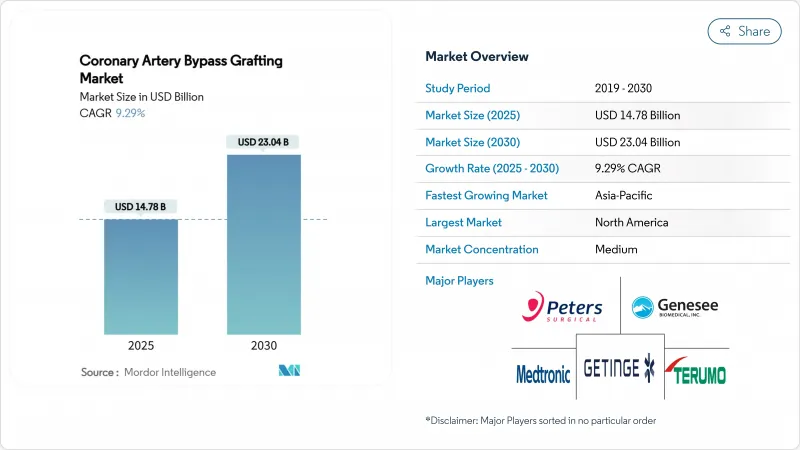
세계의 관상동맥우회술(CABG) 시장은 2025년에 147억 8,000만 달러로 추정되고, 2030년에는 230억 4,000만 달러에 이를 것으로 예측되며, 예측 기간 동안 CAGR 9.29%로 성장할 전망입니다.
꾸준한 기세는 고령화에서 관상동맥 질환 이환율 확대, 하이브리드 혈행 재건 전략의 급속한 채용, 이식편의 정확성을 향상시키면서 절차 시간을 단축하는 AI 가이드 로봇 시스템의 일상적인 사용으로 인한 것입니다. 저침습 접근법에 대한 선호도가 높아짐에 따라 병원이 차세대 시각화 도구에 투자하도록 촉구하는 반면, 중소득 경제권에서 인구 역학의 확대는 고급 심장 외과 수술을 위한 새로운 환자층을 개척합니다. 동시에 북미와 유럽에서 유리한 상환 조종사는 자본 비용 압력을 상쇄하여 장비 업그레이드 및 수술 건수 증가를 계속합니다. 경쟁 기업 간 경쟁 관계는 기존 기업이 혈관 인터벤션 자산을 인수하는 반면 혁신 기업이 조직 공학 그래프트와 예측 분석을 시장에 투입함으로써 격화하고 있습니다.
세계의 관상동맥우회술(CABG) 시장 동향 및 인사이트
CAD 및 뇌졸중 유병률 상승
라이프 스타일 위험 인자와 인구 고령화가 수렴함에 따라 세계의 심혈관 부담이 증가하고 수술적 혈행 재건술의 지속적인 수요를 견인하고 있습니다. 관상동맥 질환을 앓고 있는 미국인의 수는 2030년까지 850만 명에 달할 것으로 예상되고 있으며, 이로 인해 증례 수가 많은 의료 센터에서의 치료 체제의 강화가 요구됩니다. 아시아태평양에서는 다지 병변의 발병이 빠르며 많은 젊은 환자에서는 복잡한 PCI보다 우회술이 더 좋습니다. 확산성 병변의 발생률이 높고 혈관 직경이 작기 때문에 치료법의 선택은 수술적 완전 혈행 재건술에 더욱 기울어집니다. 이러한 환자 구성은 카테터를 이용한 치료법이 확대되어도 병원이 CABG의 능력을 유지하는 것을 뒷받침하고 있습니다.
이식편 및 로봇의 기술적 진보
da Vinci 시스템과 같은 로봇 플랫폼은 30일 사망률이 1.2%에 가깝고, 흉골 절개의 전환율은 5% 이하이며, 저침습 관상동맥 수술의 안전성을 뒷받침하고 있습니다. 인공지능은 관상동맥 매핑과 수술 중 내비게이션을 강화하고 복잡한 오프 펌프 관상동맥 성형술을 지원합니다. Humacyte는 2025년에 CABG용 세포성 소구경 이식편의 인간 최초 시험을 계획하고 있습니다. 이러한 기술 혁신은 이환율을 낮추고 입원 기간을 단축함으로써 대응 가능한 환자층을 확대합니다.
PCI 및 TAVI로 이동
최근의 임상시험은 선택된 좌주 간부 병변에서 PCI가 우수한 치료 성적을 보이는 것으로 나타났으며, PCI와 결합된 경 카테터 대동맥판 치환술은 이중 병변 환자에게 완전히 카테터 기반 대안을 제공합니다. 그러나 장기 등록에서는 복잡한 다지 병변, 당뇨병, 심실 기능 장애에 대해서는 재관류와 경색의 발생률이 낮기 때문에 여전히 CABG가 지지되고 있습니다. 스텐트 장치의 개선으로 스텐트 유치능 및 내구성이 향상됨에 따라, 인터벤셔널 카디올로지는 특히 합병증의 위험이 중등도인 경우에는 수술실에서 증례를 뽑아 갈 것으로 보입니다.
부문 분석
온펌프 수술은 2024년에 가장 높은 수익을 창출해 관상동맥우회술(CABG) 시장의 61.33%를 차지했습니다. 신뢰할 수 있는 심폐 우회 기술과 외과의사의 숙련도는 복잡한 해부학적 구조와 재검토 사례에서 수요를 안정화시킵니다. 하지만 하이브리드 기술이 CAGR 12.73%로 기술 성장을 견인한 이유는 병원이 내구성 및 회복 속도의 균형을 맞추기 위해 저침습 그래프트와 PCI를 결합했기 때문입니다. 하이브리드 절차에 의한 관상동맥우회술(CABG) 시장 규모는 10년 이상 심각한 부작용이 발생하지 않음을 보여주는 증거가 있기 때문에 2030년까지 급증할 것으로 예측됩니다.
로봇 지원 하에서 절제술은 절개창을 넓히지 않고 양쪽 내유선 동맥을 한 포트에서 사용할 수 있도록 하여 장기 개존률을 향상시킵니다. 오프펌프 수술은 바이패스 조작으로 뇌졸중 위험이 증가하는 석회화 대동맥을 가진 고위험 환자에서 여전히 유용합니다. 이러한 선택을 종합하면 외과의사는 해부학적 구조, 병존 질환, 시설 자원에 맞는 치료를 할 수 있어 관상동맥우회술 시장 전체의 성장을 유지하면서 치료 성적을 향상시킬 수 있습니다.
지역 분석
북미는 2024년 세계 매출의 33.77%를 차지하였고, 기술적 리더십, 확립된 심장 수술 프로그램, 질 높은 결과에 보답하는 일괄 지불 파일럿 등에 지지되고 있습니다. 로봇 시스템과 AI 가이드 이미징의 조기 도입은 절차의 효율성을 강화하고 강력한 자본 예산이 신속한 업데이트 사이클을 유지합니다. 인공지능 리스크 프로파일링 툴에 지급되는 메디케어의 코딩 변경은 절차 퍼널의 성장을 더욱 촉진하고 미국과 캐나다 전역에서 관상동맥우회술(CABG) 시장의 활력을 유지하고 있습니다.
유럽에서는 의료기기 규제 준수가 과제가 되고 있으며, 신형 로봇 컴포넌트의 승인까지의 기간이 길어지고 있음에도 불구하고 꾸준한 확대를 보이고 있습니다. 국경을 넘어 교육 네트워크와 정부의 심장 센터는 관류 장비와 매핑 소프트웨어를 업그레이드하고 북미의 다른 회사와 임상적 동등성을 유지합니다. 스칸디나비아 국가에서는 이식편, 소모품, 서비스 계약을 묶은 가치 기반 조달 계약을 시험적으로 도입하여 공급망의 안정성을 확보하면서 금리를 지킵니다.
가처분 소득 증가 및 기증자 자금을 통한 수술 교육 프로그램은 첨단 혈액 재건술에 대한 접근성을 확대하기 때문에 아시아태평양은 2030년까지 연평균 복합 성장률(CAGR)로 가장 빠른 12.20%로 성장할 것으로 예측됩니다. 인도는 구미 평균보다 50-80% 싼 수술 비용으로 외국인 환자를 유치하고 관상동맥 바이패스 이식술 시장의 의료 관광의 성장을 지지하고 있습니다. 중국은 이웃 국가 캄보디아와 제휴하여 수백만 명의 선천성 심장 질환을 스크리닝하고 심혈관 치료에 대한 지역 헌신을 강조합니다. 중동, 아프리카 및 남미는 자본 투자 제한과 공급망 지연으로 인해 당분간 치료 건수를 억제하는 것, 국제적인 지원을 받아 센터 업그레이드를 계속하고 있습니다.
기타 혜택 :
- 엑셀 형식 시장 예측(ME) 시트
- 3개월간의 애널리스트 서포트
목차
제1장 서론
- 조사의 전제조건 및 시장 정의
- 조사 범위
제2장 조사 방법
제3장 주요 요약
제4장 시장 상황
- 시장 개요
- 시장 성장 촉진요인
- CAD 및 뇌졸중의 유병률 상승
- 그래프트 및 로보틱스의 기술적 진보
- 주요 시장에서 유리한 상환 제도
- ASC의 하이브리드 혈행 재건술 프로그램
- AI에 의한 수술 중 영상 진단의 채용
- LMICs의 기증자 자금에 의한 심장 외과 훈련
- 시장 성장 억제요인
- PCI 및 TAVI로의 이동
- 높은 설비 투자 및 절차 비용
- 조직 조달에 관한 규제의 혼란
- Covid 후 Pci에 대한 스케줄링 바이어스
- 밸류체인 및 공급망 분석
- 규제 상황
- 기술 전망
- Porter's Five Forces 분석
- 공급기업의 협상력
- 구매자의 협상력
- 신규 참가업체의 위협
- 대체품의 위협
- 경쟁 기업 간 경쟁 관계의 강도
제5장 시장 규모 및 성장 예측
- 기술별
- 오프 펌프 CABG
- 온 펌프 CABG
- 저침습 및 로봇 지원 CABG
- 하이브리드 관상 동맥 혈행 재건술
- 제품 및 서비스별
- 도관과 그래프트
- 복재 정맥 이식편(SVG)
- 내흉 및 ITA 그래프트
- 요골동맥 이식편
- 합성 및 약물 용출 이식편
- 리트랙터 및 스태빌라이저
- 인공심폐장치
- 수술기구 및 봉합사
- 수술 중 이미지 및 네비게이션
- 서비스(CABG 센터 오브 엑셀런스)
- 도관과 그래프트
- 최종 사용자별
- 3차 의료 병원
- 순환기과 및 심장흉부 클리닉
- 외래수술센터(ASC)
- 지역별
- 북미
- 미국
- 캐나다
- 멕시코
- 유럽
- 독일
- 영국
- 프랑스
- 이탈리아
- 스페인
- 기타 유럽
- 아시아태평양
- 중국
- 일본
- 인도
- 호주
- 한국
- 기타 아시아태평양
- 중동 및 아프리카
- GCC
- 남아프리카
- 기타 중동 및 아프리카
- 남미
- 브라질
- 아르헨티나
- 기타 남미
- 북미
제6장 경쟁 구도
- 시장 집중도
- 시장 점유율 분석
- 기업 프로파일
- Medtronic plc
- Getinge AB
- Terumo Corp.
- Edwards Lifesciences
- Johnson & Johnson(Ethicon/Cordis)
- Abbott Laboratories
- Boston Scientific
- LivaNova plc
- WL Gore & Associates
- B. Braun Melsungen
- Stryker Corp.
- Karl Storz SE & Co. KG
- Teleflex Inc.
- Scanlan International
- Genesee Biomedical
- Peter Surgical
- Zimmer Biomet
- Dextera Surgical
- CardioMedical GmbH
- Novare Surgical
제7장 시장 기회 및 전망
AJY 25.11.10The global coronary artery bypass grafting market is valued at USD 14.78 billion in 2025 and is projected to reach USD 23.04 billion by 2030, advancing at a 9.29% CAGR during the forecast period.
Steady momentum comes from widening coronary artery disease incidence in aging populations, rapid adoption of hybrid revascularization strategies, and routine use of AI-guided robotic systems that shorten procedure time while improving graft accuracy. Growing preference for minimally invasive approaches encourages hospitals to invest in next-generation visualization tools, while demographic expansion in middle-income economies opens new patient pools for advanced cardiac surgery. At the same time, favorable reimbursement pilots in North America and Europe offset capital cost pressures, ensuring continued device upgrades and procedure volume growth. Competitive rivalry intensifies as incumbents acquire vascular intervention assets, while innovators bring tissue-engineered grafts and predictive analytics to market.
Global Coronary Artery Bypass Grafting Market Trends and Insights
Rising Prevalence of CAD & Stroke
Global cardiovascular burden rises as lifestyle risk factors and population aging converge, driving continuous demand for surgical revascularization. The number of Americans living with coronary artery disease is expected to reach 8.5 million by 2030, reinforcing procedure pipelines in high-volume centers.Asia-Pacific registers earlier onset of multivessel disease, making bypass surgery preferable to complex PCI in many younger patients. A higher incidence of diffuse lesions and smaller vessel diameters further tilts therapy choice toward complete surgical revascularization. This patient mix pushes hospitals to retain robust CABG capacity even as catheter-based solutions expand.
Technological Advances in Grafts & Robotics
Robotic platforms such as the da Vinci system show 30-day mortality near 1.2% and sternotomy conversion below 5%, confirming safety in minimally invasive coronary procedures. Artificial intelligence enhances coronary mapping and intra-operative navigation, supporting surgeons during complex off-pump harvests. Tissue-engineered conduits move toward commercial reality, with Humacyte planning first-in-human trials of acellular small-diameter grafts for CABG in 2025. Together, these innovations widen the addressable patient base by lowering morbidity and shortening hospital stays.
Shift Toward PCI & TAVI
Recent trials show competitive outcomes for PCI in selected left main disease, and transcatheter aortic valve replacement combined with PCI offers a fully catheter-based alternative for dual pathology patients. Yet long-term registries still favor CABG for complex multivessel disease, diabetes, and impaired ventricular function because of lower repeat revascularization and infarction rates. As device iterations improve stent deliverability and durability, interventional cardiology will continue drawing cases from surgical suites, particularly where comorbidity risk is moderate.
Other drivers and restraints analyzed in the detailed report include:
- Favourable Reimbursement in Key Markets
- Hybrid Revascularization Programmes in ASCs
- High Capex & Procedural Cost
For complete list of drivers and restraints, kindly check the Table Of Contents.
Segment Analysis
On-pump surgery generated the highest revenue in 2024, reflecting 61.33% of the coronary artery bypass grafting market. Reliable cardiopulmonary bypass techniques and surgeon familiarity keep demand steady in complex anatomies and redo cases. Nevertheless, hybrid techniques led technology growth at 12.73% CAGR as hospitals combine minimally invasive grafting with PCI to balance durability and recovery speed. The coronary artery bypass grafting market size for hybrid procedures is projected to climb sharply through 2030 as evidence shows comparable freedom from major adverse events over a decade.
Robot-assisted harvest enables bilateral internal mammary artery use through a single port, improving long-term patency without widening the incision. Off-pump surgery remains valuable in high-risk patients with calcified aortas where bypass manipulation elevates stroke risk. Taken together, these options allow surgeons to tailor therapy to anatomy, comorbidity, and institutional resources, enhancing procedural outcomes while sustaining overall coronary artery bypass grafting market growth.
The Coronary Artery Bypass Grafting Market Report is Segmented by Technology (Off-Pump CABG, On-Pump CABG, and More), Products and Services (Conduits & Grafts [Saphenous-Vein Grafts and More], Retractors & Stabilisers, Heart-lung Machines and More), End Users (Tertiary-Care Hospitals, Cardiology Clinics, and More), and Geography (North America, Europe and More). The Market Forecasts are Provided in Terms of Value (USD).
Geography Analysis
North America held 33.77% of global revenue in 2024, supported by technology leadership, established cardiac surgery programs, and bundled payment pilots that reward quality outcomes. Early uptake of robotic systems and AI-guided imaging reinforces procedure efficiency, while strong capital budgets sustain rapid refresh cycles. Medicare coding changes that pay for AI risk profiling tools further encourage procedure funnel growth, keeping the coronary artery bypass grafting market dynamic across the United States and Canada.
Europe shows steady expansion despite Medical Device Regulation compliance challenges that lengthen approval timelines for novel robotic components. Cross-border training networks and government cardiac centers upgrade perfusion equipment and mapping software to maintain clinical parity with North American peers. Scandinavian countries pilot value-based procurement contracts that bundle grafts, disposables, and service agreements, protecting margins while securing supply chain stability.
Asia-Pacific is forecast to post the fastest 12.20% CAGR through 2030 as rising disposable income and donor-funded surgical training programs broaden access to advanced revascularization. India attracts international patients with procedure costs 50-80% lower than Western averages, supporting medical tourism growth inside the coronary artery bypass grafting market. China partners with neighboring Cambodia to screen millions for congenital heart disease, highlighting regional commitment to cardiovascular care. Middle East and Africa plus South America continue upgrading centers with international assistance, though capital investment limitations and supply chain delays moderate near-term procedure volumes.
- Medtronic
- Getinge
- Terumo Corp.
- Edward Lifesciences
- Johnson & Johnson (Ethicon/Cordis)
- Abbott Laboratories
- Boston Scientific
- LivaNova plc
- W. L. Gore & Associates
- B. Braun
- Stryker
- Karl Storz
- Teleflex
- Scanlan International
- Genesee Biomedical
- Peters Surgical
- Zimmer Biomet
- Dextera Surgical
- CardioMedical GmbH
- Novare Surgical
Additional Benefits:
- The market estimate (ME) sheet in Excel format
- 3 months of analyst support
TABLE OF CONTENTS
1 Introduction
- 1.1 Study Assumptions and Market Definition
- 1.2 Scope of the Study
2 Research Methodology
3 Executive Summary
4 Market Landscape
- 4.1 Market Overview
- 4.2 Market Drivers
- 4.2.1 Rising Prevalence Of CAD & Stroke
- 4.2.2 Technological Advances In Grafts & Robotics
- 4.2.3 Favourable Reimbursement In Key Markets
- 4.2.4 Hybrid Revascularisation Programmes In ASCs
- 4.2.5 AI-Guided Intra-Operative Imaging Adoption
- 4.2.6 Donor-Funded Cardiac-Surgery Training In LMICs
- 4.3 Market Restraints
- 4.3.1 Shift Toward PCI & TAVI
- 4.3.2 High Capex & Procedural Cost
- 4.3.3 Tissue-Sourcing Regulatory Disruptions
- 4.3.4 Post-Covid Scheduling Bias To Pci
- 4.4 Value / Supply-Chain Analysis
- 4.5 Regulatory Landscape
- 4.6 Technology Outlook
- 4.7 Porter's Five Forces Analysis
- 4.7.1 Bargaining Power of Suppliers
- 4.7.2 Bargaining Power of Buyers
- 4.7.3 Threat of New Entrants
- 4.7.4 Threat of Substitutes
- 4.7.5 Intensity of Competitive Rivalry
5 Market Size and Growth Forecasts (Value-USD)
- 5.1 By Technology
- 5.1.1 Off-pump CABG
- 5.1.2 On-pump CABG
- 5.1.3 Minimally-invasive/Robot-assisted CABG
- 5.1.4 Hybrid Coronary Revascularisation
- 5.2 By Product & Service
- 5.2.1 Conduits & Grafts
- 5.2.1.1 Saphenous-vein grafts (SVG)
- 5.2.1.2 Internal thoracic/ITA grafts
- 5.2.1.3 Radial-artery grafts
- 5.2.1.4 Synthetic & drug-eluting grafts
- 5.2.2 Retractors & Stabilisers
- 5.2.3 Heart-lung Machines
- 5.2.4 Surgical Instruments & Sutures
- 5.2.5 Intra-operative Imaging & Navigation
- 5.2.6 Services (CABG Centres of Excellence)
- 5.2.1 Conduits & Grafts
- 5.3 By End-user
- 5.3.1 Tertiary-care Hospitals
- 5.3.2 Cardiology / Cardiothoracic Clinics
- 5.3.3 Ambulatory Surgical Centres
- 5.4 By Geography
- 5.4.1 North America
- 5.4.1.1 United States
- 5.4.1.2 Canada
- 5.4.1.3 Mexico
- 5.4.2 Europe
- 5.4.2.1 Germany
- 5.4.2.2 United Kingdom
- 5.4.2.3 France
- 5.4.2.4 Italy
- 5.4.2.5 Spain
- 5.4.2.6 Rest of Europe
- 5.4.3 Asia-Pacific
- 5.4.3.1 China
- 5.4.3.2 Japan
- 5.4.3.3 India
- 5.4.3.4 Australia
- 5.4.3.5 South Korea
- 5.4.3.6 Rest of Asia-Pacific
- 5.4.4 Middle East and Africa
- 5.4.4.1 GCC
- 5.4.4.2 South Africa
- 5.4.4.3 Rest of Middle East and Africa
- 5.4.5 South America
- 5.4.5.1 Brazil
- 5.4.5.2 Argentina
- 5.4.5.3 Rest of South America
- 5.4.1 North America
6 Competitive Landscape
- 6.1 Market Concentration
- 6.2 Market Share Analysis
- 6.3 Company profiles (includes Global level Overview, Market level overview, Core Segments, Financials as available, Strategic Information, Market Rank/Share for key companies, Products and Services, and Recent Developments)
- 6.3.1 Medtronic plc
- 6.3.2 Getinge AB
- 6.3.3 Terumo Corp.
- 6.3.4 Edwards Lifesciences
- 6.3.5 Johnson & Johnson (Ethicon/Cordis)
- 6.3.6 Abbott Laboratories
- 6.3.7 Boston Scientific
- 6.3.8 LivaNova plc
- 6.3.9 W. L. Gore & Associates
- 6.3.10 B. Braun Melsungen
- 6.3.11 Stryker Corp.
- 6.3.12 Karl Storz SE & Co. KG
- 6.3.13 Teleflex Inc.
- 6.3.14 Scanlan International
- 6.3.15 Genesee Biomedical
- 6.3.16 Peter Surgical
- 6.3.17 Zimmer Biomet
- 6.3.18 Dextera Surgical
- 6.3.19 CardioMedical GmbH
- 6.3.20 Novare Surgical
7 Market Opportunities and Future Outlook
- 7.1 White-Space and Unmet-Need Assessment