|
시장보고서
상품코드
1848080
수혈 기기 시장 : 시장 점유율 분석, 산업 동향, 통계, 성장 예측(2025-2030년)Blood Transfusion Devices - Market Share Analysis, Industry Trends & Statistics, Growth Forecasts (2025 - 2030) |
||||||
 Mordor Intelligence
수혈 기기 시장 규모는 2025년에 79억 2,000만 달러로 추정되고, CAGR 7.19%로 성장할 전망이며, 2030년에는 112억 1,000만 달러에 이를 것으로 예측됩니다.
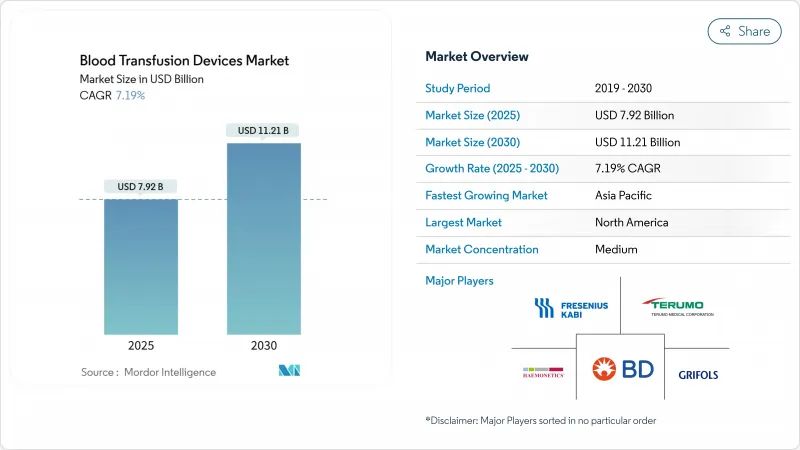
견조한 수요는 수술 건수 증가, 혈액 질환에 의한 부담 증가, 신흥 병원체를 중화하는 병원체 제거 시스템의 급속한 보급으로 인해 발생하고 있습니다. 디지털 재고 분석은 낭비를 줄이고 정부 지원 혈액 안전 프로그램이 신흥 국가에서 확대되고 있습니다. 의료 서비스 제공업체는 에너지 절약을 위해 자동화를 진행하고, 환자의 혈액 관리 이니셔티브가 수혈 최적화를 촉진하며, 장비 업그레이드에 박차를 가하고 있습니다. 엄격한 규제와 콜드체인 경비가 수익성을 압박하고 있지만, 업계 이해관계자들은 수혈 워크플로우 전체의 안전성, 효율성, 추적성을 높이는 통합 솔루션을 계속 발표하고 있습니다.
세계의 수혈 기기 시장 동향 및 인사이트
세계 수술 건수 증가
세계의 수술 수요는 증가의 길을 따라가고 있으며 세계보건기구(WHO)는 2030년까지 25% 증가할 것으로 예측했습니다. 심장혈관, 정형외과 및 종양학 수술에서 혈액 성분이 가장 많이 소비되기 때문에 처리량이 많은 병원에서는 자동 처리 장치가 필수적입니다. Termo의 Reveos 시스템은 수작업을 65% 줄이고 성분 일관성을 향상시킵니다. 안정적인 절차 증가는 장비 교체 사이클을 지원하지만, 도너 풀의 박멸은 공급망 전체의 과제가 되고 있습니다.
혈액 질환의 유병률 증가
평균 수명의 연장과 진단의 향상에 의해 겸상 적혈구증, 사라세미아, 혈액암의 증례가 증가하고 있습니다. 정기적인 수혈은 여전히 표준 요법이며 예측 가능한 장비 수요가 유지됩니다. 새로운 유전자 요법은 사전 컨디셔닝 요법에서 수혈 요건을 일시적으로 완화시켜 근육 사용량을 증가시킵니다. 면역 결핍 환자의 안전성에 대한 우려는 병원체 감소의 채택을 더욱 가속화시킵니다.
엄격한 규정 및 품질 규정 준수 요구 사항
FDA의 2025년 의제는 새로운 5가지 혈액 성분에 대한 지침을 제시하고 유럽 SoHO 규정은 규정 준수 보고서를 검토합니다. DEHP에서 벗어나면 비용이 많이 드는 재료 검증 사이클이 도입됩니다. 소규모 OEM은 복잡한 디바이스를 위해 200만 달러를 넘는 제출 비용에 직면해 개발 스케줄을 최대 5년 연장하며 깊은 규제 자원을 가진 기업에 경쟁 우위를 기울입니다.
부문 분석
2024년 수혈 기기 시장 점유율은 혈액백과 액세서리가 38.65%로 부문을 선도했습니다. 혈액백 및 액세서리 시장 규모는 수작업이 증가함에 따라 2030년까지 꾸준히 확대될 것으로 예측됩니다. CAGR 9.34%를 가장 빨리 기록한 병원체 저감 시스템은 적극적인 안전성을 요구하는 규제의 움직임에 부합하고 있으며, 현재는 세계 100개 이상의 혈액 센터에 도입되고 있습니다.
이 부문의 두 번째 촉진요인은 처리 시간을 단축하면서 혈소판의 품질을 향상시키는 자동 성분 분리 장치입니다. 백혈구 감소 필터는 현재 대부분의 신흥국 시장에서 의무화되고 있으며 교환 수요가 증가하고 있습니다. 혈액 온존 장치는 마이크로프로세서의 정확성 및 전자 차트의 상호 운용성에 중점을 두고 있지만, 소모품 키트는 단체 구매 계약에 의한 마진 압축에 직면하고 있습니다.
수동 및 기존 플랫폼은 2024년 수혈 기기 시장에서 낮은 자원 환경에서 합리적인 가격을 반영하여 54.76%의 점유율을 유지했습니다. 그러나 자동화 및 통합 시스템은 CAGR 8.86%로 상승하고 있습니다. 자동화 및 통합 솔루션의 수혈 기기 시장 규모는 노동력 제약과 오류 감소 목표가 채용을 촉진함에 따라 증가하고 있습니다. Termo의 Reveos는 한 장치에서 혈소판 처리 단계를 26에서 9로 줄이고 헌혈 1건당 더 많은 혈소판을 얻을 수 있다는 ROI를 보여줍니다.
자동화 제품군에 내장된 인공지능 모듈은 예지 보전과 품질 분석을 가능하게 하여 다운타임을 줄입니다. 병원 정보 시스템과 연결하는 인터페이스는 추적성 보고 및 규정 준수를 개선합니다. 자금 조달 모델이 진화함에 따라 수동 장치는 저용량 센터에서 지속되고 자동화는 지역 허브에서 표준이 될 것으로 예측됩니다.
지역 분석
북미는 엄격한 감독, 병원체 감소의 조기 도입, 환자 1인당 고액 지출로 2024년 세계 매출의 40.67%를 차지했습니다. FDA의 긍정적인 지침 파이프라인은 세계적인 모범 사례를 형성하고 공급업체는 예측 가능한 상환에서 이익을 얻고 있습니다. 그러나 기증자 부족은 여전히 심각합니다. 미국 적십자사는 20년간 40% 감소하고 있는 것을 꼽으며, 이상 기상으로 2024년에만 1만 9,000건의 활동이 중단되었습니다. 자동 처리 및 모집 캠페인에 대한 투자는 공급을 안정시키기 위한 것입니다.
아시아태평양은 2030년까지 연평균 복합 성장률(CAGR)이 8.66%로 가장 급성장하고 있는 지역입니다. 중국의 국산화 전략은 선진 시스템의 국산화를 촉진하고 일본의 인공 혈액 시험은 이 지역을 기술 혁신의 최전선에 위치시킵니다. 인도에서 동남아시아까지는 수술 건수 증가, 보험 적용 범위 확대, 정부 보조금에 의한 안전성 향상이 기기 수요의 지속을 지지하고 있습니다.
유럽은 대규모 설치 기반을 유지하고 있으며, 2027년까지 SoHO의 틀을 도입하고, 표준을 조화시키며, 회원국 전체에서 DEHP 프리백과 병원체 삭감의 도입을 촉진합니다. 중동 및 아프리카와 남미는 총 매출에서는 뒷걸음질치고 있지만, 도시화 및 비감염성 질환 치료의 확대에 연관된 강력한 수요 펀더멘털을 나타냅니다.
기타 혜택 :
- 엑셀 형식 시장 예측(ME) 시트
- 3개월간의 애널리스트 서포트
목차
제1장 도입
- 조사의 전제조건 및 시장 정의
- 조사 범위
제2장 조사 방법
제3장 주요 요약
제4장 시장 상황
- 시장 개요
- 시장 성장 촉진요인
- 세계 수술 건수 증가
- 혈액 질환의 유병률 증가
- 수혈 기기의 급속한 기술 진보
- 신흥 시장에서의 혈액 안전성에 대한 대처에 정부 지원 확대
- 환자 혈액 관리 프로그램의 전개 증가
- 디지털 재고 분석 통합으로 낭비 감소
- 시장 성장 억제요인
- 엄격한 규제 및 품질 컴플라이언스 요건
- 채혈과 콜드체인의 높은 운영 비용
- PVC 기반 혈액백 재료에 대한 지속가능성에 대한 압력
- 인구 동태의 변화에 의한 적격 기증자 기반의 축소
- 규제 상황
- Porter's Five Forces 분석
- 신규 참가업체의 위협
- 구매자 및 소비자의 협상력
- 공급기업의 협상력
- 대체품의 위협
- 경쟁 기업간 경쟁 관계의 강도
제5장 시장 규모 및 성장 예측
- 제품별
- 혈액백 및 액세서리
- 혈액 믹서
- 혈액 필터
- 혈액 성분 분리 장치
- 아페레시스 장치
- 병원체 제거 시스템
- 혈액 및 수액 워머
- 채혈 및 처리 소모품
- 기타 제품
- 기술별
- 수동 및 기존
- 자동 및 통합
- 용도별
- 컬렉션
- 처리 및 분리
- 보관 및 보존
- 수혈 및 투여
- 최종 사용자별
- 병원
- 외래수술센터(ASC)
- 혈액은행
- 기타 최종 사용자
- 지역별
- 북미
- 미국
- 캐나다
- 멕시코
- 유럽
- 독일
- 영국
- 프랑스
- 이탈리아
- 스페인
- 기타 유럽
- 아시아태평양
- 중국
- 일본
- 인도
- 호주
- 한국
- 기타 아시아태평양
- 중동 및 아프리카
- GCC
- 남아프리카
- 기타 중동 및 아프리카
- 남미
- 브라질
- 아르헨티나
- 기타 남미
- 북미
제6장 경쟁 구도
- 시장 집중도
- 시장 점유율 분석
- 기업 프로파일
- Becton Dickinson and Company
- B. Braun Melsungen AG
- Terumo Corporation
- Grifols SA
- Fresenius Kabi AG
- Haemonetics Corporation
- Macopharma SA
- Ecomed Solutions, LLC.
- Polymedicure Ltd.
- Baxter International Inc.
- Smiths Medical(ICU Medical)
- Stryker Corporation
- Asahi Kasei Medical Co., Ltd.
- Immucor, Inc.
- Roche Diagnostics
- Thermo Fisher Scientific Inc.
- Werfen(Instrumentation Laboratory)
- HemoCue AB
- Medtronic plc
- Kawasumi Laboratories
- Nipro Corporation
- Kawamoto Corporation
- Mitra Industries
제7장 시장 기회 및 전망
AJY 25.11.03The blood transfusion devices market size generated USD 7.92 billion in 2025 and is expected to reach USD 11.21 billion by 2030, reflecting a 7.19% CAGR.
Steady demand arises from higher surgical procedure volumes, a growing burden of hematological disorders, and rapid uptake of pathogen-reduction systems that neutralize emerging pathogens. Digital inventory analytics are lowering wastage, and government-backed blood-safety programs are expanding in emerging economies. Automation is rising as healthcare providers seek labor savings, while patient blood-management initiatives encourage optimized transfusion practices that, in turn, spur equipment upgrades. Although stringent regulations and cold-chain expenses weigh on profitability, industry stakeholders continue launching integrated solutions that enhance safety, efficiency, and traceability across the transfusion workflow.
Global Blood Transfusion Devices Market Trends and Insights
Rising Surgical Procedure Volumes Worldwide
Global surgical demand continues to climb, with the World Health Organization projecting a 25% increase by 2030. Cardiovascular, orthopedic, and oncologic procedures consume the most blood components, making automated processing equipment essential in high-volume hospitals. Terumo's Reveos system cuts manual steps by 65% and improves component consistency, illustrating how efficiency gains align with rising case loads. Stable procedure growth underpins equipment replacement cycles, though strained donor pools still challenge overall supply chains.
Growing Prevalence of Hematological Disorders
Greater life expectancy and better diagnostics reveal more cases of sickle cell disease, thalassemia, and hematologic cancers. Regular transfusions remain standard therapy, sustaining predictable equipment demand. Novel gene therapies temporarily lift transfusion requirements during pre-conditioning regimens, pushing apheresis device usage upward. Safety concerns for immunocompromised patients further accelerate pathogen-reduction adoption.
Stringent Regulatory and Quality Compliance Requirements
The FDA's 2025 agenda lists five new blood-component guidances, while Europe's SoHO rule revamps compliance reporting. The pivot away from DEHP introduces costly material validation cycles. Smaller OEMs face submission expenses topping USD 2 million for complex devices, extending development timelines by up to five years and tilting competitive advantage toward firms with deep regulatory resources.
Other drivers and restraints analyzed in the detailed report include:
- Rapid Technological Advancements in Transfusion Equipment
- Expanding Government Support for Blood-Safety Initiatives in Emerging Markets
- High Operational Costs of Blood Collection and Cold Chain
For complete list of drivers and restraints, kindly check the Table Of Contents.
Segment Analysis
Blood Bags & Accessories led the segment with 38.65% blood transfusion devices market share in 2024, supported by universal demand across collection sites. The blood transfusion devices market size for Blood Bags & Accessories is expected to advance steadily through 2030 as procedure volumes increase. Pathogen-Reduction Systems, posting the quickest 9.34% CAGR, align with regulatory pushes for proactive safety and have now reached over 100 global blood centers.
The segment's second growth driver involves automated component separators that enhance platelet quality while trimming processing time. Leukoreduction filters are now mandated in most developed markets, creating incremental replacement demand. Blood-warming devices focus on microprocessor accuracy and electronic health-record interoperability, while consumable kits face margin compression due to group-purchasing contracts.
Manual/Conventional platforms retained 54.76% share of the blood transfusion devices market in 2024, reflecting affordability for low-resource settings. Yet Automated/Integrated systems are gaining ground at 8.86% CAGR. The blood transfusion devices market size for Automated/Integrated solutions is rising as labor constraints and error-reduction targets encourage adoption. Terumo's Reveos illustrates ROI: one device cuts platelet processing steps from 26 to 9 and yields more platelets per donation.
Artificial-intelligence modules embedded in automation suites enable predictive maintenance and quality analytics, reducing downtime. Interfaces that connect with hospital information systems improve traceability reporting and compliance. As funding models evolve, manual devices are expected to persist in lower-volume centers, while automation becomes standard in regional hubs.
The Blood Transfusion Devices Market Report is Segmented by Product (Blood Bags & Accessories, Blood Mixer, and More), Technology (Manual/Conventional, Automated/Integrated, and More), Application (Collection, Processing & Separation, and More), End-User (Hospitals, and More), Geography (North America, Europe, Asia-Pacific, The Middle East and Africa, and South America). The Market Forecasts are Provided in Terms of Value (USD).
Geography Analysis
North America commanded 40.67% of global revenue in 2024 thanks to stringent oversight, early pathogen-reduction adoption, and high per-patient spending. The FDA's active guidance pipeline shapes global best practice, and suppliers benefit from predictable reimbursement. Yet donor shortages remain acute: the American Red Cross cites a 40% decline over two decades, and extreme weather led to 19,000 canceled drives in 2024 alone. Investment in automated processing and recruitment campaigns aims to stabilize supply.
Asia-Pacific is the fastest-growing region at an 8.66% CAGR through 2030. China's localization strategy encourages domestic production of advanced systems, while Japan's artificial-blood trials position the region at the innovation frontier. Rising surgical volumes, expanding insurance coverage, and government-subsidized safety upgrades underpin sustained equipment demand from India to Southeast Asia.
Europe sustains a sizable install base and will implement the SoHO framework by 2027, harmonizing standards and stimulating uptake of DEHP-free bags and pathogen-reduction across member states. Middle East & Africa and South America trail in total revenue but exhibit strong demand fundamentals tied to urbanization and non-communicable disease treatment expansion.
- Beckton Dickinson
- B. Braun
- Terumo
- Grifols
- Fresenius
- Haemonetics
- MacoPharma
- Ecomed Solutions
- Polymedicure Ltd.
- Baxter
- Smiths Group
- Stryker
- Asahi Kasei
- Immucor
- Roche
- Thermo Fisher Scientific
- Werfen (Instrumentation Laboratory)
- HemoCue AB
- Medtronic
- Kawasumi Laboratories
- Nipro
- Kawamoto Corporation
- Mitra Industries
Additional Benefits:
- The market estimate (ME) sheet in Excel format
- 3 months of analyst support
TABLE OF CONTENTS
1 Introduction
- 1.1 Study Assumptions & Market Definition
- 1.2 Scope of the Study
2 Research Methodology
3 Executive Summary
4 Market Landscape
- 4.1 Market Overview
- 4.2 Market Drivers
- 4.2.1 Rising Surgical Procedure Volumes Worldwide
- 4.2.2 Growing Prevalence of Hematological Disorders
- 4.2.3 Rapid Technological Advancements in Transfusion Equipment
- 4.2.4 Expanding Government Support for Blood Safety Initiatives in Emerging Markets
- 4.2.5 Increasing Deployment of Patient Blood Management Programs
- 4.2.6 Integration of Digital Inventory Analytics to Reduce Wastage
- 4.3 Market Restraints
- 4.3.1 Stringent Regulatory and Quality Compliance Requirements
- 4.3.2 High Operational Costs of Blood Collection and Cold Chain
- 4.3.3 Sustainability Pressures on PVC-Based Blood Bag Materials
- 4.3.4 Shrinking Eligible Donor Base Due to Demographic Shifts
- 4.4 Regulatory Landscape
- 4.5 Porter's Five Forces Analysis
- 4.5.1 Threat of New Entrants
- 4.5.2 Bargaining Power of Buyers/Consumers
- 4.5.3 Bargaining Power of Suppliers
- 4.5.4 Threat of Substitute Products
- 4.5.5 Intensity of Competitive Rivalry
5 Market Size & Growth Forecasts (Value, USD)
- 5.1 By Product
- 5.1.1 Blood Bags & Accessories
- 5.1.2 Blood Mixer
- 5.1.3 Blood Filters
- 5.1.4 Blood Component Separator
- 5.1.5 Apheresis Device
- 5.1.6 Pathogen Reduction System
- 5.1.7 Blood & Fluid Warmer
- 5.1.8 Blood Collection & Processing Consumables
- 5.1.9 Other Products
- 5.2 By Technology
- 5.2.1 Manual / Conventional
- 5.2.2 Automated / Integrated
- 5.3 By Application
- 5.3.1 Collection
- 5.3.2 Processing & Separation
- 5.3.3 Storage & Preservation
- 5.3.4 Transfusion & Administration
- 5.4 By End-user
- 5.4.1 Hospitals
- 5.4.2 Ambulatory Surgical Centres
- 5.4.3 Blood Banks
- 5.4.4 Other End-users
- 5.5 Geography
- 5.5.1 North America
- 5.5.1.1 United States
- 5.5.1.2 Canada
- 5.5.1.3 Mexico
- 5.5.2 Europe
- 5.5.2.1 Germany
- 5.5.2.2 United Kingdom
- 5.5.2.3 France
- 5.5.2.4 Italy
- 5.5.2.5 Spain
- 5.5.2.6 Rest of Europe
- 5.5.3 Asia-Pacific
- 5.5.3.1 China
- 5.5.3.2 Japan
- 5.5.3.3 India
- 5.5.3.4 Australia
- 5.5.3.5 South Korea
- 5.5.3.6 Rest of Asia-Pacific
- 5.5.4 Middle East & Africa
- 5.5.4.1 GCC
- 5.5.4.2 South Africa
- 5.5.4.3 Rest of Middle East & Africa
- 5.5.5 South America
- 5.5.5.1 Brazil
- 5.5.5.2 Argentina
- 5.5.5.3 Rest of South America
- 5.5.1 North America
6 Competitive Landscape
- 6.1 Market Concentration
- 6.2 Market Share Analysis
- 6.3 Company Profiles (includes Global level Overview, Market level overview, Core Business Segments, Financials, Headcount, Key Information, Market Rank, Market Share, Products and Services, and analysis of Recent Developments)
- 6.3.1 Becton Dickinson and Company
- 6.3.2 B. Braun Melsungen AG
- 6.3.3 Terumo Corporation
- 6.3.4 Grifols SA
- 6.3.5 Fresenius Kabi AG
- 6.3.6 Haemonetics Corporation
- 6.3.7 Macopharma SA
- 6.3.8 Ecomed Solutions, LLC.
- 6.3.9 Polymedicure Ltd.
- 6.3.10 Baxter International Inc.
- 6.3.11 Smiths Medical (ICU Medical)
- 6.3.12 Stryker Corporation
- 6.3.13 Asahi Kasei Medical Co., Ltd.
- 6.3.14 Immucor, Inc.
- 6.3.15 Roche Diagnostics
- 6.3.16 Thermo Fisher Scientific Inc.
- 6.3.17 Werfen (Instrumentation Laboratory)
- 6.3.18 HemoCue AB
- 6.3.19 Medtronic plc
- 6.3.20 Kawasumi Laboratories
- 6.3.21 Nipro Corporation
- 6.3.22 Kawamoto Corporation
- 6.3.23 Mitra Industries
7 Market Opportunities & Future Outlook
- 7.1 White-space & Unmet-Need Assessment