|
시장보고서
상품코드
1849884
BPaaS(Business Process as a Service) 시장 : 시장 점유율 분석, 산업 동향, 통계, 성장 예측(2025-2030년)Business-Process-as-a-Service - Market Share Analysis, Industry Trends & Statistics, Growth Forecasts (2025 - 2030) |
||||||
 Mordor Intelligence
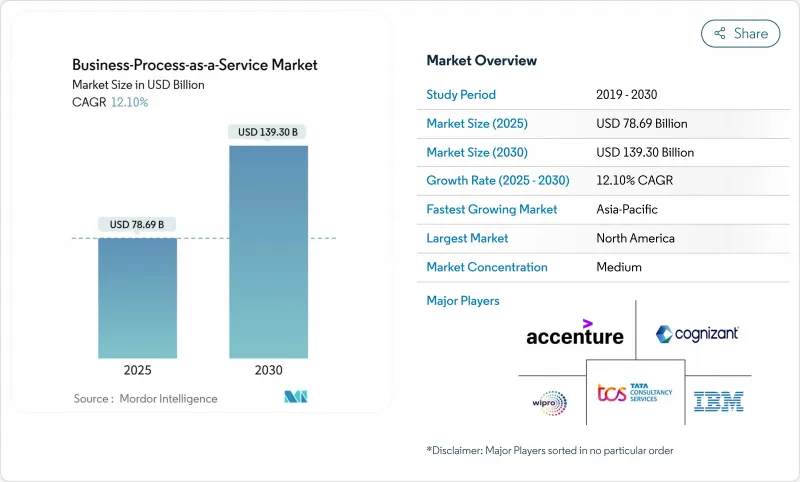
BPaaS(Business Process as a Service) 시장 규모는 2025년에 786억 9,000만 달러로 추정되고, 예측 기간(2025-2030년) CAGR 12.10%로 성장할 전망이며, 2030년에는 1,393억 달러에 이를 것으로 예측됩니다.
클라우드 네이티브 딜리버리 모델 채택 가속화, 인공지능의 급속한 진보, 탄력적인 운영을 요구하는 규제 압력 강화로 조직 전략이 재구성되고 있습니다. 기업은 고정비를 변동비로 전환하는 한편, 고급 자동화, 분석, 업계 고유의 베스트 프랙티스(과거에는 수년의 설비 투자를 필요로 한 기능)에 즉각적인 액세스를 획득하고 있습니다. 최근 공급망의 혼란에 따른 운영의 탄력성에 대한 관심 증가는 BPaaS를 전 세계적으로 확장하면서도 현지 준수 표준화된 프로세스를 실현하기 위한 우선 경로로 더욱 자리잡고 있습니다. 벤더는 성과 기반의 상업 모델, 소블린 클라우드 옵션, ESG와 연동한 프로세스 번들을 통해 대응하고 있으며, 이들 모두가 디지털 전환 프로그램에서 BPaaS(Business Process as a Service) 시장의 전략적 역할을 깊게 하고 있습니다.
세계의 BPaaS(Business Process as a Service) 시장 동향 및 인사이트
클라우드 서비스 및 표준화 프로세스에 대한 수요 증가
클라우드 플랫폼으로의 보편적인 마이그레이션은 대규모 프로세스의 표준화를 지원합니다. 현재 기업의 94%가 클라우드 솔루션을 활용하여 워크플로우의 간소화, 전개 주기 단축, 일관된 거버넌스를 실현하고 있습니다. 탄력적인 자원 할당은 새로운 자본 결정을 강요하지 않고 수요의 신속한 전환을 지원합니다. IBM은 기업의 77%가 이미 하이브리드 아키텍처를 실행하고 있으며 전략적 워크로드를 우선적인 관할 구역으로 유지하면서 여러 클라우드에서 핵심 프로세스를 통합할 수 있다고 지적합니다. 표준화된 클라우드 네이티브 모듈은 통일된 감사 추적이 필수적인 은행 및 보험 규정 준수 업무를 가속화합니다. 그 결과 BPaaS(Business Process as a Service) 시장은 속도, 탄력성, 세계 리치를 요구하는 모든 분야에서 수년에 걸쳐 기세를 지속하고 있습니다.
운영 비용 절감 및 생산성 향상의 필요성
경제적인 역풍으로 고정비를 소비형 모델로 대체하는 압력이 강해지고 있습니다. BPaaS는 다년간 라이선스 계약, 데이터센터 감가상각비, 인건비 오버헤드를 실제 사용량에 맞는 변동비로 변환합니다. DXC Technology의 보고에 따르면 기업이 기존 아웃소싱에서 BPaaS 프레임워크로 전환하면 20-30%의 비용 절감이 가능합니다. 이러한 서비스에 내장된 프로세스를 자동화함으로써 생산성이 더욱 향상되고 재무 백오피스 업무 효율이 40% 개선되었다는 기업도 있습니다. 이러한 재무와 운영의 복잡한 이점으로 인해 BPaaS(Business Process as a Service) 시장은 단기 수익성 및 장기 경쟁력을 위한 실용적인 기술로 강화됩니다.
데이터 보안 및 개인정보 보호에 대한 우려 증가
BPaaS 전개에는 위협 표면을 확장할 수 있는 분산형 인프라가 포함됩니다. 남아프리카 준비 은행은 클라우드 컴퓨팅이 통제가 취약한 경우 운영 리스크와 시스템 리스크를 증폭시킬 것이라고 경고합니다. 유럽의 GDPR(EU 개인정보보호규정)과 캘리포니아의 CCPA 규정은 규정 준수 위반에 엄격한 처벌을 부과하고 있으며, 공급자는 고급 암호화, ID 관리 및 지역별 데이터 거주 아키텍처를 도입해야 합니다. 보안이 강화된 플랫폼이 등장하고 BPaaS(Business Process as a Service) 시장의 신뢰가 회복되더라도 감시 강화로 의사결정 사이클이 일시적으로 느려지고 기밀성이 높은 분야에서의 단기적인 도입이 제한됩니다.
부문 분석
대기업은 2024년 BPaaS(Business Process as a Service) 시장 점유율의 64.3%를 차지하였으며, 감사를 단순화하고 중복 플랫폼을 줄이기 위해 표준화된 세계 워크플로우를 활용하고 있습니다. 대부분의 경우 비중핵 업무인 재무 및 인사 아웃소싱에서 착수하고 거버넌스 구조가 견고하다는 것이 입증되면 고객 경험과 공급망 분석까지 대상을 확대합니다. 많은 기업들은 온프레미스 ERP와 퍼블릭 클라우드 마이크로서비스를 융합하는 미들웨어 계층을 도입하고 전략적인 데이터 관리를 유지하면서 벤더의 혁신을 최대한 활용하고 있습니다. 이와 병행하여 신선한 전사적 거버넌스 협의회는 성과 기반 계약에 따라 공급업체의 성과를 모니터링하고 전략 목표와의 지속적인 무결성을 보장합니다.
중소기업은 역사적으로 존재감이 부족한 반면, 현재는 CAGR 예상 13.3%로 가장 기세가 있습니다. 클라우드 퍼스트 솔루션은 자본 투자, 전문가 인력 부족, 인프라 유지 보수 등 전통적인 장벽을 제거합니다. 일본 주식회사 쿠벨의 보고에 따르면, 회사의 Chatwork 플랫폼은 2024년 9월까지 60만 5,000개의 중소기업 고객에게 서비스를 제공하여 이 부문의 잠재 수요를 뒷받침하고 있습니다. 중소기업은 일반적으로 급여 계산, 인보이스 발행, 헬프 데스크 자동화와 같은 단일 프로세스 모듈로 시작하여 신뢰성이 입증됨에 따라 엔드 투 엔드 스위트로 규모를 확장합니다. 신축성있는 요금 모델은 성장기와 경기 후퇴기에서 현금 흐름의 중요한 유연성을 제공합니다. 그 결과, 중소기업에 속하는 BPaaS(Business Process as a Service) 시장 규모는 공급자가 업계 고유의 컴플라이언스에 맞는 구성된 번들을 출시함에 따라 2030년까지 크게 확대될 것으로 예측됩니다.
인사 관리는 2024년 매출의 24.1%를 차지했습니다. 이는 채용, 급여 계산, 인재 채용 워크플로우를 표준화함으로써 컴플라이언스 리스크가 감소하고 직원 경험이 향상된다는 세계적인 인식을 반영한 것입니다. 많은 공급업체는 현재 인사 모듈을 이직률 예측, 기술 격차 확인, 학습 컨텐츠 추천을 위한 예측 분석과 결합합니다. 경리 및 재무 프로세스도 로봇에 의한 송장 대조, 자동 대조, AI에 의한 부정 체크에 의해 사이클 타임을 단축하면서 정밀도를 높일 수 있습니다. 공급망 및 조달 솔루션은 공급업체의 협업 및 재고 가시성을 향상시킵니다.
고객 서비스와 지원은 연간 14.6% 증가할 것으로 예측되며 브랜드가 옴니채널 참여로 축발을 옮기는 가운데 성장을 견인합니다. AI가 주도하는 채팅봇과 음성 분석은 기존의 콜센터보다 훨씬 저렴한 비용으로 즉각적인 개인화된 응답을 제공합니다. Sutherland Global의 도입 사례에서는 1차 해결률 향상, NPS 점수 강화, 에스컬레이션 감소를 실현하면서 평균 응답 시간을 단축하고 있습니다. 영업 및 마케팅 BPaaS는 이러한 진보를 보완하고 캠페인 데이터를 프런트 오피스 애널리틱스와 동기화하여 리드 품질을 향상시킵니다. 운영 모듈은 워크플로우 엔진을 현장 서비스 파견, 공장 유지보수 스케줄링, 품질 보증에 적용합니다. 이러한 혁신은 BPaaS(Business Process as a Service) 시장의 지속적인 확대를 지원합니다.
Business Process As A Service 시장은 조직 규모별(대기업, 중소기업), 프로세스별(인사 관리, 경리 및 재무, 기타), 도입 모델별(퍼블릭 클라우드 BPaaS, 프라이빗 클라우드 BPaaS, 하이브리드 및 멀티클라우드 BPaaS), 최종 사용자 산업별(은행, 금융서비스 및 보험(BFSI), 시장 IT 및 통신, 기타), 지역별로 분류됩니다. 시장 예측은 금액(달러)으로 제공됩니다.
지역별 분석
북미는 2024년 매출의 41.2%를 차지했으며, 클라우드의 조기 도입 및 공급자 생태계의 충실이 기여했습니다. 금융기관은 BPaaS를 이용해 관할 구역을 가로지르는 컴플라이언스 문서를 통합하고 소매 그룹은 AI를 활용한 고객 서비스의 자동화를 추구하고 있습니다. 클라우드 인프라의 집중은 현저하고 영국의 경쟁 시장국은 AWS와 Microsoft가 각각 북미 인프라의 40-50%와 30-40%를 차지하고 있다고 추정하고 있습니다. 이 이점은 BPaaS 공급업체가 하이퍼스케일러와 전략적 제휴를 맺고 지연 시간 최적화 및 공동 시장 개척 프로그램을 추진하는 것을 뒷받침합니다.
아시아태평양은 2025-2030년 가장 빠른 12.8%의 연평균 복합 성장률(CAGR)로 성장할 전망입니다. 인도, 필리핀, 인도네시아 정부는 운영 비용 절감과 시민 서비스 향상을 목표로 '클라우드 퍼스트'의 의무화를 추진하고 있습니다. 인도의 Data Security Council은 국내 클라우드 시장이 2022년까지 77억 달러에 이르렀고, 기반이 되는 인프라를 준비하고 있다고 강조합니다. 현지 제공업체는 세계 기업과 제휴하여 지역 데이터 현지화 요구 사항을 충족합니다. 인력 부족에 어려움을 겪고 있는 일본 기업은 정형 업무의 자동화를 위해 BPaaS를 활용하여 제조업 및 소매업 수요를 자극하고 있습니다.
유럽에서는 엄격한 개인 정보 보호 규칙이 도입 옵션을 안내하고 신중한 성장을 보여줍니다. GDPR(EU 개인정보보호규정) 준수는 계약 조건, 데이터 거주 조항, 책임 분담의 틀을 형성하고 있습니다. 2029년까지 213억 2,000만 달러에 이를 것으로 예상되는 독일 BPO 시장은 이미 81% 기업이 클라우드를 도입하고 있습니다. 금융 기관은 하이브리드 모델을 선호하고 Eurofi의 감독 지침을 충족하기 위해 로컬 소블린 클라우드와 확장 가능한 공용 리소스를 결합합니다. 이 지역의 강력한 ESG 의제는 탄소 회계 및 사회적 영향 보고서를 자동화하는 지속가능성 중심의 BPaaS 솔루션에 대한 수요를 추진하고 있습니다.
기타 혜택
- 엑셀 형식 시장 예측(ME) 시트
- 3개월간의 애널리스트 서포트
목차
제1장 서론
- 조사의 전제조건 및 시장 정의
- 조사 범위
제2장 조사 방법
제3장 주요 요약
제4장 시장 상황
- 시장 개요
- 시장 성장 촉진요인
- 클라우드 서비스 및 표준화된 프로세스에 대한 수요 증가
- 운영 비용을 줄이고 생산성을 향상시킬 필요 발생
- BPaaS에서 AI 및 하이퍼 오토메이션의 신속한 도입
- 성과 기반 BPaaS 가격 모델 확대
- ESG 관련 보고 의무가 지속가능성 BPaaS를 추진
- 업계 특화형 BPaaS 솔루션 수요
- 시장 성장 억제요인
- 데이터 보안 및 프라이버시에 대한 우려 증가
- 종래의 코어 시스템과 통합의 복잡성
- 벤더 락인 및 상호 운용성의 제한
- 국경을 넘은 BPaaS를 제한하는 소블린 클라우드 요건
- 업계 밸류체인 분석
- 규제 상황
- 기술의 전망
- 업계의 매력-Porter's Five Forces 분석
- 공급기업의 협상력
- 구매자의 협상력
- 신규 참가업체의 위협
- 대체품의 위협
- 경쟁 기업 간 경쟁 관계
- 거시 경제 요인이 시장에 미치는 영향
제5장 시장 규모 및 성장 예측
- 조직 규모별
- 대기업
- 중소기업
- 프로세스별
- 인사관리(HRM)
- 회계와 재무
- 고객 서비스 및 지원
- 영업 및 마케팅
- 공급망 및 조달
- 운영 및 기타 수평 공정
- 전개 모델별
- 퍼블릭 클라우드 BPaaS
- 프라이빗 클라우드 BPaaS
- 하이브리드 및 멀티클라우드 BPaaS
- 최종 사용자 업계별
- BFSI
- IT 및 통신
- 헬스케어 및 생명과학
- 소매업 및 전자상거래
- 제조업
- 정부 및 공공 부문
- 기타 최종 사용자 업계
- 지역별
- 북미
- 미국
- 캐나다
- 멕시코
- 남미
- 브라질
- 아르헨티나
- 칠레
- 기타 남미
- 유럽
- 독일
- 영국
- 프랑스
- 이탈리아
- 스페인
- 러시아
- 기타 유럽
- 아시아태평양
- 중국
- 일본
- 인도
- 한국
- 호주
- 싱가포르
- 말레이시아
- 기타 아시아태평양
- 중동 및 아프리카
- 중동
- 사우디아라비아
- 아랍에미리트(UAE)
- 튀르키예
- 기타 중동
- 아프리카
- 남아프리카
- 나이지리아
- 이집트
- 기타 아프리카
- 북미
제6장 경쟁 구도
- 시장 집중도
- 전략적 동향
- 시장 점유율 분석
- 기업 프로파일
- Accenture plc
- IBM Corporation
- Tata Consultancy Services(TCS)
- Cognizant Technology Solutions
- Wipro Limited
- HCL Technologies
- Capgemini SE
- Infosys Limited
- Genpact Ltd.
- Fujitsu Ltd.
- Oracle Corporation
- SAP SE
- Deloitte Touche Tohmatsu Limited
- NTT DATA
- CGI Inc.
- DXC Technology
- Tech Mahindra
- EXL Service Holdings
- ADP Inc.
- Alight Solutions
- Paychex Inc.
- UKG(Ultimate Kronos Group)
- TriNet Group
- Ceridian HCM
- WNS Global Services
- Sutherland Global Services
제7장 시장 기회 및 미래 동향
AJY 25.11.12The Business-Process-as-a-Service Market size is estimated at USD 78.69 billion in 2025, and is expected to reach USD 139.30 billion by 2030, at a CAGR of 12.10% during the forecast period (2025-2030).
Accelerating adoption of cloud-native delivery models, rapid progress in artificial intelligence, and stronger regulatory pressure for resilient operations are reshaping organizational strategies. Enterprises are converting fixed costs into variable outlays while gaining immediate access to advanced automation, analytics, and industry-specific best practices-capabilities that once required years of capital investment. Intensifying focus on operational resilience after recent supply-chain disruptions has further positioned BPaaS as a preferred route for standardized processes that scale globally yet remain locally compliant. Vendors are responding through outcome-based commercial models, sovereign-cloud options, and ESG-linked process bundles, all of which deepen the strategic role of the Business-Process-as-a-Service market in digital transformation programs.
Global Business-Process-as-a-Service Market Trends and Insights
Growing Demand for Cloud Services and Standardized Processes
Universal migration toward cloud platforms underpins large-scale process standardization. Ninety-four percent of enterprises now leverage cloud solutions to streamline workflows, shorten deployment cycles, and ensure consistent governance. Elastic resource allocation supports rapid pivots in demand without forcing new capital decisions. IBM notes that 77% of firms already run hybrid architectures, enabling them to unify core processes over multiple clouds while keeping strategic workloads in preferred jurisdictions. Standardized, cloud-native modules accelerate compliance tasks in banking and insurance, where uniform audit trails are essential. As a result, the Business-Process-as-a-Service market experiences sustained multi-year momentum across sectors that demand speed, resilience, and global reach.
Need to Reduce Operational Cost and Boost Productivity
Economic headwinds intensify pressure to replace fixed costs with consumption-based models. BPaaS converts multi-year license contracts, data-center depreciation, and labor overhead into variable fees that align with actual usage. DXC Technology reports savings of 20-30% when organizations shift from traditional outsourcing to BPaaS frameworks. Process automation embedded in these services delivers additional productivity gains, with some enterprises citing 40% efficiency improvements in finance back-office tasks. These combined financial and operational benefits reinforce the Business-Process-as-a-Service market as a pragmatic lever for near-term profitability and long-term competitiveness.
Heightened Data-Security and Privacy Concerns
BPaaS deployments involve a distributed infrastructure that can enlarge the threat surface. The South African Reserve Bank cautions that cloud computing amplifies operational and systemic risks when controls are weak. European GDPR and California CCPA regulations impose severe penalties for non-compliance, compelling providers to implement sophisticated encryption, identity management, and regional data-residency architectures. Heightened scrutiny temporarily slows decision cycles, limiting short-term adoption in sensitive verticals even as security-enhanced platforms emerge to rebuild trust in the Business-Process-as-a-Service market.
Other drivers and restraints analyzed in the detailed report include:
- Rapid Adoption of AI / Hyper-automation in BPaaS
- Expansion of Outcome-based (Gain-share) BPaaS Pricing Models
- Integration Complexity with Legacy Core Systems
For complete list of drivers and restraints, kindly check the Table Of Contents.
Segment Analysis
Large Enterprises dominated 2024 with 64.3% of the Business-Process-as-a-Service market share, leveraging standardized global workflows to simplify audits and cut duplicative platforms. They often start by outsourcing non-core finance and HR tasks, then extend coverage to customer experience and supply-chain analytics once governance structures prove resilient. Integration remains a priority; many deploy middleware layers that blend on-premise ERPs with public-cloud microservices, preserving strategic data control while maximizing vendor innovation. In parallel, fresh enterprise-wide governance councils monitor vendor performance under outcome-based contracts, ensuring continuous alignment with strategic objectives.
SMEs, though historically under-represented, now display the strongest momentum with a forecast 13.3% CAGR. Cloud-first solutions remove traditional barriers such as capital outlay, specialist talent shortages, and infrastructure maintenance. Japan's Kubell Co. reports that its Chatwork platform served 605,000 SME clients by September 2024, underscoring the segment's pent-up demand. SMEs typically begin with single-process modules-payroll, invoicing, or help-desk automation-before scaling to end-to-end suites as reliability is proven. The elastic fee model offers crucial cash-flow flexibility during growth spurts or economic contractions. Consequently, the Business-Process-as-a-Service market size attributable to SMEs is projected to widen substantially through 2030 as providers release pre-configured bundles tailored for industry-specific compliance.
Human Resource Management retained 24.1% of 2024 revenue, reflecting global recognition that standardized recruitment, payroll, and talent-engagement workflows lower compliance risk and enhance employee experience. Many providers now pair HR modules with predictive analytics that forecast attrition, identify skill gaps, and recommend learning content. Accounting and Finance processes also gain traction as robotic invoice matching, automated reconciliations, and AI-driven fraud checks boost accuracy while shrinking cycle times. Supply Chain and Procurement solutions improve vendor collaboration and inventory visibility, critical in volatile logistics environments.
Customer Service and Support, forecast to rise 14.6% annually, leads growth as brands pivot to omnichannel engagement. AI-driven chatbots and voice analytics deliver instant, personalized responses at far lower cost than traditional call centers. Sutherland Global's deployments cut average response time while raising first-contact resolution, enhancing NPS scores, and reducing escalations. Sales and Marketing BPaaS complements these advances, synchronizing campaign data with front-office analytics to sharpen lead quality. Operations modules apply workflow engines to field-service dispatch, plant-maintenance scheduling, and quality assurance. Together, these innovations anchor sustained expansion of the Business-Process-as-a-Service market.
Business Process As A Service Market is Segmented by Organization Size (Large Enterprises and Small and Medium Enterprises), Process (Human Resource Management, Accounting and Finance, and More), Deployment Model (Public Cloud BPaaS, Private Cloud BPaaS, and Hybrid/Multi-Cloud BPaaS), End-User Industry (BFSI, IT and Telecommunications, and More), and Geography. The Market Forecasts are Provided in Terms of Value (USD).
Geography Analysis
North America generated 41.2% of 2024 revenue for the Business-Process-as-a-Service market, buoyed by early cloud uptake and deep provider ecosystems. Financial institutions use BPaaS to consolidate compliance documentation across jurisdictions, while retail groups pursue AI-led customer-service automation. Cloud infrastructure concentration is notable; the UK Competition and Markets Authority estimates AWS and Microsoft hold 40-50% and 30-40% of North American infrastructure, respectively. This dominance encourages BPaaS vendors to forge strategic alliances with hyperscalers for latency optimization and joint go-to-market programs.
Asia-Pacific is projected to record the fastest 12.8% CAGR between 2025 and 2030. Governments in India, the Philippines, and Indonesia promote "cloud first" mandates to reduce operating costs and improve citizen services. The Data Security Council of India notes that the national cloud market reached USD 7.70 billion by 2022, underscoring the readiness of foundational infrastructure. Indigenous providers partner with global players to address regional data-localization requirements. Japanese enterprises, challenged by labor shortages, lean on BPaaS to automate routine functions, stimulating demand across manufacturing and retail sectors.
Europe exhibits measured growth as stringent privacy rules guide deployment choices. GDPR compliance shapes contract terms, data-residency clauses, and shared-responsibility frameworks. Germany's BPO market, forecast to hit USD 21.32 billion by 2029, already registers 81% cloud adoption among firms. Financial institutions prefer hybrid models, pairing local sovereign clouds with scalable public resources to satisfy supervisory guidance outlined by Eurofi. The region's strong ESG agenda fuels demand for sustainability-centric BPaaS solutions that automate carbon accounting and social-impact reporting.
- Accenture plc
- IBM Corporation
- Tata Consultancy Services (TCS)
- Cognizant Technology Solutions
- Wipro Limited
- HCL Technologies
- Capgemini SE
- Infosys Limited
- Genpact Ltd.
- Fujitsu Ltd.
- Oracle Corporation
- SAP SE
- Deloitte Touche Tohmatsu Limited
- NTT DATA
- CGI Inc.
- DXC Technology
- Tech Mahindra
- EXL Service Holdings
- ADP Inc.
- Alight Solutions
- Paychex Inc.
- UKG (Ultimate Kronos Group)
- TriNet Group
- Ceridian HCM
- WNS Global Services
- Sutherland Global Services
Additional Benefits:
- The market estimate (ME) sheet in Excel format
- 3 months of analyst support
TABLE OF CONTENTS
1 INTRODUCTION
- 1.1 Study Assumptions and Market Definition
- 1.2 Scope of the Study
2 RESEARCH METHODOLOGY
3 EXECUTIVE SUMMARY
4 MARKET LANDSCAPE
- 4.1 Market Overview
- 4.2 Market Drivers
- 4.2.1 Growing demand for cloud services and standardized processes
- 4.2.2 Need to reduce operational cost and boost productivity
- 4.2.3 Rapid adoption of AI/hyper-automation in BPaaS
- 4.2.4 Expansion of outcome-based BPaaS pricing models
- 4.2.5 ESG-linked reporting mandates driving sustainability BPaaS
- 4.2.6 Demand for industry-specific BPaaS solutions
- 4.3 Market Restraints
- 4.3.1 Heightened data-security and privacy concerns
- 4.3.2 Integration complexity with legacy core systems
- 4.3.3 Vendor lock-in and interoperability limitations
- 4.3.4 Sovereign-cloud requirements restricting cross-border BPaaS
- 4.4 Industry Value Chain Analysis
- 4.5 Regulatory Landscape
- 4.6 Technological Outlook
- 4.7 Industry Attractiveness - Porter's Five Forces Analysis
- 4.7.1 Bargaining Power of Suppliers
- 4.7.2 Bargaining Power of Buyers
- 4.7.3 Threat of New Entrants
- 4.7.4 Threat of Substitutes
- 4.7.5 Intensity of Competitive Rivalry
- 4.8 Impact of Macroeconomic Factors on the Market
5 MARKET SIZE AND GROWTH FORECASTS (VALUES)
- 5.1 By Organization Size
- 5.1.1 Large Enterprises
- 5.1.2 Small and Medium Enterprises (SMEs)
- 5.2 By Process
- 5.2.1 Human Resource Management (HRM)
- 5.2.2 Accounting and Finance
- 5.2.3 Customer Service and Support
- 5.2.4 Sales and Marketing
- 5.2.5 Supply Chain and Procurement
- 5.2.6 Operations and Other Horizontal Processes
- 5.3 By Deployment Model
- 5.3.1 Public Cloud BPaaS
- 5.3.2 Private Cloud BPaaS
- 5.3.3 Hybrid/Multi-Cloud BPaaS
- 5.4 By End-user Industry
- 5.4.1 BFSI
- 5.4.2 IT and Telecommunications
- 5.4.3 Healthcare and Life Sciences
- 5.4.4 Retail and E-Commerce
- 5.4.5 Manufacturing
- 5.4.6 Government and Public Sector
- 5.4.7 Other End-user Industries
- 5.5 By Geography
- 5.5.1 North America
- 5.5.1.1 United States
- 5.5.1.2 Canada
- 5.5.1.3 Mexico
- 5.5.2 South America
- 5.5.2.1 Brazil
- 5.5.2.2 Argentina
- 5.5.2.3 Chile
- 5.5.2.4 Rest of South America
- 5.5.3 Europe
- 5.5.3.1 Germany
- 5.5.3.2 United Kingdom
- 5.5.3.3 France
- 5.5.3.4 Italy
- 5.5.3.5 Spain
- 5.5.3.6 Russia
- 5.5.3.7 Rest of Europe
- 5.5.4 Asia-Pacific
- 5.5.4.1 China
- 5.5.4.2 Japan
- 5.5.4.3 India
- 5.5.4.4 South Korea
- 5.5.4.5 Australia
- 5.5.4.6 Singapore
- 5.5.4.7 Malaysia
- 5.5.4.8 Rest of Asia-Pacific
- 5.5.5 Middle East and Africa
- 5.5.5.1 Middle East
- 5.5.5.1.1 Saudi Arabia
- 5.5.5.1.2 United Arab Emirates
- 5.5.5.1.3 Turkey
- 5.5.5.1.4 Rest of Middle East
- 5.5.5.2 Africa
- 5.5.5.2.1 South Africa
- 5.5.5.2.2 Nigeria
- 5.5.5.2.3 Egypt
- 5.5.5.2.4 Rest of Africa
- 5.5.1 North America
6 COMPETITIVE LANDSCAPE
- 6.1 Market Concentration
- 6.2 Strategic Moves
- 6.3 Market Share Analysis
- 6.4 Company Profiles (includes Global level Overview, Market level overview, Core Segments, Financials as available, Strategic Information, Market Rank/Share for key companies, Products and Services, and Recent Developments)
- 6.4.1 Accenture plc
- 6.4.2 IBM Corporation
- 6.4.3 Tata Consultancy Services (TCS)
- 6.4.4 Cognizant Technology Solutions
- 6.4.5 Wipro Limited
- 6.4.6 HCL Technologies
- 6.4.7 Capgemini SE
- 6.4.8 Infosys Limited
- 6.4.9 Genpact Ltd.
- 6.4.10 Fujitsu Ltd.
- 6.4.11 Oracle Corporation
- 6.4.12 SAP SE
- 6.4.13 Deloitte Touche Tohmatsu Limited
- 6.4.14 NTT DATA
- 6.4.15 CGI Inc.
- 6.4.16 DXC Technology
- 6.4.17 Tech Mahindra
- 6.4.18 EXL Service Holdings
- 6.4.19 ADP Inc.
- 6.4.20 Alight Solutions
- 6.4.21 Paychex Inc.
- 6.4.22 UKG (Ultimate Kronos Group)
- 6.4.23 TriNet Group
- 6.4.24 Ceridian HCM
- 6.4.25 WNS Global Services
- 6.4.26 Sutherland Global Services
7 MARKET OPPORTUNITIES AND FUTURE TRENDS
- 7.1 White-Space and Unmet-Need Assessment